Eugene Onegin — Alexander Pushkin
Eugene Onegin — Alexander Pushkin — an illustrated literature story. 10 illustrated pages, free to read on Wonder Novels.
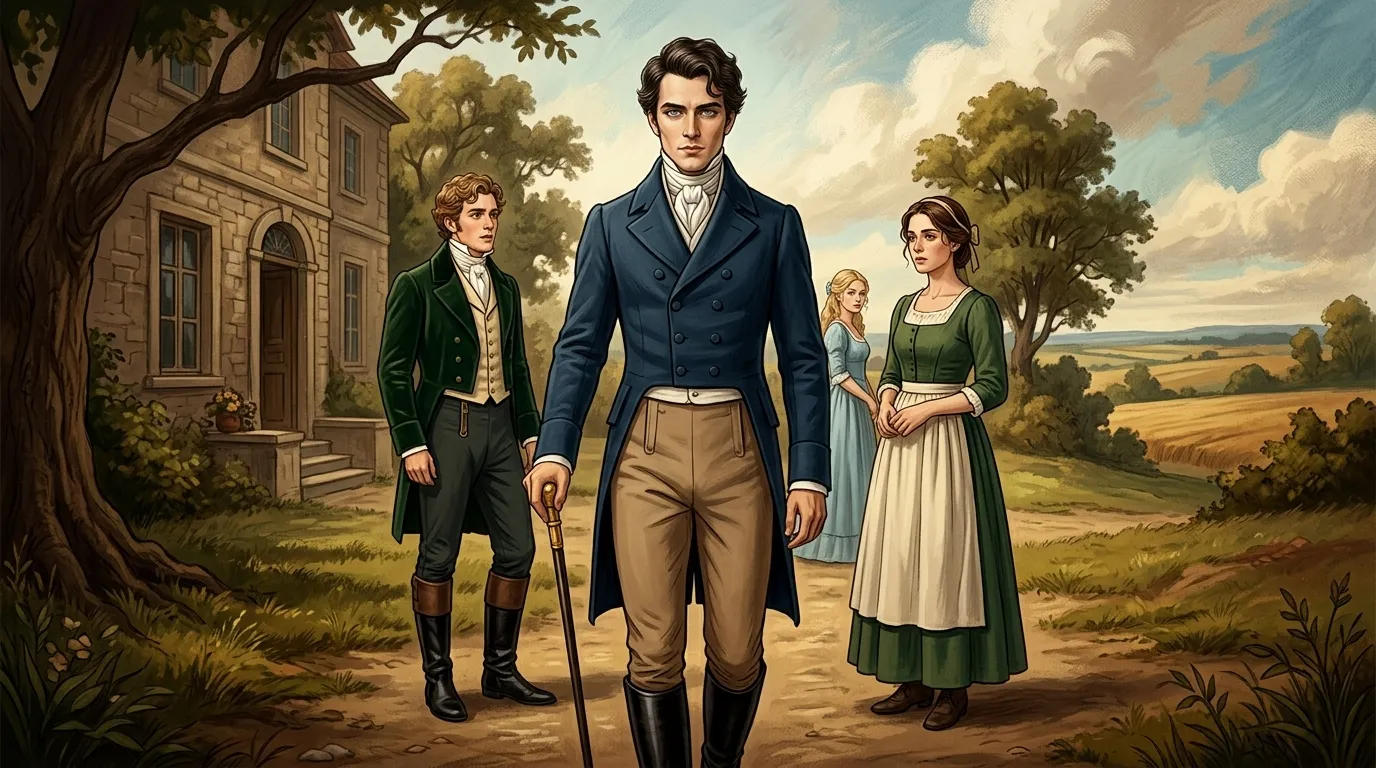
Page 1
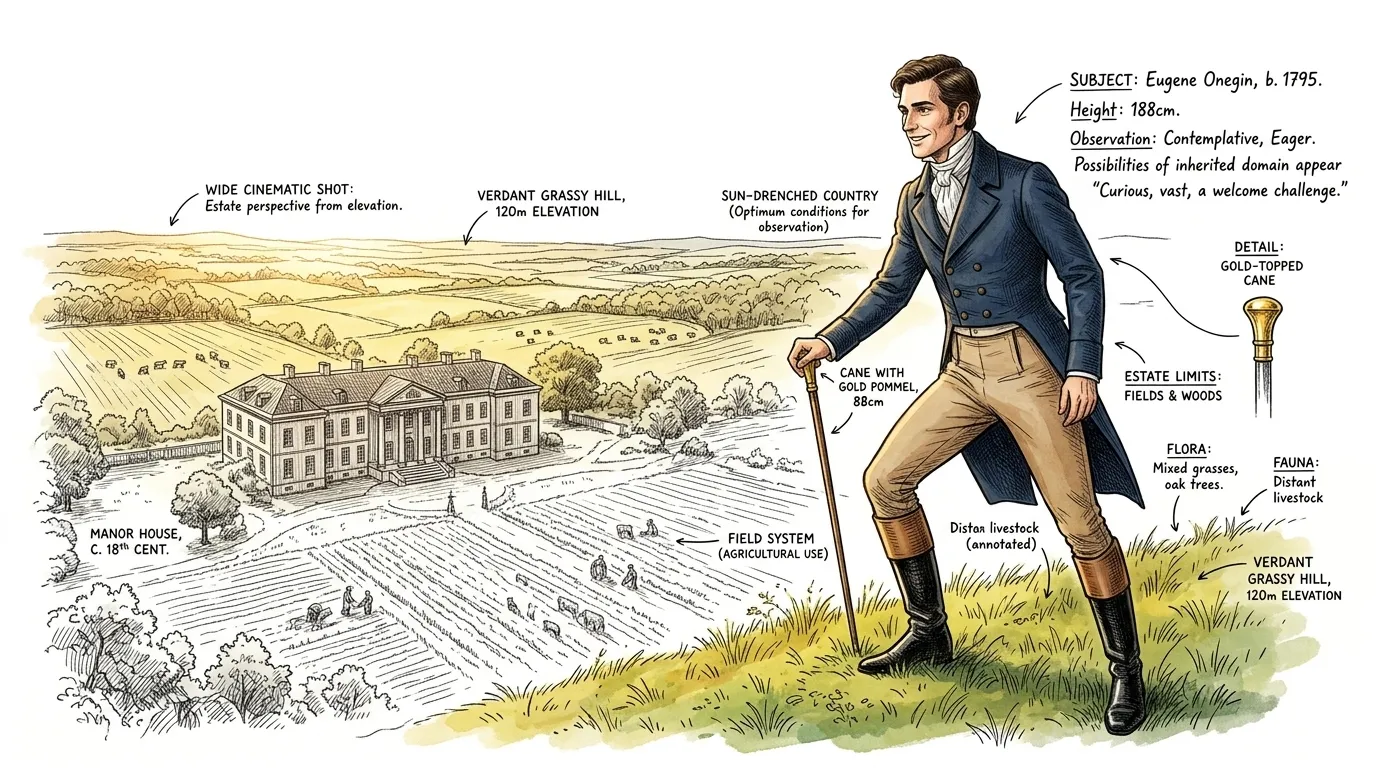
Eugene Onegin, a scion of wealth, inherited his uncle's estate, a vast domain where he hoped to escape the Parisian ennui that gnawed at his soul. He yearned for something beyond the endless balls and superficial flirtations of high society. "Ah, how tedious this world has become!" he often sighed, finding little joy even in the unexpected fortune.
️ Literary Fact: This opening scene establishes Onegin's character: a dandy disillusioned with urban life, seeking purpose in the countryside. His posture and distant gaze immediately convey his characteristic ennui, a key theme of Pushkin's novel.
Page 2

Settling into his new life, Onegin soon encountered Vladimir Lensky, a vibrant young poet, recently returned from Germany. "You find a certain poetry in this provincial life, do you not, Lensky?" Onegin asked, his tone hinting at mild amusement. Lensky, gesturing grandly at the fields, replied, "Indeed, my friend! Here, the very breeze whispers verses, and nature's beauty is untainted by the city's artifice."
""You find a certain poetry in this provincial life, do you not, Lensky?" "Indeed, my friend! Here, the very breeze whispers verses, and nature's beauty is untainted by the city's artifice.""
️ Literary Fact: The introduction of Lensky highlights the stark contrast between the two men: Onegin's cynicism versus Lensky's romantic idealism. This foundational friendship will prove tragically fragile.
Page 3

Lensky, with boundless enthusiasm, introduced Onegin to the Larin sisters, exclaiming, "Tatiana is a pensive soul, immersed in her books, while Olga, as you see, is all sunshine!" Tatiana, quietly reading an old volume, looked up as her sister, Olga, playfully tugged at her sleeve. "See, Tatiana, he's just like those heroes in your novels!" Olga teased, referring to Onegin, but Tatiana merely smiled softly, turning a page where a passage described how one must observe a person's sillage—the faint, lingering impression—to truly discern their hidden thoughts, a concept Olga found impossibly dull.
""Tatiana is a pensive soul, immersed in her books, while Olga, as you see, is all sunshine!" "See, Tatiana, he's just like those heroes in your novels!""
️ Literary Fact: This scene introduces Tatiana's introspective nature and her imaginative world shaped by novels, contrasting with Olga's vivacity. The mention of 'sillage' serves as a crucial 'Chekhov's Gun' for later events, hinting at unspoken communication.
Page 4

Deeply smitten by Onegin's enigmatic charm, Tatiana spent sleepless nights composing a letter, her heart overflowing with desperate courage. Trembling, she pressed the wax seal, her face flushed with emotion, believing she had confessed her very soul. "He must understand," she whispered, hoping against hope for a return of her fierce, innocent devotion.
""He must understand.""
️ Literary Fact: Tatiana's letter is a pivotal moment, a courageous and unconventional act for a young woman of her time. It reveals the depth of her passion and her innocent belief in romantic ideals.
Page 5

Onegin received Tatiana's fervent letter with a mixture of surprise and disinterest, unable to reciprocate such raw emotion. "I am not formed for bliss, nor for domestic affection," he declared, his voice measured, almost clinical, as he gently rebuked her confession. Tatiana stood before him, her shoulders slumped, her large dark eyes filling with tears as his cold words shattered her fragile hopes.
""I am not formed for bliss, nor for domestic affection.""
️ Literary Fact: Onegin's rejection is a cruel awakening for Tatiana, exposing his emotional detachment and inability to embrace genuine affection. This scene underscores his character's tragic flaw.
Page 6

At a country ball, boredom once again led Onegin to indulge in a petty act of spite, flirting brazenly with Olga, Tatiana's sister. "Do you not dance, my charming Olga?" he asked, twirling her about the floor, oblivious to the storm brewing in Lensky's heart. Lensky, his face contorted with jealousy and fury, watched their every move, his hand clenching, the seeds of tragedy sown by Onegin's casual indifference.
""Do you not dance, my charming Olga?""
️ Literary Fact: Onegin's flirtation with Olga, born of boredom, serves as a catalyst, igniting Lensky's passionate, youthful jealousy. This seemingly trivial act sets the stage for the escalating conflict.
Page 7
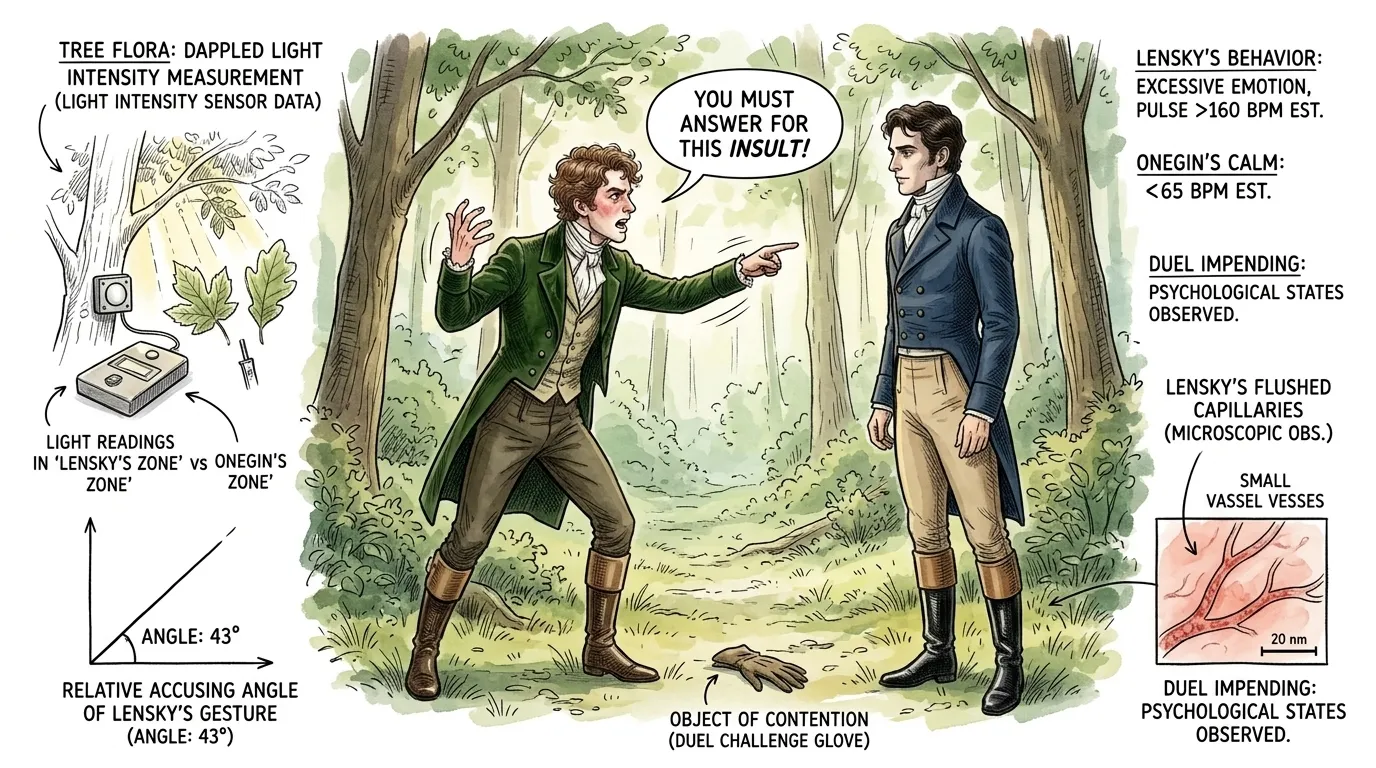
Fueled by wounded pride and fiery romantic ideals, Lensky confronted Onegin in a secluded glade, his voice trembling with indignation. "Your betrayal cannot be forgiven! I challenge you, sir!" he cried, gesturing wildly. Onegin, though inwardly regretting his foolishness, accepted the challenge, his face impassive. "As the philosopher Seneca once wrote, 'Anger: an acid that can do more harm to the vessel in which it is stored than to anything on which it is poured.' Lensky, you pour acid on your own soul," Onegin remarked, but his words offered no solace.
""Your betrayal cannot be forgiven! I challenge you, sir!" "As the philosopher Seneca once wrote, 'Anger: an acid that can do more harm to the vessel in which it is stored than to anything on which it is poured.' Lensky, you pour acid on your own soul.""
️ Literary Fact: Lensky's challenge, driven by honor and passion, is met by Onegin's stoic acceptance, tinged with a philosophical observation on the destructive nature of anger. The quote from Seneca adds depth to Onegin's detached wisdom.
Page 8
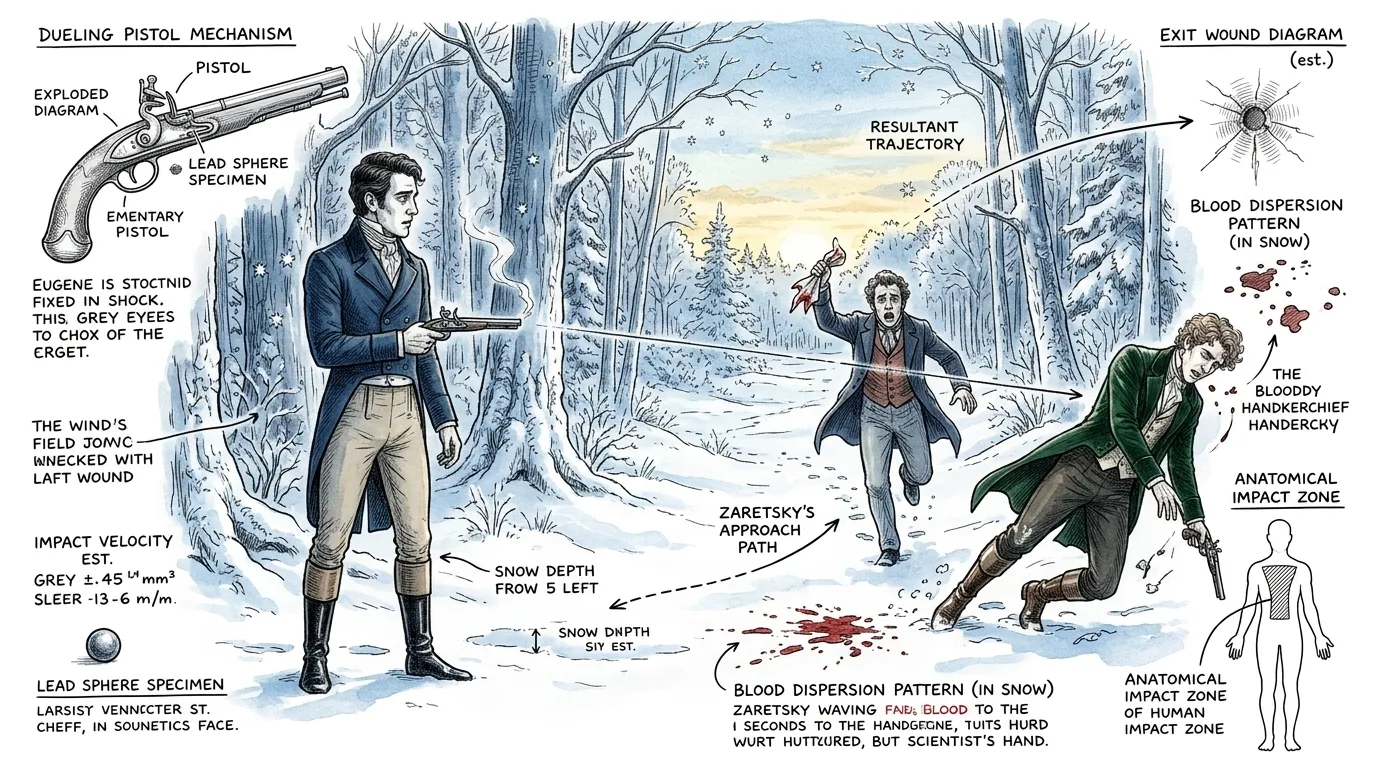
At dawn, the two friends stood face to face, pistols raised, the frosty air biting at their cheeks. Onegin, his conscience heavy, hesitated for a fraction of a second, his deep grey eyes fixed on Lensky's determined gaze. The shot rang out, sharp and final, echoing through the silent forest. Lensky crumpled to the snowy ground, his youthful ideals extinguished with his life, a victim of senseless honor.
️ Literary Fact: The duel marks the tragic climax, highlighting the devastating consequences of Onegin's emotional detachment and Lensky's youthful impetuosity. This pivotal event forever alters Onegin's path.
Page 9

Haunted by Lensky's death, Onegin embarked on years of aimless travel, seeking escape from his remorse, his face now etched with suffering. "The world offers no solace for a soul burdened by such guilt," he often muttered to himself. Meanwhile, Tatiana, having blossomed into a composed and elegant princess, attended a grand ball, where her graceful composure spoke volumes. Onegin, catching sight of her, immediately recalled Tatiana's earlier fascination with sillage, suddenly understanding the subtle, unspoken language of her poised demeanor—a silent testament to her enduring strength and profound transformation.
""The world offers no solace for a soul burdened by such guilt.""
️ Literary Fact: This page depicts the profound transformation of both characters. Onegin's journey of remorse contrasts sharply with Tatiana's dignified rise in society, now a princess. His sudden understanding of her 'sillage' (from Page 3) reveals his newfound emotional maturity and the tragic wisdom gained through suffering.
Page 10

Onegin, finally confessing his deep, belated love to Tatiana, found himself rebuffed. "I love you, and the feelings of my soul I confess entirely," he pleaded, his voice ragged. Tatiana, though admitting her heart still harbored affection for him, stood firm in her duty to her husband. "I am given to another, and I shall be true to him forever," she declared, her eyes filled with profound sadness, yet her resolve unwavering, leaving Onegin to face the bitter consequence of his earlier indifference.
""I love you, and the feelings of my soul I confess entirely." "I am given to another, and I shall be true to him forever.""
️ Literary Fact: The final encounter brings Pushkin's narrative to a poignant close. Tatiana's rejection, though heartbreaking, underscores her integrity and the theme that true happiness lies in duty and moral steadfastness, a lesson Onegin learned too late.
About this story
- Audience: general readers
Questions and answers
Questions and answers about Eugene Onegin — Alexander Pushkin
Read Wonder Novels on your phone
Wonder Novels is available on Android. Get Wonder Novels on Google Play.