Andy Warhol
Andy Warhol — an illustrated biography story, set in Global. 10 illustrated pages, free to read on Wonder People.

Page 1
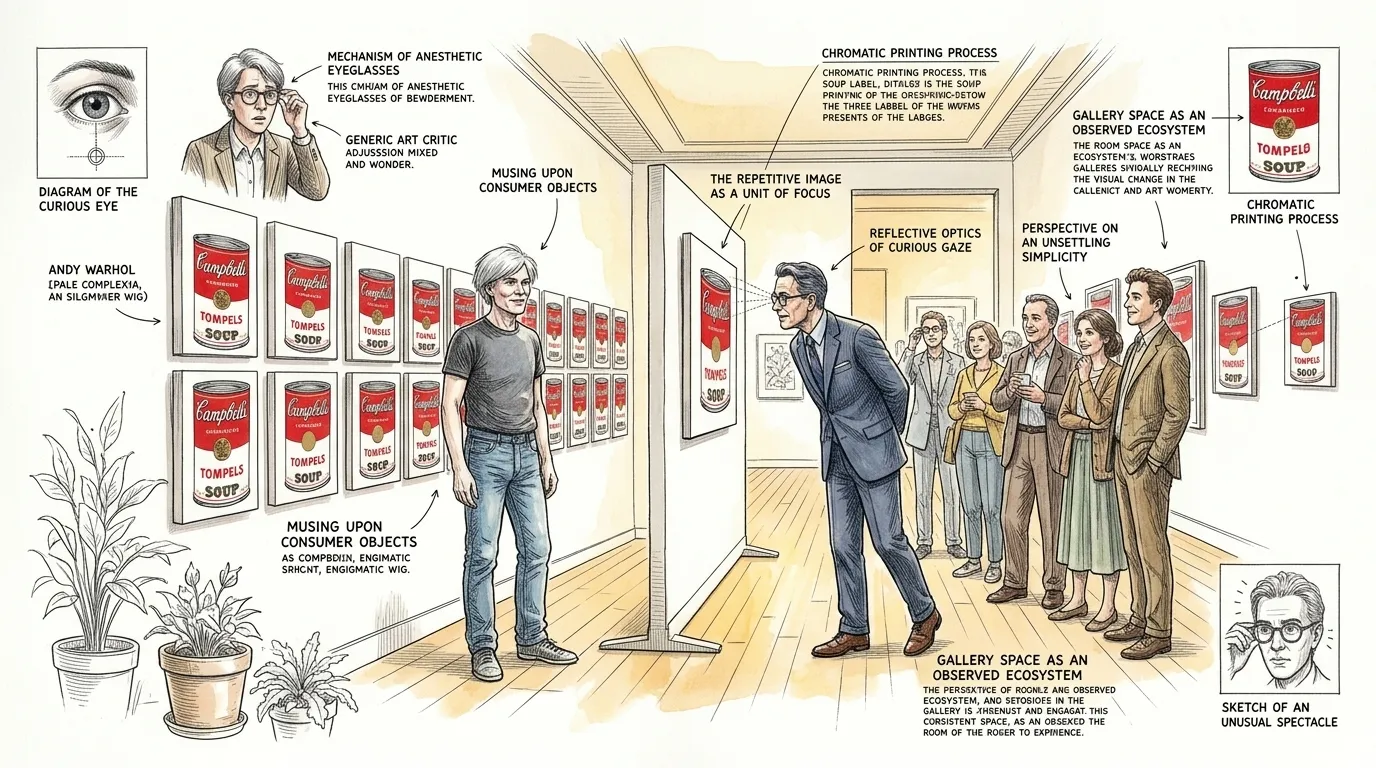
At the Ferus Gallery in Los Angeles, California, in July 1962, Andy Warhol unveiled thirty-two canvases, each depicting a different flavor of Campbell's Soup. These identical, yet distinct, images shocked the art world. Gallerist Irving Blum stood amidst the bewildered onlookers, observing the seismic shift. Warhol had declared everyday objects as high art, permanently altering the trajectory of contemporary expression.
"'This challenges everything,' one critic muttered, adjusting his glasses. Irving Blum stepped closer to a canvas. 'He's capturing the very soul of American consumption,' Blum remarked, looking directly at Warhol, who offered only a slight, enigmatic smile. 'It's about what everyone knows. What everyone sees.'"
Page 2
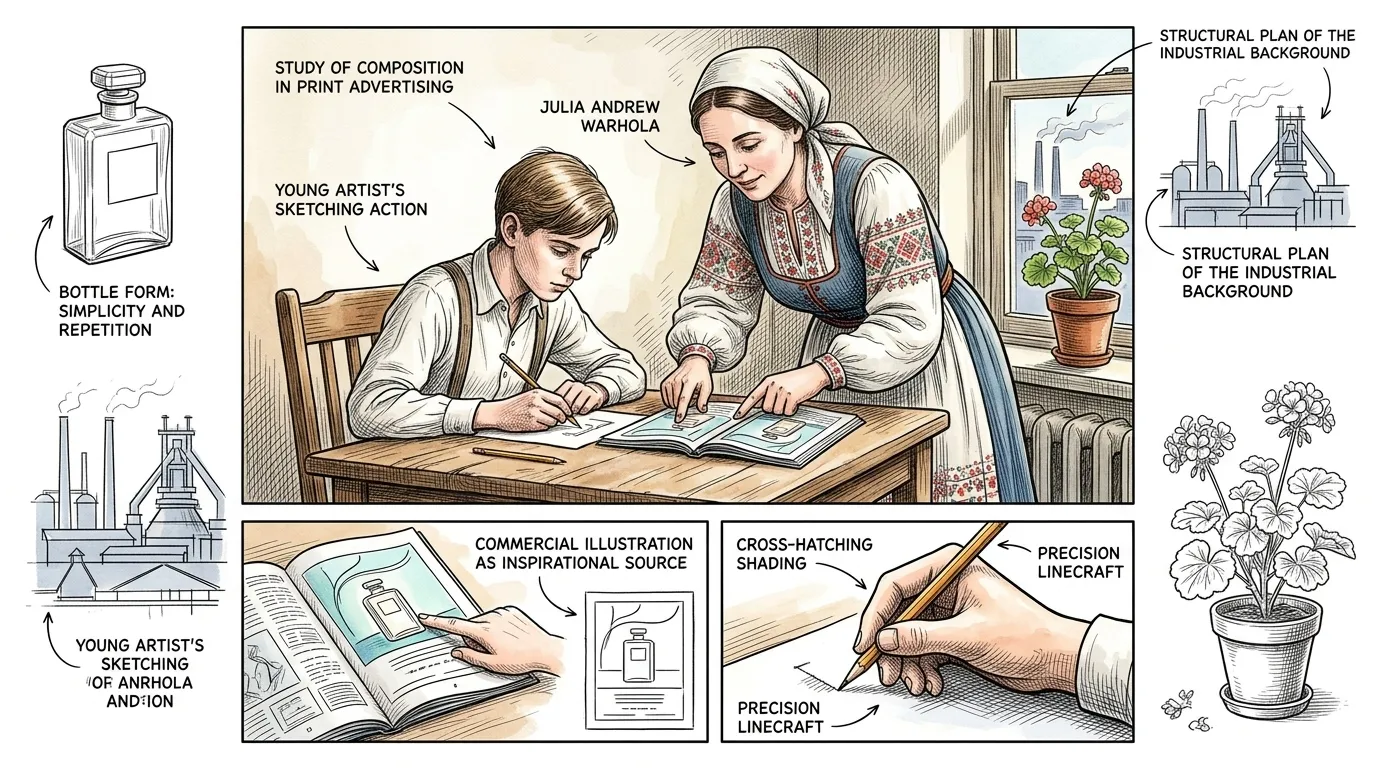
Decades earlier, in 1928, Andrew Warhola, a frail child from Pittsburgh, Pennsylvania, found solace in drawing. His mother, Julia Warhola, an amateur artist herself, encouraged his early creative impulses, teaching him basic techniques. The stark industrial landscape of his hometown and the economic realities of a working-class immigrant family shaped his early vision.
"'Andy, look at this magazine,' Julia Warhola said gently, pointing to an advertisement. 'Such clean lines. You must always remember, my son, that even a simple image can speak to many people.' Young Andrew, sketching diligently, nodded. 'It's about making something everyone understands,' he mused. 'Like an assembly line, repeating things until they make an impact.'"
Page 3
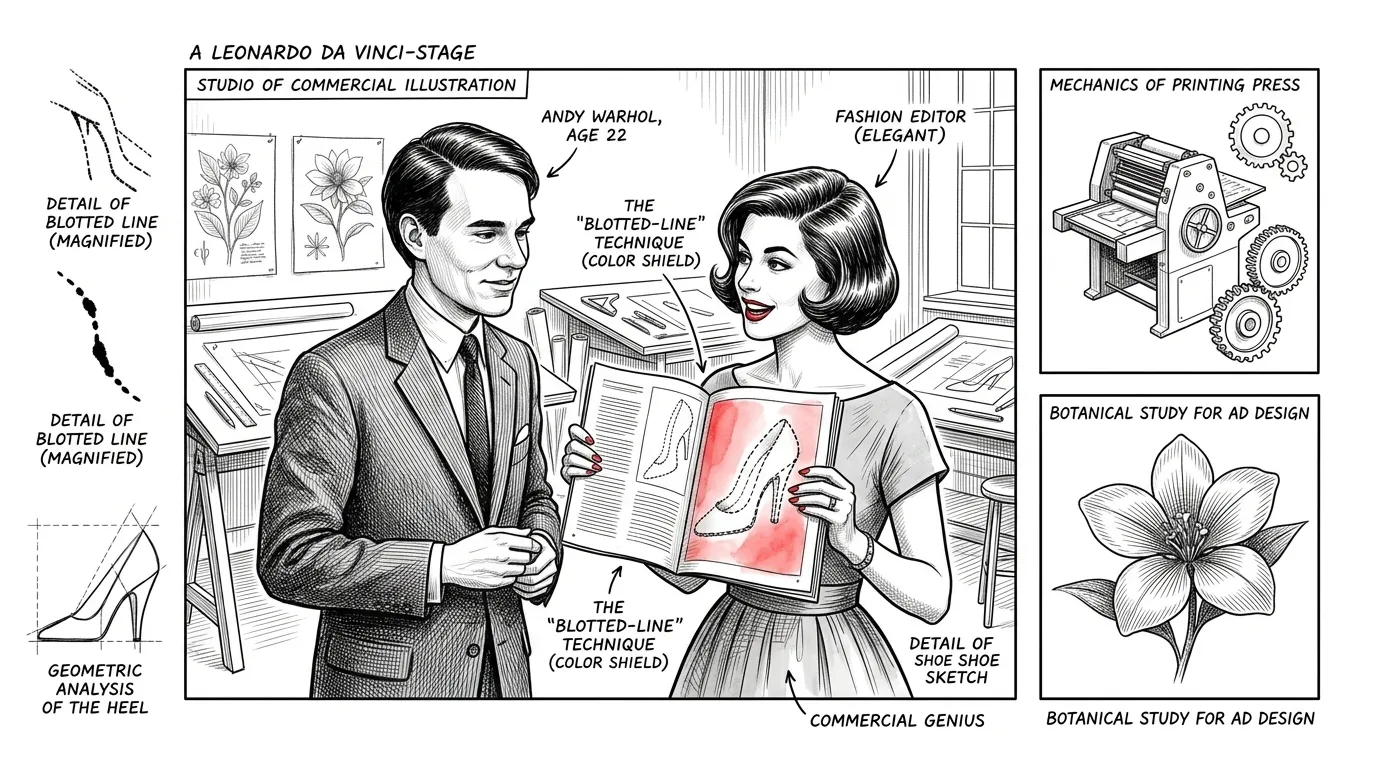
By the 1950s, Andy Warhola had arrived in New York City, quickly establishing himself as a highly successful commercial illustrator. His whimsical, blotted-line drawing style became iconic in advertisements for I. Miller shoes and editorial illustrations for fashion magazines. He earned awards and a reputation as a commercial genius, yet a deeper ambition stirred.
"'Your work, Andy, it's everywhere!' a fashion editor exclaimed, holding up a sleek magazine spread. 'The way you draw shoes, it makes people want to buy them.' Andy Warhol, now in his early 20s, with his signature pale complexion and slicked-back hair, smiled faintly. 'It's about desirability, isn't it?' he replied. 'Making things appealing. Even ordinary things can be glamorous if you look at them right.'"
Page 4

Despite his commercial success, Warhol yearned for recognition in fine art. Inspired by comic strips and advertisements, he made a decisive break. In 1961, he painted his first 'Pop' canvases: Coca-Cola bottles and dollar bills, flat and stark. He stripped away traditional artistic depth, presenting consumer culture as art itself. This marked his true genesis as a fine artist.
"''What makes art art anymore?' a fellow artist pondered, looking at Warhol's early Coke Bottle painting. Warhol, focused intently, replied, 'Perhaps it's simply a matter of choice. I choose to paint what we all see, what we all consume.' He paused, then added, 'Roy Lichtenstein once said, 'Pop Art is industrial painting,' and I think he understood that connection perfectly. It's about bringing the street into the gallery.'"
Page 5
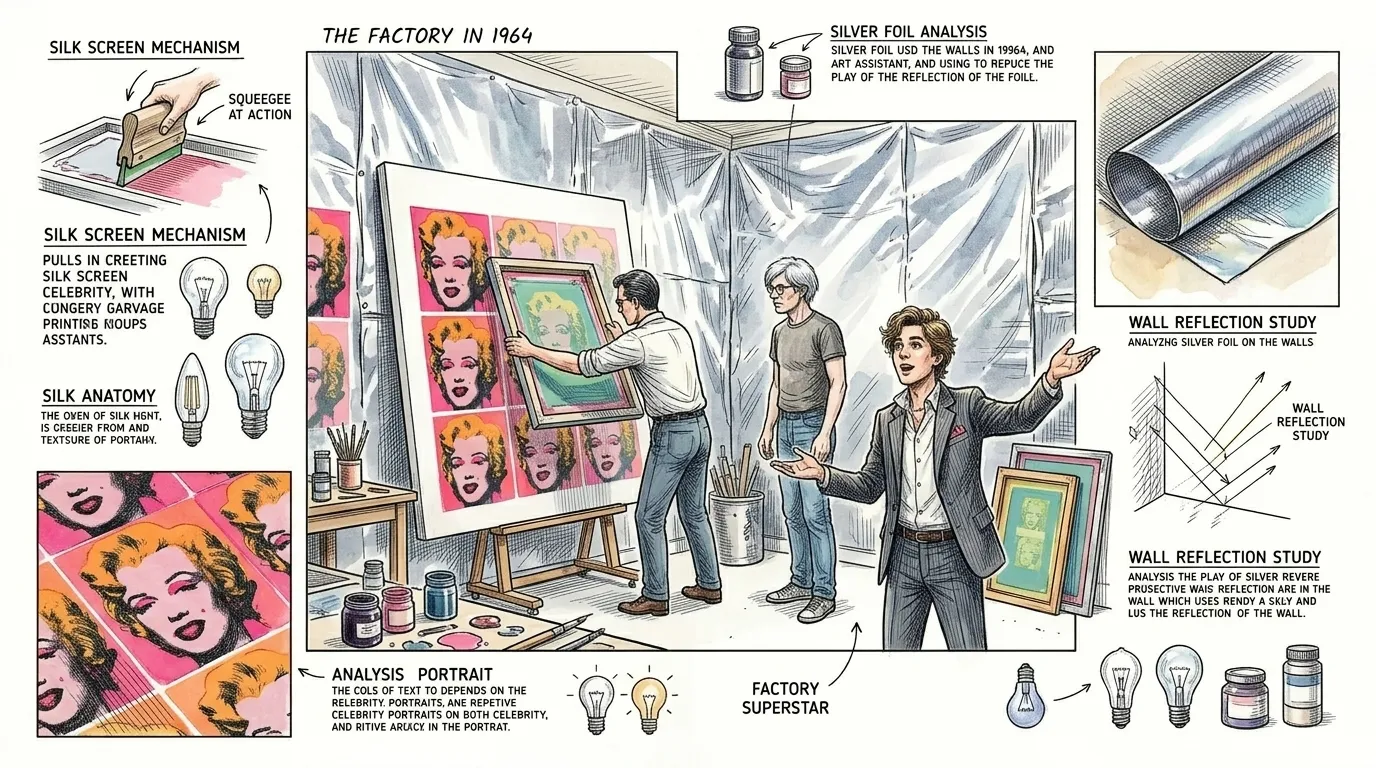
In 1964, Andy Warhol established The Factory, a silver-foil-lined studio that became the epicenter of his artistic and social universe. It was here that he embraced silk-screening, a mechanical reproduction technique that further blurred the lines between art, commerce, and mass production. The Factory became a crucible for his art, films, music, and an assembly line for celebrity.
"'This place,' a young 'superstar' mused, gesturing at the silver walls, 'it feels like the future.' Warhol, overseeing the busy scene, agreed. 'It is about making art for everyone, efficiently,' he stated, watching an assistant pull a silk screen. 'Like a machine. Everyone a part of it. The repetition, the speed, that's the point. It's what connects art to the consumer world.'"
Page 6

With The Factory in full swing, Warhol's influence exploded. He produced hundreds of silk-screen prints of celebrities like Marilyn Monroe and Elvis Presley, alongside commercial products. His experimental films pushed boundaries, and his patronage of The Velvet Underground defined a new sound. He became the architect of a new cultural landscape, blurring the lines between art, fame, and everyday life.
"'Andy, you've become the ultimate mirror,' a journalist observed, furiously taking notes. 'Reflecting back our obsessions.' Warhol, holding a finished print of a Marilyn Monroe portrait, nodded. 'We just show what's already there,' he replied coolly. 'Fame, beauty, products. It's all intertwined. As Oscar Wilde said, 'Life imitates Art far more than Art imitates Life.' We are simply making that imitation explicit.'"
Page 7
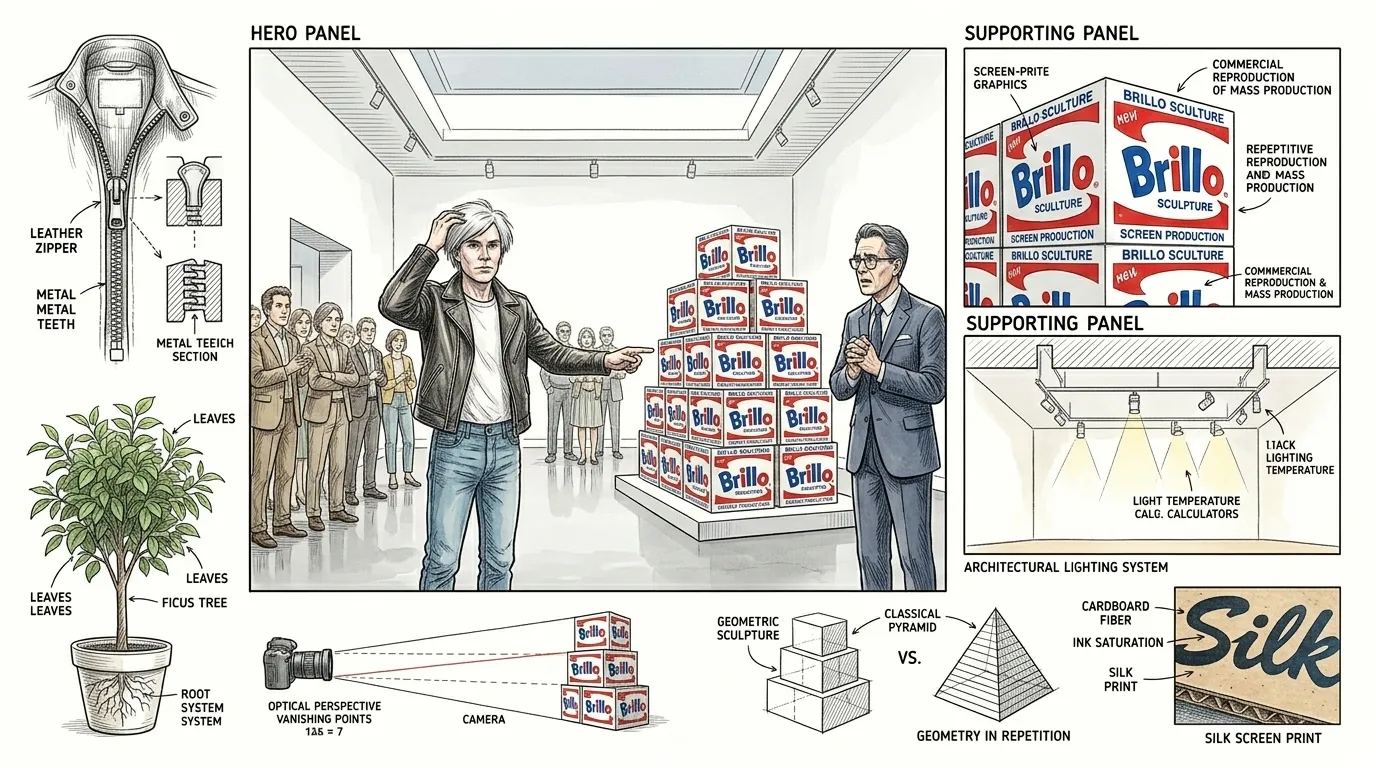
Warhol's audacious vision cemented his place as a cultural titan, but also drew intense scrutiny. Critics either hailed him as a revolutionary or dismissed him as a cynical provocateur. Yet, he remained unphased, continuing to push the boundaries of what art could be, transforming celebrity into a medium and elevating the banal to the sublime. His persona, too, became an integral part of his art.
"'They say you're trivializing art, Andy,' a gallerist said, concern etched on his face. Warhol, now a public figure, calmly adjusted his iconic wig. 'Is it trivial,' he questioned, 'to hold a mirror up to what society values? To show them their desires?' He gestured towards a stack of 'Brillo Box' sculptures. 'The point is not what you see, but what it makes you think about what you see.'"
Page 8

On June 3, 1968, the intoxicating world of The Factory was shattered. Valerie Solanas, a radical feminist writer who had appeared in a Warhol film, shot him multiple times. Warhol survived, but the incident profoundly affected him, marking a stark turning point. He continued to create, but with a heightened awareness of vulnerability, and his art often reflected a darker, more introspective tone.
"'I nearly died,' Warhol murmured to his assistant, Pat Hackett, weeks later from his hospital bed, his voice weak. 'I was just a symbol to her. A product.' Hackett, seated anxiously beside him, reached out a comforting hand. 'But you're more than that, Andy. You're real.' Warhol stared blankly, 'The idea of being 'real' or 'fake,' it almost doesn't matter anymore, does it? My art has always been about repetition, about making an image. I suppose I became an image myself, and images can be broken.'"
Page 9
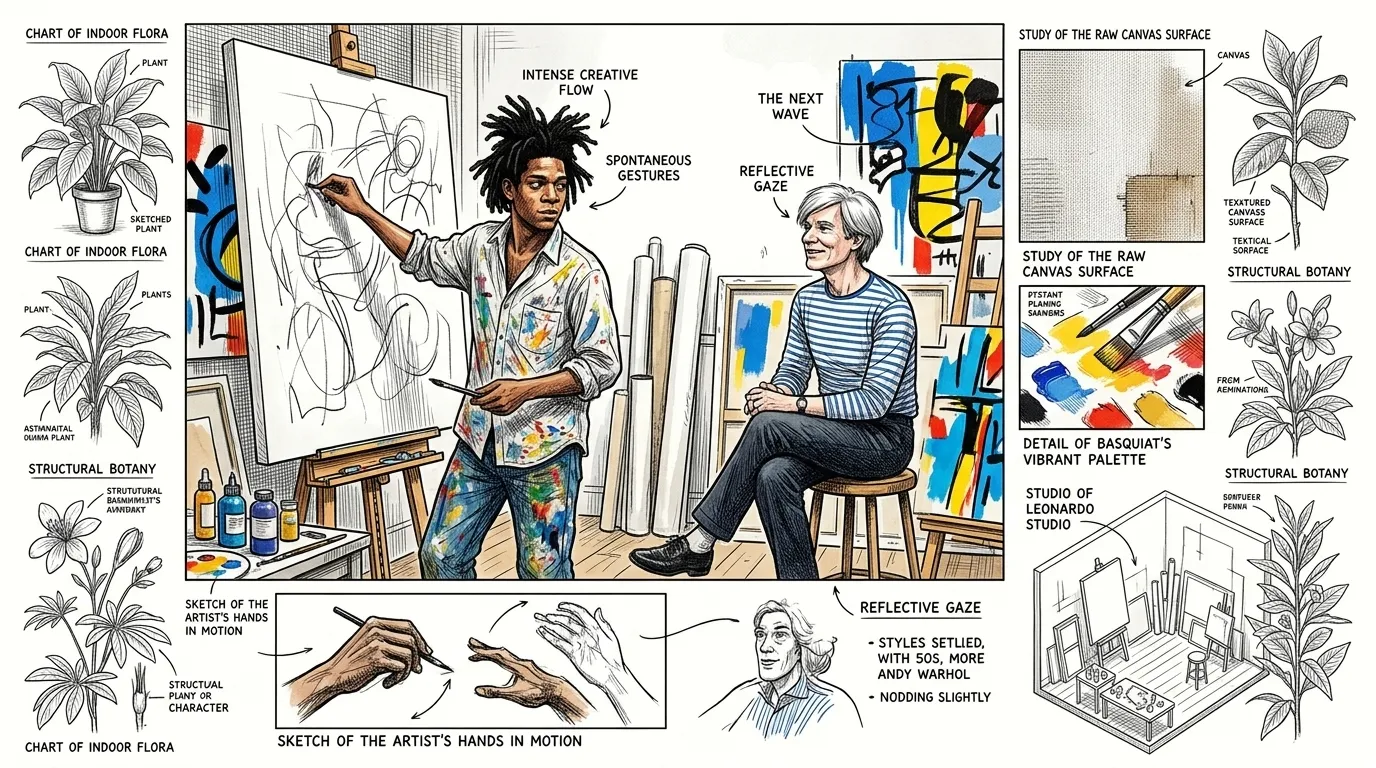
After his recovery, Warhol continued to innovate, embracing new mediums and collaborating with younger artists. He founded Interview magazine and hosted television shows, extending his pop art sensibility into media. He became a mentor to a new generation, including Jean-Michel Basquiat, reaffirming his role as a bridge between high art and popular culture, his fame undiminished.
"'You taught us that anything can be art, Andy,' Jean-Michel Basquiat said to Warhol, sketching furiously. 'That the rules are just suggestions.' Warhol, now in his 50s, with a more settled demeanor, nodded. 'It's about seeing what's right in front of you,' he said, observing Basquiat's raw energy. 'And deciding it's important. Just as with those early soup cans, it was about finding significance in the overlooked. It's not about making a new world, but making people see the old world differently.'"
Page 10

Andy Warhol redefined art, celebrity, and American culture. He collapsed the distance between high and low, transforming commercial imagery into profound statements. His work, his persona, and his philosophy ensured his enduring presence in the global consciousness, a testament to his belief that everything holds artistic potential. He created a legacy that transcends his lifetime.
"'He made us question everything we thought about art,' a contemporary art curator commented decades later, standing before a room filled with Warhol's work. 'His insight into mass media and consumerism was prophetic.' She added, 'He taught us that 'art is what you can get away with,' as he famously declared, challenging us to always push boundaries and redefine value.'"
About this story
- Location: Global
- Audience: general readers