Egyptian Schools and Education
Egyptian Schools and Education — an illustrated stories story, set in Egypt. 10 illustrated pages, free to read on Wonder Books.
Page 1

Nalini skipped through the Grand Egyptian Museum, her eyes scanning the towering exhibits. "Wow! Look at this stele, Vivaan!" she exclaimed, pointing to a weathered limestone slab covered in hieroglyphs. Vivaan peered at the stele. "I wonder what it says?" Suddenly, the stele began to glow, and the museum faded away.
Page 2

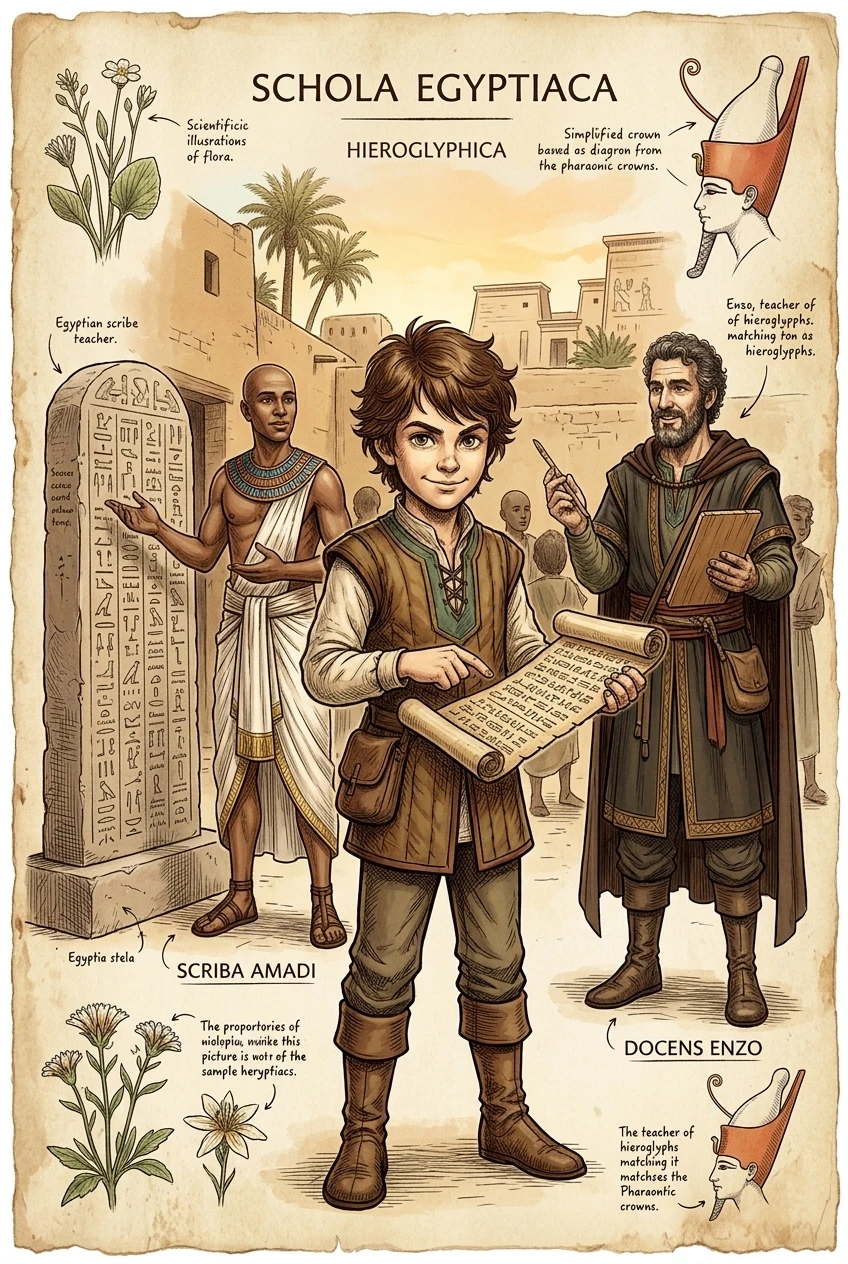
They found themselves standing on the banks of the Nile. "Where are we?" Nalini asked, her voice filled with wonder. Vivaan shielded his eyes, gazing at the bustling river. "It looks like ancient Egypt!" A man in a simple linen kilt approached them. "Welcome, travelers. I am Amadi, a scribe. Are you here to learn?"
Page 3

"Learn?" Nalini tilted her head. Amadi smiled. "Indeed. In our land, education begins with understanding the gifts of the Nile. As the Greek philosopher Heraclitus said, 'The only constant is change.' The Nile teaches us that, doesn't it?" Vivaan nodded, watching farmers tending fields along the riverbank. "So, learning is about understanding change?"
Page 4

Amadi led them towards a mud-brick building. "Before scribes, there were farmers, and before farmers, there was the land itself. Come, I will show you how our children learn to read the world before they read the papyrus." He gestured for them to follow. "Understanding the seasons, the river's flow, the stars at night – that is the first book of Egypt."
Page 5

Inside, children were drawing in the sand with sticks. "They learn to recognize shapes and patterns," Amadi explained. "These are the foundations of hieroglyphs." A stern-looking man, Enzo, watched over them. "The patience of the river is needed for this task," Enzo declared, his voice booming. "The Nile does not flood in a day. Learning takes time."
Page 6

"But why are we learning shapes in the sand?" Nalini asked, tracing a circle. Enzo pointed to a wall painting of a cow. "That is a hieroglyph representing plenty. The circle can represent the sun, or a god. Each symbol holds power." Vivaan looked closer at the wall. "So, everything is connected? The land, the symbols, the gods?"
Page 7

Later, Amadi showed them a papyrus scroll covered in detailed writing. "Here are stories of our pharaohs, our harvests, our gods. But it all begins with what you learn from the land. See, these glyphs represent the river itself, and its life-giving properties to sustain us."
Page 8

"But how can we read the land back in our museum?" Nalini asked, puzzled. Suddenly, a sandstorm blew in, obscuring everything. "The land is testing us!" Vivaan shouted, shielding his eyes. Amadi pointed to the shifting sand. "Remember the shapes! The lines of the dunes show where the wind flows. The deep patterns reveal the strongest currents!"
Page 9

Vivaan remembered the shapes they had learned in the sand. "Look! The wind is carving a circle in the dunes. That's like the sun glyph!" He pointed in the opposite direction of the strongest wind currents. "If we go that way, we'll be out of the storm!" Nalini grabbed his hand, her eyes wide. "You're right!"
Page 10
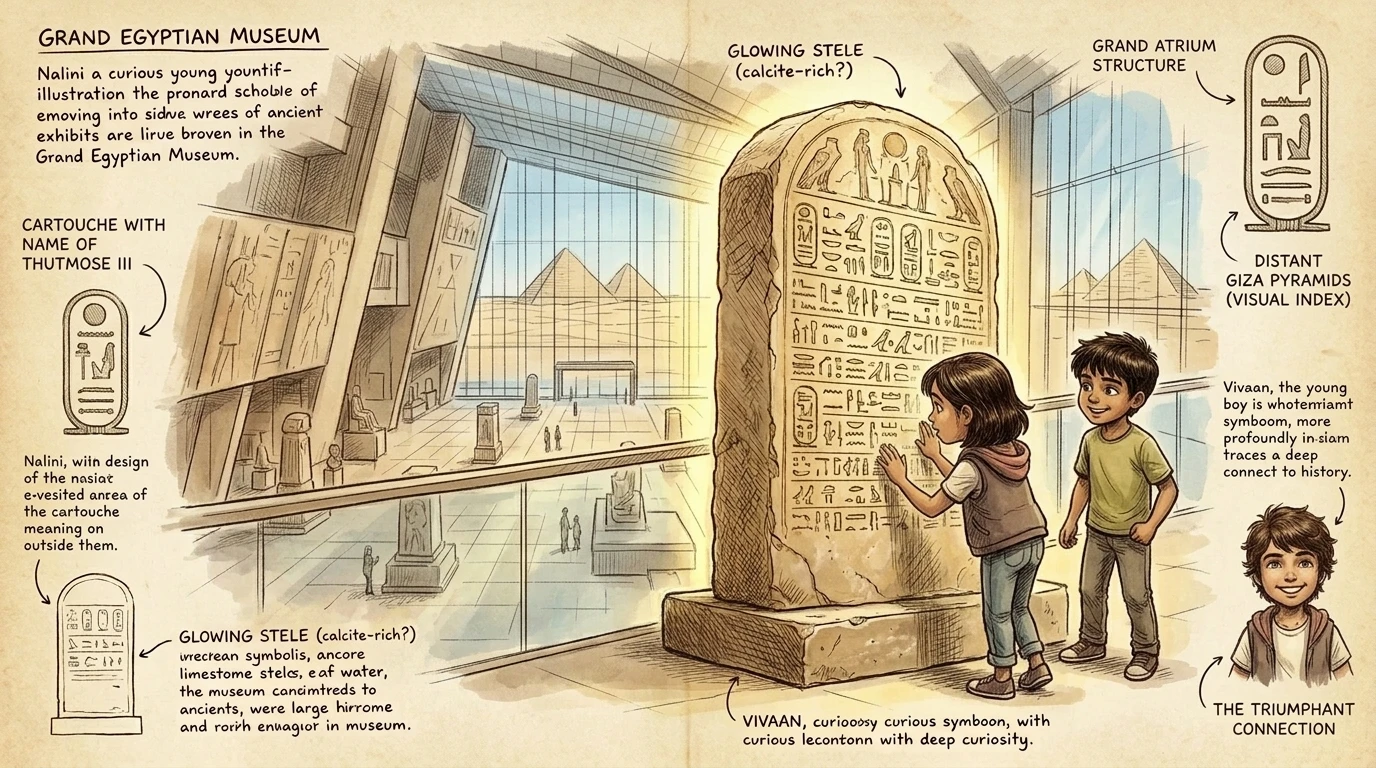
Suddenly, they were back in the museum, standing before the stele. "Now I understand," Nalini whispered, tracing the hieroglyphs. "It's not just writing. It's the story of the land!" Vivaan smiled. "We learned more than history, we learned to read the world!"
About this story
- Location: Egypt
- Audience: kids (ages 6–12)