Hatshepsut: The Woman Who Became Pharaoh
Hatshepsut: The Woman Who Became Pharaoh — an illustrated stories story, set in Egypt. 10 illustrated pages, free to read on Wonder Books.
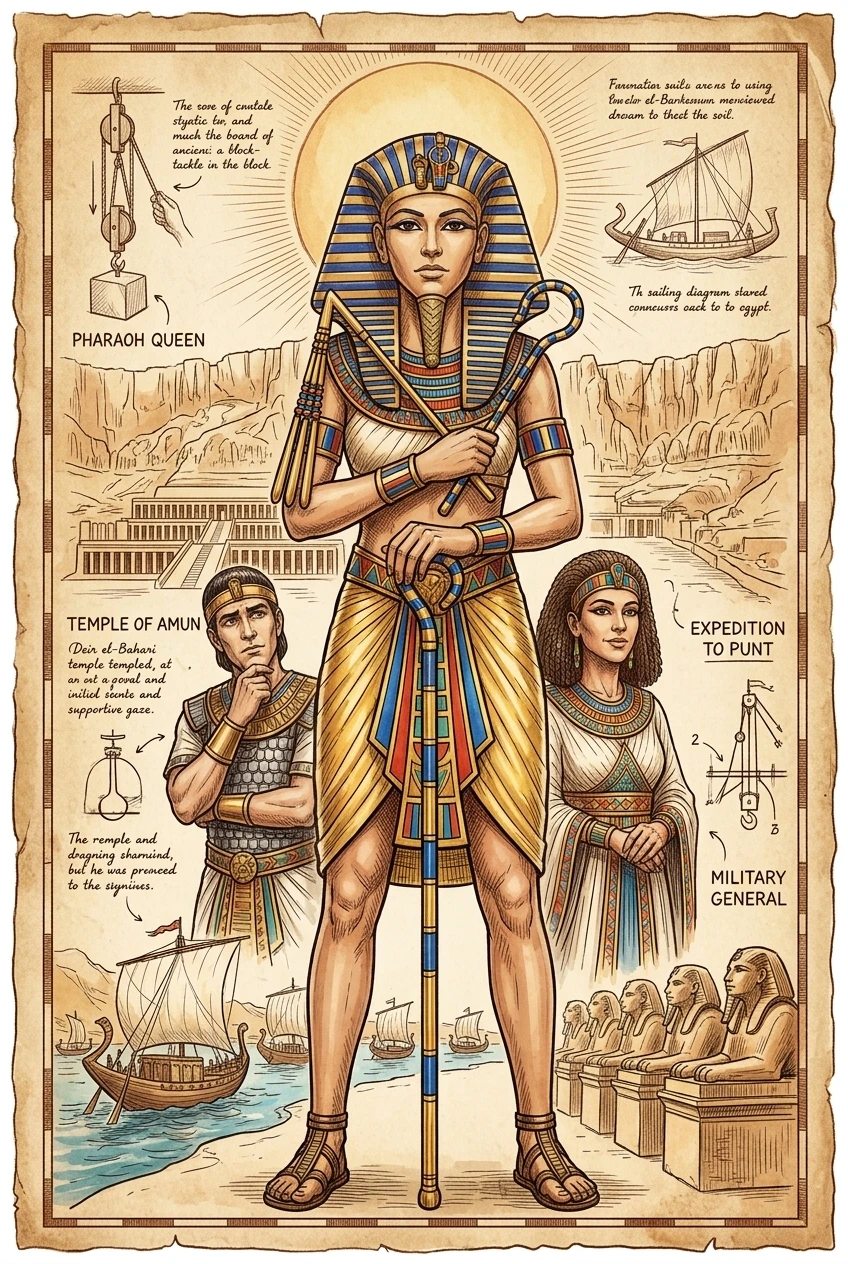
Page 1
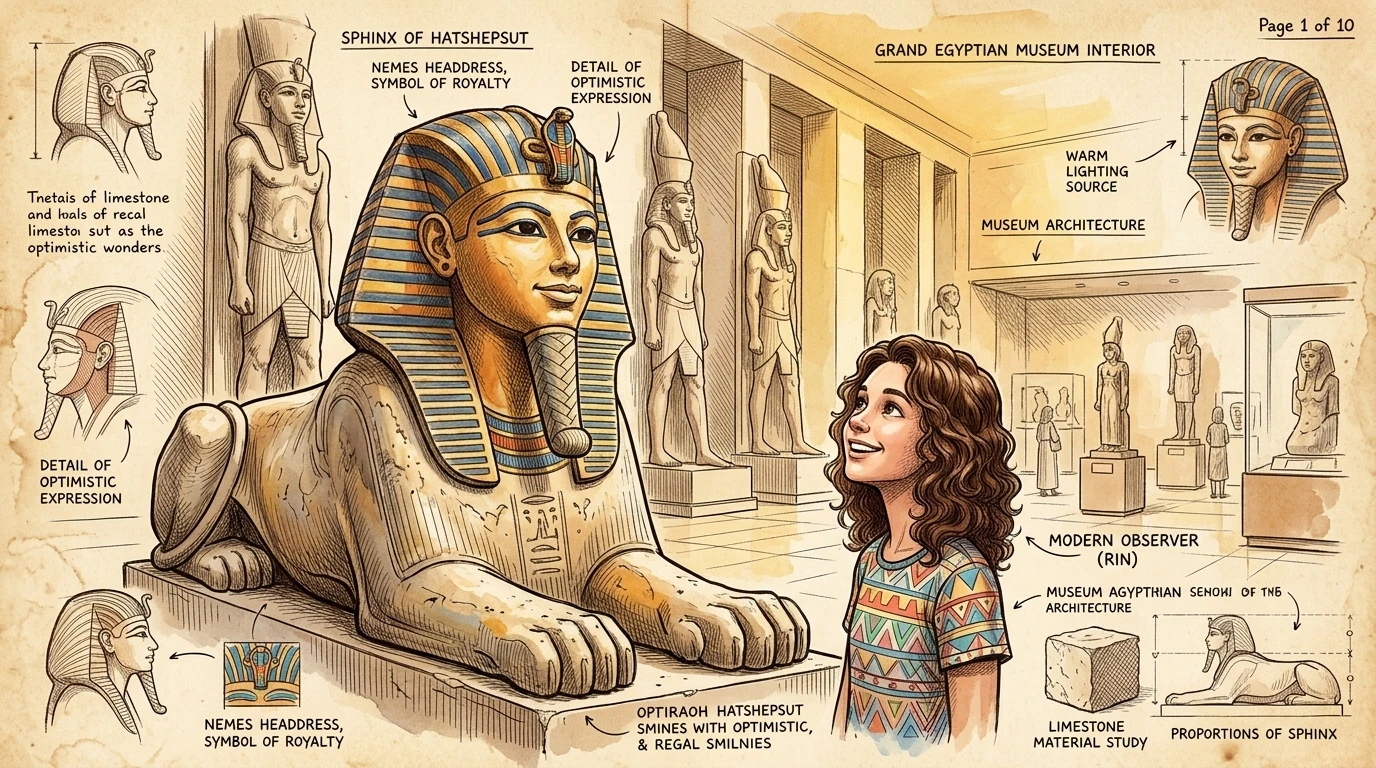
Rin skipped ahead of her group, her eyes scanning the towering statues in the Grand Egyptian Museum. She paused, drawn to a regal, stone sphinx. An inscription detailed the pharaoh Hatshepsut. "Wow! Who was she, Nikhil?" [Museum Fact: Hatshepsut: One of the few women to rule Egypt as Pharaoh.]
Page 2

Nikhil smiled, adjusting her glasses. 'Hatshepsut claimed a divine birth, Rin. She said the god Amun visited her mother, Queen Ahmose, in the form of her father, Thutmose I.' Rin tilted her head, confused. Suddenly, the sphinx shimmered. The museum faded away, replaced by a brightly painted palace wall. "Divine birth? You mean like a god was her real dad?" [Museum Fact: Queen Ahmose: Hatshepsut's mother and wife of Thutmose I.]
Page 3

Ingrid, an elderly man in his late 60s female, average height with a warm presence, with porcelain skin with pink cheeks and long flowing midnight-black hair with subtle blue sheen, walked toward Rin and Nikhil. 'Hatshepsut ingeniously secured her power,' Ingrid whispered, 'by emphasizing her lineage and divine right to rule.' She pointed to a carving of Hatshepsut wearing the double crown. "But how could a woman become pharaoh?" [Museum Fact: The Double Crown: Symbolizes the unification of Upper and Lower Egypt.]
Page 4

Nikhil traced the outline of a massive obelisk in another carving. 'She didn't just claim power, Rin; she earned it. Hatshepsut commissioned grand building projects, like the temple at Deir el-Bahri, and expanded trade routes.' Rin gasped as she saw workers hauling enormous stones. "Wow, she built all this? It must have taken forever!" [Museum Fact: Deir el-Bahri: Hatshepsut's mortuary temple, a marvel of ancient architecture.]
Page 5

Ingrid pointed to a detailed depiction of ships laden with exotic goods. 'One of Hatshepsut's most daring achievements was the expedition to Punt, a land far to the south. She brought back valuable resources like incense, ebony, and myrrh.' Rin's eyes widened at the sight of the strange animals. "Punt? I've never heard of it! What was it like?" [Museum Fact: Punt: A wealthy trading partner of ancient Egypt, likely located in modern-day Somalia.]
Page 6

Nikhil furrowed her brow. 'Some historians argue Hatshepsut's reign was largely peaceful, focused on trade and building. Others believe she suppressed potential rivals to maintain power.' Ingrid nodded slowly, stroking his chin. 'History is rarely simple, Rin. Like Shakespeare said, 'There is nothing either good or bad, but thinking makes it so.' "So... was she a good pharaoh or a bad one?" [Museum Fact: Hatshepsut's legacy remains a topic of debate among historians.]
Page 7

Rin gasped. 'But why did they try to erase her name from the monuments after her death?' Nikhil sighed. 'After Hatshepsut died, Thutmose III, her successor, ordered many of her statues destroyed and her name removed from inscriptions. It might have been to secure his own claim to the throne.' "That's so unfair! Why would he do that?" [Museum Fact: Thutmose III: Hatshepsut's nephew and successor.]
Page 8

Ingrid smiled. 'But history always finds a way to reveal the truth. Archaeologists rediscovered Hatshepsut's story in the 19th century, piecing together the fragments of her reign.' He showed Rin a drawing of the expedition to Punt, recalling that it brought exotic animals. "So, we know about her even though they tried to hide her?" [Museum Fact: Archaeological discoveries revealed Hatshepsut's achievements to the world.]
Page 9

Rin realized that even though someone tried to erase Hatshepsut, her impact remained. She stood tall, just like Hatshepsut must have. 'She proved that anyone, even a woman, could lead a great nation,' Rin declared. "Hatshepsut was amazing!" [Museum Fact: Hatshepsut's story inspires us to challenge expectations.]
Page 10

Suddenly, they were back in the Grand Egyptian Museum. Rin gazed at the sphinx with new understanding. Nikhil smiled. 'Hatshepsut's golden age reminds us what humans can achieve when we dare to break boundaries.' "I'll never forget her, Nikhil!" [Museum Fact: Visit the Grand Egyptian Museum to see Hatshepsut's legacy firsthand!]
About this story
- Location: Egypt
- Audience: kids (ages 6–12)