How Roman Aqueducts Were Engineered
How Roman Aqueducts Were Engineered — an illustrated inventions story, set in United States. 10 illustrated pages, free to read on Wonder Inventions.
Page 1

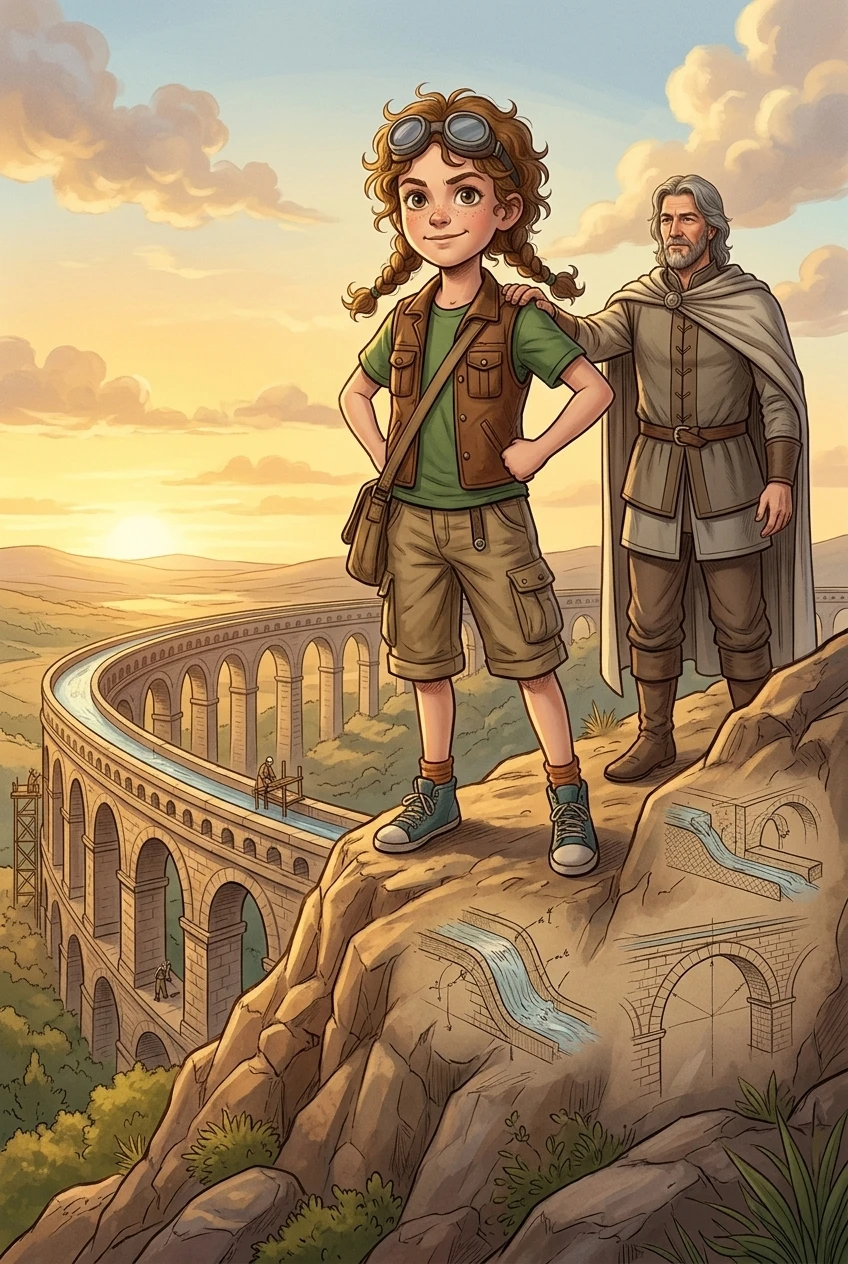
Winona plopped down on the couch next to her uncle Stefan, watching him struggle with the garden hose. "Need some help, Uncle Stefan?" she asked, giggling. Stefan sighed, wiping sweat from his brow. "This leaky old thing! It's always something. Imagine fetching all our water from the river every day, like they did in the olden days!" Winona's eyes widened. "Wait, how did people get water before hoses?" she asked, grabbing her worn leather notebook from the coffee table.
Page 2

Winona raced to her bedroom, which was decorated with posters of rockets and constellations. She pulled a large, leather-bound book from her bookshelf. As she opened the 'Magical Invention Encyclopedia,' a soft golden light filled the room. "Aqueducts," she whispered, tracing the word with her finger as the room began to spin. "Uncle Stefan always says, 'The journey of a thousand miles begins with a single step,' like Lao Tzu said," she mused, holding the book tight. "I guess this is my first step into the past!"
Page 3

The swirling light stopped, and Winona found herself in a bustling marketplace. Merchants hawked their wares, and Roman citizens hurried by in togas. "Wow!" she exclaimed, taking in the sights. The air was dusty and smelled of animals and spices. Suddenly, she noticed a woman struggling to carry two heavy buckets of water from a distant well. The woman grimaced with each step.
Page 4

"Excuse me," Winona called out to a man wearing a simple brown tunic, his brow furrowed as he studied some parchment. "What's it like getting water here?" The man looked up, startled. "Tiring!" he exclaimed. "We spend half our day just hauling water from the river or the few wells we have. It's hard work, especially for the women." Winona opened her notebook and started scribbling furiously.
Page 5

A tall, serious man approached them. "That's why I'm working on a solution," the man said, his voice booming. "I'm Marcus Vitruvius Pollio, and I believe we can bring water to the city using aqueducts!" He unfurled a large scroll showing a detailed drawing of a structure. "It will take years, maybe decades, but we can do it!"
Page 6

"But how will it work?" Winona asked, peering at the diagrams. Vitruvius pointed to the scroll. "Using gravity!" he explained. "We'll build a channel that slopes slightly downhill over many miles, bringing water from distant springs. We are using arches, which are strong! The Aqua Appia, Rome's first aqueduct, was built in 312 BC."
Page 7

"It's not easy, though," the Roman engineer chimed in. "We have to carefully measure the slope – just a tiny drop per mile! And the construction is expensive. The Aqua Marcia alone, built around 144 BC, cost about 180 million sesterces!" Vitruvius nodded grimly. "And it takes skilled workers, something Rome did not have enough of at the time."
Page 8

Winona frowned, remembering the woman struggling with the buckets. "But what if the aqueduct breaks? What if there's an earthquake?" Vitruvius smiled slightly. "Then we will repair it! Roman aqueducts brought so much water into the city that, by the 3rd century AD, Rome had over 1,126 fountains! We must be prepared for all possibilities," he said, adjusting his toga.
Page 9

Suddenly, Winona's Magical Invention Encyclopedia started to glow again. "I have to go!" she exclaimed. "Thank you for showing me how aqueducts work!" Vitruvius nodded. "Remember," he said, "'The supreme quality for leadership is unquestionably integrity. Without it, no real success is possible,' as Dwight D. Eisenhower would say many centuries from now. Build strong and build true!"
Page 10
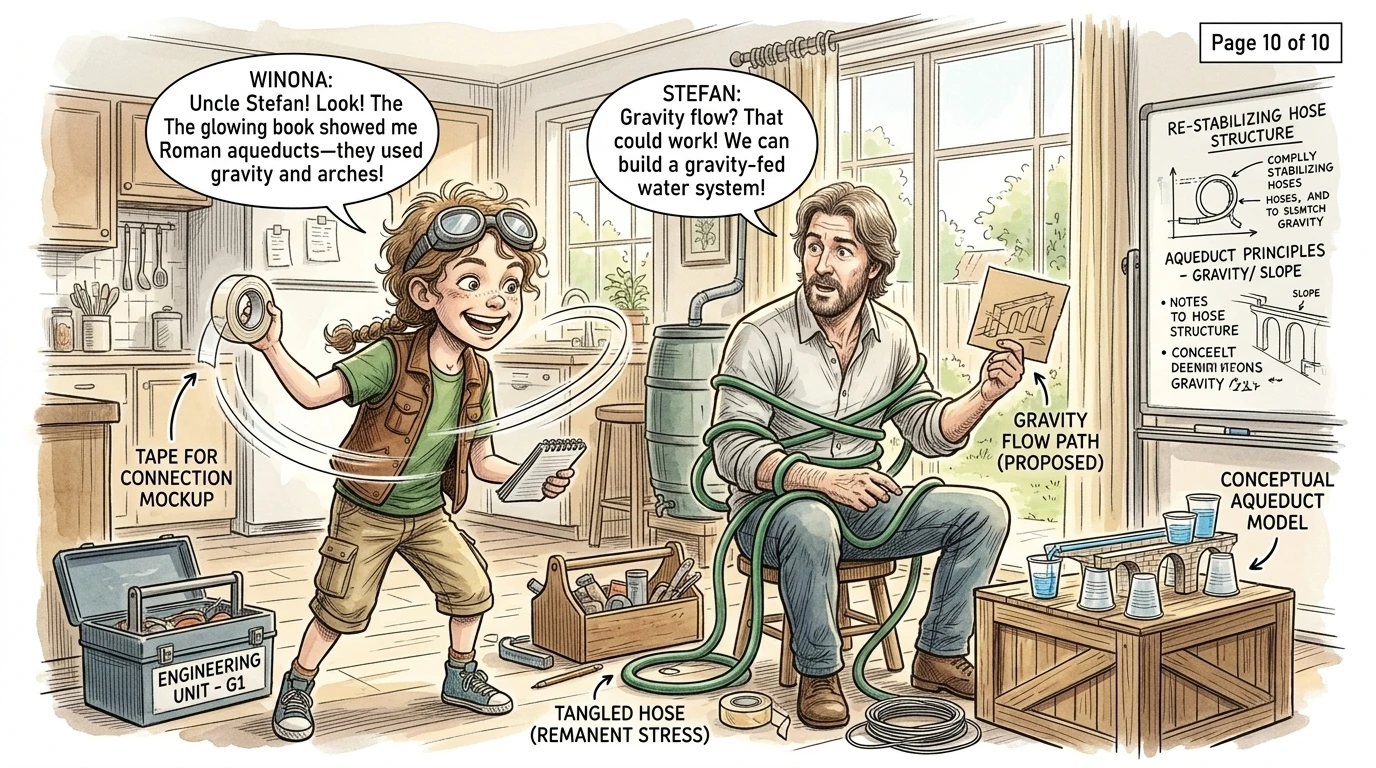
Back in her bedroom, Winona closed the encyclopedia. She ran downstairs and found Uncle Stefan still struggling with the hose. "Uncle Stefan!" she cried. "Did you know the Romans built aqueducts to bring water to their cities? Some are still standing today! Maybe we can fix our leaky hose with some engineering," she exclaimed with a grin, grabbing some tape. She showed him how modern aqueducts STILL use the same principles.
About this story
- Location: United States
- Audience: kids (ages 6–12)
Read Wonder Inventions on your phone
Wonder Inventions is available on Android. Get Wonder Inventions on Google Play.