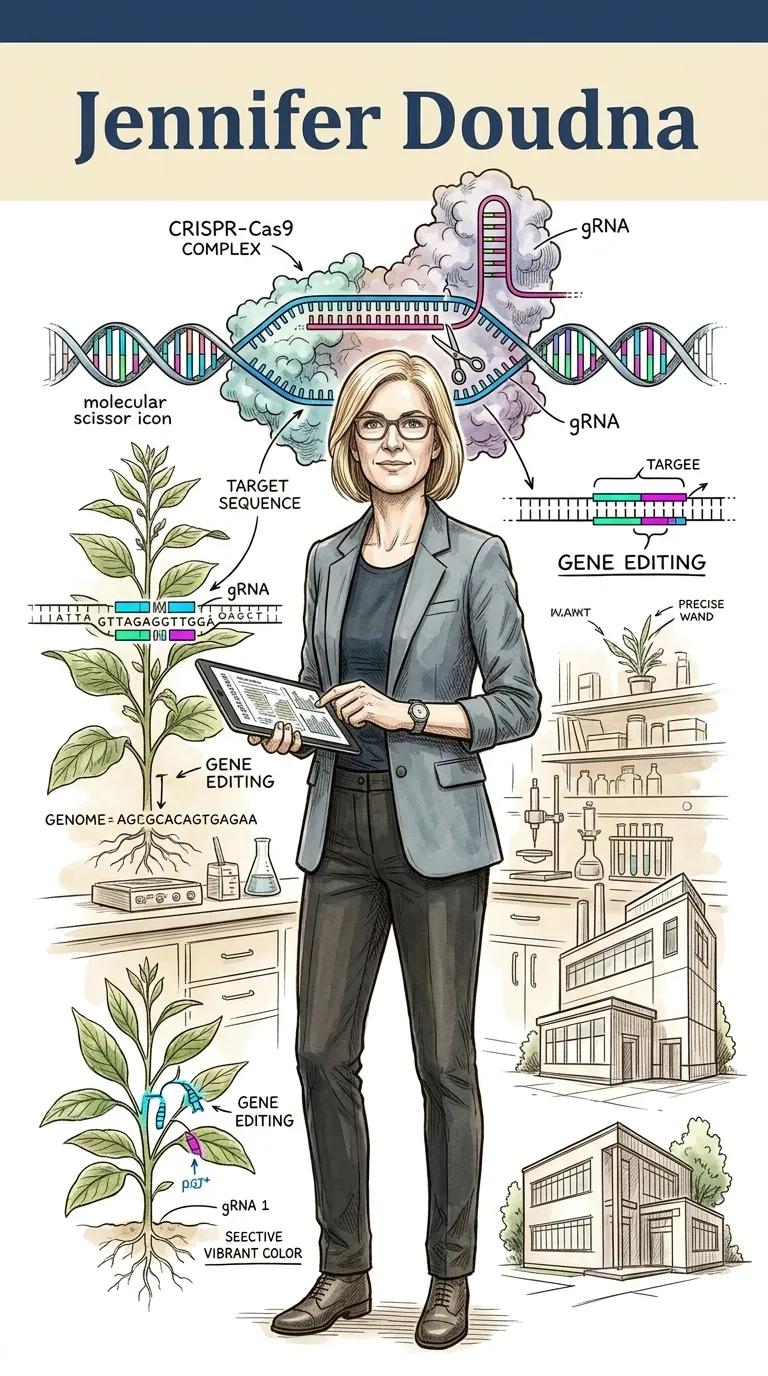
Jennifer Doudna

Jennifer Doudna — an illustrated science story, set in Global. 10 illustrated pages, free to read on Wonder Science.

Jennifer Doudna — book cover — Wonder Science
Jennifer Doudna — book cover

Page 1

Jennifer Doudna — page 1 illustration — Wonder Science

In the annals of scientific discovery, few breakthroughs have resonated with the profound potential to redefine life itself as much as CRISPR-Cas9. At its heart lies the groundbreaking work of Jennifer Doudna, whose collaborative insights unlocked a precise, powerful tool capable of rewriting the very code of biological existence. Her research, culminating in 2012, transformed our understanding of bacterial immunity into a revolutionary system for genome engineering.

Page 2

Jennifer Doudna — page 2 illustration — Wonder Science

Before CRISPR became a household name, its origins lay hidden in the microscopic world of bacteria and archaea. For billions of years, these single-celled organisms have waged a relentless battle against viral invaders, developing sophisticated defense mechanisms. One such system, observed by early researchers, featured peculiar, repeating DNA sequences interspersed with 'spacer' DNA, fragments of past viral attackers.

Page 3

Jennifer Doudna — page 3 illustration — Wonder Science

This bacterial 'immune system,' known as Clustered Regularly Interspaced Short Palindromic Repeats (CRISPR), functions by creating RNA copies of these stored viral fragments. These small RNAs, combined with specific Cas (CRISPR-associated) proteins, act as molecular guides, leading the proteins to matching viral DNA sequences for precise destruction. Early pioneers like Francisco Mojica recognized this system's adaptive memory.

Page 4

Jennifer Doudna — page 4 illustration — Wonder Science

Before Doudna and Charpentier's breakthrough, manipulating specific genes within an organism's DNA was a complex, time-consuming endeavor. Techniques such as zinc-finger nucleases and Transcription Activator-Like Effector Nucleases (TALENs) offered some precision but required bespoke protein engineering for each target sequence, making them prohibitively difficult and expensive for widespread use. The scientific community yearned for a simpler, more universal genetic editing tool.

Page 5

Jennifer Doudna — page 5 illustration — Wonder Science

The pivotal moment arrived through the collaboration of Jennifer Doudna and Emmanuelle Charpentier. Their critical insight was recognizing that the two RNA molecules central to the bacterial CRISPR defense – crRNA and tracrRNA – could be fused into a single, synthetic 'guide RNA' (sgRNA). This elegant simplification transformed a multi-component system into a remarkably streamlined, programmable molecular machine.

Page 6

Jennifer Doudna — page 6 illustration — Wonder Science

With the streamlined single guide RNA, the CRISPR system's power could be precisely directed. The Cas9 protein, an enzyme dubbed 'molecular scissors,' acts as the effector. Guided by the sgRNA, Cas9 scans the vast stretches of DNA within a cell, searching for a sequence that perfectly matches its RNA guide. A crucial 'PAM' (Protospacer Adjacent Motif) sequence, a short indicator found next to the target DNA, ensures Cas9 only cuts foreign DNA, preventing self-destruction.

Page 7

Jennifer Doudna — page 7 illustration — Wonder Science

Upon finding a perfect match to its sgRNA, immediately adjacent to the PAM sequence, Cas9 undergoes a conformational change. Its two catalytic domains, HNH and RuvC, then spring into action. They precisely cleave both strands of the DNA double helix, creating a clean double-strand break. This break is the 'cut' that allows scientists to either disable a gene or insert new genetic material using the cell's own repair mechanisms.

Page 8

Jennifer Doudna — page 8 illustration — Wonder Science

The advent of CRISPR-Cas9 has revolutionized medicine, offering unprecedented hope for treating previously incurable genetic diseases. From correcting the gene responsible for sickle cell anemia to silencing genes implicated in Huntington's disease, CRISPR provides a powerful new therapeutic avenue. Clinical trials are underway globally, exploring its potential to engineer T-cells to combat cancer, modify stem cells, and even directly edit genes in vivo.

Page 9

Jennifer Doudna — page 9 illustration — Wonder Science

CRISPR's utility extends far beyond human health. In agriculture, it promises to engineer crops with enhanced resilience to disease and pests, improved nutritional value, and increased yields, all without introducing foreign DNA. In fundamental research, it has become an indispensable tool for understanding gene function across countless organisms, accelerating discovery and redefining experimental design. Yet, with such power comes profound ethical considerations, particularly concerning germline editing.

Page 10

Jennifer Doudna — page 10 illustration — Wonder Science

The profound impact of Jennifer Doudna and Emmanuelle Charpentier's work was recognized with the 2020 Nobel Prize in Chemistry, a testament to CRISPR-Cas9's revolutionary potential. This technology has ushered in an entirely new era of biological research and medical intervention, democratizing gene editing and inspiring countless scientists globally. While ethical debates and technical challenges, such as off-target edits and efficient delivery, persist, the ongoing evolution of CRISPR systems continues to expand its horizons, promising ever more precise and sophisticated control over the blueprint of life itself.

About this story

  • Location: Global
  • Audience: general readers

More Wonder Science stories

All Wonder Science stories · Open the library