Sadko and the Sea King
A musician, a wager, and a journey to the bottom of the sea

Page 1
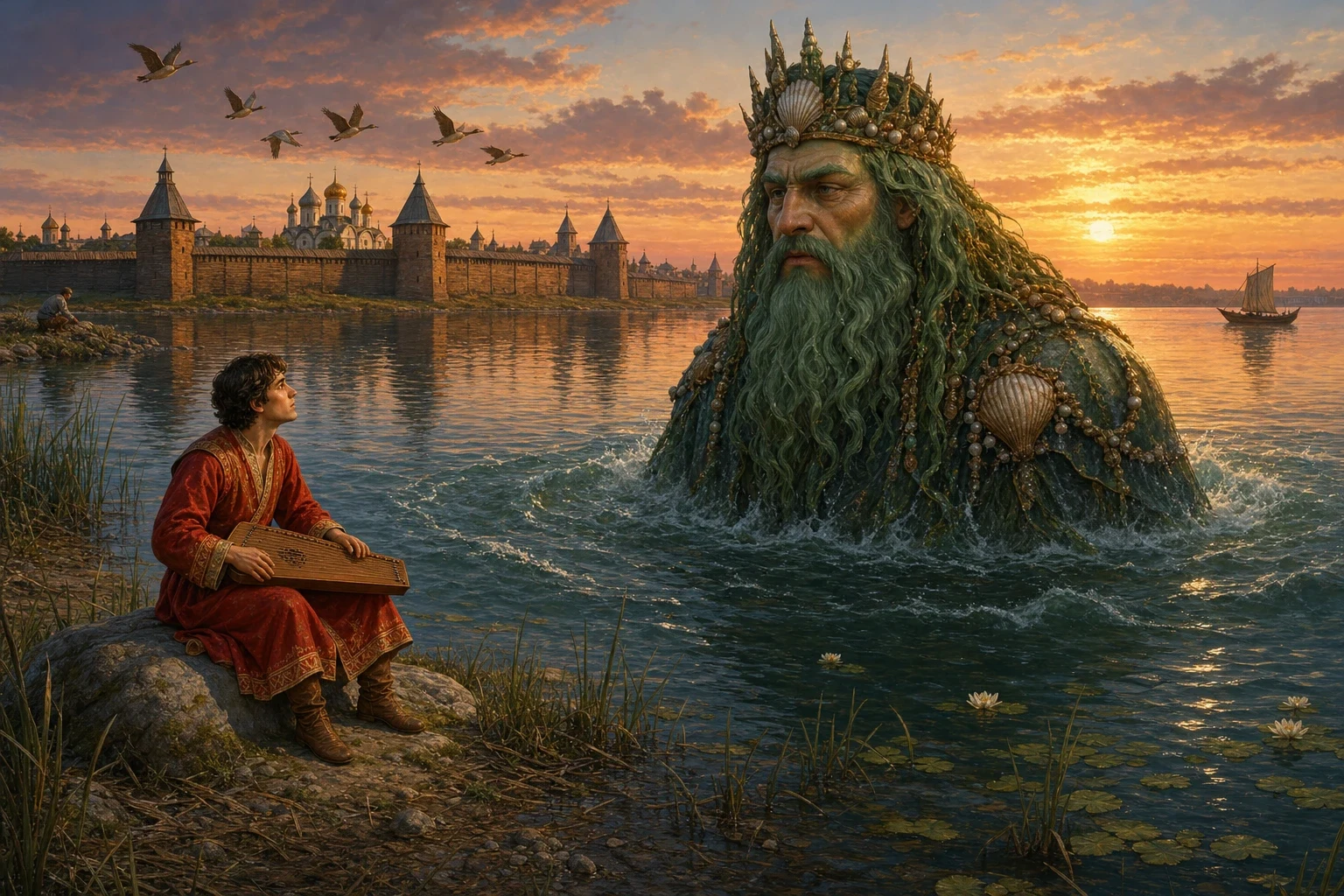
In the great city of Novgorod, there lived a young man named Sadko. He owned nothing but his gusli, a sweet-sounding instrument he played better than anyone. But Sadko was poor, and the rich merchants no longer invited him to play at their feasts. He would go to the shore of Lake Ilmen and play his music for the blue water alone. One evening, as his sad songs drifted over the waves, the water stirred, and the mighty Sea King rose from the depths, his head and shoulders towering over the surface. “Your music has pleased me, Sadko,” the king’s voice boomed like distant thunder. “I will reward you. Go back to Novgorod and make a wager with the merchants.” Sadko stared, clutching his gusli. “What wager, great king?” he asked. “Bet them you can catch fish with fins of gold in this very lake,” said the king, before sinking back beneath the waves.
Page 2

Sadko trusted the Sea King’s words. He walked straight into a grand hall where the richest merchants of Novgorod were feasting. The room was filled with the smell of roasted meats and the sound of loud laughter. Sadko stood before their high table. “Good sirs, I have a proposition,” he announced, his voice clear and strong. The lead merchant, a man with a thick beard and a heavy fur collar, looked down at him. “Speak then, musician. What is it?” Sadko took a deep breath. “Let us make a bet! I wager my own head against all your finest goods that I can catch three fish with fins of gold in Lake Ilmen.” The merchants roared with laughter. “Fish of gold?” scoffed their leader. “You are a fool, Sadko, but we accept your bet. Prepare to lose everything!”
Page 3
The next morning, Sadko cast a silk net into Lake Ilmen and pulled out three small fish with fins of pure, glittering gold. He carried them straight to the bustling city marketplace. A huge crowd had gathered to see the outcome of the wager. Sadko walked through the throng and held up the fish for all to see. A gasp went through the crowd. The merchants stared, their mouths open in disbelief. “It cannot be!” the lead merchant stammered, stepping forward to inspect one of the fish. “But it is! The fins are real gold!” He had no choice but to honor the bet. He turned to his men. “Pay him! Give him the shops, the goods, everything we wagered.” Overnight, Sadko the poor musician became Sadko the rich merchant, owner of thirty shops filled with treasures.
Page 4
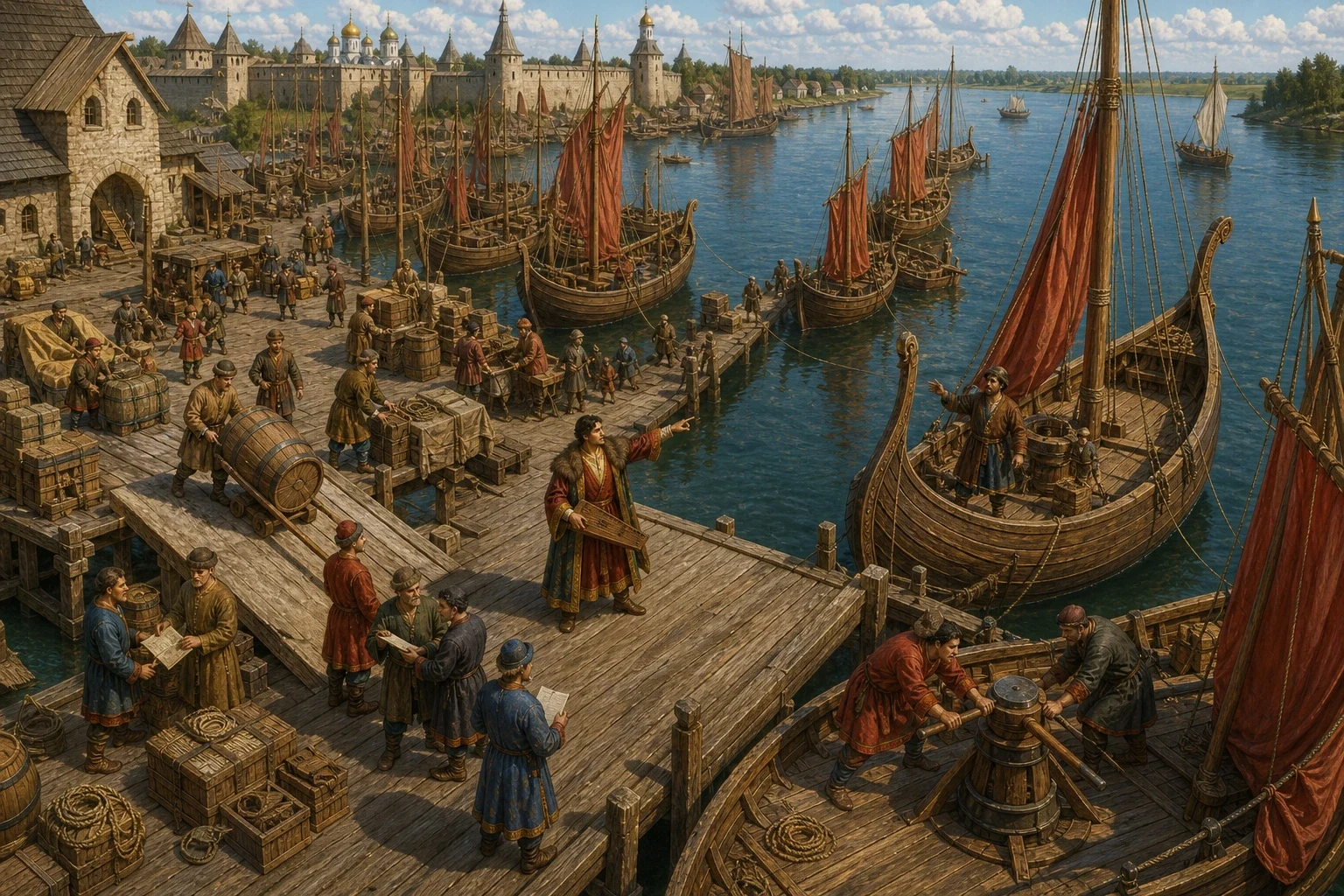
Sadko’s ambition grew with his riches. He was no longer content being the wealthiest merchant in Novgorod; he wanted to see the world. He had a fleet of thirty fine ships built, with high masts and sails of red silk. Now, dressed in robes of fine brocade, he stood proudly on the wooden docks of the Volkhov River, watching his crew make the final preparations. The ships were loaded with honey, furs, and fine Novgorod crafts. “Is everything ready?” he called to his captain. “Aye, Master Sadko! We are ready to sail on your command,” the captain replied, saluting from the deck of the lead ship. “Then raise the anchors!” Sadko commanded. “We sail for foreign lands and greater fortunes!” He planned to be gone for twelve years, trading his goods for even greater treasures.
Page 5
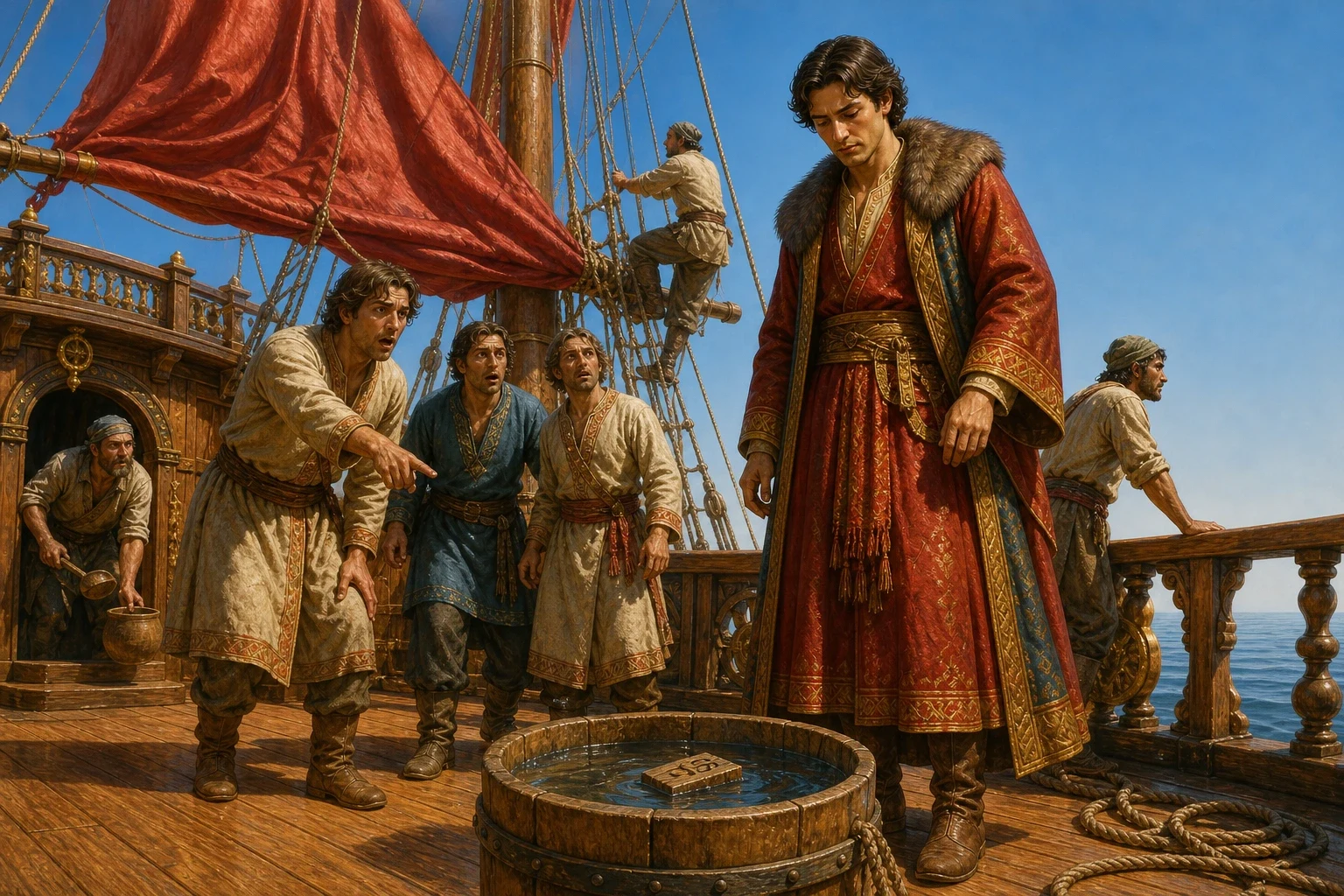
For twelve years, Sadko sailed the world, his fortune growing with every voyage. But on his way home, in the middle of a vast, calm sea, the wind suddenly died. The great red sails went limp, and the thirty ships stopped dead in the water. For days they waited, but not a ripple stirred the glassy surface. The crew grew fearful. “This is unnatural,” an old sailor said. “The Sea King is angry! We have sailed his seas for twelve years and never paid him tribute.” They decided to cast lots to see who the king demanded. Twice they threw barrels of gold and silver overboard, but the ships would not move. On the third lot, a small piece of wood with Sadko’s name on it floated, while all others sank. “The king wants me,” Sadko said quietly. “He gave me my wealth, and I have forgotten him.”
Page 6
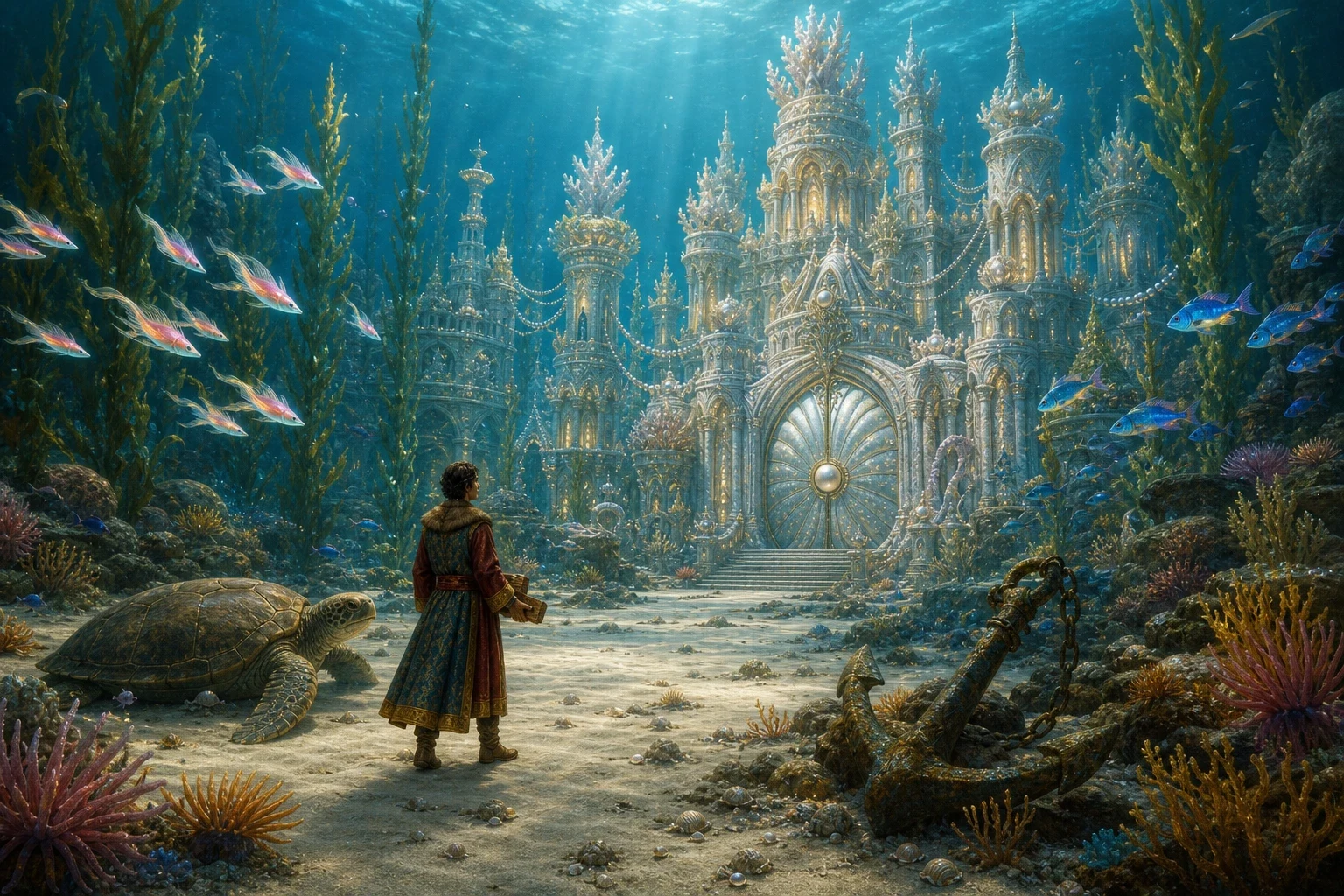
Sadko understood his fate. He took his beloved gusli, said farewell to his men, and lowered himself onto a plank of oak. As soon as he touched the sea, a wind filled his ships' sails and they moved away, leaving him behind. He floated on his plank and fell into a deep sleep. When he awoke, he was sinking gently down, down through the silent green water. He landed softly on the sandy bottom of the sea. There was no sound, only a gentle, perpetual twilight. Strange, glowing plants grew like trees, and fish of every shape and colour swam by. Before him stood a magnificent palace made of white stone and luminous crystal, its towers reaching up into the green gloom. “So this is his kingdom,” Sadko whispered to himself, clutching his gusli. “What does he want of me now?” He took a breath and began to walk toward the palace gates.
Page 7
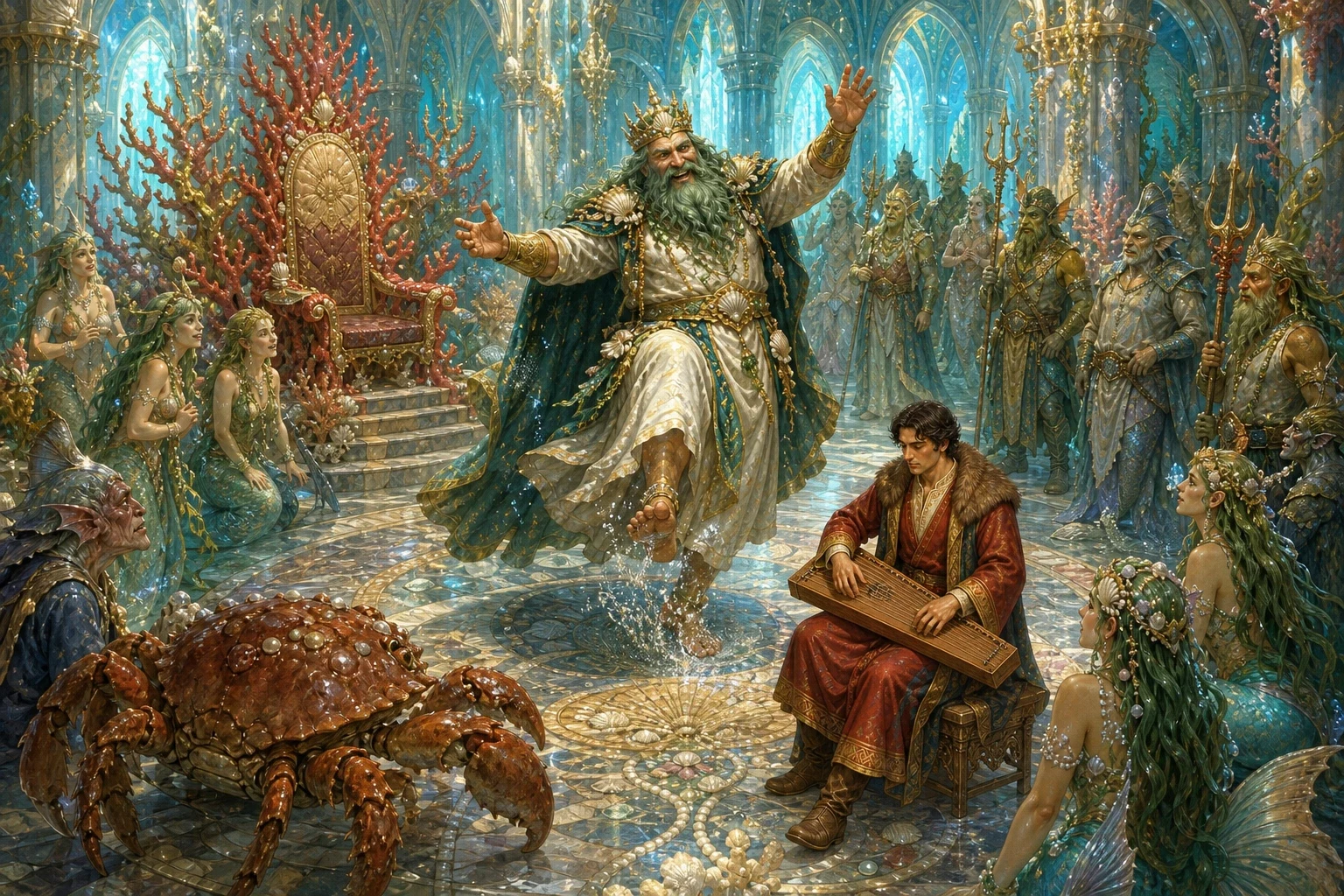
Sadko entered the palace and was led to the Sea King’s throne room. The king sat on a throne of coral, his green beard flowing to the floor. His court of strange sea-creatures and merfolk watched in silence. “Ah, Sadko the musician!” the king boomed. “It has been a long time. You have sailed my seas without paying tribute. Now, you will stay here and play your gusli for me.” Sadko knew he had no choice. He sat on a stool of polished shell and began to play a fast, lively tune. His music was so infectious that the Sea King’s feet began to tap. “Wonderful!” he roared, rising from his throne. “I must dance!” He began to stomp and clap, his huge body moving with surprising speed, and the whole underwater palace began to shake with the force of his joy.
Page 8

The Sea King danced for three days and nights without stopping. On the surface of the sea, his stomping caused terrible storms, tossing ships on huge waves. Sadko grew desperate; he had to stop the music, but he dared not disobey the king. During a brief pause, he slipped away and hid in a quiet grotto. Suddenly, a wise old man with a long white beard appeared before him. “Sadko, your music is wrecking ships and endangering sailors,” the old man said gently. “You must stop this at once.” “But how?” Sadko cried. “The king will be furious!” The old man placed a hand on his shoulder. “Break the strings of your gusli. When the king offers you a bride to make you stay, you must refuse all the beautiful maidens and choose the very last one, the simple girl named Chernavushka. Do exactly as I say, and you will see Novgorod again.”
Page 9

Sadko returned to the throne room and snapped the strings of his gusli. The music stopped. “Why have you stopped?” the Sea King roared, but his anger quickly passed. “No matter. I will forgive you if you marry one of my daughters and stay here forever.” He led Sadko to a grand hall where a long line of beautiful sea-maidens stood waiting. There were nine hundred of them, all dazzling. Sadko remembered the old man’s words. He walked slowly down the line, past maidens with hair like spun gold and eyes like pearls. He walked past them all until he came to the very end. There stood a small, simple maiden with dark hair and a quiet face, dressed in plain clothes. “I choose this one,” Sadko announced, turning to the king. The Sea King looked surprised. “Her? That is only Chernavushka. Very well, the choice is made!”
Page 10
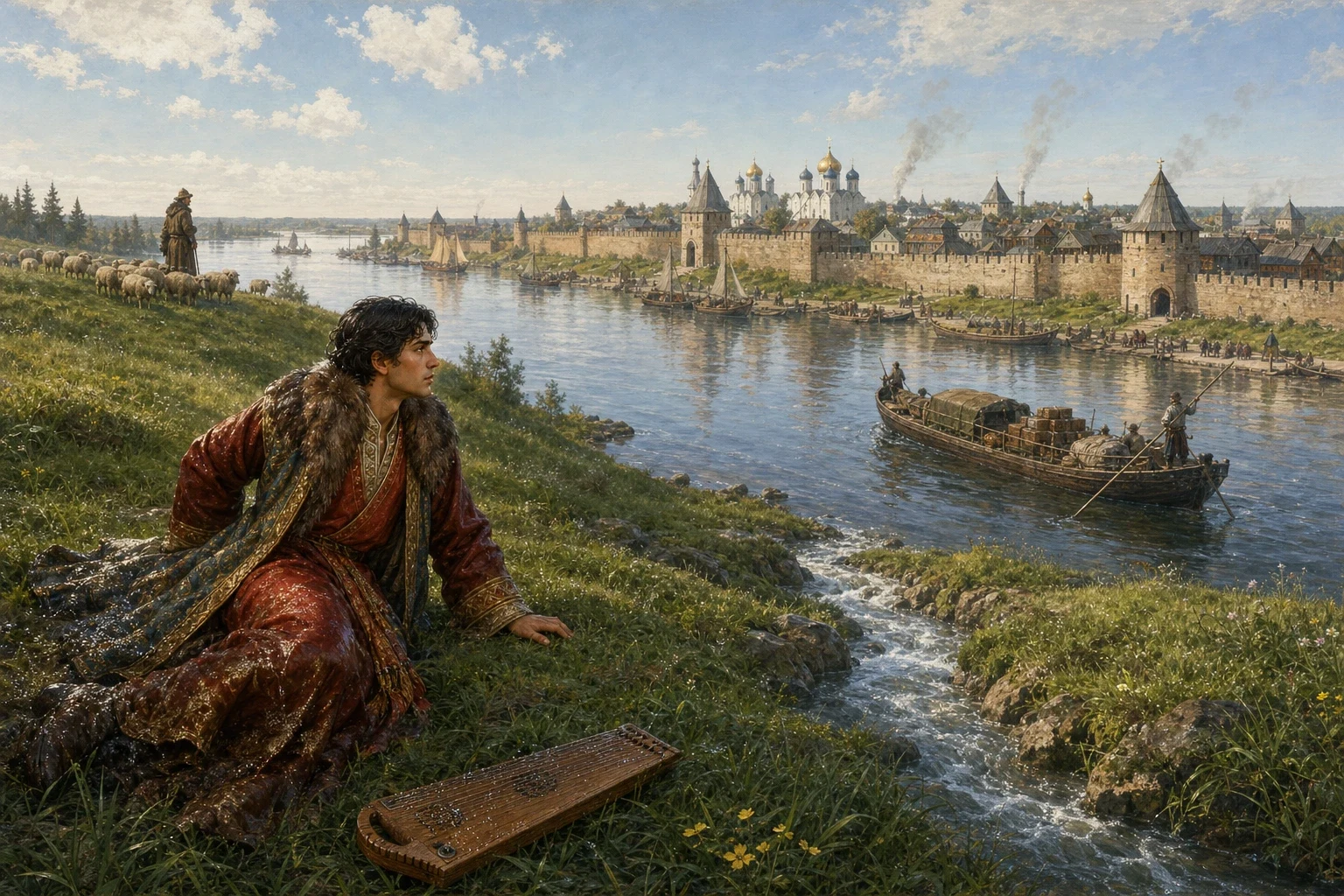
A great wedding feast was held, but Sadko did not eat the sea-food or drink the sea-water. He lay down beside his new bride and fell into a deep, dreamless sleep. When he opened his eyes, he was no longer in the Sea King’s palace. He lay on soft green grass. He felt the warm sun and heard birds singing. He sat up. “Novgorod!” he whispered, his voice full of disbelief. Across the water stood the familiar walls of his beloved city. His rich merchant’s robes were heavy with sea-water, but he was home. His adventure was over. He looked and saw that where there had been only one river, a gentle new stream now flowed into it. “Chernavushka,” he said softly. Sadko stood up, leaving his gusli on the grass. He would not seek fortunes on the sea again; he was content to be a merchant of Novgorod.
About this story
- Audience: kids (ages 6–12)
Read Wonder Tales on your phone
Wonder Tales is available on Android. Get Wonder Tales on Google Play.