American Gothic: Uncovering the Truth Behind Grant Wood’s Icon
Grant Wood's *American Gothic* is one of the most recognizable paintings in American art. But what's the real story behind this iconic artwork and its subjects?
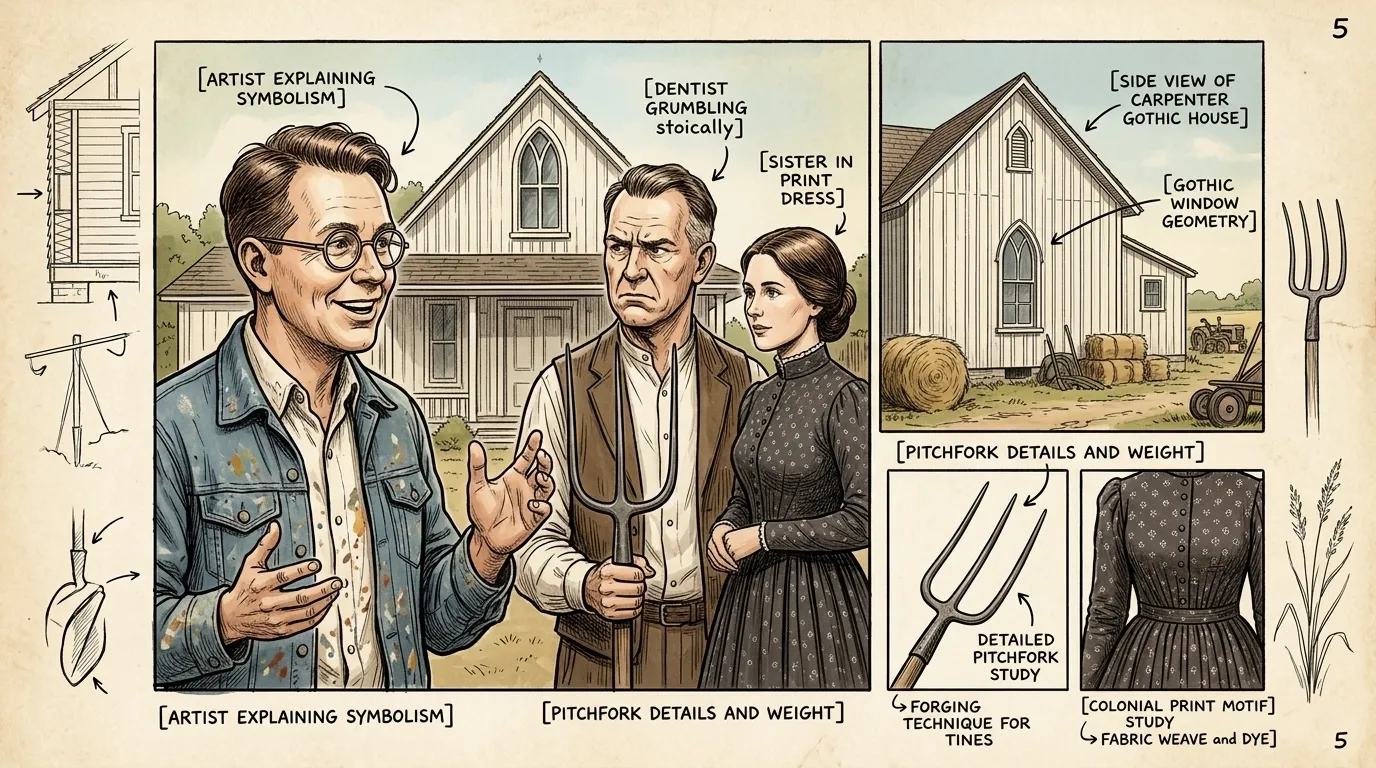
Grant Wood’s American Gothic is an image almost everyone recognizes: a stern-faced man and woman standing before a white house with a distinctive Gothic window. It’s a painting that has become deeply embedded in American culture, often seen as representing the stoicism, resilience, and sometimes the perceived narrow-mindedness of rural America. Many people have strong ideas about the painting’s meaning and the people depicted in it, ideas that have been passed down through popular culture and anecdotes.
- The painting shows a farmer and his wife.
- The models were a real farming couple from Iowa.
- The house in the background is a fictional creation.
- The painting was intended to poke fun at rural life.
Are They a Farmer and His Wife?
This is perhaps the most common misconception. While the man and woman certainly embody the look of hardworking Midwesterners, Grant Wood himself stated that they were not intended to be husband and wife. Instead, he envisioned them as a father and his unmarried daughter. The models for the figures were Wood's sister, Nan Wood Graham, and his dentist, Byron McKeeby. This choice allowed Wood to explore themes of generational connection and the specific dynamics within a family unit rather than a marital one. Understanding this original intent can shift how one interprets the relationship and expressions captured in the painting.
Were the Models a Real Farming Couple?
As mentioned, the models were indeed real people, but they were not a farming couple. Nan Wood Graham was Wood's sister, and Byron McKeeby was his dentist in Cedar Rapids, Iowa. Nan, a spirited woman, posed for the daughter, while Dr. McKeeby, a more reserved individual, provided the face for the father figure. Wood chose them for their distinct features and their ability to convey the solemnity he sought. Neither of them were professional farmers, nor were they a couple in real life. Their involvement highlights Wood's careful casting for his artistic vision. You can explore more about regional American art movements through the collections available in Wonder Arts.
Is the House Real?
The house in the background of American Gothic is very much real. It's a small white house located in Eldon, Iowa. Grant Wood spotted the house in 1930 and was immediately struck by its distinctive Carpenter Gothic style window, which he found both fascinating and somewhat pretentious for such a humble dwelling. He sketched the house on an envelope and knew he wanted to include it in a painting. The house, now known as the American Gothic House, is a popular tourist attraction and is listed on the National Register of Historic Places. Wood did take some artistic liberties, making the window slightly larger and more pronounced, but the core structure is a genuine Iowa landmark.
Was It a Satire of Rural Life?
This belief is a bit more nuanced. When the painting was first exhibited, many Iowans were offended, believing Wood was mocking them. However, Wood consistently denied this. He maintained that he intended the painting as an affirmation of American values, particularly the steadfastness and resilience of rural Midwesterners. He saw the figures as embodying the strength and dignity of people who had endured hard times. While there might be a subtle irony in the juxtaposition of the severe figures with the ornate window, Wood's primary intention was not satire. He sought to capture a particular type of American character and spirit. The controversy around its initial reception, however, shows how art can be interpreted in many ways, sometimes far from the artist's original intent.
I had to go to France to appreciate Iowa.
What to Remember About *American Gothic*
The enduring power of American Gothic lies not just in its iconic imagery, but in its ability to spark conversation and reflection. While many popular beliefs about the painting are not entirely accurate, they speak to its profound impact on the collective imagination. Remembering that the figures are a father and daughter, modeled by Wood’s sister and dentist, and that the house is a real Iowa landmark, helps us appreciate the artist's specific choices. Grant Wood aimed to capture the enduring spirit of the American Midwest, creating a masterpiece that continues to resonate with audiences worldwide. For more insights into how art shapes our understanding of history and culture, you can explore other articles on American art.
Frequently Asked Questions
Where is the original *American Gothic* painting located?
The original American Gothic painting by Grant Wood is housed at the Art Institute of Chicago. It has been a part of their collection since 1930, shortly after its creation and exhibition.
What artistic movement does *American Gothic* belong to?
American Gothic is a prime example of Regionalism, an American art movement of the 1930s. Regionalist artists depicted realistic scenes of rural and small-town America, often with a focus on local themes and a rejection of European modernism.
How large is the *American Gothic* painting?
The painting is relatively modest in size, measuring approximately 29 inches by 24 inches (74.3 cm by 62 cm). Its compact scale contributes to its intimate and focused portrayal of the two figures and the house.