Why Andreas Vesalius’s Discoveries Were Important: Anatomy’s Two Revolutions
Andreas Vesalius revolutionized understanding of human anatomy, challenging centuries of tradition. Discover the two key aspects of his work.
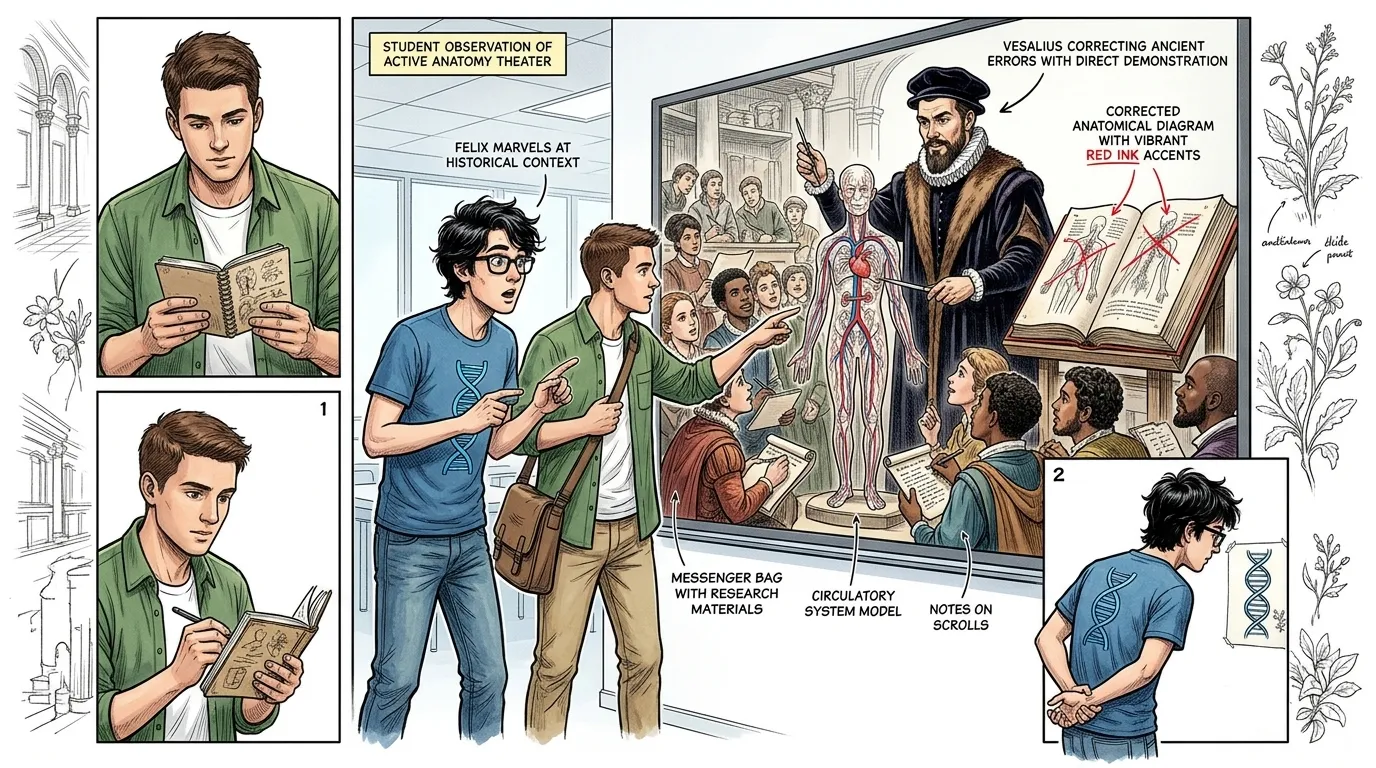
When we look back at the history of medicine, few figures stand as tall as Andreas Vesalius. His work in the 16th century fundamentally reshaped our understanding of the human body. But what exactly made his discoveries so important? The answer lies in two major shifts he introduced: a radical new approach to anatomical study and the fearless challenge he posed to long-held, but incorrect, medical doctrines. These two aspects represent a pivotal moment, moving science from passive acceptance to active, empirical observation.
For over a thousand years, medical teaching was dominated by the writings of Galen, an ancient Greek physician whose work was considered almost infallible. While Galen was brilliant for his time, his anatomical knowledge was largely based on dissecting animals, not humans. This led to many inaccuracies being perpetuated through generations of medical students. Vesalius arrived at a time when anatomical study was often a demonstration, with a barber-surgeon doing the cutting while a professor read from Galen, often without ever touching a cadaver themselves. Vesalius changed this entirely, getting his hands dirty and seeing for himself.
“I have not only restored but also corrected, and indeed I have almost entirely rewritten the science of anatomy.”
The Hands-On Approach: Direct Observation
One of the most important aspects of Vesalius's work was his insistence on direct observation and dissection of human cadavers. He didn't just read Galen; he performed his own dissections, meticulously recording what he saw. This was a groundbreaking shift. Instead of relying on ancient texts, he championed empirical evidence. His magnum opus, De humani corporis fabrica libri septem (On the Fabric of the Human Body in Seven Books), published in 1543, was not just a textbook; it was an atlas of human anatomy based on his own extensive work. The detailed illustrations, often attributed to artists from Titian's workshop, were revolutionary in their accuracy and beauty, allowing students to visualize the body as never before. This emphasis on seeing for oneself laid the foundation for modern scientific inquiry, where observation and experimentation are paramount. You can explore more about the history of scientific methods in our Wonder Science library.
Challenging Authority: Correcting Galen
Perhaps even more important than his method was Vesalius's willingness to challenge the revered authority of Galen. As he dissected human bodies, Vesalius found numerous discrepancies between what Galen described and what he actually observed. For example, Galen believed the human sternum had seven segments, like apes, but Vesalius showed it had three. Galen described a perforated septum in the heart, allowing blood to pass directly between ventricles, a belief Vesalius disproved. These were not minor corrections; they were fundamental challenges to the prevailing medical dogma of his time. This required immense courage, as contradicting such a revered figure could be dangerous. His corrections paved the way for a more accurate understanding of physiology and disease, freeing medicine from ancient errors and setting it on a path of continuous refinement based on verifiable facts. This spirit of inquiry is central to how we learn about history and science today.
When Vesalius's Discoveries Matter Most
- For medical students: When learning human anatomy, Vesalius's emphasis on direct observation underpins modern dissection and imaging techniques.
- For historians of science: His work marks a clear break from medieval scholasticism towards the empirical methods of the scientific revolution.
- For anyone studying critical thinking: Vesalius exemplifies challenging established authority with evidence, rather than blind acceptance.
- For understanding scientific progress: His corrections to Galen show that even brilliant minds can be wrong, and science constantly evolves.
The Enduring Verdict: A Foundation for Modern Medicine
Andreas Vesalius's discoveries were important not just for what he found, but for how he found it. His lasting legacy is twofold: he provided the first truly accurate and comprehensive description of human anatomy, and he established a new standard for scientific inquiry based on direct observation, verification, and a willingness to challenge long-held beliefs. The true importance of his work depends on whether one emphasizes the factual content he corrected or the methodological revolution he initiated. Both are crucial. Without his meticulous dissections and the courage to publish his findings, medicine might have remained shackled to ancient errors for far longer, delaying the advancements that define modern healthcare. He didn't just update a book; he changed how we learn about ourselves.
Frequently Asked Questions
Did Vesalius perform all his dissections legally?
Vesalius obtained bodies through various means, some legal and others less so, reflecting the challenges of anatomical study in his era. He often relied on bodies of executed criminals, but also sometimes resorted to other methods to secure cadavers for his detailed work.
What was the immediate reaction to Vesalius's book?
His book, De fabrica, was met with mixed reactions. While admired for its accuracy and illustrations, it also provoked controversy due to its direct challenges to Galenic authority. Some traditionalists resisted his findings, while others quickly recognized the genius and importance of his work.
How did Vesalius's work influence later anatomists?
Vesalius's work set a new standard for anatomical study and observation. It inspired generations of anatomists to conduct their own dissections, question received wisdom, and build upon his foundations, leading to further discoveries and a deeper understanding of the human body throughout the scientific revolution.