The Battle of Mohács, 1526: How Medieval Hungary Fell
What happened at the Battle of Mohács in 1526? A plain guide to the Ottoman victory, the death of King Louis II and the split of Hungary.
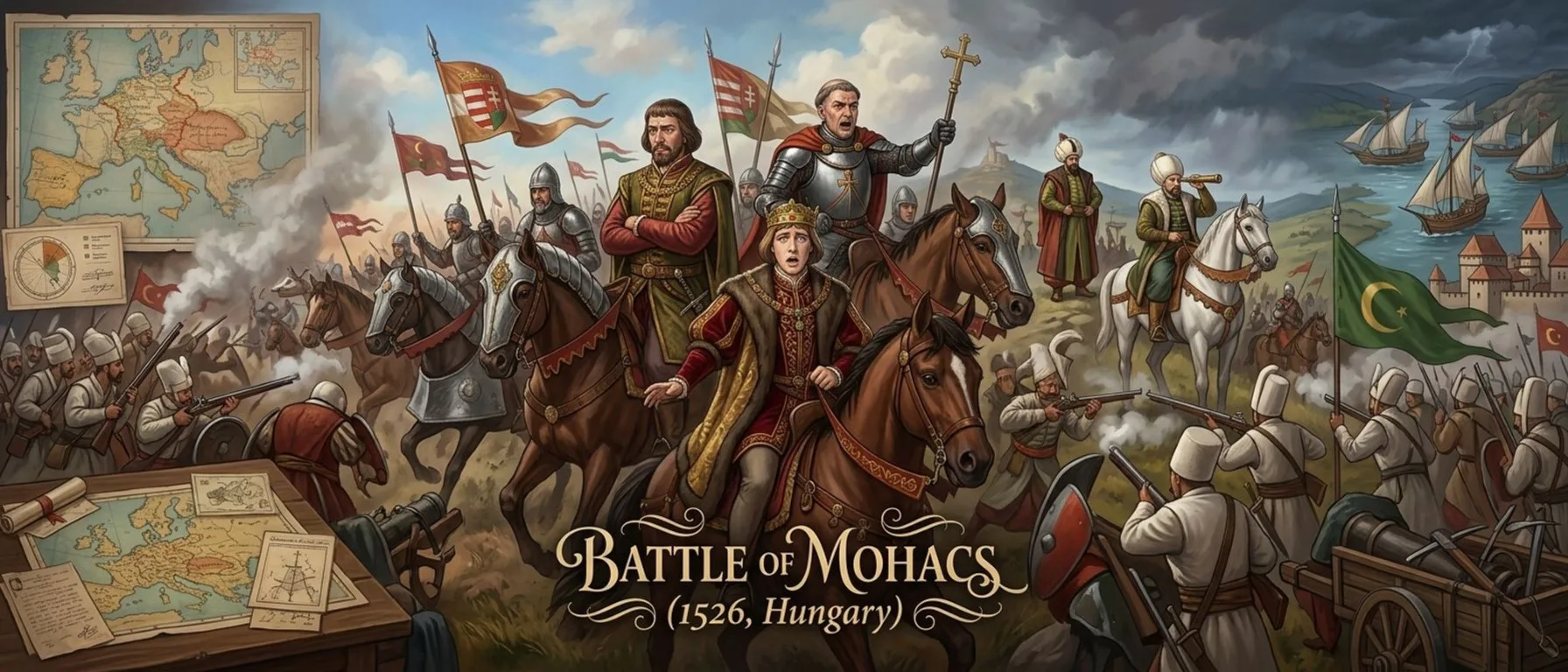
On 29 August 1526, on a plain beside the Danube near the town of Mohács, the army of Sultan Suleiman I destroyed the army of King Louis II of Hungary. The fight lasted about two hours. The king drowned while fleeing, much of Hungary's leadership died, and the medieval kingdom never recovered its old shape. Without this battle, the later map of Central Europe makes little sense.
In the infographic above you will see two kinds of picture. One set of bars compares the estimated armies at Mohács: roughly 25,000 Hungarians against an Ottoman force of at least twice that, though historians' estimates vary widely. Highlighted cards mark four dates: 1389 (Kosovo), 1526 (Mohács), 1541 (Buda taken) and 1699 (the Treaty of Karlowitz). A final pair of figures shows Belgrade, held against the Ottomans in 1456 and lost in 1521. Read the dates below in that order.
- 1389 – Battle of Kosovo: Ottoman power takes root in the Balkans.
- 1444 – Battle of Varna: a crusade fails and King Władysław III dies.
- 1456 – John Hunyadi holds Belgrade against Sultan Mehmed II.
- 1521 – Suleiman captures Belgrade, opening the road north.
- 1526 – Mohács: Louis II dies and the field army is destroyed.
- 1541 – Ottomans take Buda and Hungary splits three ways.
- 1699 – Treaty of Karlowitz ends Ottoman rule over most of Hungary.
Ottoman power in the Balkans, 1389–1521
The Ottomans first broke Serbian forces at Kosovo in 1389, and Hungary soon became the main Christian power facing them. A crusade led by King Sigismund was crushed at Nicopolis in 1396. Constantinople fell in 1453. Hungary's best answer came from the commander John Hunyadi, who won at Belgrade in 1456. That success bought about sixty years. When Suleiman took the throne in 1520, he turned straight to the same fortress, and it fell in 1521. Hungary's southern gate was open.
Hungary before Mohács: a strong crown, a weak state
Hunyadi's son Matthias Corvinus ruled from 1458 to 1490. He kept a paid force, the Black Army, and made Hungary a leading Renaissance court. After his death the nobles chose weaker Jagiellonian kings, first Vladislaus II, then his young son Louis II from 1516. The great lords held land and ignored the crown, and money ran short. In 1514 a crusade turned into a peasant revolt under György Dózsa, and its harsh crushing left the country bitter and divided. This is the weakness that mattered most. Hungary had the men and the pride, but not a government able to use them.
29 August 1526: two hours on the plain
Suleiman marched up the Danube in spring 1526. Louis II, then twenty, gathered what troops he could. The commander was Pál Tomori, Archbishop of Kalocsa. The Hungarians were outnumbered and short of allies, and John Zápolya, the powerful lord of Transylvania, did not arrive with his forces in time. Tomori attacked with heavy cavalry and broke the first Ottoman lines. The Ottoman guns and the Janissaries then held, and the Hungarian army was surrounded. Tomori and many nobles and bishops were killed. Louis fled and drowned in a swollen stream, the Csele. Ottoman troops entered Buda in September, then withdrew. The loss of the king left no one to lead the response.
After Mohács: two kings and a three-way split
Louis had no children. In late 1526 two groups elected rival kings: John Zápolya, and Ferdinand of Habsburg, brother-in-law of Louis and brother of Emperor Charles V. Civil war followed. Suleiman backed Zápolya and besieged Vienna in 1529 without success. After Zápolya's death, the Ottomans took Buda in 1541. Hungary was then divided. The west and north, called Royal Hungary, stayed under the Habsburgs. The centre and south became Ottoman territory. Transylvania became a semi-independent principality under Ottoman overlordship.
Habsburgs and Ottomans: the long contest
The Habsburgs gained the Hungarian and Bohemian crowns, and so a base in Central Europe that lasted until 1918. The Ottomans gained a frontier on the Danube. The war went on for generations. Buda was retaken in 1686, and the Treaty of Karlowitz in 1699 confirmed the Habsburg gains. One caution: the standard story that Mohács ended Hungary is too simple. The kingdom continued, with its own Diet and laws, and some historians argue its decline was already well underway before 1526. Army figures are also estimates, since the sources are thin. For related reading, see the Wonder History library and our wider editorial articles.
WonderBooks is a library of illustrated books, many of them narrated and available in several languages, with one founder directing the writing, the pictures and the narration. That suits a subject like this one, where maps, banners and landscapes carry much of the story. Readers who want to hear the events told aloud can find illustrated, narrated stories on the wars and battles shelf of the Wonder History library.
Frequently Asked Questions
Why did Hungary fight at Mohács without waiting for reinforcements?
Some of the king's advisers wanted to wait for Zápolya's Transylvanian troops and other help. Others feared the Ottomans would plunder the country if no one stopped them. The decision to fight is still debated by historians.
Did the Ottomans occupy Hungary right after the battle?
No. Suleiman took Buda in September 1526 and then withdrew. Lasting Ottoman rule in the centre of the country began only after Buda fell in 1541.
Who was Suleiman the Magnificent?
Suleiman I ruled the Ottoman Empire from 1520 to 1566. He is known for his conquests, including Belgrade and much of Hungary, and for reforming Ottoman law. He died in 1566 during the siege of Szigetvár in Hungary.
Is Mohács still remembered in Hungary today?
Yes. There is a national memorial site near Mohács, and Hungarians have long used the battle as a symbol of national loss. A well-known saying about 'more was lost at Mohács' recalls this.