Why Did the Battle of Talas Happen? The Tang Dynasty's Western Expansion
The Battle of Talas in 751 CE marked a clash between two rising empires. Discover why this pivotal event occurred.
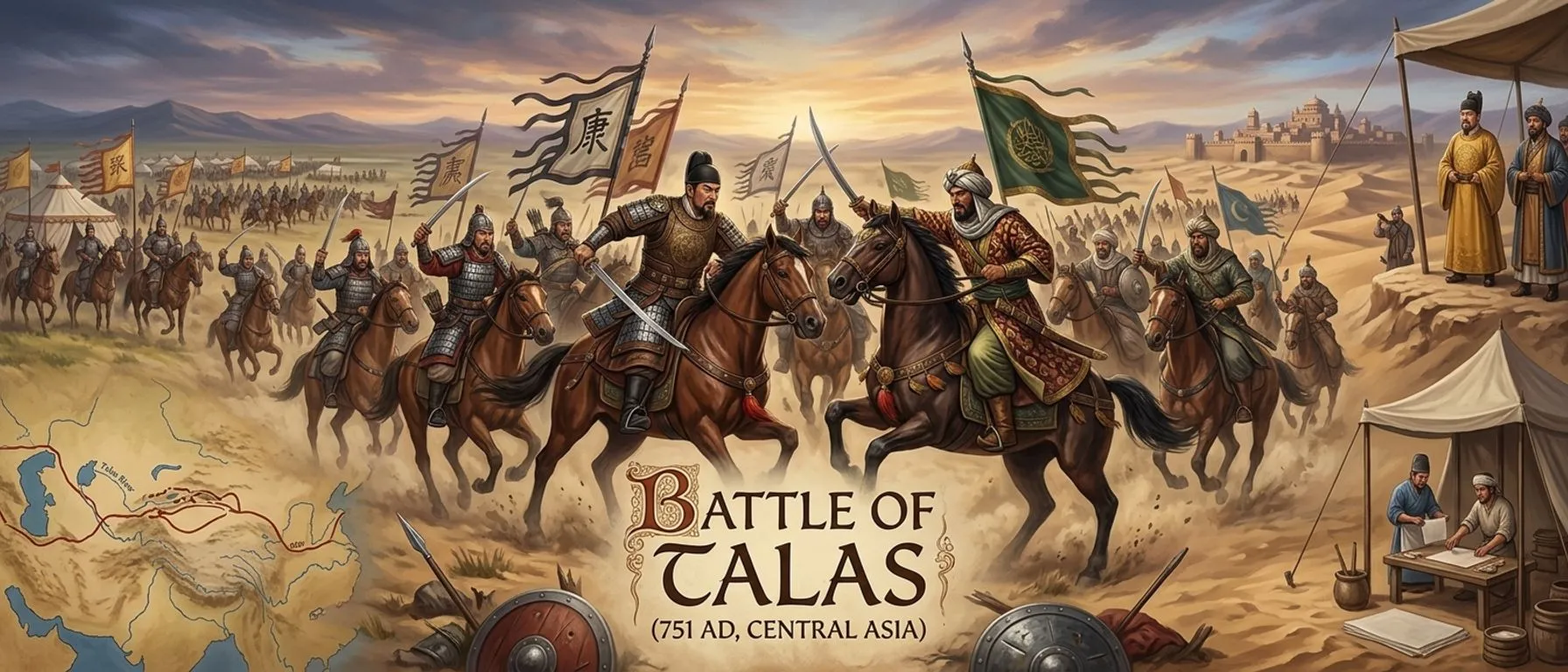
The year 751 CE saw a clash of empires on the banks of the Talas River, a confrontation often remembered for its impact on technology, particularly papermaking. But before we consider its long-term effects, we must understand the immediate cause: the Tang Dynasty's aggressive westward expansion into Central Asia, which directly challenged the growing influence of the Abbasid Caliphate. This article explores the precise reasons why these two great powers met on the battlefield.
At its heart, the Battle of Talas was not a sudden, isolated incident, but the culmination of decades of strategic maneuvering and territorial disputes. Both the Tang Dynasty and the newly established Abbasid Caliphate viewed control over the lucrative trade routes of the Silk Road as crucial for their economic and political dominance. The specific spark for the battle was a request for aid from a local Central Asian kingdom, drawing the Tang deeper into a region the Abbasids also coveted.
Who Were the Key Players in the Talas Conflict?
On one side stood the mighty Tang Dynasty, at the peak of its power and influence. Led by General Gao Xianzhi, the Tang forces were well-trained and had a history of successfully extending Chinese control over various Central Asian states. Their motivation was clear: to secure the western borders of the empire and ensure the continued flow of goods and tribute from the region. The Tang had already established several protectorates and garrisons across the Tarim Basin, pushing their influence further west with each campaign. For more on the Tang Dynasty's rise, explore the resources available at Wonder History.
What Was the Strategic Importance of Central Asia?
Central Asia, often referred to as Transoxiana, was far more than just a collection of small kingdoms. It was a vital crossroads, connecting China to Persia, India, and the Mediterranean world. The Silk Road, a network of trade routes, passed directly through this region, carrying not only silk but also spices, precious metals, and crucially, ideas and technologies. For both the Tang and the Abbasids, controlling these routes meant immense wealth and strategic advantage. The local rulers, caught between these two giants, often played one against the other, leading to a volatile political landscape. The Tang had been particularly active in consolidating their power by installing pro-Tang rulers and demanding tribute, actions that inevitably brought them into conflict with other emerging powers.
How Did the Abbasid Caliphate Become Involved?
The Abbasid Caliphate, which had recently overthrown the Umayyad Caliphate in 750 CE, was also keen to expand its influence eastward. They saw the Tang's incursions into Central Asia as a direct threat to their own burgeoning empire. The immediate catalyst for Abbasid involvement was the Tang's siege of Talas, a city that was nominally allied with the Abbasids or at least within their sphere of influence. When the ruler of Tashkent, a city that had been attacked by Gao Xianzhi, appealed to the Abbasids for help, it provided the perfect opportunity for the Caliphate to assert its authority and check Tang expansion. The Abbasid army, under Ziyad ibn Salih, marched to meet the Tang forces, leading to the fateful confrontation near the Talas River.
The Talas River: A Turning Point for East and West
The Battle of Talas, though often seen as a decisive military defeat for the Tang, represents something larger than a single battle. It marked the effective end of large-scale Chinese military expansion westward for centuries and firmly established Islamic influence in Central Asia. More famously, captured Chinese artisans are said to have introduced papermaking technology to the Islamic world, which then spread to Europe. This single detail — the transfer of a crucial technology — highlights how seemingly localized conflicts can have profound, long-lasting global consequences. The clash of empires over control of a remote region ultimately reshaped the cultural and technological landscape of the medieval world, proving that even minor historical events can echo through time. You can find more articles on historical turning points at our articles page.
Frequently Asked Questions
Did the Battle of Talas truly stop Chinese expansion?
While the Tang Dynasty continued to exert influence in some parts of Central Asia, the defeat at Talas significantly curtailed their aggressive westward military expansion. It marked a practical limit to their imperial reach, allowing Islamic culture and power to solidify in the region for centuries to come.
What happened to General Gao Xianzhi after the battle?
General Gao Xianzhi was initially blamed for the defeat but continued to serve the Tang Dynasty. He was later involved in suppressing the An Lushan Rebellion, a massive internal uprising that further weakened the Tang Empire and shifted its focus away from Central Asian ambitions.
Was the transfer of papermaking the only technological exchange?
Papermaking is the most well-known technological transfer attributed to the Battle of Talas, but it likely facilitated other cultural and technological exchanges as well. The constant interaction, even through conflict, between these two great civilizations led to a broader sharing of knowledge, although papermaking remains the most documented and impactful.