Can One Founder Do the Work of 443 People?
A real comparison, ten years apart: a 2016 idea nobody would fund is now a 2,341-book library — priced at $12.87M and 443 people against what AI actually did.
Before building anything, we priced it at $12.87 million.
Every number below was known in advance, roughly — the way anyone who has hired a studio knows roughly what a studio costs. This is that estimate, written out properly: role by role, against a real catalogue, at salaries chosen to be realistic rather than flattering.
We're publishing it because the comparison is unusual enough to be useful to other people — not "AI can write a paragraph," but what happens when one person directs AI across every job a publishing company actually needs: engineering, art, translation, narration, marketing, support. Long enough to produce a real library of 2,341 illustrated books. What a staffed equivalent would cost is below. What was actually spent to get here stays private, the way most companies don't publish their payroll.
A 2016 prototype hit 100,000 downloads — and still couldn't get funded.
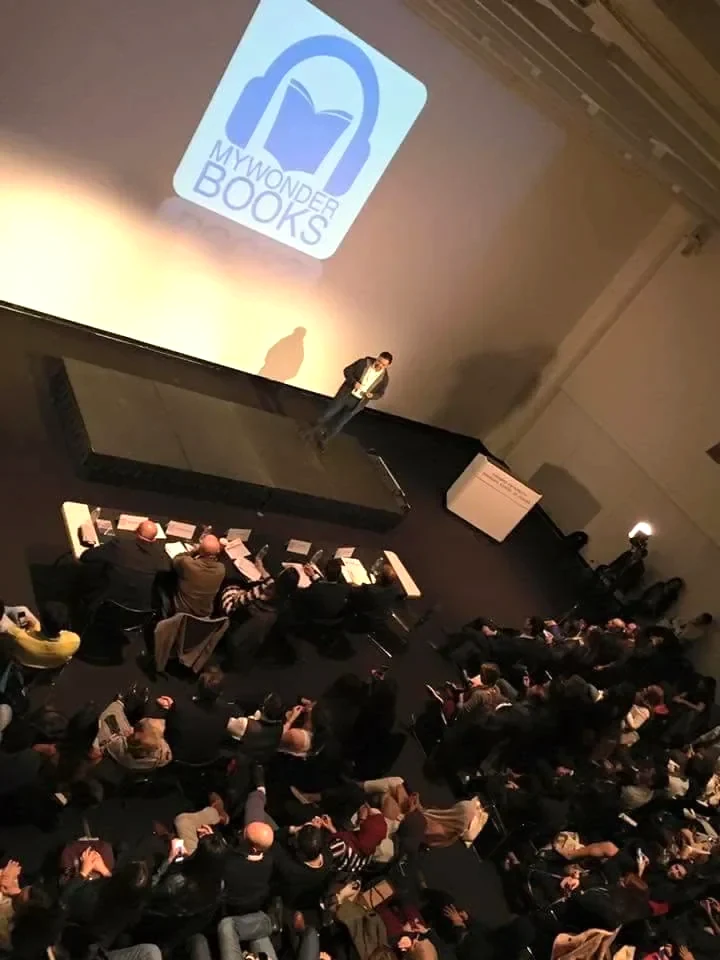
This isn't the first attempt at the idea. It's the second half of one. In 2016, an earlier version — My Wonder Books, eighteen stories, built without a studio or a budget — was picked to pitch at Harvard, top ten of more than 150 startups. It found real readers on its own: that app is still live on Google Play today, holding 4.5 stars across 976 reviews and over 100,000 downloads, earned with no marketing budget, no agency and no team.
What stopped it wasn't demand. It was execution — producing illustrated books by hand, at the rate a real catalogue needs, cost more than one person could carry alone. The idea sat proven and unscaled for years: not abandoned, paused by cost, waiting for a way to build it that an individual could actually run. That way arrived. What follows is what it replaced.
Running a publisher like this takes about thirty separate jobs.
A publishing company this size runs on roughly thirty distinct jobs. Before pricing anyone, here is what actually has to get done — the same list whether a founder directs AI through it or a staff is hired to do it by hand.
Platform — building and shipping the apps
- Web reader and admin console — React/TypeScript, nine library shells
- Shared mobile app — one React Native codebase powering twelve iOS and twelve Android builds
- iOS build, signing and App Store submission, plus Apple TV, Vision Pro, Watch and Mac targets
- Android build, signing and Play Console submission, plus Android TV and Wear OS
- Cloud backend — database, auth, storage, functions — and release infrastructure
- Quality assurance across twelve apps, two platforms, thirteen languages
- Security review and credential management
Content — writing, drawing, translating, voicing
- Story writing and historical or factual research, book by book
- Illustration — one finished painting per page, continuity kept per character and per book
- Art direction holding a distinct visual style across twelve libraries
- Translation into thirteen languages
- Narration recorded in fifteen languages, synced to text
- Audio editing and post-production
- Quality review on every one of the above
Growth — getting the books in front of readers
- Brand and visual identity — icon sets, colour systems, store art, for twelve libraries
- Store listing copy and screenshots, localised, for twenty-four apps
- Search optimisation — per-language sitemaps, structured data, crawlable pages
- Paid acquisition campaigns across twelve libraries and dozens of markets
- Social content, calendars and creative
- Press and partnership outreach
- Analytics and growth reporting
Operations — running the business underneath it
- Reader support — reviews, support inbox, feedback, in thirteen languages
- App-store policy compliance and review responses
- Project coordination across every lane above
- Finance, billing and cost control
- Recruiting and managing a production floor of this size
443 people. $12.87 million a year. That is the staff this takes.
Salaries below are deliberately mid-market, not cheap: the kind of pay you'd offer a competent remote hire in a lower-cost European market — Poland, for this exercise — rather than either a bargain rate or a San Francisco one. Nobody on this roster is underpaid for where they're based.
Content roles are sized by actual throughput: an illustrator finishing ten paintings a month, a translator covering roughly 50,000 words a month, a narrator recording and editing about forty finished minutes a day — applied against the real catalogue of 29,179 pages and roughly 5.25 million words across thirteen languages. Platform and growth roles are sized the way a real company staffs them: one of each, because that work doesn't scale with the number of books.
Platform, engineering and brand — $379,000/year, 9.5 people
- Product lead — 1 at $45,000/year
- Senior web engineer (reader app, nine shells, admin console) — 1 at $48,000/year
- Mobile engineer, shared app — 1 at $45,000/year
- iOS platform engineer (builds, store, TV/Vision/Watch/Mac) — 1 at $42,000/year
- Android platform engineer (builds, store, TV, Wear OS) — 1 at $40,000/year
- Cloud and backend engineer — 1 at $44,000/year
- QA engineer — 1 at $30,000/year
- Brand and UI/UX designer — 1 at $32,000/year
- SEO and technical content engineer — 1 at $36,000/year
- Security analyst, half-time — 0.5 at $34,000/year ($17,000)
Growth and operations — $306,000/year, 10 people
- Data and growth analyst — 1 at $34,000/year
- Marketing lead — 1 at $38,000/year
- Performance / ads specialist — 1 at $34,000/year
- Social media and content manager — 1 at $28,000/year
- Press and partnerships specialist — 1 at $32,000/year
- Reader support specialist, 13 languages — 1 at $24,000/year
- Store compliance and submissions manager — 1 at $30,000/year
- Delivery / project coordinator — 1 at $30,000/year
- Finance and accounting admin — 1 at $28,000/year
- Workforce / HR coordinator — 1 at $28,000/year
Illustration — $5,658,000/year, 255 people
29,179 painted pages, at ten finished paintings per artist per month.
- Illustrators — 243 at $22,000/year each — $5,346,000/year
- Art directors, style continuity across 12 libraries — 6 at $30,000/year — $180,000/year
- Illustration continuity reviewers — 6 at $22,000/year — $132,000/year
Writing and story — $524,000/year, 19 people
Roughly 5.25 million English words across 2,341 books.
- Writers and researchers — 15 at $28,000/year — $420,000/year
- Fact-checking editors — 4 at $26,000/year — $104,000/year
Translation — $3,090,000/year, 120 people
Thirteen languages, at roughly 50,000 words per translator per month.
- Translators — 105 at $26,000/year each — $2,730,000/year
- Translation proofreaders — 15 at $24,000/year — $360,000/year
Narration — $768,000/year, 29 people
Fifteen languages, at roughly forty finished minutes per narrator per day.
- Narrators and voice talent — 19 at $28,000/year — $532,000/year
- Audio engineers — 4 at $26,000/year — $104,000/year
- Narration quality reviewers — 6 at $22,000/year — $132,000/year
Base payroll, one year: 442.5 people, $10,725,000. Add benefits, equipment, recruiting and management overhead at 20% — $2,145,000 — and the total for the first year alone is $12,870,000, for a staff of roughly 443 people.
Method: headcounts are production volume divided by quota per worker per year, assuming twelve working months and no ramp-up or attrition — a real staffed studio would likely need both, which makes this a floor, not a ceiling. Salary figures are 2026 mid-market averages for remote Poland-based hires in each discipline, drawn from public salary aggregators and Polish industry rate guides for translation and voice work, rounded to the nearest thousand. Platform, brand and operations roles are priced at one full-time hire each, since that work scales with the business, not with catalogue size. This is a modelling exercise, not an audited study — built to be directionally honest about its assumptions, not accurate to the decimal.
Put another way: $5,500 for every finished, illustrated, translated and narrated book, staffed the conventional way. $441 for every painted page — the actual unit this whole catalogue is built from.
One person did all 443 of those jobs.
Every job on that roster still had to happen — nobody skipped research, continuity, translation accuracy or narration quality to get here. What changed is who did the work: one person, directing AI tools through each of those thirty jobs, in roughly the time a single department above would have needed for its own slice alone.
The actual production cost behind these twelve libraries stays private — the same way most companies don't publish their payroll. What's public is the comparison: the ledger above is what the conventional version costs. The one that actually built this library cost nowhere near it.
20-plus years of experience is the part AI didn't replace.
One thing is worth being precise about, because it's the part of this story people most often get wrong: this wasn't someone new to any of these jobs, with AI filling in the gaps. Every discipline on the ledger above — building a website, standing up hosting and infrastructure, running ad campaigns, reading analytics, writing, directing a visual style, telling a story well — had already been worked, directly, across a career, long before any of it was handed to AI. Storytelling specifically came by way of studying filmmaking.
AI did not supply the judgment about what the work should look like, or notice when a result was merely adequate instead of right. It executed — fast, and at almost no marginal cost — on judgment that already existed. Pointed at the same tools, someone without that background gets what any beginner gets: the median answer, competently spelled. Getting something better than that still takes knowing, in detail, what better looks like — and that part doesn't get smaller as the staff does.
443 jobs that were never going to be funded anyway.
It's worth sitting with the uncomfortable number in the middle of this piece rather than skipping past it: 443 people's worth of work, done by one. No honest version of this story pretends that's a small thing.
But it's also worth saying plainly what the realistic alternative was. No one funds a 443-person, twelve-month payroll for an unproven idea with no revenue — the earlier, hand-built version of this same library proved exactly that in 2016, and it took years before any workable path forward existed at all. This isn't a staff that lost a job to AI. It's a library that would not exist, for anyone, without this exact combination: one person's accumulated judgment, built up across a career, and what AI tools can now execute at scale. What happens to the work those 443 roles represent is the real question this era raises — and the honest answer looks less like work disappearing than like it moving, toward whoever brings the judgment, the taste and the creativity that AI still cannot supply on its own.
More books was never the goal. Better ones are.
None of this is about the numbers, and it was never meant to be. More books are always coming, but what's actually happening right now, book by book, is improvement: stronger story structure, deeper characters, illustration that keeps getting closer to what a scene actually deserves. AI is what makes doing that continuously, at this scale, possible — it isn't the point of it. The point is quality, getting better on purpose, not a count going up.
The clearest signal for what to improve comes from readers themselves: a language that's missing, a translation that doesn't read naturally, a kind of book people keep asking for. Every piece of that feedback becomes part of what gets built next — readers aren't just finding this library, they're shaping where it goes.
The next real step, already underway in intent, is a new wave of books held to a noticeably higher standard in both story and illustration — including bringing some of these pages to life as animation. Same founder, same process, now pointed at quality rather than scale.