Don Quixote: More Than Just Windmills
Don Quixote is famous for many reasons, but not all common beliefs about the knight-errant are entirely accurate. We explore his enduring legacy.
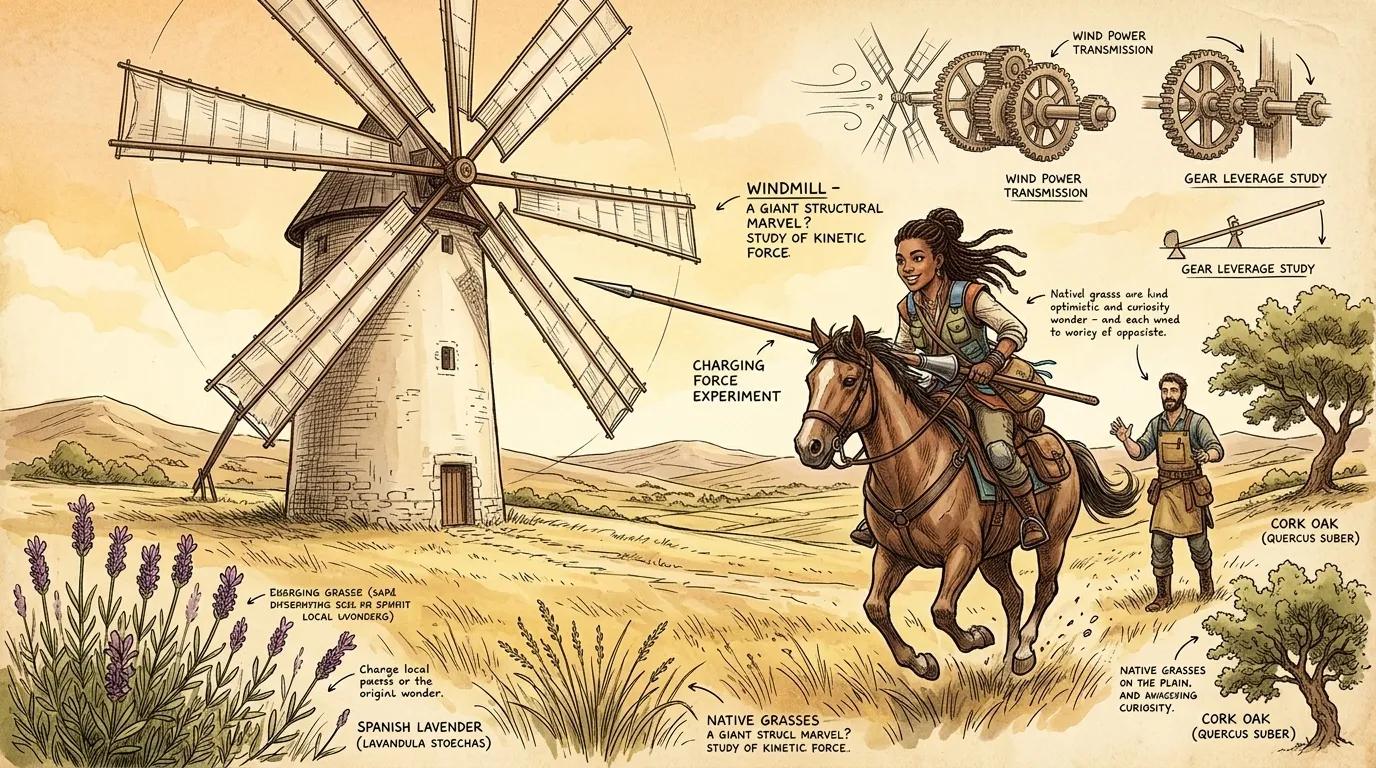
Most people know Don Quixote as the story of a deluded old man who fights windmills, mistaking them for giants. This image is so strong that "tilting at windmills" has become a common phrase for fighting imaginary enemies. But the novel by Miguel de Cervantes is far richer and more complex than this single, famous scene suggests. Its enduring fame comes from many layers of meaning, humor, and insight into human nature that have resonated across centuries and cultures.
The novel's lasting impact is often attributed to a few key ideas. These popular notions capture parts of the story, but the full truth of Don Quixote's fame is a bit more nuanced. Let's look at some of these common beliefs.
- It's famous because it's a funny story about a madman.
- It's famous for inventing the modern novel.
- It's famous because it's a critique of chivalric romances.
- It's famous because Don Quixote is an inspiring idealist.
When life itself seems lunatic, who knows where madness lies? Perhaps to be too practical is madness. To surrender dreams — this may be madness. Too much sanity may be madness — and the maddest of all: to see life as it is, and not as it should be!
A Funny Story About a Madman
It is certainly true that Don Quixote is a very funny book. Cervantes uses slapstick, wordplay, and situational irony to great effect. Don Quixote's misadventures, driven by his warped perception of reality, often lead to hilarious outcomes. His squire, Sancho Panza, provides a down-to-earth contrast, making their exchanges a source of much humor. The novel's humor was a major reason for its immediate popularity. Readers in Cervantes' time found the antics of the knight and his squire endlessly entertaining. This comedic element remains a strong draw today. However, the novel's fame goes beyond mere entertainment. The humor often serves to highlight deeper philosophical questions about reality, illusion, and the nature of storytelling itself. You can find many stories that use humor to explore big ideas, even in Wonder Novels.
Inventing the Modern Novel
This belief is largely supported by literary historians. Don Quixote is often cited as the first modern novel for several reasons. It features a complex, developing protagonist whose internal thoughts and motivations are central to the story. Unlike earlier epics or romances, Don Quixote's character changes and grows through his experiences. The novel also uses realistic dialogue, social commentary, and a blend of different narrative styles. It consciously plays with the idea of authorship and storytelling, even including a meta-narrative where characters discuss the first part of the book. These innovations moved literature away from purely fantastical tales and towards explorations of individual psychology and social realities, setting a new standard for narrative fiction. Its influence on subsequent writers, from Fielding to Flaubert and beyond, is undeniable.
A Critique of Chivalric Romances
This is another belief that holds a lot of truth. In Cervantes' era, chivalric romances—tales of knights, dragons, and damsels in distress—were immensely popular. Cervantes himself stated his intention was to satirize these books, which he believed promoted unrealistic ideals and corrupted readers' minds. Don Quixote's madness stems directly from reading too many of these romances. His attempts to live out their fantastical scenarios in the real world lead to absurd and often painful results, effectively mocking the genre's conventions. By showing the disconnect between the idealized world of chivalry and the gritty reality of 17th-century Spain, Cervantes delivered a powerful critique. Yet, the novel is not just a parody; it also explores the human need for ideals and adventure, even if misguided. You can read more about literary movements and their critiques in articles like those found at articles.
Don Quixote as an Inspiring Idealist
While Don Quixote's actions are often absurd, many readers find his unwavering commitment to his ideals, however deluded, to be inspiring. He seeks to right wrongs, protect the innocent, and uphold justice in a world he perceives as needing a hero. This idealism, even in the face of constant failure and ridicule, resonates with people who dream of making the world a better place. He embodies a kind of noble madness, a refusal to accept the world as it is, choosing instead to shape it according to his own heroic vision. This aspect has contributed significantly to his fame, turning him from a mere caricature into a symbol of aspiration and the power of imagination, even when it veers into delusion. His journey highlights the complex relationship between idealism and reality.
What to Remember About Don Quixote
Don Quixote's fame isn't just about fighting windmills. It stems from its groundbreaking literary form, its sharp satire of popular culture, and its profound exploration of human nature. Cervantes masterfully combined humor, philosophy, and a new way of telling stories, creating a character who is both ridiculous and deeply moving. He remains famous because he asks us to consider what is real, what is ideal, and what it means to live with conviction, even when the world calls you mad.
Frequently Asked Questions
What does "tilting at windmills" mean?
The phrase "tilting at windmills" means attacking imaginary enemies or fighting battles that are based on delusion rather than reality. It comes from the scene in Don Quixote where the protagonist mistakes windmills for giants and charges at them with his lance.
Was Miguel de Cervantes a knight himself?
No, Miguel de Cervantes was not a knight. He was a soldier who fought in the Battle of Lepanto, where he was wounded, and later worked in various administrative roles. His experiences in life, including imprisonment, deeply influenced his writing.
Is *Don Quixote* a long book to read?
Don Quixote is generally considered a long book, often published in two volumes. Its length and the language of its time can be challenging for some modern readers, but many find its humor and depth rewarding.