Free illustrated stories for ages 6 to 8: a map of the kinds
Fairy tales, fables, myths and adventures: a guide to free illustrated stories for children aged 6 to 8, and how to choose and share them.
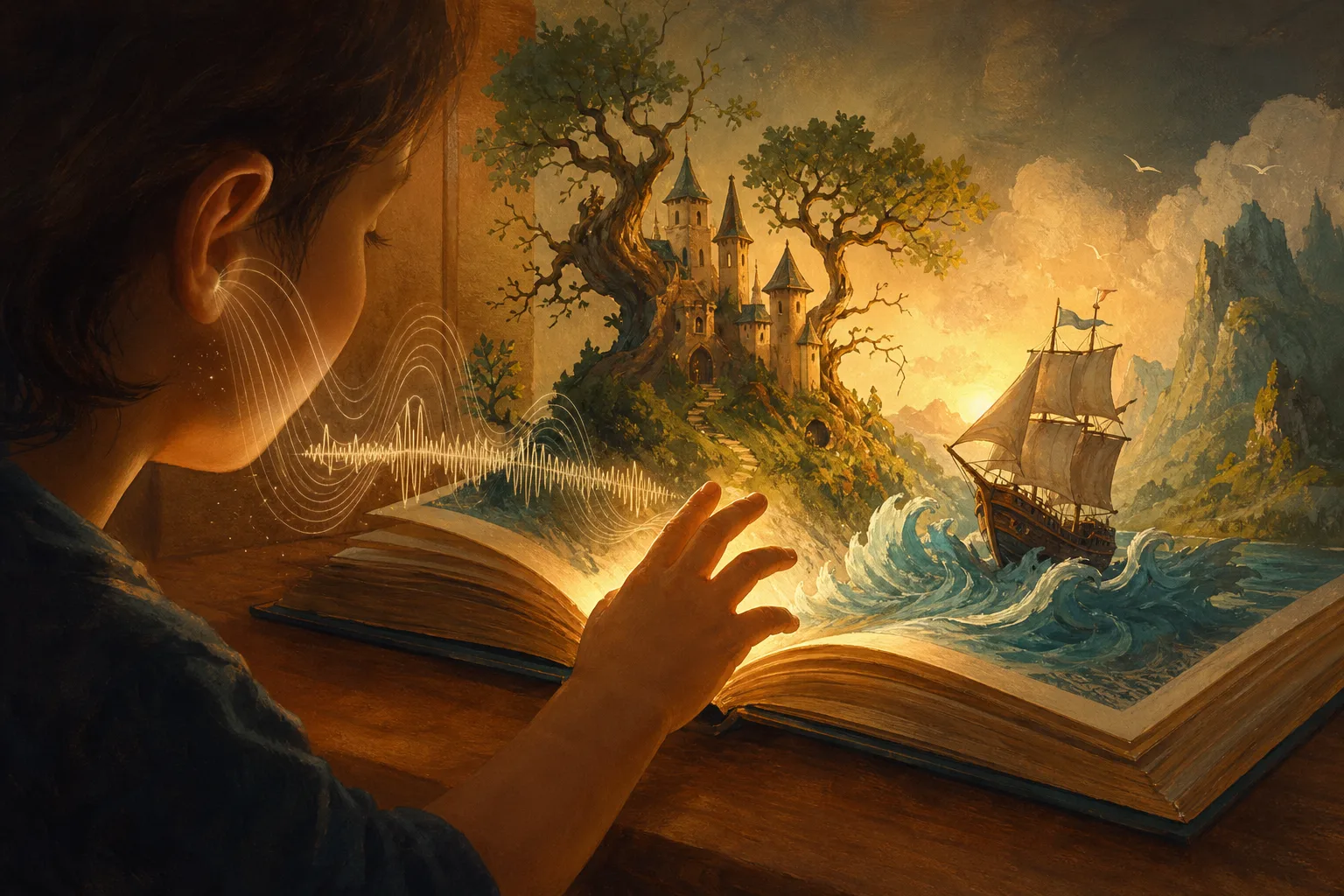
Children aged 6 to 8 sit in a gap. They can decode words, but their ears are still far ahead of their eyes. The best-known stories for them, such as the fairy tales of the Brothers Grimm, were never written in easy-reader language. What suits this age is a short chapter or a single sitting, a clear plot with a beginning, a problem and an ending, pictures that carry part of the meaning, and sentences with a rhythm that sounds good aloud. Hearing a story read, or narrated, lets a child enjoy richer language than they could manage alone, and that builds vocabulary for the day they read it themselves.
In the infographic above you will see three groups of figures. One pair of bars compares the share of US fourth-graders at or above proficient in reading, 35% in 2019 and 33% in 2022. A second pair compares the number of tales in the Grimms' first volume with their final edition, 86 and 200. A highlighted card gives UNESCO's estimate that 40% of people worldwide lack education in a language they speak or understand. The figures are real, and each one is explained below.
- Charles Perrault, Histoires ou contes du temps passé (1697): the short, polished fairy tale.
- Brothers Grimm, Children's and Household Tales (1812 to 1857): the big folk-and-fairy collection.
- Hans Christian Andersen (from 1835): the author-made tale, tender and sometimes sad.
- Aesop's fables and the Panchatantra: tiny animal stories with a point.
- Greek myths and the Arabian Nights: gods, monsters and clever heroes.
- Robert Louis Stevenson, Treasure Island (1883), and Kenneth Grahame, The Wind in the Willows (1908): longer adventure, best read aloud first.
Fairy tales: Perrault, the Grimms and Andersen
Charles Perrault published eight tales in France in 1697, including Cinderella, Puss in Boots and Sleeping Beauty. They are short and tidy, which makes them a good first step. The Brothers Grimm, Jacob and Wilhelm, went further. The first volume of their collection in 1812 held 86 tales, and the seventh and final edition in 1857 held 200, according to standard references. Their stories are blunter and darker, so preview them for a sensitive child. Hans Christian Andersen then did something new: he wrote his own, starting in Denmark in 1835. The Little Match Girl and The Ugly Duckling are tales about feeling, not just plot. Fairy tales give children a safe place to meet fear and see it defeated. For more reading on this subject, see the articles section.
Folk tales and animal fables: Aesop and the Panchatantra
Folk tales come from oral tradition, so they were built to be told aloud. That is why repetition and rule-of-three patterns work so well for this age. The standard story, that the Grimms simply wrote down peasant storytellers, is an oversimplification. Many of their sources were educated, middle-class acquaintances, and the brothers edited heavily. Fables are shorter still. Aesop, said to have lived in Greece around the 6th century BC, may be partly legendary, and the collection grew over centuries. India's Panchatantra, a Sanskrit animal-tale collection of roughly 2,000 years ago (dating is approximate), adds stories within stories. Fables teach one idea at a time, and a seven-year-old can retell them in a minute.
Myths and adventure stories: Greek heroes to Treasure Island
Myths explain the world through gods and monsters. Children aged 6 to 8 often love the Greek stories of Perseus, Theseus and Heracles, and Homer's Odyssey retold for young readers. The Arabian Nights, a medieval collection of Middle Eastern and South Asian tales, gives Aladdin and Sinbad, though the best-known Aladdin tale was added by its European translator Antoine Galland in the early 1700s. Adventure novels such as Treasure Island work as read-alouds, a chapter a night, and teach a child to wait for the next installment.
No act of kindness, no matter how small, is ever wasted.
Choosing, reading together and moving to solo reading
Choose by length first, then by mood. Pick tales that finish in one sitting, and keep a darker one for daytime. Read aloud with the child holding the book, so they can follow the pictures and the words. Pause before the ending and ask what might happen. Then swap roles: you read one page, they read the next. Replay a narrated story while they follow the text, then let them read the same tale alone. Familiar stories lower the fear of hard words. The home language matters too. UNESCO's 2016 Global Education Monitoring Report estimated that 40% of people do not get education in a language they speak or understand. A child who loves stories in the language of home has a head start in every other language. Reading is slipping in some places: the US National Assessment of Educational Progress found 35% of fourth-graders at or above proficient in 2019 and 33% in 2022. Those children are a little older than 6 to 8, but the habit begins earlier.
One place to read: illustrated and narrated libraries
WonderBooks is a library of illustrated books, many of them narrated and available in several languages. One founder directs the writing, the pictures and the narration, so the voice and the look stay consistent across the shelves. The Wonder Tales library holds the fairy-tale and folk-tale end of that collection, which suits listening first and reading later. It is one option beside the printed books and public libraries a family already knows.
Frequently Asked Questions
Are fairy tales too scary for a six-year-old?
Some are, and it depends on the child. The Grimms' original versions can be harsh, so read them yourself first. Perrault's and Andersen's tales, or gentler retellings, are often a softer start.
Should my child read aloud or silently at this age?
Both are useful. Reading aloud helps you hear mistakes and builds confidence. Silent reading comes gradually, often with shorter, familiar stories first.
How long should a story session last?
Ten to twenty minutes suits most children aged 6 to 8, though there is no official rule. A short tale in one sitting, or one chapter of a longer book, is a natural stopping point.
Does a child need stories in more than one language?
Not necessarily, but stories in the home language keep it rich and strong. Many families add a second language later through narrated stories the child already knows.