Commodore Matthew Perry's Expedition Opened New Trade: How It Changed Japan
Commodore Matthew Perry's 1853-1854 expedition to Japan dramatically altered its isolationist policies, creating new trade opportunities and reshaping its future.
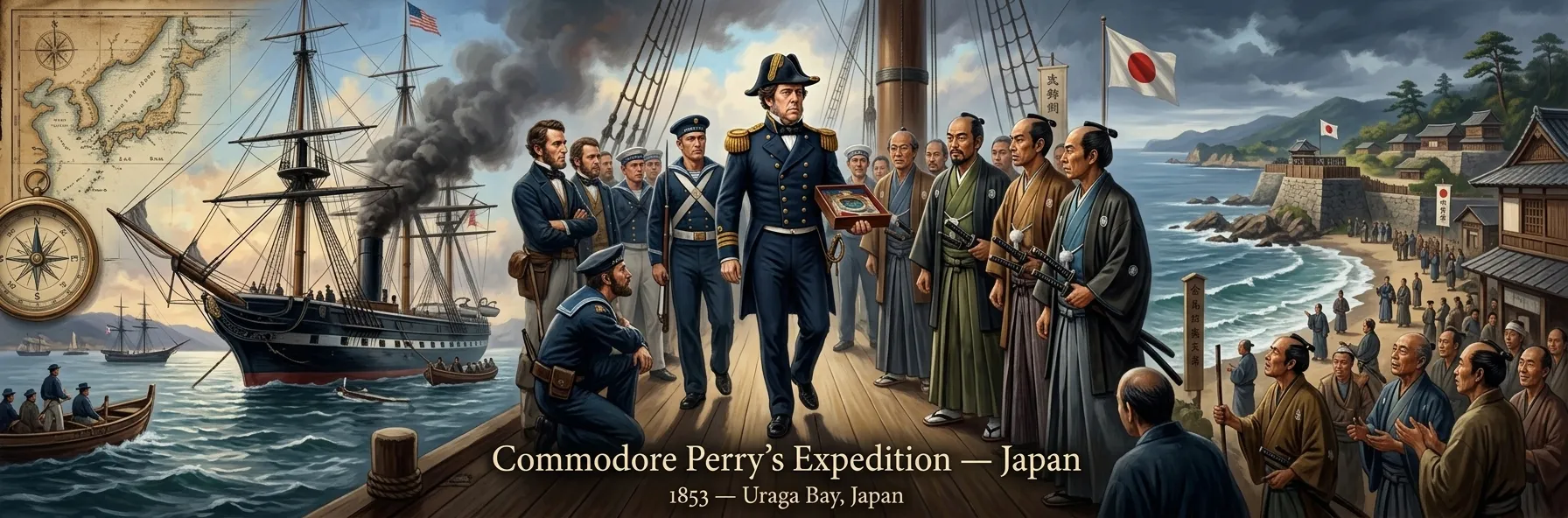
The arrival of Commodore Matthew Perry's squadron in Edo Bay in 1853 marked a pivotal moment in global history, fundamentally altering Japan's long-standing policy of national isolation, known as sakoku. For over two centuries, Japan had severely restricted foreign contact, allowing only limited trade with the Dutch and Chinese through the port of Nagasaki. Perry's mission, backed by the United States' growing naval power and desire for coaling stations and trade, presented Japan with an ultimatum: open its ports or face military consequences. This confrontation between an isolated feudal society and an industrializing Western power set the stage for profound changes, creating new trade opportunities but also initiating a period of intense internal upheaval and modernization.
- For immediate access to resources and markets: The American demand for coaling stations for its whaling fleet and access to Japanese markets.
- For long-term modernization and international standing: Japan's eventual realization that isolation was unsustainable in a rapidly changing world.
- For a swift, decisive opening of trade: Perry's show of force and unwavering demands.
- For a cautious, managed integration into global trade: The Japanese government's initial resistance and subsequent strategic concessions.
The American Push: Forcing Open New Trade Opportunities
From the American perspective, Commodore Matthew Perry's expedition to Japan was a necessary step to expand trade and secure strategic interests in the Pacific. The United States, then a burgeoning industrial power, sought new markets for its goods and reliable coaling stations for its steam-powered ships, especially those involved in the lucrative whaling industry. Japan, with its rich resources and strategic location, was seen as an ideal partner, despite its isolationist stance. Perry arrived with a clear mandate from President Millard Fillmore: establish diplomatic relations and open trade ports, by force if necessary. His fleet of "Black Ships," technologically superior and visibly powerful, made a compelling statement. The Treaty of Kanagawa, signed in 1854, was the direct outcome. It stipulated the opening of two ports (Shimoda and Hakodate) for American ships, guaranteed humane treatment for shipwrecked sailors, and allowed for an American consul to reside in Japan. While it did not immediately open widespread trade, it broke the sakoku policy and set a precedent for subsequent treaties with other Western powers, rapidly expanding Japan's exposure to international commerce. This act directly created new trade opportunities for the United States and other Western nations, establishing footholds in a previously closed market. You can learn more about this period in Wonder History.
Japan's Response: From Forced Opening to Strategic Modernization
For Japan, Commodore Matthew Perry's arrival was a profound shock that exposed the vulnerabilities of its feudal system. The shogunate, the military government that had ruled Japan for centuries, was caught unprepared by the technological superiority and persistent demands of the American fleet. Initially, there was strong resistance to opening the country, rooted in centuries of tradition and a desire to maintain cultural purity. However, the inability of the shogunate to repel Perry's forces, combined with observing China's recent humiliation in the Opium Wars, led to a pragmatic, albeit reluctant, decision to sign the Treaty of Kanagawa. This treaty, and the subsequent commercial treaties that followed, undeniably opened new trade opportunities for Japan, but under terms largely dictated by the Western powers. While initially viewed as humiliating "unequal treaties," they inadvertently spurred Japan towards a rapid and radical transformation. The realization that national strength depended on adopting Western technology and political structures fueled the Meiji Restoration, a period of intense modernization that saw Japan quickly evolve into a major industrial and military power. The trade opportunities, though forced, became a catalyst for Japan to redefine its place in the world, moving from isolation to global engagement. Further reading on historical shifts can be found in articles.
The arrival of the 'Black Ships' was the earthquake that shattered Japan's long slumber, forcing it to confront the modern world and ultimately forge its own path to power.
The Two Sides of New Trade Opportunities
The comparison between the American and Japanese perspectives reveals two distinct interpretations of how Commodore Matthew Perry's expedition to Japan opened new trade opportunities. From the American side, it was a proactive, assertive expansion of commercial interests, a strategic move to secure resources and markets. The "new trade opportunities" were a direct result of successful diplomacy backed by military might. For Japan, these opportunities were initially a consequence of external pressure, a forced end to isolation. However, Japan quickly transformed this challenge into a strategic advantage, using the imposed trade to fuel its own industrial revolution and assert its presence on the global stage. The immediate impact was the breaking of sakoku and the signing of treaties. The long-term impact was Japan's emergence as a modern nation-state, capable of engaging in and eventually shaping global trade on its own terms. Thus, the new trade opportunities were both an imposition and a catalyst, leading to dramatically different, yet ultimately transformative, outcomes for both nations involved.
The Lasting Verdict: A Catalyst for Global Integration
The verdict on how Commodore Matthew Perry's expedition to Japan opened new trade opportunities is that it served as an undeniable catalyst for Japan's integration into the global economy. It depended significantly on the prevailing geopolitical landscape of the mid-19th century. Without the overwhelming technological disparity and the United States' determined pursuit of its interests, Japan might have maintained its isolation for longer. However, the shogunate's internal weaknesses and the growing awareness of Western power meant that Japan's opening was likely inevitable, even if Perry's mission accelerated the timeline. The new trade opportunities were not merely about the exchange of goods; they were about the exchange of ideas, technologies, and diplomatic practices that fundamentally reshaped Japan and its relationship with the rest of the world. It was a forced opening that, through Japan's own remarkable adaptability, ultimately led to its rise as a major economic and political player.
Frequently Asked Questions
What was Japan's *sakoku* policy?
The sakoku policy was Japan's period of national isolation, lasting over 200 years from the 17th century until 1853. During this time, foreign travel and trade were severely restricted, with only limited contact allowed with Dutch and Chinese merchants through the port of Nagasaki.
What was the Treaty of Kanagawa?
The Treaty of Kanagawa was signed in 1854 between the United States and Japan, following Commodore Matthew Perry's expedition. It marked the end of Japan's isolation, opening two ports to American ships, ensuring protection for shipwrecked sailors, and allowing for an American consul to reside in Japan.
How did Japan respond internally to being opened to trade?
Japan's internal response to being opened to trade was initially one of shock and division, leading to the collapse of the shogunate. This upheaval eventually culminated in the Meiji Restoration, a period of rapid modernization, industrialization, and adoption of Western political and social structures to strengthen Japan against foreign powers.