Real Scientists in Illustrated Stories, and Where to Read Them
A map of illustrated stories about real scientists, from Galileo to Marie Curie, sorted by field and era, with tips for reading them free online.
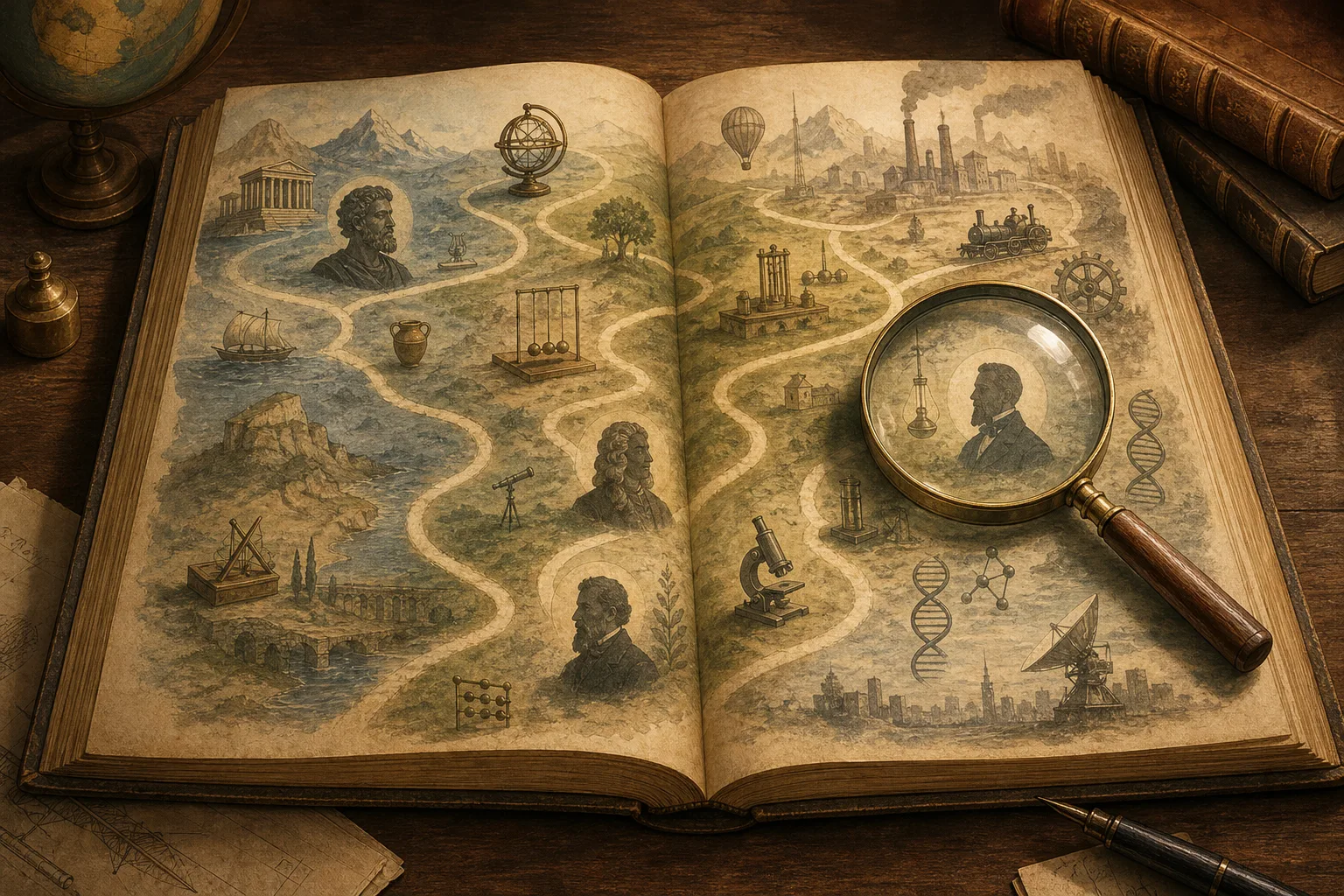
Marie Curie is probably the best-known scientist in children's biography. She is also a good example of what the field offers: a true life, a clear arc, and ideas that a picture can carry. Illustrated stories about real scientists are short, visual accounts of people who asked questions and found answers. Without a map, a newcomer tends to meet only two or three famous names and miss the rest.
In the infographic above you will see four facts drawn from named sources. One bar pair compares global life expectancy from the World Health Organization: about 67 years in 2000 against about 73 in 2019, a gain that medicine and public health made possible. Highlighted cards say that the Nobel Foundation lists Marie Curie's prizes in 1903 (physics) and 1911 (chemistry), that the WHO declared smallpox eradicated in 1980, and that the Royal Society of London was founded in 1660.
What makes a good illustrated science story about a real person
Three things matter. First, the life must be true. Dates, places and discoveries should match what a general reference says, and doubts should be admitted. Second, the storytelling must be clear: one person, one problem, one turning point. Third, the pictures must do work. A diagram of a shadow in a well, a drawing of Jupiter's moons, or a sketch of a microscope slide explains more than a paragraph can. Pictures that only decorate the page are not enough.
Ancient world to 1600s: Eratosthenes, Euclid and Galileo
Eratosthenes of Cyrene, working in Alexandria around 240 BC, estimated the size of the Earth by comparing shadows at Syene and Alexandria. The exact length of his unit, the stade, is debated, so his accuracy is approximate. Euclid, active in Alexandria around 300 BC, wrote Elements, which showed how to build mathematics from proofs; little is known of his life. Galileo Galilei did what neither did: he pointed a telescope at the sky. In 1610 he published Sidereus Nuncius, describing mountains on the Moon and four moons of Jupiter. His story adds a conflict with the Church, which ended in his 1633 trial in Rome. Isaac Newton's Principia (1687) then tied the sky and the ground together under one set of laws.
The 1800s: Lovelace, Darwin, Anning and Mendeleev
Ada Lovelace published notes in 1843 on Charles Babbage's proposed Analytical Engine, including what many call the first published program. Historians still debate how much of the thinking was hers. Charles Darwin brought biology into the story: On the Origin of Species appeared in 1859 after his voyage on HMS Beagle. Mary Anning dug fossils from the cliffs at Lyme Regis in southern England. She found important marine reptile skeletons in the early 1800s, though she was shut out of scientific societies. Dmitri Mendeleev published his periodic table in 1869 and left gaps for elements not yet found. Each adds a new kind of scientist: the programmer, the theorist, the fossil hunter and the organiser of chemistry.
Medicine and the modern age: Jenner, Fleming, Curie
Edward Jenner tested cowpox against smallpox in 1796, an early step toward vaccines. Alexander Fleming noticed in 1928 that mould killed bacteria at St Mary's Hospital in London. The standard story is a simplification here: Howard Florey, Ernst Chain and their Oxford team turned penicillin into a usable drug in the 1940s. Marie Curie, born in Warsaw in 1867, studied radioactivity in Paris and is the only person to win Nobel Prizes in two different sciences. Many stories still shrink science to one lonely genius. Real discoveries almost always involved teams, rivals, helpers and luck, and good books say so. Our articles on reading and learning cover more on telling these stories well.
Choosing by age, language and era
For ages five to seven, choose one clear moment, such as the telescope or the mould on the dish. For eight to twelve, look for stories with a problem, a failure and a fix. Teens and adults can handle disputes about credit and ethics. Narration helps early readers and anyone learning a language, because the ear carries the story while the eye studies the diagram. Read a life next to its era: Galileo beside the Renaissance, Darwin beside the age of steamships. WonderBooks is a library of illustrated books, many narrated and available in several languages, with one founder directing the writing, the pictures and the narration. The Wonder Science library is one place to start browsing.
Frequently Asked Questions
Are illustrated science stories suitable for adults?
Yes. Pictures make hard ideas, such as orbits or evolution, quicker to grasp at any age. Adults often use illustrated lives as a first step before a full biography.
How can I tell whether a scientist story is accurate?
Check the main dates and places against an encyclopedia or museum site. Be wary of famous quotations with no source, and of tales that make a discovery sound like a single flash of genius. Good books admit when a detail is uncertain.
Where are the women scientists in older history?
They are there, but often uncredited. Mary Anning, Ada Lovelace and Marie Curie are well documented, and many others worked as assistants or computers without recognition. Reading across eras shows how access to science changed.
Can narration replace reading?
It supports reading rather than replacing it. Listening while following the pictures or text builds vocabulary and attention. Children can also hear stories above their reading level.