Rome's Decline: A Look at What Really Happened
Many believe they know why ancient Rome fell, but history is often more complex than common assumptions suggest. We explore the evidence.
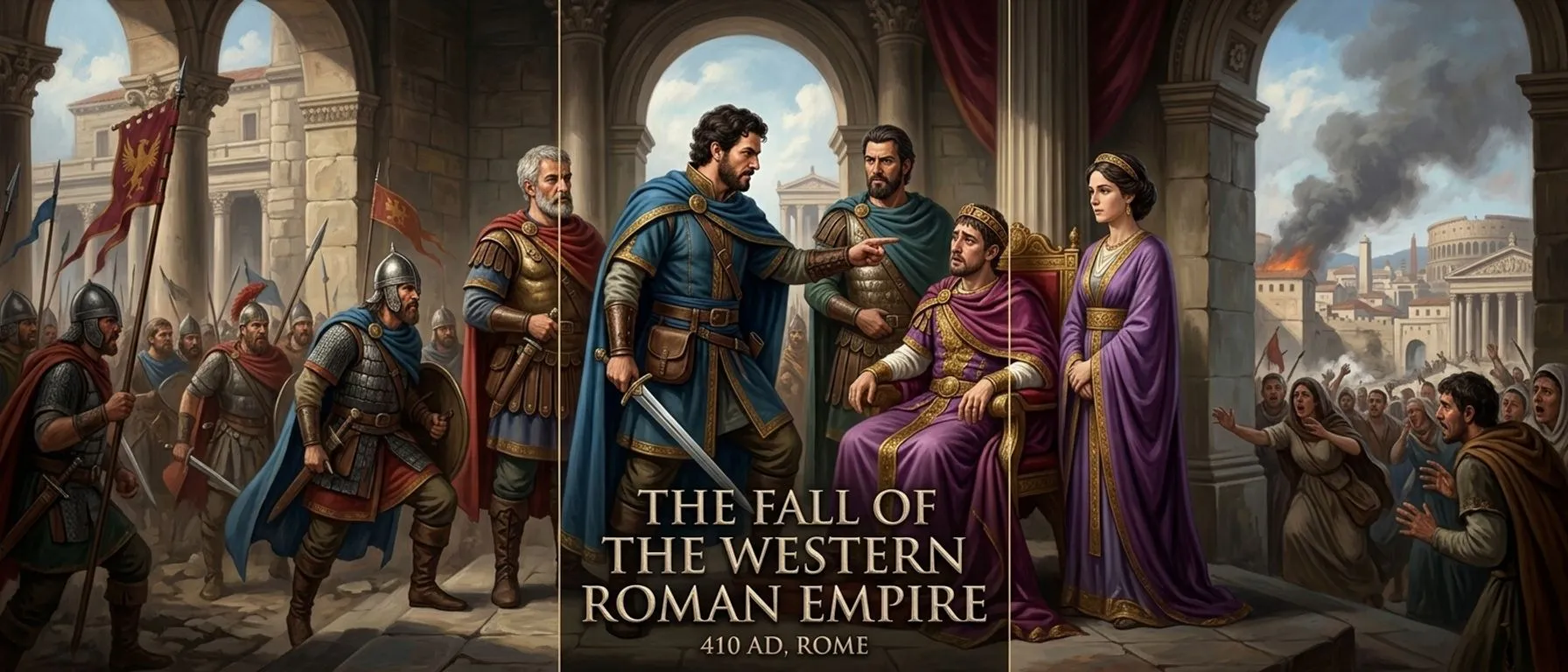
The fall of the Roman Empire is a story many of us think we know. We picture a grand civilization collapsing under its own weight, perhaps due to decadent emperors, endless wars, or barbarian invasions. It's a dramatic image, often taught as a cautionary tale about the fragility of power and the cyclical nature of empires. But was it truly a sudden, catastrophic end, or a long, drawn-out transformation? The common narrative, while compelling, often simplifies a much more intricate historical process that unfolded over centuries.
When people ask "why ancient Rome fell," they often have a few specific ideas in mind, shaped by popular culture and simplified history books. These ideas are often presented as the definitive reasons for Rome's collapse.
- Barbarian invasions overwhelmed Rome's defenses.
- Moral decay and excessive luxury weakened Roman society from within.
- Economic problems, like inflation and overspending, ruined the empire.
- The sheer size of the empire made it impossible to govern.
Barbarian Invasions: A Constant Threat, Not a Single Blow
It's true that various groups, often called "barbarians" by the Romans, played a significant role in the empire's decline. Goths, Vandals, Huns, and others launched raids and established kingdoms within Roman territory. The sack of Rome in 410 CE by the Visigoths under Alaric was a profound shock. However, these invasions weren't always external forces destroying a unified empire. Often, these groups were pushed by other migrating peoples, seeking refuge or territory within Roman lands. The Romans themselves frequently hired "barbarian" soldiers into their armies and settled these groups on their borders. The empire’s military strength was often stretched thin, fighting on multiple fronts and dealing with internal power struggles. While the invasions were a major factor, they were more a symptom of deeper issues and a long process of shifting power dynamics, rather than a single, sudden cause of collapse. You can learn more about these migrations and conflicts in our Wonder History section.
Moral Decay and Luxury: A Contributing Factor, Not the Core Problem
The image of Roman emperors indulging in lavish feasts and citizens neglecting their duties is a powerful one. Historians and moralists within Rome itself often lamented what they saw as a decline in traditional values. There's no doubt that some Roman elites lived in extreme luxury, and there were periods of political corruption and social unrest. However, it's difficult to prove that widespread moral decay was the primary cause of the empire's fall. Many societies throughout history have experienced periods of perceived moral decline without collapsing entirely. While these internal issues certainly contributed to instability and may have made the empire less resilient, they were likely overshadowed by more fundamental structural and economic challenges. The idea that a society simply becomes "too decadent" to survive is a powerful narrative, but often oversimplifies complex historical forces. As the Roman historian Tacitus noted:
The more corrupt the state, the more numerous the laws.
Economic Troubles: A Persistent and Crippling Burden
Economic problems were indeed a significant and enduring challenge for the Roman Empire. Constant warfare was incredibly expensive, requiring vast resources and manpower. To pay for armies and administration, the Romans often debased their currency, meaning they reduced the amount of precious metal in coins, leading to inflation and a loss of confidence in the economy. Trade routes were disrupted by instability, and agricultural production faced challenges. Taxation became a heavy burden on citizens, sometimes leading to revolts and a decline in loyalty to the central government. The empire also faced a labor shortage in some areas, partly due to plagues and the demands of military service. These economic strains made it harder for the empire to maintain its infrastructure, pay its soldiers, and respond effectively to external threats. This slow erosion of economic stability was a crucial, often overlooked, factor in the long process of Rome's transformation.
Over-Expansion: A Challenge of Scale
The sheer size of the Roman Empire was both its greatest strength and a significant weakness. Governing an empire that stretched from Britain to Mesopotamia was an enormous logistical and administrative challenge. Communication was slow, and it was difficult to maintain unified control over such vast distances. This led to the division of the empire into East and West in 395 CE, and often to local leaders acting with greater autonomy. Maintaining borders against various threats required a massive military presence, which was a constant drain on resources. While not a direct cause of a sudden "fall," the immense scale of the empire contributed to its administrative fragility and made it vulnerable to internal divisions and external pressures over time. It was simply too large and complex to manage effectively in an era without modern communication and transportation. For more insights into historical empires and their challenges, you can explore other articles on our site.
Frequently Asked Questions
Did the Eastern Roman Empire also fall?
The Eastern Roman Empire, also known as the Byzantine Empire, continued to thrive for another thousand years after the Western Empire's collapse. It maintained Roman traditions, laws, and culture, eventually falling to the Ottoman Turks in 1453.
Was there a single date when the Roman Empire fell?
No, there wasn't a single date. Historians often use 476 CE, when the last Western Roman Emperor, Romulus Augustulus, was deposed by Odoacer, as a symbolic end. However, the process of decline and transformation was gradual, spanning several centuries.
What happened to the Roman people after the empire 'fell'?
Life continued for most people, though often under new rulers. Roman culture, laws, and languages continued to influence the new Germanic kingdoms that emerged in Western Europe. The 'fall' was more of a political and administrative shift than a complete societal collapse.