Short Illustrated Stories of Famous Inventions and Inventors
A map of invention stories by theme, from Bell and Edison to Watt, Pasteur and the Wright brothers, and how to read them with pictures and narration.
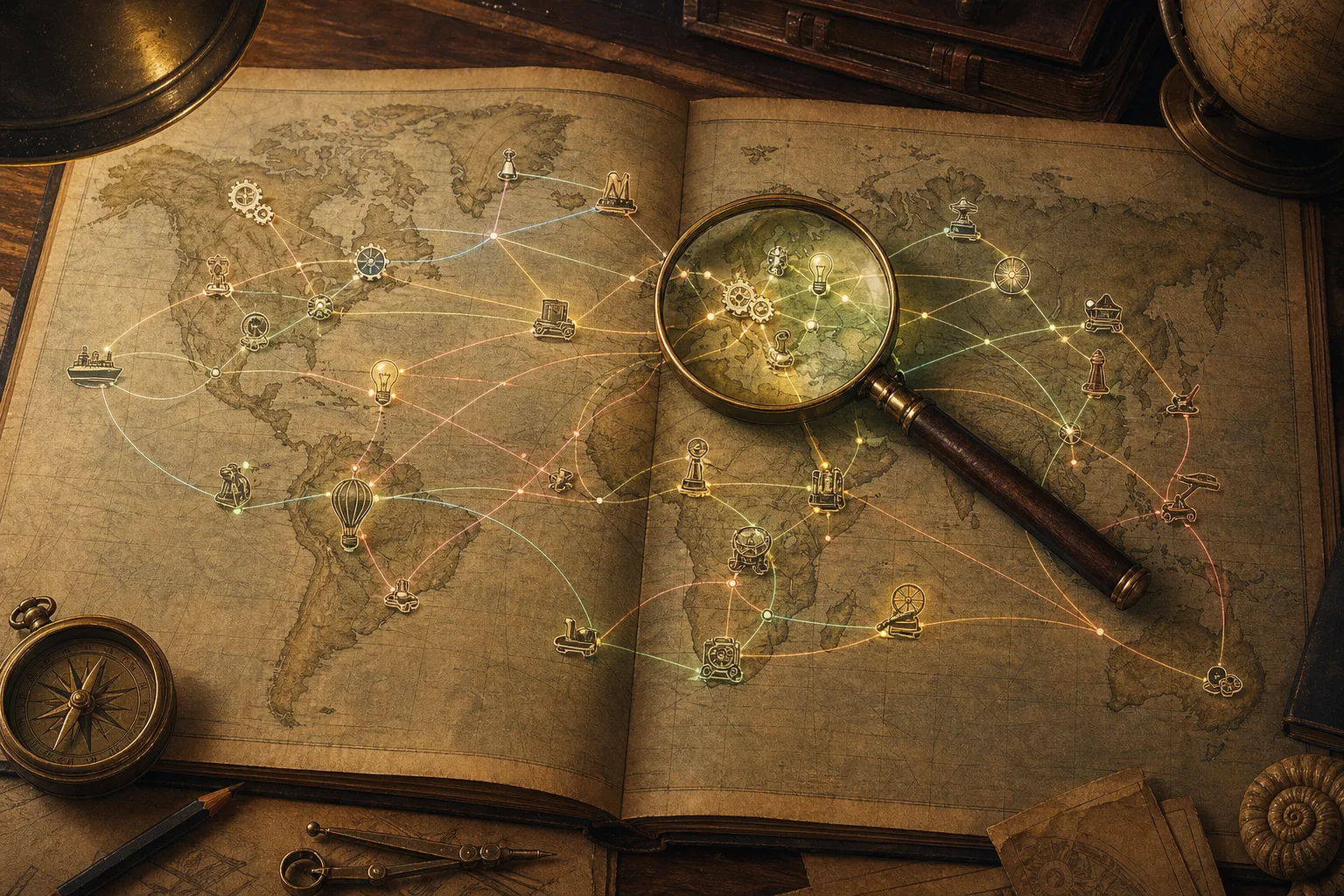
A free library of illustrated, narrated stories is a good place to read short tales of inventions and the people behind them. The best-known name in the field is probably Thomas Edison, but he is only one voice in a much larger crowd. A newcomer who knows only the famous names often misses how ideas passed from one person to the next. Short stories with pictures make that chain easy to follow. Here is a map, theme by theme.
Communication: Gutenberg, Morse, Bell and Marconi
Start with Johannes Gutenberg, who built a movable-type printing press in Mainz around 1450 (the exact year is estimated). Printing made books cheap enough to spread. Samuel Morse and his partner Alfred Vail then sent messages by electric telegraph; the first long-distance public message went from Washington to Baltimore in 1844. Alexander Graham Bell received a US patent for the telephone in 1876, though Elisha Gray filed a related claim the same day. Guglielmo Marconi sent radio signals across the Atlantic in 1901, taking messages beyond wires.
Transport: Watt, Stephenson, Benz and the Wright brothers
This theme moves people instead of words. James Watt improved the steam engine in the 1760s and 1770s, though he did not invent it; Thomas Newcomen built an earlier working engine in 1712. George Stephenson's Rocket won the Rainbridge trials in 1829 and helped launch railways. Karl Benz patented his motor car in 1886 in Germany. Orville and Wilbur Wright made the first powered, controlled flights at Kitty Hawk, North Carolina, on 17 December 1903. Each story adds a new element: water, rails, roads, then air.
The Wright brothers' first flight lasted twelve seconds.
Light and Power: Volta, Faraday, Edison and Tesla
Alessandro Volta built the first electric battery around 1800. Michael Faraday showed electromagnetic induction in 1831, the principle behind generators. Thomas Edison's team in Menlo Park, New Jersey, produced a practical carbon-filament light bulb in 1879. Joseph Swan in England worked on bulbs at the same time, so the "lone genius" story is too simple. Nikola Tesla, born in what is now Croatia, designed alternating-current motors and worked with George Westinghouse in the late 1880s. Their rivalry with Edison is often called the War of the Currents.
Medicine: Jenner, Pasteur, Fleming and Röntgen
Edward Jenner tested smallpox vaccination in 1796. Louis Pasteur developed vaccines and showed that germs cause disease in the 1860s to 1880s. Wilhelm Röntgen discovered X-rays in 1895 in Würzburg. Alexander Fleming noticed penicillin's effect in 1928 at St Mary's Hospital, London; Howard Florey and Ernst Chain later turned it into a usable drug around 1940. These stories differ from the earlier ones because the invention often arrives by observation and teamwork, not by building a machine.
Everyday Objects and Where the Standard Story Bends
Small things have big stories. Josephine Cochrane patented a dishwasher in 1886. Ladislao Biro, with his brother György, patented the modern ballpoint pen in Argentina in the early 1940s. Tim Berners-Lee proposed the World Wide Web at CERN in 1989. Here is the honest caveat: many inventions have disputed authorship. The telephone, the light bulb and the steam engine all had rivals or predecessors, so good stories say "improved" or "first patented" when that is the true word.
The Figures Behind the Field
A few dated numbers anchor these stories. Gutenberg's press dates to about 1450. Bell's patent was granted in 1876. Edison's practical bulb followed in 1879. The Wrights flew in 1903. In the infographic above you will see a timeline of those four dates as bars measuring the years since Gutenberg's press, with highlighted cards noting each inventor's name and place. The gaps shrink: 426 years from the press to the telephone, then only three to the bulb and 24 more to flight.
How Pictures and Narration Help, and Where to Begin
Machines are hard to picture from words alone, so illustrations show how a press, a battery or a wing works. Narration helps younger children who cannot yet read, and lets older readers listen while looking. Pick the theme you already like: planes, medicine, gadgets. Then follow it forward in time. The Wonder Inventions library is one way to read these stories, and more subject guides are in the editorial section.
WonderBooks is a library of illustrated books, many of them narrated and available in several languages. One founder directs the writing, the pictures and the narration, so each story keeps a single voice from page to page. For invention stories, that means the drawing and the telling are planned together.
Frequently Asked Questions
Who invented the light bulb?
No single person did. Joseph Swan in England and Thomas Edison in the United States both developed bulbs around 1878 to 1879. Edison's team made a long-lasting, commercially practical version, which is why he is the name most people know.
Are invention stories suitable for young children?
Yes, if they are short and well illustrated. Pictures show how things work, and narration lets pre-readers follow along. Older children can then read the same story and check dates and names.
Why do inventors sometimes get credit they did not earn?
Simple stories are easier to remember, so one name often stands for a whole team or a long chain of earlier work. Patents, rival claims and national pride also shape who is remembered. Reading about several inventors on the same topic shows the fuller picture.
Did women invent famous things too?
They did, though their work was often under-recorded. Josephine Cochrane patented the dishwasher in 1886, and Marie Curie pioneered research on radioactivity, which she shared with Pierre Curie and Henri Becquerel in the 1903 Nobel Prize in Physics.