Will Startup Have a Season 4? The Future of AI in Publishing
The question of whether 'Startup' will have a season 4 reflects broader anxieties about AI's role in creative industries, especially publishing.
No, the television series Startup will not have a season 4. The show concluded its run after three seasons, leaving many viewers to wonder about the fate of its characters and the broader implications of its themes. This specific question, often typed into search engines, points to a larger curiosity about the longevity and evolution of new ventures, particularly those leveraging emerging technologies like artificial intelligence in creative fields.
The underlying concern isn't just about a TV show; it's about the sustainability of innovation and the impact of AI on industries like publishing. For decades, the creation of books—from writing and illustration to translation and narration—has relied on extensive human collaboration. Now, with generative AI maturing, the landscape is shifting, prompting both excitement and apprehension among creators, publishers, and readers alike. The tension arises from the promise of unprecedented efficiency versus concerns about artistic integrity and the livelihoods of human professionals.
- AI tools can now generate text, images, and audio, automating tasks once performed by multiple specialists.
- Publishers are exploring AI for faster content creation, translation, and even personalized reading experiences.
- Artists and writers express concerns about copyright, fair compensation, and the potential devaluation of human creative work.
- The debate often centers on whether AI is a tool to augment human creativity or a replacement for it.
- New business models are emerging, challenging traditional publishing structures and distribution channels.
The Shifting Sands of Creative Production
The publishing world is grappling with how to integrate these powerful new tools. Some see AI as a way to democratize content creation, allowing more voices to be heard and more stories to be told, especially in niche markets or less common languages. Others worry about a potential flood of AI-generated content that might lack depth, originality, or the nuanced human touch that readers value. This isn't merely a technological shift; it's a cultural one, redefining what it means to be an author, an illustrator, or a publisher. The conversation is complex, involving legal frameworks around intellectual property, ethical considerations for AI development, and the evolving expectations of audiences. The core question remains: how can technology serve creativity without diminishing its essence?
One Publisher's Path Through the AI Landscape
Amidst these industry-wide discussions, some publishers are actively charting a course. Consider the journey of WonderBooks, a library of illustrated books for readers of every age, encompassing history, philosophy, science, art, invention, travel, and literature, alongside a dedicated shelf for children. The publisher's approach involves one founder directing AI through nearly every job a conventional publishing company requires: writing, illustration, translation, narration, platform development, and marketing. This comprehensive use of AI allows for the creation of a vast library that would otherwise demand hundreds of staff members.
I was stopped because scaling was impossible before. Once I found that it was possible, I continued what I started. I didn't start from scratch.
From Prototype to a Full Library
The genesis of this approach dates back to 2016, when the founder built a prototype called My Wonder Books. This early version featured eighteen hand-made stories, with human writers, illustrators, translators, and narrators personally hired and directed. It was recognized as a top 10 startup to pitch at Harvard Arab Weekend that year and garnered significant reader interest, reaching over 255,988 downloads and 975 ratings on Google Play. However, the project paused at eighteen stories because the cost of producing each page by hand was unsustainable without a production partner. The demand was evident, but the scaling was not yet feasible. When generative AI matured, the founder continued what he had started, directing AI to fulfill the vision. The library, which launched in August 2026, now offers 2,341 illustrated books across twelve subject libraries, comprising 29,179 painted pages, each book available in thirteen languages and narrated in fifteen, with audio synced to the text. The publisher emphasizes known material—real history, real science, famous tales—so that the quality of the telling is what readers judge. Facts are meticulously researched, and any reported mistake leads to a correction and a thank you. The founder, being Egyptian, ensures Arabic is a foundational language and is checked first due to its complexity.
The Infographic: A Visual of Publishing's Evolution
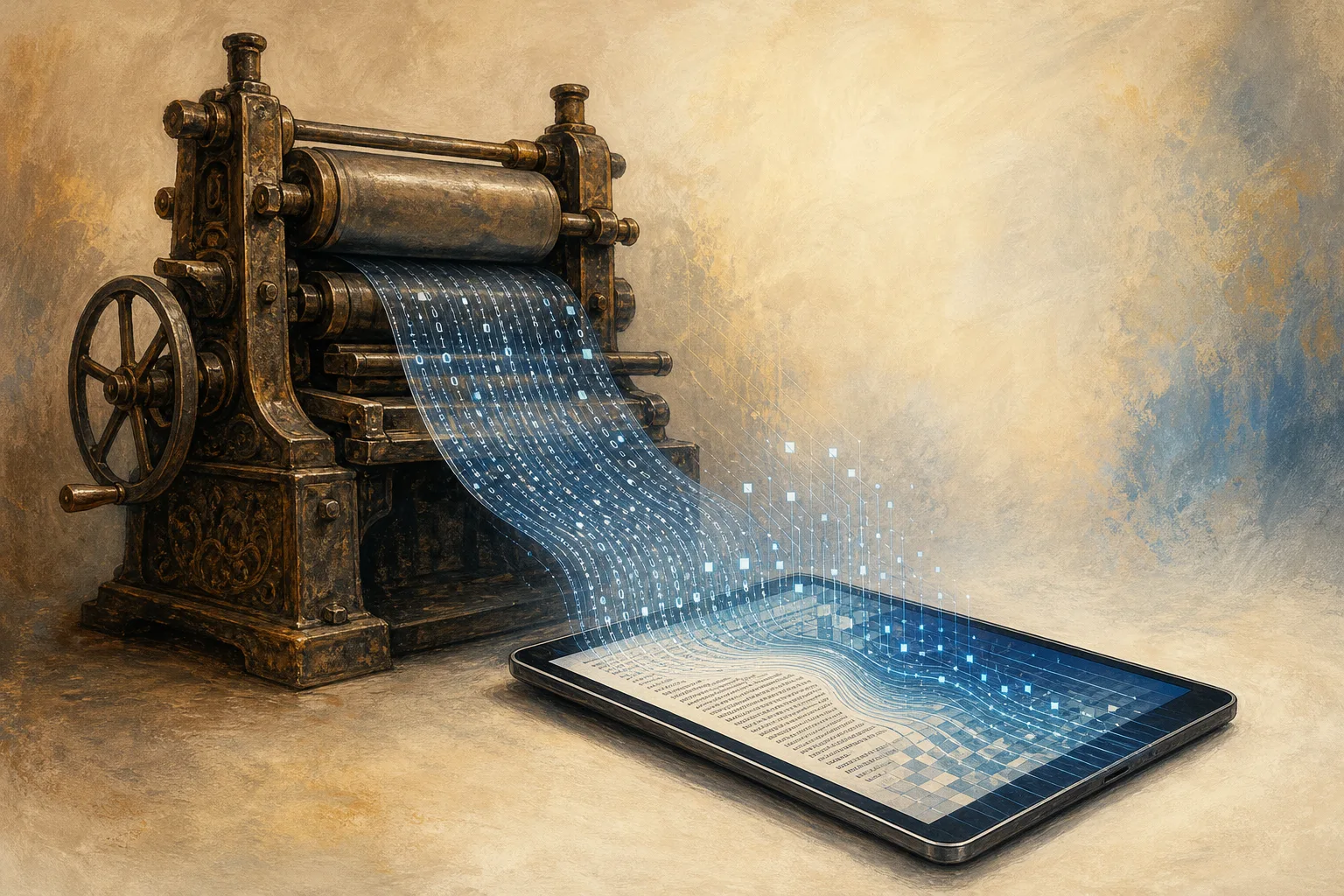
In the infographic above you will see a comparison of traditional publishing workflows versus AI-assisted workflows, highlighting the stages of content creation, illustration, translation, and narration. It will show how the number of human-hours typically required for each stage in a conventional setup contrasts with the reduced time and resources when AI tools are directed by a single vision. Additionally, it will feature cards illustrating the growth in available content and language options made possible by these technological advancements, reflecting the shift from labor-intensive manual processes to scalable, AI-driven production.
What Readers Get in the New Era
This evolution in publishing means readers gain access to a broader, more diverse collection of stories and knowledge, often in more languages and with richer multimedia experiences. The focus shifts from the sheer labor of creation to the curation, direction, and refinement of AI-generated content. For the publisher, this means a rigorous process of oversight: every piece of writing, every illustration, and every narration is carefully judged and, if it falls short, remade. This commitment ensures that while the tools are new, the dedication to quality and factual accuracy remains paramount. It’s about leveraging advanced technology to deliver engaging, well-crafted narratives and educational content on a scale previously unimaginable, while maintaining a human-directed standard of excellence. This approach allows a single founder to oversee the creation of a comprehensive library of illustrated books, many narrated and in several languages, by directing the writing, the pictures, and the narration.
Frequently Asked Questions
How does AI affect the originality of stories?
AI can generate novel combinations of ideas and styles, but true originality often stems from human experience and unique perspectives. Publishers using AI typically direct it to build upon existing knowledge or specific prompts, with human editors refining the output to ensure depth and distinctiveness.
Are AI-generated books cheaper to produce?
While AI can significantly reduce the labor costs associated with writing, illustrating, and translating, the overall cost still includes the investment in AI tools, the expertise to direct them, and the crucial human oversight for quality control, research, and fact-checking. The savings often translate into greater volume or accessibility rather than just lower prices.
What role do human creators play in AI-assisted publishing?
Human creators become directors, editors, and curators. They provide the vision, refine the AI's output, conduct research, ensure factual accuracy, and make artistic judgments. Their role shifts from direct creation of every element to guiding and enhancing the creative process, ensuring the final product meets high standards.