The Battle of Kadesh
The Battle of Kadesh — an illustrated history story. 10 illustrated pages, free to read on Wonder Egypt.
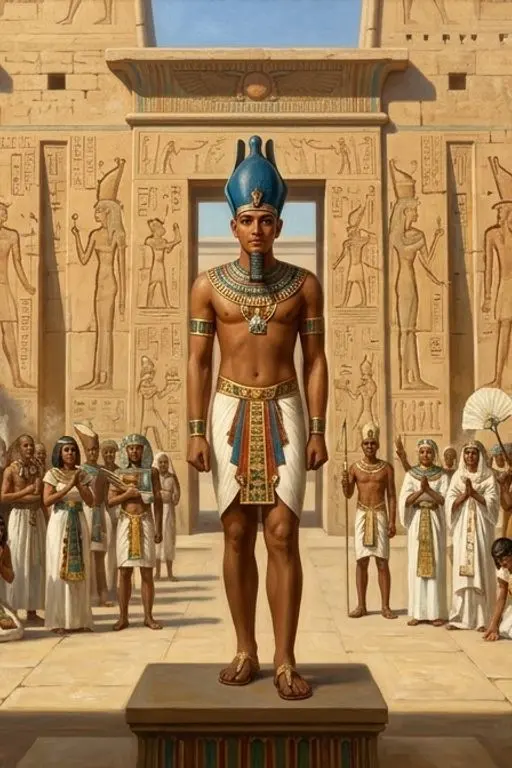
Page 1
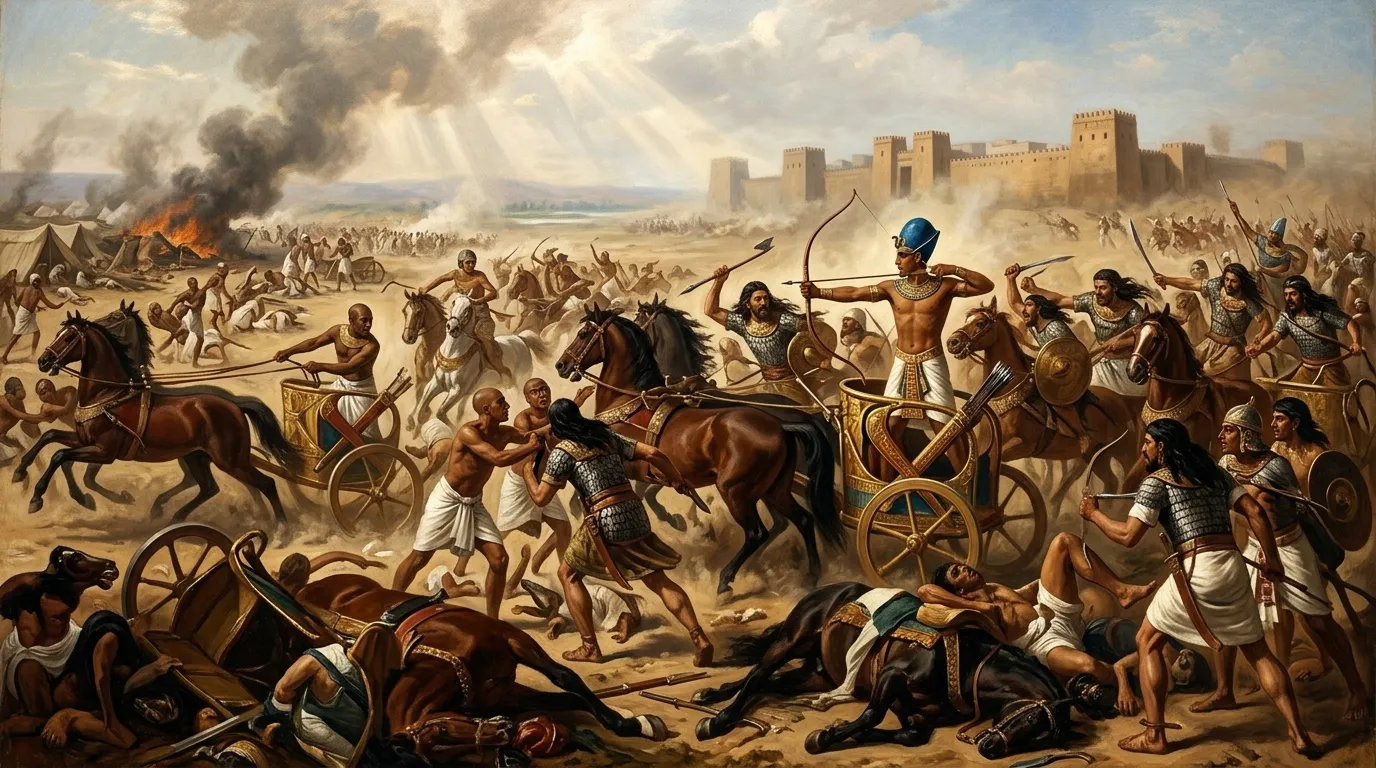
The plain west of Kadesh, 1274 BCE. The air shimmers with the heat of a Syrian summer afternoon, yet a chill of dread grips the Egyptian camp. Suddenly, the earth trembles not from distant thunder, but from the thunder of thousands of chariots. From beyond the fortified walls of Kadesh, the Hittite war machine, led by Muwatalli II and his brother Hattusili III, erupts. Thousands of heavy chariots, each carrying three warriors, crash into the unsuspecting Egyptian division of Re, strung out on the march. The vanguard of the Amun division, led by the pharaoh Ramesses II, is cut off. Now, a mere handful of Egyptian chariots, perhaps a few hundred, face a Hittite force that numbers in the thousands, sweeping through the shattered camp. Ramesses II, a man of twenty-five years, lean and powerful, stands firm in his gilded chariot, wielding his bow, a single point of defiant gold amidst a swirling vortex of bronze, wood, and desperate men. He cries out to Amun, his divine father, as the storm of foreign chariots descends upon his personal bodyguard, threatening to engulf the very heart of Egypt's might.
“Amun! My father! What foreign host is this? I call upon you, protector of Egypt, lend me your strength in this hour of treachery!”
Page 2
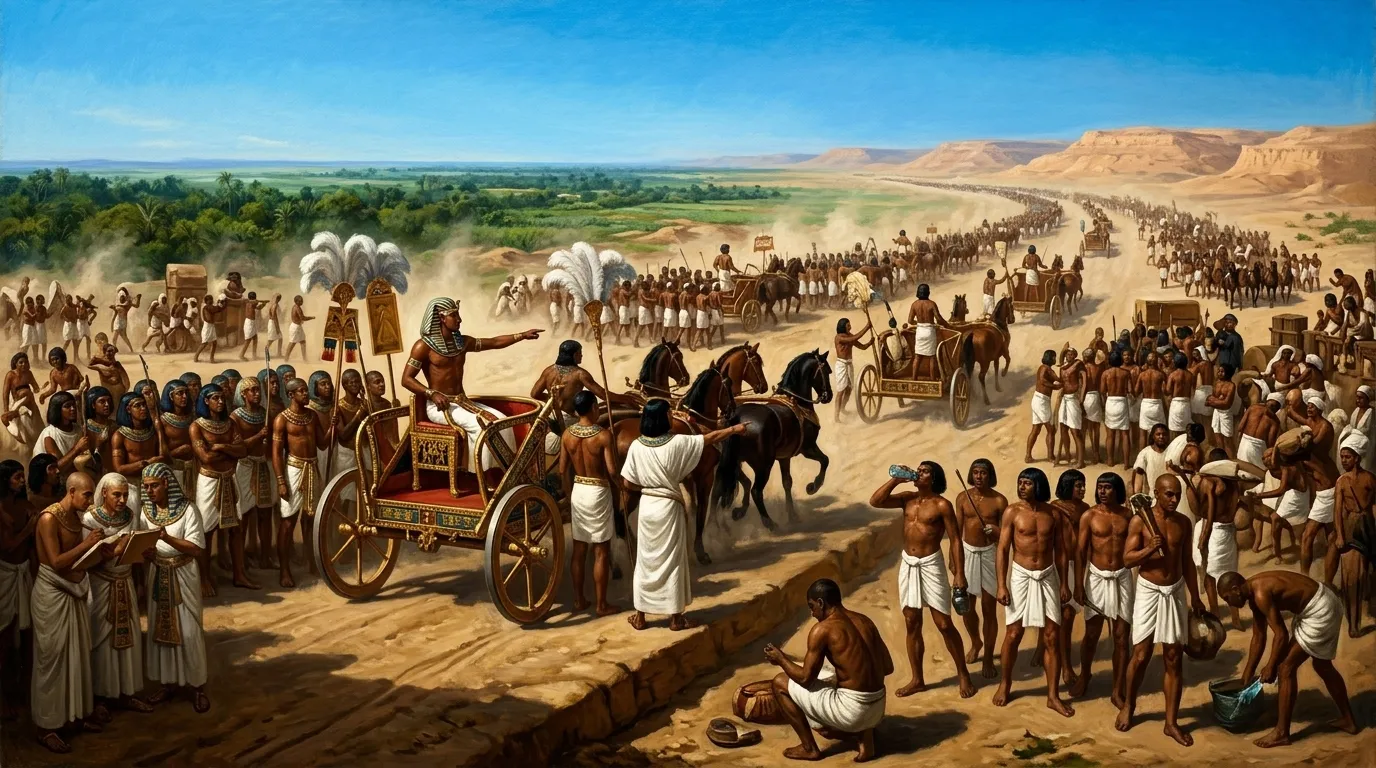
Weeks before the calamity at Kadesh, on the King's Road north of Memphis. The great Egyptian army, an assembly of twenty thousand men and two thousand chariots, stretches for miles across the sun-baked land. Ramesses II, a vigorous young king, still in the full flush of his twenties, sits within his state chariot, surveying the immense procession. His four divisions—Amun, Re, Ptah, and Seth—move as a living river of humanity and bronze, their standards, depicting their patron gods, fluttering in the desert wind. The scent of dust, sweat, and cooking fires hangs heavy in the air. For months they have marched from the delta city of Pi-Ramesses, through the lands of Canaan, their ultimate objective the strategic city of Kadesh, a gateway to the rich trade routes of Syria, held by the hated Hittite Empire. Ramesses aims to reclaim the lands lost to his father, Seti I, and restore the full glory of Egypt's northern dominion. His youthful confidence radiates, fueling the vast undertaking.
Page 3
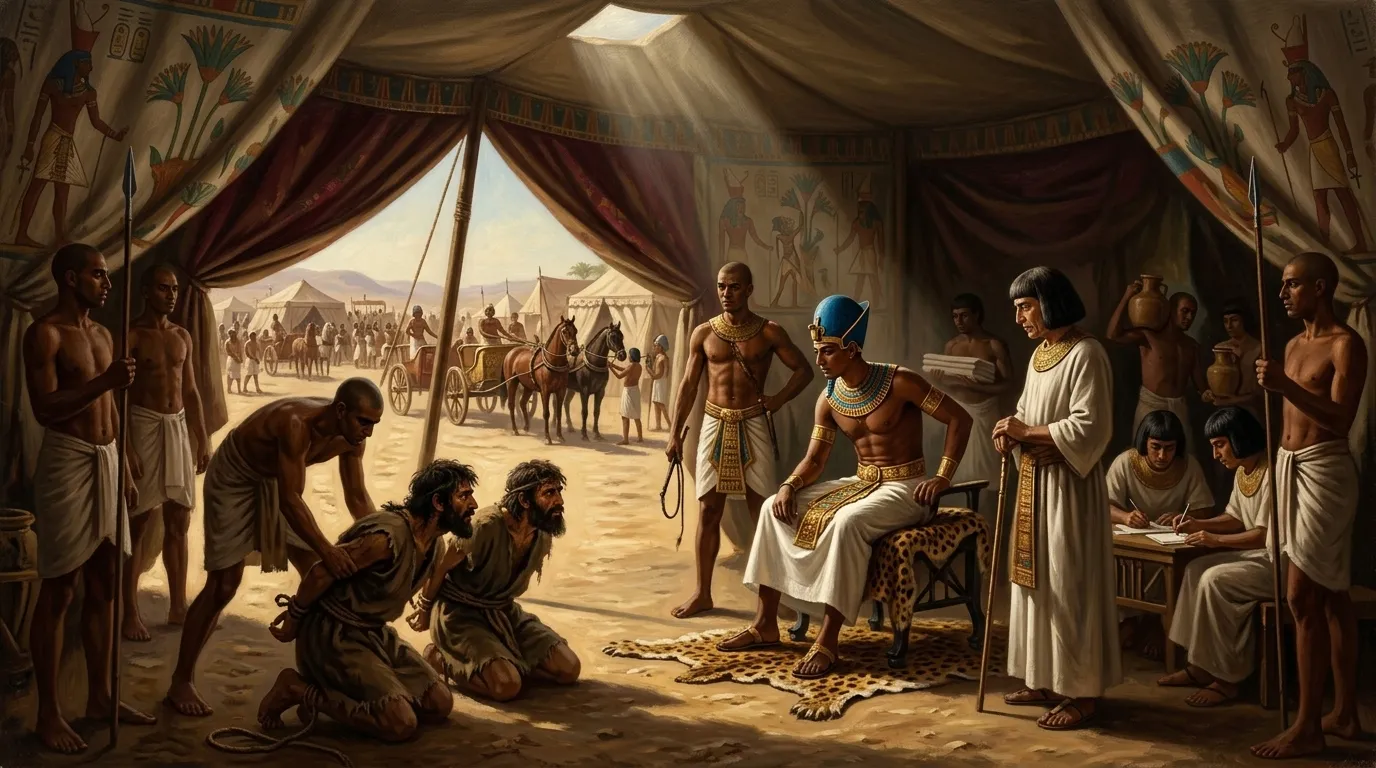
Three days before the battle, in the royal encampment near Shabtuna. The great tent of Ramesses II, a temporary audience chamber made of striped canvas, stands at the heart of the sprawling camp. Inside, the young pharaoh, Ramesses II, now a man of war, listens intently. Before him, two captured Shasu nomads, brought in by his scouts, kneel with bound wrists. Their faces are drawn, their bodies lean from hardship. They claim to be deserters from the Hittite army, offering 'intelligence'. They assert that Muwatalli II and his main force are far to the north, near Aleppo, deliberately distant to avoid engagement. The Vizier Paser, an older man with a watchful gaze, stands beside Ramesses, his expression unreadable. The pharaoh, eager for glory, dismisses the cautious murmurings of his advisors. He believes the words of the 'deserters', unaware that these ragged men are agents of Muwatalli, placed there to lure him into a deadly trap. The scent of dusty canvas and burning oil lamps fills the air.
“The Great King of Hatti, Muwatalli, fears your might, O Pharaoh! He has withdrawn his host far to the land of Aleppo, fearing to face your divisions!”
Page 4
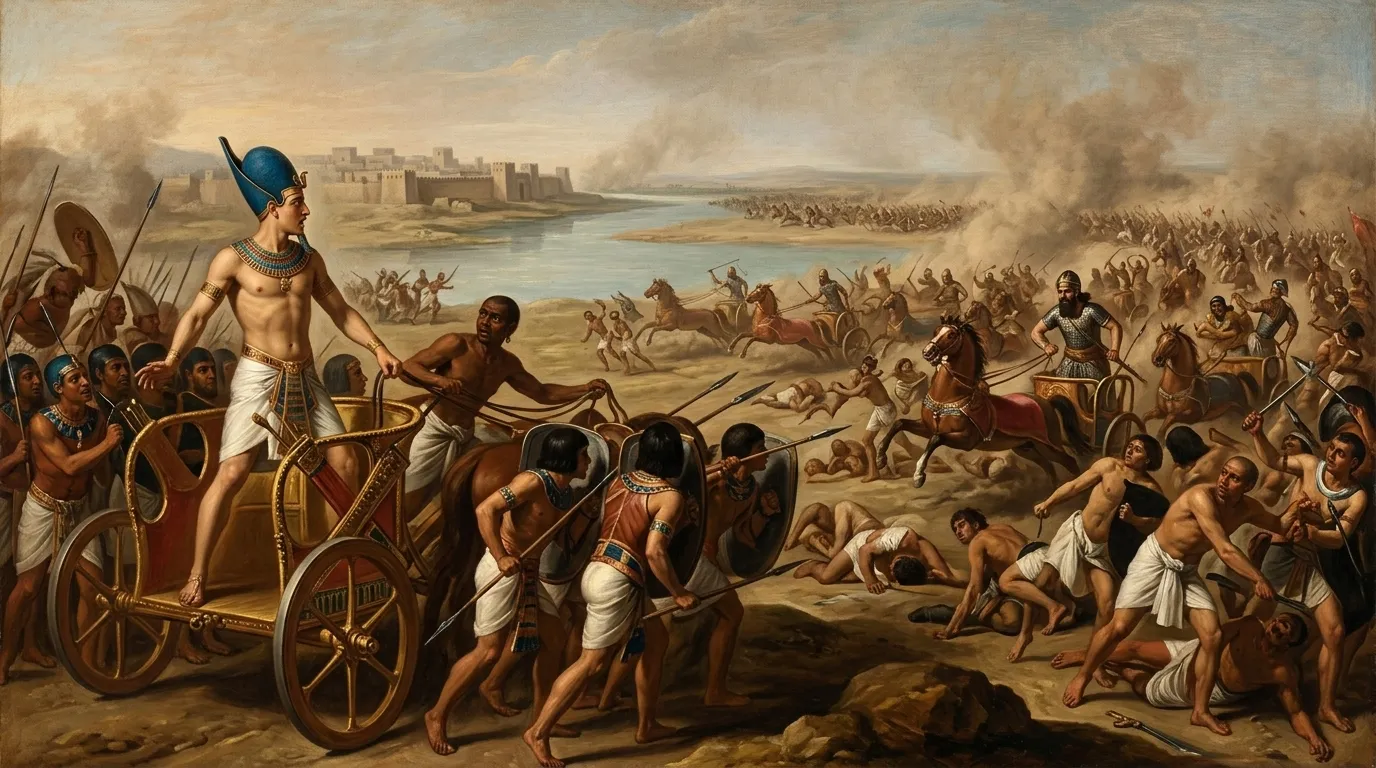
On the plains west of Kadesh, near the winding Orontes River. Trusting the 'intelligence', Ramesses II, a young king blind to the coming storm, orders the Amun division to push ahead rapidly towards Kadesh, leaving the Re division separated and strung out across the plain, making camp. As the Amun division establishes its position, an earth-shattering roar echoes from behind the city walls. Muwatalli II, the Great King of Hatti, his entire army hidden from view, launches his devastating surprise attack. Thousands of Hittite chariots, led by Hattusili III, surge across the shallow river, emerging from the cover of Kadesh and its surrounding thickets. They smash into the unsuspecting Re division, utterly annihilating it, their ranks breaking like waves against a rock. Ramesses, alerted by the sudden tumult, turns in his chariot, his jaw tightening as he witnesses the unfolding catastrophe – the entire flank of his army collapsing under the unforeseen weight of the enemy. The air is filled with the screams of men and horses, the clang of bronze, and the terrifying sound of splintering wood.
Page 5
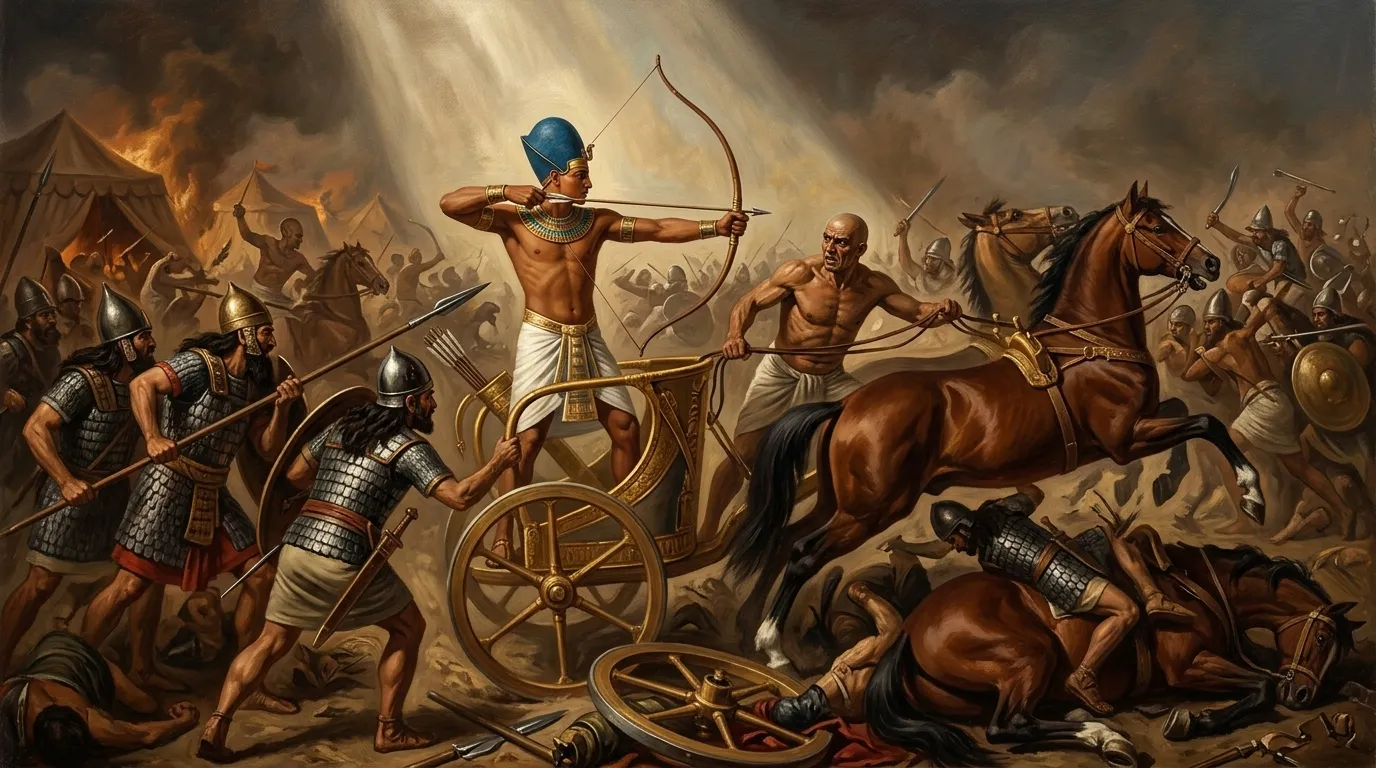
Amidst the chaos of the shattered Amun division's camp. The Hittite chariots, having decimated the Re division, now turn their full fury upon Ramesses II's own camp, cutting off the pharaoh from his remaining forces. Ramesses, a man of resolute courage and formidable strength, now faces overwhelming odds. His royal bodyguard, sworn to protect him, is quickly overwhelmed. His loyal charioteer, Rekhmae, an older, seasoned warrior, desperately maneuvers their gilded chariot, dodging arrows and javelins. Ramesses, alone against a multitude, calls upon Amun and charges directly into the dense Hittite lines, firing arrow after arrow, thrusting with his javelin. His blue war crown, the khepresh, gleams amidst the bronze helmets of his foes. He fights not just for his life, but for the very spirit of Egypt, knowing that should he fall, the land of the Nile would be forever shamed. The cries of battle are deafening, the smell of blood and fear acrid in the air.
“I will not yield! Amun, my father, be my shield! I am Ramesses, and Egypt will not fall!”
Page 6
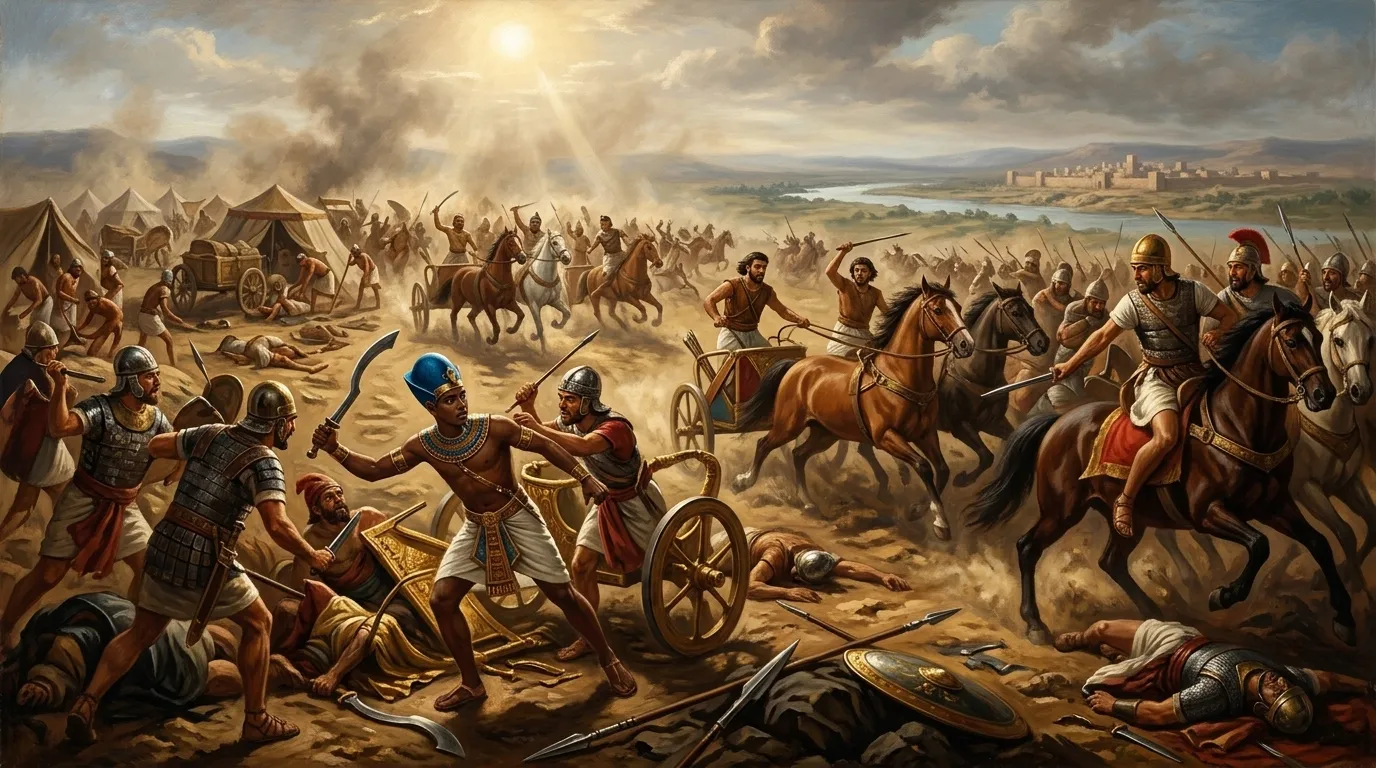
Just as the Hittite chariots begin to close around Ramesses II, forcing him to fight on foot, a new dust cloud appears on the northern horizon, startling both Egyptian and Hittite alike. The ground trembles anew. It is the Ne'arin, a contingent of Canaanite auxiliaries, who were marching separately, attached to the Ptah division. Seeing the chaos, they charge into the exposed flank of the Hittite chariots, many of whom are now dismounted, greedily plundering the Egyptian camp. The sudden, unlooked-for assault catches the Hittites completely off guard, turning their focus from the trapped pharaoh. Ramesses, a fierce young warrior, seizing this miraculous reprieve, scrambles back into his chariot. His eyes, burning with renewed determination, scan the battlefield, seeking any opportunity to rally his shattered forces. The air, thick with dust and the stench of burnt offerings, now also carries the shouts of new combatants.
Page 7
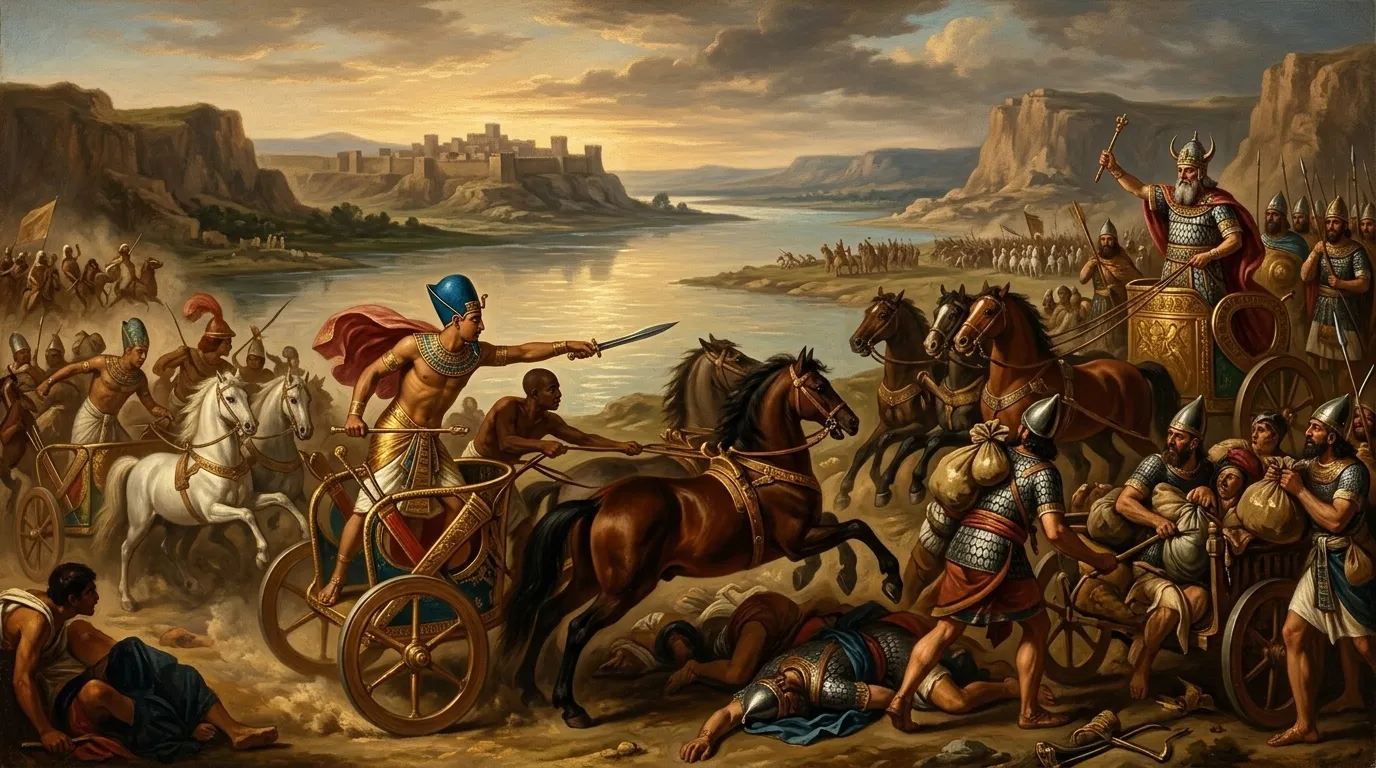
The plain of Kadesh transforms into a maelstrom of counter-attacks. Seizing the momentum created by the Ne'arin's intervention, Ramesses II, a king reborn in battle, rallies his surviving Amun division troops. With renewed ferocity, he leads his chariots in a devastating series of charges, driving the heavily laden Hittite chariots, many struggling with the spoils of their plunder, back towards the Orontes. Across the river, Muwatalli II, the Great King of Hatti, a stoic and formidable leader in his forties, watches the tide turn. He commits his final reserve of a thousand chariots, hoping to stem the Egyptian resurgence. The two vast forces clash in a brutal, protracted struggle, neither able to gain a decisive advantage. Arrows darken the sky, and the ground becomes slick with mud and blood. The roar of battle is relentless, a symphony of destruction.
“Drive them back! Push them to the river! For Amun! For Egypt!”
Page 8
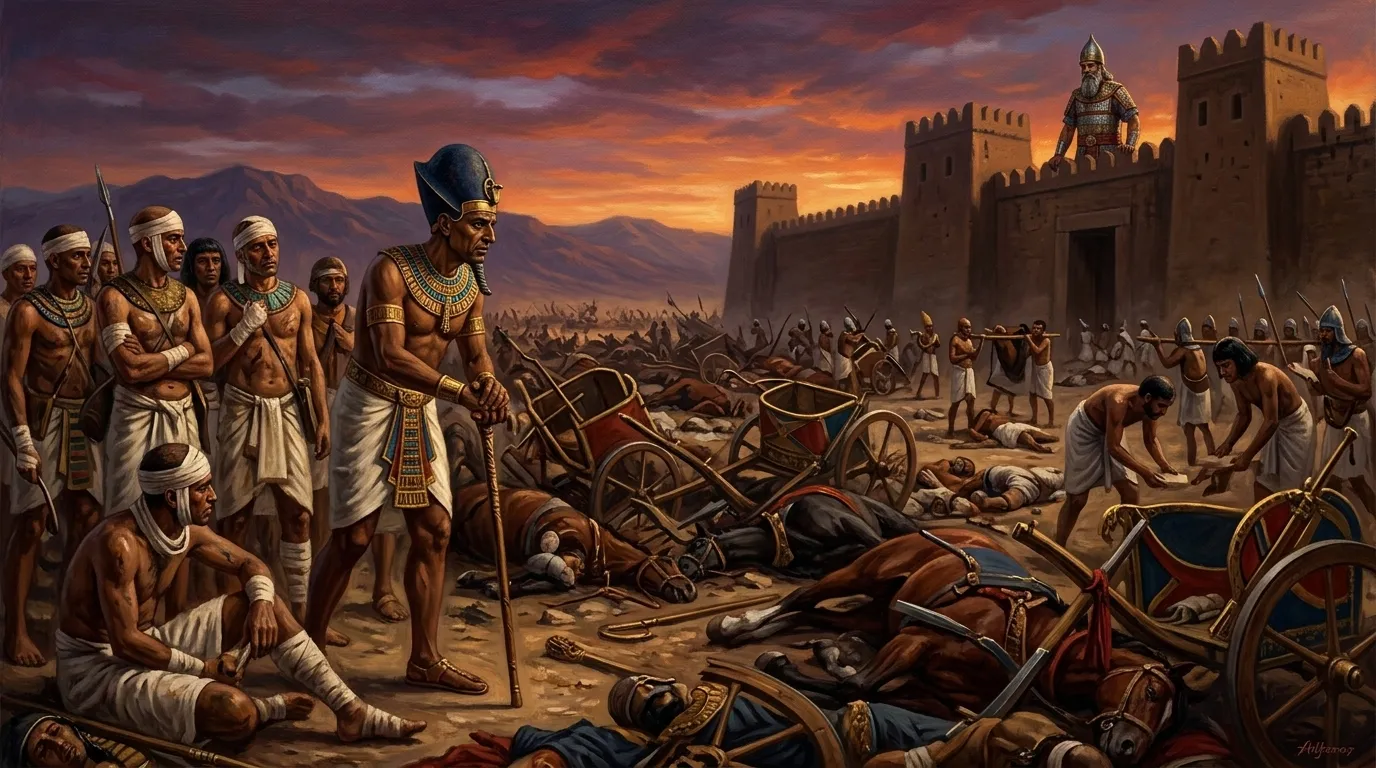
As twilight descends upon the plains outside Kadesh, the fighting slowly ebbs, leaving behind a scene of unspeakable devastation. Thousands of chariots, both Egyptian and Hittite, lie shattered, their wheels broken, their horses dead. Countless warriors, from both empires, litter the bloodied ground. Muwatalli II, having committed his entire reserve, surveys the carnage from atop the walls of Kadesh. Though his army fought valiantly, the element of surprise was lost, and the Egyptian pharaoh's desperate resilience prevented a complete rout. Ramesses II, now a weary but unbowed man, perhaps twenty-six years old, leans heavily on a simple wooden staff, his khepresh crown askew. He stands amidst his exhausted but still-formed troops, gazing at the distant, unyielding walls of Kadesh. The strategic prize remains untaken. The cost of victory, or even a draw, is now starkly clear. The air is heavy with the stench of death and the acrid smell of burnt wood from the camps.
Page 9
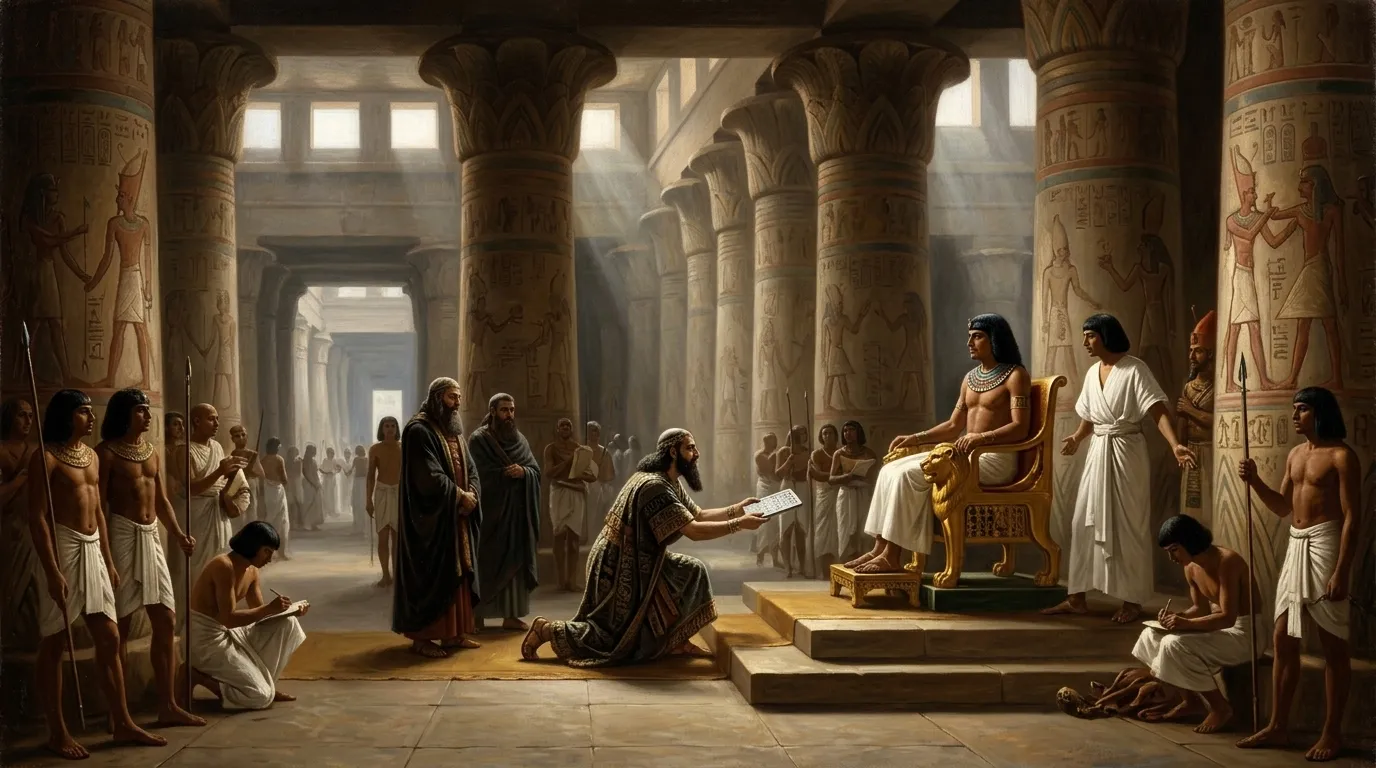
Sixteen years after the harrowing day at Kadesh. In the opulent Audience Hall of the Great Palace in Pi-Ramesses, the new capital city now thriving in the Nile Delta, a moment of profound historical significance unfolds. Ramesses II, now a powerful ruler in his early forties, his shoulders broader, his face etched with the wisdom of decades, sits upon his majestic throne. Before him, ambassadors from the Hittite Empire, led by an older, distinguished official representing Hattusili III, now the Great King of Hatti, kneel. They present a silver tablet, its surface gleaming, inscribed with hieroglyphs and cuneiform. It is the Treaty of Kadesh, the world's first surviving written peace treaty. Its terms declare a 'good peace and brotherhood' between the two great powers, promising mutual defense against invasion and the extradition of fugitives. The once bitter rivals, through years of diplomatic exchange, have forged a lasting accord, transcending the bloody memory of Kadesh. The air in the hall is rich with the scent of cedar and expensive incense.
“Let there be eternal peace between the Great King of Egypt, Ramesses, and the Great King of Hatti, Hattusili, from this day forth!”
Page 10
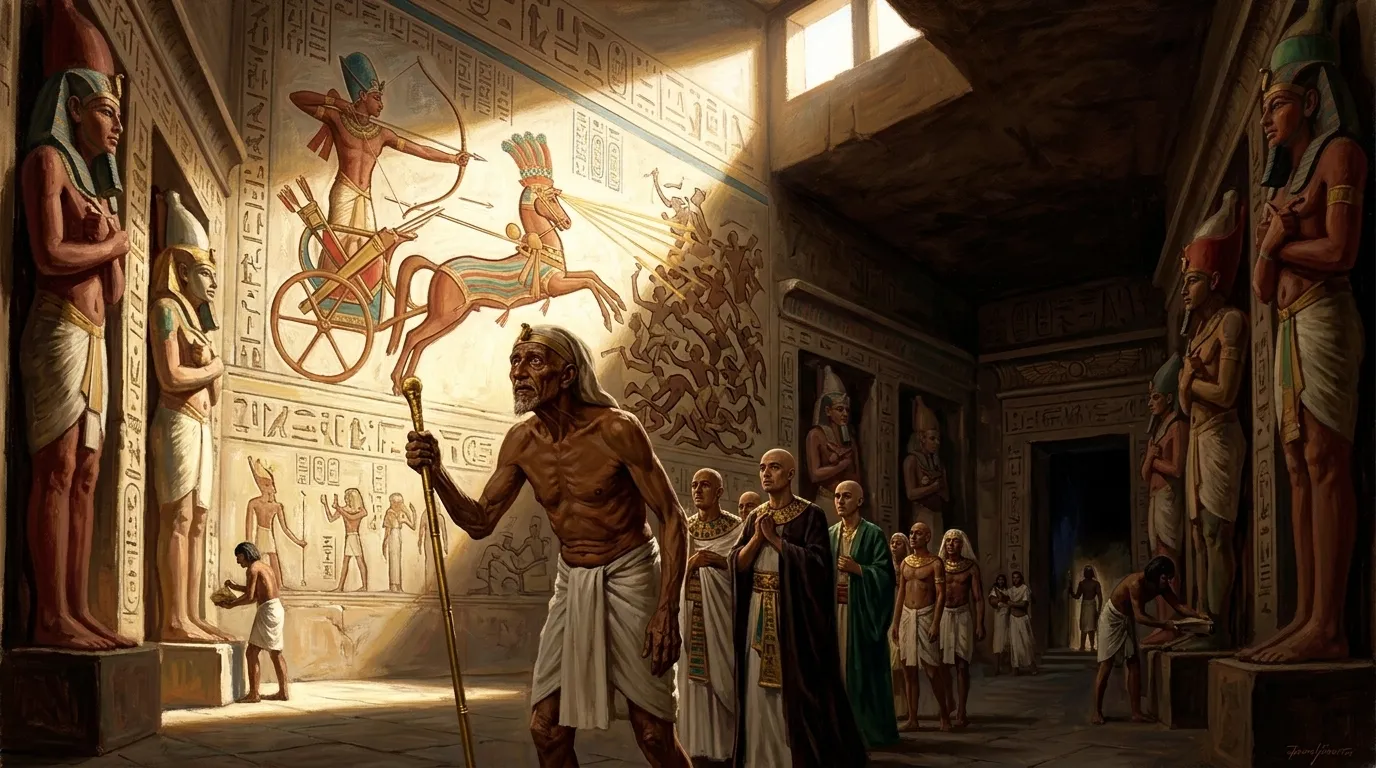
Decades after Kadesh, at the colossal Great Temple of Ramesses II at Abu Simbel, carved into the sandstone cliffs of Nubia. Ramesses II, now an ancient king in his eighties, his body frail and slightly stooped, his once powerful frame diminished by time, walks slowly through the vast hypostyle hall. He leans upon a gilded wooden staff, his steps deliberate. Priests and officials follow deferentially, their hushed voices barely breaking the echoing silence. Towering reliefs and inscriptions cover every wall, depicting the Battle of Kadesh. Here, the pharaoh, eternally youthful and muscular, is shown as a solitary heroic figure, personally vanquishing thousands of fleeing Hittite chariots. This propaganda, known as the 'Poem of Pentaur', omits the near-defeat and the crucial intervention of the Ne'arin, transforming a desperate draw into a glorious, single-handed triumph. The peace forged at Kadesh, however, held for over a century, a testament to its enduring power, even as the narrative of the battle itself was endlessly reshaped to serve the pharaoh's eternal glory. The air is cool and dry, smelling of ancient stone and dust.
About this story
- Audience: general readers
Questions and answers
Read Wonder Egypt on your phone
Wonder Egypt is available on Android. Get Wonder Egypt on Google Play.