The Rosetta Stone
The Rosetta Stone — an illustrated history story. 10 illustrated pages, free to read on Wonder Egypt.
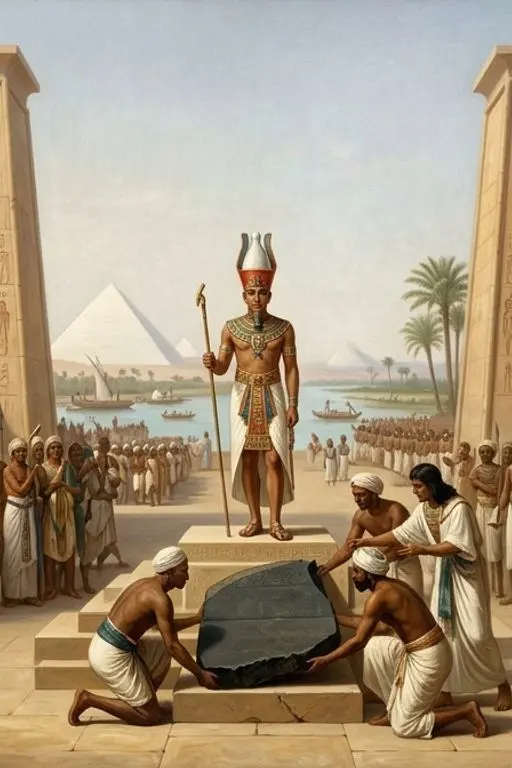
Page 1
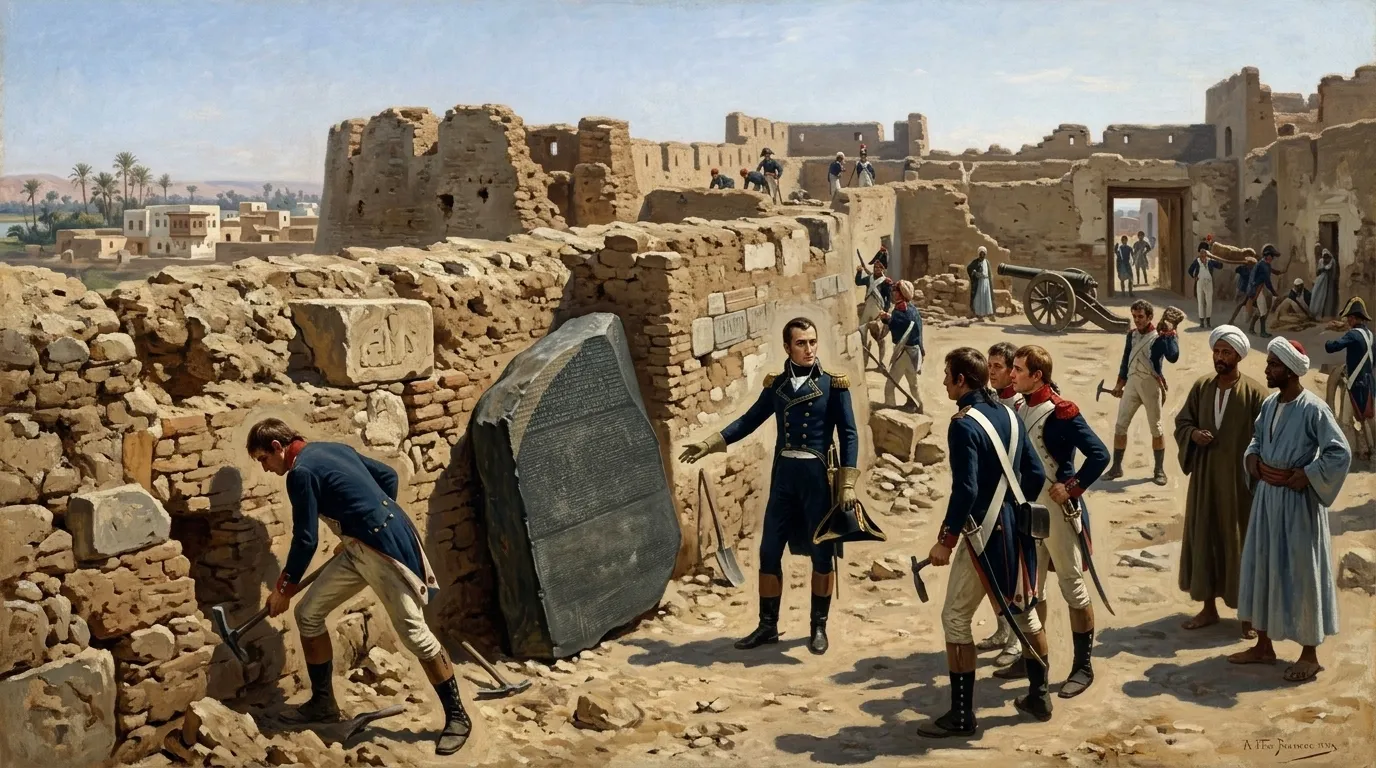
The year is 1799 of the Christian reckoning, the month July, in the sun-baked dust of Rashid, ancient Rosette, on the western arm of the Nile Delta. Beneath the scorching Egyptian sun, the walls of Fort Julien begin to yield. French engineers and soldiers, toiling to strengthen the ancient Mamluk bastion against expected British assault, hack at the crumbling stonework. Sergeant Pierre-François Bouchard, a man of engineering, oversees the labor. As pickaxes strike and pry, a massive block of dark stone, unlike any other in the wall, slowly tilts free. It is polished on one face, inscribed with three distinct bands of writing: the pictographic script of the pharaohs at the top, a cursive Egyptian hand in the middle, and the script of the Greeks at the bottom. The air, thick with the smell of sun-baked earth and sweat, briefly stills. Bouchard, his eyes tracing the unfamiliar yet orderly lines, senses a profound significance in this unexpected find, a weight of ages suddenly laid bare. He directs his men to carefully extract the slab, a silent testament emerging from its long burial.
Page 2
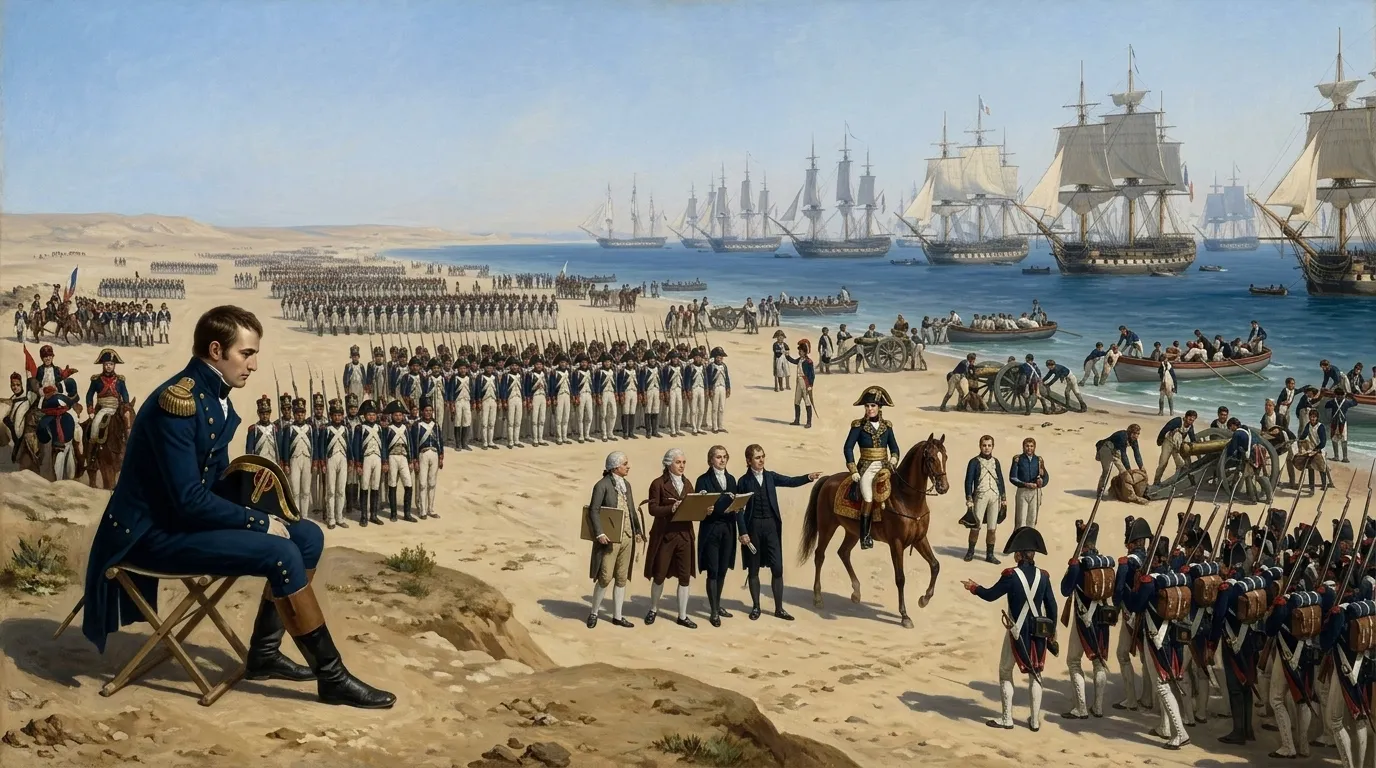
Two years prior, in the summer of 1798, a vast French fleet, bearing General Napoleon Bonaparte and his legions, had anchored in the Bay of Abukir, its sails once swelling with the ambition to conquer Egypt. With the military might came a contingent of scholars, savants, and artists—a Commission of Sciences and Arts, numbering over 160 minds. Their mandate was not merely to subjugate, but to catalogue, to understand, to unveil the secrets of this ancient land. From the moment their boots touched the sands near Alexandria, these men fanned out, sketching monuments, measuring ruins, collecting specimens of flora and fauna. The expedition was a grand intellectual enterprise, intent on bringing the light of European reason to the enigmatic Nile Valley. In Cairo, amidst the chaos of occupation, they established institutions, the Institut d'Égypte among them, where scrolls were unrolled, and ancient texts, albeit still unreadable, were studied. The stage was set for revelations, though none knew from where the true understanding would emerge.
Page 3
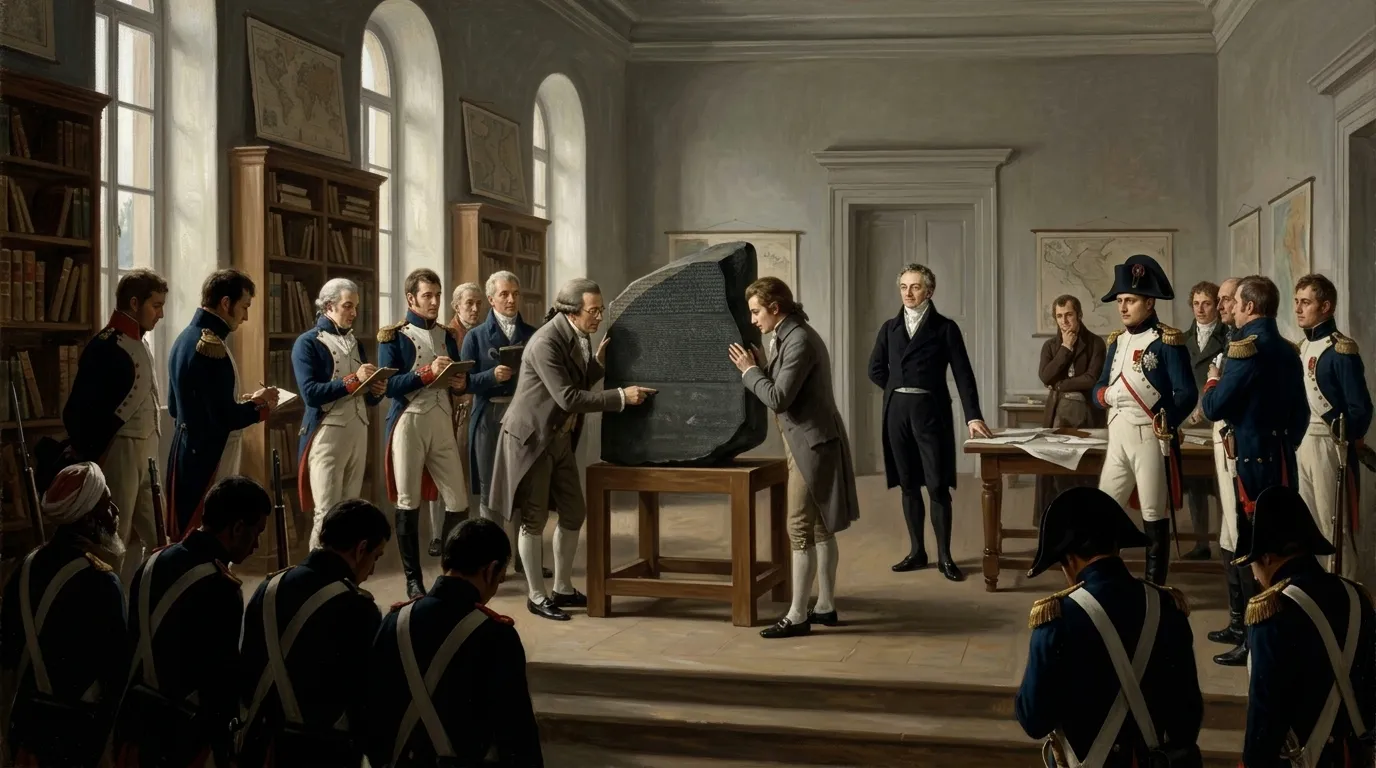
News of the dark, inscribed stone quickly reached the scholarly circle within the Institut d'Égypte in Cairo. By August 1799, the slab, now carefully transported from Rashid, lay within the Institut's walls, presented for examination. Jean-Joseph Marcel, director of the expedition's printing press, a man of letters and a keen observer, along with Édouard de Villiers du Terrage, a young engineer, were among the first to scrutinize its surface. They saw the fractured hieroglyphs at the top, the elegant Greek at the bottom, and the mysterious intermediate script. The Greek, thankfully, was legible. It spoke of a decree issued by Egyptian priests in Memphis, honoring Ptolemy V Epiphanes in the year 196 BCE. The crucial phrase, 'This decree shall be inscribed on a stela of hard stone in sacred, native, and Greek characters,' immediately captured their attention. A wave of excitement rippled through the gathered savants. This was not merely an artifact; it was a potential key, a promise of access to a language that had been silent for fourteen centuries, its secrets locked in monumental walls and papyrus scrolls. Copies were quickly commissioned, both by hand and with ink, to disseminate this monumental discovery.
Page 4
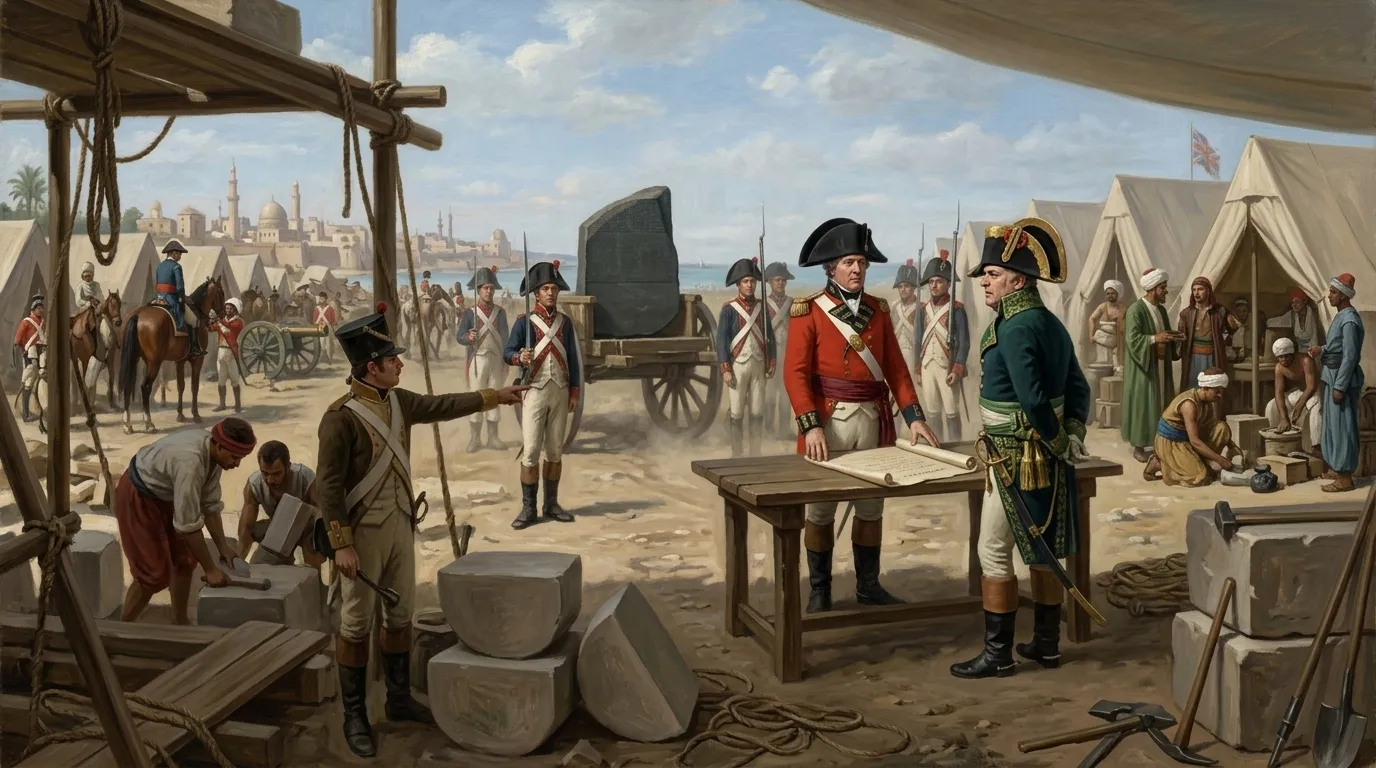
As the war in Egypt turned against the French, the Rosetta Stone became a prize of contention. In 1801, with the British advancing on Alexandria, General Jacques-François Menou, the French commander-in-chief, saw the stone not merely as a scientific marvel but as a symbol of French intellectual triumph. He refused to surrender it, despite the escalating military defeats. The French forces, besieged and demoralized, fought a losing battle. Following the capitulation of Alexandria, the Treaty of Alexandria was signed. The British, aware of the stone's significance through earlier reports and captured copies, demanded its transfer. Menou, defiant to the last, attempted to conceal it, claiming it was his private property. But the British forces, led by figures like William Richard Hamilton, a diplomat and antiquarian, were resolute. They uncovered the hidden slab amidst Menou’s personal baggage. The transfer was not a polite exchange; it was a firm seizure, a spoils of war that transcended gold and weaponry, representing the very knowledge of a lost civilization.
“The Stone belongs to France! It is a part of my personal collection!” cries the French General, his voice hoarse with indignation. A British officer, stern-faced, replies, “The terms of capitulation are clear, General. All antiquities discovered by your expedition are now the property of His Majesty’s forces.”
Page 5
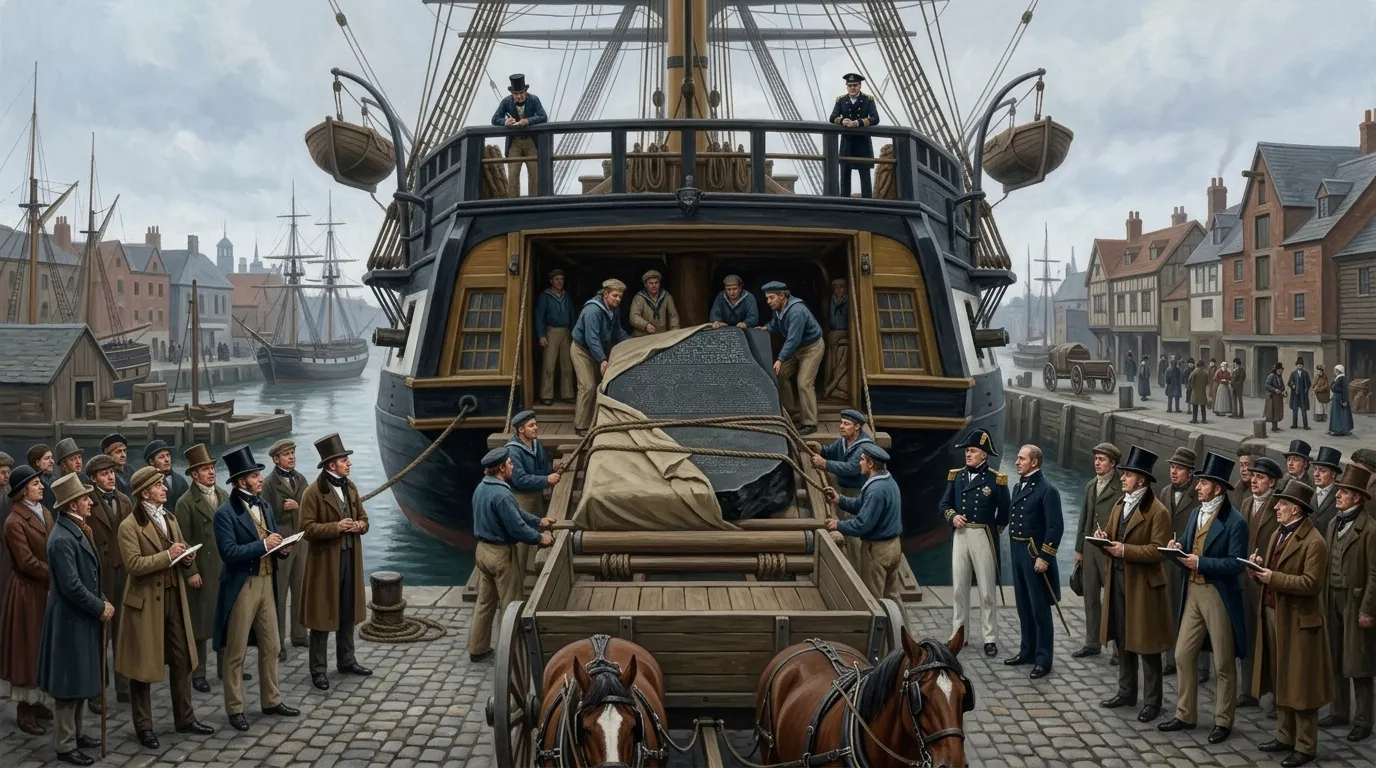
Once secured by the British, the Rosetta Stone embarked on its momentous journey. Wrapped in canvas and carefully stowed aboard a captured French frigate, the HMS Egyptienne, the precious cargo traversed the Mediterranean Sea, bound for England. The voyage was swift, propelled by favorable winds. The heavy stone, emblematic of a distant land and an ancient past, was a silent passenger, its secrets still unyielding. On the cold English shores of Portsmouth, in February of 1802, the ship docked. From there, it was transported to London, a city bustling with the mercantile and intellectual energy of a new century. Before it found its permanent home, the stone was briefly displayed at the Society of Antiquaries, allowing scholars and curious citizens alike their first direct glimpse of the artifact that promised to unlock Egypt's forgotten voice. A palpable excitement accompanied its arrival, a sense that something truly transformative had been brought to British soil, a key to a world previously unimaginable.
Page 6
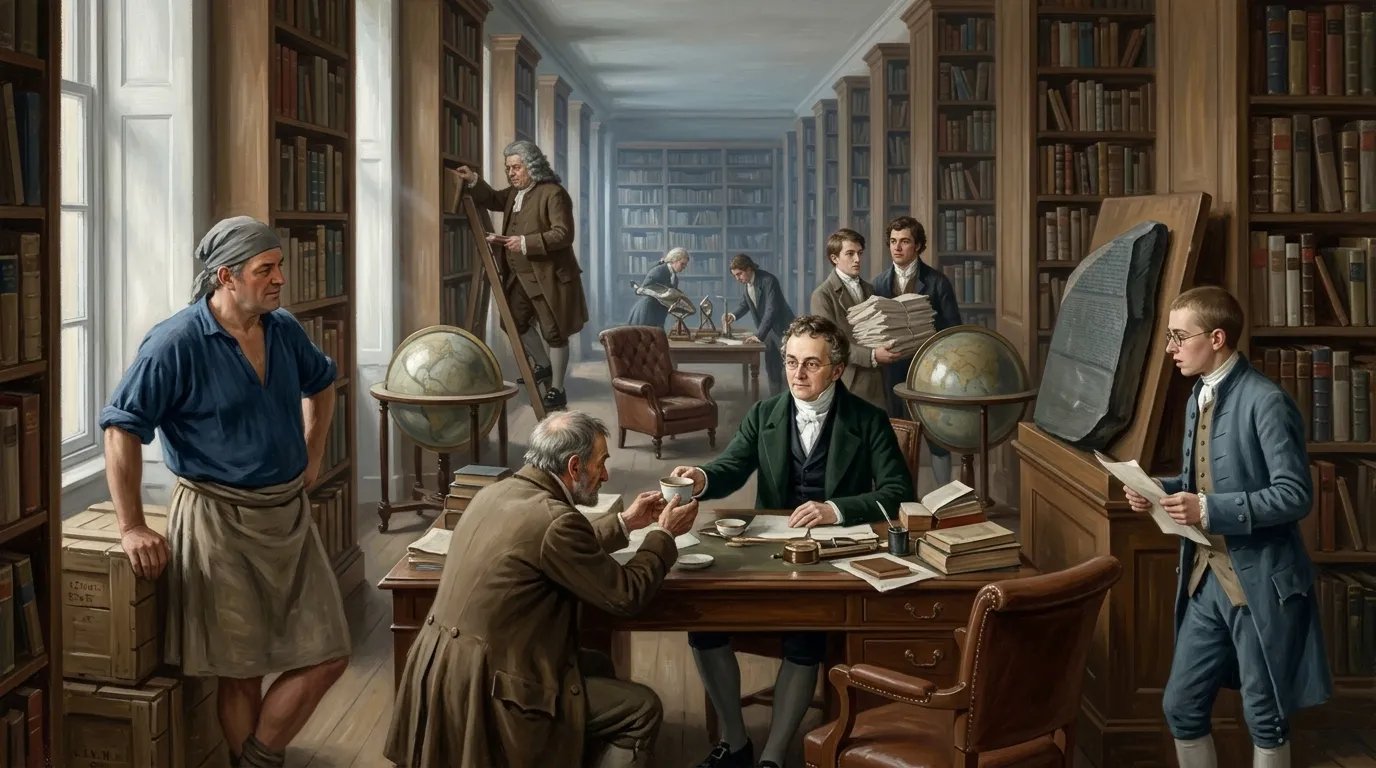
In London, the Rosetta Stone became a focal point of scholarly endeavor. Among the first to seriously tackle its mystery was Thomas Young, a polymath of prodigious intellect, a physician, physicist, and linguist. Working from copies and direct observation in the British Museum, Young, in his studies around 1814, focused intently on the middle script, which he correctly identified as demotic, a cursive form of ancient Egyptian. He began by comparing the demotic with the known Greek text, painstakingly searching for recurring patterns and proper names. His genius allowed him to make significant initial breakthroughs. Young discerned that some hieroglyphs were phonetic, particularly those used for foreign names like 'Ptolemy' and 'Cleopatra' within cartouches—the oval enclosures signifying royal names. He correctly identified several phonetic values and established that the demotic script was partially alphabetic, partially syllabic. Though he could not fully decipher the hieroglyphs, his insights formed the crucial foundational steps, a daring leap into the darkness that would guide others to the full light of understanding.
Page 7
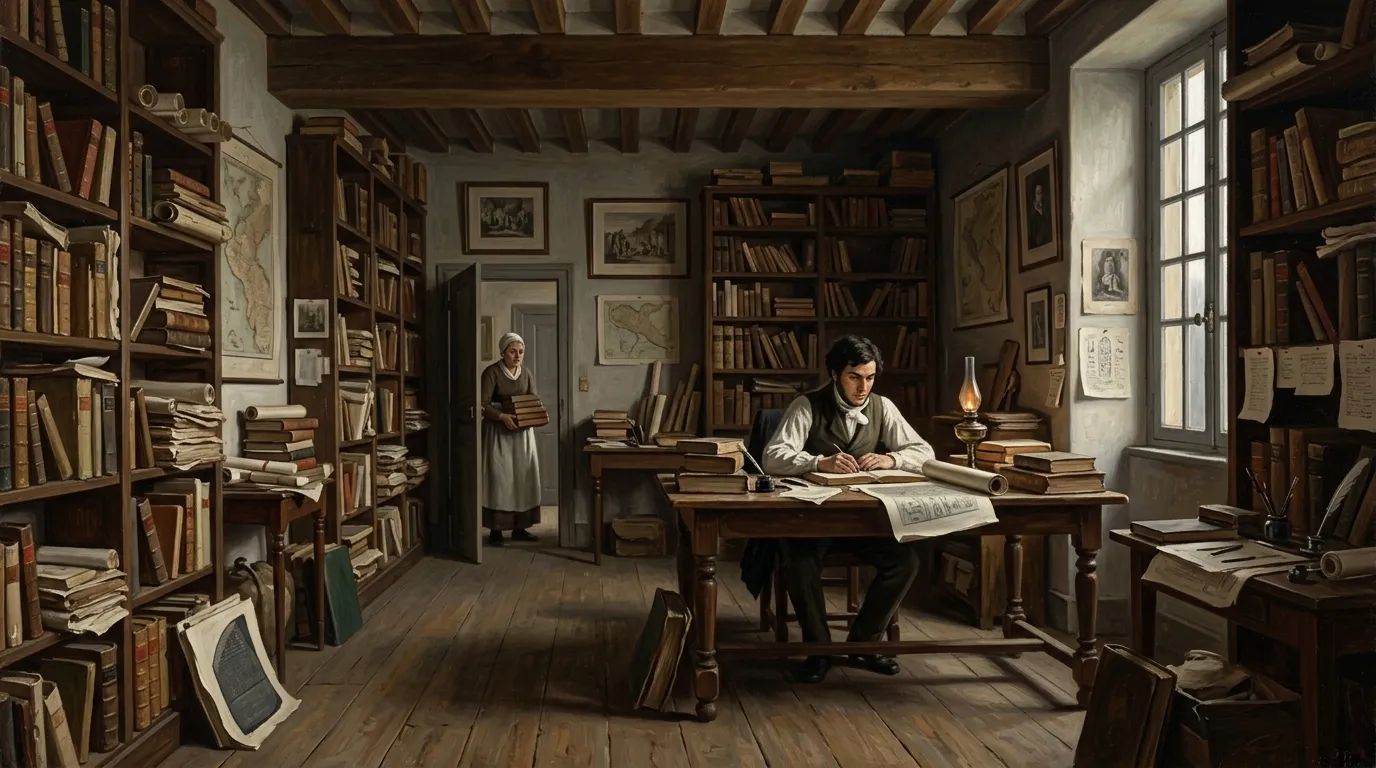
Across the Channel, in Grenoble, France, a young man named Jean-François Champollion nurtured an extraordinary obsession. Even as a boy in the early 1800s, he had been captivated by the tales of Napoleon's Egyptian expedition and the mysterious scripts it brought to light. Unlike Young, Champollion dedicated his entire academic life to Egyptology, learning Coptic, the late descendant of the ancient Egyptian language, believing it held the key. He devoured every available copy of the Rosetta Stone, every inscription brought back from the Nile. By his early twenties, a slender, intense youth, Champollion’s study was a cluttered sanctuary of knowledge, overflowing with texts, maps, and drawings of hieroglyphs. He worked relentlessly, driven by a singular purpose: to hear the voices of the pharaohs. The lack of complete decipherment, despite Young's progress, fueled his frustration and his determination. He believed the hieroglyphs were not merely symbolic, as many assumed, but contained a phonetic element, an idea solidified by his deep understanding of Coptic.
Page 8
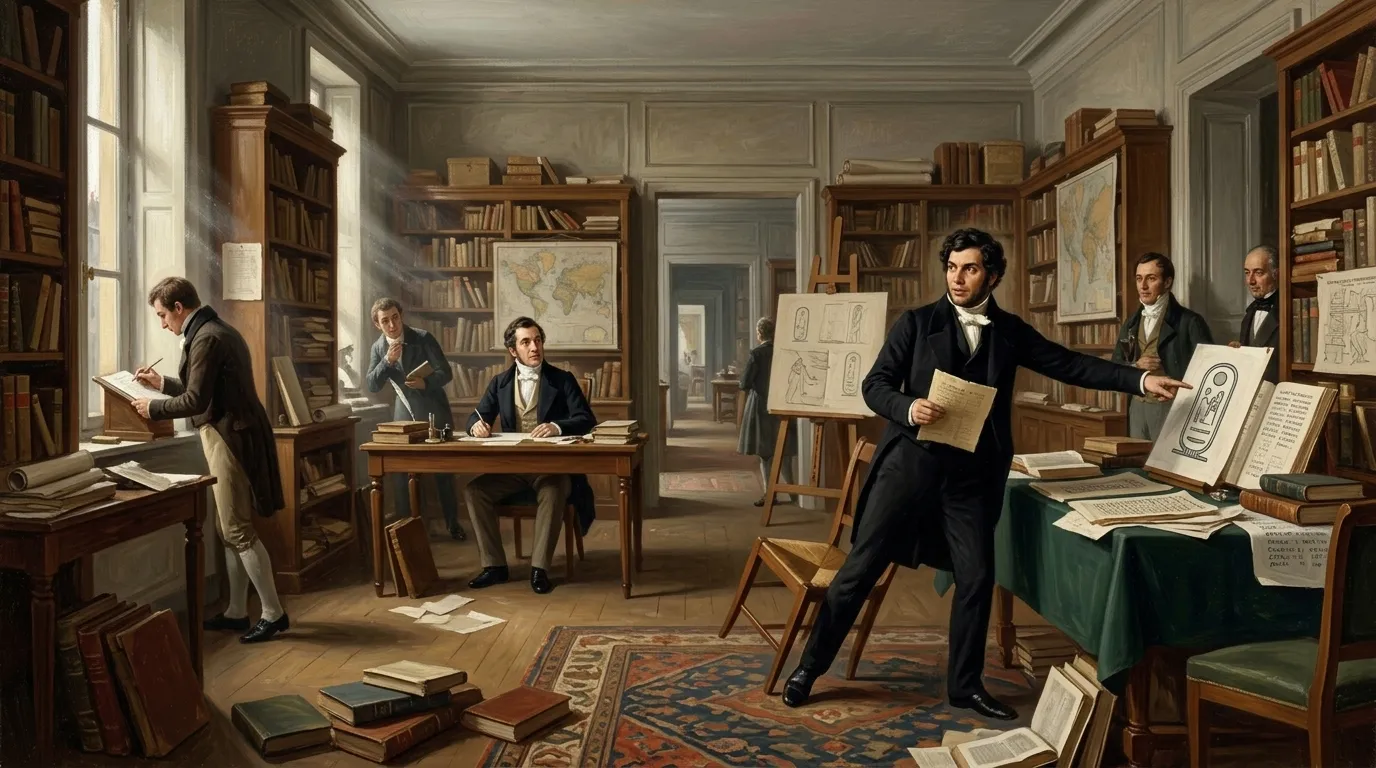
The year is 1822 in Paris, and Jean-François Champollion, now a man nearing thirty-two, his slight frame thrumming with nervous energy, stands before a crucial insight. He had received newly acquired copies of inscriptions from the temple at Abu Simbel, particularly a cartouche containing four distinct signs. Simultaneously, he re-examined the Rosetta Stone’s cartouches and those from the Philae Obelisk, where the name 'Cleopatra' was written. Combining Thomas Young’s earlier work on 'Ptolemy' with the new evidence, Champollion made the monumental leap. He realized that the hieroglyphs within the royal cartouches were not purely symbolic, but primarily phonetic, spelling out the names of pharaohs and queens. He saw the phonetic values of the sun disk for 'Ra' and the 's' sound, connecting them with Coptic. The moment of revelation, the 'eureka' that rewrote history, struck him like a bolt of lightning. He raced from his study to his brother's office, crying, 'Je tiens l'affaire!' — 'I've got it!' The silent tongue of Egypt had finally begun to speak, through the humble cartouche.
“Je tiens l’affaire!” cries a man, his voice trembling with a profound revelation. He gestures wildly towards a document. His brother, startled, asks, “What is it? What have you found?” The first man, breathless, replies, “The names, the names! They are not symbols alone, but sounds! The pharaohs speak!”
Page 9
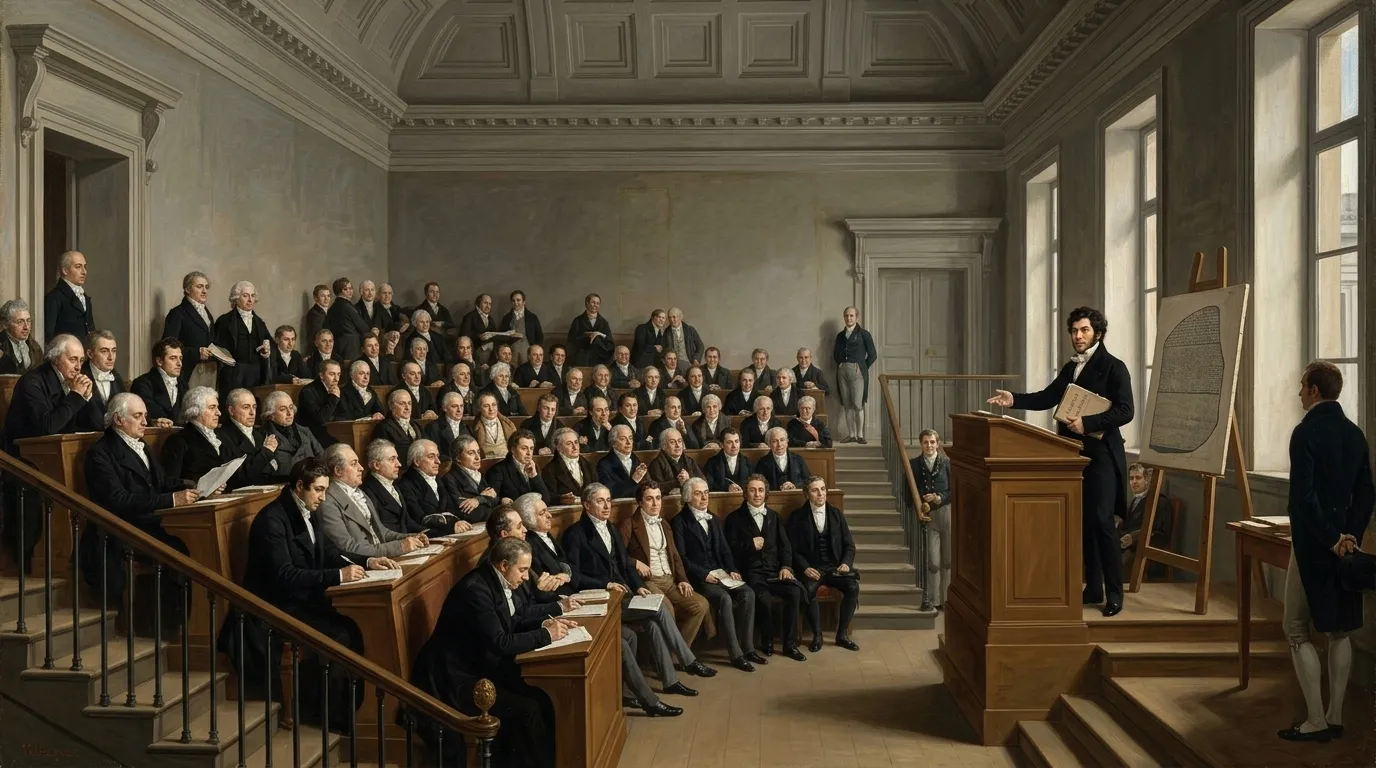
On September 27, 1822, before the esteemed Académie des Inscriptions et Belles-Lettres in Paris, Jean-François Champollion presented his monumental findings in his 'Lettre à M. Dacier.' With quiet dignity, yet radiating immense intellectual power, he systematically laid out his evidence: the comparison of the hieroglyphic, demotic, and Greek scripts on the Rosetta Stone, his insights into the phonetic nature of cartouches, and his ability to read the names of pharaohs long silent. The room, filled with Europe's most brilliant minds, listened in rapt attention as he demonstrated how the seemingly pictorial hieroglyphs could be translated into sounds and words, matching the Coptic language he knew so well. He revealed the system, a complex blend of phonetic, ideographic, and determinative signs, that governed the ancient tongue. A profound silence descended as the implications settled: a civilization buried under millennia of sand and incomprehensibility was now, literally, speaking again. The weight of fourteen centuries of silence was lifted, and the stories of Egypt, from the earliest kings to the Ptolemaic Greeks, were once more accessible to humankind.
“...and thus, gentlemen, the names of the pharaohs, long obscured by mere pictograms, reveal their true phonetic values! The Coptic tongue holds the key!” declares Champollion, his voice resonating with clarity.
Page 10
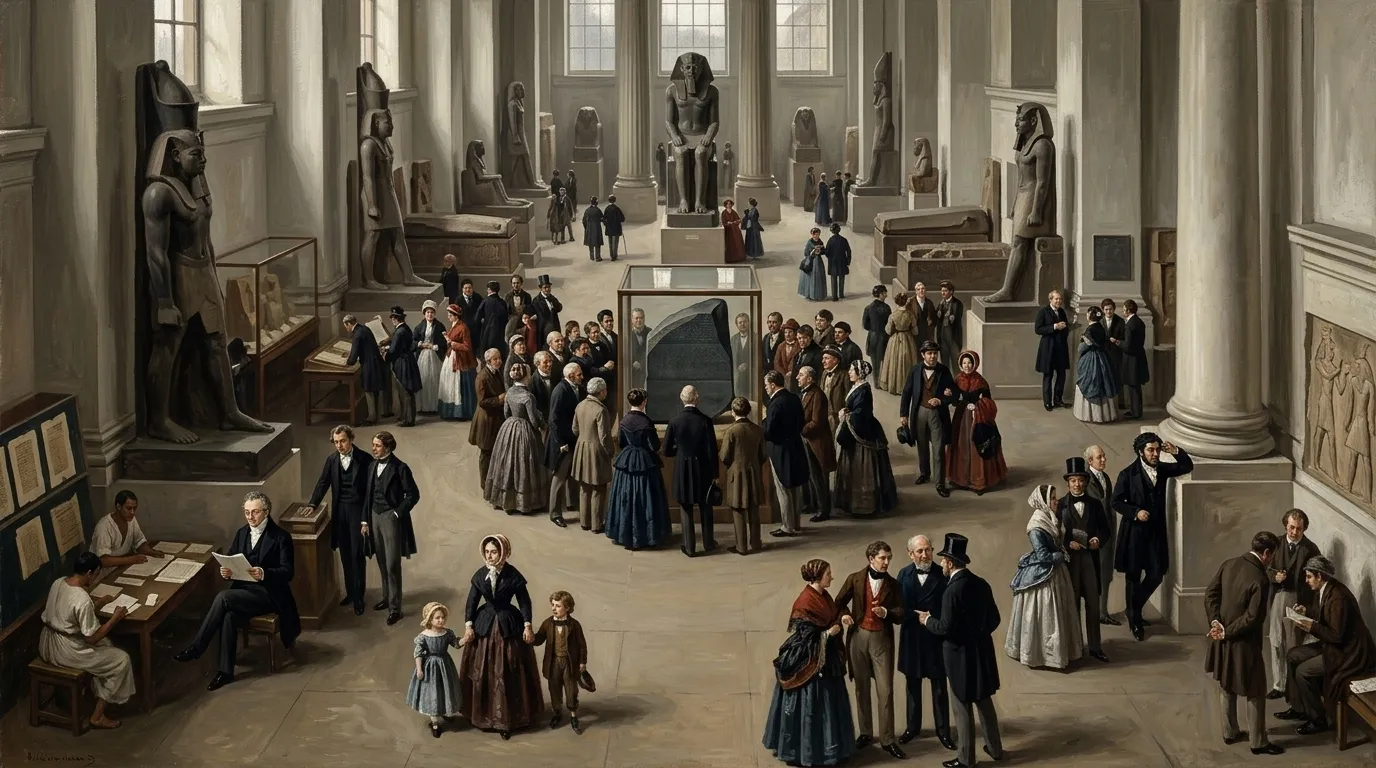
The decipherment of the Rosetta Stone, achieved primarily by Jean-François Champollion, irrevocably altered humanity's understanding of ancient Egypt. The single dark slab, now residing permanently in the British Museum, became the bridge between a lost world and the modern mind. With the hieroglyphic system understood, scholars flocked to the Nile Valley, now able to read the inscriptions on colossal temple walls, the texts in royal tombs, and the narratives on papyri. The faces of pharaohs, once mute, now spoke their names, their deeds, their religious beliefs, and their aspirations across millennia. Akhenaten's revolutionary monotheism, the military campaigns of Ramesses the Great, the burial rituals of Tutankhamun – all these, and countless other narratives, emerged from the silence. The Rosetta Stone did not merely translate a decree; it resurrected an entire civilization, allowing its majestic voice to echo once more, transforming Egypt from an enigma into a vibrant, accessible chapter in human history. Its legacy is the endless flow of knowledge that continues to spill from the sands, ceaselessly enriching our understanding of antiquity.
About this story
- Audience: general readers
Questions and answers
Read Wonder Egypt on your phone
Wonder Egypt is available on Android. Get Wonder Egypt on Google Play.