The Great Sphinx of Giza
The Great Sphinx of Giza — an illustrated history story. 10 illustrated pages, free to read on Wonder Egypt.
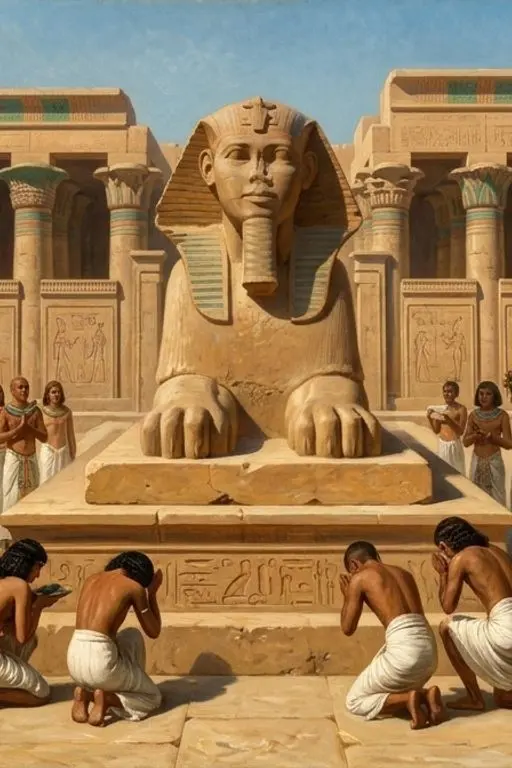
Page 1
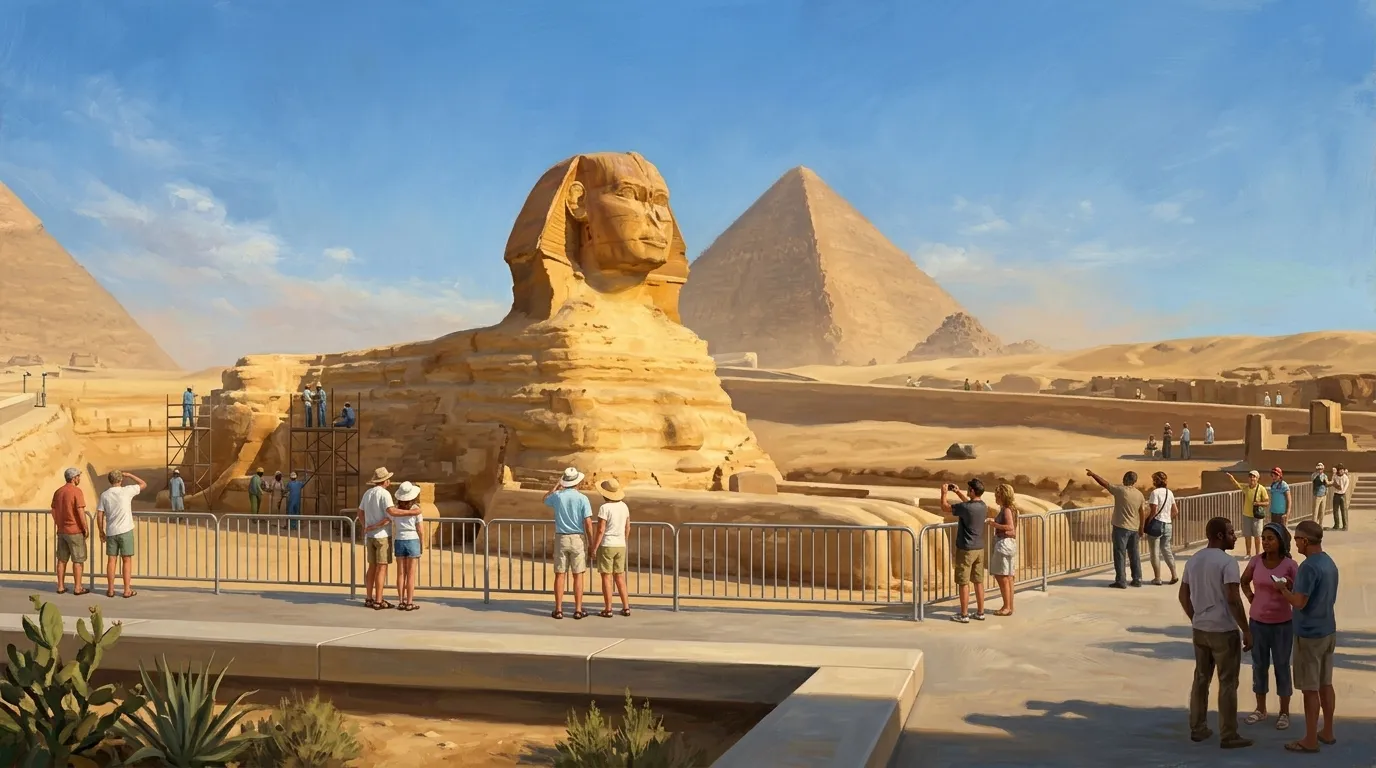
Here, on the sun-baked expanse of the Giza Plateau, the Great Sphinx stands sentinel, a colossal creature carved from the very bedrock of this ancient land. Before you, the limestone titan, approximately 20 meters (66 feet) high and 73 meters (240 feet) long, commands the horizon, its lion's body poised in eternal repose, its human head gazing eastward towards the rising sun. Three millennia have worn its surface, softened its edges, yet its immense presence is undiminished. The absence of its original nose, and the faint traces where a ceremonial beard once adorned its chin, are details a visitor cannot ignore, hinting at a past both grand and turbulent. It is a monolithic testament to the enduring power of the Fourth Dynasty, an age that began over 4,500 years ago. To comprehend its genesis and its many rebirths, one must understand its builders, its dreamers, and its rediscoverers. This journey will also touch upon the 'Dream Stele' of Thutmose IV, found nestled between its paws, and the awe-inspiring diorite statue of Khafre, unearthed from his nearby Valley Temple, both fragments of its grand narrative.
Page 2
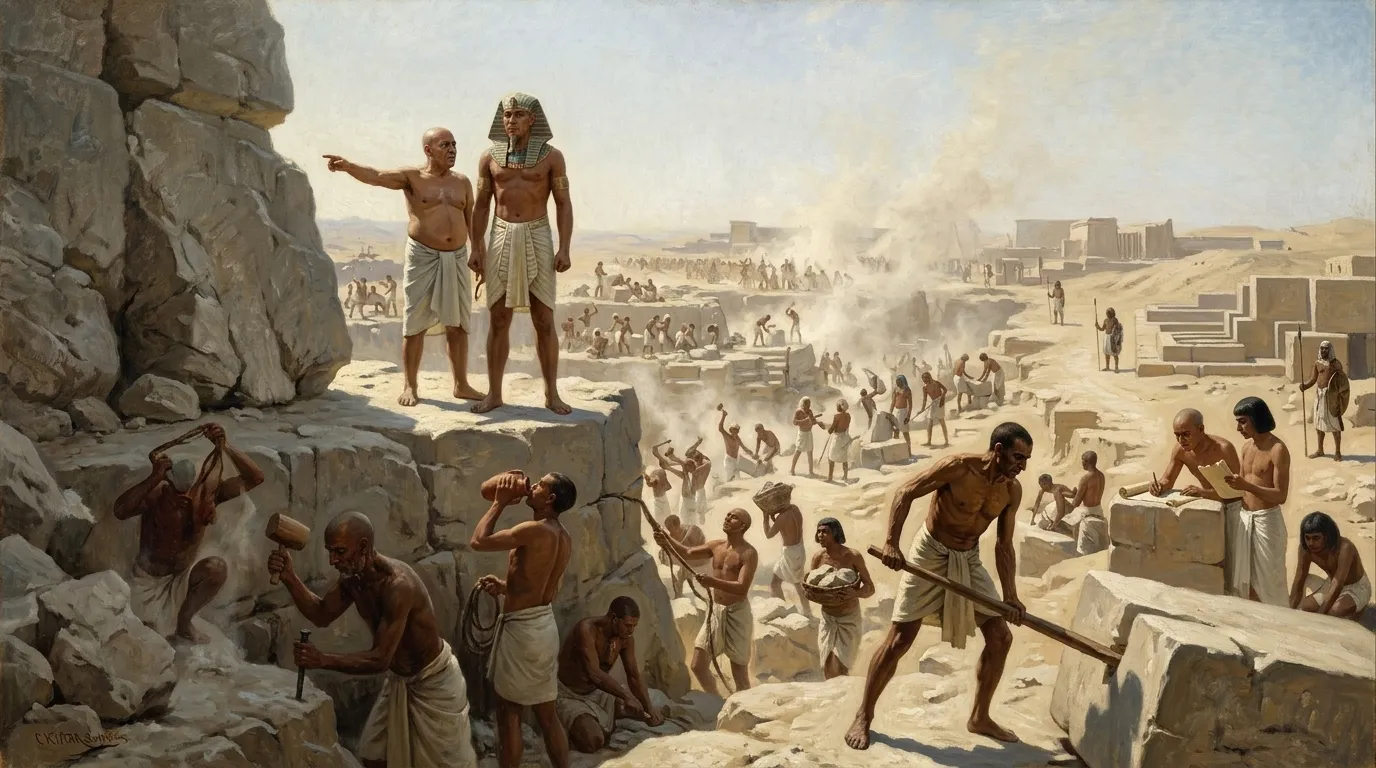
Four thousand five hundred and seventy-eight years ago, on the rugged, sun-blasted plateau of Giza, the very ground trembled with the work of men. Pharaoh Khafre, a man in his late thirties, robust and commanding, stood with his Vizier, Hemiunu, an older man with the quiet authority of long experience, surveying a natural rise of limestone bedrock. The air was thick with the dust of quarrying, the rhythmic clanging of copper chisels against stone echoing across the nascent necropolis. Khafre gestured with a powerful sweep of his arm, encompassing the raw, untamed stone. His vision was not merely for a monument, but for a living deity, a guardian embodying his own strength and the divine protection of the sun god, Re. The Vizier, a master of every royal work, listened intently, his aged eyes already calculating the immense task of transforming this unforgiving landscape into an eternal symbol. This was not a request, but a decree that would bind thousands of lives to the shaping of stone.
Khafre: "From this mountain, a lion-bodied guardian shall rise, bearing my likeness, facing the sunrise. It shall stand forever, a witness to my reign and a protector of this sacred place."
Hemiunu: "It shall be as your Majesty commands. The rock itself shall yield to your will, transformed into a visage of enduring power."
Page 3
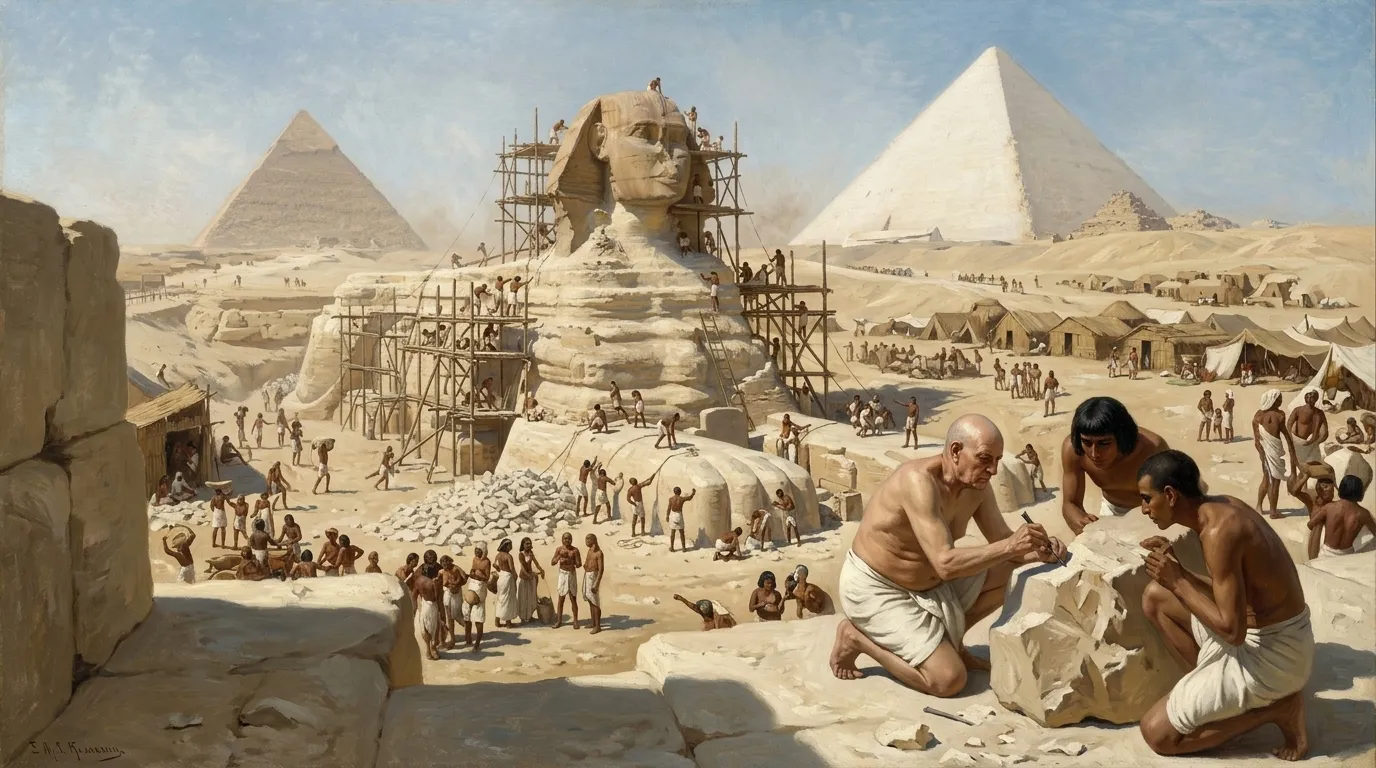
Months, then years, passed in the relentless work of carving. At the base of the colossal stone, hundreds of skilled artisans toiled under the merciless desert sun. The Master Sculptor, a man of quiet focus and immense practical knowledge, directed his teams. He moved amongst them, his hands calloused, occasionally demonstrating a precise blow with a stone hammer and copper chisel on a rough section of the lion's paw. Each stroke chipped away at the raw limestone, slowly revealing the mighty limbs and musculature of the mythical beast. The scale of the endeavor was staggering; scaffolds of timber and mud-brick surrounded the upper sections, where other sculptors painstakingly shaped the broad chest and shoulders. The air was filled with the gritty smell of pulverized rock, the constant 'tap-tap-tap' of tools, and the shouts of foremen. This was not merely construction; it was an act of creation, bringing a divine presence into being from the earth itself.
Page 4
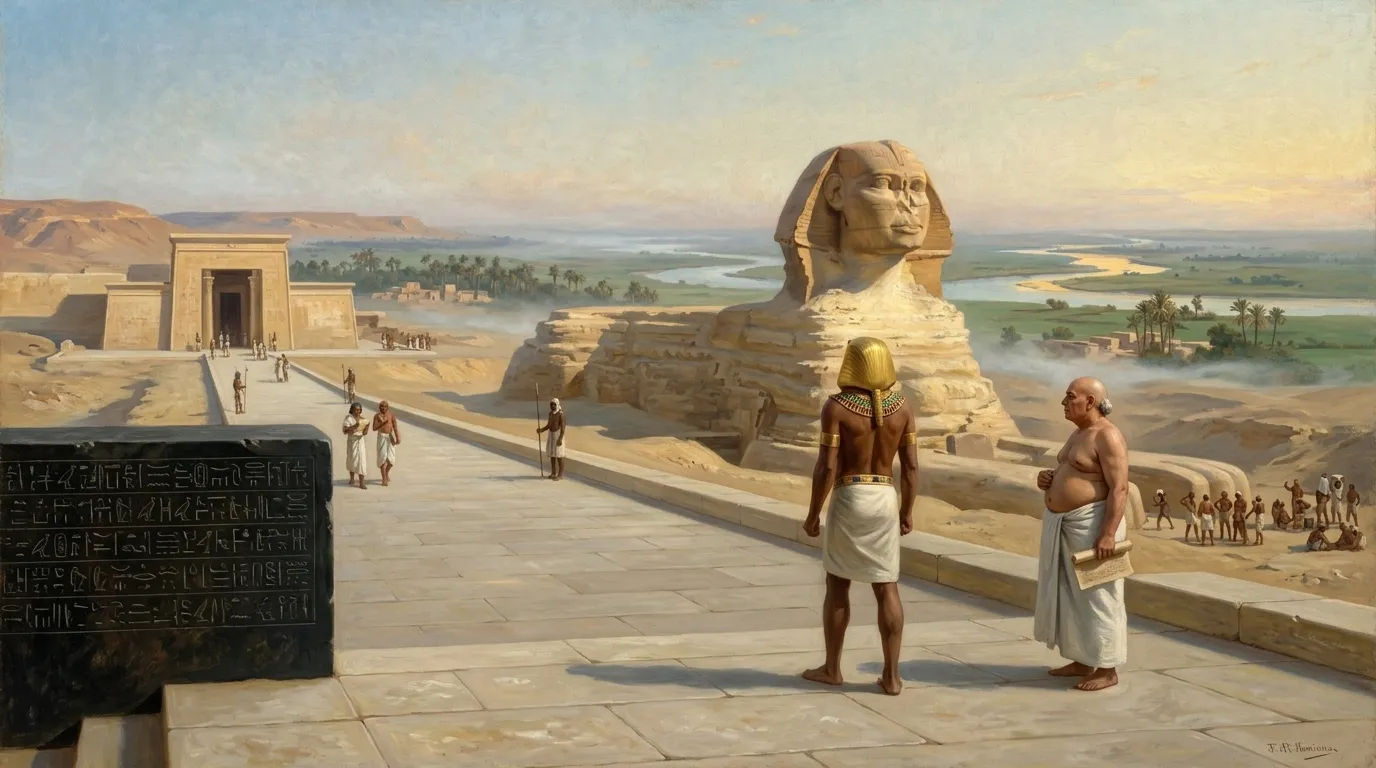
Finally, after years of relentless labor, the Great Sphinx stood complete, its lion's body solid, its human head gazing east. Pharaoh Khafre, now a man in his early forties, his presence radiating immense power, stood at the approach to his Valley Temple, his eyes fixed upon the immense statue. The Vizier, Hemiunu, stood a respectful distance behind him, observing the pharaoh's contemplation. The first rays of the morning sun struck the Sphinx's visage, illuminating its features with a golden light, a testament to its connection with the sun god. A palpable silence hung over the newly finished complex, broken only by the distant murmur of the Nile. For Khafre, this monument was an embodiment of his divine right, a permanent extension of his ka, guarding his sacred burial grounds. The very landscape had been molded to his will, reflecting an unshakeable order. It was a declaration in stone, destined to outlast the generations of men who labored to create it.
Khafre: "It watches. It guards. It will endure, like the sun itself."
Page 5
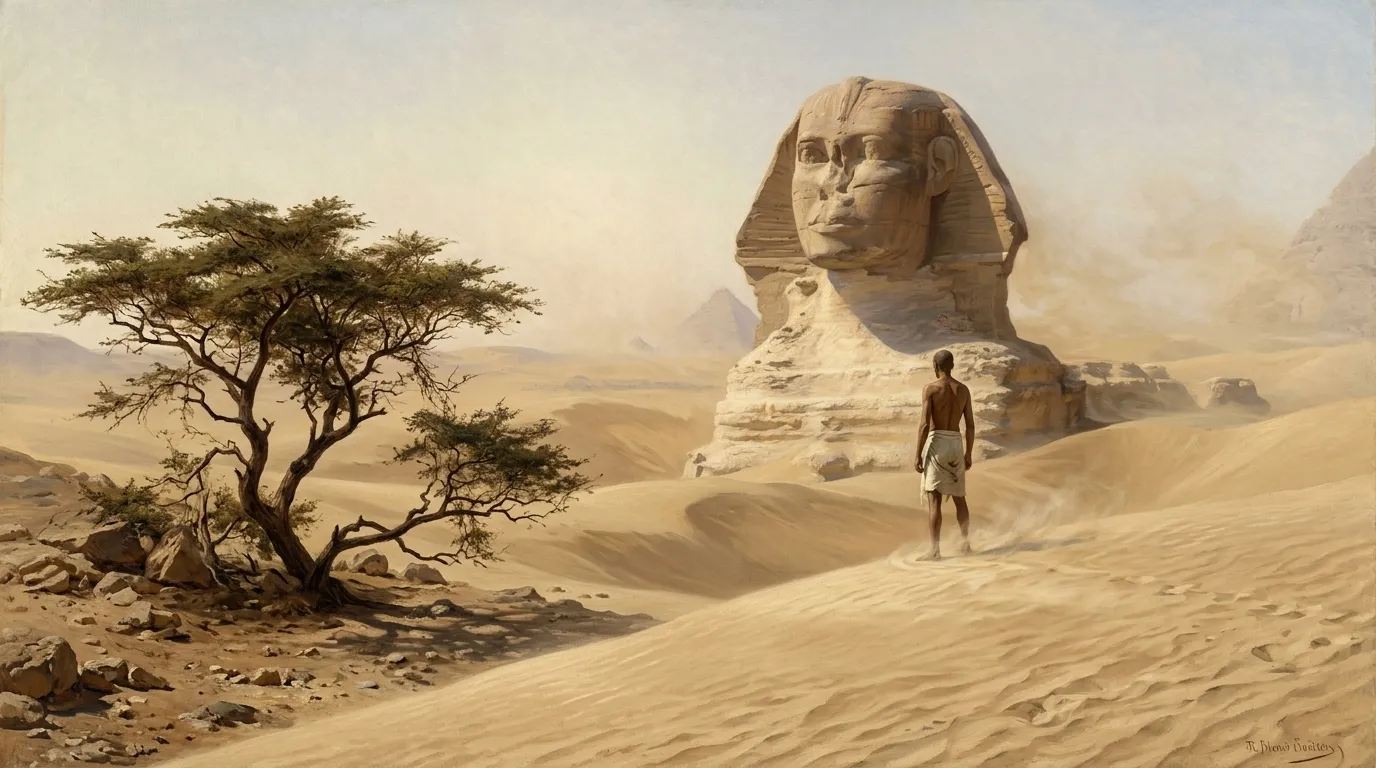
Centuries flowed by, slow and inexorable, like the drifting sands of the desert. The Great Sphinx, though carved to endure, began its silent battle against the elements. Generations lived and died, empires rose and fell, and the memory of its true purpose sometimes faded. High on the Giza plateau, as the wind whipped across the barren ground, a lone sentinel, a man whose duty it was to watch over the necropolis, observed the slow, relentless encroachment. He was a simple man, clad in worn linen, but his eyes held the weight of millennia. The lower parts of the colossal lion body, the massive paws, and even the broad chest, were gradually swallowed by the golden dunes. Each dawn, the sun rose over a Sphinx slightly more buried than the day before. The monument, once a symbol of paramount power, became a mystery half-hidden, its ancient wisdom obscured by the very land it stood upon, awaiting rediscovery by those who would again seek its secrets.
Page 6
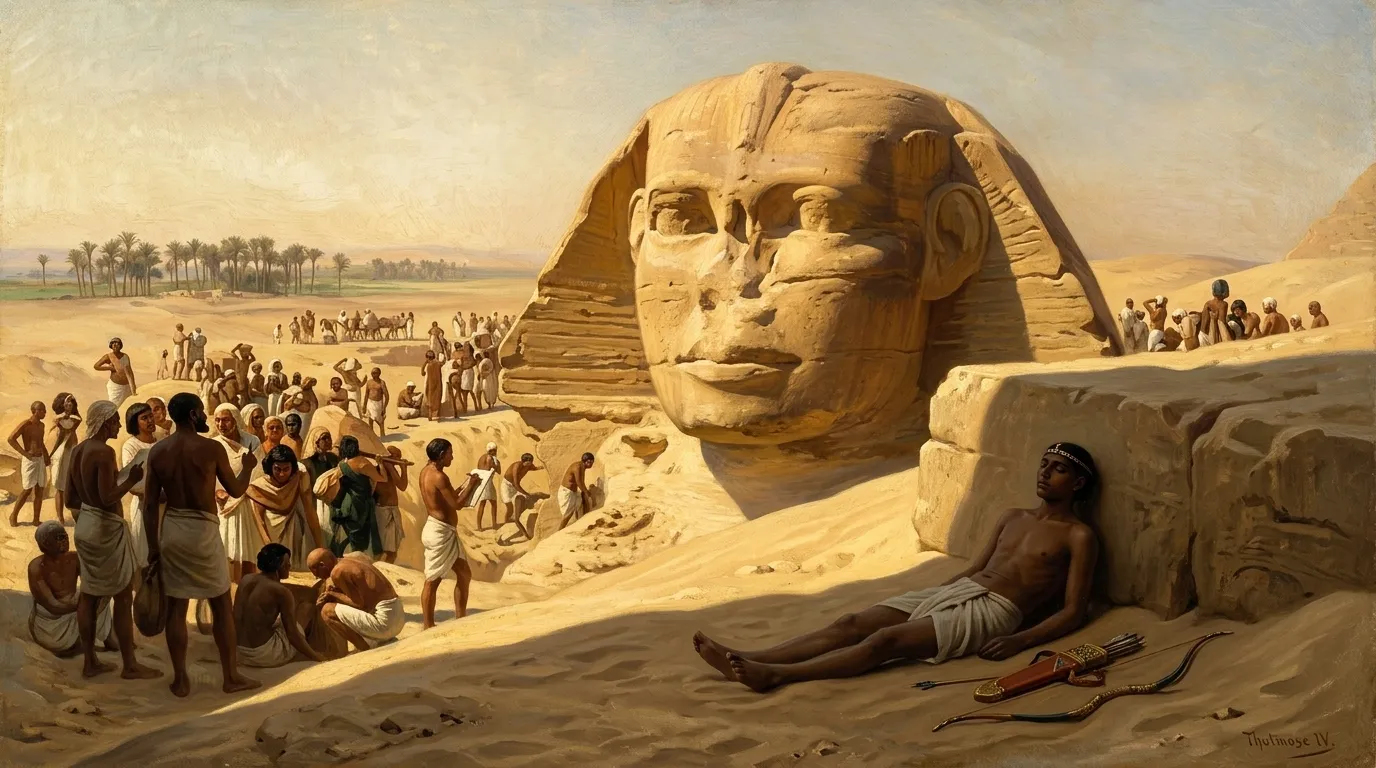
Nearly eleven centuries after its creation, the Great Sphinx lay largely buried, a monumental head rising from an ocean of sand. It was the eighteenth dynasty, a new age of pharaonic power. One sweltering afternoon, a young prince, Thutmose, barely in his late teens, his lean frame clad in simple linen, sought respite from a royal hunt. He found it in the shade of the Sphinx's immense, weathered head, which alone remained clear of the dunes. As he rested, slumber claimed him, and in his dream, the colossal deity spoke. The Sphinx, in its ancient voice, promised him the double crown of Egypt if he would only clear the sands that choked its body. The prophecy resonated deeply within the ambitious youth. He awoke, the dream vivid, the promise ringing in his ears, solidifying his resolve. He saw not just a monument, but a living god offering him destiny. This encounter would forever link his name to the mighty guardian.
The Sphinx (voice only): "Behold me, Thutmose, my son. The sands engulf me. Clear them, and I shall grant you the kingship of Egypt."
Page 7
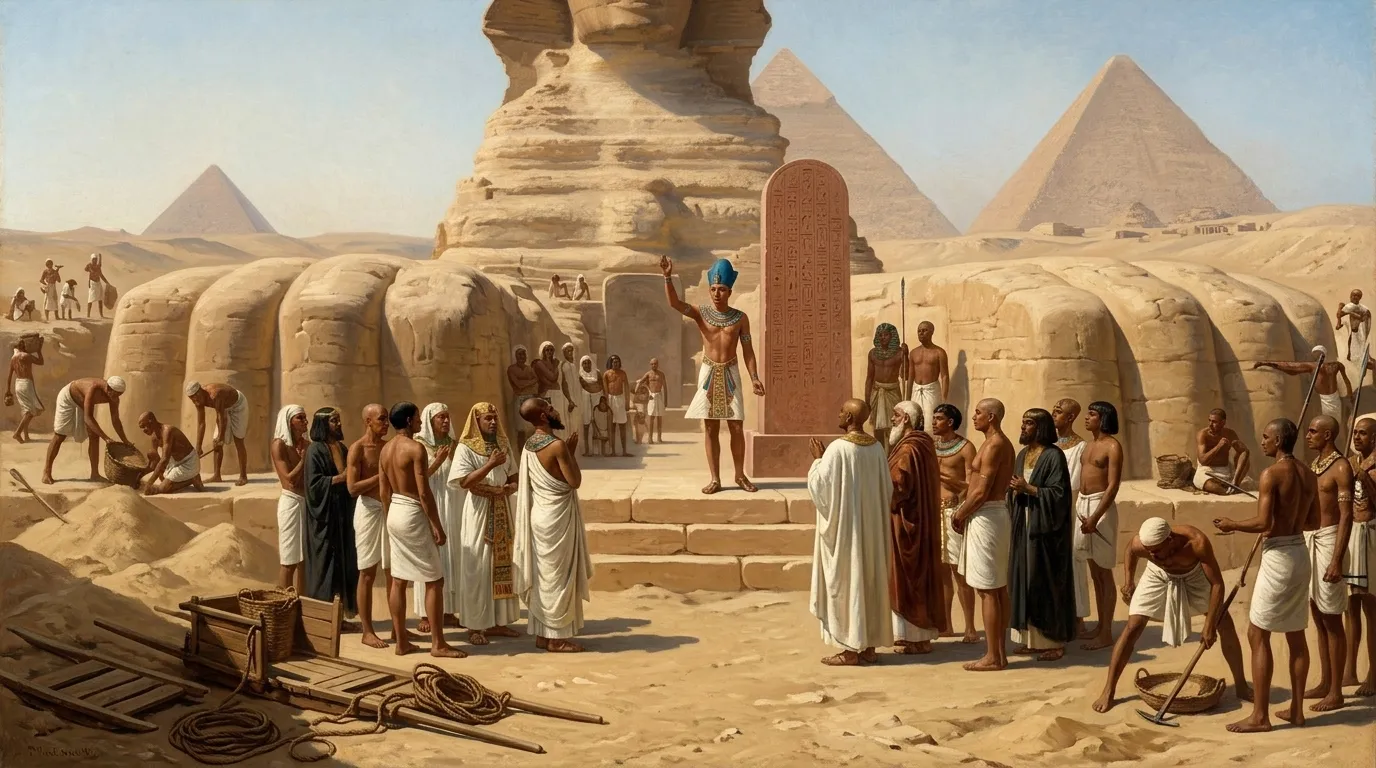
The prince's dream became the pharaoh's decree. Thutmose IV, now a man in his early twenties and newly crowned king, oversaw the massive undertaking to unearth the colossal guardian. Hundreds of laborers, sweating under the relentless sun, worked tirelessly, removing thousands of cubic meters of sand. Their efforts revealed the full splendor of the lion's body, its powerful paws, and the ancient temple structures that surrounded it. Between the newly exposed forepaws of the Sphinx, Thutmose ordered the erection of a grand stele, carved from red granite, known today as the 'Dream Stele.' He stood before it, resplendent in his blue war crown, flanked by priests and officials, as the inscription recounting his divine encounter and his act of piety was read aloud. This act of restoration not only fulfilled a prophecy but solidified his legitimacy as pharaoh, linking his rule directly to the will of the ancient gods and the enduring power of the Sphinx.
Thutmose IV: "Let this enduring stone proclaim the divine will, and my obedience, for all time. The Sphinx breathes anew!"
Page 8
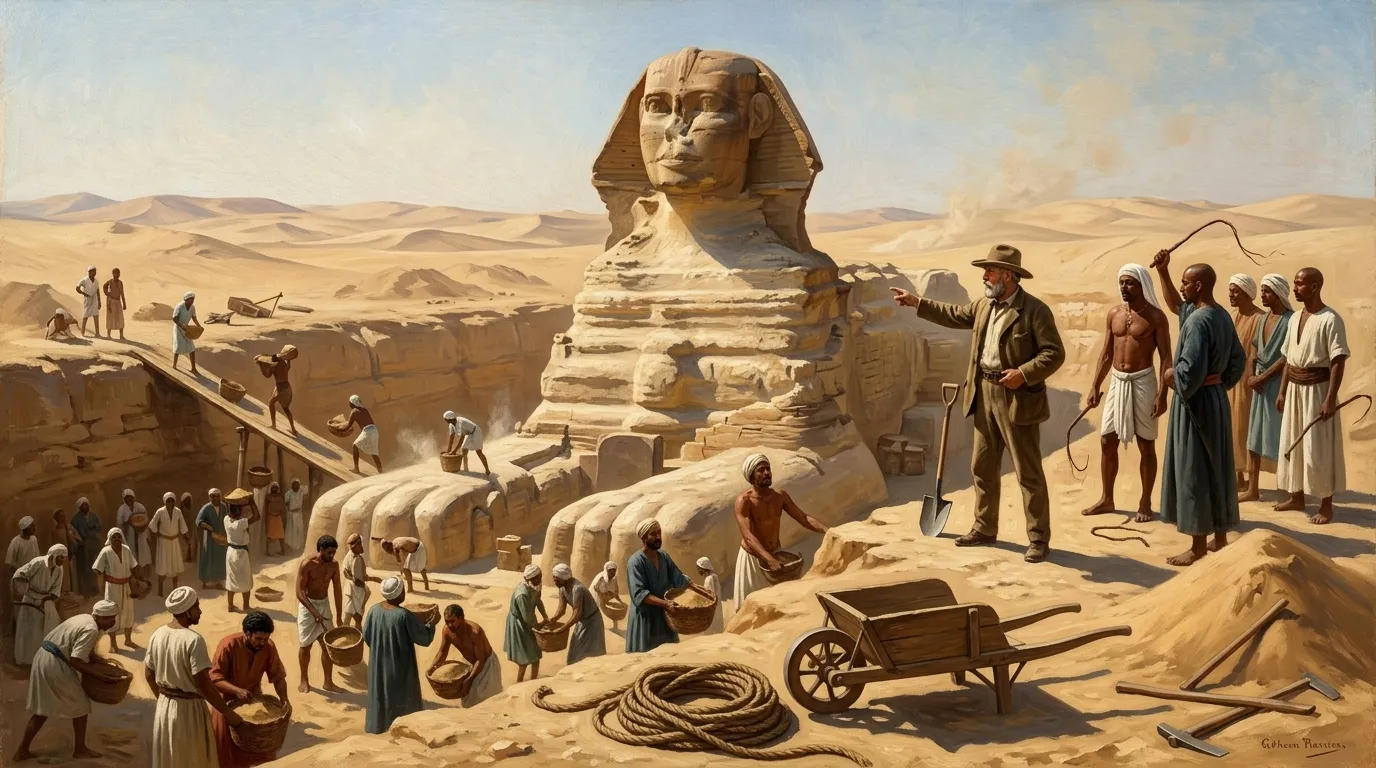
By the early 19th century, the Sphinx was once again largely swallowed by the desert, its head emerging from the dunes like an ancient island. It was then that Giovanni Battista Caviglia, an Italian sea captain and explorer in his sixties, began his ambitious excavations. In 1817, with a large team of Egyptian laborers, he systematically began clearing the colossal monument. The work was arduous, demanding immense physical effort and perseverance. Caviglia, a robust man with a thick, sun-bleached beard, directed his men, shouting instructions in a mix of Italian and Arabic, his shovel biting into the soft sand. He unearthed parts of the Sphinx's chest, its paws, and for the first time in centuries, the remnants of the ancient temple structures between its legs. He marveled at the immense scale, but his focus was on discovery, on revealing what had long been hidden, driven by the burgeoning European fascination with Egypt's monumental past. He recorded his findings, contributing to the world's growing knowledge of this ancient wonder, though his methods were those of an explorer, not a modern archaeologist.
Caviglia: "More hands! Push these mounds back! The ancient sands hide too much!"
Page 9
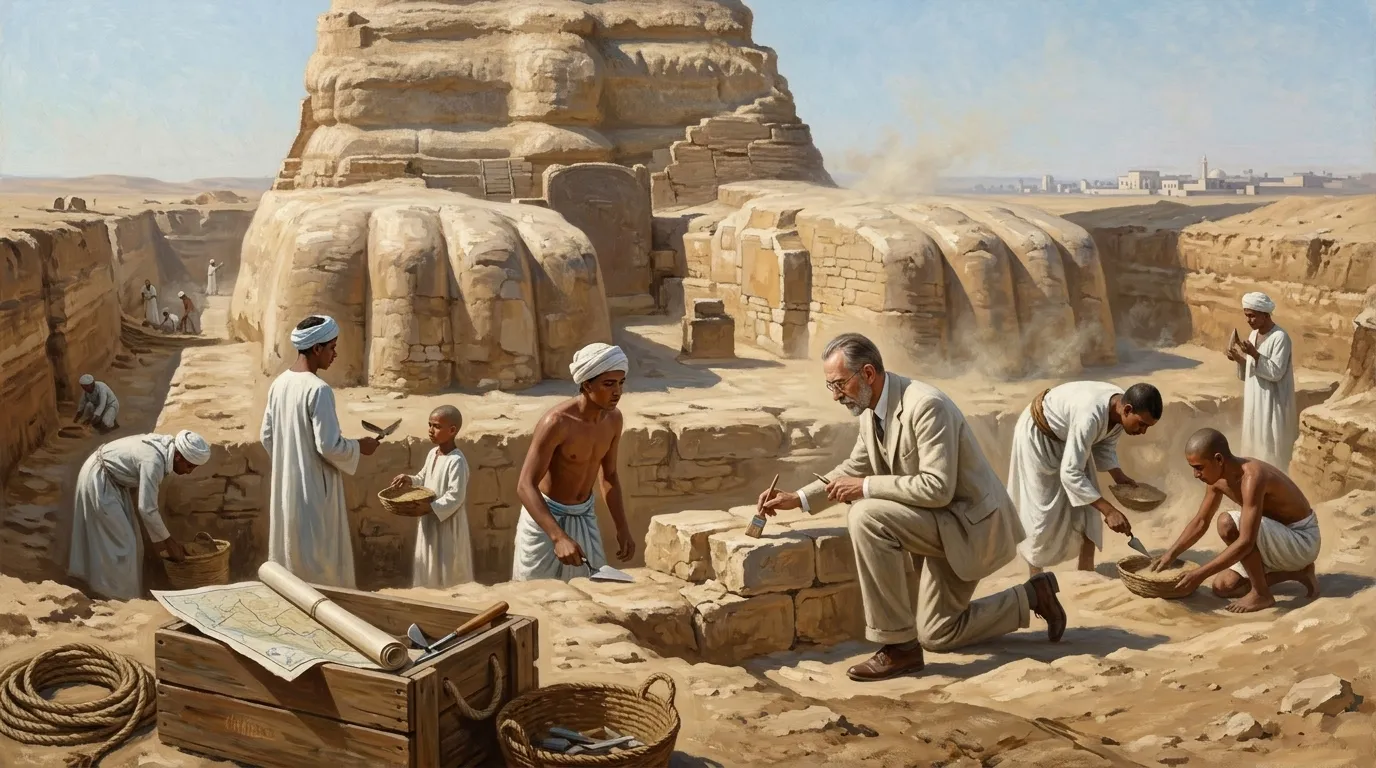
Decades later, in the early 20th century, the task of safeguarding the Sphinx fell to Egyptian hands. Dr. Selim Hassan, a pioneering Egyptian archaeologist in his fifties, slender but radiating quiet authority, led extensive excavation and restoration campaigns. His approach was meticulous, scientific, a stark contrast to earlier treasure-hunting endeavors. From 1936 to 1937, under his precise direction, thousands of Egyptian workers removed the sand, not merely to expose, but to study and preserve. Dr. Hassan, spectacles perched on his nose, carefully examined inscriptions and structural elements, his notebook always at hand. He not only cleared the Sphinx but also its surrounding temples and associated structures, meticulously documenting every discovery. He reinforced the Sphinx's body with new masonry, addressing centuries of erosion. It was a monumental effort to stabilize and understand the icon from his own heritage, ensuring its survival for future generations, grounding its mystery in rigorous academic study.
Selim Hassan: "Every grain of sand holds a story. Every block, a testament. We must preserve this legacy with the utmost care."
Page 10
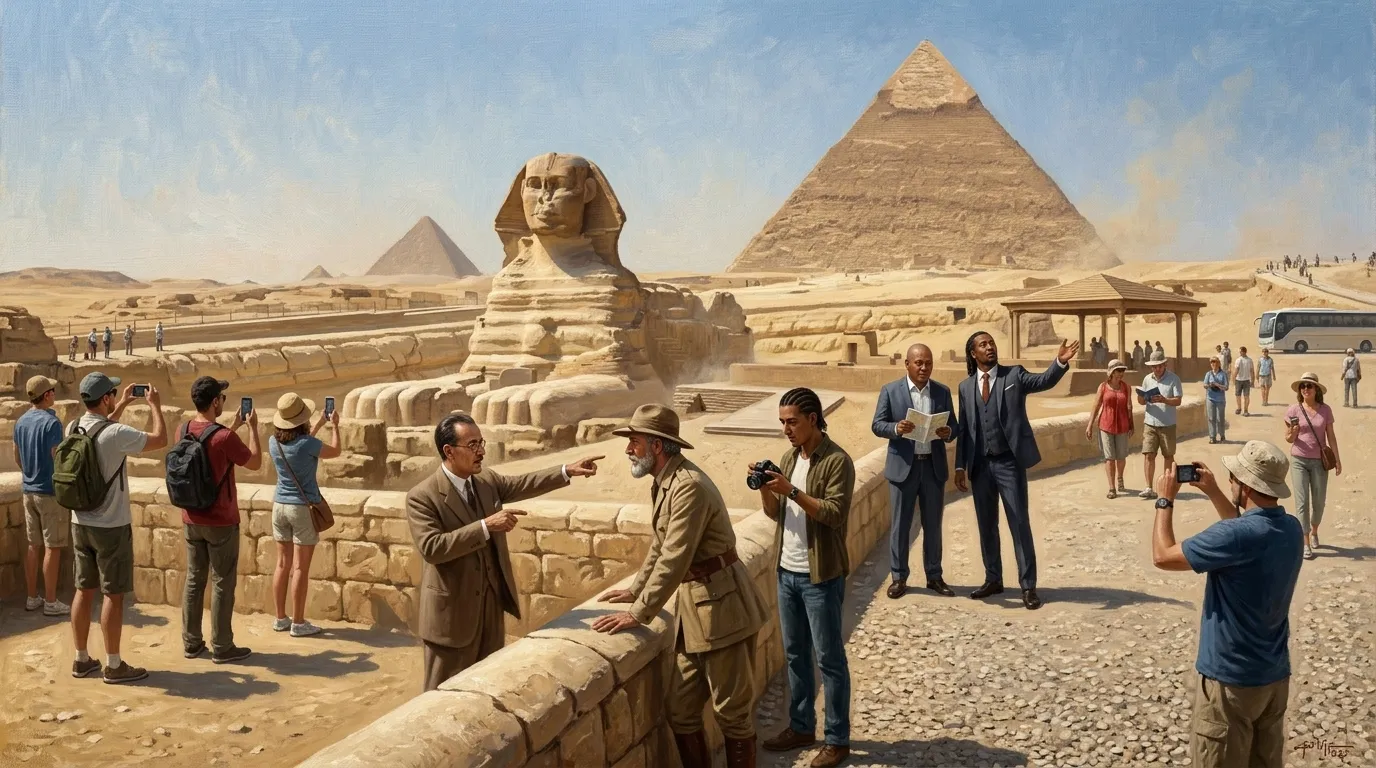
Today, you stand once more before the Great Sphinx, its immense form fully revealed to the desert air. It is not merely a statue, but a testament to an unbroken chain of human endeavor, belief, and preservation stretching across more than four millennia. From the decree of Pharaoh Khafre, a man of power and vision, who sculpted his image into the very land, to the diligent hands of the unnamed ancient craftsmen who painstakingly shaped the rock, to the prophetic dream of Prince Thutmose IV that led to its first grand clearing, and finally to the rigorous archaeological work of figures like Giovanni Battista Caviglia and Dr. Selim Hassan who systematically brought it to light and preserved it for the modern world. Each individual, separated by vast spans of time and culture, played a vital role in its journey. The Sphinx endures, a silent guardian of secrets, a symbol of royal power, and a monument that has inspired wonder and devotion through every age it has witnessed. Its silence speaks volumes of the continuity of Egypt's civilization, a legacy immense and profound.
About this story
- Audience: general readers
Questions and answers
Read Wonder Egypt on your phone
Wonder Egypt is available on Android. Get Wonder Egypt on Google Play.