The Weighing of the Heart
The Weighing of the Heart — an illustrated history story. 10 illustrated pages, free to read on Wonder Egypt.
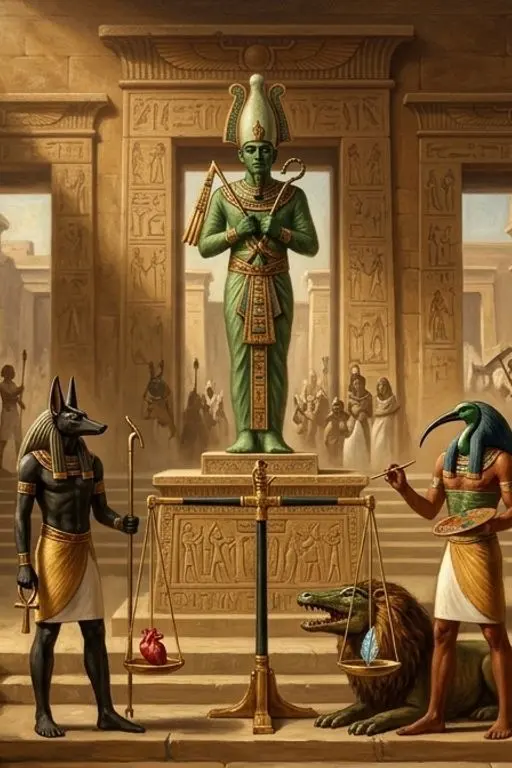
Page 1
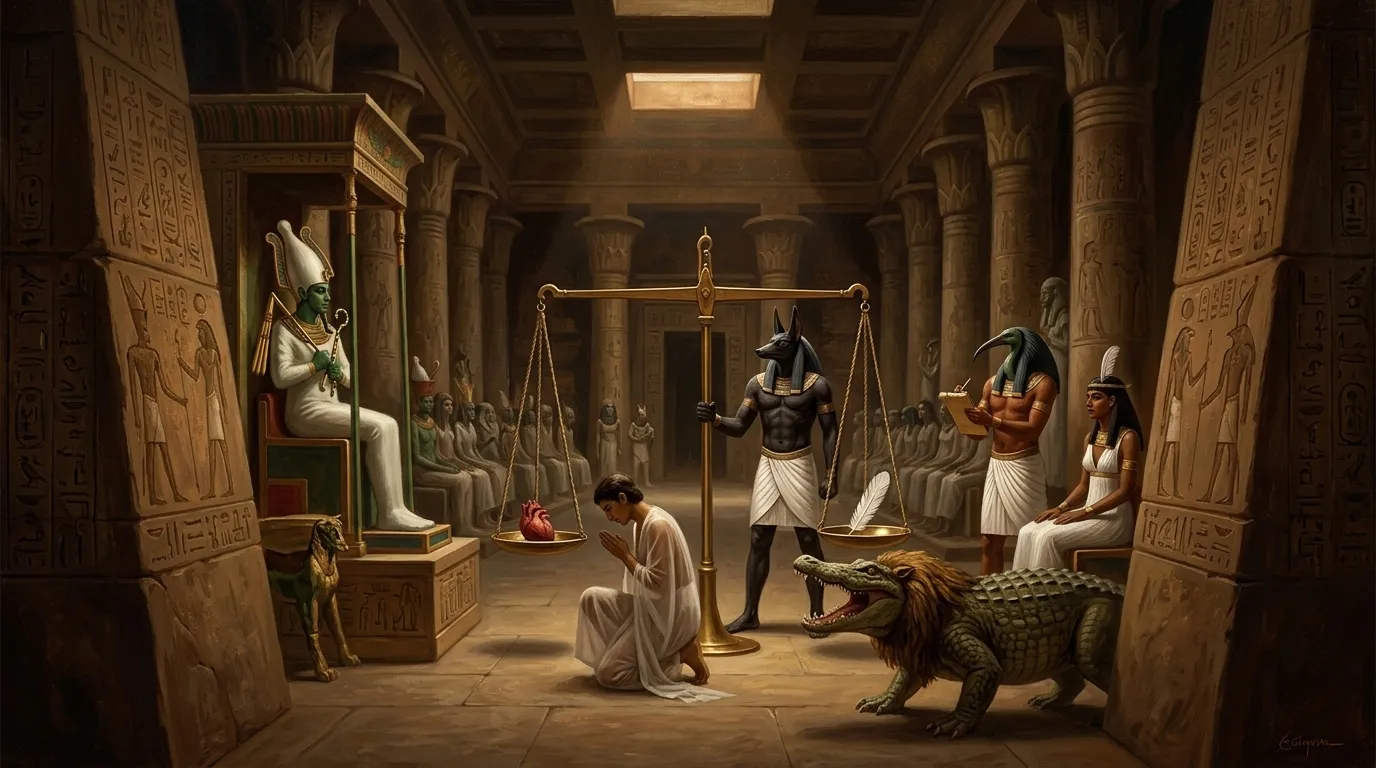
The colossal Hall of Two Truths trembles with the unspoken weight of destiny. Thousands of centuries, stretching back to the First Time, have led to this singular moment of reckoning. Before the enthroned Lord of the Duat, Osiris, whose skin is the green of eternal renewal, stands the magnificent scale. Its towering beam, carved from the very essence of cosmic balance, hovers, awaiting its final, immutable decree. Anubis, the jackal-headed guide of souls, his dark form stark against the shimmering air, carefully places the heart—a living, beating organ, shimmering with the memories of a mortal life—onto one pan. Across from it, serene and pure, lies the Feather of Ma'at, representing truth and cosmic order. Thoth, the ibis-headed scribe of the gods, quill poised over a waiting papyrus, gazes with an intensity that pierces the veils of existence, ready to inscribe the verdict. The air itself seems to hold its breath. Ammit, the Devourer, a monstrous composite of crocodile, lion, and hippopotamus, crouches low, her gaze fixed on the pan, her enormous jaws agape, a promise of oblivion for the soul found wanting. The silence is profound, broken only by the faint, rhythmic thrumming of the universe itself. This is the moment when all earthly deeds find their true measure.
Page 2
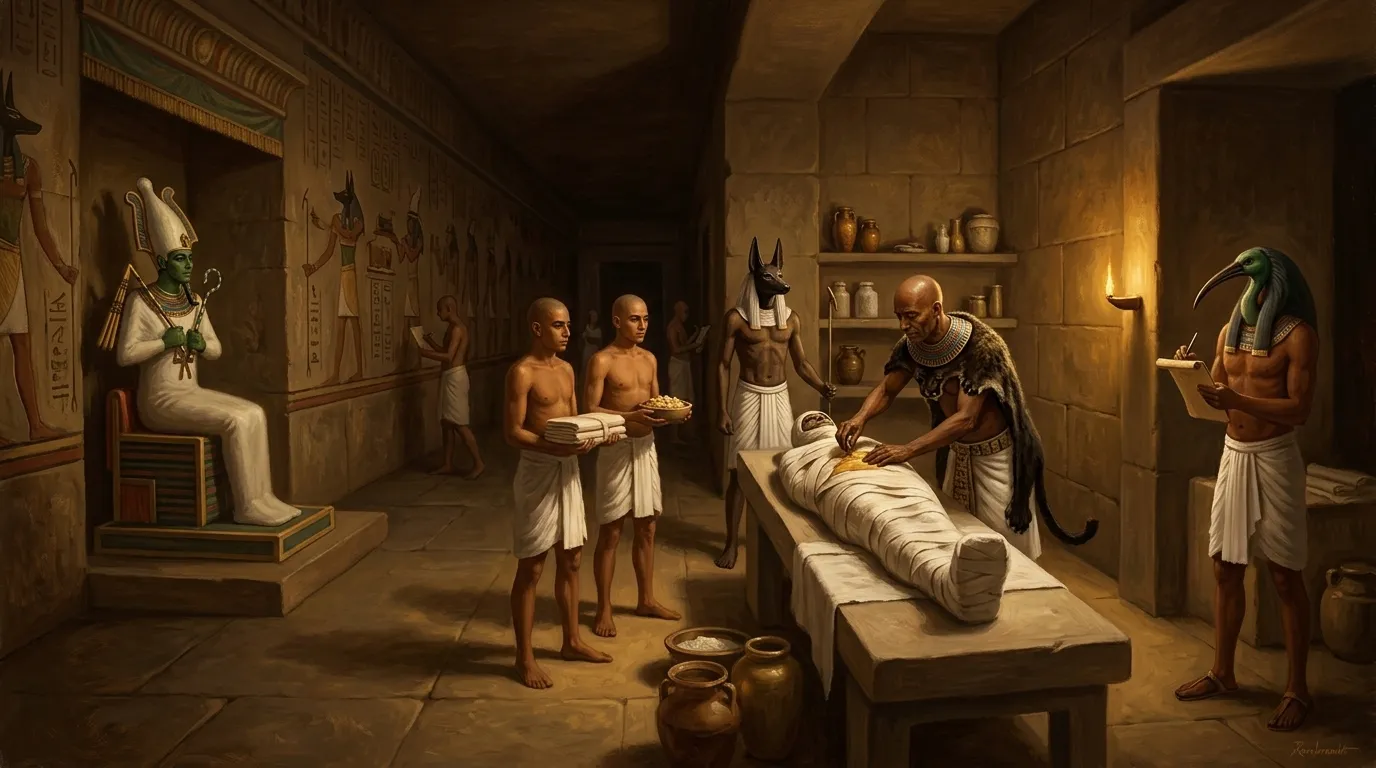
Centuries before the heart's fate is decided, the journey to the Duat begins in the earthly realm. Deep within a mortuary complex, within the silent, cool embrace of the 'House of Purification,' the meticulous work of preparing the body for eternity unfolds. Anubis, not yet the guide of souls in the Duat but present in spirit through his priests, watches over the ritual. The chief embalmer, a dignified figure with shaven head and a panther skin draped over his white linen kilt, his hands stained with natron and sacred oils, tends to the body of the deceased. Around him, assistants meticulously wrap strips of fine linen, each binding imbued with protective spells. The air hangs heavy with the scent of myrrh, frankincense, and cedar oil. Every incision, every anointing, every precise fold of linen is a step in the millennia-old rite, ensuring the Ka and Ba can reunite with the mummified form, readying the vessel for its perilous passage through the realms of the dead. This earthly dedication secures the soul's very possibility of reaching the great scales.
Page 3
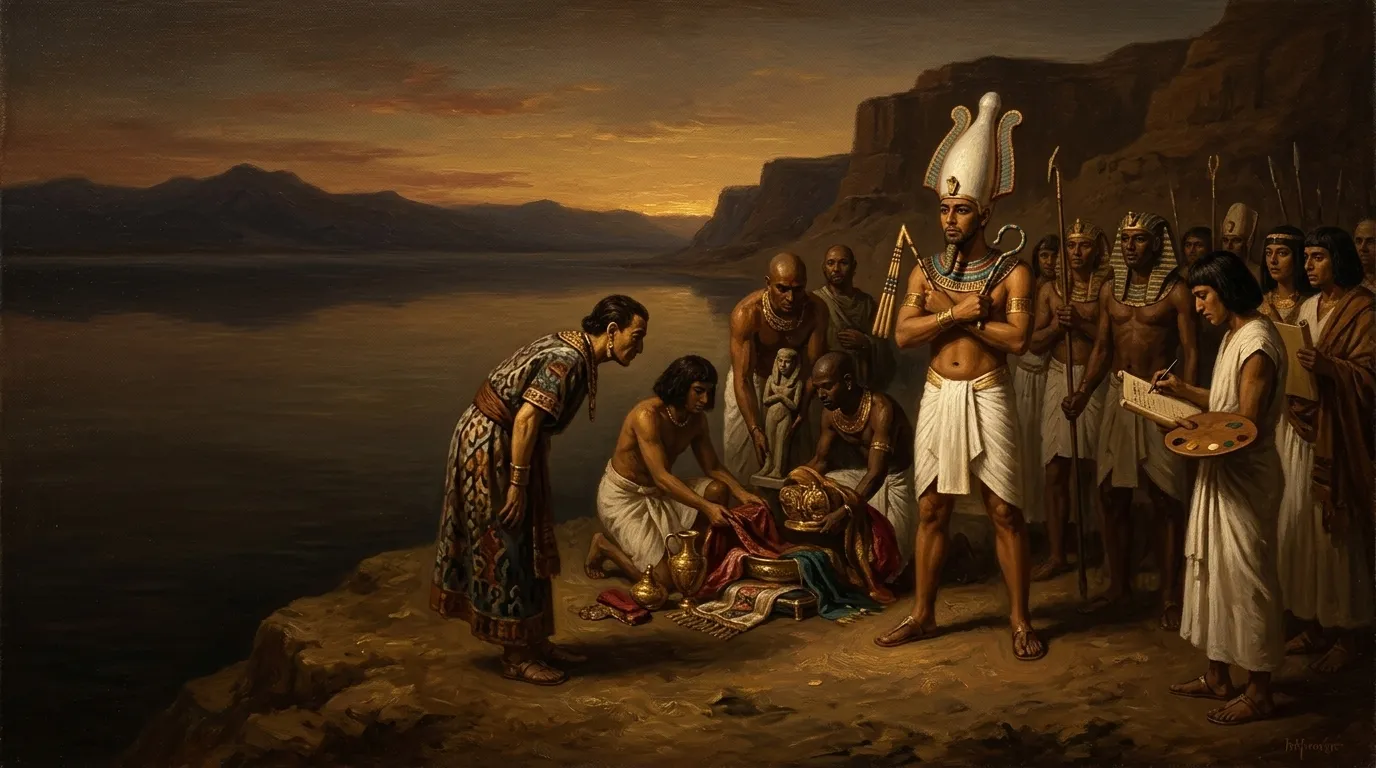
As the sun dips below the western desert rim, painting the sky in fiery hues of crimson and gold, the soul embarks on its true journey. This is the moment of transition, the crossing of the Western Horizon, the liminal gateway between the mortal realm and the endless Duat. The deceased, now a disembodied spirit, stands upon the edge of a vast, tranquil body of water, shimmering under the last vestiges of twilight. Before them, a divine barque, adorned with protective symbols and guided by unseen forces, awaits. The air, cool and still, carries the distant, faint murmur of the deceased’s family offering prayers on earth. This crossing is not a physical act, but a profound spiritual unfolding, a severing of ties with the world of the living and a surrender to the mysteries beyond. The monumental journey has begun, a testament to a belief held steadfast for three thousand years, that death is but a threshold to an even grander existence, if one proves worthy.
Page 4
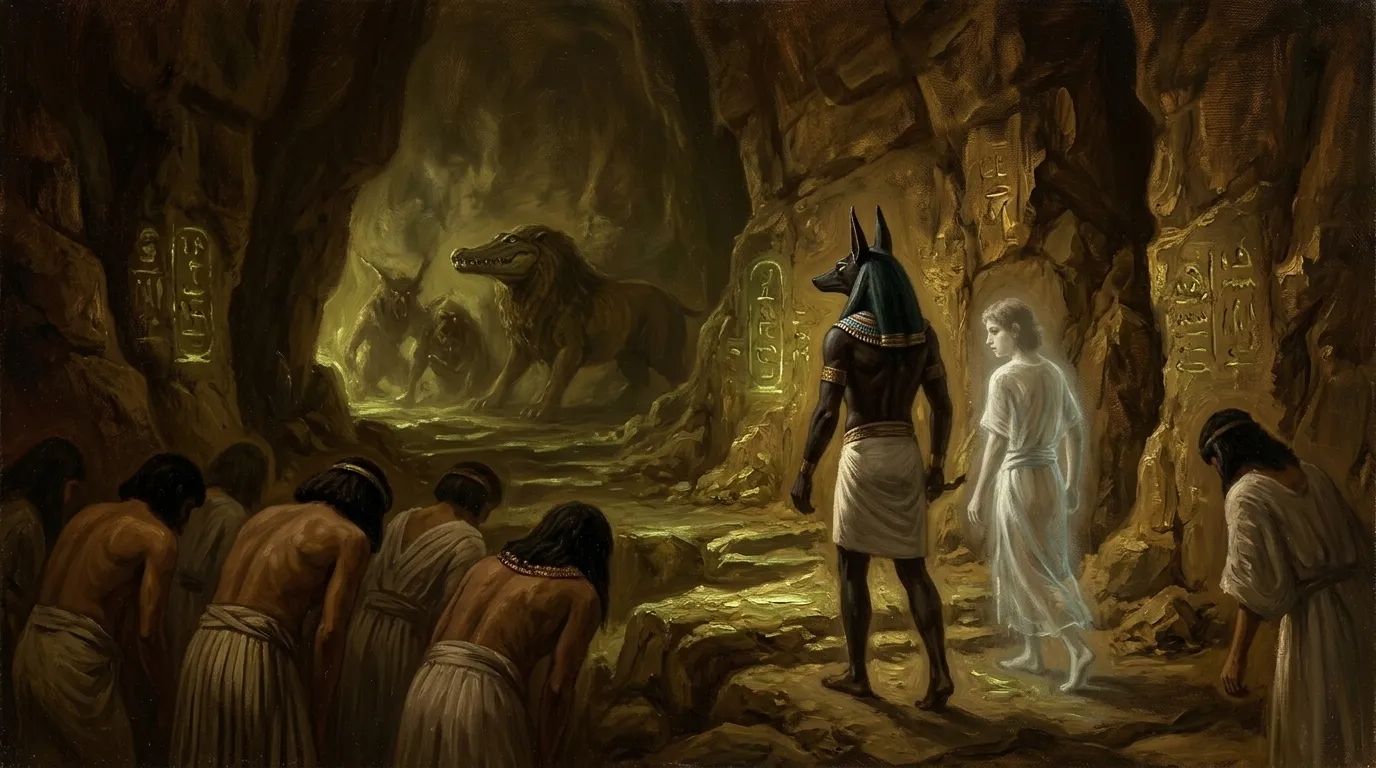
Through the deep, echoing passages of Amenti, the labyrinthine paths of the netherworld, the soul presses onward. It is a journey fraught with spectral dangers, guarded by fearsome beings whose forms shift in the dim, otherworldly light. Anubis, the jackal-headed guide, his divine gaze piercing the gloom, leads the way. His presence, an unwavering beacon, assures the soul's safe passage through this treacherous domain. The ground beneath them is uneven rock, polished smooth by countless aeons of passing spirits, occasionally glinting with scattered gold dust. The walls are not carved stone, but the very substance of the Duat itself, vast and oppressive. The path twists and turns, each bend revealing a new, fantastical landscape – fields of fire, lakes of darkness, or silent, spectral gardens. It is a testament to the enduring faith of the Egyptians that these unseen perils were confronted, not with physical courage, but with the power of sacred words and a life lived in accordance with Ma'at, the cosmic balance.
Page 5
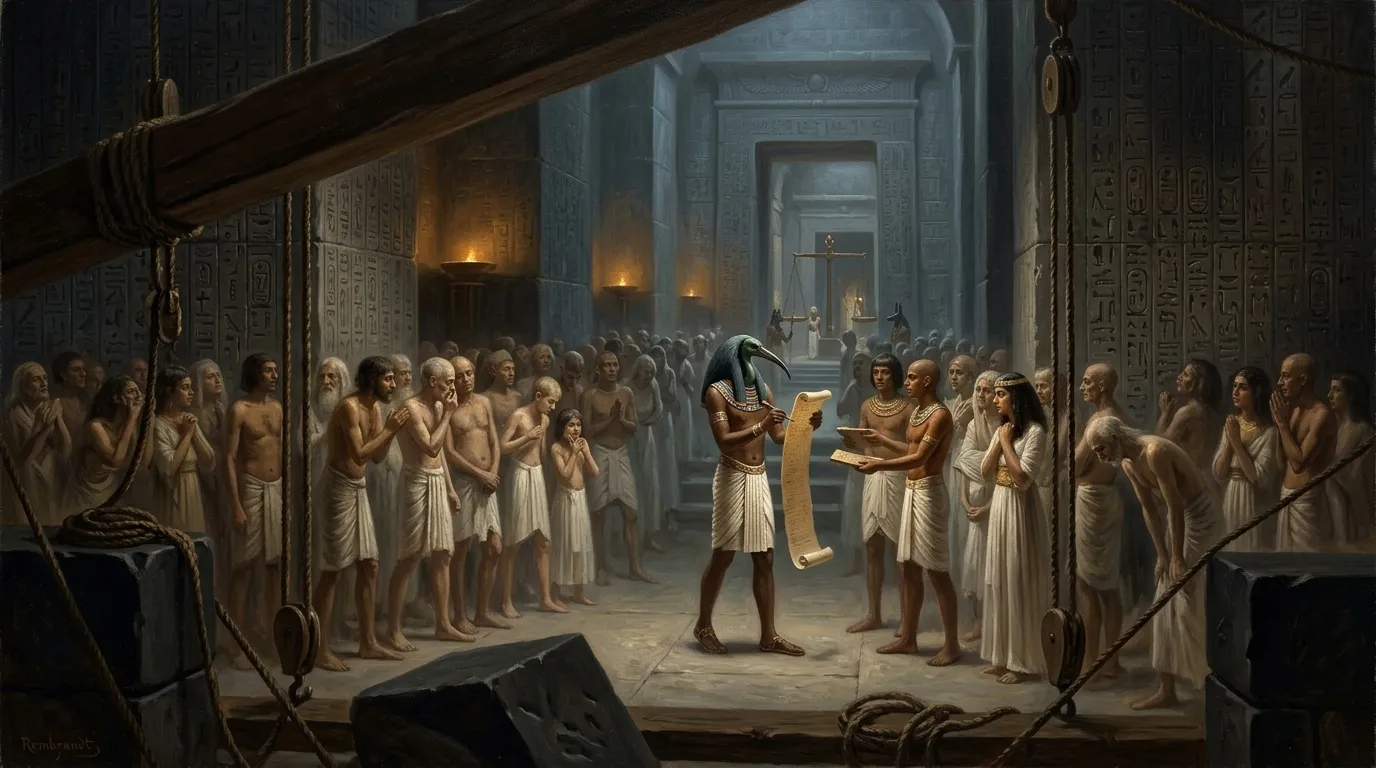
After navigating the arduous paths, the soul arrives at the Antechamber of Weighing, a vast, somber space immediately preceding the Hall of Two Truths. Here, a multitude of other spectral figures, some shimmering brightly, others appearing faded and anxious, await their summons. A palpable tension hangs in the air, a silence heavier than any earthly stone. Thoth, the ibis-headed god, strides through the silent ranks, a long, unfurled papyrus scroll clutched in one hand, his stylus poised. He calls out names, his voice echoing with ancient authority, summoning souls one by one to face the ultimate judgment. The walls of this antechamber are inscribed with the names of forgotten kings and commoners, a silent reminder that all, regardless of earthly station, must pass this trial. The waiting, for many, is a final internal reckoning, a review of their mortal existence under the unblinking eye of eternity. For this is the last moment of quiet contemplation before the truth of their heart is laid bare.
A male deity with an ibis head calls out, his voice resonating: 'Come forth, O Soul of Imhotep, son of Ptahmes!'
Page 6
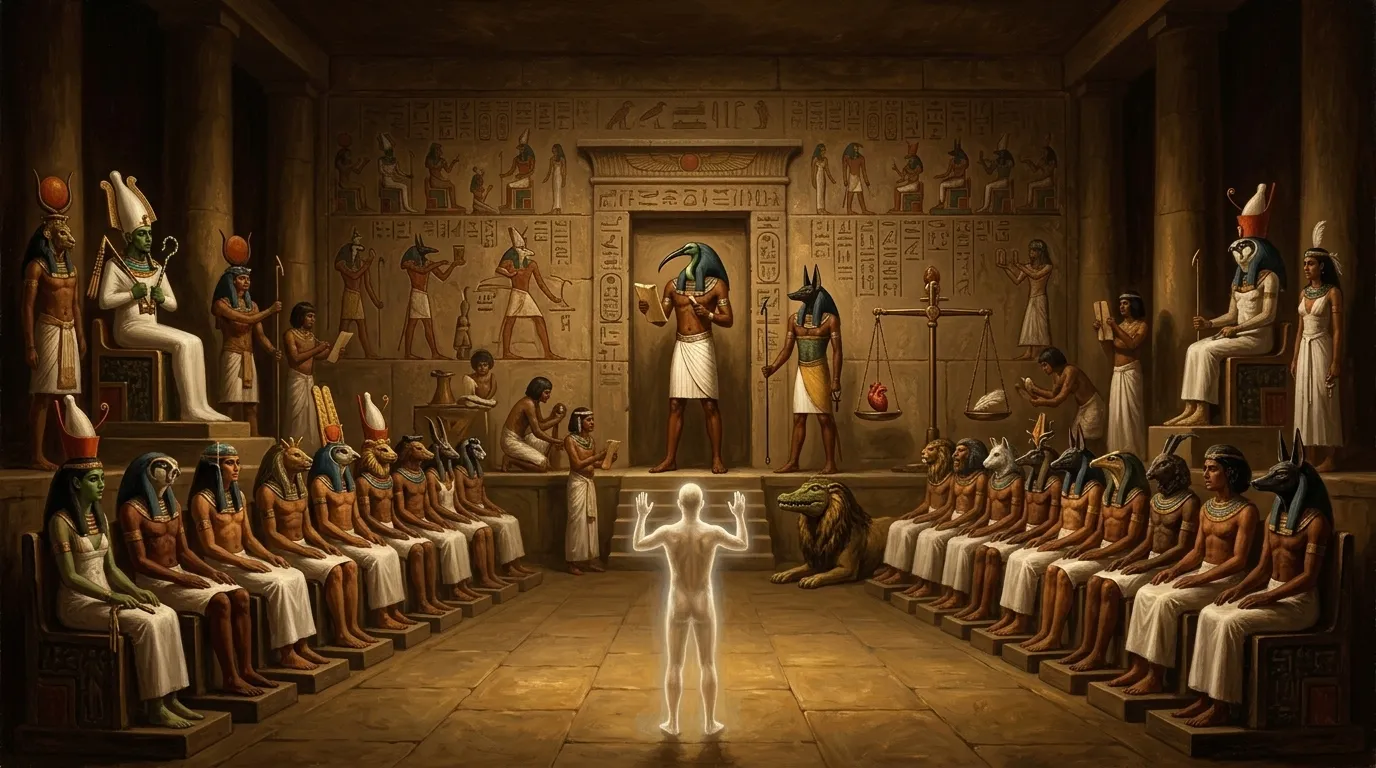
Stepping into a subsidiary chamber of the Hall of Two Truths, the soul faces forty-two fearsome divine judges, each associated with a specific transgression. This is the Hall of Negative Confessions, where the heart's true burden is assessed not by what one *did*, but by what one *did not* do. The deceased stands before this formidable council, their voice, though ethereal, resounding with declarations of purity. 'I have not stolen. I have not killed. I have not slandered,' the soul proclaims, addressing each deity by name, reciting the litany of ethical conduct prescribed by Ma'at for millennia. The judges, silent and unblinking, listen to every word, their forms varied and ancient, some crowned with animal heads, others with symbols of their power. Thoth, vigilant, stands nearby, his gaze fixed on the proceedings, ready to note any faltering, any hint of untruth. This elaborate 'Declaration of Innocence' is a pivotal step, a verbal assertion of a life lived in cosmic harmony, preparing the heart for its ultimate test on the scales.
A spectral figure proclaims, their voice echoing: 'I have not snatched bread. I have not polluted the water. I have not done violence to a stranger.'
Page 7
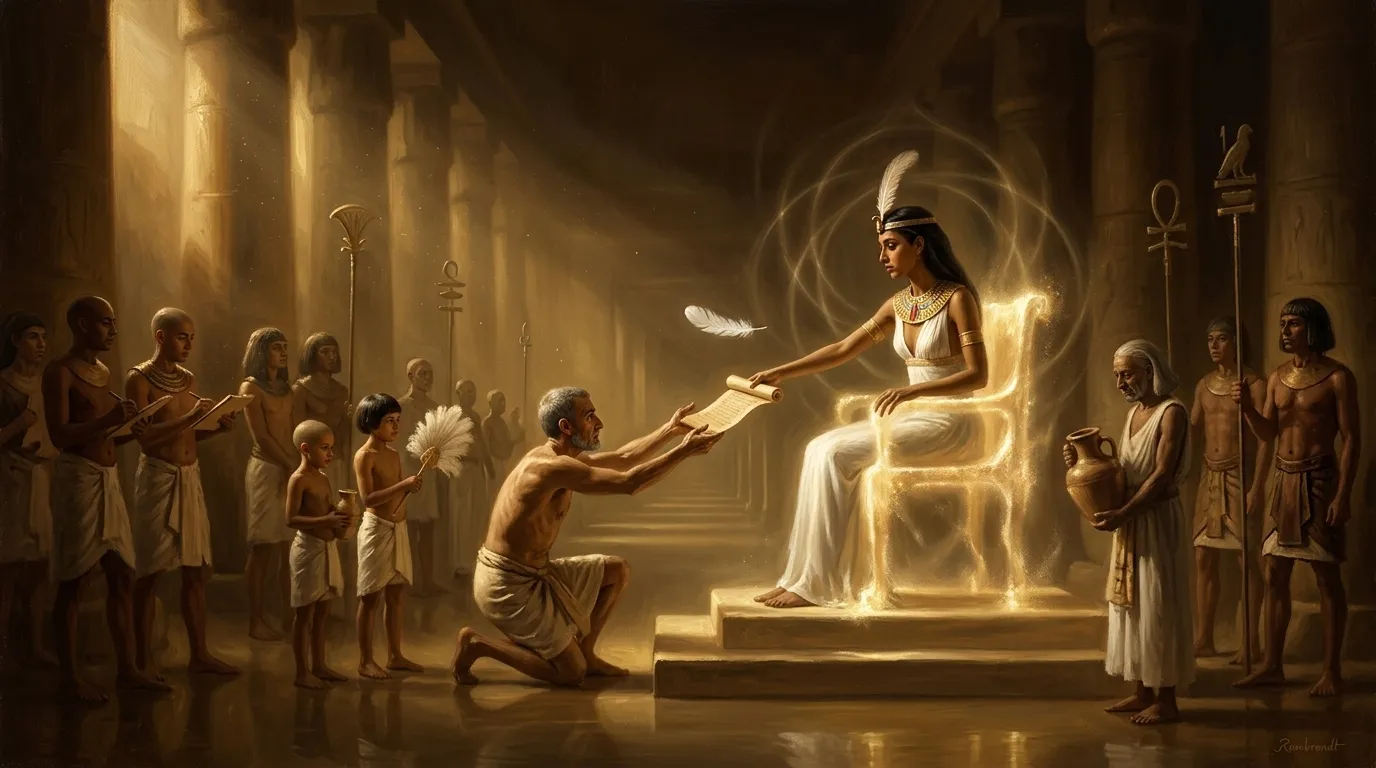
Before the final judgment, the essence of cosmic order, Ma'at herself, resides in a serene, hidden sanctum, influencing all within the Duat. This is not a physical hall, but a plane of pure principle, where the feather that graces the scales is imbued with its immutable power. Here, the goddess Ma'at, serene and eternal, sits on a throne of shimmering light. A single, perfect ostrich feather rests upon her head, glowing with an inner luminescence. The air is still, permeated by a profound sense of equilibrium and truth, a stark contrast to the tumultuous paths of the netherworld. Surrounding her, subtle, spectral representations of balance — perfect geometric forms, harmoniously flowing currents — demonstrate the very fabric of existence she embodies. It is from this sanctum that the feather is drawn, a tangible representation of the cosmic law against which every human heart is measured. Her unwavering presence underscores the gravity and impartiality of the weighing, a divine standard upheld for countless generations of the dead.
Page 8
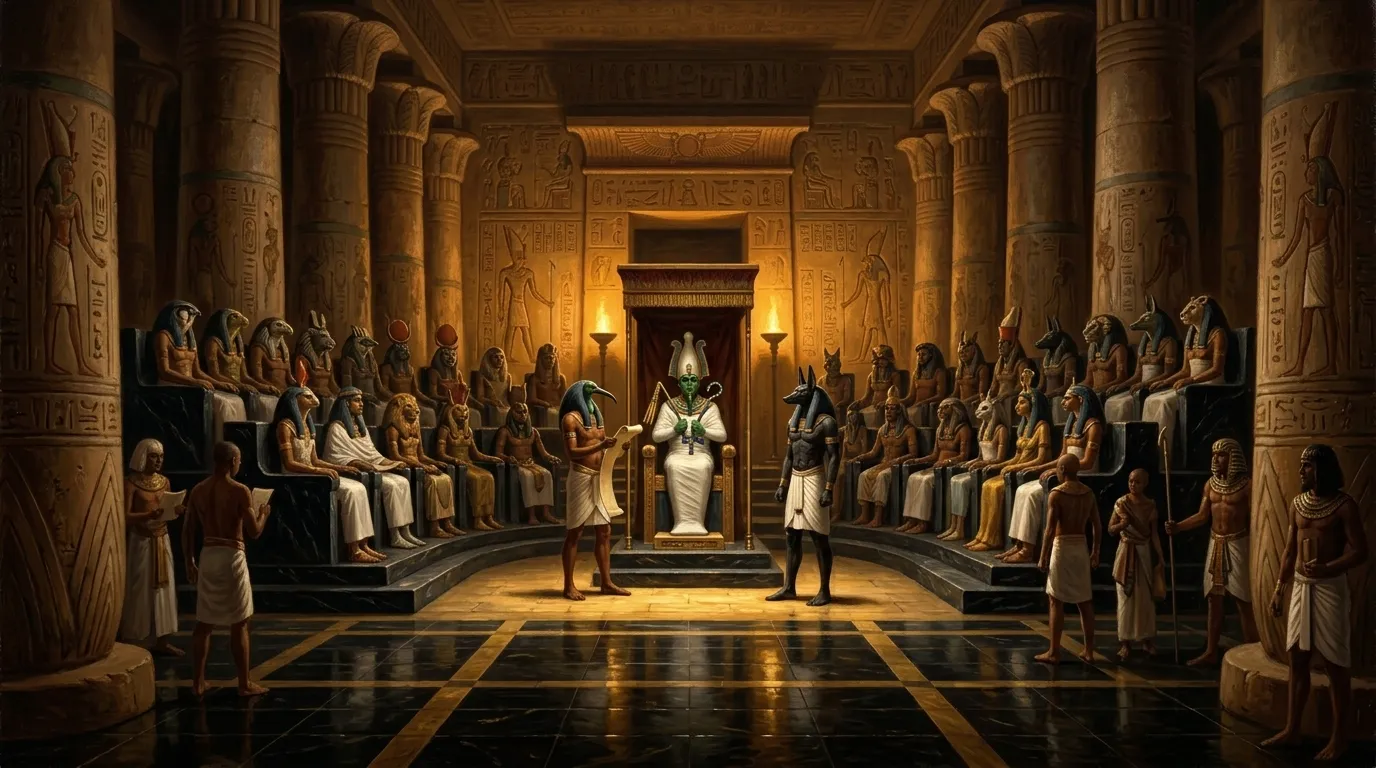
Within a grand, pillared chamber just beyond the Hall of Confessions, a gathering of the most ancient and potent gods convenes. This is the Divine Council of Overseers, who sanction the solemnity of the weighing before it begins. Osiris, majestic on his throne, presides, his green skin illuminated by the sacred fire. Anubis stands at his right, solemn and prepared. Thoth prepares his papyrus scrolls, while other venerable deities of judgment and destiny — such as Shu, holding the sky aloft, and Geb, the earth god — watch with profound gravity from their own elevated positions. The air pulses with the combined power of these divine beings, their silent consensus reinforcing the inviolable nature of the forthcoming judgment. No mortal plea or earthly power can sway this council; their purpose is to ensure the integrity of the cosmic law. The final preparations are made, the sacred declarations complete, and the stage is now set for the ultimate and unavoidable truth to be revealed.
Page 9
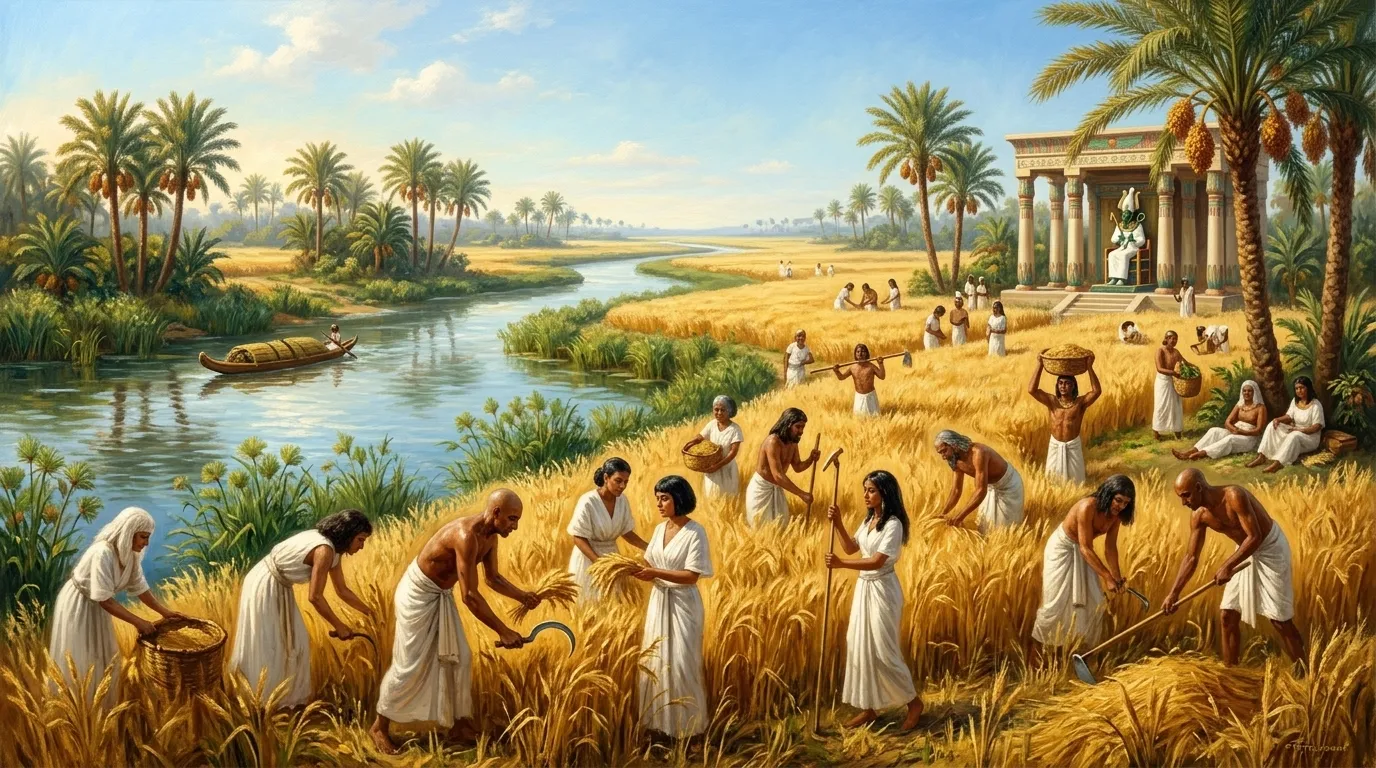
For the soul whose heart balanced perfectly with the Feather of Ma'at, the reward is eternal bliss in the Field of Reeds, the Egyptian paradise. This vast, fertile land mirrors the most idyllic visions of the Nile Valley, yet it is infinitely more perfect. The justified soul, now vibrant and complete, walks among fields of eternally ripe barley, taller than any man, harvested effortlessly. The waters flow pure and sweet, teeming with fish. Abundant date palms sway gently, heavy with fruit. Other blessed souls, their forms radiant and serene, greet the newcomer, sharing in the endless bounty. Osiris, benevolent and welcoming, can be seen in the distance, overseeing this domain of eternal peace. The labor is joyful, the sustenance plentiful, and the company divine. This is not merely an afterlife, but a perfected continuation of life, a place where all earthly desires for comfort and prosperity are fulfilled beyond measure, secured by a lifetime of adherence to truth and justice.
Page 10
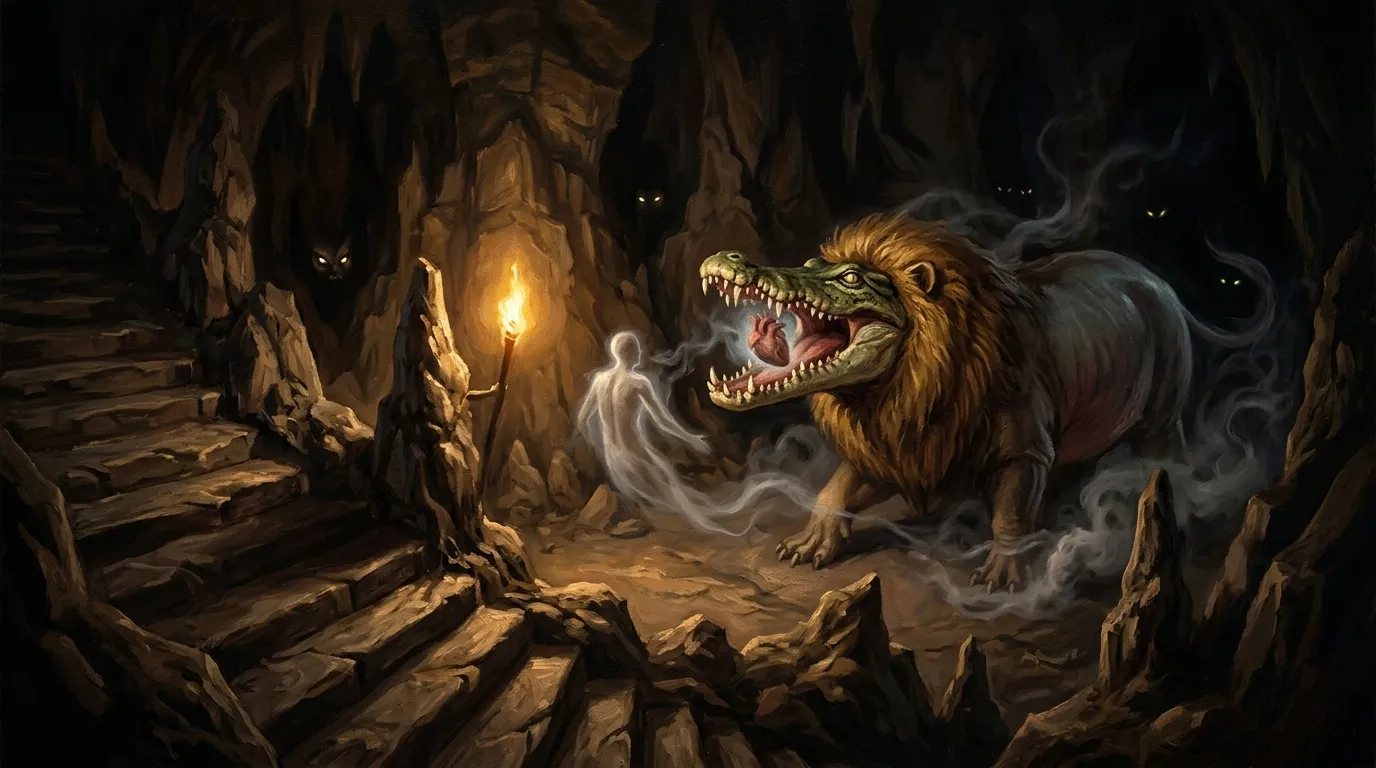
But for the soul whose heart, heavy with transgressions, tilts the scales against the Feather of Ma'at, a terrible fate awaits. No Field of Reeds, no eternal bliss. Instead, the abyss. Ammit, the Devourer, her monstrous jaws already agape, lunges forward. With a swift, final gulp, she consumes the unworthy heart, rendering the soul utterly annihilated, condemned to a 'second death' – a complete and irreversible oblivion. There is no resurrection from this fate, no hope of reunion, no memory preserved. The dark, cavernous abode of Ammit, shrouded in perpetual gloom and the faint stench of decay, yawns open for these condemned. This ultimate annihilation, feared above all else, solidified the profound moral framework of Egyptian society for three millennia. The threat of oblivion, far more terrifying than any earthly punishment, compelled adherence to Ma'at, ensuring the cosmic balance extended from the heavens down to the smallest human action. This was the unyielding consequence, the finality that underscored the entire divine justice system.
About this story
- Audience: general readers
Questions and answers
Read Wonder Egypt on your phone
Wonder Egypt is available on Android. Get Wonder Egypt on Google Play.