The Battle of Verdun (1916, France)

The Battle of Verdun (1916, France) — an illustrated history story, featuring Crown Prince Wilhelm, Philippe Pétain, Erich von Falkenhayn, set in France. 10 illustrated pages, free to read on Wonder History.
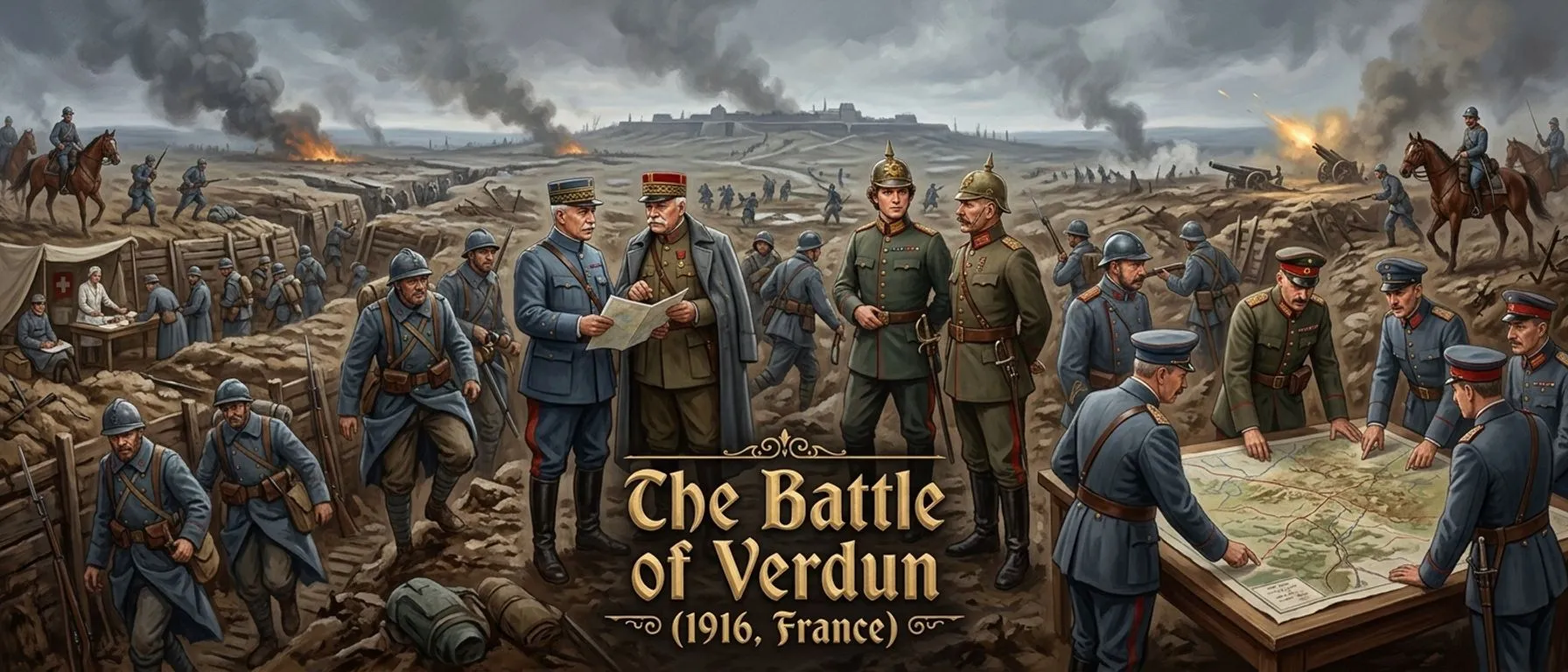
The Battle of Verdun (1916, France) — book cover — Wonder History
The Battle of Verdun (1916, France) — an illustrated history story, featuring Crown Prince Wilhelm, Philippe Pétain, Erich von Falkenhayn, set in France. 10 illustrated pages, free to read on Wonder History.

Page 1
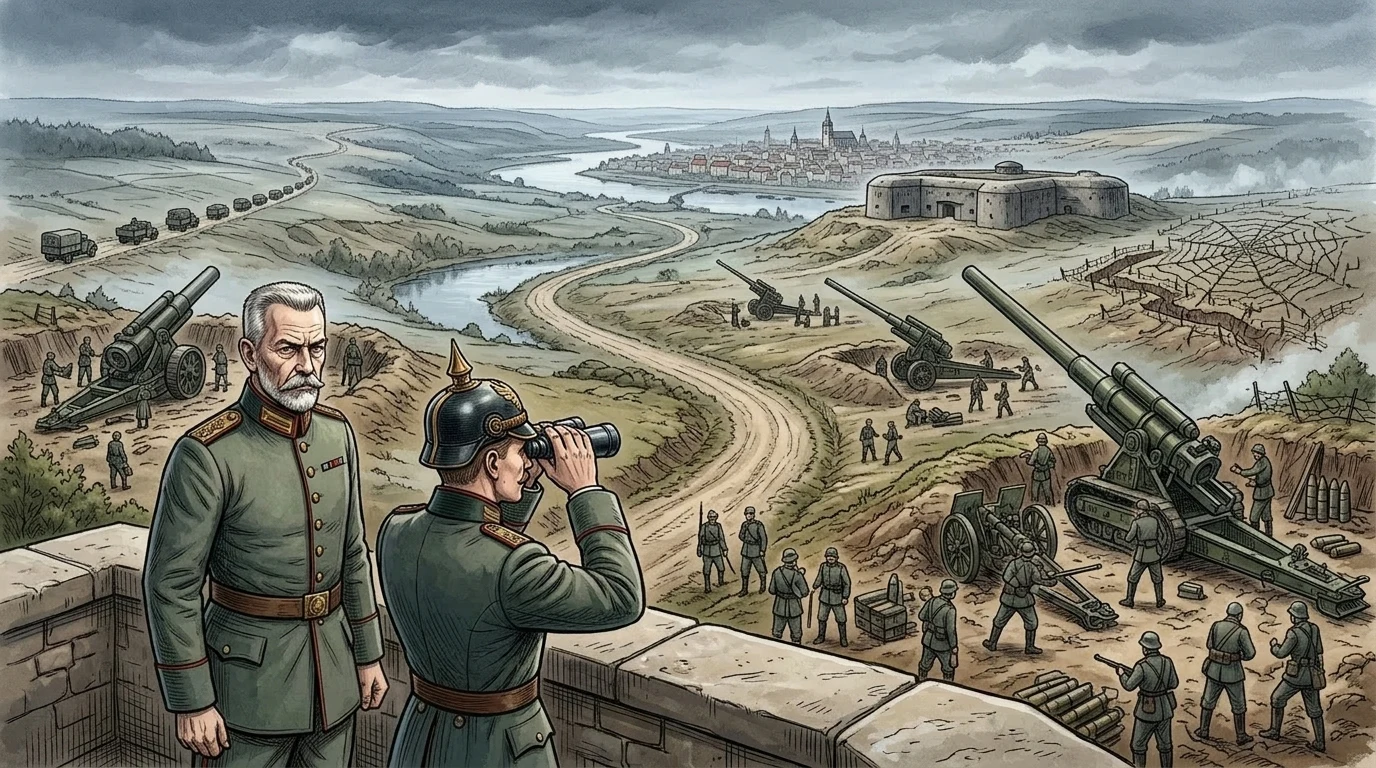
On February 21, 1916, the earth around Verdun, France, erupted. German Crown Prince Wilhelm, eager for a decisive victory, aimed to "bleed France white." French…
On February 21, 1916, the earth around Verdun, France, erupted. German Crown Prince Wilhelm, eager for a decisive victory, aimed to "bleed France white." French General Philippe Pétain, later a controversial figure, rallied his troops to defend the sacred soil. Erich von Falkenhayn, the German Chief of Staff, orchestrated the brutal offensive. But how did this small city become a symbol of unimaginable suffering?

On February 21, 1916, the earth around Verdun, France, erupted. German Crown Prince Wilhelm, eager for a decisive victory, aimed to "bleed France white." French General Philippe Pétain, later a controversial figure, rallied his troops to defend the sacred soil. Erich von Falkenhayn, the German Chief of Staff, orchestrated the brutal offensive. But how did this small city become a symbol of unimaginable suffering?

Historical Fact: The Battle of Verdun lasted 303 days and resulted in over 700,000 casualties.

Page 2

Years before the storm broke, the seeds of conflict were sown. The Schlieffen Plan, a German strategy to quickly defeat France, had failed at the Marne in 1914.
Years before the storm broke, the seeds of conflict were sown. The Schlieffen Plan, a German strategy to quickly defeat France, had failed at the Marne in 1914. Erich von Falkenhayn, now Chief of the General Staff, sought a new approach: attrition. He believed that by focusing on a strategically important location like Verdun, the French would be forced to defend it at all costs, leading to unsustainable losses.

Years before the storm broke, the seeds of conflict were sown. The Schlieffen Plan, a German strategy to quickly defeat France, had failed at the Marne in 1914. Erich von Falkenhayn, now Chief of the General Staff, sought a new approach: attrition. He believed that by focusing on a strategically important location like Verdun, the French would be forced to defend it at all costs, leading to unsustainable losses. The German objective wasn't necessarily to capture Verdun, but to bleed the French army dry.

Historical Fact: The Schlieffen Plan aimed to avoid a two-front war by swiftly defeating France before turning to Russia.

Page 3

Verdun was a fortress city, protected by a ring of powerful forts. Fort Douaumont, the largest and highest, was considered the linchpin of the defenses.
Verdun was a fortress city, protected by a ring of powerful forts. Fort Douaumont, the largest and highest, was considered the linchpin of the defenses. However, due to pre-war budget cuts and strategic reassessments, many of the forts were undermanned and their heavy artillery had been removed. This left them vulnerable to the massive German bombardment that was about to begin. The French High Command had underestimated the scale and intensity of the coming assault.

Verdun was a fortress city, protected by a ring of powerful forts. Fort Douaumont, the largest and highest, was considered the linchpin of the defenses. However, due to pre-war budget cuts and strategic reassessments, many of the forts were undermanned and their heavy artillery had been removed. This left them vulnerable to the massive German bombardment that was about to begin. The French High Command had underestimated the scale and intensity of the coming assault.

Historical Fact: Fort Douaumont was captured by the Germans in the early days of the battle with surprisingly little resistance.

Page 4

On the morning of February 21st, over 1,200 German artillery pieces opened fire on the Verdun sector. For eight hours, a continuous barrage of shells rained…
On the morning of February 21st, over 1,200 German artillery pieces opened fire on the Verdun sector. For eight hours, a continuous barrage of shells rained down, pulverizing trenches, destroying communication lines, and burying men alive. The scale of the bombardment was unprecedented, turning the battlefield into a hellish landscape of mud, smoke, and shattered bodies. The earth itself seemed to tremble under the onslaught.

On the morning of February 21st, over 1,200 German artillery pieces opened fire on the Verdun sector. For eight hours, a continuous barrage of shells rained down, pulverizing trenches, destroying communication lines, and burying men alive. The scale of the bombardment was unprecedented, turning the battlefield into a hellish landscape of mud, smoke, and shattered bodies. The earth itself seemed to tremble under the onslaught.

Historical Fact: The initial German bombardment at Verdun involved more artillery than any previous battle in history.

Page 5

As the situation deteriorated, General Joseph Joffre, the French Commander-in-Chief, appointed Philippe Pétain to take command of the defense of Verdun.
As the situation deteriorated, General Joseph Joffre, the French Commander-in-Chief, appointed Philippe Pétain to take command of the defense of Verdun. Pétain, known for his cautious and methodical approach, immediately implemented a strategy of rotating troops in and out of the line, preventing any one unit from being completely destroyed. He also organized a continuous supply line, known as the 'Voie Sacrée' (Sacred Way), to keep Verdun supplied with men and materiel.

As the situation deteriorated, General Joseph Joffre, the French Commander-in-Chief, appointed Philippe Pétain to take command of the defense of Verdun. Pétain, known for his cautious and methodical approach, immediately implemented a strategy of rotating troops in and out of the line, preventing any one unit from being completely destroyed. He also organized a continuous supply line, known as the 'Voie Sacrée' (Sacred Way), to keep Verdun supplied with men and materiel.

Historical Fact: The 'Voie Sacrée' was the only road connecting Verdun to the rest of France, and was kept open at all costs.

Page 6

The 'Voie Sacrée' became the lifeline of Verdun. Day and night, thousands of trucks transported troops, ammunition, and supplies along the narrow road.
The 'Voie Sacrée' became the lifeline of Verdun. Day and night, thousands of trucks transported troops, ammunition, and supplies along the narrow road. The road was constantly under repair due to the relentless German shelling. Despite the danger, the supply line never broke, ensuring that Verdun could continue to resist. The dedication and bravery of the drivers and road repair crews were crucial to the French defense.

The 'Voie Sacrée' became the lifeline of Verdun. Day and night, thousands of trucks transported troops, ammunition, and supplies along the narrow road. The road was constantly under repair due to the relentless German shelling. Despite the danger, the supply line never broke, ensuring that Verdun could continue to resist. The dedication and bravery of the drivers and road repair crews were crucial to the French defense.

Historical Fact: Over 6,000 trucks traveled the 'Voie Sacrée' every day, carrying over 90,000 tons of supplies per week.

Page 7

The Battle of Verdun became a symbol of the futility and horror of trench warfare. Both sides suffered enormous casualties for minimal territorial gains.
The Battle of Verdun became a symbol of the futility and horror of trench warfare. Both sides suffered enormous casualties for minimal territorial gains. The fighting was relentless, with attacks and counter-attacks occurring daily. Soldiers lived in constant fear of artillery fire, gas attacks, and enemy assaults. The battle became known as the 'Meat Grinder,' consuming men at an unimaginable rate. As Erich Maria Remarque wrote, "Our knowledge of life is limited to death.

The Battle of Verdun became a symbol of the futility and horror of trench warfare. Both sides suffered enormous casualties for minimal territorial gains. The fighting was relentless, with attacks and counter-attacks occurring daily. Soldiers lived in constant fear of artillery fire, gas attacks, and enemy assaults. The battle became known as the 'Meat Grinder,' consuming men at an unimaginable rate. As Erich Maria Remarque wrote, "Our knowledge of life is limited to death. What else remains?"

Historical Fact: Erich Maria Remarque's novel 'All Quiet on the Western Front' vividly depicts the horrors of trench warfare.

Page 8

After months of relentless fighting, the French launched a counter-offensive to recapture Fort Douaumont. The assault was costly, but the French soldiers…
After months of relentless fighting, the French launched a counter-offensive to recapture Fort Douaumont. The assault was costly, but the French soldiers, driven by a fierce determination to reclaim their lost territory, fought with incredible bravery. On October 24, 1916, after intense hand-to-hand combat, French troops finally retook Fort Douaumont, a major turning point in the battle.

After months of relentless fighting, the French launched a counter-offensive to recapture Fort Douaumont. The assault was costly, but the French soldiers, driven by a fierce determination to reclaim their lost territory, fought with incredible bravery. On October 24, 1916, after intense hand-to-hand combat, French troops finally retook Fort Douaumont, a major turning point in the battle.

Historical Fact: The recapture of Fort Douaumont was a major morale boost for the French army.

Page 9

By December 1916, the Battle of Verdun had ground to a stalemate. Both sides were exhausted and had suffered immense losses.
By December 1916, the Battle of Verdun had ground to a stalemate. Both sides were exhausted and had suffered immense losses. The front lines had barely shifted from where they had been at the beginning of the battle. Although the French had successfully defended Verdun, the cost had been staggering. The battle became a symbol of the senseless slaughter of World War I. Historical Fact: The Battle of Verdun is considered one of the bloodiest battles in human history.

By December 1916, the Battle of Verdun had ground to a stalemate. Both sides were exhausted and had suffered immense losses. The front lines had barely shifted from where they had been at the beginning of the battle. Although the French had successfully defended Verdun, the cost had been staggering. The battle became a symbol of the senseless slaughter of World War I.

Historical Fact: The Battle of Verdun is considered one of the bloodiest battles in human history.

Page 10

The Battle of Verdun left a permanent scar on the landscape and the psyche of France. The area around Verdun remains heavily contaminated with unexploded…
The Battle of Verdun left a permanent scar on the landscape and the psyche of France. The area around Verdun remains heavily contaminated with unexploded ordnance and the remains of soldiers. Memorials and cemeteries dot the landscape, serving as a constant reminder of the sacrifices made during the battle. The forests have regrown, but the earth still bears the wounds of war, a solemn testament to the horrors of Verdun.

The Battle of Verdun left a permanent scar on the landscape and the psyche of France. The area around Verdun remains heavily contaminated with unexploded ordnance and the remains of soldiers. Memorials and cemeteries dot the landscape, serving as a constant reminder of the sacrifices made during the battle. The forests have regrown, but the earth still bears the wounds of war, a solemn testament to the horrors of Verdun.

Historical Fact: The Verdun Memorial houses the remains of over 130,000 unidentified soldiers.

About this story

  • Historical figures: Crown Prince Wilhelm, Philippe Pétain, Erich von Falkenhayn
  • Location: France
  • Period: Modern
  • Audience: general readers

Questions and answers

Questions and answers about The Battle of Verdun (1916, France)

Read Wonder History on your phone

Wonder History is available on Android. Get Wonder History on Google Play.

More Wonder History stories

All Wonder History stories · Open the library