The Berlin Conference — Africa (1884, Africa)

The Berlin Conference — Africa (1884, Africa) — an illustrated history story, featuring Otto von Bismarck, Jules Ferry, Sir Edward Malet, set in Africa. 10 illustrated pages, free to read on Wonder History.
The Berlin Conference — Africa (1884, Africa) — book cover — Wonder History
The Berlin Conference — Africa (1884, Africa) — an illustrated history story, featuring Otto von Bismarck, Jules Ferry, Sir Edward Malet, set in Africa. 10 illustrated pages, free to read on Wonder History.

Page 1

On November 15, 1884, in Berlin, Germany, Otto von Bismarck, the powerful Chancellor of the German Empire; Jules Ferry, the French Premier; Sir Edward Malet…
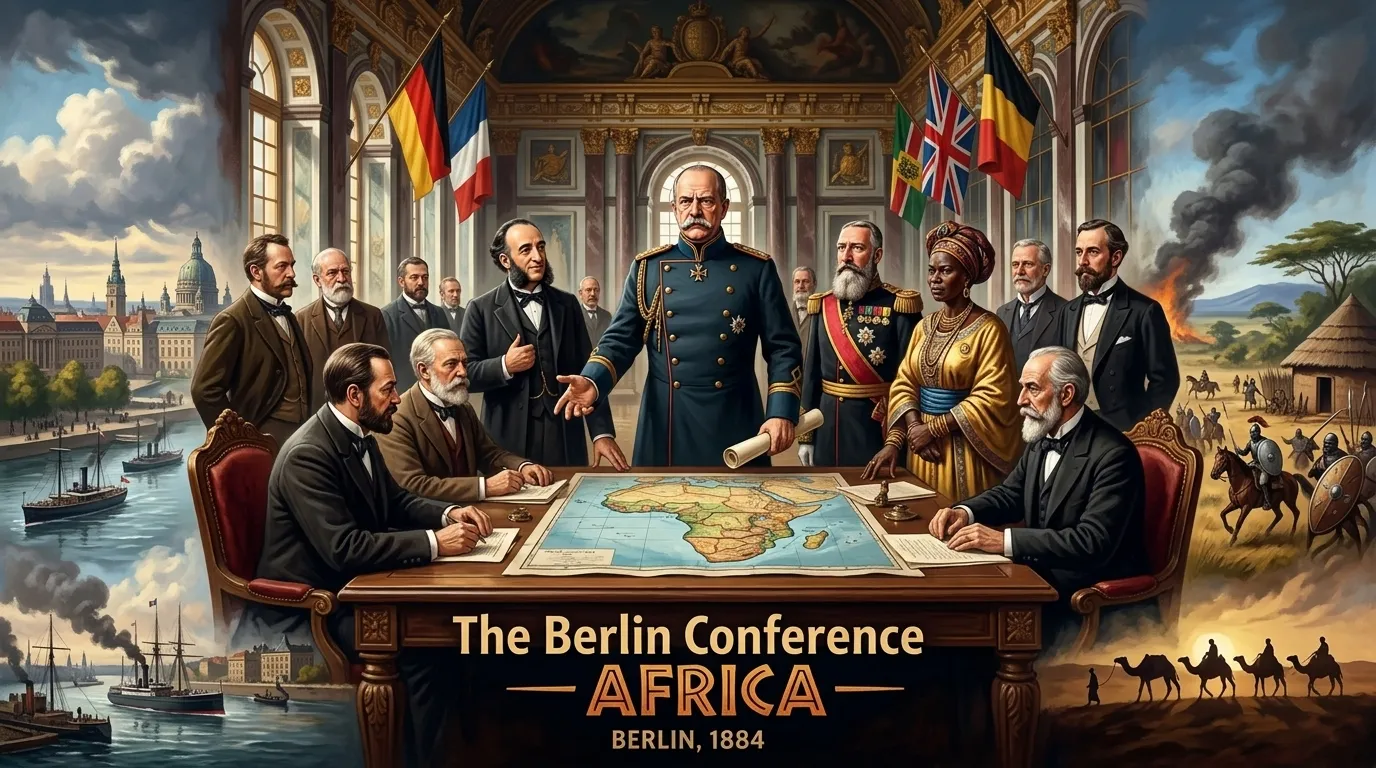
On November 15, 1884, in Berlin, Germany, Otto von Bismarck, the powerful Chancellor of the German Empire; Jules Ferry, the French Premier; Sir Edward Malet, the British Ambassador to Germany; and King Leopold II of Belgium, along with representatives from twelve other European nations and the United States, gathered to carve up the continent of Africa. The Berlin Conference, a meeting that would seal the fate of millions, was about to begin.

On November 15, 1884, in Berlin, Germany, Otto von Bismarck, the powerful Chancellor of the German Empire; Jules Ferry, the French Premier; Sir Edward Malet, the British Ambassador to Germany; and King Leopold II of Belgium, along with representatives from twelve other European nations and the United States, gathered to carve up the continent of Africa. The Berlin Conference, a meeting that would seal the fate of millions, was about to begin. But how did these nations come to believe they had the right to divide a continent among themselves?

Page 2

Decades before, King Leopold II of Belgium dreamed of an empire. He declared to Émile Banning, his trusted advisor, 'I don't want to miss a chance of getting us…
Decades before, King Leopold II of Belgium dreamed of an empire. He declared to Émile Banning, his trusted advisor, 'I don't want to miss a chance of getting us a slice of this magnificent African cake.' Banning, a shrewd man with a pointed beard, cautioned Leopold, 'Your Majesty, such ambitions require careful navigation. The other powers will not take kindly to unilateral action.' Leopold, ever the pragmatist, responded, 'Then we shall proceed with subtlety and diplomacy.'

Decades before, King Leopold II of Belgium dreamed of an empire. He declared to Émile Banning, his trusted advisor, 'I don't want to miss a chance of getting us a slice of this magnificent African cake.' Banning, a shrewd man with a pointed beard, cautioned Leopold, 'Your Majesty, such ambitions require careful navigation. The other powers will not take kindly to unilateral action.' Leopold, ever the pragmatist, responded, 'Then we shall proceed with subtlety and diplomacy.'

Page 3

Meanwhile, in France, Jules Ferry, the French Premier, advocated for colonial expansion to boost France's prestige and economy.
Meanwhile, in France, Jules Ferry, the French Premier, advocated for colonial expansion to boost France's prestige and economy. He argued to the French National Assembly, 'France must look to its colonial empire to secure its future. We need raw materials and new markets.' A deputy challenged him, 'But at what cost, Monsieur le Premier? Are we to subjugate entire peoples for our benefit?' Ferry, undeterred, retorted, 'Civilization demands it!'

Meanwhile, in France, Jules Ferry, the French Premier, advocated for colonial expansion to boost France's prestige and economy. He argued to the French National Assembly, 'France must look to its colonial empire to secure its future. We need raw materials and new markets.' A deputy challenged him, 'But at what cost, Monsieur le Premier? Are we to subjugate entire peoples for our benefit?' Ferry, undeterred, retorted, 'Civilization demands it!'

Page 4

Otto von Bismarck, the German Chancellor, initially hesitant about colonies, saw an opportunity to play peacemaker and solidify Germany's position in Europe.
Otto von Bismarck, the German Chancellor, initially hesitant about colonies, saw an opportunity to play peacemaker and solidify Germany's position in Europe. During a private conversation with a colleague, he mused, 'Perhaps a conference would appease these colonial appetites and prevent conflicts amongst ourselves.' His colleague replied, 'But what of the Africans, Herr Chancellor?

Otto von Bismarck, the German Chancellor, initially hesitant about colonies, saw an opportunity to play peacemaker and solidify Germany's position in Europe. During a private conversation with a colleague, he mused, 'Perhaps a conference would appease these colonial appetites and prevent conflicts amongst ourselves.' His colleague replied, 'But what of the Africans, Herr Chancellor? Do they have no say in their own fate?' Bismarck sighed, 'Realpolitik demands difficult choices, my friend.'

Page 5

As the conference progressed, representatives meticulously drew lines on the map of Africa, paying little attention to existing ethnic and tribal boundaries.
As the conference progressed, representatives meticulously drew lines on the map of Africa, paying little attention to existing ethnic and tribal boundaries. Sir Edward Malet, the British Ambassador, pointed at a map. 'This territory,' he announced to the assembled delegates, 'is vital for our trade routes to India.' Bismarck nodded, 'Indeed, control of strategic points is paramount.' Leopold, meanwhile, surreptitiously eyed the vast Congo Basin, whispering to his advisor…

As the conference progressed, representatives meticulously drew lines on the map of Africa, paying little attention to existing ethnic and tribal boundaries. Sir Edward Malet, the British Ambassador, pointed at a map. 'This territory,' he announced to the assembled delegates, 'is vital for our trade routes to India.' Bismarck nodded, 'Indeed, control of strategic points is paramount.' Leopold, meanwhile, surreptitiously eyed the vast Congo Basin, whispering to his advisor, 'That region, Banning, will be the jewel in our crown.'

Page 6

The Berlin Conference — Africa (1884, Africa) — page 6 illustration — Wonder History

The Africans themselves were not invited to the conference. They learned of their fate through whispers and rumors. Queen Ndaté Yalla Mbodj of the Waalo kingdom in Senegal, upon hearing of the European powers' decisions, declared to her council, 'They seek to divide our lands without even consulting us! We must resist!' One of her warriors responded, 'How can we fight against so many?' Ndaté Yalla retorted, 'As Nelson Mandela wisely said, 'Education is the most powerful weapon which you can use to change the world.' We must educate our people and fight for our sovereignty.'

Page 7

News of the Berlin Act spread across Africa, causing widespread anger and resistance. Samori Touré, the leader of the Wassoulou Empire in West Africa, rallied…
News of the Berlin Act spread across Africa, causing widespread anger and resistance. Samori Touré, the leader of the Wassoulou Empire in West Africa, rallied his troops. 'They claim to bring civilization,' he thundered, 'but they only bring chains! We will defend our land, our people, and our freedom.' His lieutenant asked, 'But their weapons are far superior, Almami.' Samori responded, 'Courage and unity are weapons of their own, weapons the Europeans can't match.'

News of the Berlin Act spread across Africa, causing widespread anger and resistance. Samori Touré, the leader of the Wassoulou Empire in West Africa, rallied his troops. 'They claim to bring civilization,' he thundered, 'but they only bring chains! We will defend our land, our people, and our freedom.' His lieutenant asked, 'But their weapons are far superior, Almami.' Samori responded, 'Courage and unity are weapons of their own, weapons the Europeans can't match.'

Page 8

The consequences of the Berlin Conference were devastating. Arbitrary borders divided ethnic groups, sparking conflicts that continue to this day.
The consequences of the Berlin Conference were devastating. Arbitrary borders divided ethnic groups, sparking conflicts that continue to this day. Leopold's Congo Free State became notorious for its brutal exploitation of the Congolese people for rubber. A Congolese villager lamented to a missionary, 'They force us to collect rubber day and night. If we fail to meet their quota, they cut off our hands.' The missionary, horrified, replied, 'This is a crime against humanity!'

The consequences of the Berlin Conference were devastating. Arbitrary borders divided ethnic groups, sparking conflicts that continue to this day. Leopold's Congo Free State became notorious for its brutal exploitation of the Congolese people for rubber. A Congolese villager lamented to a missionary, 'They force us to collect rubber day and night. If we fail to meet their quota, they cut off our hands.' The missionary, horrified, replied, 'This is a crime against humanity!'

Page 9

The conference accelerated the Scramble for Africa, leading to numerous wars and rebellions. Colonial powers suppressed local cultures and imposed their own…
The conference accelerated the Scramble for Africa, leading to numerous wars and rebellions. Colonial powers suppressed local cultures and imposed their own systems of governance. A young African student in a colonial school wrote in his diary, 'They teach us their history, their language, their values. But what about our own?' He continued, 'We must reclaim our heritage and forge our own destiny.'

The conference accelerated the Scramble for Africa, leading to numerous wars and rebellions. Colonial powers suppressed local cultures and imposed their own systems of governance. A young African student in a colonial school wrote in his diary, 'They teach us their history, their language, their values. But what about our own?' He continued, 'We must reclaim our heritage and forge our own destiny.'

Page 10

The legacy of the Berlin Conference continues to shape Africa today. The arbitrarily drawn borders have contributed to ongoing ethnic tensions and political…
The legacy of the Berlin Conference continues to shape Africa today. The arbitrarily drawn borders have contributed to ongoing ethnic tensions and political instability. Despite these challenges, African nations are striving to overcome the past and build a future of peace and prosperity. A modern African leader, addressing a gathering of nations, declared, 'Though the scars of colonialism remain, the spirit of Africa endures.

The legacy of the Berlin Conference continues to shape Africa today. The arbitrarily drawn borders have contributed to ongoing ethnic tensions and political instability. Despite these challenges, African nations are striving to overcome the past and build a future of peace and prosperity. A modern African leader, addressing a gathering of nations, declared, 'Though the scars of colonialism remain, the spirit of Africa endures. We will rise above the divisions of the past and create a united and strong Africa!'

About this story

  • Historical figures: Otto von Bismarck, Jules Ferry, Sir Edward Malet
  • Location: Africa
  • Period: Modern
  • Audience: general readers

Questions and answers

Questions and answers about The Berlin Conference — Africa (1884, Africa)

Read Wonder History on your phone

Wonder History is available on Android. Get Wonder History on Google Play.

More Wonder History stories

All Wonder History stories · Open the library