The Day Hawaii Chose a Kingdom: Kamehameha at Nuuanu (1795)
The Day Hawaii Chose a Kingdom: Kamehameha at Nuuanu (1795) — a history story. 10 illustrated pages, narrated, free to read on Wonder History.
Page 1
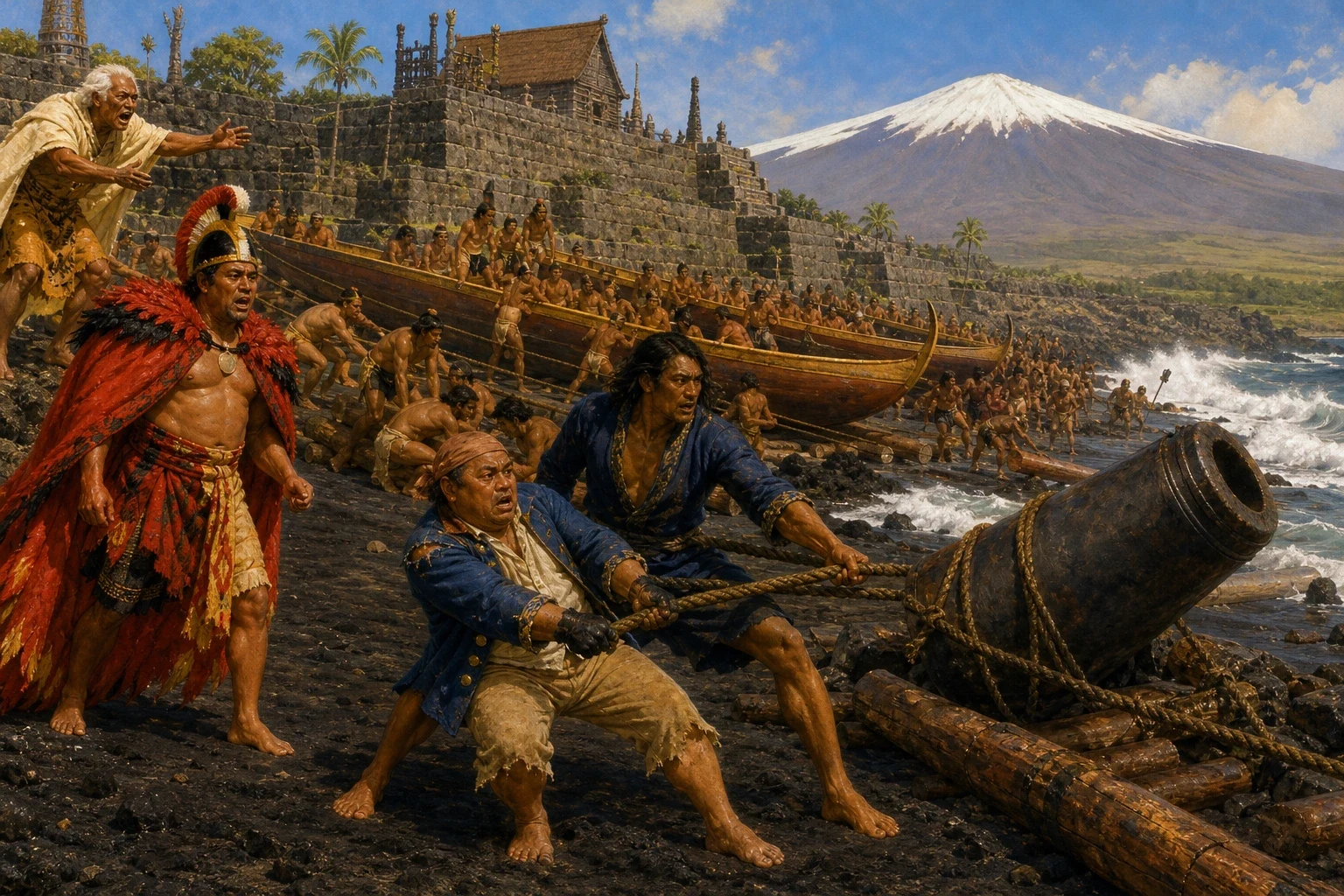
The black lava beach burned hot under hundreds of bare feet as the peleleu canoes, each hull longer than six men laid end to end, groaned down the greased hau-log rollers toward the surf. Ropes of braided coconut fiber snapped taut, whipping sand, as crews heaved in rhythm, chanting to keep the pull together. Near the water's edge, a thicker log cracked beneath the weight of the ship's cannon being winched aboard a double-hulled platform, and the iron gun lurched backward, grinding toward the rollers and the men crouched below them. Shouts tore across the beach. John Young threw himself onto the drag-rope, boots skidding in black sand, his blackened hands burning as the rope tore through them. Kaʻiana lunged beside him, planting his bare feet wide, hauling back with his whole body until the gun's slide stopped dead inches from a rower's legs. Keʻeaumoku barked orders from above, steadying a second line of men with his stick-thin arms, while Kamehameha strode down through the chaos, his red cloak snapping, bellowing for fresh rollers to be thrown under the carriage.
Page 2
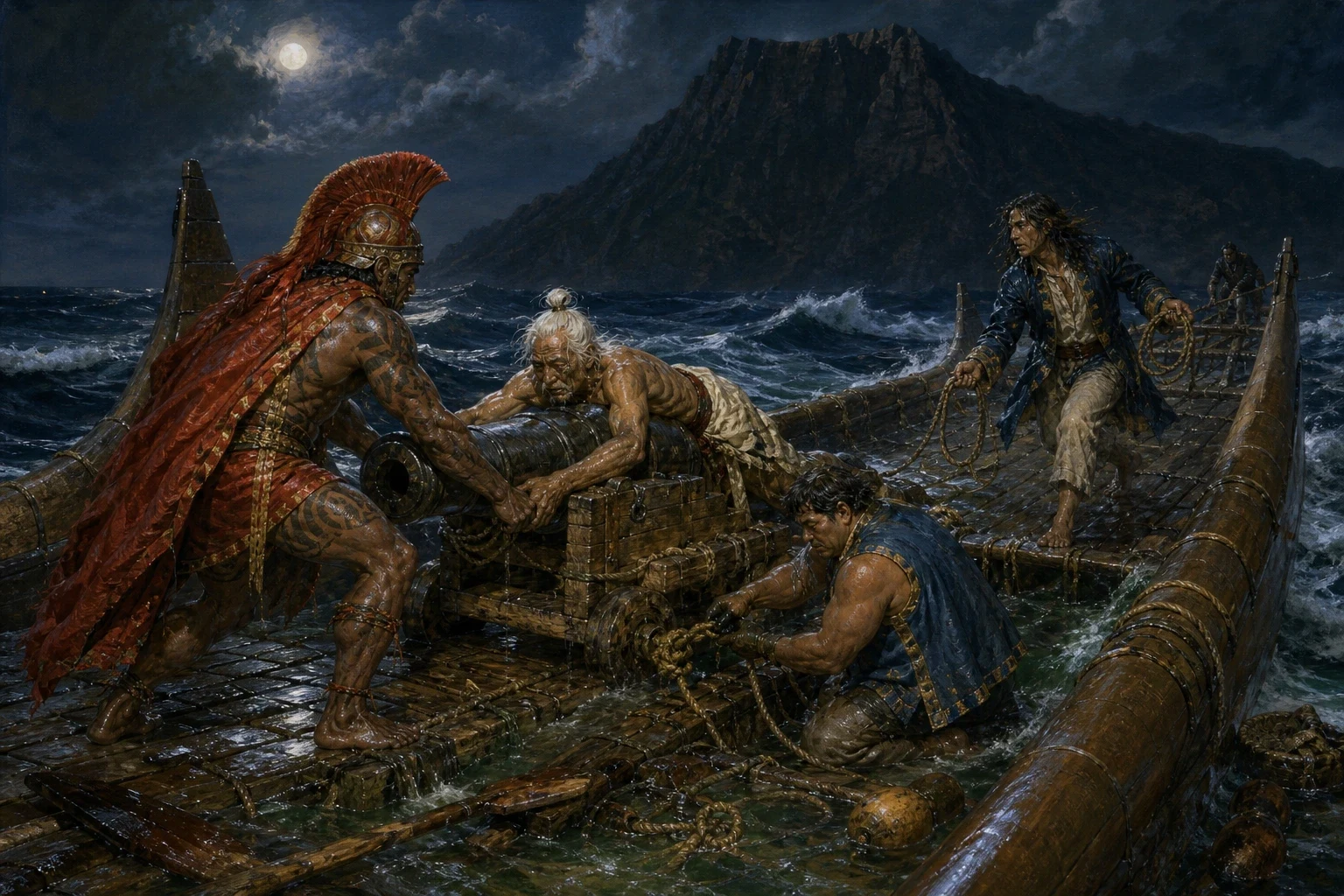
The rogue swell came without warning, lifting the double hull and twisting it hard against the trough. The steering paddle, long as a man and thick as a thigh, snapped across the gunwale with a crack like bone. Green water slammed between the twin canoes, bursting the coconut-fibre lashings that pinned the cannon to its platform, and the great iron gun lurched sideways, grinding toward open water. Keʻeaumoku threw himself across the barrel, driving his bony shoulder under it, screaming for hands. Kamehameha dropped his paddle and hauled on the gun carriage with both arms, boots braced wide against the slick planking, while Kaʻiana scrambled across the heaving platform to grab fresh cord from the stores. John Young plunged to his knees in the rising water, blackened hands fishing for the severed lashing-ends, knotting furiously even as another wave broke over the hulls. Men bailed frantically with gourds, flinging water back into the black sea as Haleakalā's shoulder loomed ahead through the spray, indifferent and enormous.
Page 3
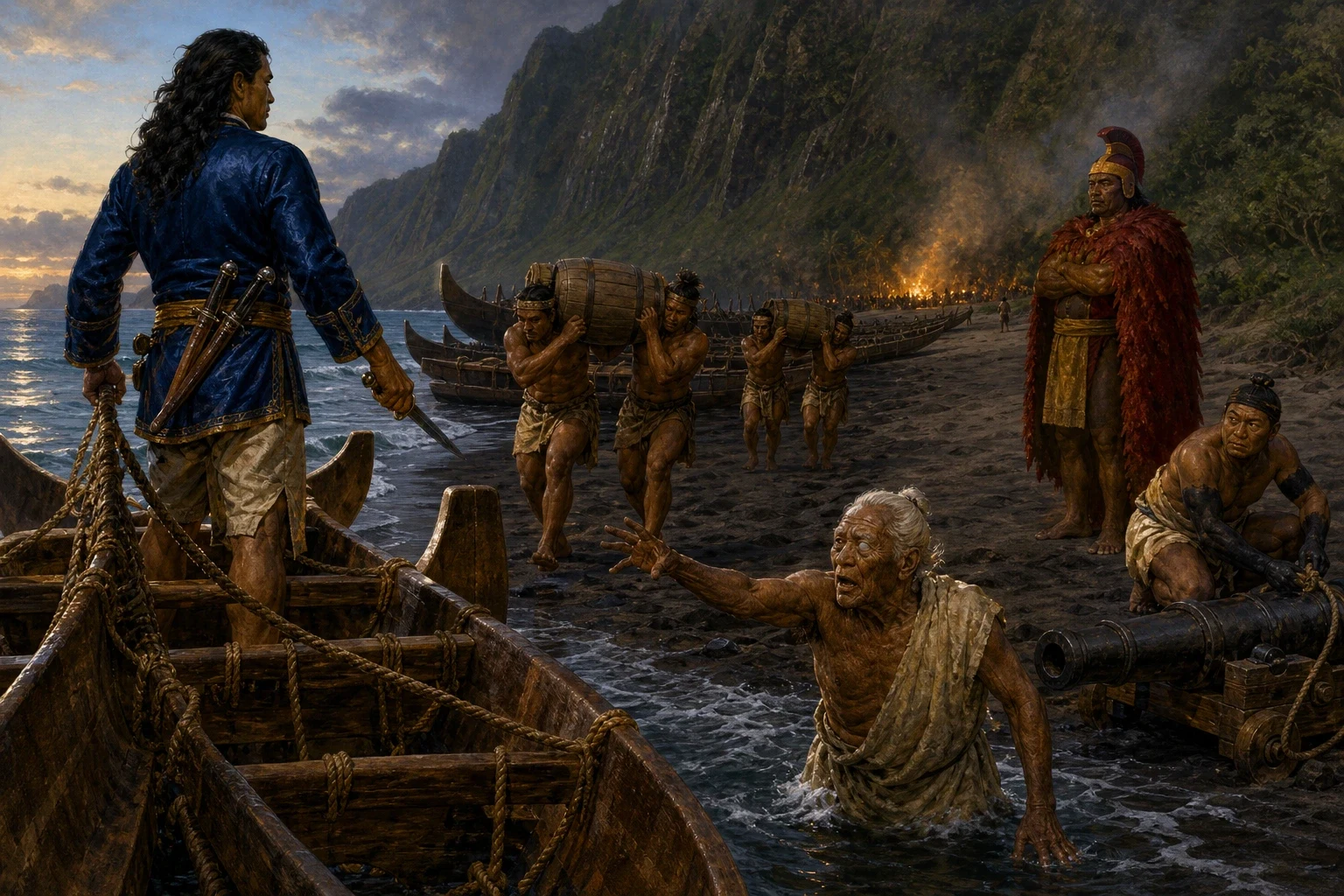
The council fire still smoked on the sand when word came down the line that the tall chief in the blue silk jacket had been passed over again, no command given him, no canoes under his name. He said nothing to the men who brought the news. He walked to his double canoe where it lay among four miles of hulls under the dark wall of Kamakou, drew a knife, and sawed through the braided anchor cords himself. His men came running at his low call, shouldering four heavy powder kegs down through the loose sand two at a time, grunting under the weight, slamming them into the hull wells. Keʻeaumoku came stumbling across the beach barefoot, robe flapping, shouting the chief's name into the wind, wading out into the surf to grab for the gunwale as it slid past him. His clawed hand caught only spray. The canoe cleared the breakers and was gone into the black water, and the old man stood thigh-deep, roaring after it, fists raised, until Kamehameha's voice called him back from the dry sand.
Page 4
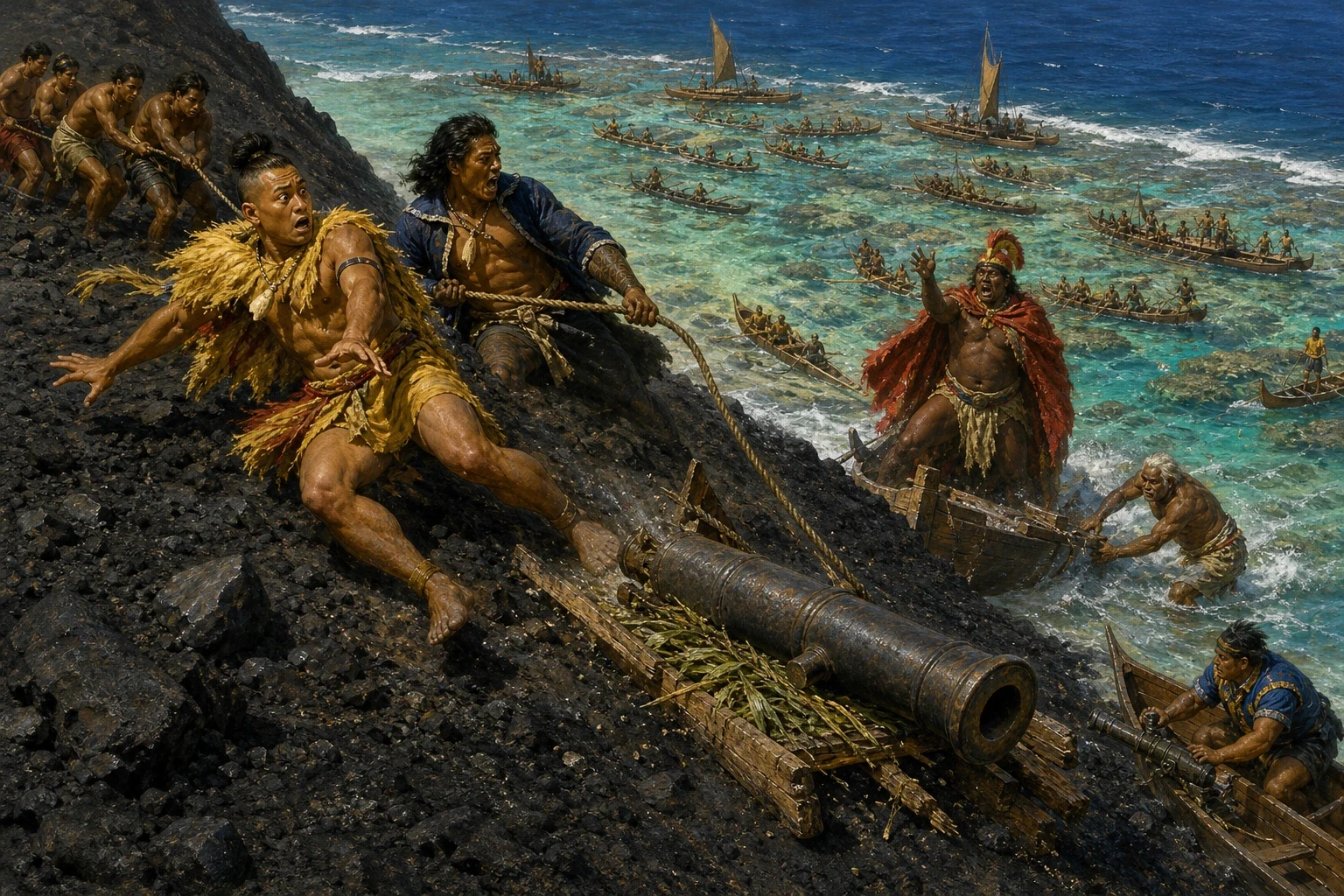
Up the black cinder slope of Lēʻahi, forty men hauled the captured ship's gun on skids of lashed ti-leaf, the fronds glistening with grease. Kalanikūpule gripped the drag-rope with both hands, his shaved temples running sweat, bracing his narrow shoulders against the weight. Kaʻiana climbed alongside, bare chest heaving, shouting the count, his loose hair plastered to his neck. Then the forward skid cracked under the gun's iron bulk. Men scrambled backward, slipping on loose cinder, as the gun lurched sideways and began to slide, gathering speed, grinding a black scar down the crater face. Kalanikūpule flung himself clear, rolling hard across the slope. Below, on the reef at Waikīkī, the first canoes of Kamehameha's fleet ground onto the coral in a crash of white water. Kamehameha stood in the bow, cloak snapping, roaring orders as his paddlers leapt into the surf. Keʻeaumoku, waist-deep, hauled a grounded hull sideways by main force, bracing his stork-thin legs against the current, while far above the runaway gun thundered down toward the beach where they stood.
Page 5
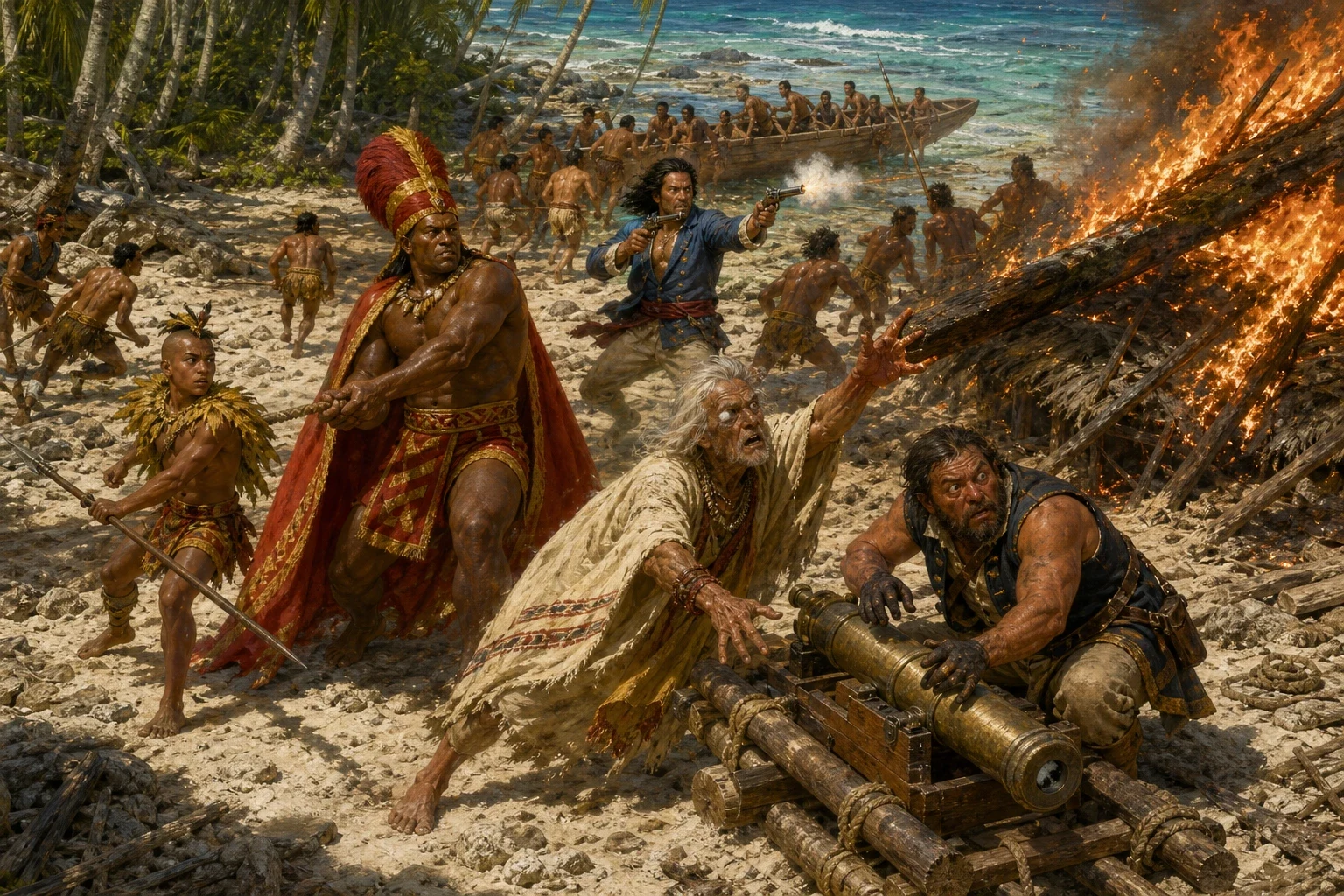
The coral shallows churned white as hundreds of men hauled the great double canoes over the reef, backs bent under the gunwales, feet slipping on broken coral the size of fists. Nearer the coconut grove, John Young's cannon rode a sledge of lashed palm trunks, and a dozen warriors threw ropes over their shoulders, dragging it hand over hand through the sand toward the trees. Kamehameha strode alongside, one huge fist closing on a straining rope to add his own weight, his cloak dragging a furrow behind him. Then flame bloomed ahead — Oʻahu spearmen, falling back, had thrust torches into a thatched hale's roof, and the whole structure sagged and crashed down across the cleared path in a shower of sparks. Keʻeaumoku lunged forward, grabbing a burning rafter with his bare hand and hauling it clear before it could catch the sledge. Kaʻiana wheeled, pistols out, firing twice at the fleeing spearmen. Kalanikūpule, still among his own retreating men, snatched up a fallen spear and turned to cover their run into the trees.
Page 6
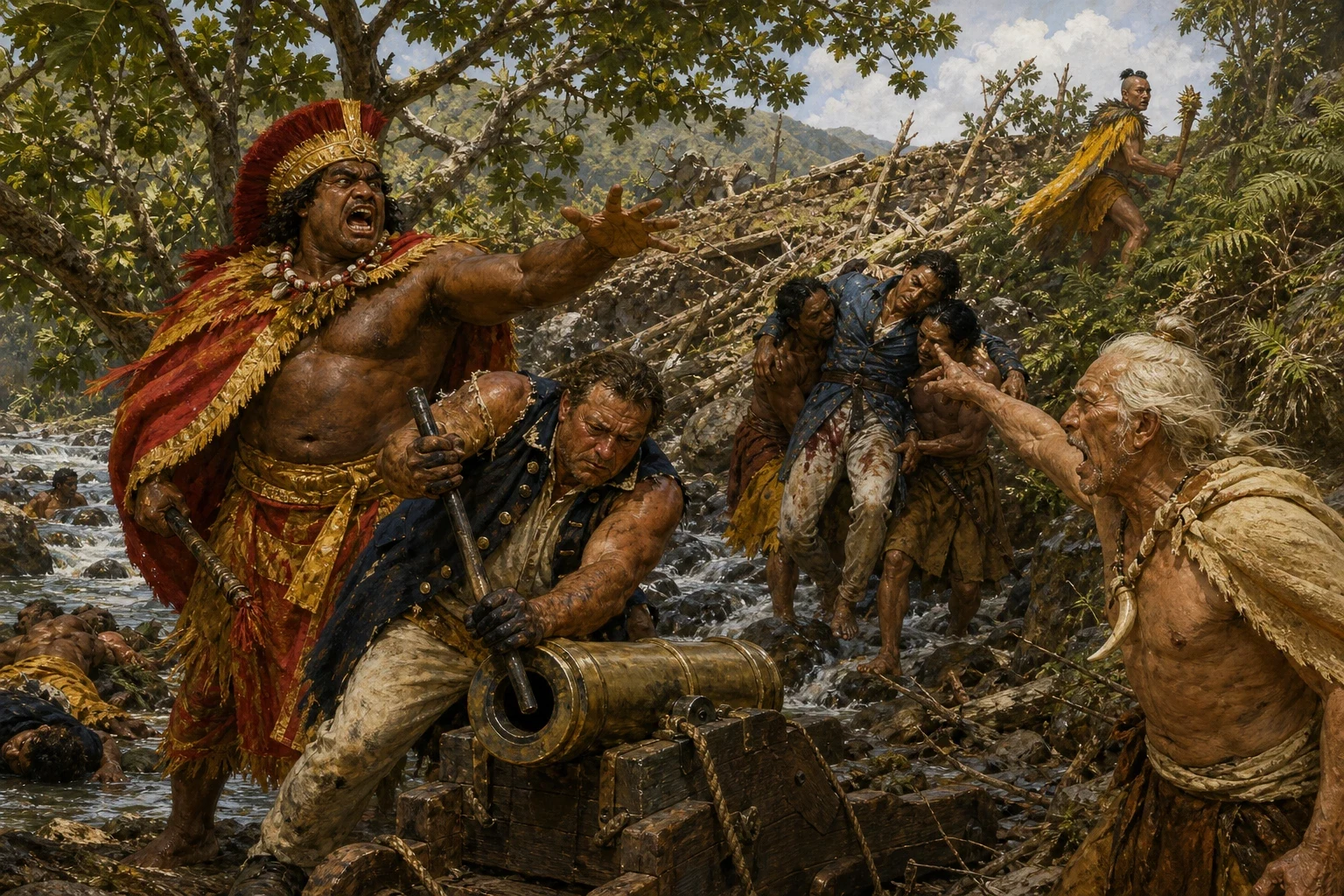
The earthwork above Puʻiwa let go all at once. Boulders the size of water barrels crashed down through the breadfruit grove, splintering trunks and crushing the front ranks of the advancing column into the mud of the streambank. Men screamed and scrambled sideways, but the front line was gone, flattened under stone and broken wood. Kamehameha roared across the chaos, waving Young forward with one huge arm. Young slammed a fresh charge down the barrel of his gun, hands black with powder, and touched the match. The cannon bucked and the breastwork above burst apart in a spray of rock and splinters, scattering the defenders who had rolled the boulders. Through the smoke came the counter-blow: Kaʻiana, pressing too far up the slope, took a spear below the ribs and went down hard. Four men scrambled to him, hauling him up by the arms and shoulders, his blue silk jacket soaked black-dark with blood, and carried him stumbling and sagging back down through the broken trees toward the rear, while Keʻeaumoku screamed orders over the din and Kalanikūpule's men melted back into the gulch above.
Page 7
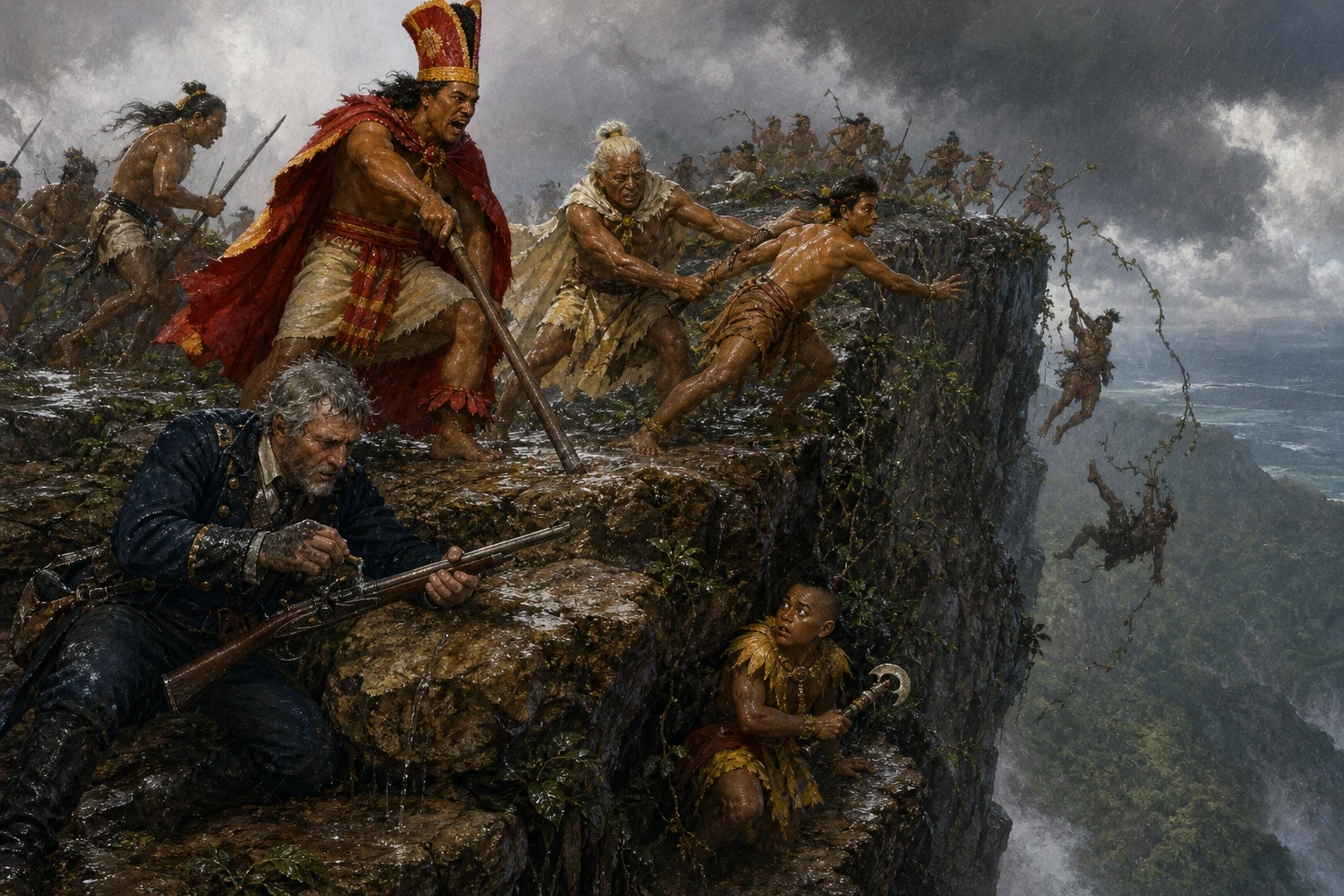
The gale tore sideways across the notch, and the Oʻahu line broke apart against it like dry thatch. Men ran three steps and found no ground, boots skidding on wind-polished rock slicked with rain, hands slapping out for the ʻieʻie vines that coiled along the rim. Some caught them and hung, swinging over the thousand-foot drop; some did not catch them at all. Kamehameha slammed his spear butt into the earth and roared his warriors forward across the lip, driving the broken line further back into empty air. Keʻeaumoku lunged sideways, his stork-thin arm shooting out, fingers clamping around a young warrior's wrist just as the boy's feet left the rock, and he hauled him bodily back over the edge with a grunt that tore from his chest. Below the rim, flattened against a goat ledge no wider than a plank, Kalanikūpule inched along sideways, club gripped tight, breath held, watching the slaughter pass over his head like weather. John Young fired once into the press and reloaded with blackened hands, bracing his boots against the wind that wanted to take him too.
Page 8
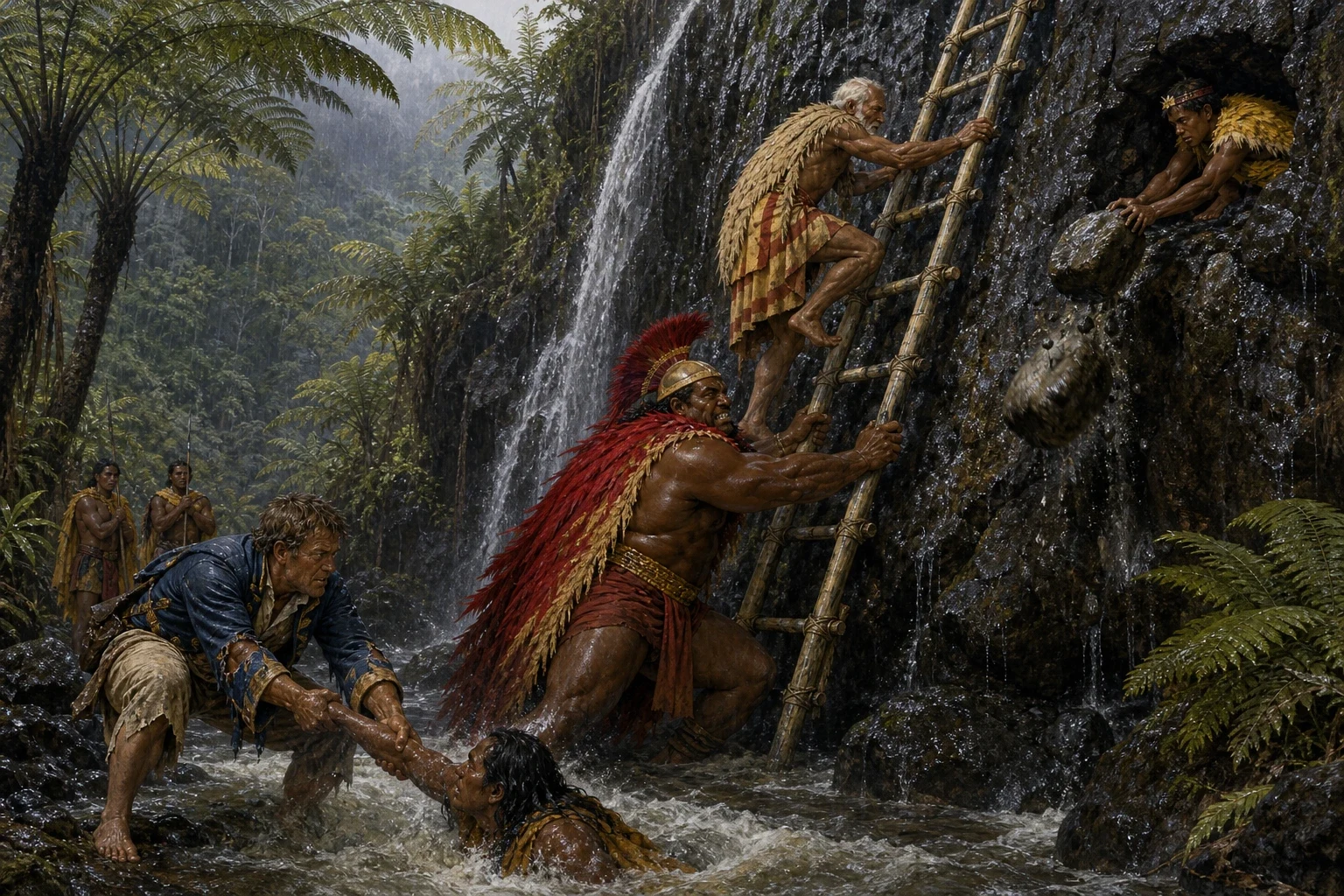
The rock face rises three times the height of a man, black and sheeted with runoff, and the ladder lashed against it is nothing but hau poles bound with twisted bark cord, bowing under the climbers' weight. Keʻeaumoku goes up first, hooking his bony fingers into the rungs, his stork-thin legs trembling as he hauls himself higher into the spray. Below him Kamehameha grips the ladder's base with both huge hands, bracing it against the stone, his red cloak sodden and heavy against his calves. A rung splits under the third climber's foot with a crack like a snapped spear shaft, and the man drops, arms flailing, into the pool below with a heavy slap. John Young lunges to the pool's edge, blackened hands outstretched, grabbing the gasping climber's wrist and dragging him onto the rock. High above, wedged flat inside a lava tube barely wider than his own shoulders, the small yellow-caped fugitive works a stone loose with his heel and sends it bouncing down past the ladder, narrowly missing Keʻeaumoku's skull.
Page 9
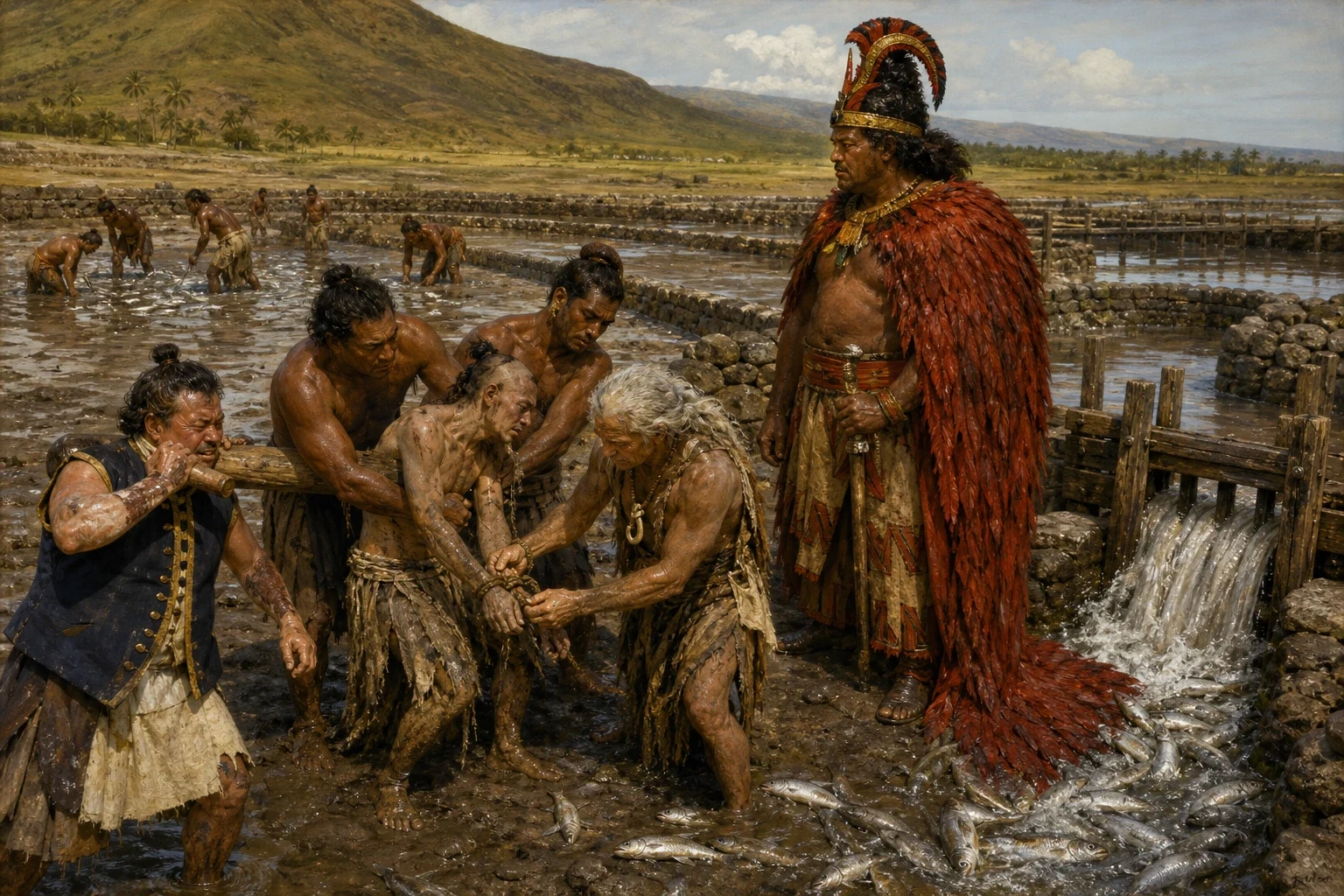
Warriors ran the length of the stone-walled fishpond, shoulders slamming into the sluice gate until the lashed timbers gave way and a silver flood of mullet poured roaring across the mud flats. Men shouted and dove after the thrashing fish, but Keʻeaumoku stabbed his staff toward the broken wall itself, where a shape thrashed among the reeds that was no mullet. Warriors waded in waist-deep and hauled out the starved, reed-stained young chief by the arms, his ribs sharp beneath mud-slicked skin. Kamehameha strode down the bank, cloak dragging through the churned water, and planted himself over the captive. Keʻeaumoku seized a rope and looped it twice round the prisoner's wrists, dragging him upright and lashing him hard to a waiting carrying pole while John Young steadied the pole's far end against his own shoulder. The young chief's legs buckled; two men forced him onto the pole's crossbar and bound his ankles beneath it. Fish still flopped silver across the flats behind them as the pole was hoisted onto bearers' shoulders.
Page 10
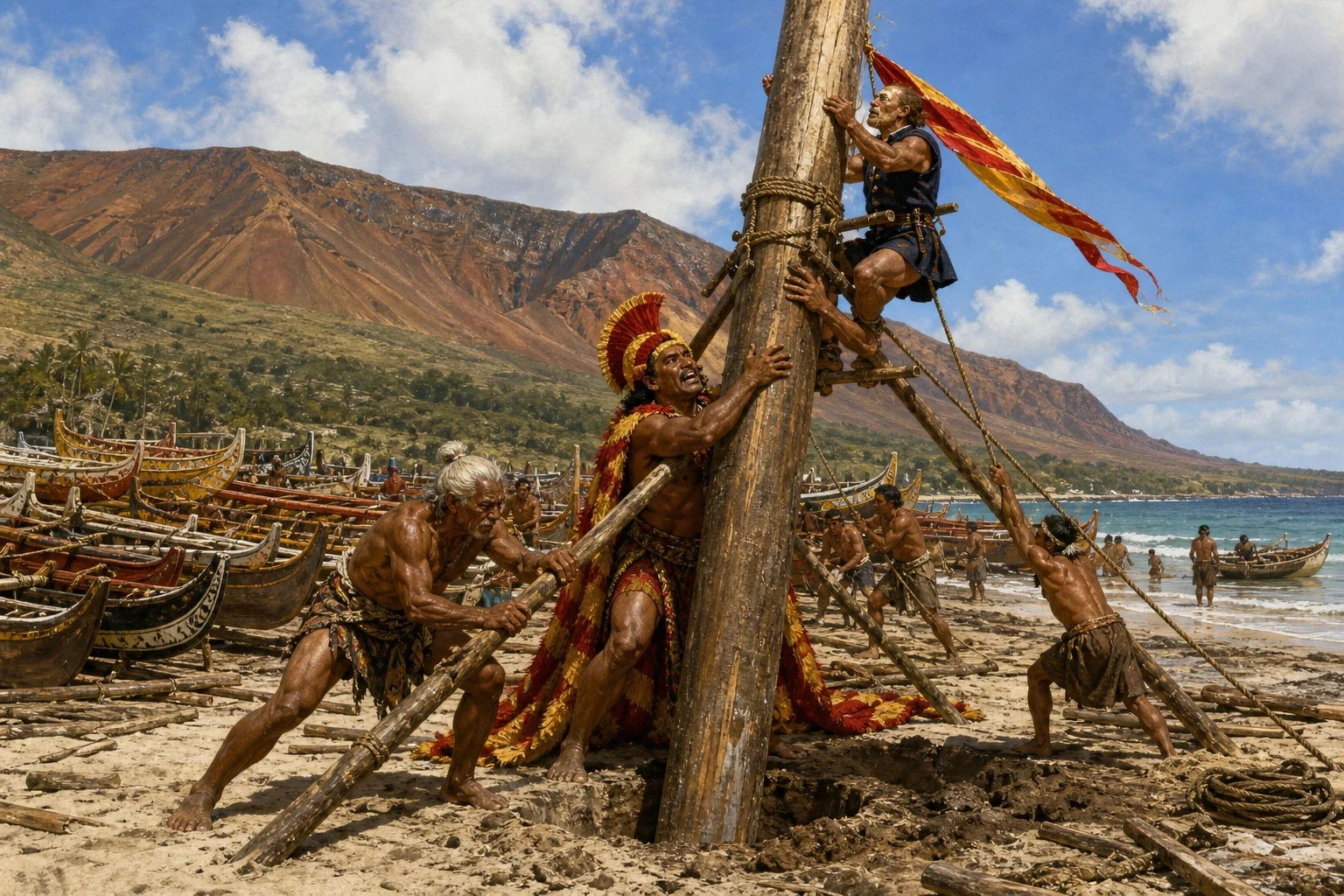
The flats at Kou lay crowded with canoes hauled up in long ranks, hulls from every island pulled past the tideline by crews still slick with salt. Behind them Pūowaina rose bare and red-brown against the sky. At the center of it all a crew of a dozen men hauled on long ropes, walking the first great ʻōhiʻa post upright hand over hand, its base scraping into the waiting pit while others braced it with shoulders and forked poles. Kamehameha gripped the post itself near its top, guiding its swing with the flat of both huge hands, calling the count. Keʻeaumoku threw his ropy weight against a brace pole, digging his splayed feet into the sand to hold the angle true. The post thudded home into the pit, shuddering the ground, and the crew gave a shout. John Young climbed the lashed crosspieces near the top, blackened hands knotting the kapu pennant fast to the ridgepole, tying it off hard before dropping back down the post to solid ground.
About this story
- Audience: general readers
- Format: 10 illustrated pages, narrated, free to read on Wonder History
Read Wonder History on your phone
Wonder History is available on Android and iPhone and iPad. Get Wonder History on Google Play · Get Wonder History on the App Store.
More Wonder History stories
- The Day Hypatia's Students Measured the Stars (400 AD, Alexandria)
- The Day Tashkent's Earthquake Rebuilt a City (1966)
- The Day the Chinchorro Wrapped Their Dead (5000 BC, Atacama)
- The Day the Ice Road Opened to Lake Ladoga (1941)
- The Day the Mapuche Stopped an Empire at Curalaba (1598, Chile)
- The Decision to Drop the Atomic Bomb (1945, United States)