The Decision to Drop the Atomic Bomb (1945, United States)
The Decision to Drop the Atomic Bomb (1945, United States) — an illustrated history story, featuring Franklin Delano Roosevelt, Harry S. Truman, Henry Stimson, set in United States. 10 illustrated pages, free to read on Wonder History.
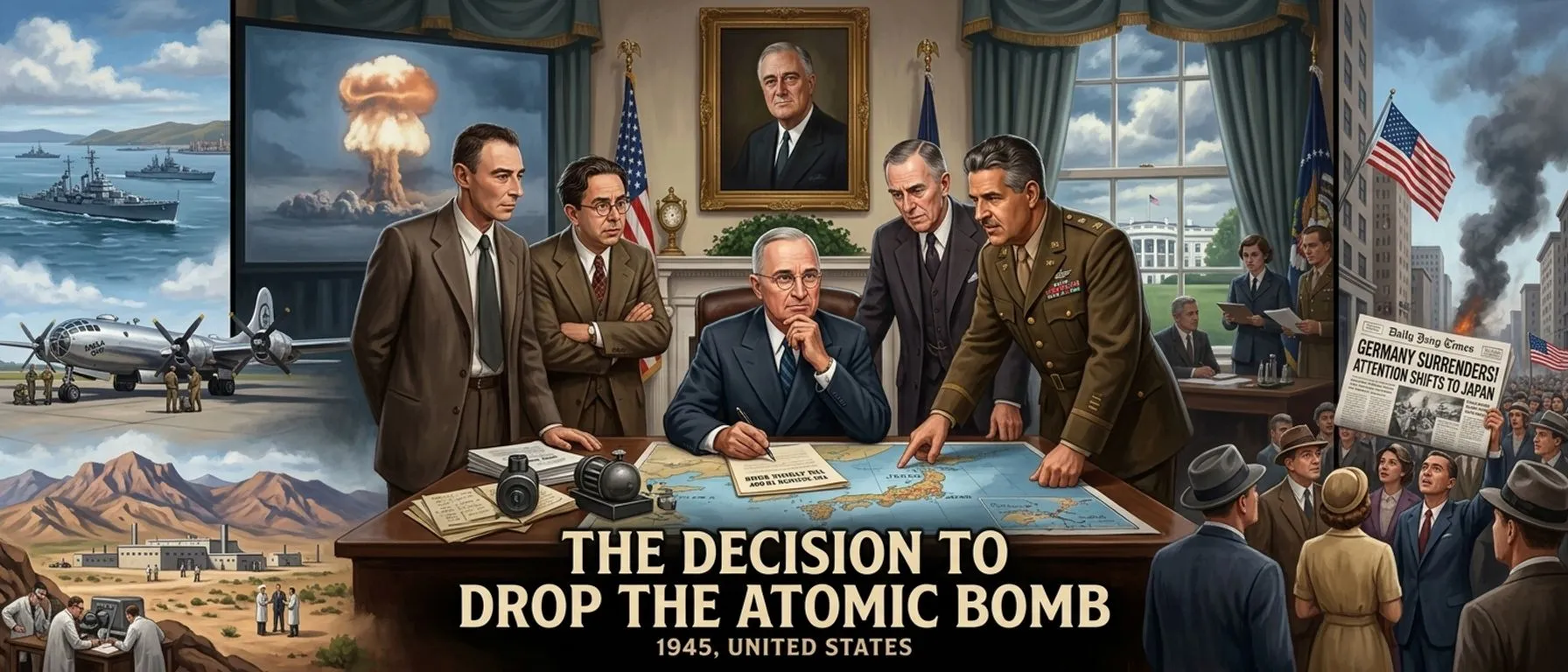
Page 1

August 6, 1945, over the city of Hiroshima. Colonel Paul Tibbets piloted the Enola Gay, the B-29 Superfortress carrying 'Little Boy'. The bomb doors opened, and the world changed forever. But how did Harry S. Truman, the 33rd President of the United States, come to this decision?
Page 2

In December 1941, the United States entered World War II after the attack on Pearl Harbor. President Franklin Delano Roosevelt, addressing the nation, declared war on Japan. The conflict raged across Europe and the Pacific. The question became, how could it be ended swiftly and decisively?
Page 3

Leo Szilard, the physicist who first conceived of the atomic bomb, approached Albert Einstein with his concerns. "Einstein," Szilard explained, "if the Germans were to develop a similar weapon before the Allies, the consequences would be dire. We have to warn President Roosevelt about the possibility." Einstein agreed to write to Roosevelt, outlining the potential dangers of atomic weaponry.
Page 4

General Leslie Groves, the man overseeing the Manhattan Project, spoke with J. Robert Oppenheimer in Los Alamos. 'Oppenheimer, the future of the free world rests on your shoulders. We need to produce a working atomic bomb before the enemy does.' Oppenheimer, the scientific director, understood the immense pressure. "We must proceed with all haste," he said.
Page 5

Following Roosevelt's death, Vice President Harry S. Truman ascended to the presidency. Secretary of War Henry Stimson briefed him on the Manhattan Project. 'Mr. President,' Stimson said gravely, 'we are on the verge of creating a weapon unlike any the world has ever seen. Its implications are enormous.' Truman listened intently, understanding the weight of the decision he would soon face.
Page 6

Truman met with Winston Churchill, Prime Minister of the United Kingdom, and Joseph Stalin, the leader of the Soviet Union, at the Potsdam Conference. The implications of the new weapon hung in the air, unmentioned but understood. The leaders discussed the terms of surrender for Japan. Truman received word that the Trinity test in New Mexico had been successful, confirming the bomb's devastating power.
Page 7

Leo Szilard and a group of scientists presented Truman with a petition. They argued against the use of the atomic bomb without a demonstration. 'Mr. President,' Szilard pleaded, 'demonstrating its power might be enough to convince Japan to surrender, without the devastating loss of life.' Truman listened, but his mind was already made up. He later recalled, 'I regarded the bomb as a military weapon and never had any doubt that it should be used.'
Page 8

August 6th, 1945, Hiroshima. The Enola Gay approached its target. Colonel Tibbets released 'Little Boy'. The explosion was instantaneous. As Oppenheimer later quoted from the Bhagavad Gita, 'Now I am become Death, the destroyer of worlds.'
Page 9

Three days later, a second bomb, 'Fat Man', was dropped on Nagasaki. Emperor Hirohito, addressing his people, announced Japan's unconditional surrender. 'We have resolved to pave the way for a grand peace for all generations to come,' he stated. World War II was finally over.
Page 10

The decision to drop the atomic bombs remains one of the most controversial in history. It brought a swift end to World War II, but at a terrible cost. As Winston Churchill said, 'Never give in, never give in, never, never, never—in nothing, great or small, large or petty—never give in, except to convictions of honor and good sense.' The world entered the atomic age, forever changed by the choices made in those fateful days.
About this story
- Historical figures: Franklin Delano Roosevelt, Harry S. Truman, Henry Stimson
- Location: United States
- Period: Modern
- Audience: general readers
Questions and answers
Questions and answers about The Decision to Drop the Atomic Bomb (1945, United States)
Read Wonder History on your phone
Wonder History is available on Android. Get Wonder History on Google Play.
More Wonder History stories
- The Defeat of the Spanish Armada (1588, English Channel)
- The Defeat of the Spanish Armada (1588) - United Kingdom (1588, United Kingdom)
- The Delano Grape Strike (1965, Delano)
- The Discovery of the New World (1492, Europe)
- The Edict of Milan (313 AD) - Italy (313 AD, Italy)
- The End of the Atlantic Slave Trade (1829, USA)