The Storming of the Bastille (1789, France)

The Storming of the Bastille (1789, France) — an illustrated history story, featuring King Louis XVI, Queen Marie Antoinette, Maximilien Robespierre, set in France. 10 illustrated pages, free to read on Wonder History.

The Storming of the Bastille (1789, France) — book cover — Wonder History
The Storming of the Bastille (1789, France) — an illustrated history story, featuring King Louis XVI, Queen Marie Antoinette, Maximilien Robespierre, set in France. 10 illustrated pages, free to read on Wonder History.

Page 1

On July 14, 1789, the air crackled with defiance as Parisians surged toward the Bastille. Cannons roared, smoke billowed, and the fortress loomed—a symbol of…
On July 14, 1789, the air crackled with defiance as Parisians surged toward the Bastille. Cannons roared, smoke billowed, and the fortress loomed—a symbol of royal oppression. Jacques Necker, the Finance Minister, watched from afar, his face etched with worry, while Camille Desmoulins, the impassioned journalist, rallied the crowds, his voice a beacon of revolt. But how did France reach this breaking point?

On July 14, 1789, the air crackled with defiance as Parisians surged toward the Bastille. Cannons roared, smoke billowed, and the fortress loomed—a symbol of royal oppression. Jacques Necker, the Finance Minister, watched from afar, his face etched with worry, while Camille Desmoulins, the impassioned journalist, rallied the crowds, his voice a beacon of revolt. But how did France reach this breaking point?

Page 2

The seeds of revolution were sown not in the streets of Paris, but in the gilded halls of Versailles. King Louis XVI, detached from the suffering of his people…
The seeds of revolution were sown not in the streets of Paris, but in the gilded halls of Versailles. King Louis XVI, detached from the suffering of his people, indulged in lavish feasts while bread prices soared. Queen Marie Antoinette, adorned in jewels and silks, remained oblivious to the growing discontent. "Let them eat cake," she reportedly quipped, though the truth of the quote is debated, the sentiment rang true.

The seeds of revolution were sown not in the streets of Paris, but in the gilded halls of Versailles. King Louis XVI, detached from the suffering of his people, indulged in lavish feasts while bread prices soared. Queen Marie Antoinette, adorned in jewels and silks, remained oblivious to the growing discontent. "Let them eat cake," she reportedly quipped, though the truth of the quote is debated, the sentiment rang true. Where did this disconnect between royalty and the people begin?

Page 3

Jacques Necker, the Finance Minister, attempted to bridge the chasm. He warned King Louis XVI of the impending financial crisis, advocating for fiscal reforms…
Jacques Necker, the Finance Minister, attempted to bridge the chasm. He warned King Louis XVI of the impending financial crisis, advocating for fiscal reforms and greater representation for the Third Estate. "Your Majesty, the people are burdened beyond measure," Necker pleaded, his voice laced with urgency. But his pleas fell on deaf ears, the King unwilling to relinquish his absolute authority. The Estates-General was summoned for the first time in 175 years.

Jacques Necker, the Finance Minister, attempted to bridge the chasm. He warned King Louis XVI of the impending financial crisis, advocating for fiscal reforms and greater representation for the Third Estate. "Your Majesty, the people are burdened beyond measure," Necker pleaded, his voice laced with urgency. But his pleas fell on deaf ears, the King unwilling to relinquish his absolute authority. The Estates-General was summoned for the first time in 175 years.

Page 4

The Estates-General convened in May 1789. Maximilien Robespierre, a rising voice from the Third Estate, challenged the rigid social hierarchy, advocating for…
The Estates-General convened in May 1789. Maximilien Robespierre, a rising voice from the Third Estate, challenged the rigid social hierarchy, advocating for equality and representation. "The rights of man must be protected!" Robespierre declared, his voice echoing through the assembly hall. The Third Estate, representing the common people, demanded a vote by head, not by order, but their demands were rejected. The stage was set for revolution.

The Estates-General convened in May 1789. Maximilien Robespierre, a rising voice from the Third Estate, challenged the rigid social hierarchy, advocating for equality and representation. "The rights of man must be protected!" Robespierre declared, his voice echoing through the assembly hall. The Third Estate, representing the common people, demanded a vote by head, not by order, but their demands were rejected. The stage was set for revolution.

Page 5

On June 20, 1789, members of the Third Estate, locked out of their usual meeting hall, gathered at a nearby tennis court.
On June 20, 1789, members of the Third Estate, locked out of their usual meeting hall, gathered at a nearby tennis court. Defying the King's authority, they swore an oath, known as the Tennis Court Oath, not to disband until a constitution was established. "We shall not yield!" proclaimed Marquis de Lafayette, a nobleman who sided with the people. This act of defiance marked a turning point, signaling the resolve of the Third Estate.

On June 20, 1789, members of the Third Estate, locked out of their usual meeting hall, gathered at a nearby tennis court. Defying the King's authority, they swore an oath, known as the Tennis Court Oath, not to disband until a constitution was established. "We shall not yield!" proclaimed Marquis de Lafayette, a nobleman who sided with the people. This act of defiance marked a turning point, signaling the resolve of the Third Estate.

Page 6
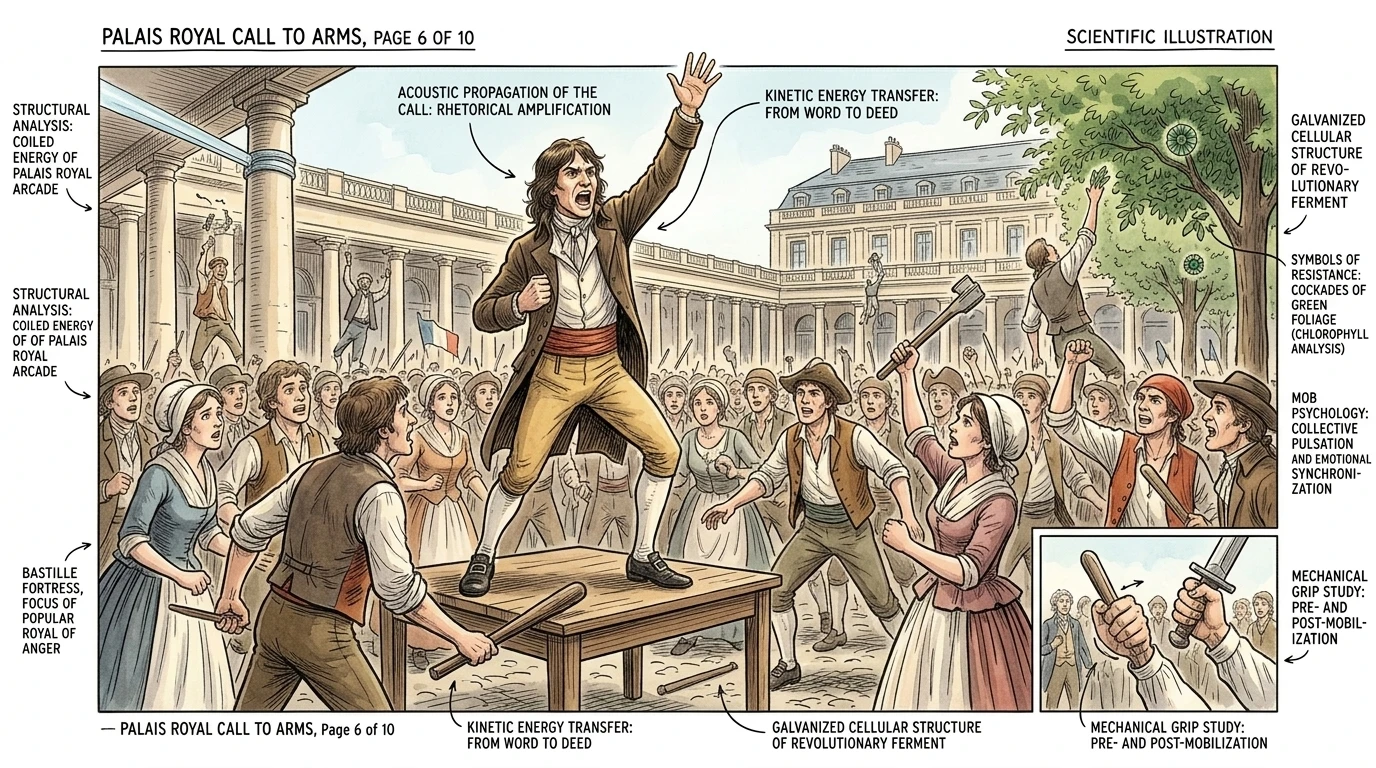
As tensions escalated, King Louis XVI ordered troops to Paris, further fueling the people's fears. Camille Desmoulins, a journalist known for his fiery…
As tensions escalated, King Louis XVI ordered troops to Paris, further fueling the people's fears. Camille Desmoulins, a journalist known for his fiery rhetoric, climbed atop a table in the Palais Royal, urging Parisians to arm themselves. "To arms, citizens!" he cried, his voice filled with urgency. "Dismissal of Necker is a signal for a Saint Bartholomew for patriots!" His words ignited the spark, transforming fear into action. The hunt for weapons began.

As tensions escalated, King Louis XVI ordered troops to Paris, further fueling the people's fears. Camille Desmoulins, a journalist known for his fiery rhetoric, climbed atop a table in the Palais Royal, urging Parisians to arm themselves. "To arms, citizens!" he cried, his voice filled with urgency. "Dismissal of Necker is a signal for a Saint Bartholomew for patriots!" His words ignited the spark, transforming fear into action. The hunt for weapons began.

Page 7

On the morning of July 14, 1789, Parisians marched towards the Bastille, seeking gunpowder and weapons. Bernard-René de Launay, the governor of the Bastille…
On the morning of July 14, 1789, Parisians marched towards the Bastille, seeking gunpowder and weapons. Bernard-René de Launay, the governor of the Bastille, initially refused to surrender, ordering his troops to fire upon the crowd. "Hold the line!" he commanded, his voice echoing across the courtyard. The clash between the people and the royal forces had begun, but the walls of the Bastille could not contain the fury of a nation.

On the morning of July 14, 1789, Parisians marched towards the Bastille, seeking gunpowder and weapons. Bernard-René de Launay, the governor of the Bastille, initially refused to surrender, ordering his troops to fire upon the crowd. "Hold the line!" he commanded, his voice echoing across the courtyard. The clash between the people and the royal forces had begun, but the walls of the Bastille could not contain the fury of a nation.

Page 8

After hours of fierce fighting, the Bastille fell. The storming of the Bastille was a pivotal moment—a symbol of the people's triumph over royal tyranny.
After hours of fierce fighting, the Bastille fell. The storming of the Bastille was a pivotal moment—a symbol of the people's triumph over royal tyranny. Marquis de Lafayette, now commander of the National Guard, secured the release of the remaining prisoners. He knew true power rests in the hands of the people. Bernard-René de Launay was seized and executed, but many lives were lost on both sides of this revolutionary day.

After hours of fierce fighting, the Bastille fell. The storming of the Bastille was a pivotal moment—a symbol of the people's triumph over royal tyranny. Marquis de Lafayette, now commander of the National Guard, secured the release of the remaining prisoners. He knew true power rests in the hands of the people. Bernard-René de Launay was seized and executed, but many lives were lost on both sides of this revolutionary day.

Page 9

With the Bastille captured, King Louis XVI was forced to acknowledge the National Assembly, signaling a shift in power. News of the Bastille's fall spread like…
With the Bastille captured, King Louis XVI was forced to acknowledge the National Assembly, signaling a shift in power. News of the Bastille's fall spread like wildfire across France and beyond, inspiring other uprisings. Jacques Necker, reinstated as Finance Minister, knew the King had to respond to the people's demands. France would never be the same again.

With the Bastille captured, King Louis XVI was forced to acknowledge the National Assembly, signaling a shift in power. News of the Bastille's fall spread like wildfire across France and beyond, inspiring other uprisings. Jacques Necker, reinstated as Finance Minister, knew the King had to respond to the people's demands. France would never be the same again.

Page 10

The storming of the Bastille marked the beginning of the French Revolution, a period of profound social and political upheaval.
The storming of the Bastille marked the beginning of the French Revolution, a period of profound social and political upheaval. As Maximilien Robespierre would later say, quoting Jean-Jacques Rousseau, "Man is born free, and everywhere he is in chains." The echoes of that fateful day continue to reverberate, reminding us of the enduring power of the human spirit to fight for liberty and equality. The ripple effects changed France and the world forever.

The storming of the Bastille marked the beginning of the French Revolution, a period of profound social and political upheaval. As Maximilien Robespierre would later say, quoting Jean-Jacques Rousseau, "Man is born free, and everywhere he is in chains." The echoes of that fateful day continue to reverberate, reminding us of the enduring power of the human spirit to fight for liberty and equality. The ripple effects changed France and the world forever.

About this story

  • Historical figures: King Louis XVI, Queen Marie Antoinette, Maximilien Robespierre
  • Location: France
  • Period: Early Modern
  • Audience: general readers

Questions and answers

Questions and answers about The Storming of the Bastille (1789, France)

Read Wonder History on your phone

Wonder History is available on Android. Get Wonder History on Google Play.

More Wonder History stories

All Wonder History stories · Open the library