Hovercraft
Hovercraft — an illustrated inventions story, set in Global. 10 illustrated pages, free to read on Wonder Inventions.
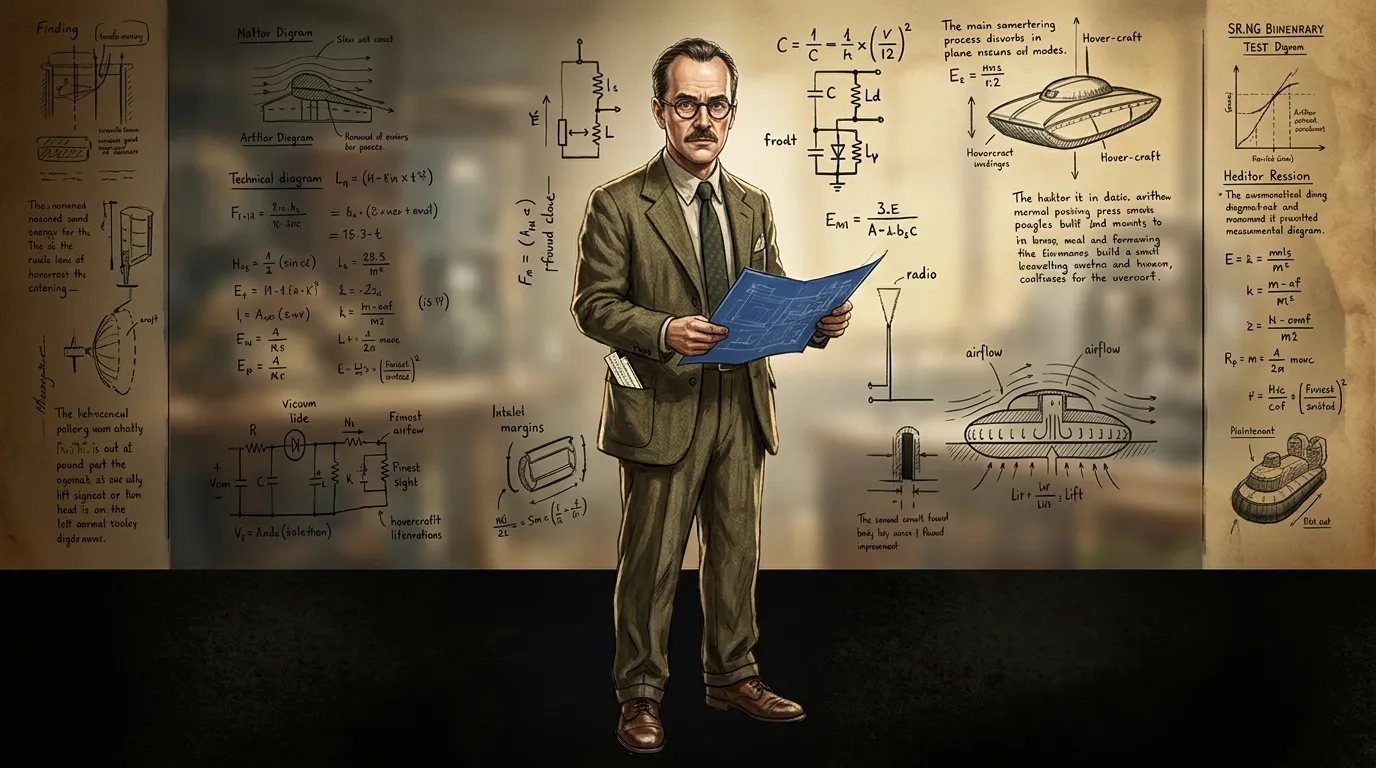
Page 1
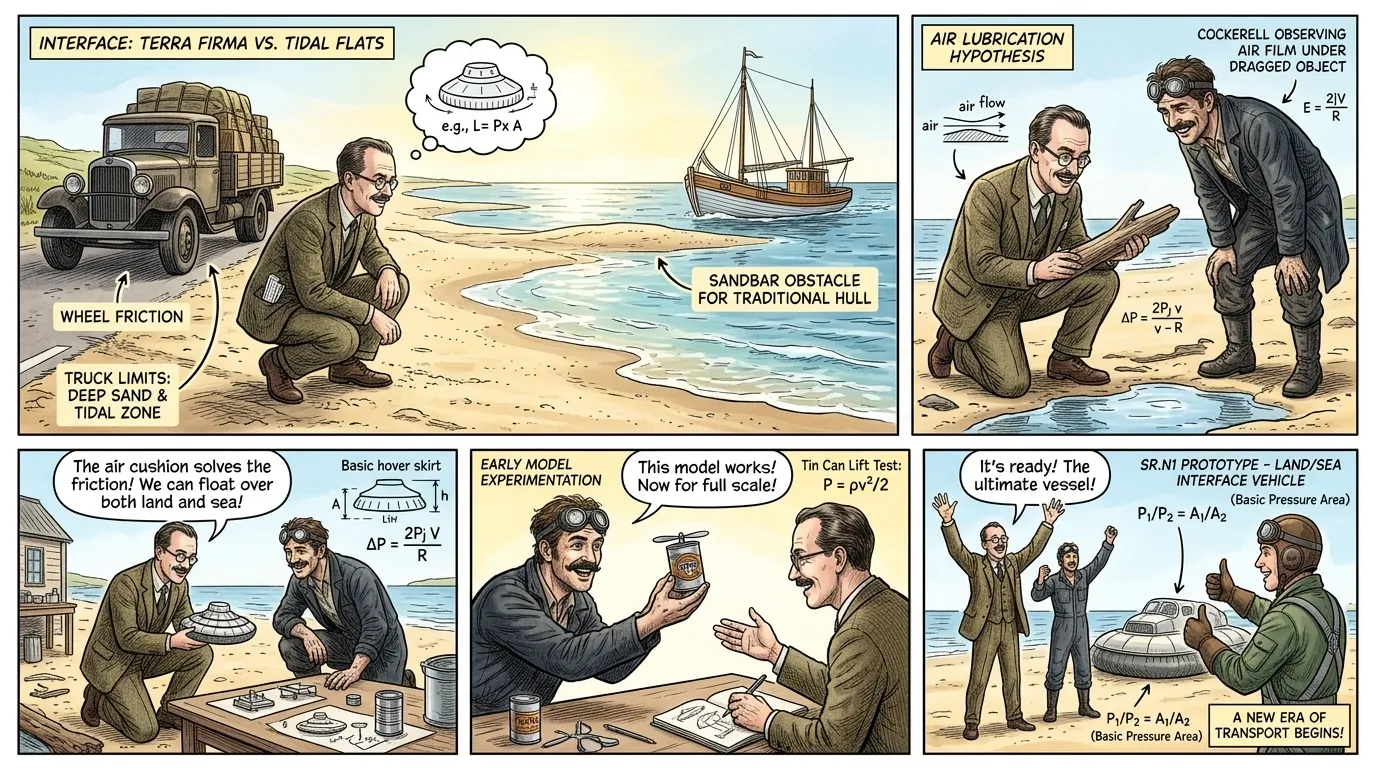
For centuries, the interface between land and water presented an intractable challenge for transport. Conventional vessels were bound by depth and friction, while land vehicles faltered on soft terrain or submerged obstacles. This inherent limitation created logistical bottlenecks, hindering everything from naval operations to vital cargo delivery in coastal or marshy regions. The urgent need for a vehicle capable of seamlessly traversing both mediums, defying friction and surface inconsistencies, became a critical engineering pursuit.
Page 2
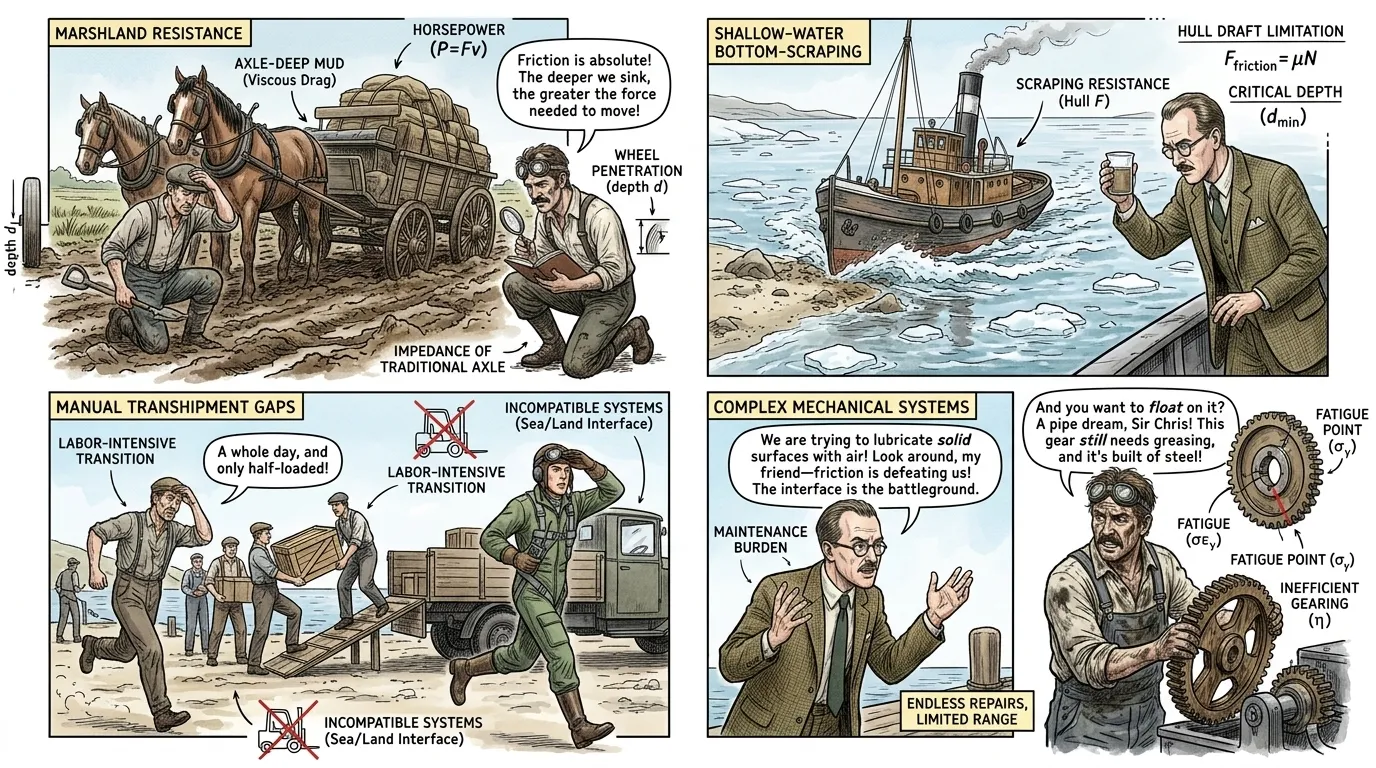
Before the advent of the hovercraft, humanity's mastery over terrain was segmented and often inefficient. Ships, reliant on deep water, faced impassable shallows, tidal flats, and ice. Land vehicles, despite their robust construction, bogged down in mud, soft sand, or marshland, their wheels and tracks losing purchase or sinking. The transition zone between land and water, a realm of constant flux, remained a formidable barrier, necessitating laborious transfers of cargo and personnel, or entirely different modes of transport for short distances. This forced reliance on diverse, often incompatible systems highlighted a glaring gap in amphibious mobility.
Page 3
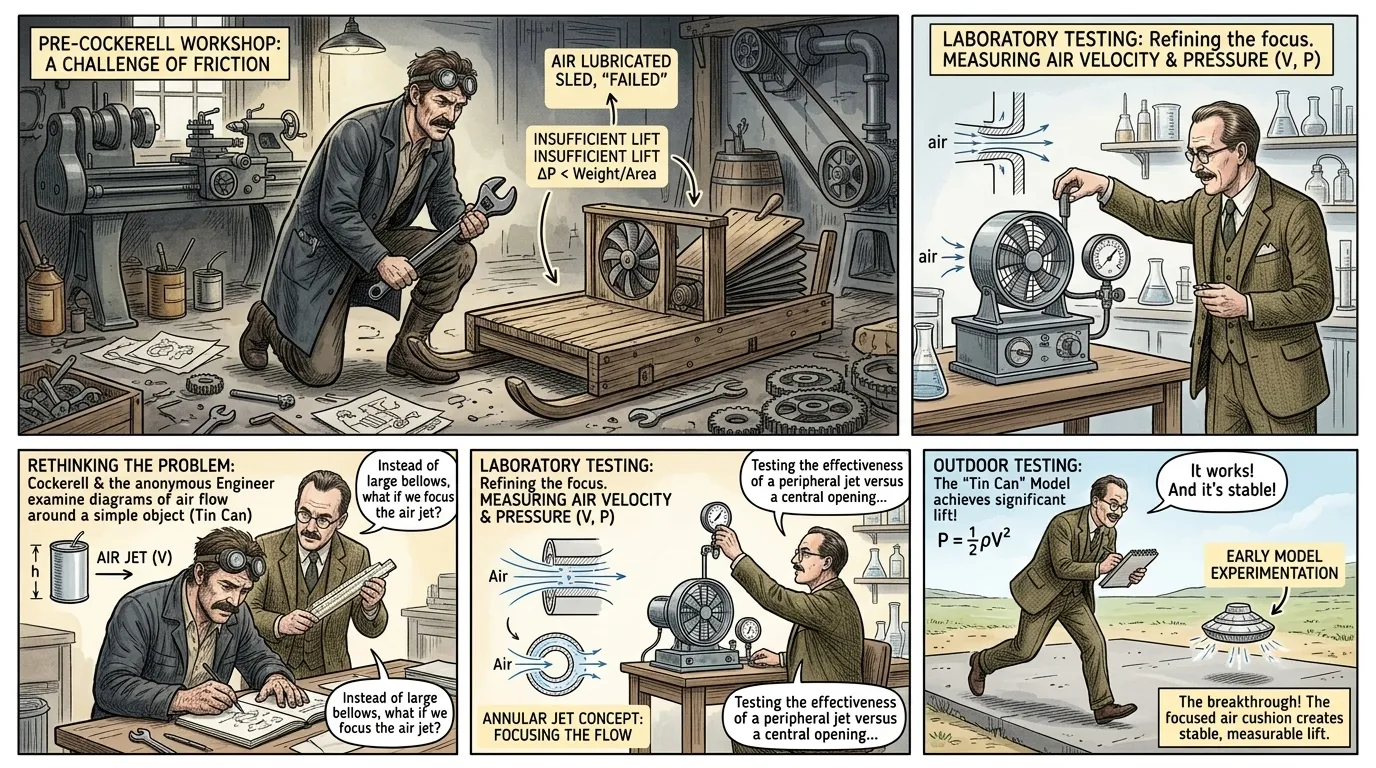
Engineers and thinkers had long envisioned vehicles that could glide effortlessly, unhindered by solid or liquid surfaces. Concepts ranged from air-lubricated sleds to devices supported by jets of compressed air, yet practical implementation remained elusive. The core challenge was sustaining a stable, high-pressure air cushion beneath a vehicle without an exorbitant power demand or significant air loss. Early experimental designs often failed due to insufficient lift, instability, or the rapid escape of the air cushion, rendering them impractical for anything beyond laboratory curiosities. This barrier forced inventors to rethink fundamental principles of support and propulsion.
Page 4
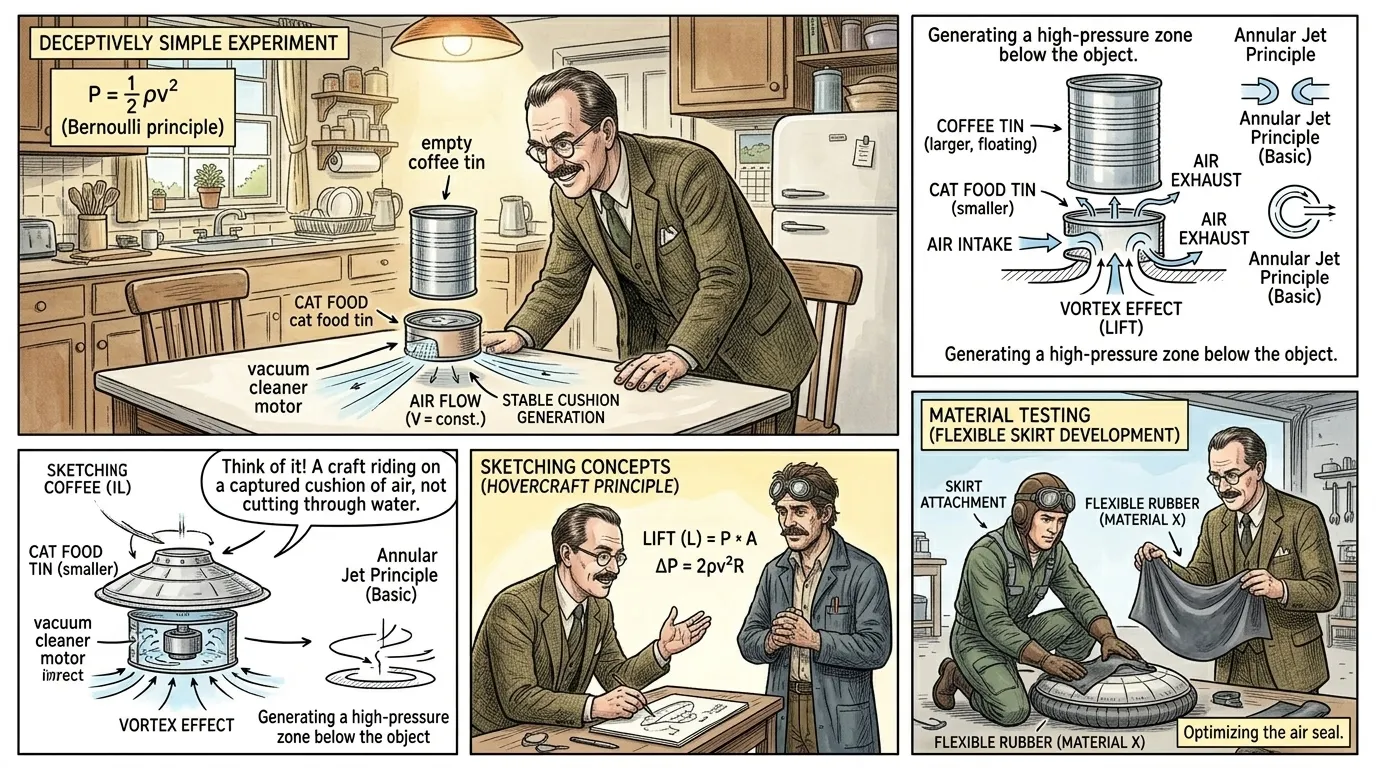
Sir Christopher Cockerell, a brilliant British radio engineer, approached the problem with a fresh perspective in the early 1950s. While working on radar and radio navigation systems, he became intrigued by the notion of reducing drag on boat hulls. His critical insight emerged not from maritime engineering, but from a deceptively simple domestic experiment. By placing a small, working vacuum cleaner motor into an empty cat food tin and directing its exhaust under a larger coffee tin, he observed a dramatic reduction in friction. The air, trapped and pressurized in an annular jet, created a more stable and efficient cushion than had previously been achieved.
Page 5
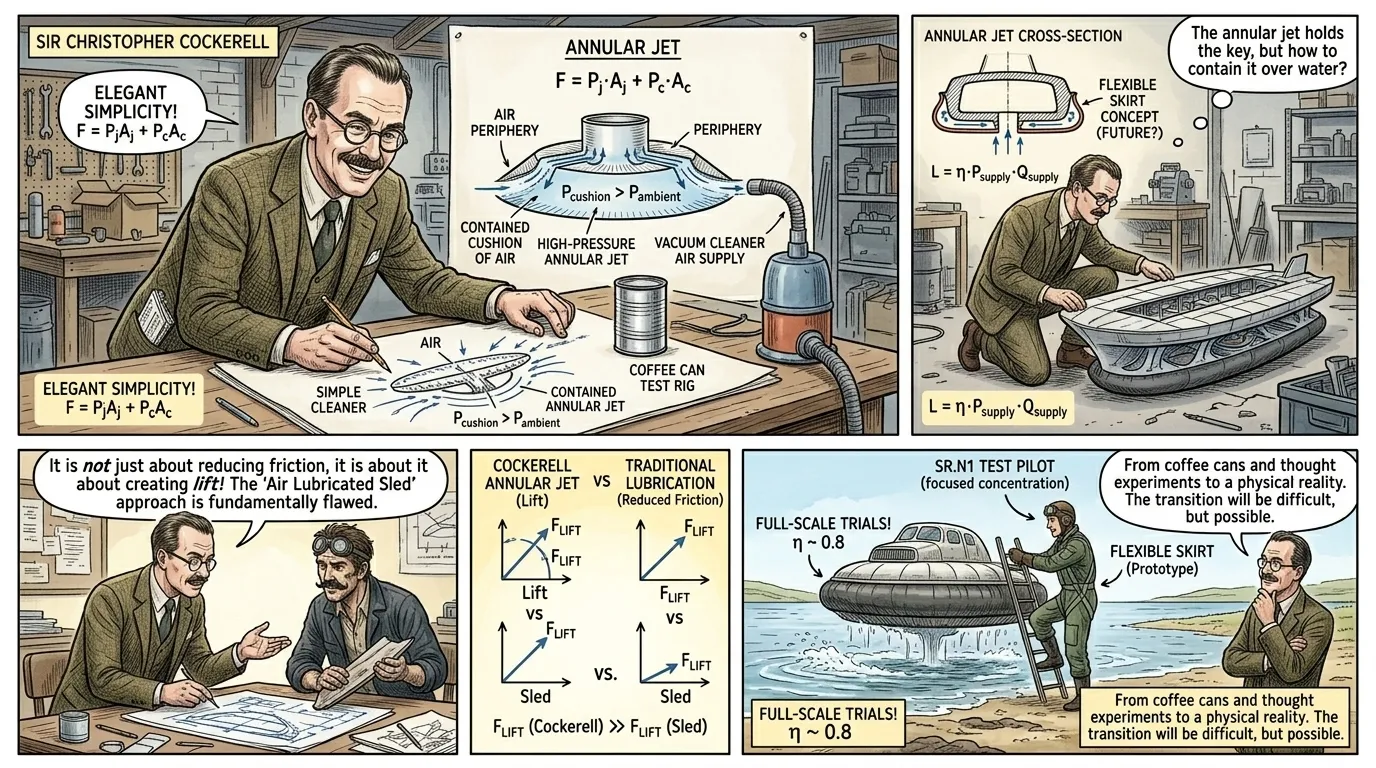
Cockerell recognized that simply blowing air downwards was inefficient; most of the air would escape immediately. His innovation was the 'annular jet' principle: directing a curtain of high-pressure air downwards and inwards around the periphery of the vehicle. This jet, striking the surface and turning outwards, created an enclosed 'wall' of moving air. Inside this 'wall', a lower-pressure air cushion could be maintained more effectively, significantly reducing the power required to lift the craft. This breakthrough transformed the concept from an energy-intensive novelty into a potentially viable mode of transport, paving the way for serious prototype development. As he once remarked, 'The principle is so simple, it can be demonstrated with a coffee can and a vacuum cleaner.'
Page 6
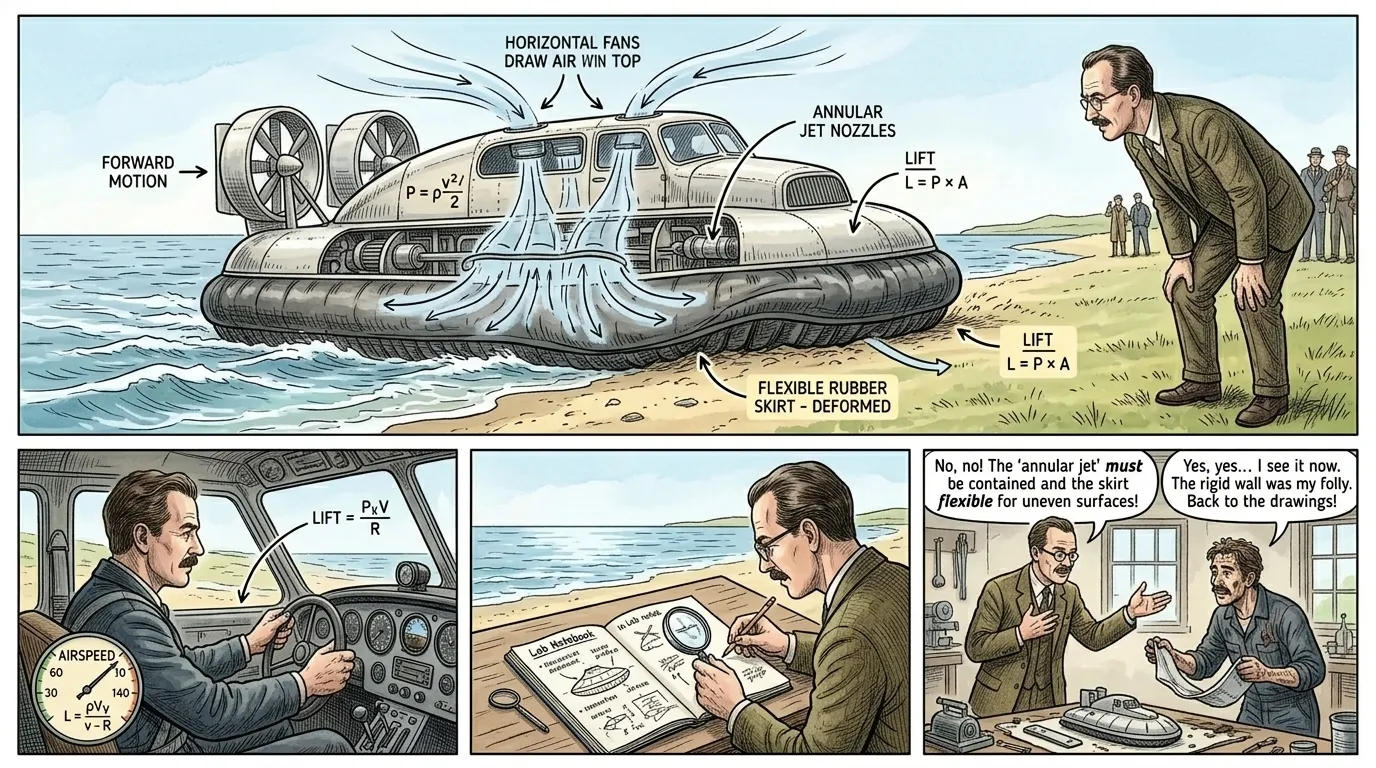
The hovercraft's operation relies on two distinct, yet coordinated, systems: lift and propulsion. Powerful fans, typically mounted horizontally within the craft, draw in large volumes of air from above. This air is then channeled downwards and expelled through the peripheral 'annular jet' nozzles, as well as sometimes into a flexible 'skirt' that runs around the craft's base. The skirt, a critical innovation, provides additional height and allows the craft to clear obstacles, conforming to uneven surfaces while maintaining the air cushion. Once airborne on its cushion of air, separate engines drive large aircraft-style propellers or ducted fans, providing thrust for forward motion, allowing precise control over speed and direction.
Page 7
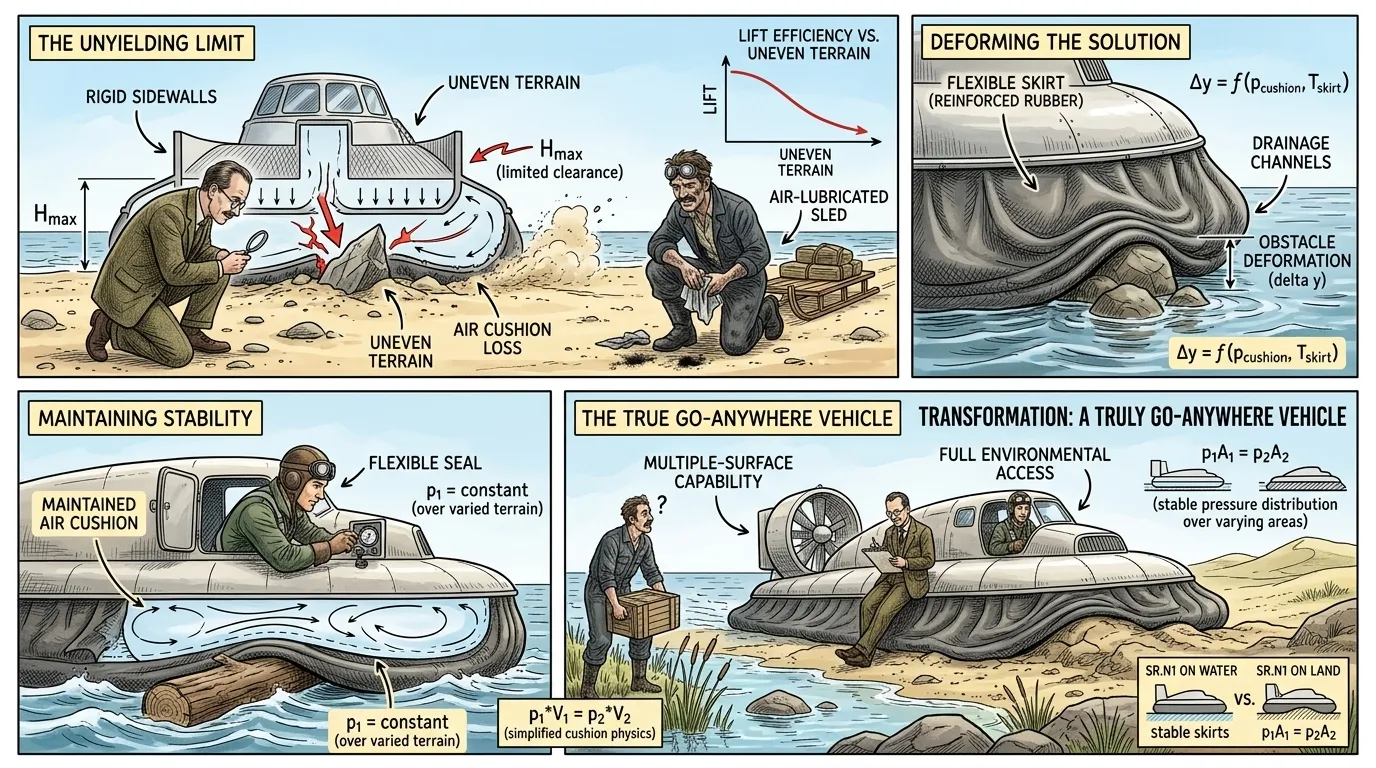
Initially, hovercraft designs featured rigid walls to contain the air cushion. However, this limited their ability to traverse uneven terrain or handle waves, as any contact would instantly dissipate the cushion and cause significant impact. The crucial advancement came with the development of the flexible skirt. Made from durable, abrasion-resistant materials like reinforced rubber or synthetic fabrics, the skirt acts as a pliant containment system. It allows the hovercraft to 'drape' over obstacles, maintaining the air cushion even when parts of the skirt are momentarily deformed or lifted. This flexibility dramatically expanded the hovercraft's amphibious capabilities, transforming it from a smooth-surface glider into a truly go-anywhere vehicle.
Page 8
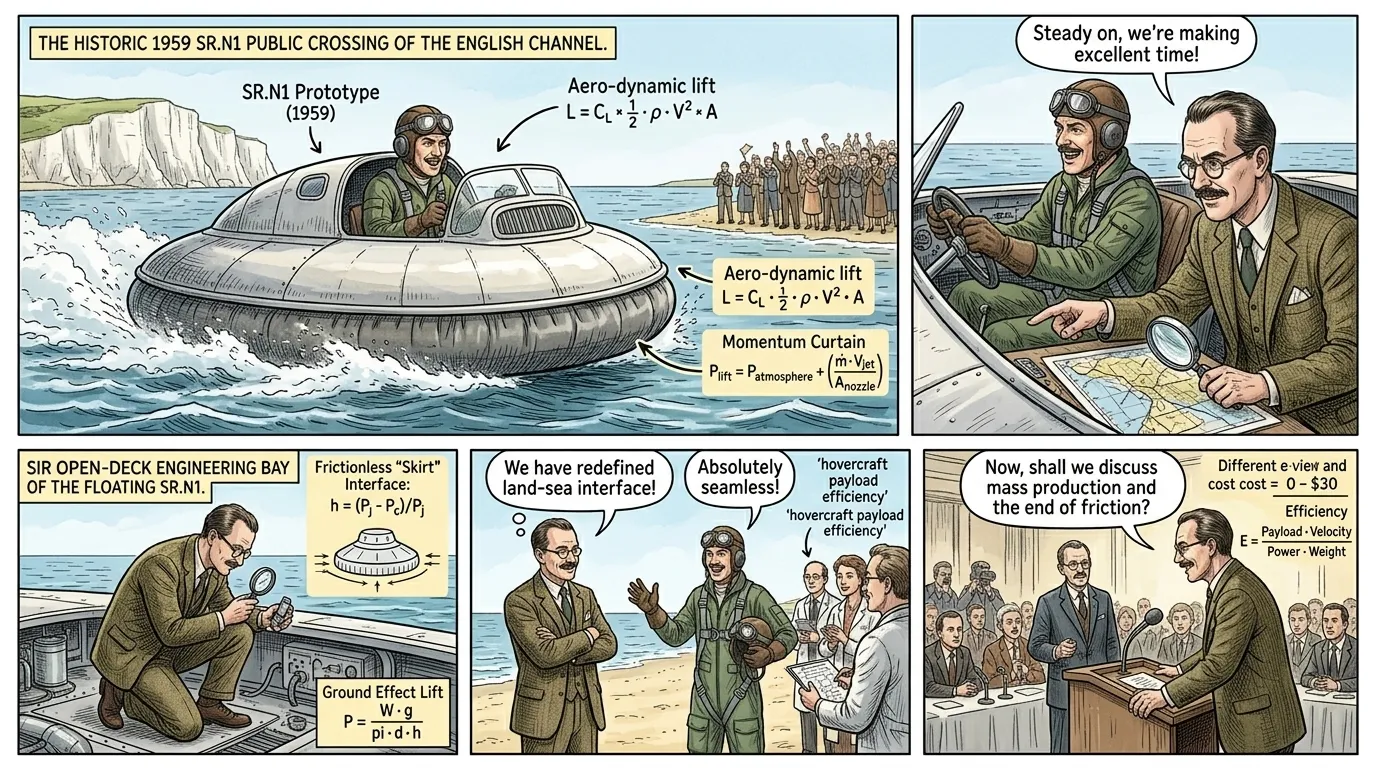
The culmination of Cockerell's work arrived in 1959 with the SR.N1, the world's first practical hovercraft. Its successful demonstration, particularly the public crossing of the English Channel, captivated global attention. This landmark event proved the hovercraft's potential, igniting immediate interest from military, commercial, and civilian sectors. The SR.N1, though modest by later standards, demonstrated that a vehicle could indeed glide seamlessly between land and sea, a feat previously confined to speculative fiction. This success spurred further research and development, rapidly evolving the design towards larger, more powerful, and versatile craft.
Page 9
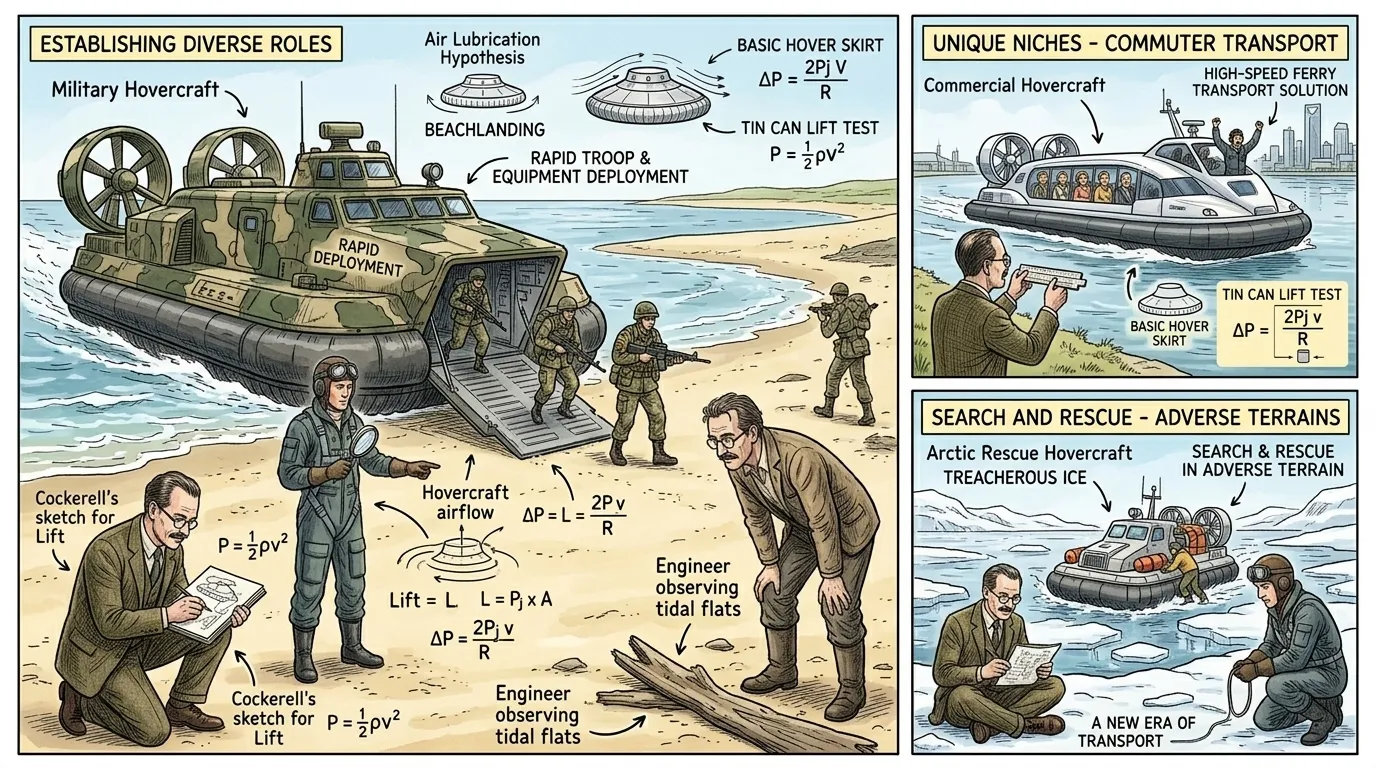
Following the SR.N1's success, hovercraft rapidly diversified into critical roles. Militaries recognized their unparalleled amphibious assault capabilities, enabling rapid troop and equipment deployment from ship to shore, bypassing fortified ports. Commercial enterprises explored their use for high-speed passenger ferries, particularly across estuaries or shallow waters where conventional ferries struggled. Furthermore, their ability to navigate treacherous ice, mudflats, and rapids made them invaluable for rescue operations, surveying remote regions, and delivering aid where other vehicles could not go. This versatility carved out unique niches for the hovercraft, establishing it as a specialized, high-performance transport solution.
Page 10
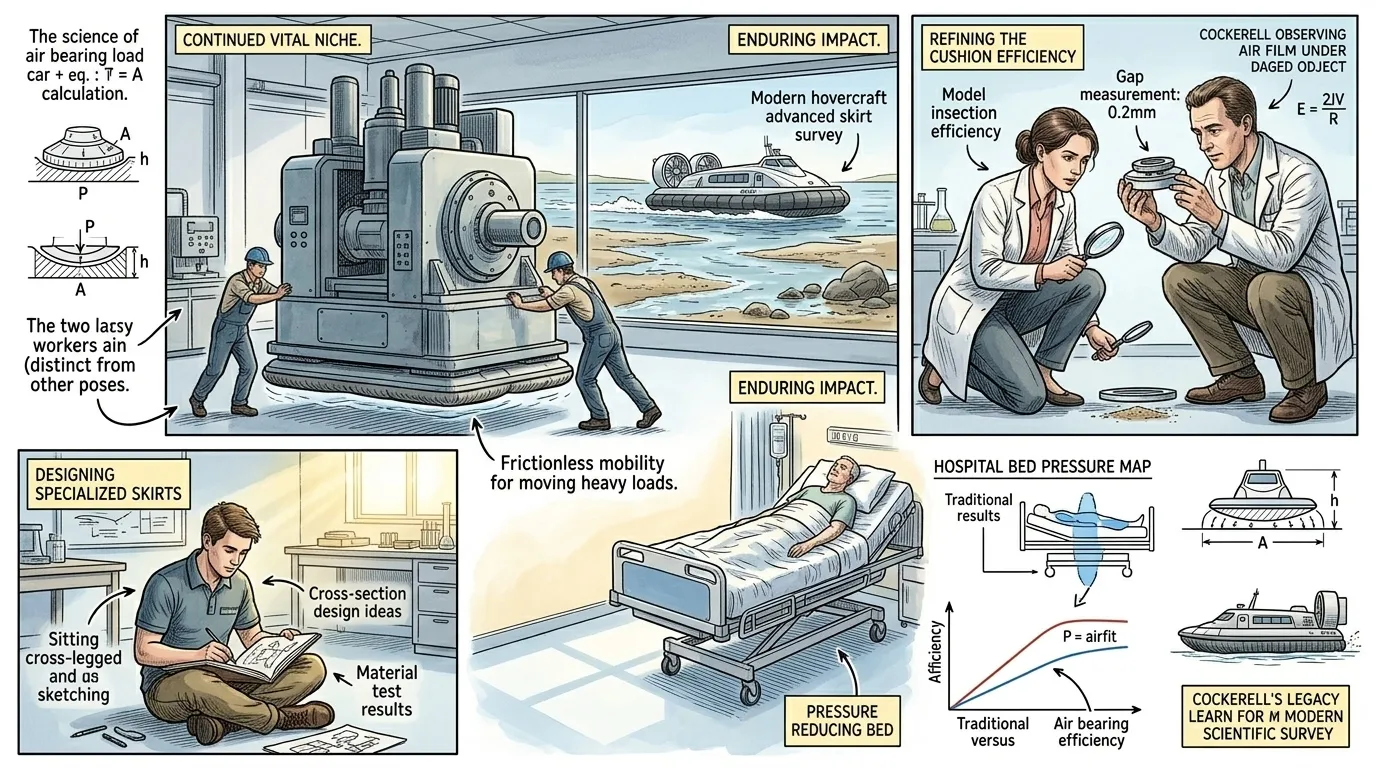
While not as ubiquitous as initially predicted, the hovercraft carved a vital niche in specialized transport. Its legacy extends beyond the iconic amphibious vehicle; the underlying principles of air cushion technology have found applications in diverse fields, from industrial air bearings for moving heavy loads in factories to specialized hospital beds that reduce pressure on patients. Modern hovercraft continue to evolve, with improvements in efficiency, noise reduction, and skirt design, ensuring their continued relevance for niche operations where no other vehicle can perform with such agility across disparate surfaces. Sir Christopher Cockerell's simple coffee tin experiment ultimately opened a new frontier in frictionless mobility, forever changing how humanity navigates the world's most challenging terrains.
About this story
- Location: Global
- Audience: general readers
Read Wonder Inventions on your phone
Wonder Inventions is available on Android. Get Wonder Inventions on Google Play.