Dom Casmurro
A Faithful Compression of Machado de Assis's Classic Novel
Page 1
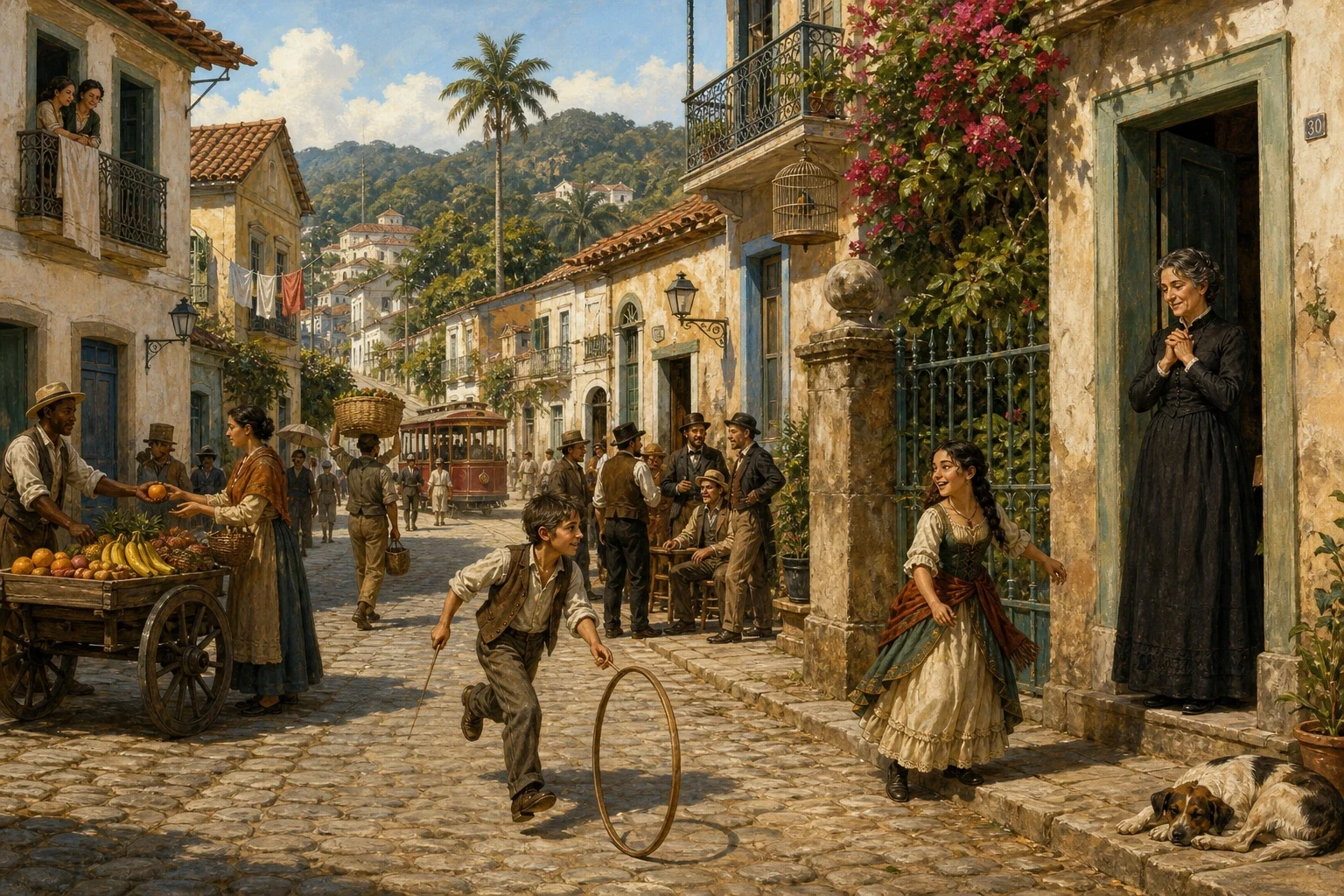
In the bustling Rua de Matacavalos, a vibrant street in old Rio de Janeiro, lived young Bento, a boy of twelve. His mother, Dona Glória, a woman of deep and unwavering faith, had made a solemn vow to God before his birth: if she had a son, he would enter the seminary and dedicate his life to the priesthood. This promise, a quiet but firm decree, loomed over Bento's future, a weight he sensed but could not yet fully grasp. Next door lived Capitu, a girl with eyes like the shifting tide, dark and ever-changing, full of life, curiosity, and a hint of mischief. She and Bento were inseparable companions, their childhood intertwined like the lush vines on the garden walls, sharing secrets and dreams that seemed worlds away from any solemn vows. Their world was small, bounded by their two houses and the sun-drenched, lively street, where every day brought new adventures and shared laughter.
Page 2
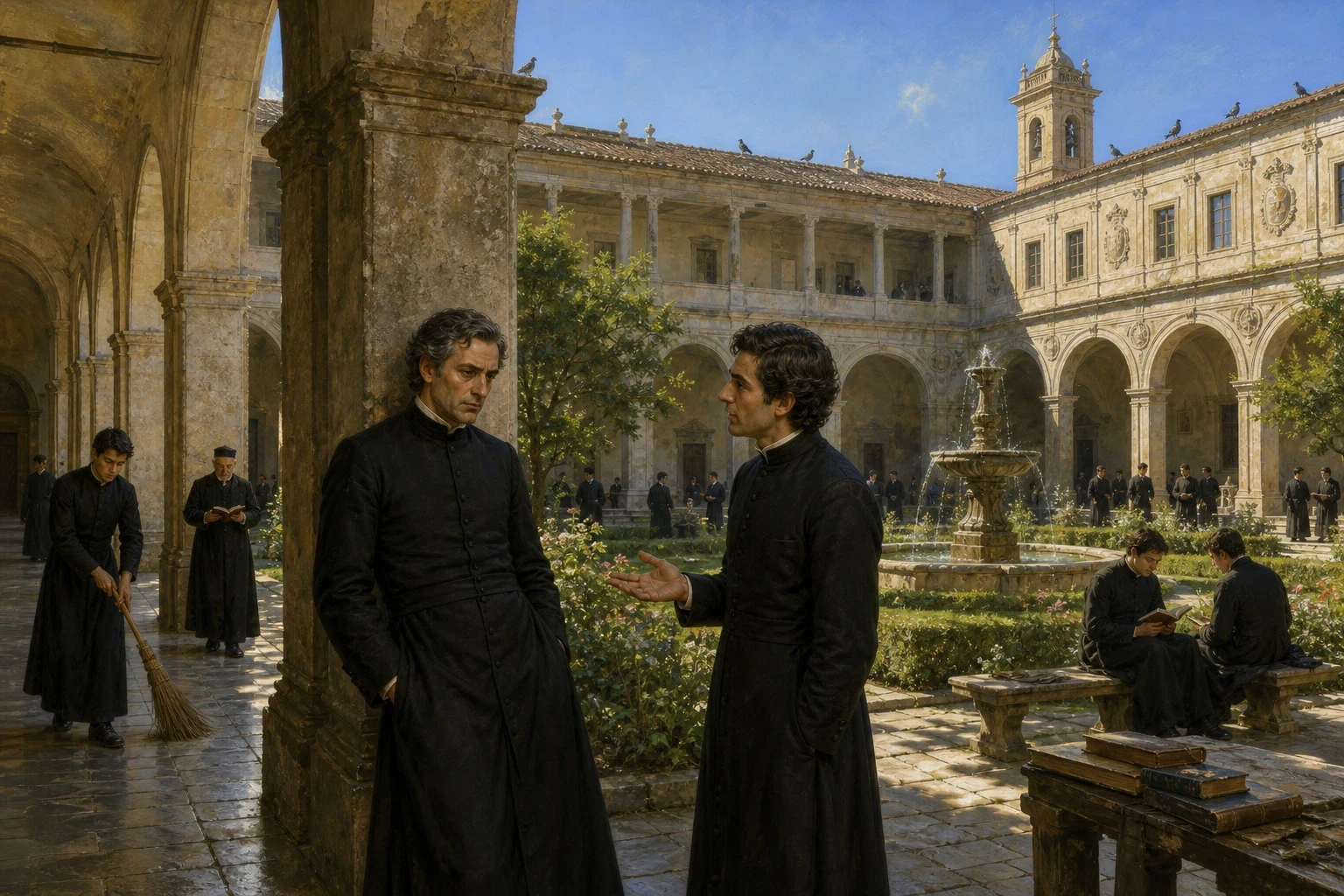
At the age of fifteen, Bento entered the austere Seminary of St. Peter, reluctantly leaving behind the sunlit streets of his home and Capitu's captivating eyes. The stern, silent walls and rigid routines of seminary life quickly began to chafe against his restless spirit. He found no genuine calling within the hallowed halls, only a growing disquiet and a profound yearning for the vibrant world he had left behind. It was there, amidst the solemn prayers, dusty theological texts, and hushed corridors, that he formed a deep and unexpected friendship with Ezequiel Escobar. Escobar was in many ways Bento's opposite: cheerful, remarkably practical, and seemingly content with his chosen path. They shared long, whispered talks in hidden corners, finding solace in their companionship, though Bento carefully guarded the true depth of his unhappiness, and the enduring memory of Capitu, deep within himself. Escobar's steady, open presence became a welcome anchor in Bento’s increasingly turbulent inner world, a true brother in an otherwise solitary existence.
Page 3
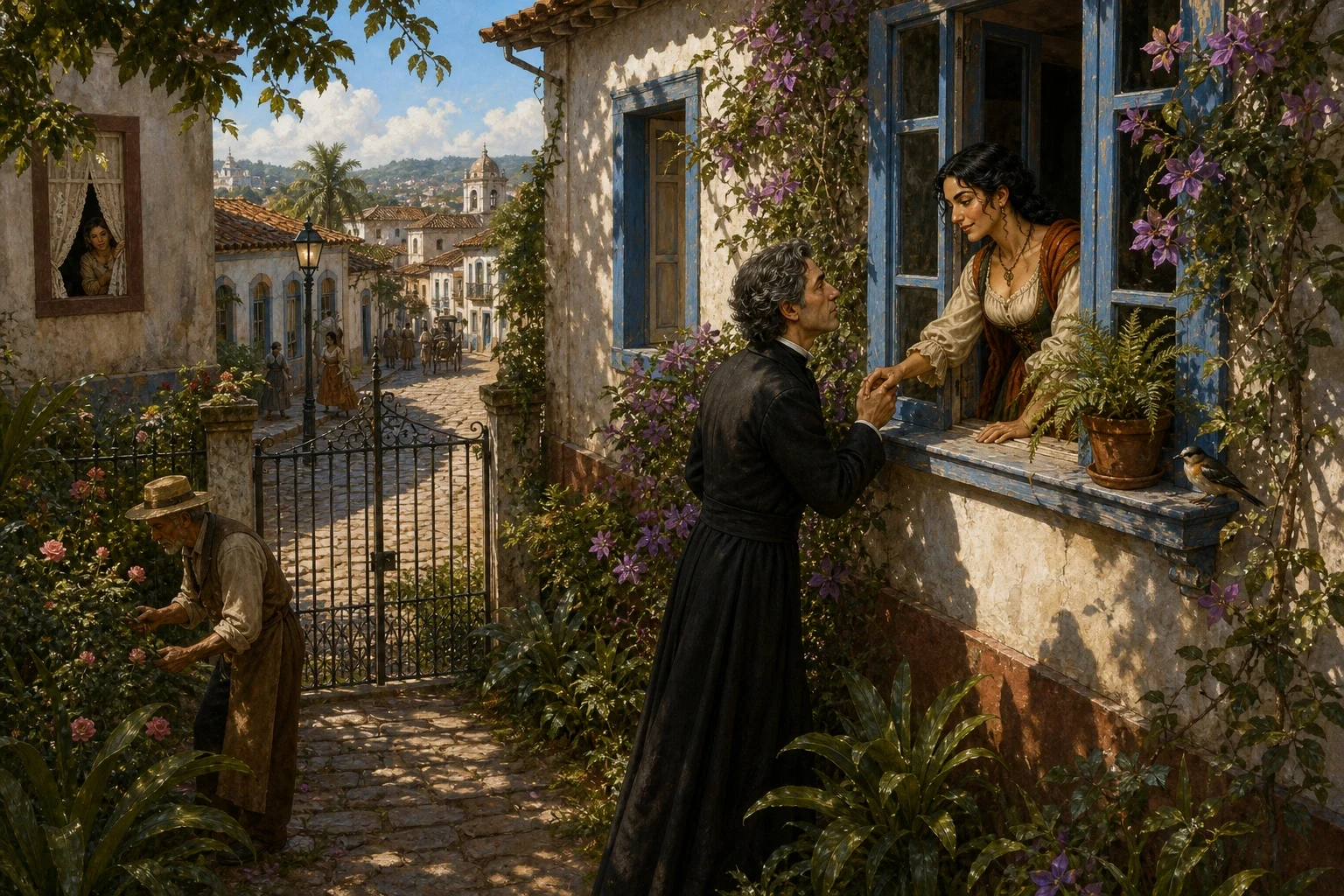
Bento's visits home from the seminary became precious, clandestine opportunities, carefully planned to avoid suspicion. He would slip away to Capitu's house, their old childhood haven, which now felt charged with a new, urgent energy of secret longing. They would meet by a discreet window, or at the secluded garden gate, their conversations filled with urgent, whispered hopes and dreams for a future together—a future entirely free from the seminary's oppressive shadow. Capitu, ever resourceful and quick-witted, found ingenious ways to help Bento's mother believe he was still devout and committed, all while subtly fueling Bento's growing resolve to abandon the priesthood. Their youthful love deepened with every stolen moment, every shared glance, their shared longing a powerful, defiant force against the predetermined destiny his mother had chosen for him. The old vow now felt like an unbreakable chain, and Capitu was the dazzling, undeniable promise of freedom and a life truly his own.
Page 4
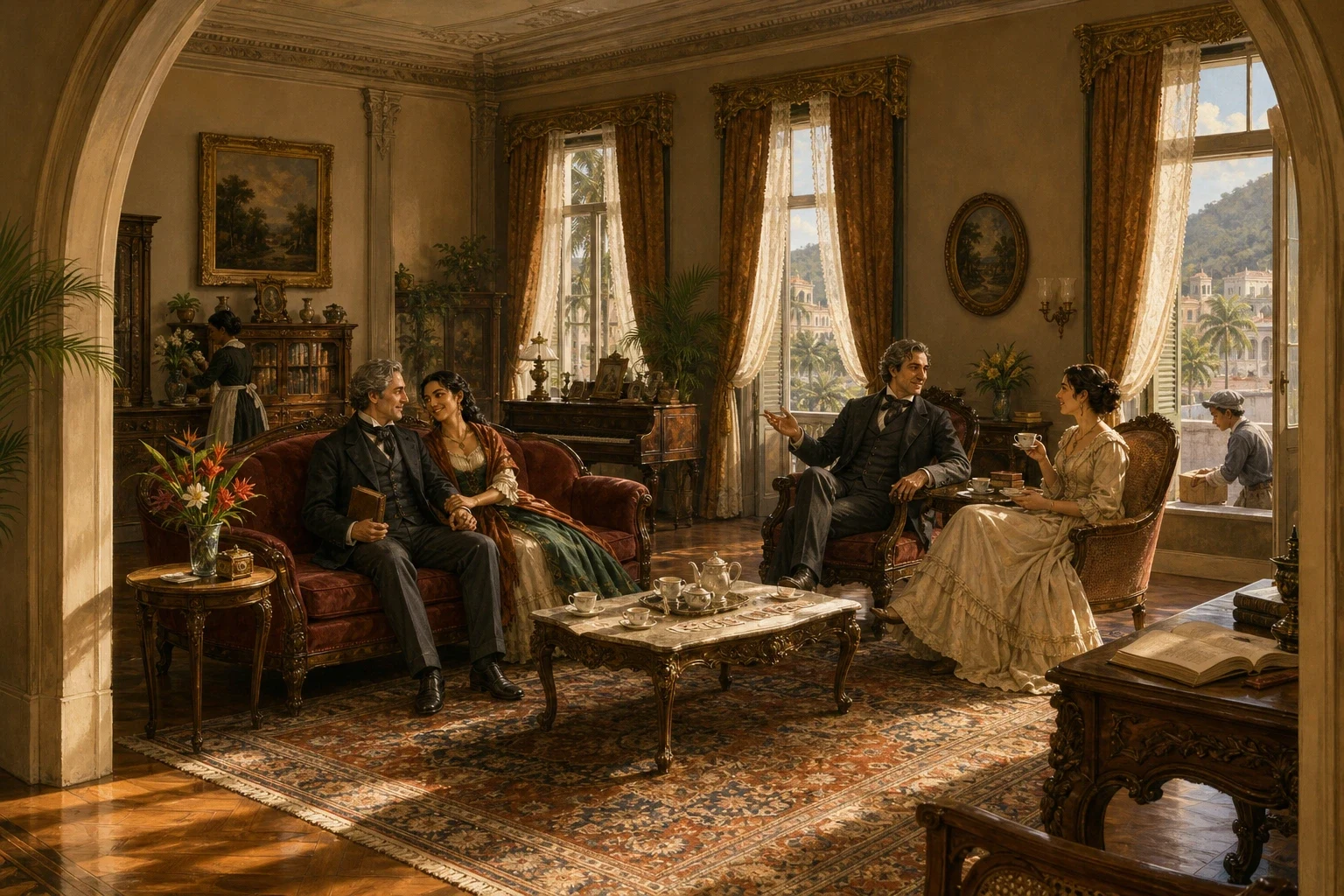
Against all expectations and overcoming the binding vow, Bento was released from his priestly commitment, and he and Capitu were finally married. Their early years together were a blissful, sun-drenched dream, filled with shared laughter, quiet contentment, and the vibrant rhythms of their new life in their first home. Their lives became closely and happily intertwined with those of Escobar, who had also successfully left the seminary to pursue a thriving career in commerce, and his gentle, elegant wife, Sancha. The two couples were inseparable, their days marked by lively conversations, spirited card games, and convivial shared meals. Capitu and Sancha quickly became fast friends, sharing confidences and laughter, and Bento continued to find in Escobar the truest, most steadfast companion. Their living room often echoed with the sounds of their collective happiness, a vibrant testament to the life Bento had chosen, and the boundless love he believed was theirs.
Page 5
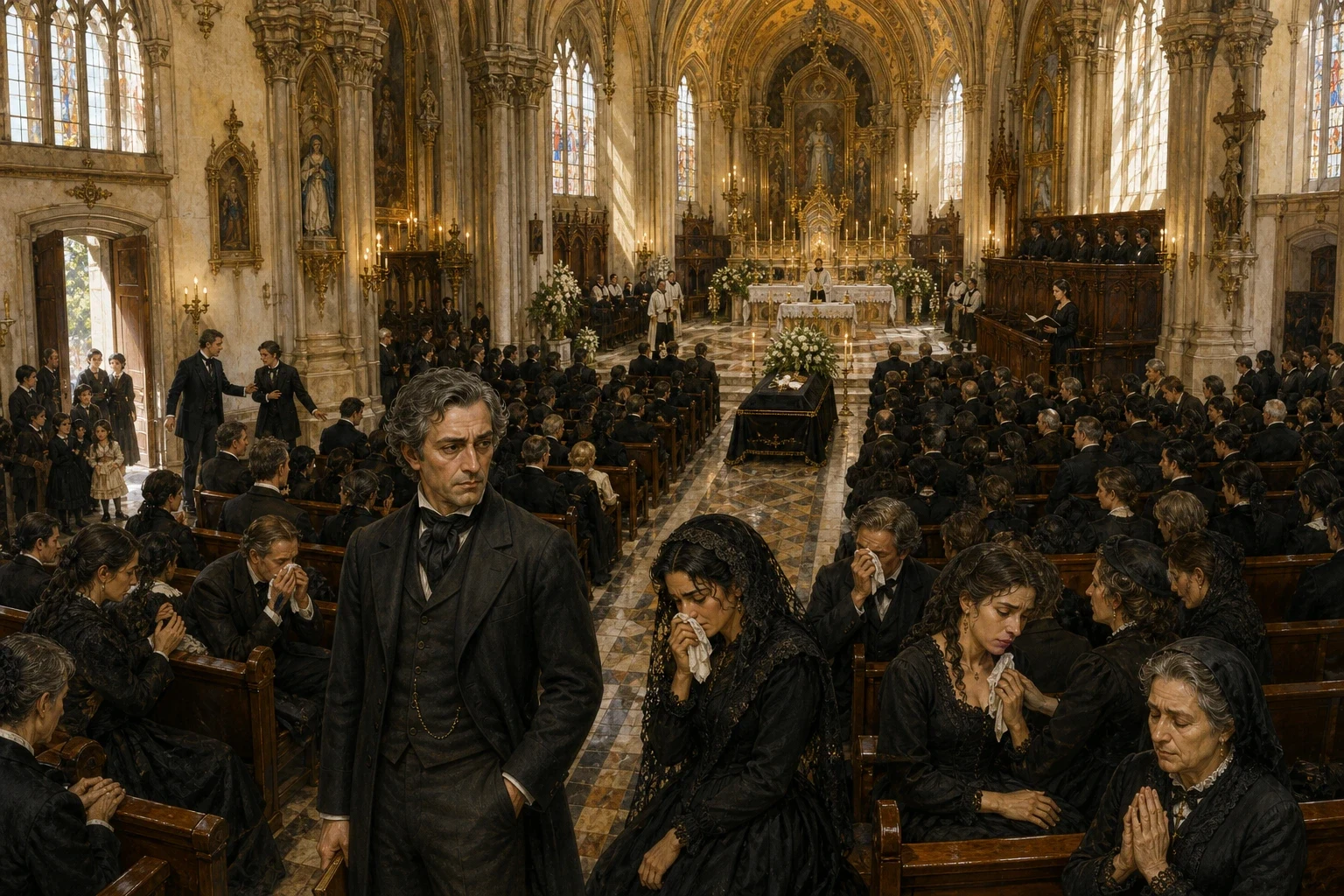
Then, tragedy struck with a cruel swiftness. Escobar, robust and full of life, drowned in a sudden, unexpected accident at sea. The news shattered their world, leaving a profound void. The funeral was a somber and heavily attended affair, held in a grand, hushed church in Rio. Bento, consumed by his own raw grief for his closest friend, found his eyes drawn inexorably, almost compulsively, to Capitu. She wept openly, her sorrow profound and unrestrained, but in the midst of her tears, her 'gypsy eyes' seemed to take on a strange, unsettling quality. They were not merely sad; they seemed to gaze into a distant, unfathomable nothingness, then return with an unnerving, almost unfocused intensity that made Bento deeply uneasy, stirring a sense of disquiet in his soul. In that moment of collective mourning, a tiny, cold seed of doubt, unwelcome and insidious, began to germinate in Bento’s troubled mind, subtly twisting his perception of his wife’s powerful, raw sorrow.
Page 6

Years passed, and a son, Ezequiel, was born to Bento and Capitu. At first, Bento felt immense joy and pride, a father’s natural happiness. But as the boy grew from infancy into a lively child, a disquieting thought began to torment him, a whisper that grew into a shout in the confines of his mind: Ezequiel bore an undeniable, startling resemblance to Escobar. The shape of his head, the way he carried himself with a certain confidence, even his characteristic gestures – all seemed to echo his deceased friend with unnerving clarity. Bento would watch his son playing with boundless energy in the sprawling, sun-drenched garden of their new, larger house, a knot of dread tightening relentlessly in his stomach. Capitu, seemingly oblivious to Bento’s internal turmoil, cherished their son with open affection, but Bento's eyes, now thoroughly clouded by suspicion, saw only the haunting, inescapable image of Escobar in Ezequiel's innocent, joyful face. The old doubt, once a tiny seed, had now taken firm root and was flourishing, poisoning his peace.
Page 7

The tormenting suspicions, festering for years, finally erupted into a devastating climax. In the late hours of the night, within the solemn, high-ceilinged quiet of Bento's private study, he confronted Capitu directly, unleashing years of pent-up paranoia. His voice, usually measured and controlled, was now raw with fury and despair, trembling with the weight of his perceived betrayal. He accused her explicitly of infidelity, of betraying their sacred vows with Escobar, of passing off another man's son as his own. Capitu, initially shocked into silence, then became fiercely defiant, denying everything with flashing eyes that held a complex mixture of indignation, hurt, and desperate weariness. The accusations hung heavy in the air, a poisonous shroud, utterly shattering the last vestiges of their once-beautiful marriage. Bento, overwhelmed by his consuming jealousy and the agonizing pain of his perceived betrayal, descended into a profound mental darkness. He contemplated a desperate, destructive act to end his torment and their life together, but as he looked at Capitu, now collapsing into innocent sleep, and thought of Ezequiel’s innocent, sleeping face in the next room, he recoiled from the brink, destroying the means he had considered, unable to commit such an atrocity. The marriage, however, was irrevocably broken, beyond any hope of repair.
Page 8
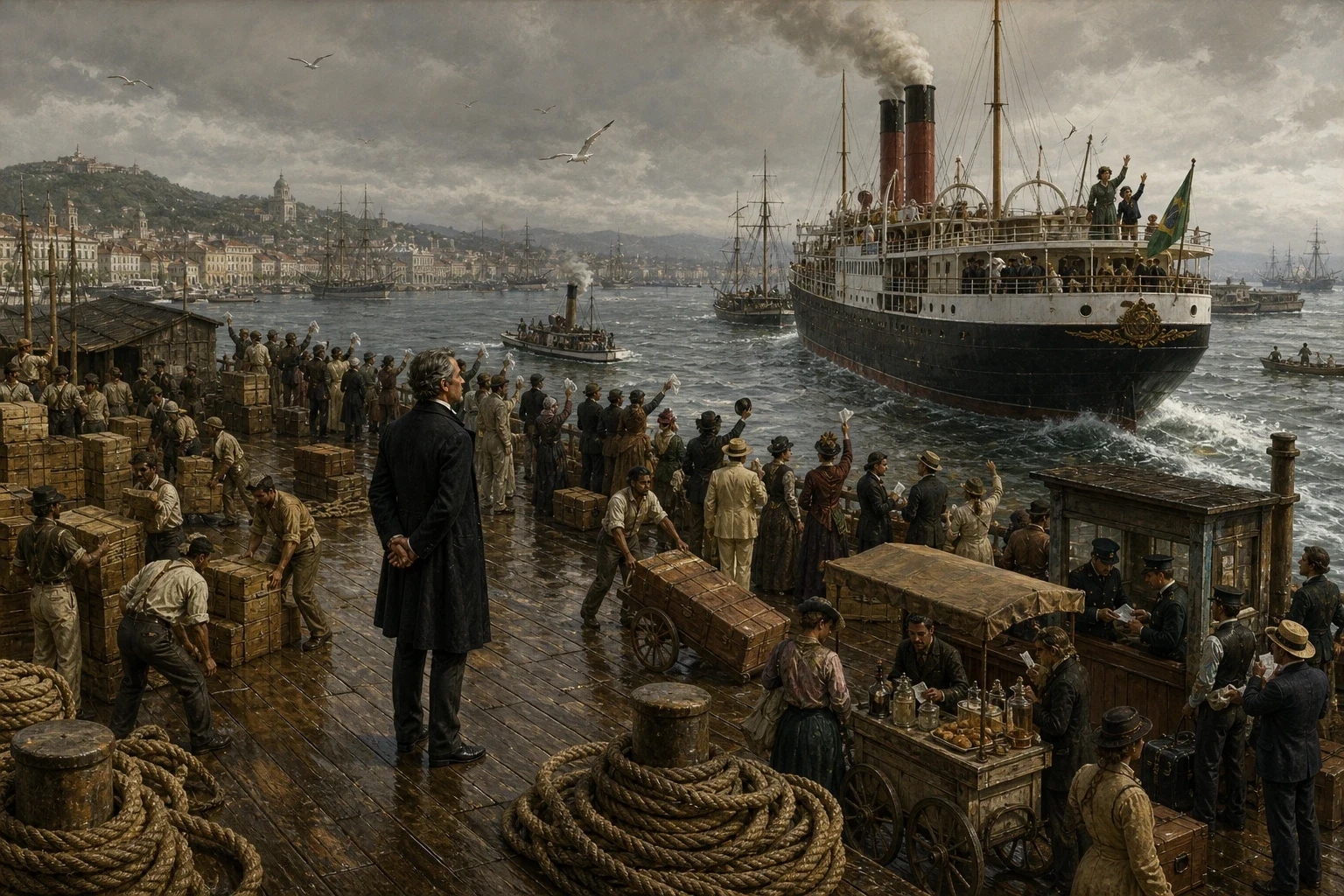
The rift between Bento and Capitu was irreparable, a chasm too wide to bridge. After the terrible confrontation, Capitu, with a quiet dignity, agreed to a separation, though she maintained her steadfast innocence to the very last. It was decided that she and Ezequiel would move far away, to Europe, to begin a new life. The day of their departure was bleak and heavy with unspoken sorrow. At the bustling port of Rio, amidst the piercing cries of gulls and the relentless clamor of the docks, Bento stood like a statue, watching them go. Ezequiel, now a lively young boy, waved eagerly towards the shore, entirely unaware of the profound chasm that had opened between his parents. Capitu, her face a mask of sorrow and quiet dignity, cast one last, long, piercing look at Bento before turning her back definitively. As the great ship pulled slowly and majestically from the pier, carrying away his wife and son towards a distant horizon, Bento was left standing alone, a hollow, aching void in his chest, the weight of his suspicion now compounded by an agonizing, unyielding loneliness that would follow him for years.
Page 9
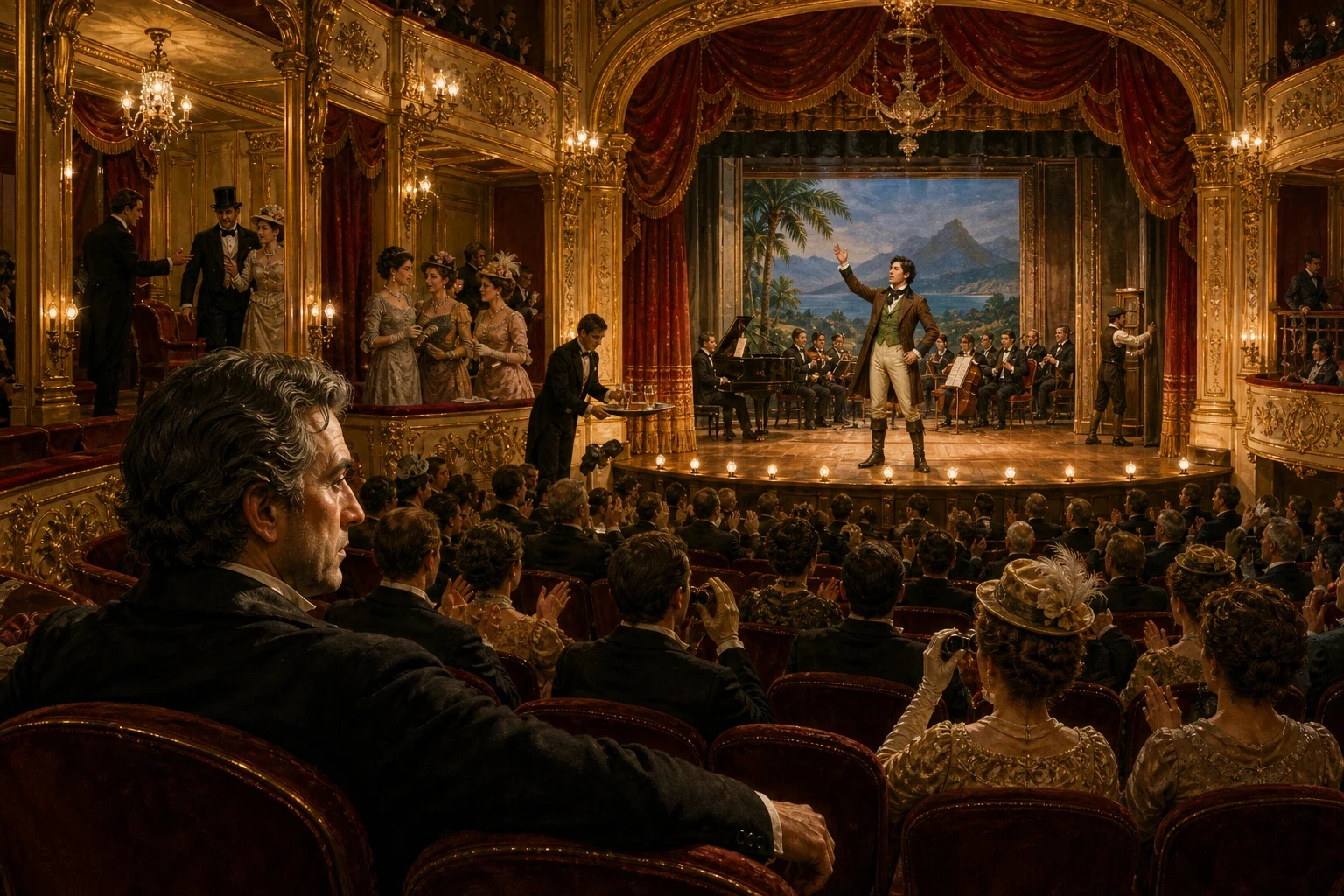
Many years later, a young man named Ezequiel returned to Rio, having grown up and been educated abroad, far from his father's scrutiny. He pursued a burgeoning career in the arts, displaying a natural talent that soon brought him to perform in the city's grandest stages and most fashionable salons. Bento, now significantly older, more withdrawn, and burdened by his solitary existence, attended one of Ezequiel's acclaimed performances. He watched his son, a talented, confident, and captivating young man, and felt the old, haunting suspicion surge anew, chilling him to the bone. The resemblance to Escobar was now more pronounced than ever, undeniable in Ezequiel's mature features, his gestures, his very bearing. It was a cruel, inescapable confirmation of Bento’s lifelong torment, a living echo of his darkest fears. The intervening years had not lessened the doubt; they had only etched it deeper into his soul, leaving him with a bitter, agonizing clarity, an inescapable truth that no performance, however brilliant, could ever truly mask or alleviate.
Page 10
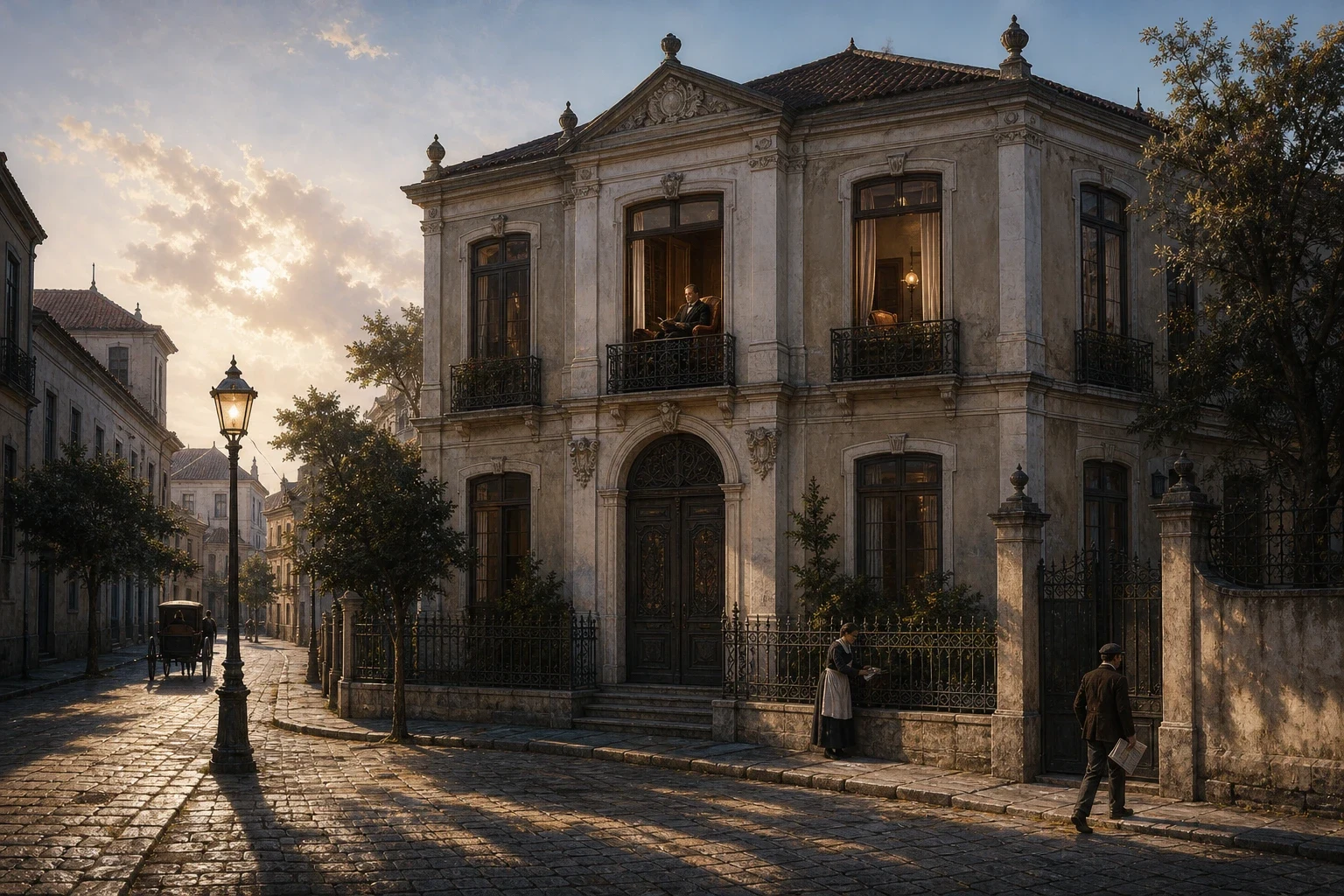
In his advanced old age, Bento Santiago, now known to all as Dom Casmurro, returned to his childhood home on Rua de Matacavalos. He meticulously renovated it, striving with an almost obsessive dedication to recreate the past, to make the new house a faithful, exact copy of the old one he remembered. But the past, like the house, could ultimately only be imitated, never truly recovered or relived. He lived alone within its walls, a solitary figure haunted by indelible memories and the unresolved, gnawing mystery of Capitu. He became known as Dom Casmurro, 'Lord Taciturn,' a man entirely withdrawn into the labyrinthine confines of his own mind, forever pondering the enigma of his wife's 'tide-like' eyes, the elusive truth of his son’s parentage, and the complex, irrevocable choices that had shaped his entire life. His lifelong efforts to 'tie together the two ends of life' had failed utterly, leaving him with only the lingering echoes of a love irrevocably lost, and the bitter, unyielding certainty of his own profound and unending lonely existence. The street was still there, but the vibrant life he once knew on it was long gone, replaced by a quiet, melancholic emptiness.
About this story
- Audience: general readers
Read Wonder Novels on your phone
Wonder Novels is available on Android. Get Wonder Novels on Google Play.