The Hunchback of Notre-Dame
A bellringer, a dancer, and the cathedral that watched over both of them
Page 1
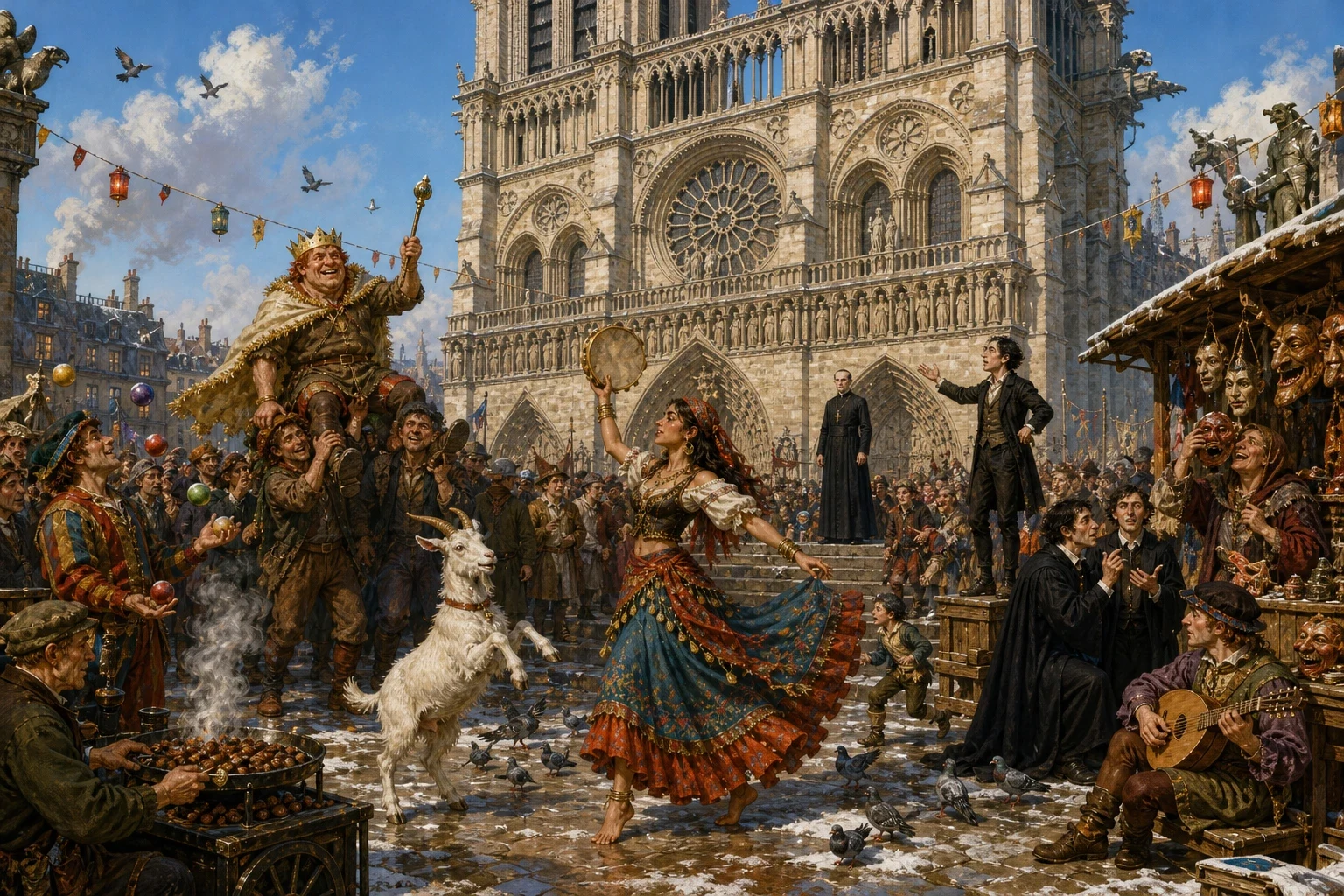
High above the roofs of medieval Paris stood the great cathedral of Notre-Dame, and on the sixth of January, the Feast of Fools, its square was packed with a roaring crowd. By ancient custom, whoever pulled the ugliest face through a chapel window would be crowned Pope of Fools, and no face in Paris could beat the one belonging to Quasimodo, the cathedral's deaf bellringer — a hunchback with one huge eye and a head like a bell himself. The crowd lifted him up in a mock cope and paper crown and carried him shouting through the square. Nearby, a young Gypsy dancer named Esmeralda spun to a tambourine with her goat Djali capering at her skirts, coins flashing, while a hungry poet named Pierre Gringoire watched his own play collapse unheard around him. From the cathedral steps, the archdeacon Claude Frollo watched her too — and could not look away.
Page 2
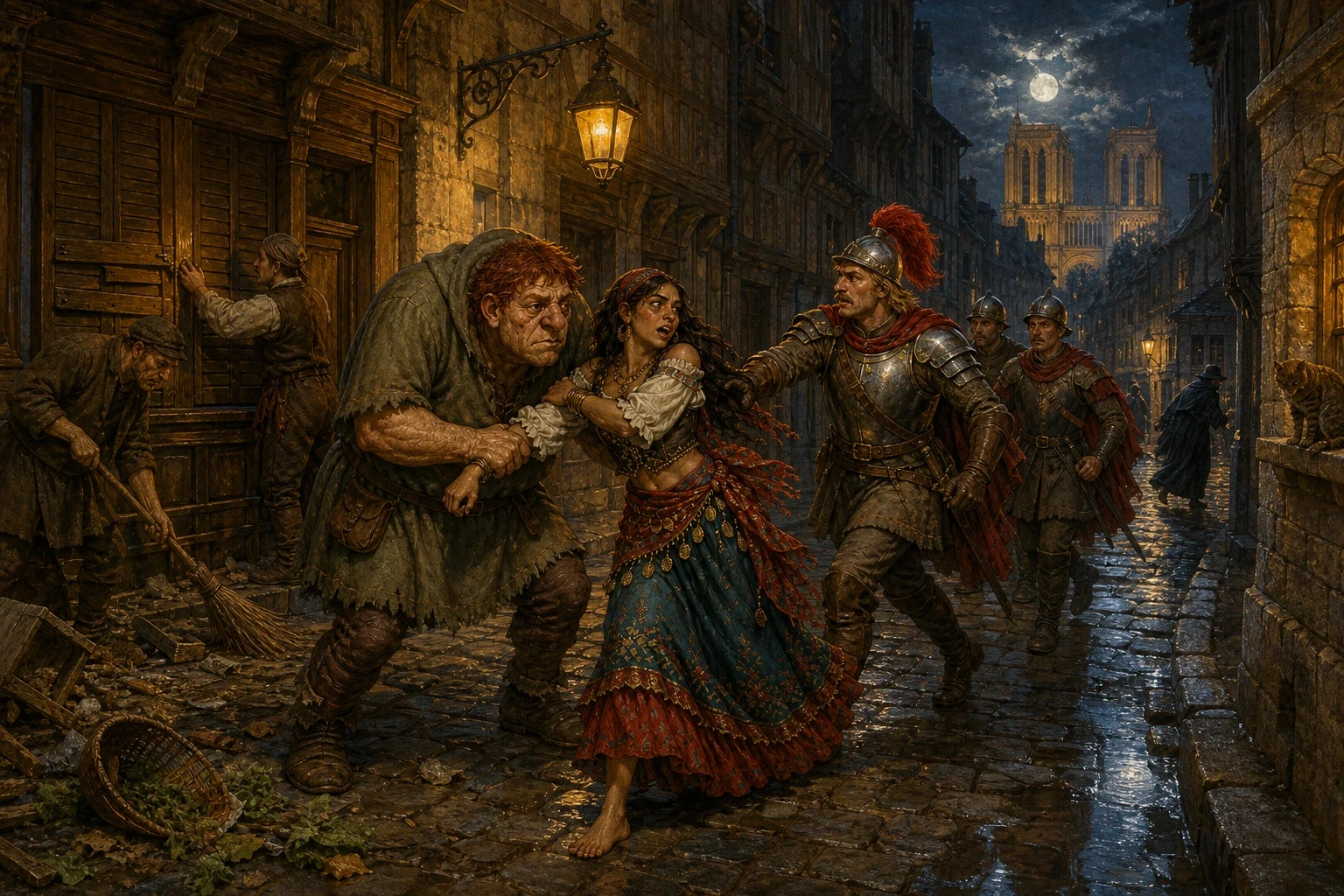
That same night, Claude Frollo, consumed by a desire he could not master, ordered Quasimodo to seize Esmeralda and bring her to him. Quasimodo, who owed the archdeacon everything and questioned him in nothing, crept after her through the dark streets and caught her as she walked home alone. She screamed, and the scream carried to a passing patrol of the King's archers led by a dashing young captain, Phoebus de Châteaupers. Phoebus himself tore Quasimodo off her, and his men bound the hunchback where he stood. Esmeralda, shaking and still clutching her shawl, looked up into the face of the man who had saved her and fell in love before she even learned his name. Frollo, who had followed close behind to watch, slipped away into a side alley the moment the archers appeared, and no one saw him go.
Page 3
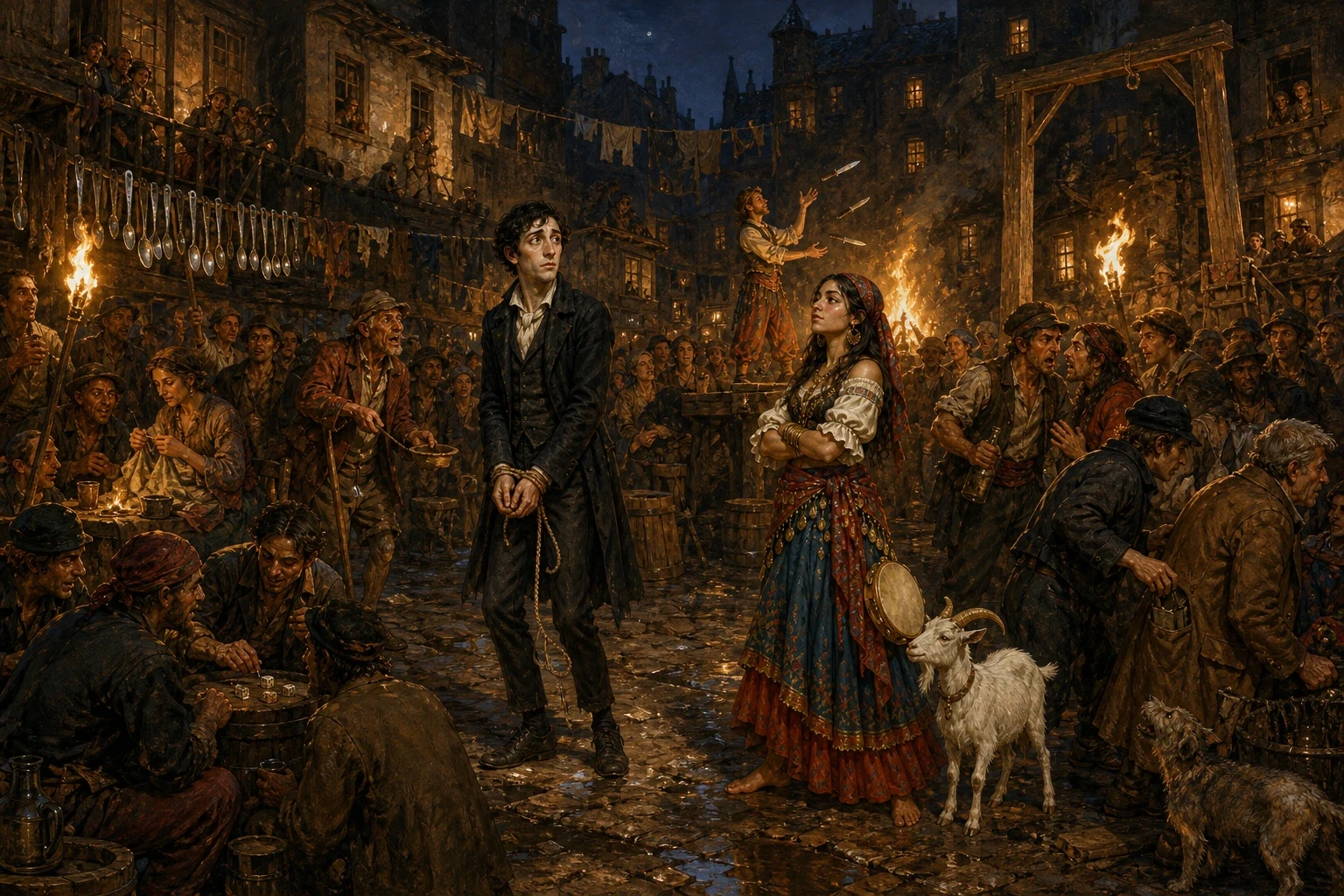
Lost in the dark after the night's commotion, Gringoire wandered into a hidden slum of thieves and beggars known as the Court of Miracles, ruled by its own king of rags. Taken for a spy, he was dragged toward a gibbet in the courtyard to be hanged on the spot, the crowd laughing that only one thing could save a stranger's life: for one of their own women to take him as a husband. Esmeralda, who had followed the noise with Djali at her heels, stepped forward out of pity and agreed to marry him — in name only, for four years, and not a day more. Cut down and still trembling, Gringoire found himself a married man to a wife who did not love him and never would. She told him plainly how things stood between them, and, grateful simply to be breathing, he agreed to every word.
Page 4
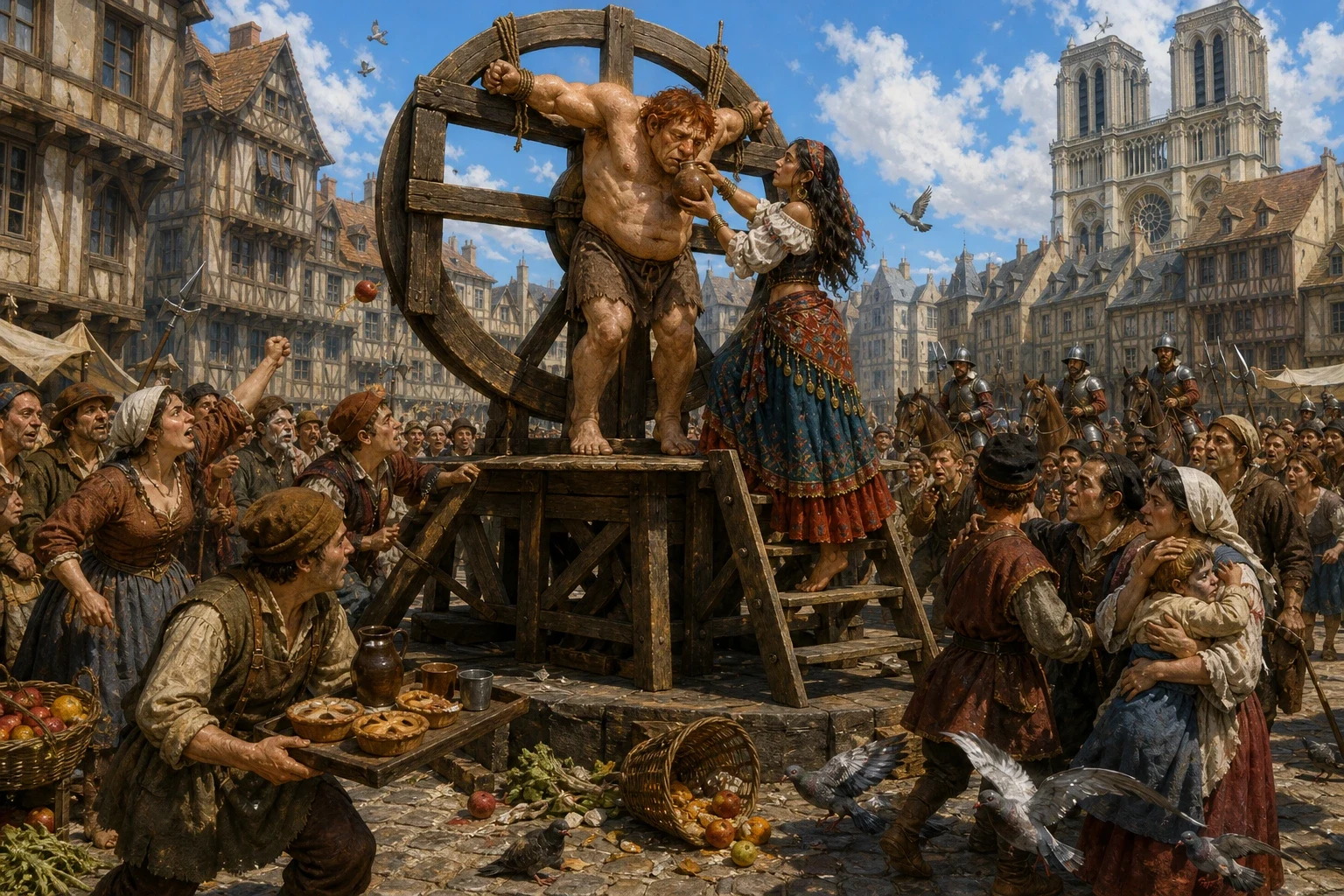
Quasimodo was tried for the night's abduction and sentenced to be shown and beaten in the pillory. In the full glare of noon in the Place de Grève, bound to the turning wheel of the platform, he was punished before a jeering crowd who mocked his ugliness and gave him nothing but abuse. Thirsty and exhausted, he begged for water and was answered only with laughter from every side — until Esmeralda, the very woman he had tried to carry off, climbed the ladder to the platform without a word and held a gourd of water to his cracked lips. The crowd fell silent. For the first time in his whole life, a single tear ran down the ruined face of a man who had never once, until that moment, been shown pity by another living soul.
Page 5
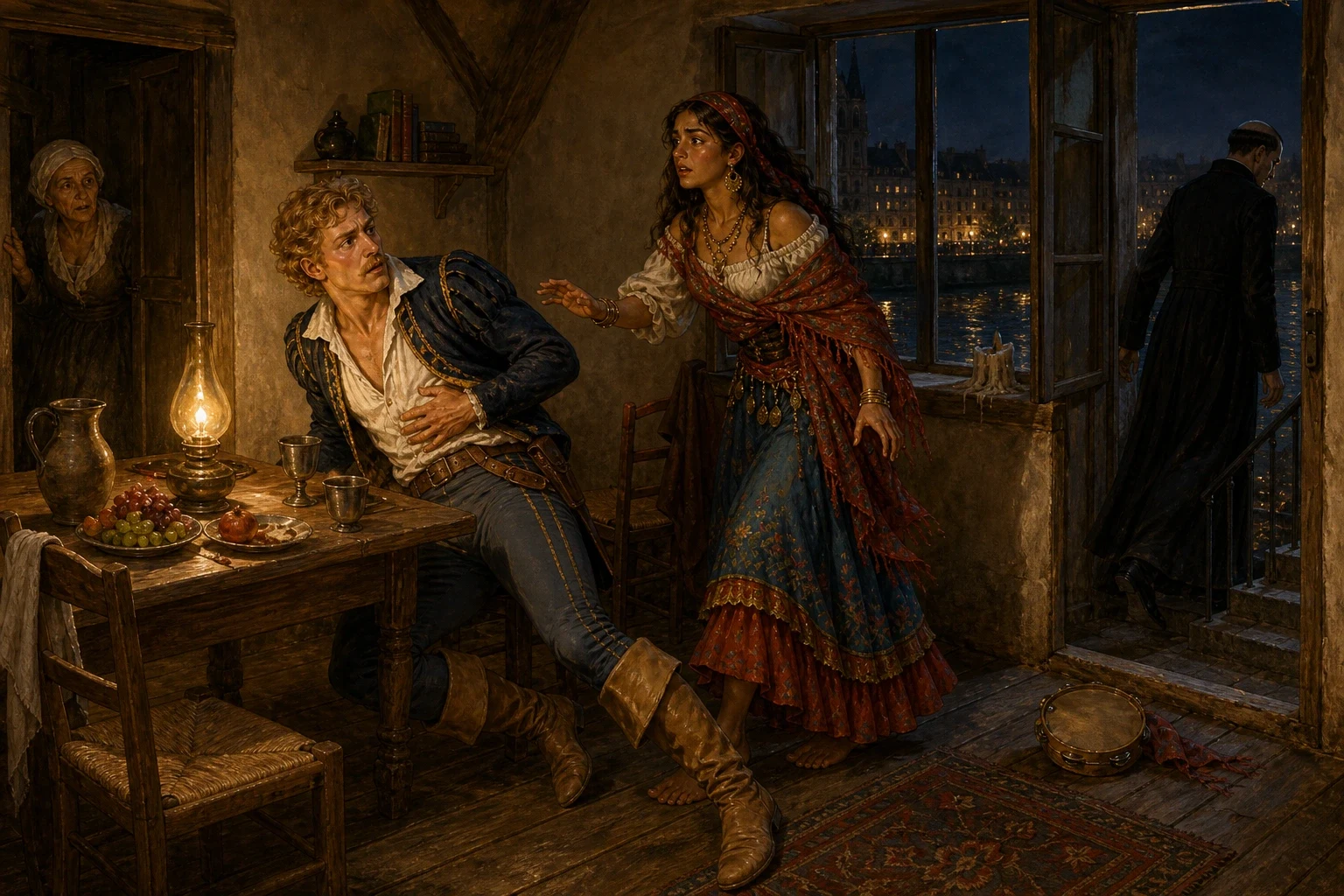
Weeks later, hopelessly in love, Esmeralda agreed to meet Captain Phoebus in secret, in a small rented room above the Seine kept by an old woman named Falourdel. Phoebus, careless and already promised to a rich bride, treated the meeting lightly, but Esmeralda gave him her whole heart. Unknown to either of them, Claude Frollo had followed the captain there, sick with jealousy, and had hidden himself in a narrow side closet to watch. The moment Phoebus drew close to her, Frollo could bear no more. He struck before Phoebus even saw him and was gone through the window onto the river stairs before Esmeralda understood what had happened. She turned to find Phoebus fallen against the table, badly hurt, and in the next instant the watch burst in and seized her as his attacker.
Page 6
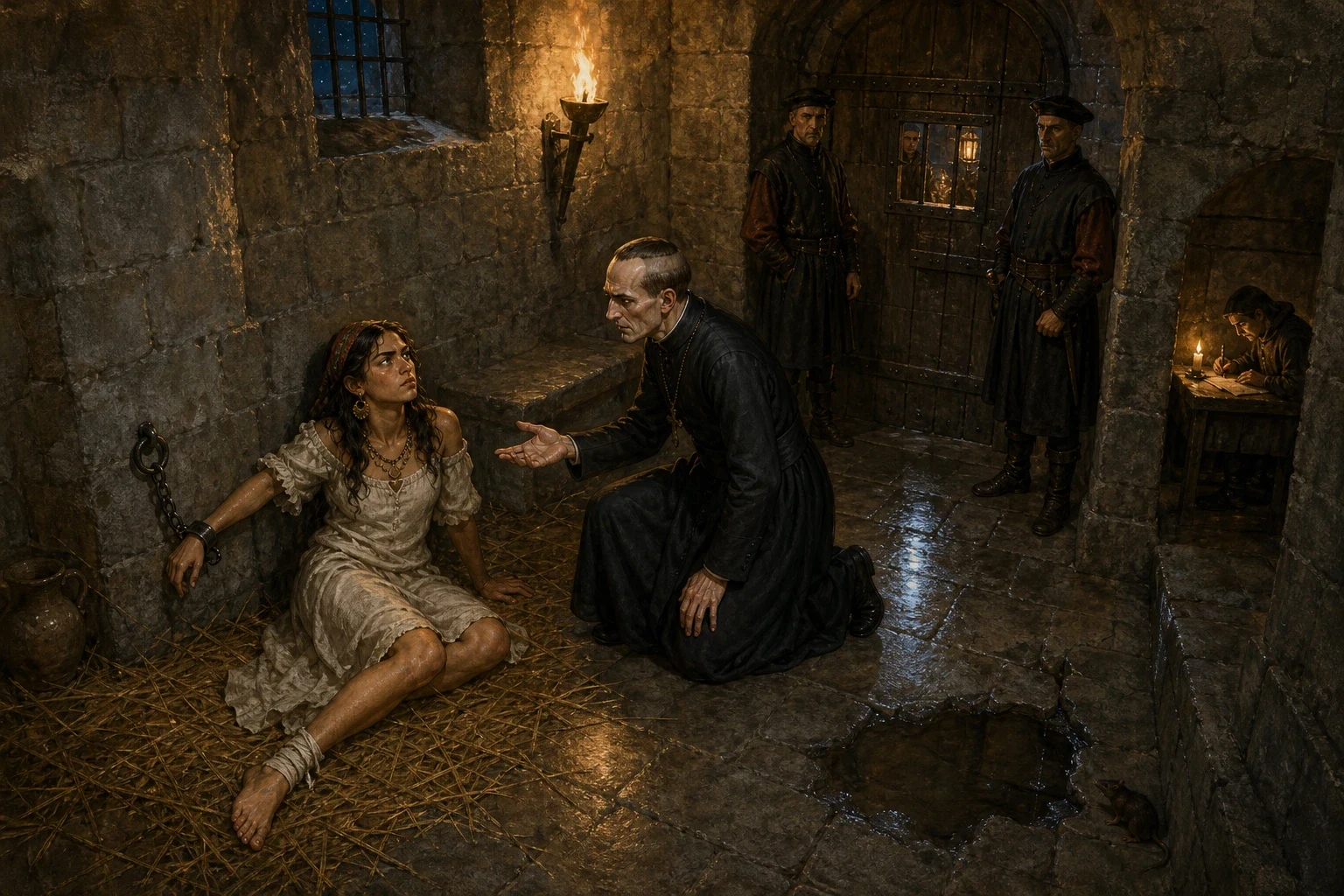
Accused of witchcraft and the attempted murder of Phoebus, Esmeralda was dragged before the King's judges in a stone cellar beneath the Palais de Justice and put to the question until, broken by the ordeal, she confessed to crimes she had never committed. She was condemned to be hanged in the Place de Grève. Alone afterward, chained to the cell wall, she received one last visitor: Claude Frollo, who offered to save her from the gallows if only she would love him instead of the captain who had never truly loved her. She refused him with the last of her strength, calling him the true murderer and telling him she would rather die than ever touch his hand.
Page 7
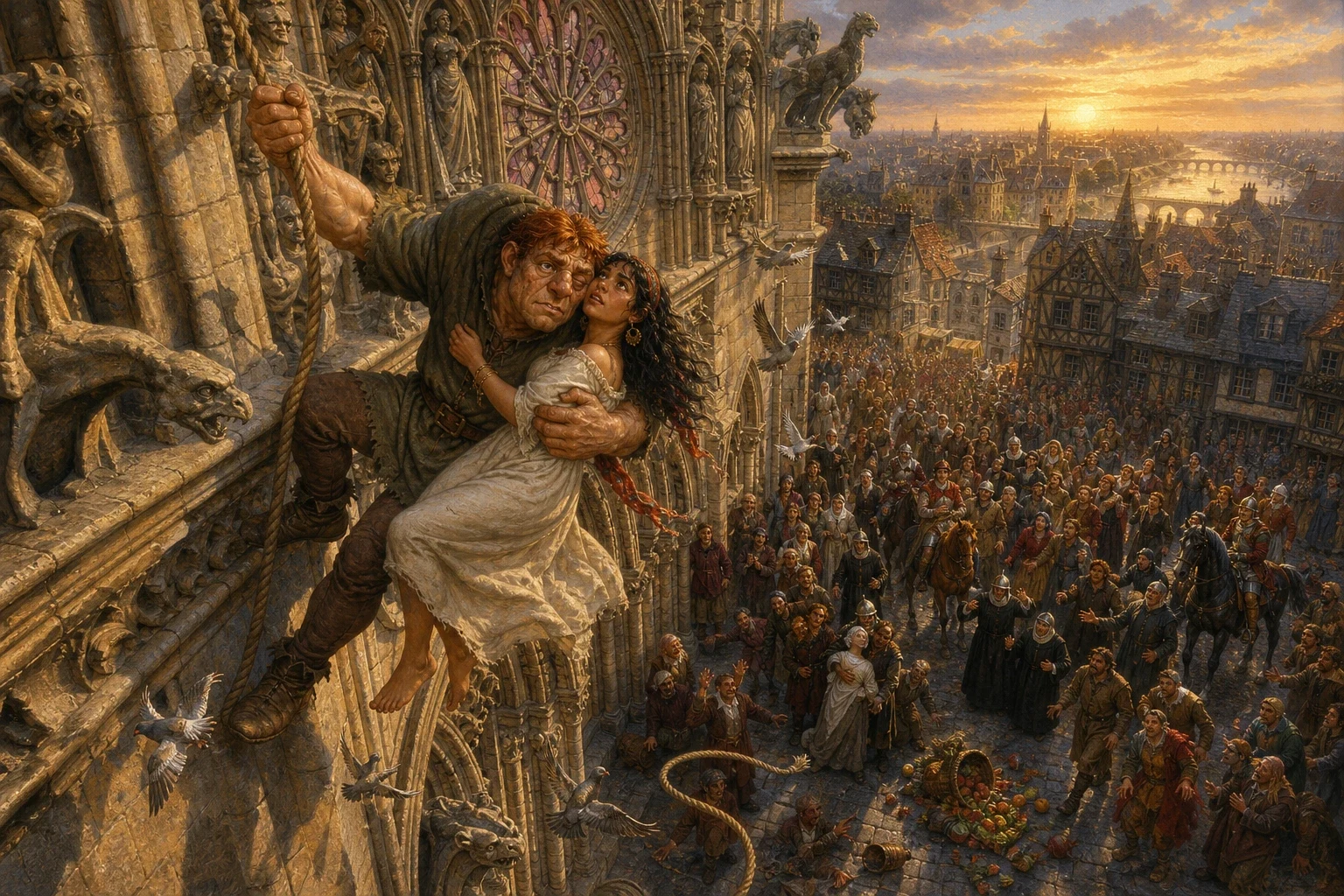
On the morning Esmeralda was led out in her plain shift to be hanged in the Place de Grève, Quasimodo was watching from high on the cathedral he loved. The instant the rope touched her, he swung down the face of Notre-Dame on a bell rope, snatched her out of the hangman's hands in a single motion, and scaled back up the stone wall with her held tight against his chest, bounding from ledge to ledge while the whole square below roared in astonishment. He carried her through a high window into the cathedral itself and laid her safely on the stone floor of the nave, where by the old right of the Church, no soldier of the King could touch her.
Page 8
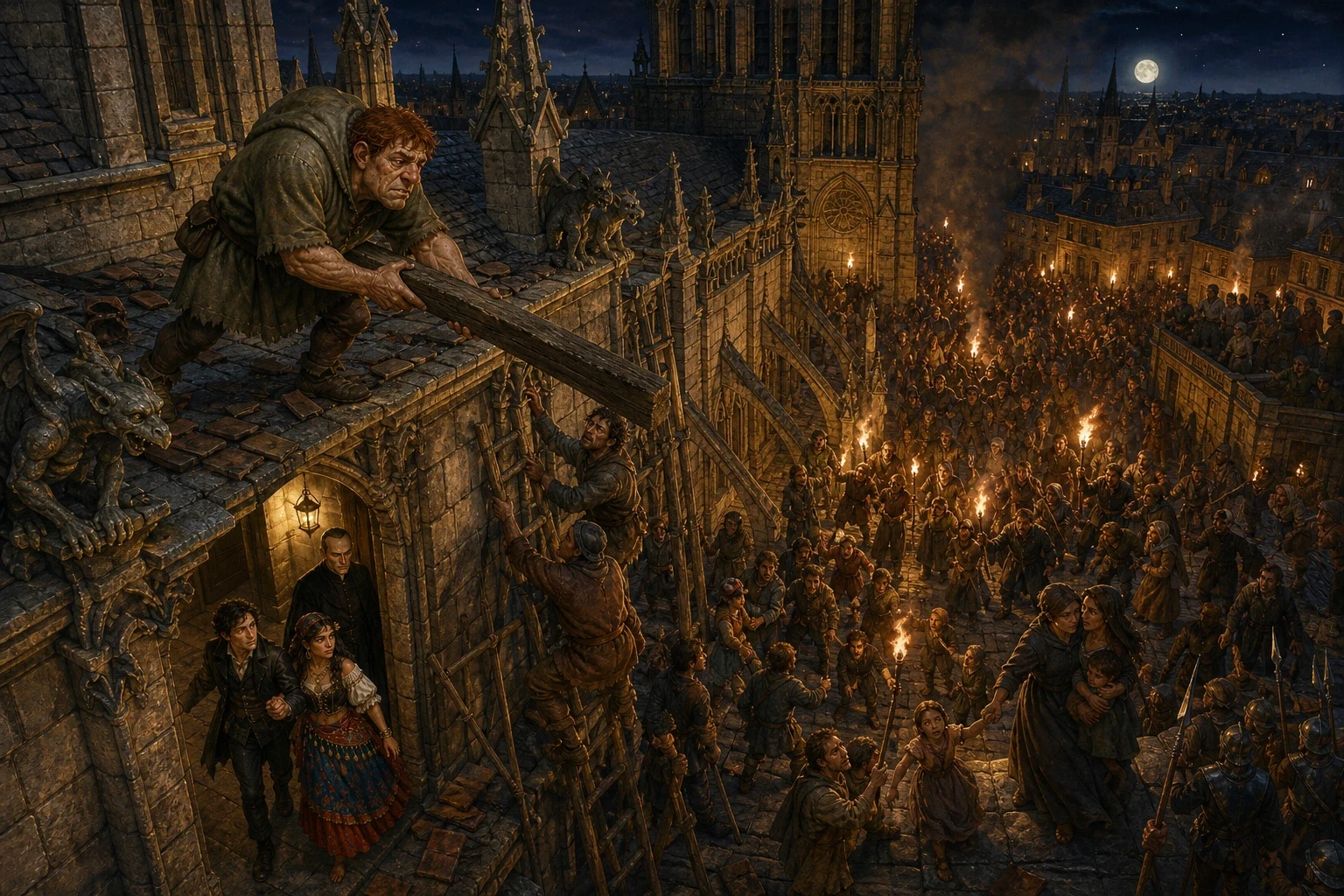
Weeks passed with Esmeralda safe inside the cathedral, but Clopin and the whole Court of Miracles, fearing the Church meant to hand her back to the King's men after all, gathered by torchlight and stormed the doors of Notre-Dame to carry her off themselves. Quasimodo, seeing only an armed mob coming for the woman he had sworn to protect, fought them back alone from the towers with everything he could lay his hands on, certain to the end that he was saving her life. In the confusion, the King's own soldiers arrived and scattered the attackers through the streets below. While the fight still raged, Frollo and Gringoire slipped Esmeralda out through a hidden side door, each believing — for very different reasons — that he alone was the one saving her.
Page 9
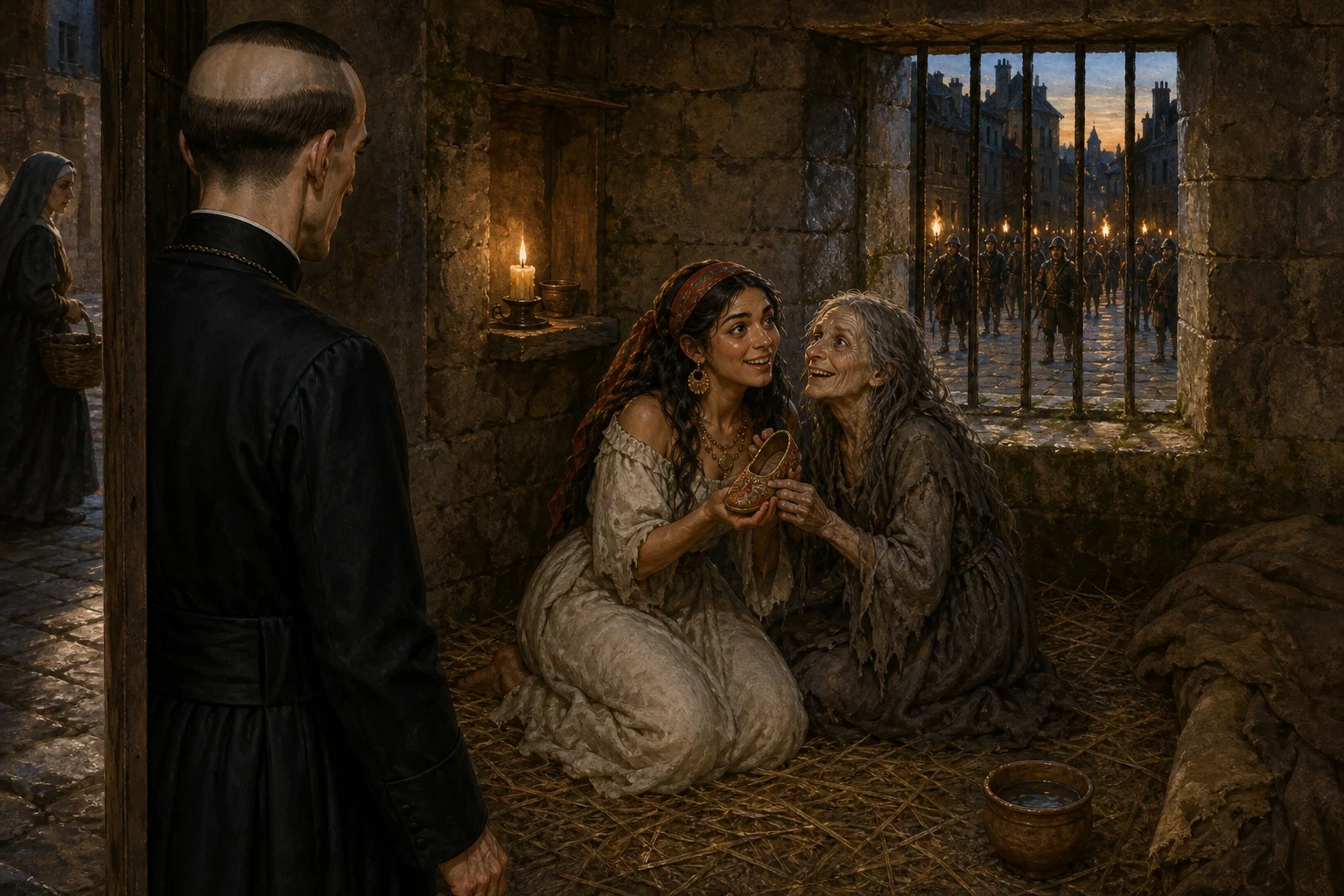
Frollo led Esmeralda, hidden and exhausted, to a tiny barred cell built into a tower wall where a recluse called Sister Gudule had lived walled up alone for years, mourning a baby daughter stolen from her by Gypsies long ago. Frollo made Esmeralda one final offer and one final threat; she refused him for the last time, and he stormed off to fetch the soldiers himself, abandoning her to be found. Left alone with the recluse, Esmeralda showed her a little embroidered shoe she had carried her whole life — and Gudule recognized it as her lost daughter's own. For a few stolen minutes, mother and daughter held each other, found again after fifteen years, just as soldiers' torches appeared at the end of the street. Gudule threw herself across the cell door to hold them back and fell in the struggle; the soldiers took Esmeralda regardless.
Page 10
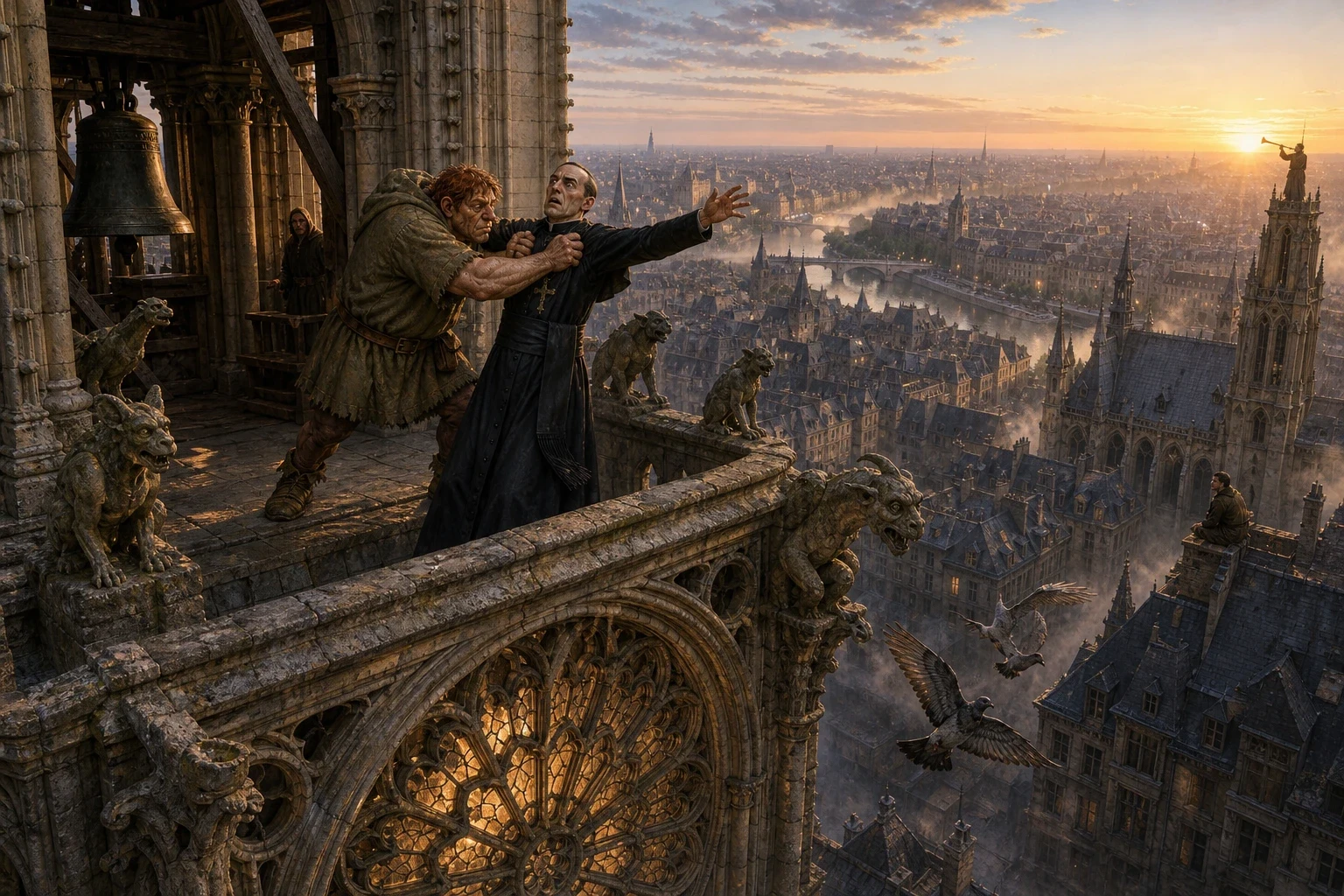
At dawn, Esmeralda was hanged in the Place de Grève below, and Claude Frollo stood at the parapet of the north tower watching her die, and began to laugh. Quasimodo, who had climbed up silently beside him, understood in that single instant everything the archdeacon had done — the abduction, the knife at Falourdel's, the abandonment in the cell — and in one terrible movement seized Frollo and cast him from the tower. Frollo fell the whole height of the cathedral to the pavement of the parvis far below. Quasimodo looked once at the man who had raised him, and did not look again. He was never seen in Notre-Dame after that day. Years afterward, in the common burial pit at Montfaucon, among the bones of the city's dead, two skeletons were found locked together in an embrace — one of them with a twisted spine. When they tried to part the two, both crumbled into dust.
About this story
- Audience: general readers
Read Wonder Novels on your phone
Wonder Novels is available on Android. Get Wonder Novels on Google Play.