The Pendulum's Secret
The Pendulum's Secret — an illustrated science story. 10 illustrated pages, free to read on Wonder Science.

Page 1
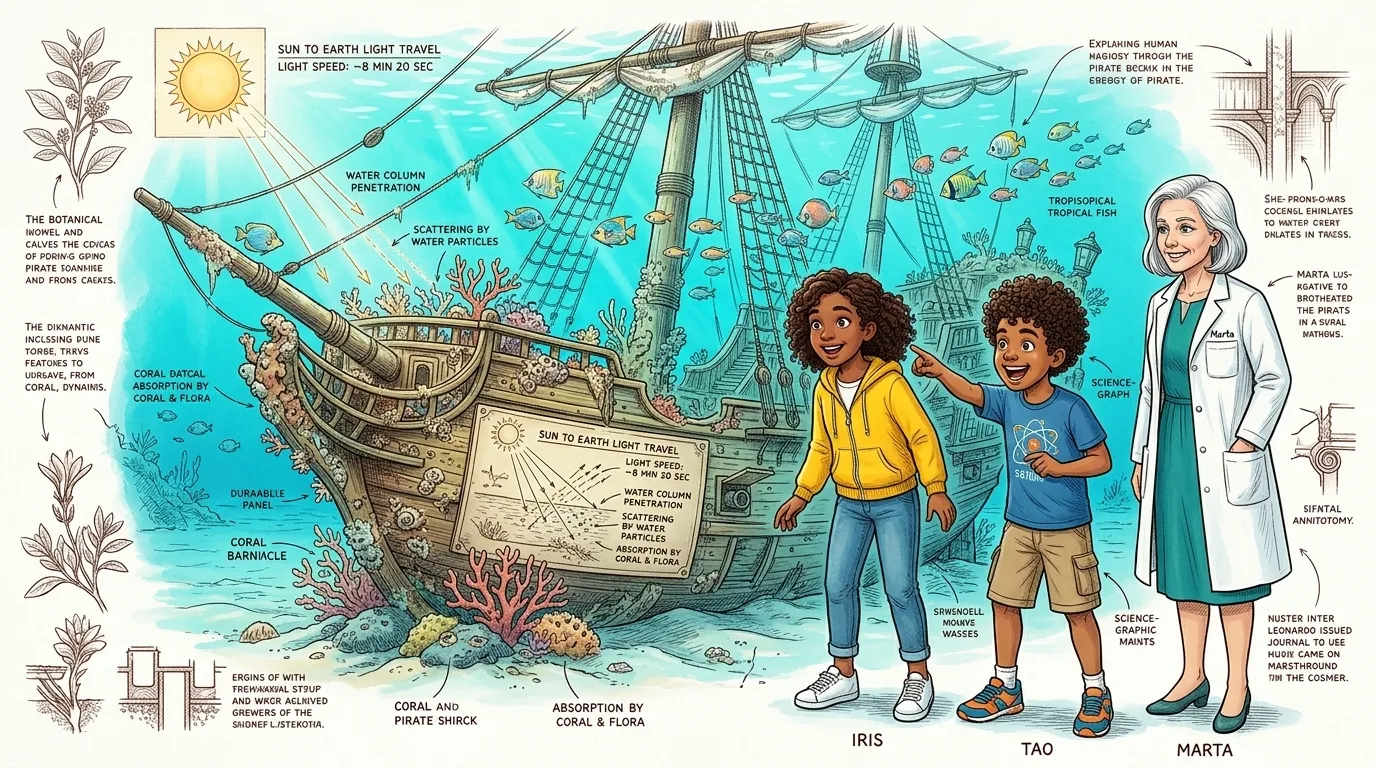
Sunlight filters through the turquoise water, illuminating an odd sight. A once-grand pirate ship, now encrusted with coral and teeming with fish, rests peacefully on the ocean floor. This is no ordinary shipwreck; it's a school!
"Wow! Imagine learning science in a place like this!"
Fact: Fun Fact: Light takes 8 minutes and 20 seconds to travel from the Sun to Earth, but it's scattered and absorbed by the water column before it reaches this depth.
Page 2
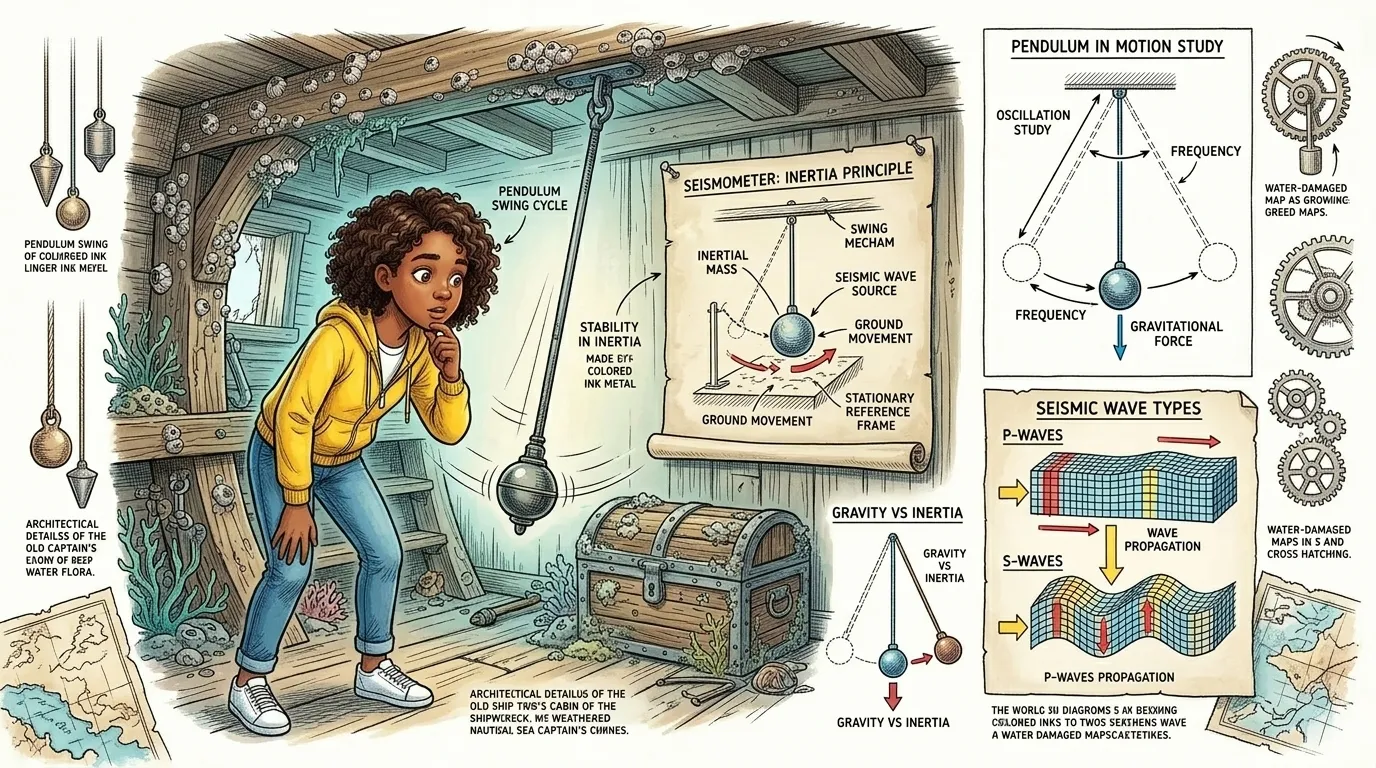
Iris, an energetic 11-year-old with curly dark brown hair, brown skin, wearing a yellow hoodie, blue jeans, and white sneakers, peers into the old captain's cabin. An oddity hangs from a beam: a long, heavy pendulum, swinging slowly and rhythmically. Its movement seems...off.
"That pendulum...it's not swinging like the ones at the Exploratorium."
Fact: Pendulums are used in seismometers to detect earthquakes. The inertia of the pendulum keeps it relatively still while the Earth moves around it, allowing scientists to measure the seismic waves.
Page 3
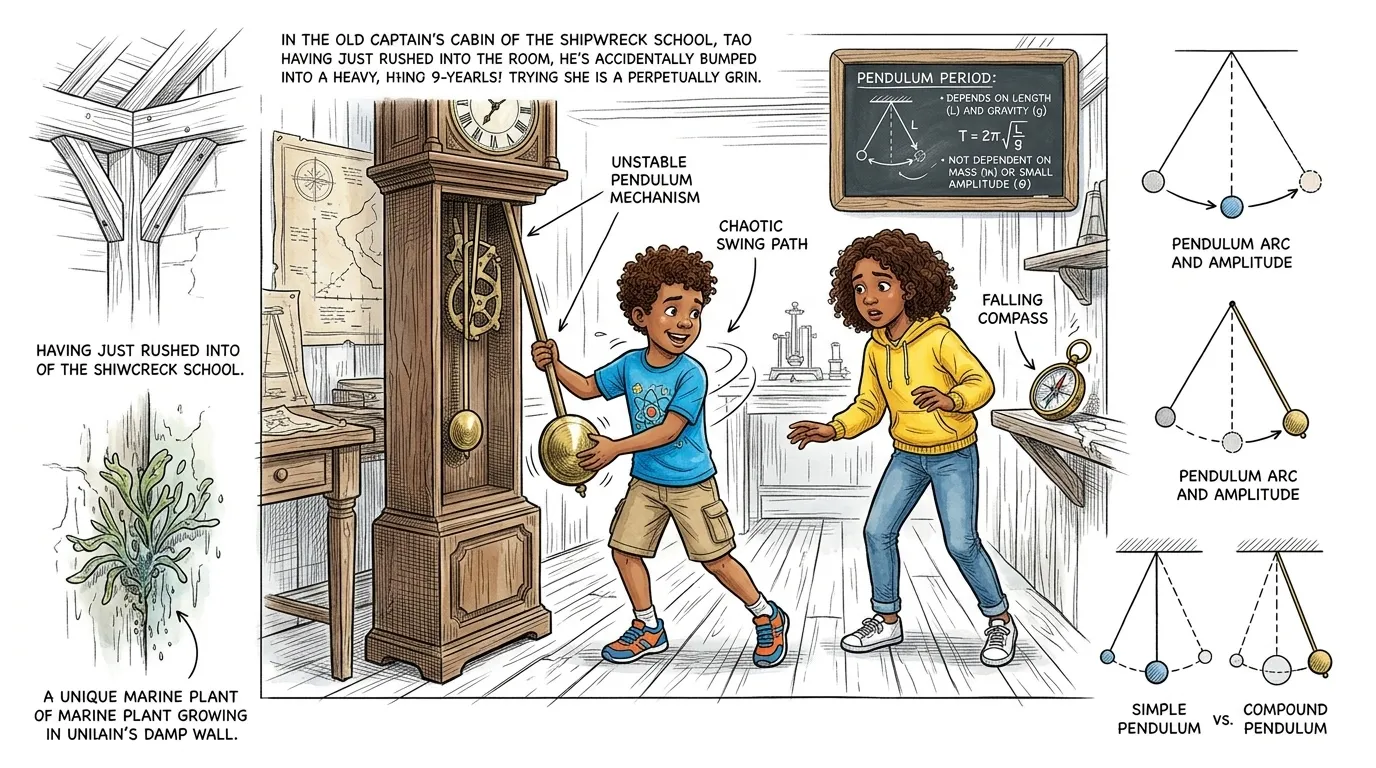
Tao, a spirited 9-year-old male with medium brown skin and dark brown curly hair, rushes in, accidentally bumping into the pendulum. "Oops! Sorry!" he says, steadying the weight. The pendulum's swing becomes erratic, chaotic. A small artifact on a nearby shelf falls to the floor.
"Careful, Tao! You've disturbed its swing."
Fact: The period of a pendulum depends on its length and the acceleration due to gravity. It doesn't depend on the mass of the bob or the amplitude of the swing (as long as the amplitude is small).
Page 4

Iris picks up the compass, noticing its needle spinning wildly. "It's like it's lost its direction," she says. She remembers learning about Jean Foucault, a French physicist. He used a pendulum in 1851 to prove the Earth rotates.
"Foucault's pendulum! He used it to show the Earth spins!"
Fact: Jean Foucault's pendulum experiment was conducted in 1851 in the Panthéon in Paris. The pendulum's apparent change in direction proves the Earth's rotation.
Page 5

The pendulum's swing seems to be tied to the compass's direction, and the Earth's rotation. The Earth spins on its axis, pulling the pendulum ever so slightly.
"Is the pendulum connected to the Earth somehow?"
Fact: The Earth completes one rotation roughly every 24 hours. The speed of rotation varies depending on latitude, being fastest at the Equator and zero at the poles.
Page 6
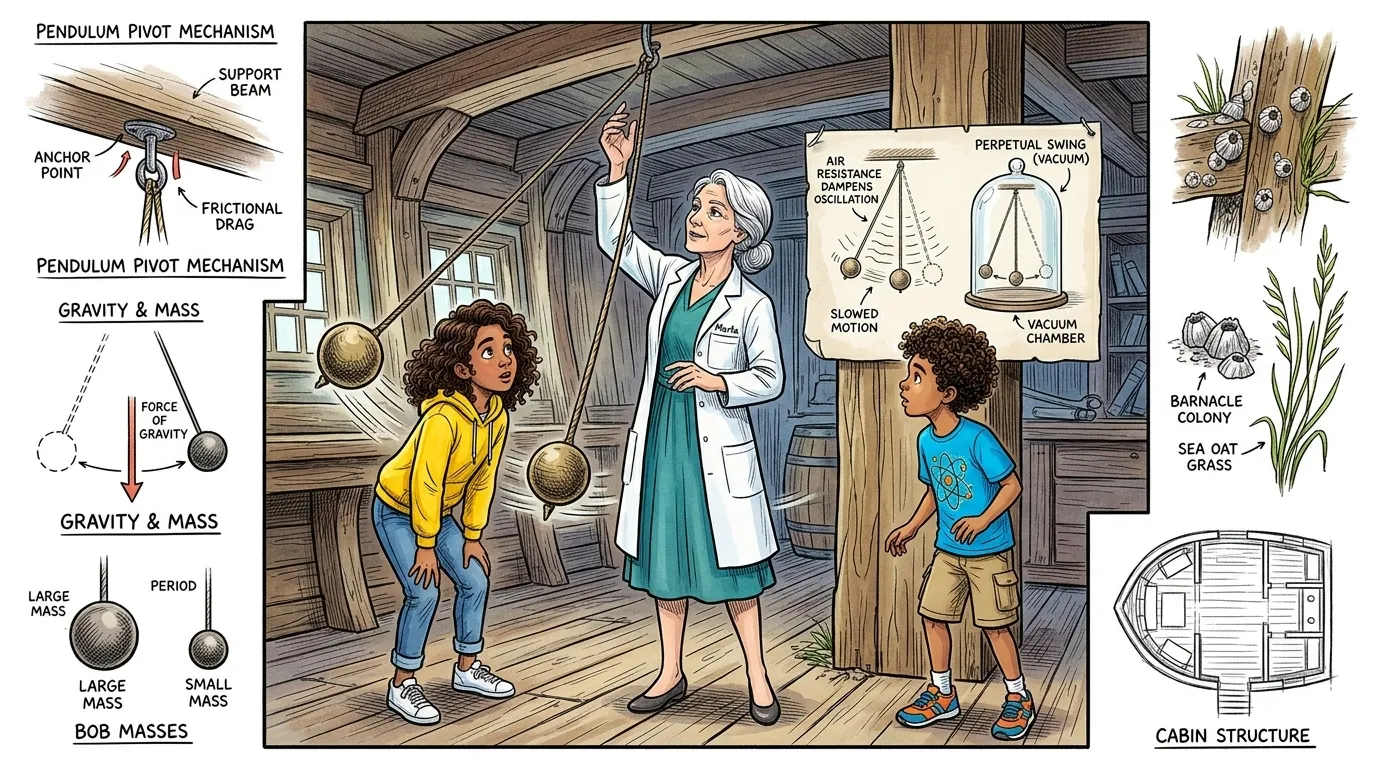
The pendulum, once gently oscillating, now swings erratically. Marta, a heavyset and gentle woman with silver-white hair, examines the anchor point above. "Something's disrupting the natural oscillation," she says. "It's reacting to forces it shouldn't."
"Forces it shouldn't? What kind?"
Fact: Air resistance slows down a pendulum, but in the absence of air resistance, a pendulum would swing forever.
Page 7

Iris recalls how pendulums are used in seismographs to measure earthquakes. They help scientists detect tiny movements in the Earth's crust. Could something similar be happening here?
"Wait! Pendulums detect earthquakes! What if this is sensing something?"
Fact: The Richter scale, developed by Charles Richter in 1935, is a logarithmic scale used to quantify the magnitude of earthquakes. Each whole number increase represents a tenfold increase in amplitude.
Page 8
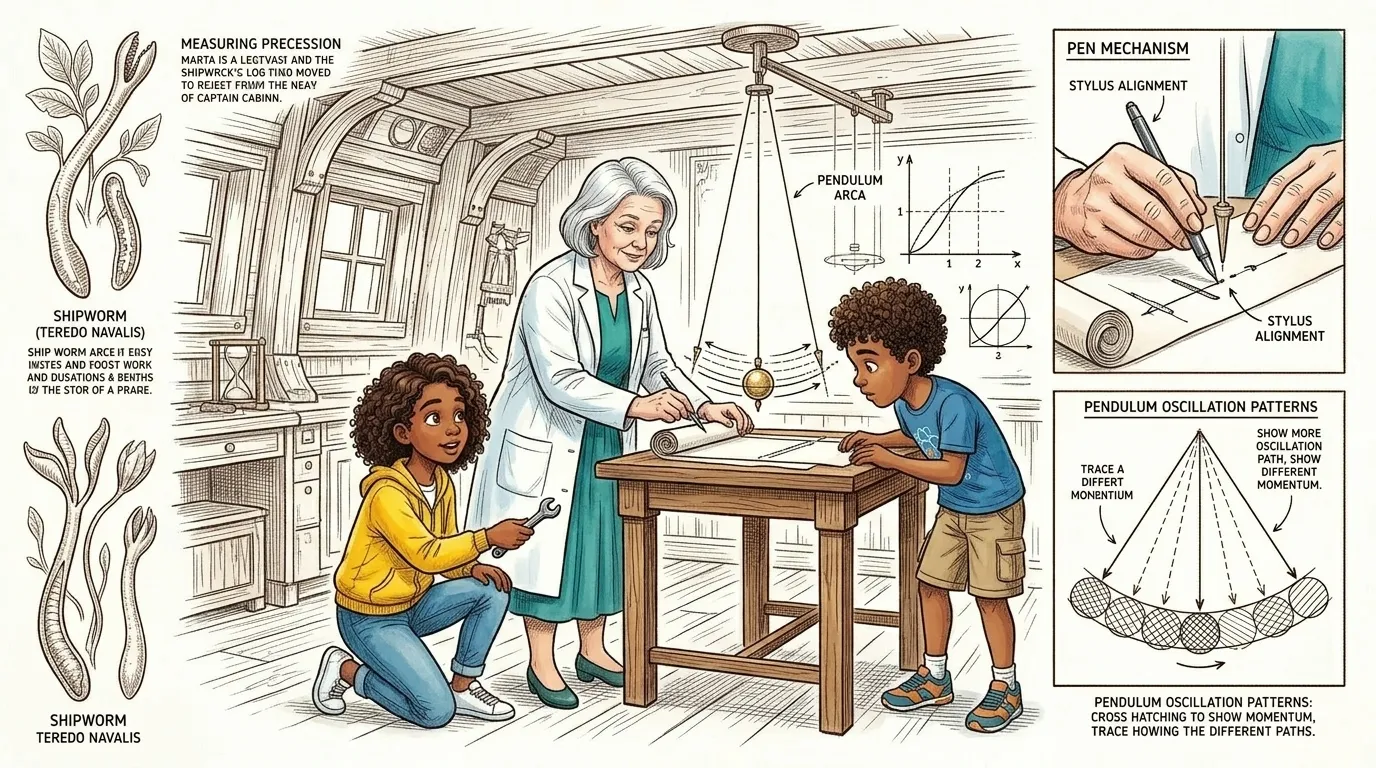
Tao examines the pendulum’s base. “Look! Tiny wires connect it to that panel…and the panel is glowing.”
Marta rushes over. “It's not an earthquake sensor, it’s a signal receiver! The pendulum isn’t *detecting* movement, it’s *responding* to something being sent!”
Iris points upwards. “The tower! It must be broadcasting…but what?” A low hum fills the room as the pendulum swings faster, its shadow dancing wildly on the stone floor.
Page 9
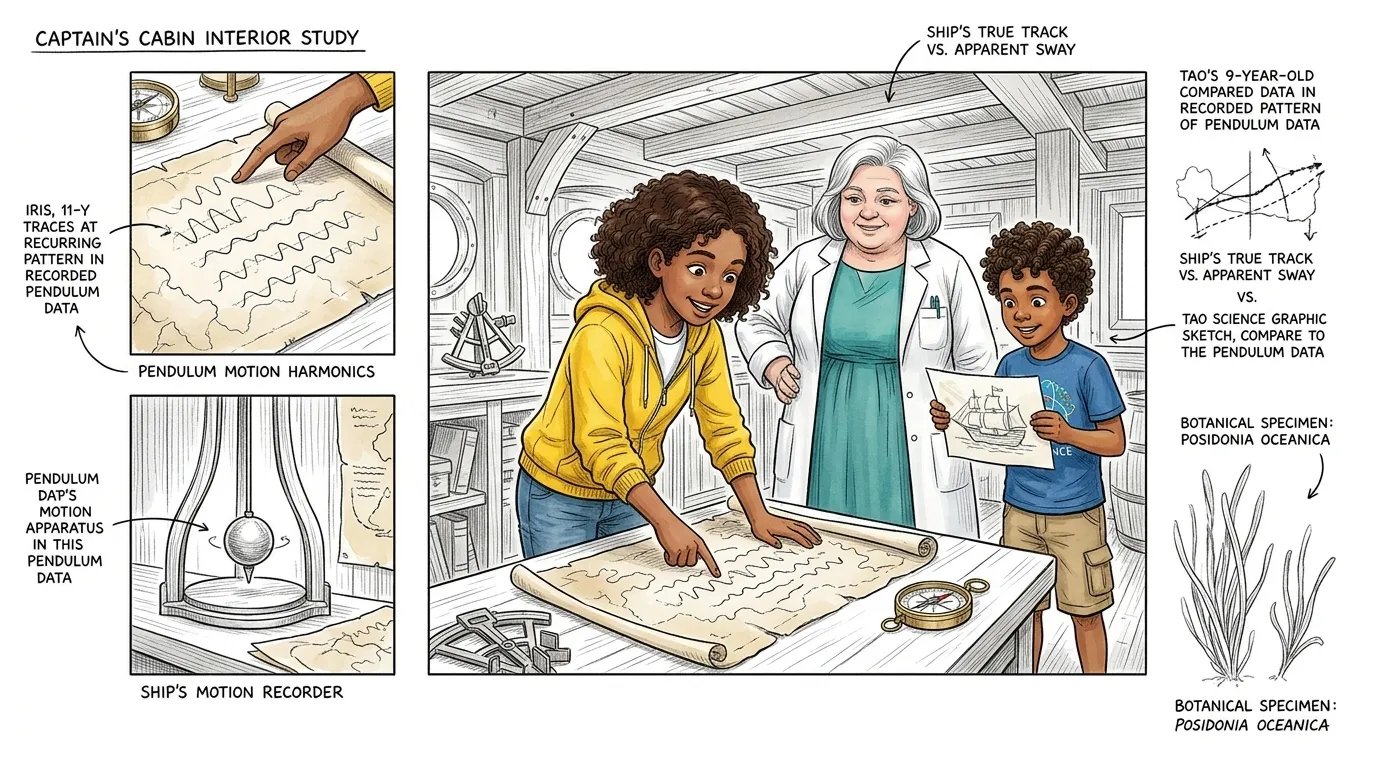
…Tao traced a finger along the dusty glass of the clock’s face. “It doesn't just tell time,” he murmured, more to himself than to Iris or Marta. “Grandfather said it *holds* time.”
Iris scoffed, but her eyes were fixed on the pendulum swinging with hypnotic rhythm. “Holds time? What does that even mean?”
Marta, who had been quietly examining a small brass plate beneath the clock, suddenly gasped. "Look! There's an inscription…it’s almost worn away. I think it says…‘When the shadow falls on the rose…’”
Page 10
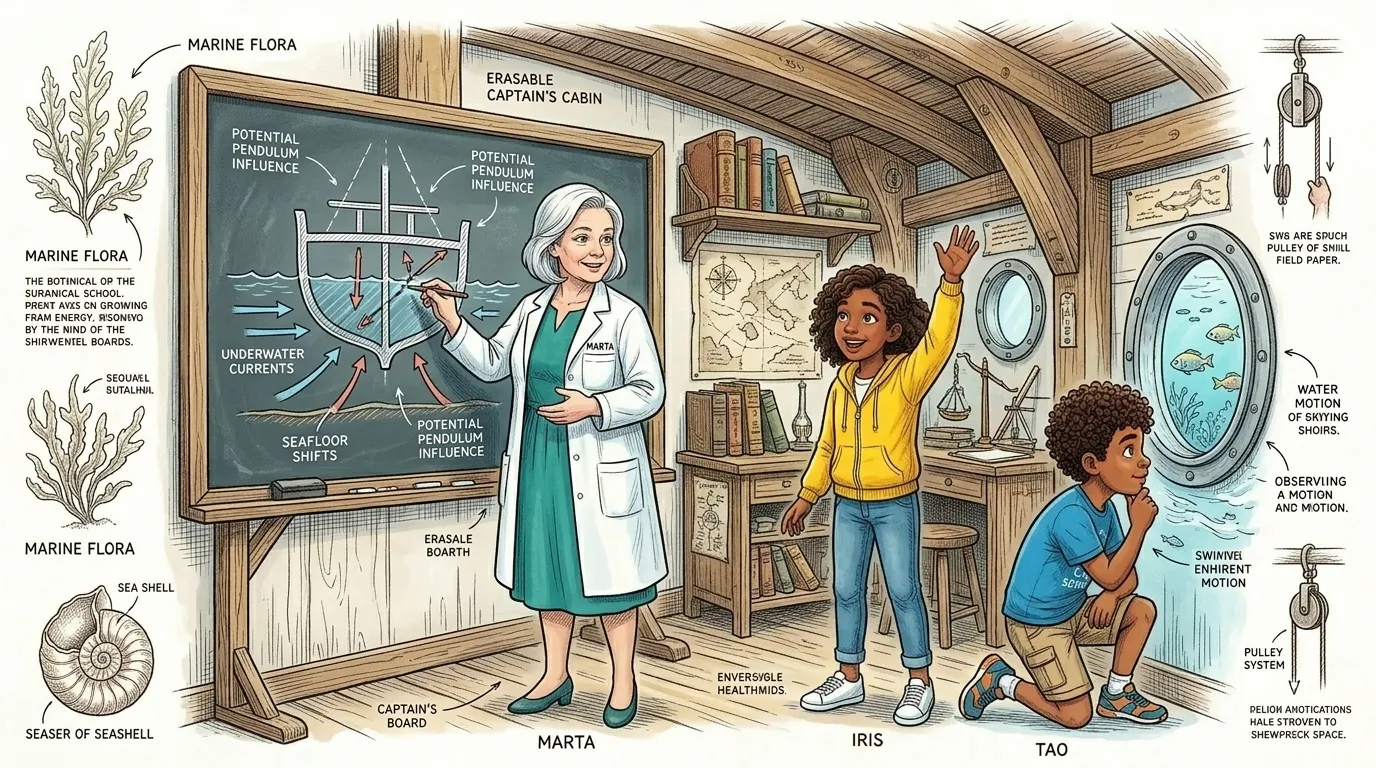
…Tao carefully adjusted the small brass pendulum hanging from the archway. “It’s almost right,” he murmured, his brow furrowed in concentration. Iris shielded her eyes, watching the rhythmic swing. Marta traced the strange symbols carved into the stone floor around them. A faint hum filled the chamber as the pendulum slowed, then stopped precisely over a hidden seam in the wall.
“There!” Iris exclaimed. “That’s it! The secret passage.” Tao pressed on the indicated stone, and with a grinding rumble, a section of the wall slid inward, revealing darkness beyond.
About this story
- Audience: kids (ages 6–12)
Questions and answers
Read Wonder Science on your phone
Wonder Science is available on Android. Get Wonder Science on Google Play.