Pinocchio
A wooden puppet who tells lies, learns to love, and longs to become a real boy
Page 1
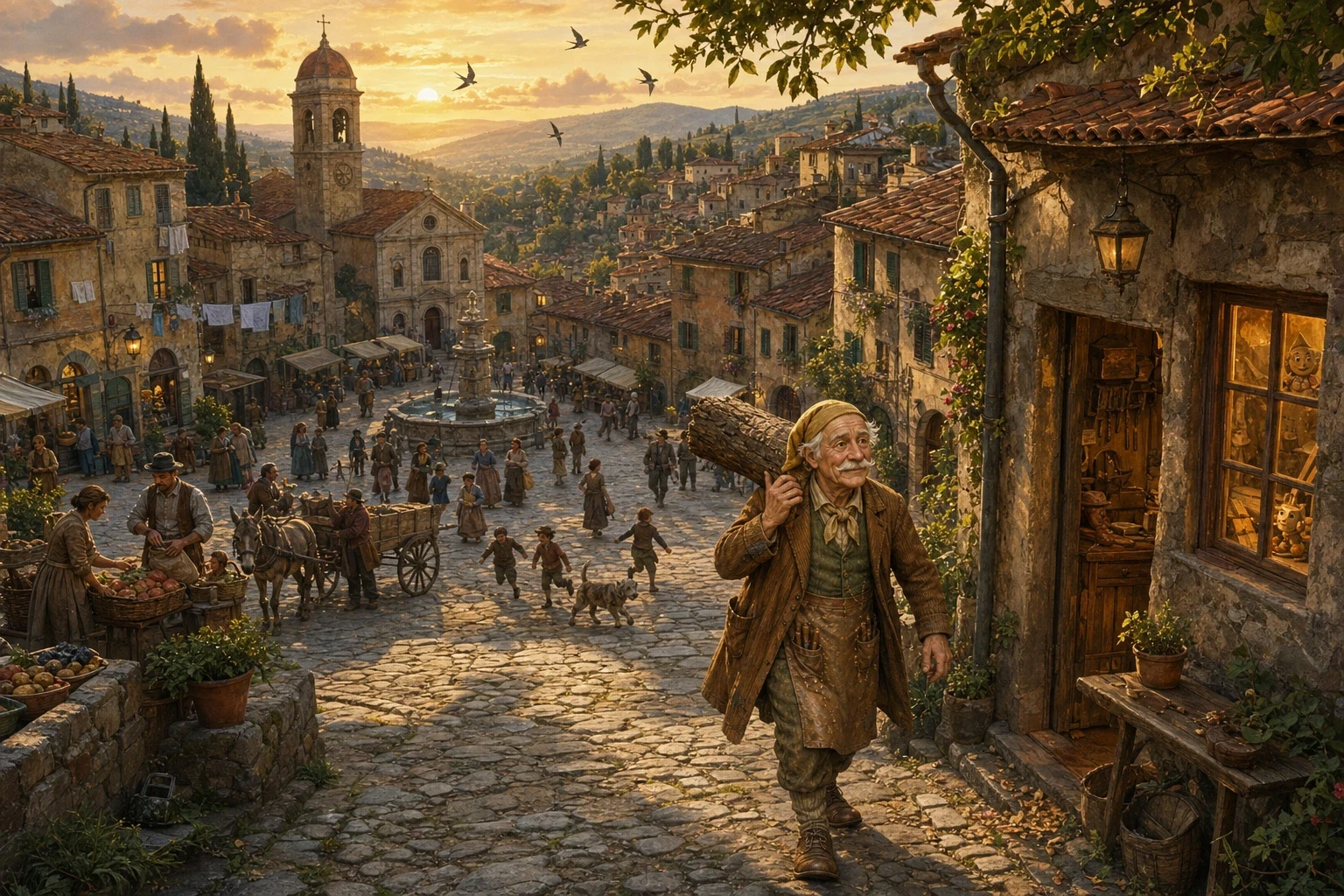
In an old town in the hills of Italy, where red rooftops tumbled down to a little square and a church bell rang the hours, there lived a poor old woodcarver named Geppetto. He had no wife and no children, only his tools, his bench, and a great loneliness that no amount of work could carve away. One day a neighbour gave him an odd piece of firewood, and Geppetto had a sudden happy idea: he would carve himself a wooden puppet — a fine, lively puppet that could dance and tumble and travel the world with him — and he would love it as if it were his very own little boy. Humming to himself for the first time in years, he carried the log home through the busy evening streets, past the market stalls and the children playing, and shut his workshop door behind him.
Page 2
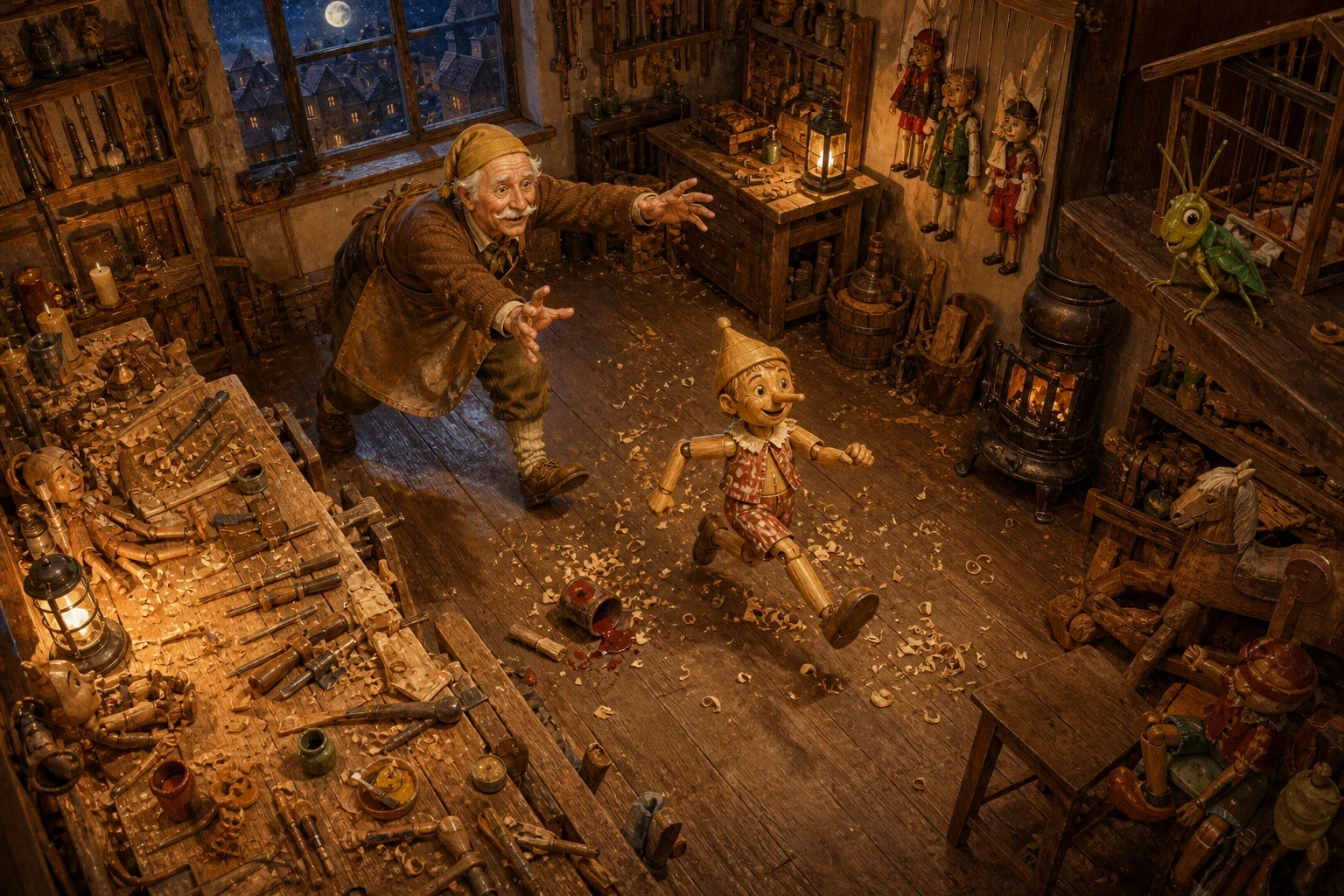
All through the night Geppetto carved, and as he worked a strange and wonderful thing happened. The moment he shaped the eyes, they blinked and looked at him. The moment he finished the mouth, it laughed. And the moment the little wooden legs were done, the puppet leapt down from the bench and went scampering about the workshop on his new feet, knocking over pots of paint and tangling himself in wood shavings, while the old man chased after him laughing and weeping both at once. 'I shall call you Pinocchio,' said Geppetto, catching him at last and holding him close, 'and you shall be my own dear boy.' From a corner, a wise old cricket who had lived in the workshop for a hundred years watched it all, and quietly wondered what sort of life this wooden child would choose.
Page 3
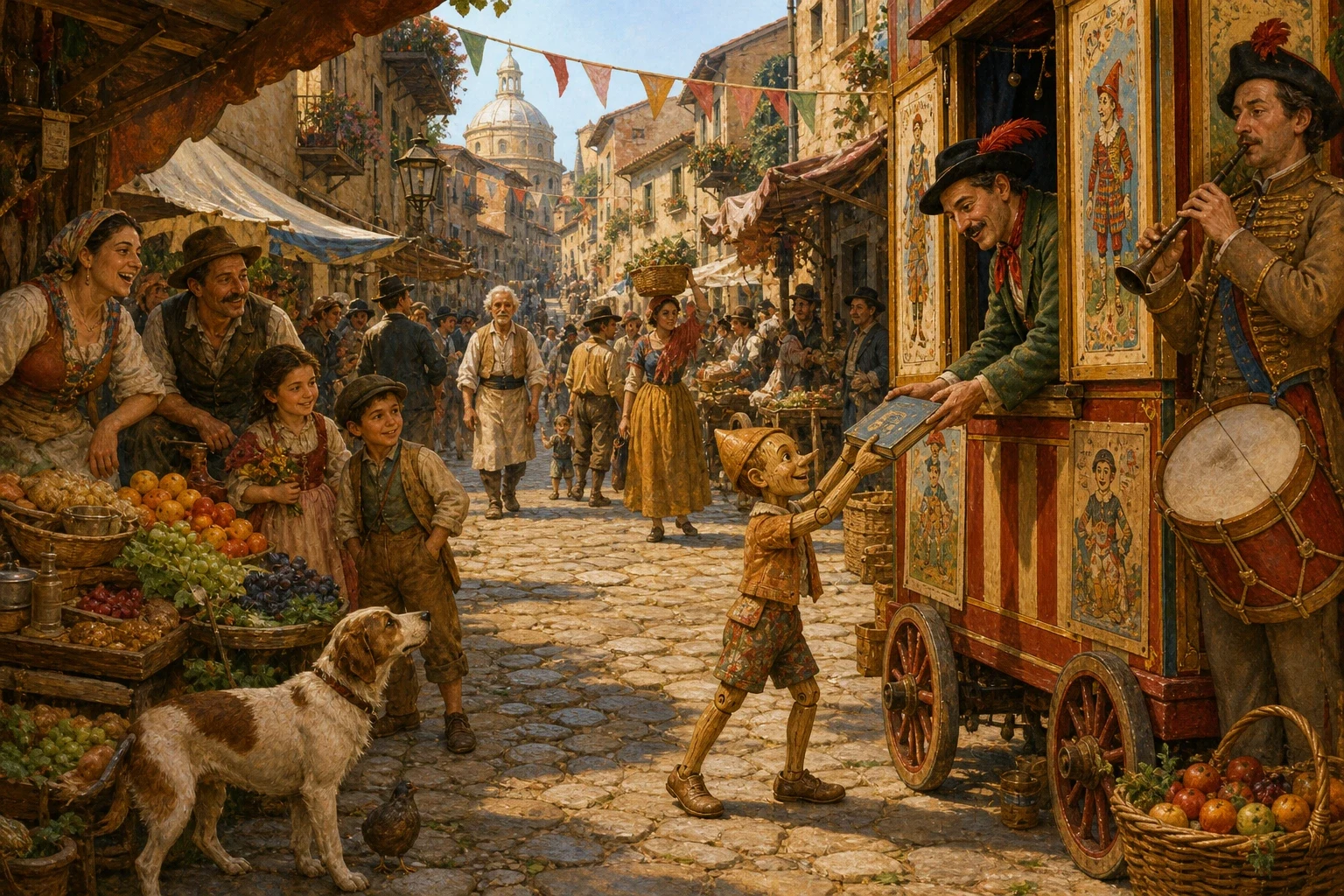
Geppetto loved Pinocchio so dearly that he sold his only coat to buy him a spelling-book, and sent him off to school to learn to read and write like a real boy. But Pinocchio had not gone far down the busy street before his ears caught the squeal of a fife and the boom of a drum. Following the music through the crowd, he came upon a gaudy travelling puppet-theatre, and all thought of school flew straight out of his wooden head. He had no penny for a ticket — but he had his brand-new spelling-book. And so, telling himself he would go to school tomorrow, tomorrow for certain, the foolish puppet sold his father's gift for the price of a seat, and pushed his way eagerly into the crowd at the theatre door.
Page 4
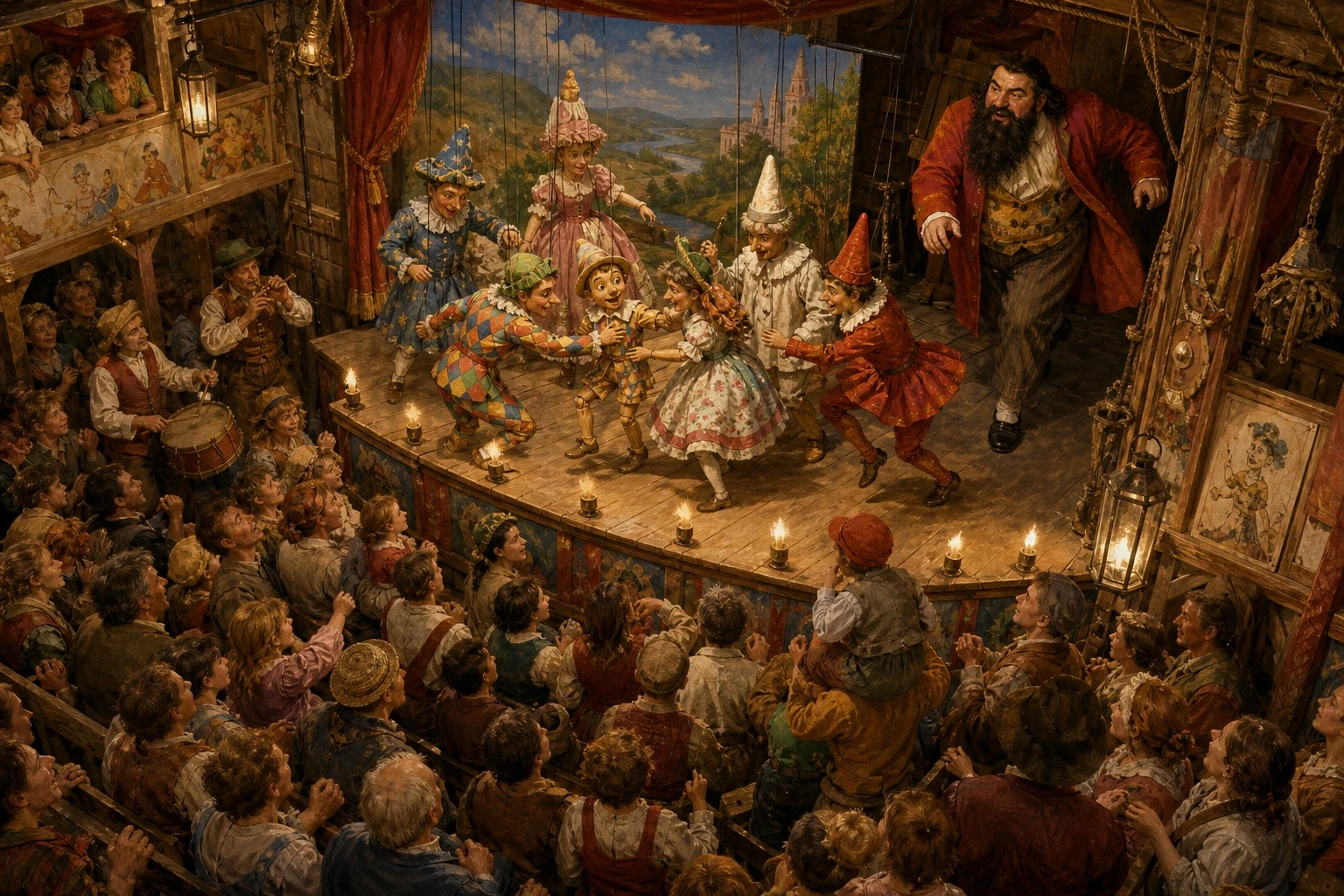
Inside, the little theatre was packed and roaring with laughter as the marionettes danced upon the stage. But the moment the puppets caught sight of Pinocchio in the crowd, they stopped their play and cried out with joy, for they knew him at once as one of their own kind, and pulled him up onto the stage to join their dance. Such an uproar followed that out stormed the theatre's master — the huge, black-bearded puppet-master Mangiafuoco, with eyes like coals and a voice like thunder — furious that his show had been spoiled. He was a fearsome-looking giant, but he had a soft heart underneath; and when Pinocchio bravely told him the tale of poor lonely Geppetto at home, the great man's temper melted, and he let the puppet go — and pressed five gold coins into his wooden hand to carry home to his father.
Page 5
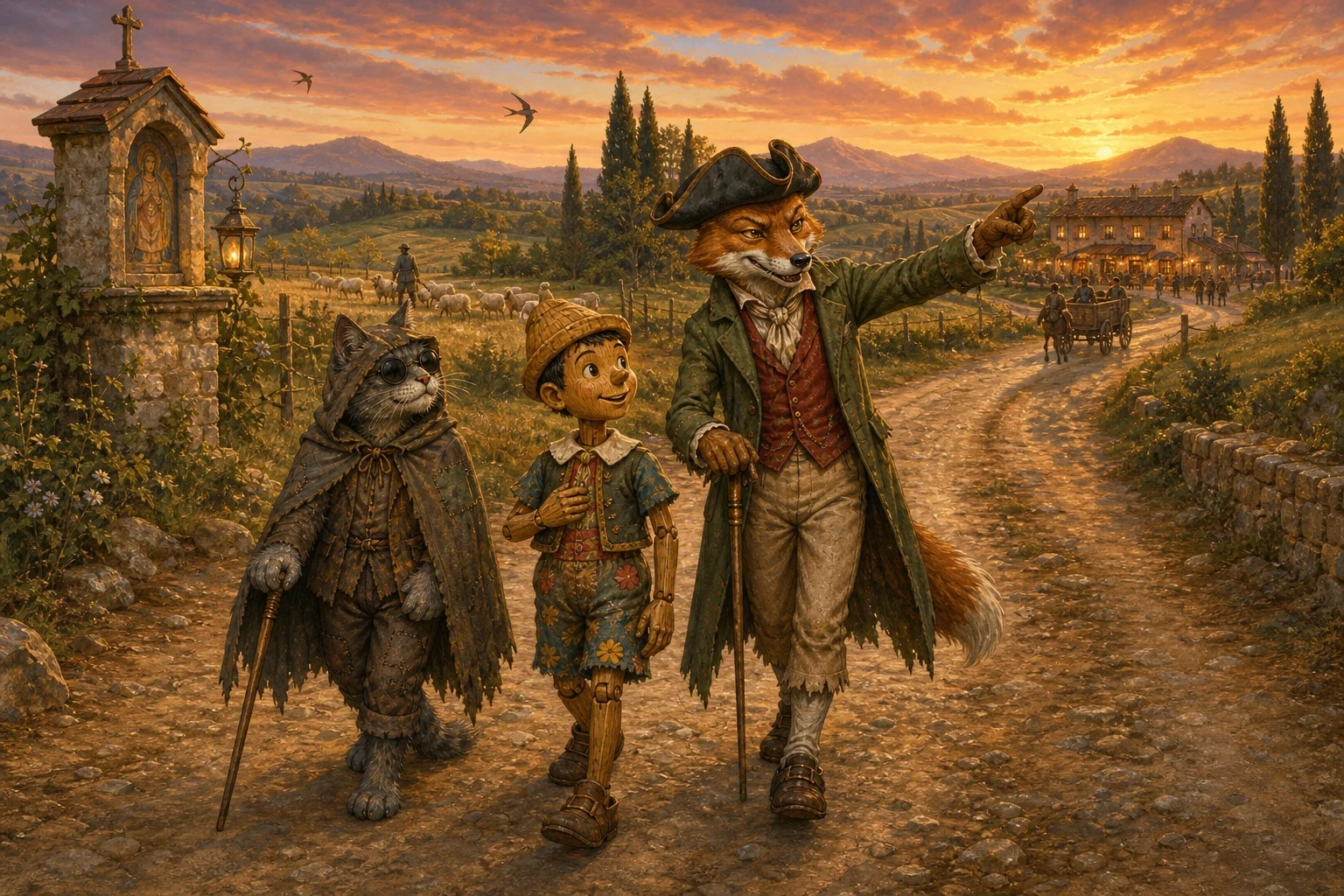
On the road home, his five gold coins jingling in his pocket, Pinocchio fell in with two sorry-looking travellers: a Fox who limped along on a cane, pretending to be lame, and a Cat who felt his way with a stick, pretending to be blind. They were really a pair of clever swindlers, and the moment they heard the coins jingle their eyes gleamed. What a foolish thing, they told him, to carry gold all the way home — when in the magical Field of Miracles, just a little way off, he had only to bury his coins in the ground and by morning they would grow into a tree hung with a thousand gold pieces! Pinocchio, who still had so much to learn, believed every word, and let the two rogues lead him off down the darkening road toward the famous Field of Miracles.
Page 6
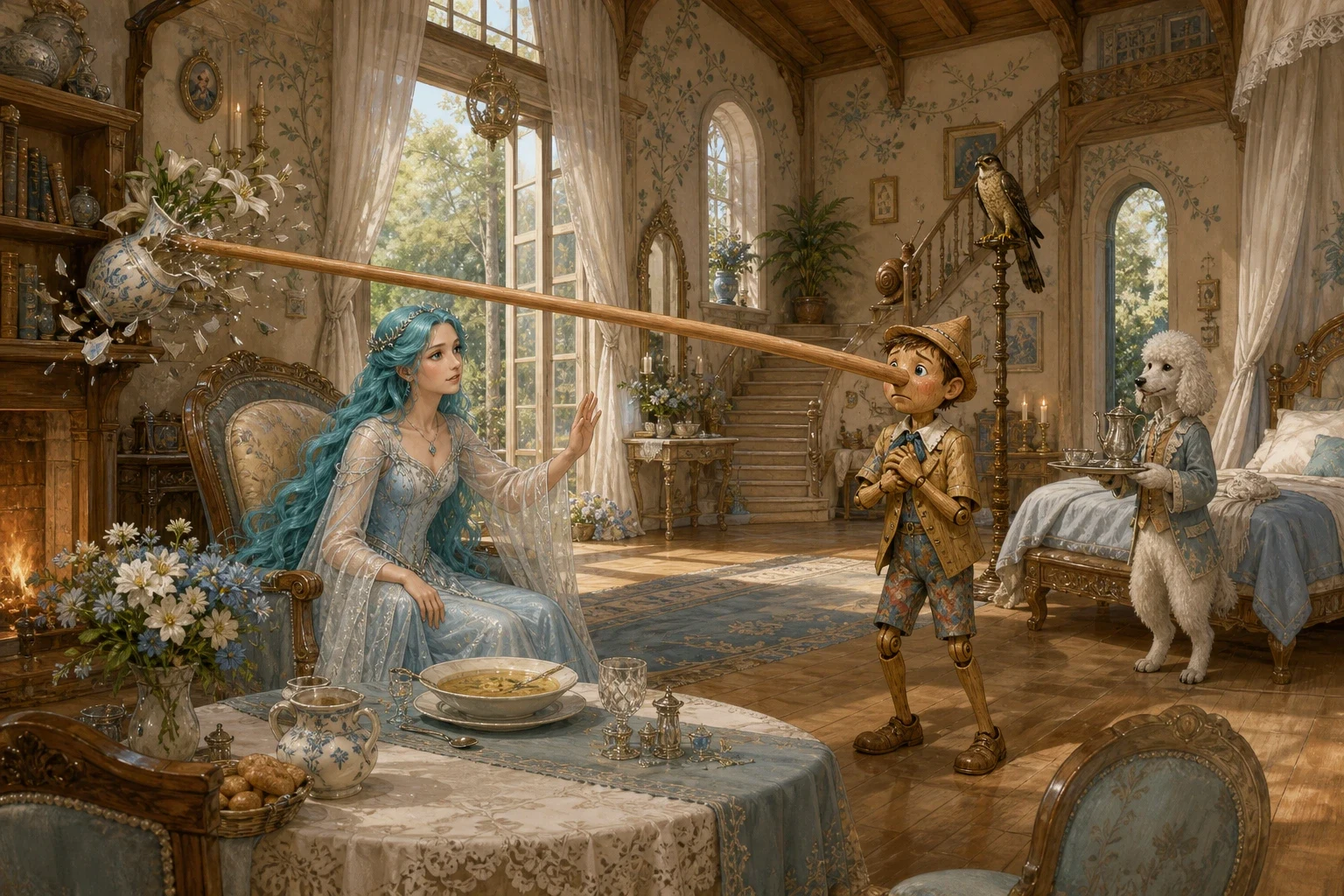
The rogues' trick went wrong, and at last Pinocchio found his way, tired and sorry, to a little white cottage in the woods. There lived the Fairy with Turquoise Hair, gentle and wise, who took the runaway puppet in, tended him, and gave him warm soup and a soft bed. When she asked him kindly what had become of his five gold coins, Pinocchio was ashamed to tell the truth — so he told a lie. And the very instant the lie left his lips, his little wooden nose began to grow, longer and longer, right across the room, until he could not even turn around without knocking things over. The Fairy did not scold him. She only smiled sadly and explained that lies are found out as quickly as a nose that grows, and that only honesty could set him right. Red with shame, Pinocchio told her the whole true story at last.
Page 7
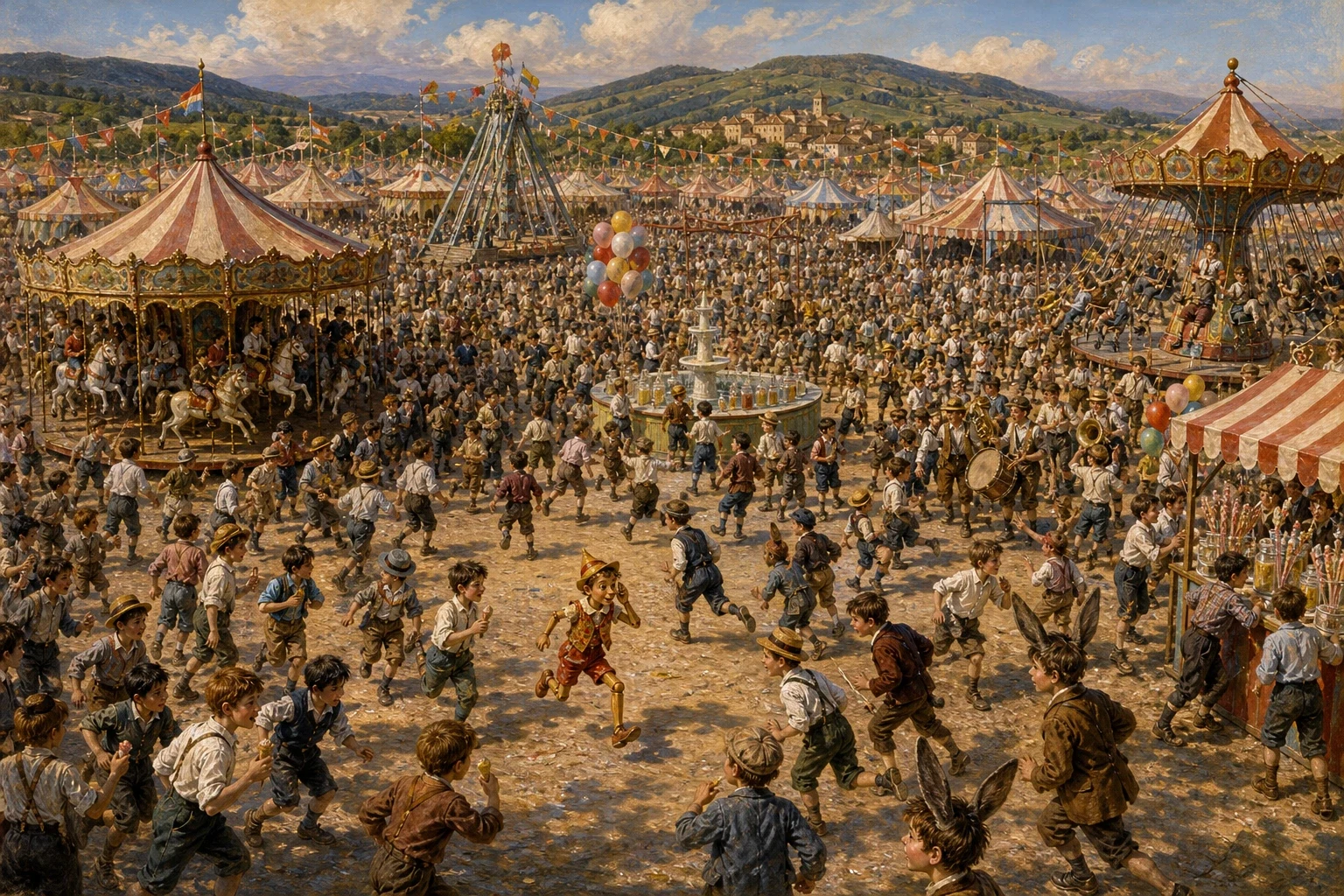
Pinocchio truly meant to be good — but temptation is a patient thing. Before long he let himself be talked into running away to the Land of Toys, a wonderful country where there was no school and no work at all, only games and sweets and play from morning to night, with hundreds of other truant boys. For days it was pure delight. But the Land of Toys hid a secret: boys who did nothing but idle and play, and never worked or learned, slowly began to grow long furry ears and little tails, until one sad morning each of them woke up turned into a donkey. When Pinocchio felt the first tufts of fur sprouting on his own ears, he understood at last the price of all his foolishness, and he longed with his whole wooden heart to be back home with his good old father.
Page 8
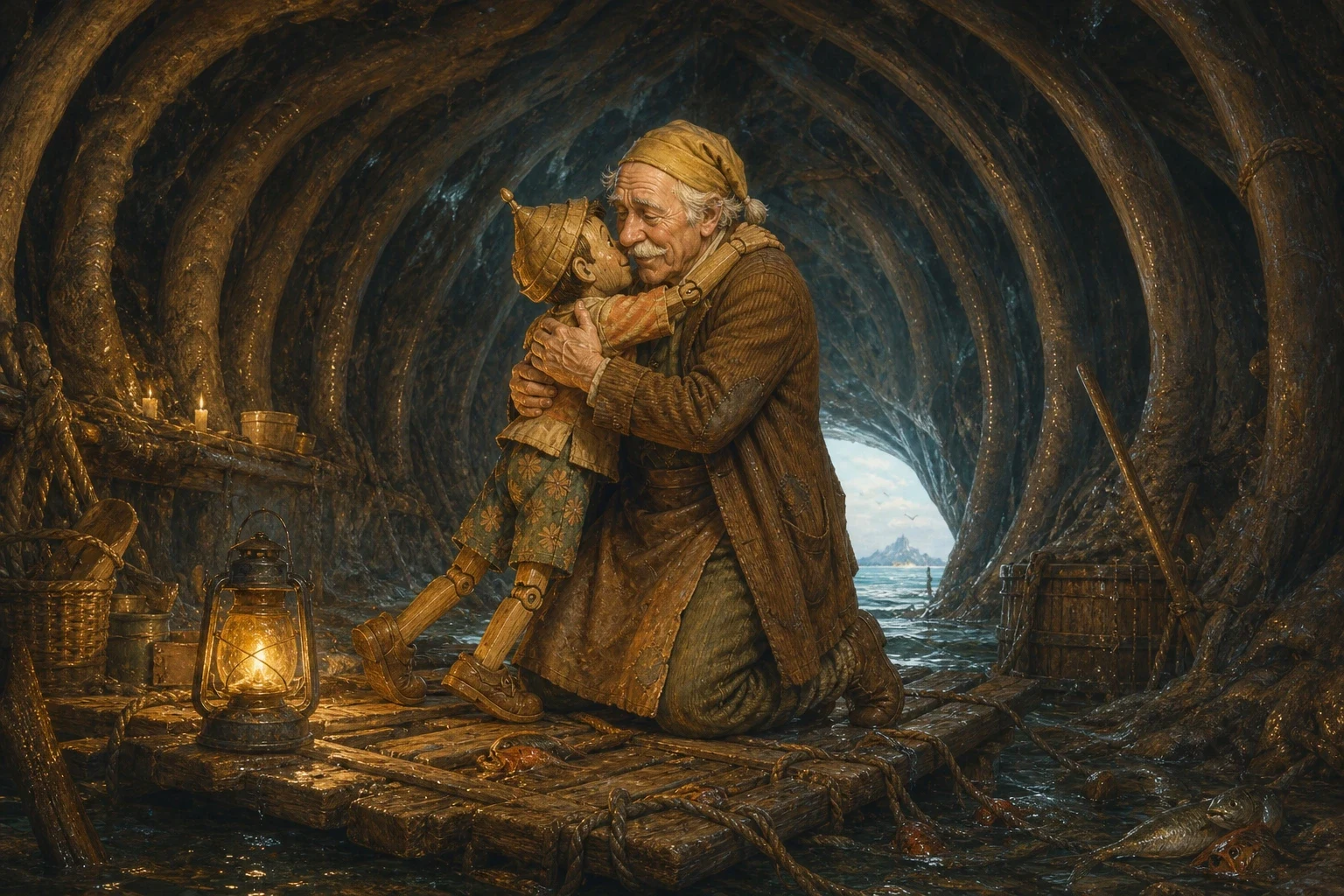
Pinocchio escaped the Land of Toys and, through many more adventures, learned at last to be brave and true. Searching the wide sea for the father who had gone looking for him, he was swallowed whole by a monstrous Dogfish as big as a mountain. And there, deep inside the great fish, by the light of a single candle, sat old Geppetto — who had been swallowed long before and had lived on inside the beast, never losing hope that his boy would come. When Pinocchio saw him, he flung his wooden arms around the old man's neck and could not stop weeping for joy. Then, clever and brave at last, the puppet took his weak old father on his back, waited for the great fish to open its sleeping mouth, and swam them both out through the dark water and up into the bright open air, free.
Page 9
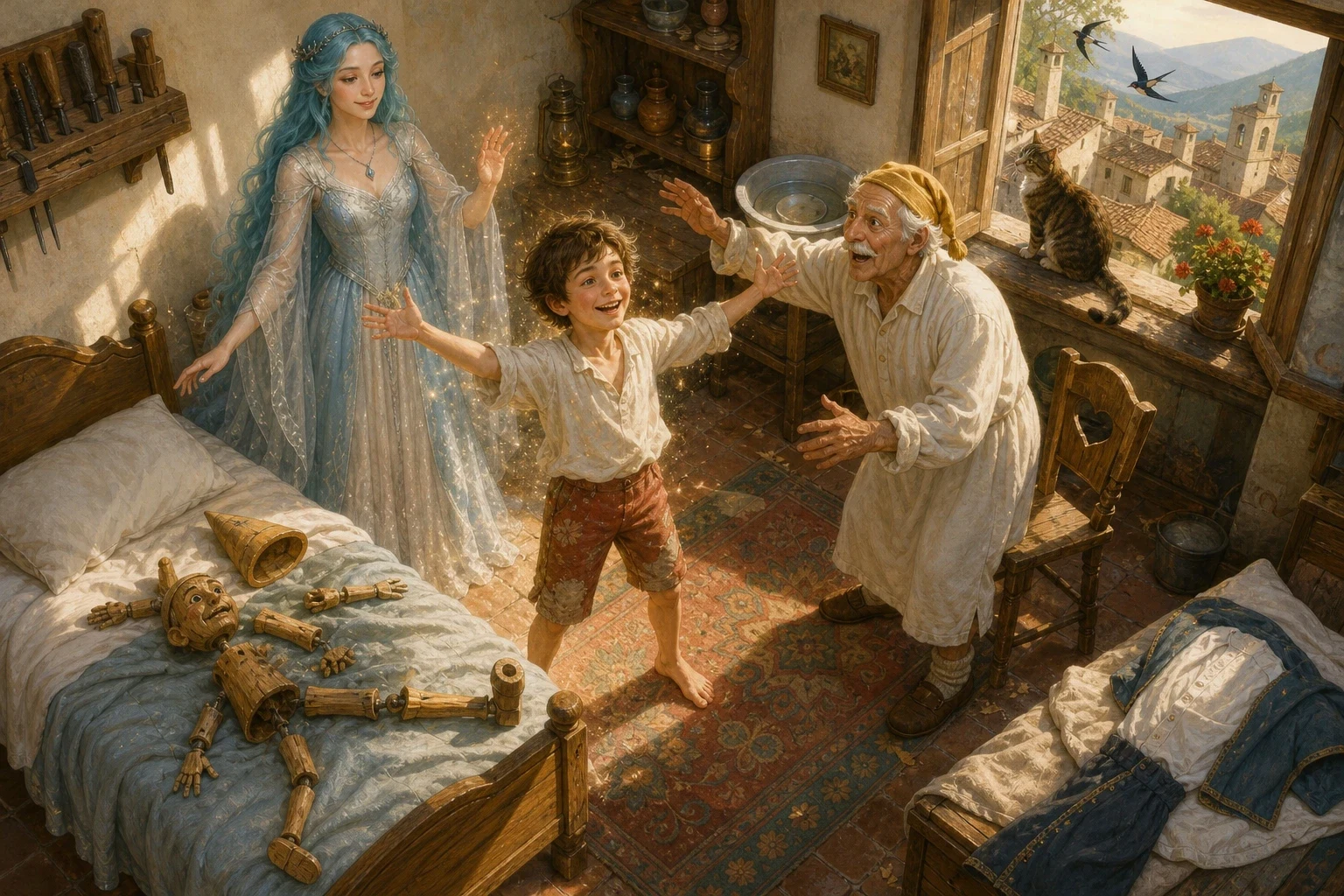
Safe on dry land again, Pinocchio became a different puppet altogether. He nursed his old father back to health, worked hard every single day, went to school at last, and gave up lying and idleness for good — doing all of it not because anyone made him, but out of love. And then one night, as he slept, the gentle Fairy with Turquoise Hair came to him once more. She had watched his brave and loving heart grow true, and now she granted the wish he had carried from the very first: when Pinocchio woke in the morning, the warm honey-coloured wood was gone, and in its place lay a real, living boy of flesh and blood, with rosy cheeks and bright eyes. He leapt up and ran to Geppetto, and the two of them held each other and laughed and wept, for the long journey was over and the puppet's dearest dream had come true.
Page 10
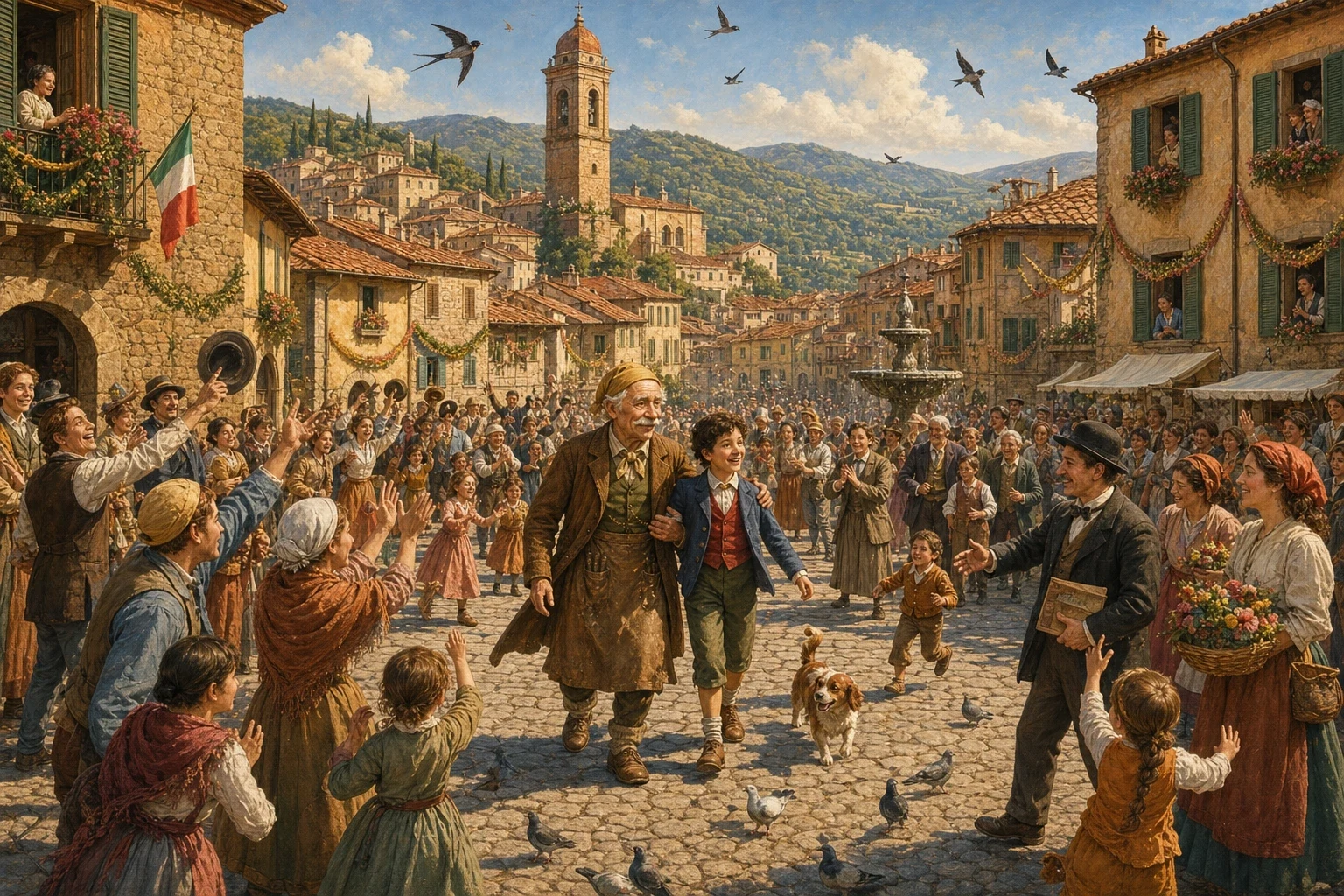
And so the lonely old woodcarver who had once carried a log through the streets dreaming of a little boy now walked those same streets with a real son at his side. The whole town, which had watched the strange tale unfold, came out into the square to cheer them — the market folk, the schoolmaster, the children, the old neighbours — glad to see honest Geppetto's dream come true at last. Pinocchio, who had learned the hard way that cleverness means nothing without kindness and that a lie is never worth the telling, grew up to be a good and happy man, loved by everyone who knew him. And on cold evenings, by the fire in the little workshop, he would sometimes look at the old puppet-strings on the wall and smile, remembering the long and wonderful road that had carried him all the way from a block of firewood to a real and loving life.
About this story
- Audience: kids (ages 6–12)
Read Wonder Tales on your phone
Wonder Tales is available on Android. Get Wonder Tales on Google Play.