The Table, the Donkey and the Stick
A tailor's three sons, three magic gifts, and the innkeeper who tried to steal them all
Page 1
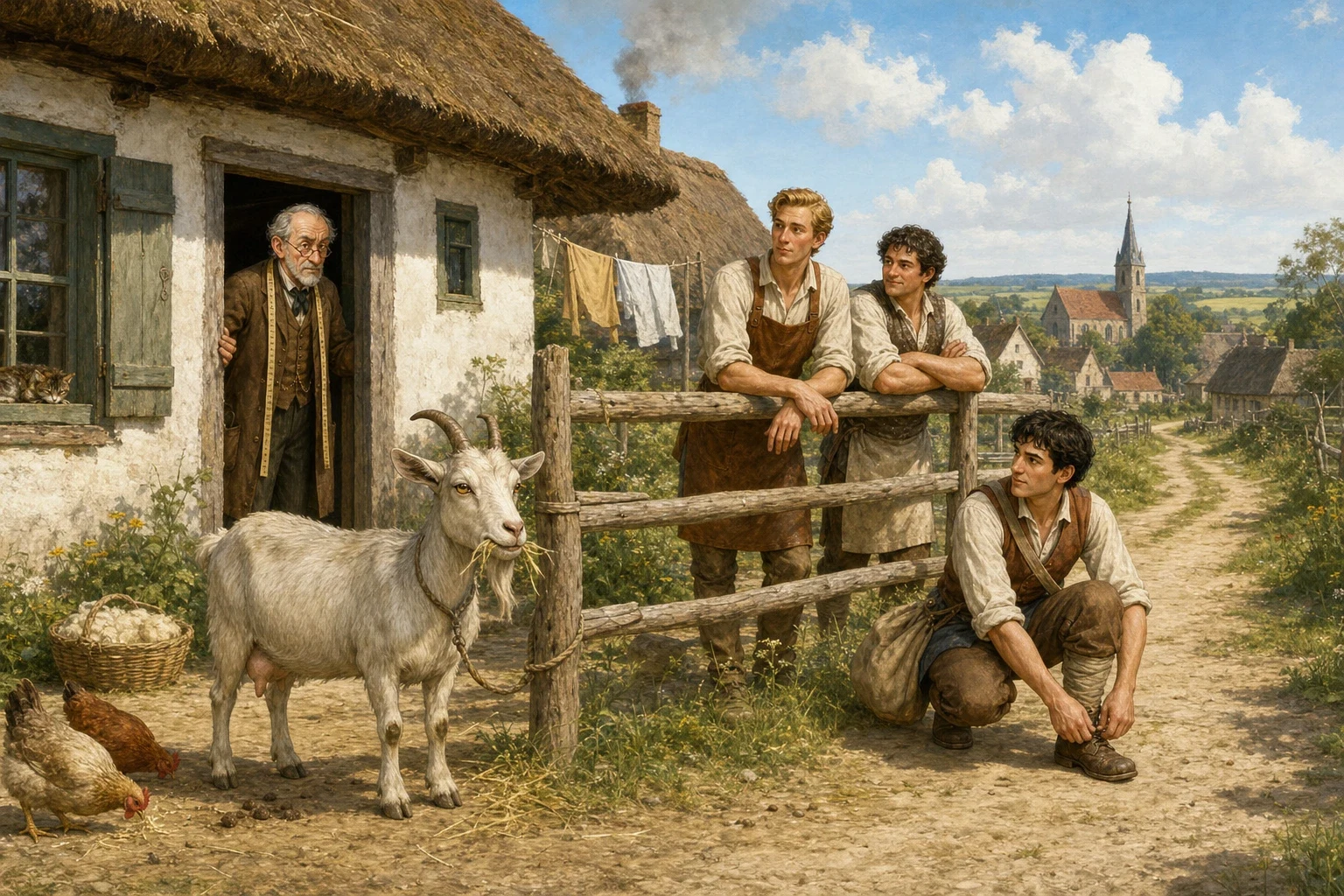
Long ago, in a village of thatched roofs and narrow lanes, there lived an old tailor with his three sons and one goat. The sons were named Hans, the eldest; Peter, the second; and Jakob, the youngest. The goat gave them good milk every day, and because of that she had to be fed well and taken out to the green pasture to graze — a chore the sons shared, turn by turn. Every evening when the day's son brought her home and tied her to the post, the old tailor liked to lean out of his doorway, pleased with his quiet little household. The goat stood chewing at her rope, round-sided and content-looking, while the three brothers leaned on the fence rail behind her, waiting to see whose turn it would be the next morning. It was, that evening, as ordinary and peaceful a yard as any in the village — though it would not stay that way for long.
Page 2
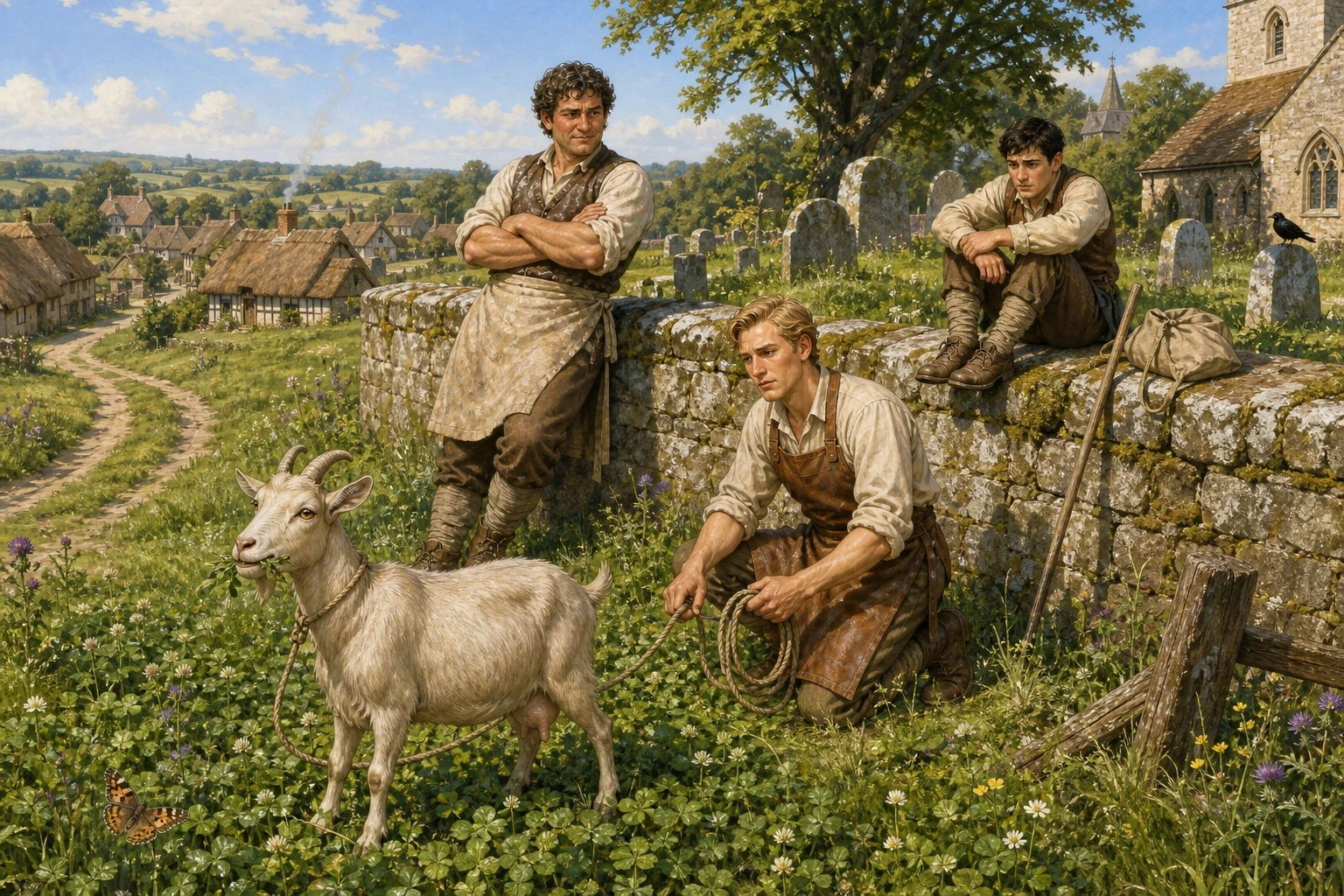
Turn by turn, each brother led the goat out to the green pasture by the old churchyard wall, let her graze all day on the sweetest grass she could find, and brought her home every evening with her sides round and full. But the goat had a mischievous streak nobody had guessed at. Each night, when the old tailor went out to ask her himself whether she'd had enough to eat, she answered, 'How should I have had enough? I found nothing all day but a little moss on a stone, baa, baa.' Believing his goat over his own sons, the old tailor flew into a rage each time, certain the day's son had let her starve out of laziness. One by one — first Hans, then Peter, then Jakob — he drove his sons from the house in his fury, and one by one they walked away down the lane with nothing but a bundle on a stick, not knowing where they were going, only that they could not go home.
Page 3
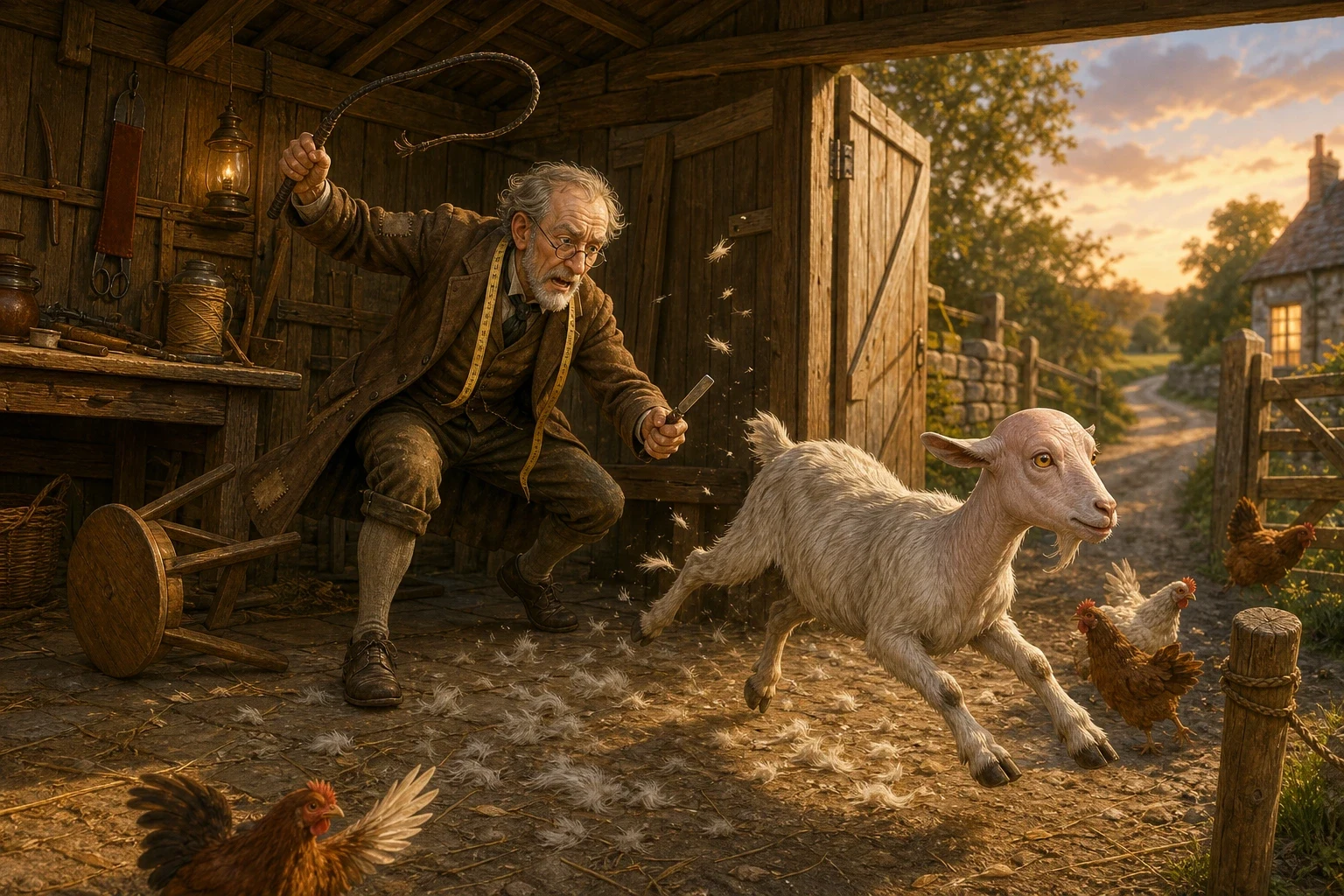
With all three sons gone, the old tailor decided he would tend the goat himself, so there could be no more quarrel about it. He led her out to pasture all day, watched her graze with his own eyes until she could not have eaten another mouthful, and brought her home that evening satisfied he had done right by her. But when he asked her, out of habit, whether she'd had enough, she gave him the very same answer she had given his sons: 'How should I have had enough? I found nothing all day, baa, baa.' In an instant the old tailor understood — his sons had told the truth all along, every one of them, and he had driven all three from his house for nothing. Shaking with shame and fury at once, he caught up his razor, shaved the goat's head smooth and bald as the back of his own hand, and chased her out of the yard, snapping the whip in the air behind her.
Page 4
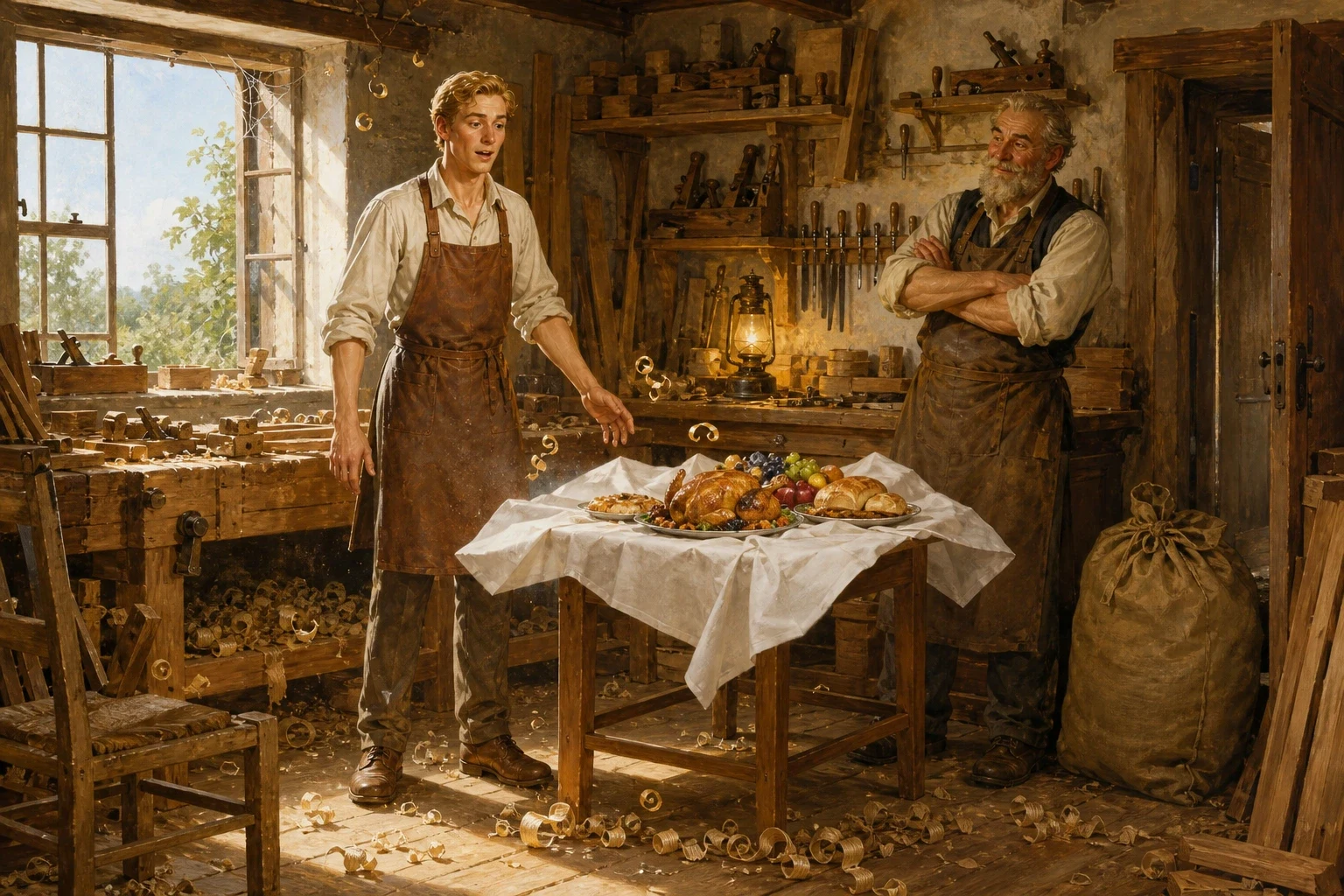
Hans walked until he came to a town he had never seen before, and there he found work with a joiner, a careful craftsman who built fine furniture from good wood. Hans worked hard and learned quickly, and in time he became as skilled as his master. When the years of his service were done, the old joiner called him in to say goodbye. 'You have served me well,' he said, 'and I have no gold to give you, but I will give you something better.' He set a small, plain-looking wooden table in front of Hans. 'This is no ordinary table,' the joiner said. 'Say to it, "Table, cover thyself," and watch.' Hans said the words, and at once a white cloth spread itself across the table, and plates and cups and platters of good food appeared upon it as if out of the air. Overjoyed, Hans thanked his master again and again, shouldered the little table, and set off for home to show his father what he had earned.
Page 5
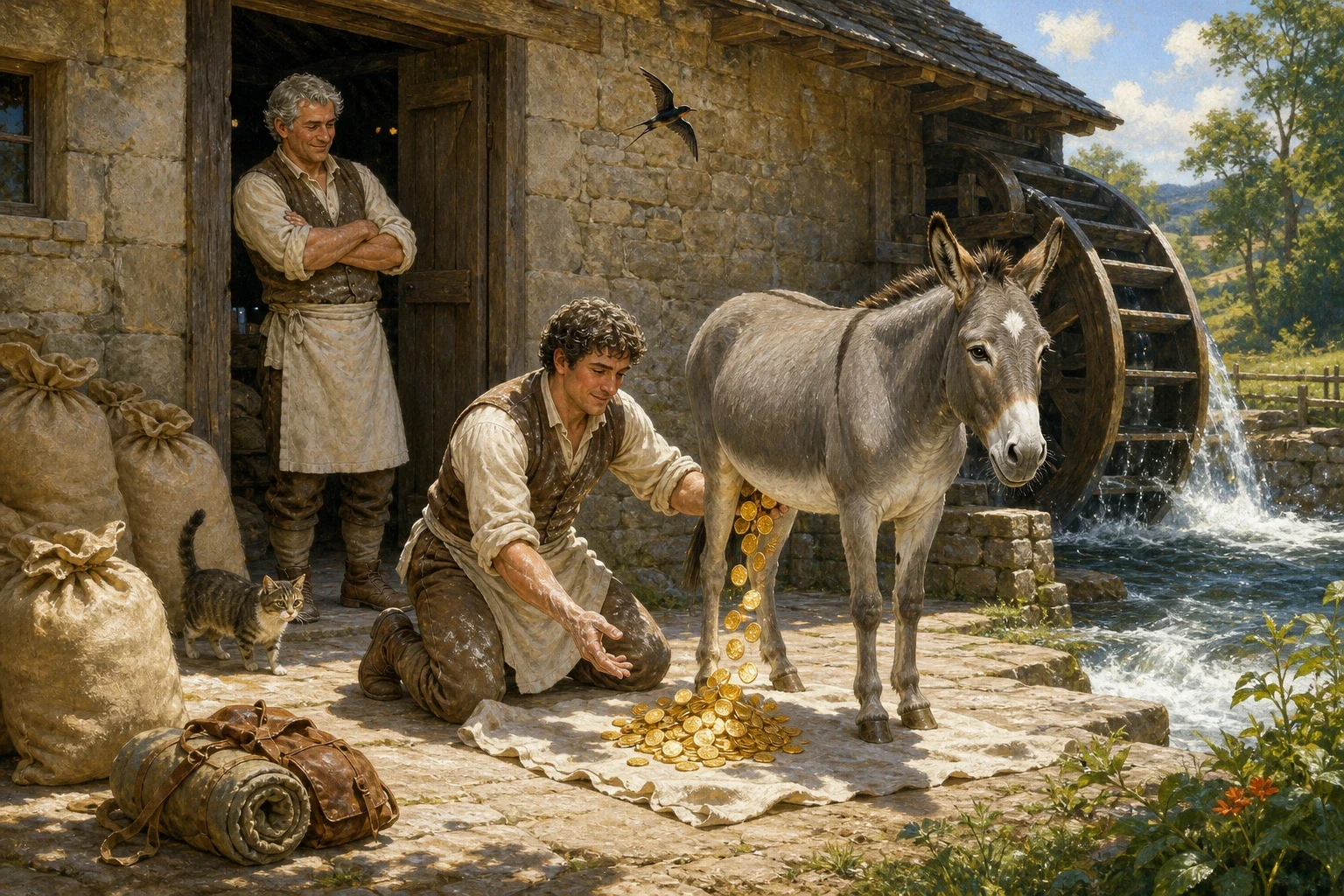
Peter, too, wandered until he found work, taking service with a miller beside a rushing stream. He learned to grind grain and mend the great turning wheel, and he served so faithfully that when his years were up, the miller wanted to reward him properly. 'I have no coin to spare,' the miller said, 'but I have something you will find more useful.' He brought out a grey donkey with a white-starred face, calm and patient as any donkey Peter had ever seen. 'Say "Bricklebrit" to him,' said the miller, 'and spread a cloth first, or you'll have a mess to clean up.' Peter spread his cloth on the ground, said the word, and gold ducats came pouring from the donkey, more gold than Peter had ever seen in his life, piling up bright and heavy on the cloth. Peter could hardly speak for joy. He thanked the miller, folded his gold carefully away, and led the donkey out onto the road toward home, eager to show his father.
Page 6
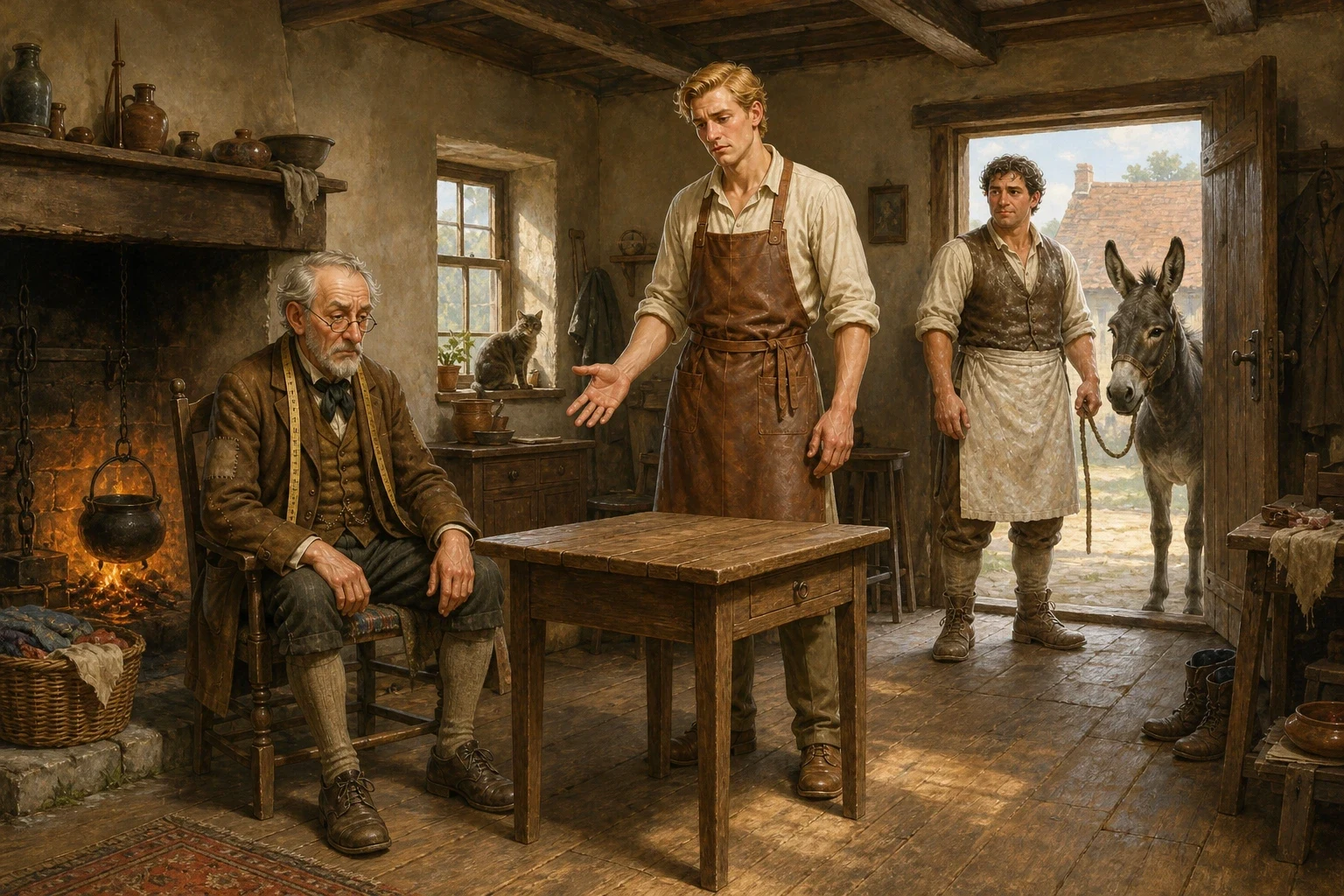
Hans came home first, proud of his wonderful table, and set it down in front of his father by the cold hearth. 'Watch, Father,' he said, and spoke the words — but nothing happened at all. The table stayed bare and plain, just an ordinary table, and the old tailor, more disappointed than angry now, shook his head and said his son had learned nothing but tall tales at his trade. What neither of them knew was that Hans had stopped for the night at a roadside inn on his way home, and the innkeeper there, watching him work the magic, had quietly swapped the real table for an ordinary one while Hans slept. Not long after, Peter came home too, just as proud, and led his donkey into the yard to show off the gold. But when Peter said the word, the donkey only stood there, an ordinary donkey after all — because the very same innkeeper, at the very same inn, had swapped him for an ordinary donkey too.
Page 7
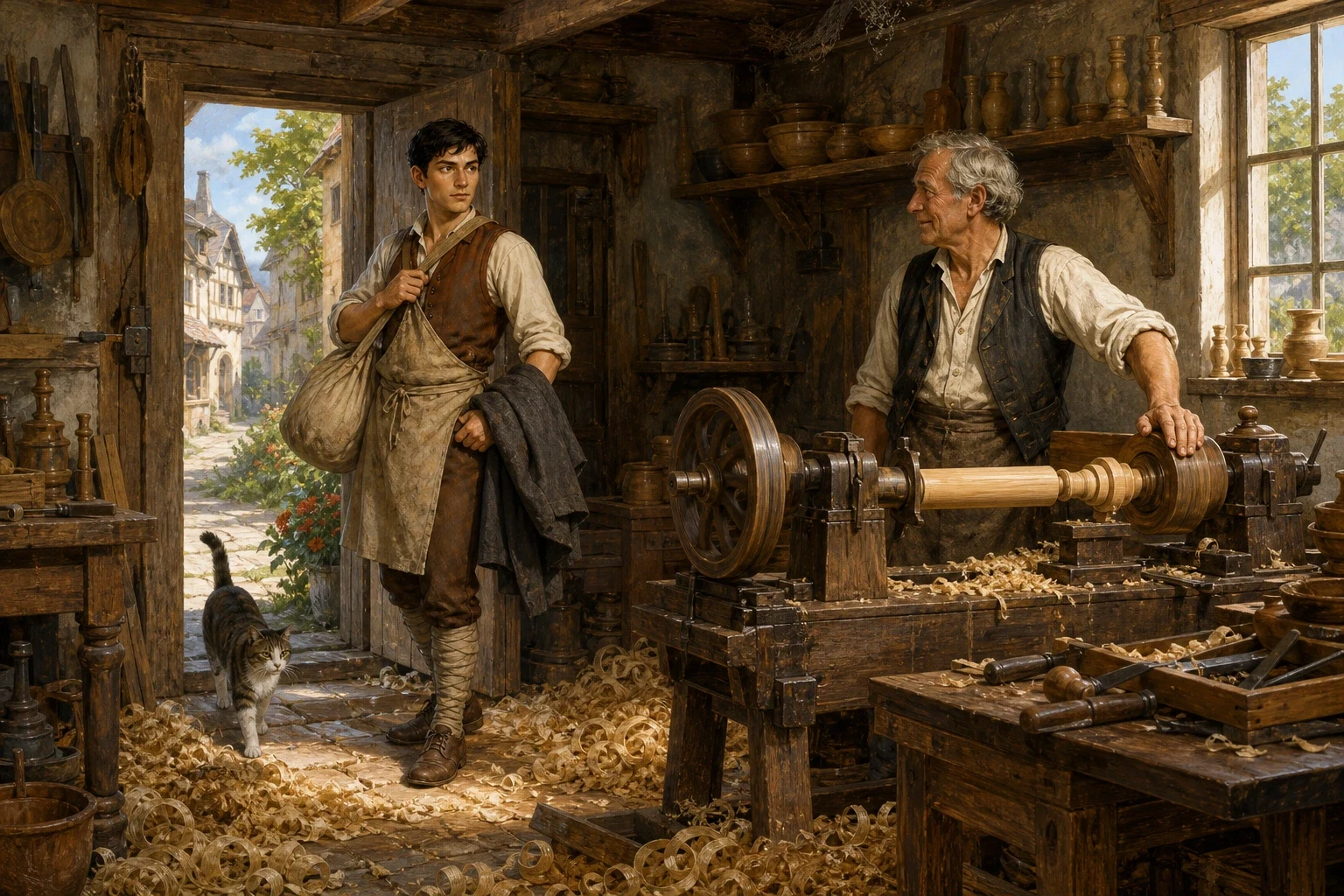
Jakob, the youngest, walked the farthest of the three before he found work, taking service with a turner who shaped wood on a spinning lathe. He was clever with his hands and quick to learn, and he listened carefully, too, to every story that passed through the workshop — including news, now and then, of a roadside inn where travelers' luck seemed to run strangely bad. When his own years of service ended, the turner handed him a plain canvas sack. 'Inside this sack is a stick,' the turner said, 'and if anyone ever does you wrong, say "Stick, out of the sack," and it will see that right is done. Say "Stick, into the sack," when you want it to stop.' Jakob thanked him, slung the sack carefully over his shoulder, and set out for home — walking slowly, watching the road ahead, and keeping the sack close against his side the whole way, for he had a feeling, somehow, about what might be waiting for him at the next inn he came to.
Page 8
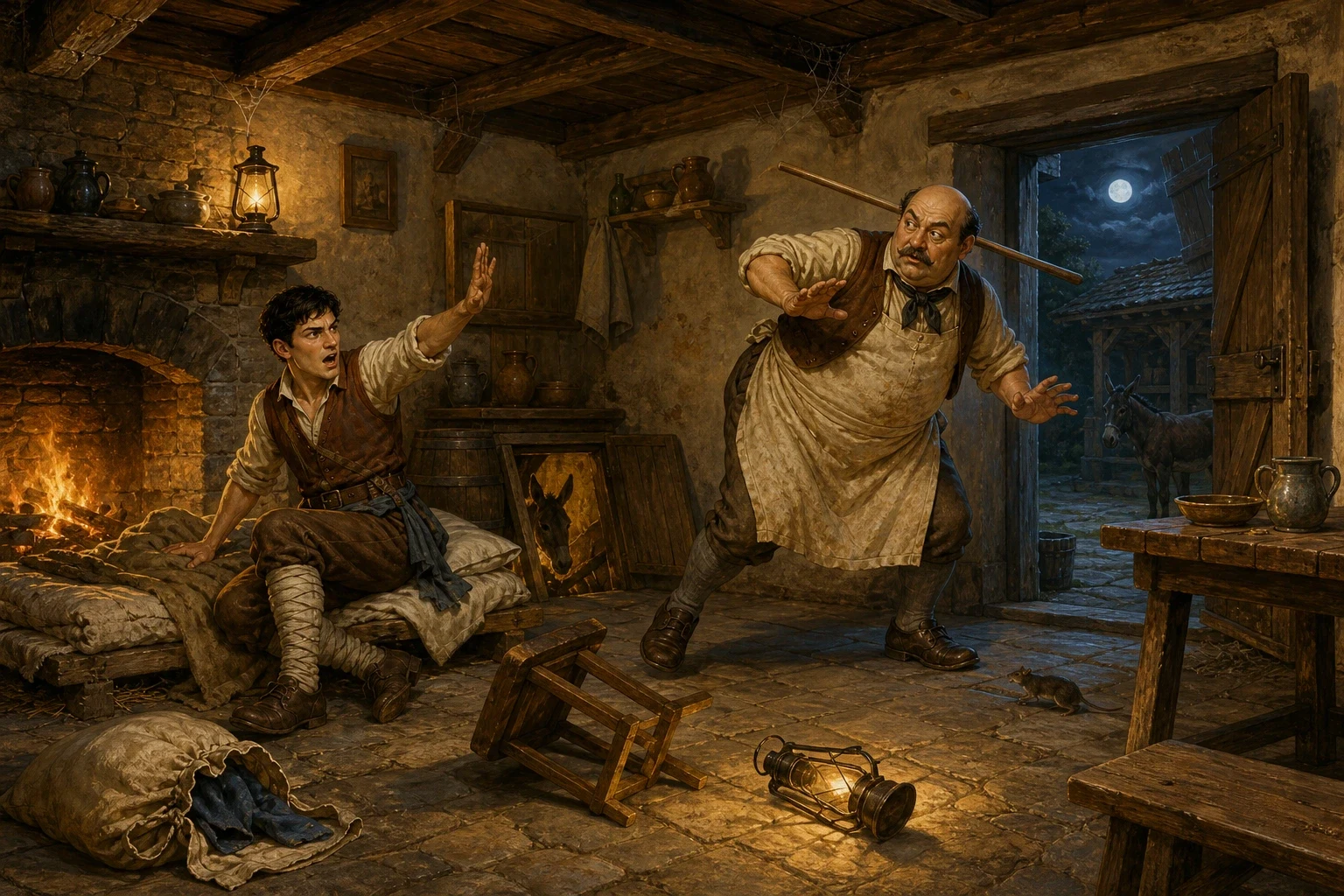
That evening Jakob came to the very same inn where his brothers had stayed, though he did not yet know it. He ate his supper, said nothing of what was in his sack, and lay down to sleep with it tucked under his head instead of beside the hearth. The innkeeper, who had done very well out of a magic table and a gold-giving donkey already hidden away in his cellar, crept in after midnight, certain there must be something just as valuable inside this traveler's plain sack too. The moment his fingers touched it, Jakob sat bolt upright and cried, 'Stick, out of the sack!' Out it sprang, and set upon the innkeeper at once, bouncing him from wall to wall until he howled and begged for mercy. 'Stop it, stop it, I'll give back everything!' he cried. Jakob made him fetch the real table and the real donkey up from the cellar that very minute, and only then did he say the word that sent the stick back into its sack.
Page 9
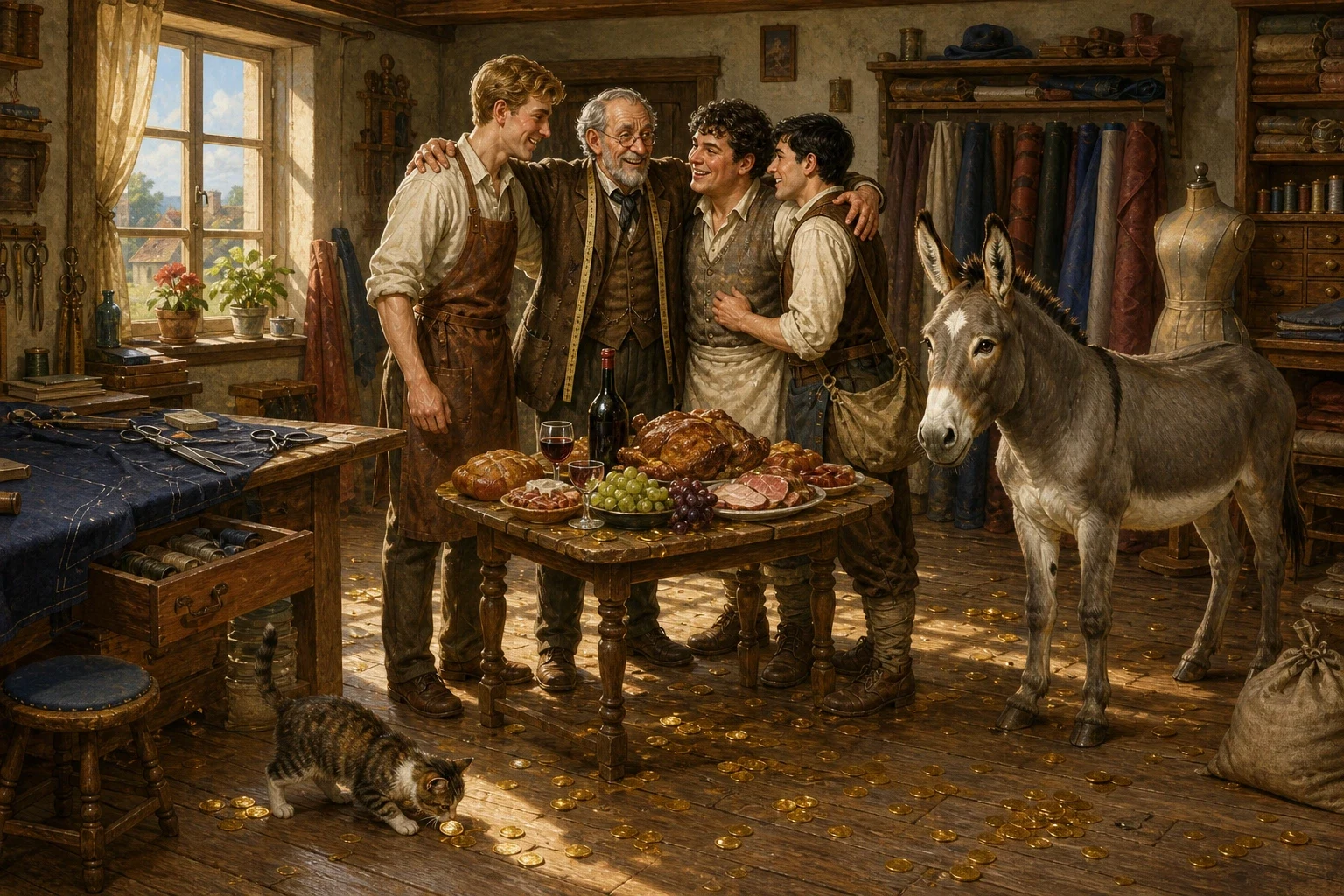
Jakob came home at last with the table, the donkey, and the sack with the stick still inside it, and found his brothers already there, waiting uncertainly to see what their youngest brother had brought. In the tailor's own cutting-room, where he had spent his whole life measuring cloth, Jakob set the little table down and said the words, and at once it spread itself with the finest feast the old tailor had ever seen — meats and bread and fruit and wine enough for the whole family and more. Then they led the donkey in and said 'Bricklebrit,' and gold ducats poured out across the floor until it glittered everywhere. The old tailor stared from the table to the donkey to his three sons, and for the first time since that terrible evening with the goat, he understood that he had wronged every one of them. He wept and embraced each son in turn, begging their forgiveness, and from that day on the family lived together in the cottage, wanting for nothing at all.
Page 10
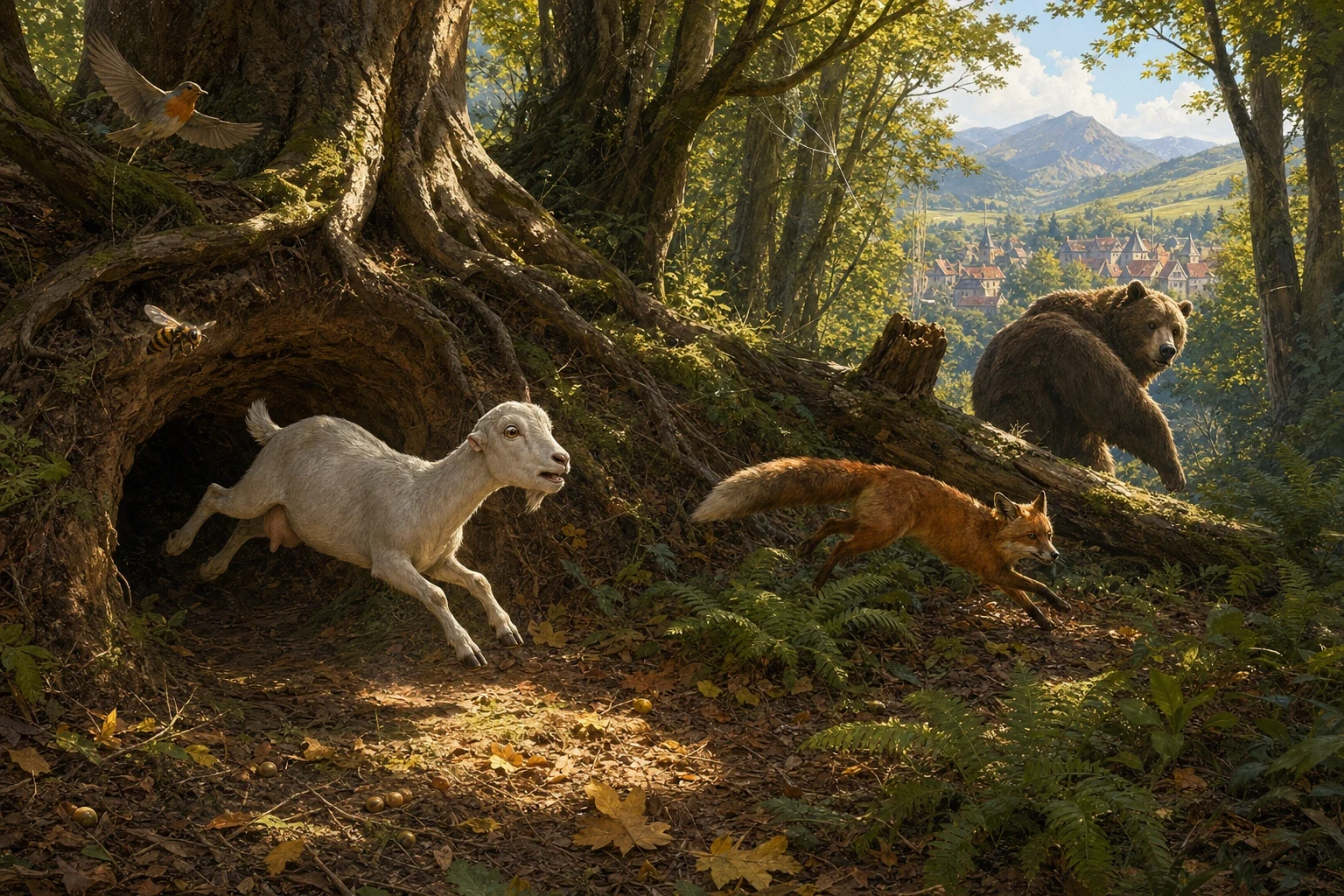
As for the goat — for a story is not finished until every creature in it is accounted for — this is what became of her. Ashamed of her bald bare head, she ran off into the deep forest and hid herself in an empty fox's earth dug into the hillside. When the fox came home that night and found two strange eyes gleaming at him out of his own burrow, he fled in terror and told the bear a fearsome beast had taken his den. The bear went to look, took one glance at the pale gleaming head staring out of the dark, and ran off just as fast as the fox had. Then a little bee, hearing all the fuss, said she would soon settle the matter, and flew straight down into the earth and stung the goat sharply on her bald bare head. Up jumped the goat with a bleat of fright, and off she ran into the world — and to this day, nobody has ever seen where she went.
About this story
- Audience: kids (ages 6–12)
Read Wonder Tales on your phone
Wonder Tales is available on Android. Get Wonder Tales on Google Play.