What are the main theories of knowledge in philosophy?
Explore the most influential theories of knowledge in philosophy, from foundationalism to skepticism, understanding how we know what we know.

The main theories of knowledge in philosophy, known as epistemology, primarily revolve around how we acquire, justify, and validate what we claim to know. These theories can be broadly categorized into rationalism, empiricism, skepticism, and constructivism, each offering a distinct perspective on the nature and limits of human understanding. This article will rank the five most influential approaches based on their historical impact and ongoing philosophical debate.
- Foundationalism (often associated with Rationalism)
- Empiricism
- Skepticism
- Coherentism
- Constructivism
1. Plato: Foundationalism and the Theory of Forms
Plato, an ancient Greek philosopher, is often credited with laying the groundwork for foundationalism, a theory asserting that all knowledge ultimately rests on a set of basic, self-evident beliefs or axioms. His theory of Forms, elaborated in works like The Republic and Meno, posits that true knowledge is not derived from the changing world of sensory experience but from grasping eternal, unchanging Forms. For Plato, these Forms are perfect, abstract blueprints existing independently of the physical world, and our access to them comes through reason and recollection rather than observation. This idea of innate knowledge and the superiority of reason over sensory experience is a cornerstone of rationalist thought. Many subsequent philosophers, even those who disagreed with Plato, had to contend with his powerful and comprehensive system for understanding knowledge.
The object of knowledge is what exists, and the function of ignorance is what does not exist.
2. Bertrand Russell: Logical Atomism and Empirical Knowledge
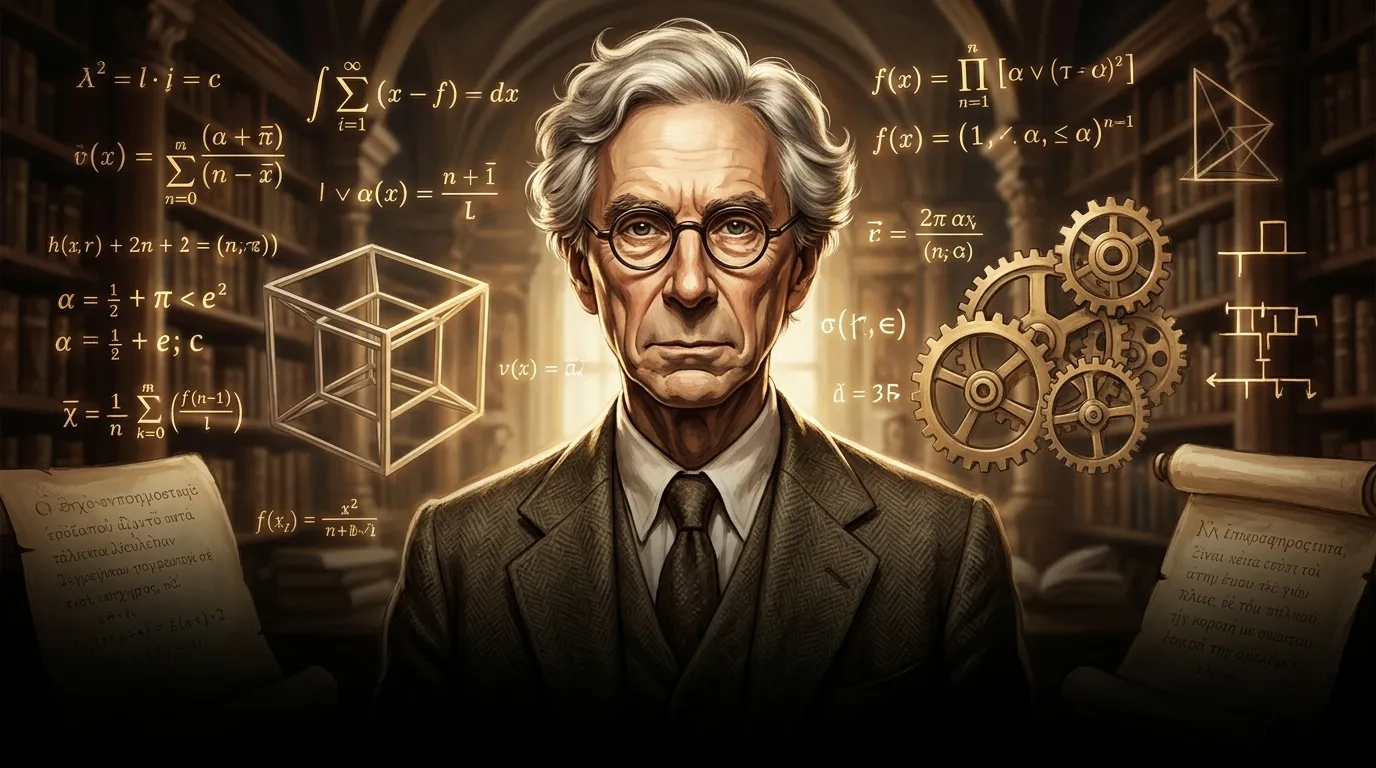
While empiricism has roots in earlier thinkers like John Locke and David Hume, the 20th-century philosopher Bertrand Russell significantly advanced its modern form, particularly through his work on logical atomism. Russell, in works such as The Problems of Philosophy (1912), argued that all knowledge is ultimately derived from sensory experience and logical analysis. He sought to break down complex ideas into their simplest components, or 'atomic facts,' which could be directly observed or logically inferred. His collaboration with Alfred North Whitehead on Principia Mathematica (1910–1913) further aimed to establish a logical foundation for mathematics, reflecting a belief that precise, empirically grounded language was crucial for accurate knowledge. Russell's emphasis on direct experience and logical construction profoundly influenced analytical philosophy and the philosophy of science. Readers interested in his foundational work can find more information about Alfred North Whitehead.
3. Karl Popper: Falsificationism and the Growth of Knowledge
Karl Popper, a prominent philosopher of science in the 20th century, challenged traditional views of knowledge acquisition with his concept of falsificationism, articulated in Logik der Forschung (The Logic of Scientific Discovery, 1934). Instead of seeking to verify theories through observation, Popper argued that scientific theories should be formulated in a way that makes them falsifiable – meaning there must be potential observations that could prove them false. For Popper, knowledge progresses not by accumulating confirmed truths, but by eliminating false theories. This approach emphasizes the provisional nature of scientific knowledge and the importance of critical testing. He believed that even if a theory has survived many attempts at falsification, it should still be considered provisional, always open to being disproven by future evidence. This marked a significant departure from earlier inductivist views of science and profoundly impacted our understanding of how scientific knowledge evolves. The work of early Greek thinkers, such as Anaximander, often grappled with observational evidence in ways that foreshadowed later scientific methods.
Frequently Asked Questions
What is the difference between a priori and a posteriori knowledge?
A priori knowledge is knowledge gained independently of experience, often through reason or definition, such as mathematical truths. A posteriori knowledge, conversely, is knowledge derived from sensory experience or observation, like scientific facts about the natural world.
What is the Gettier problem?
The Gettier problem, introduced by Edmund Gettier in 1963, challenges the traditional definition of knowledge as 'justified true belief.' It presents scenarios where a person has a justified true belief, but their justification is based on a false premise, leading to the conclusion that they do not truly know. This problem highlights the complexities of defining what truly constitutes knowledge.
How does epistemology relate to other branches of philosophy?
Epistemology is deeply intertwined with metaphysics (the study of reality), ethics (the study of morality), and logic (the study of reasoning). Our understanding of what exists (metaphysics) often influences what we believe we can know, while the methods we use to acquire knowledge are governed by logical principles. Epistemological questions also arise in ethics when considering how we justify moral beliefs.