Karl Popper
Karl Popper — an illustrated philosophy story. 10 illustrated pages, free to read on Wonder Philosophy.

Page 1

At the heart of scientific inquiry lies a fundamental question: How do we truly know what is scientific and what is not? For much of intellectual history, the answer seemed to involve finding evidence that confirmed a theory. Yet, one philosopher challenged this very foundation, arguing that true science thrives not on confirmation, but on the brave pursuit of refutation. His name was Karl Popper, and his radical insight continues to shape our understanding of discovery.
""Dr. Thorne," Dr. Petrova began, gesturing towards a complex diagram, "Popper's idea of falsifiability feels counterintuitive at first, doesn't it? We're taught to seek evidence that proves our ideas." Dr. Aris Thorne nodded, thoughtfully adjusting his spectacles. "Indeed, Lena. Popper argued that the strength of a scientific theory isn't in its ability to be proven right, but in its courage to be proven wrong. This distinction fundamentally reshaped how we define genuine knowledge.""
Philosophy Note: Karl Popper (1902-1994) – Austrian-British philosopher. Key Idea: Falsifiability – the principle that a scientific theory must be empirically testable and potentially proven false.
Page 2
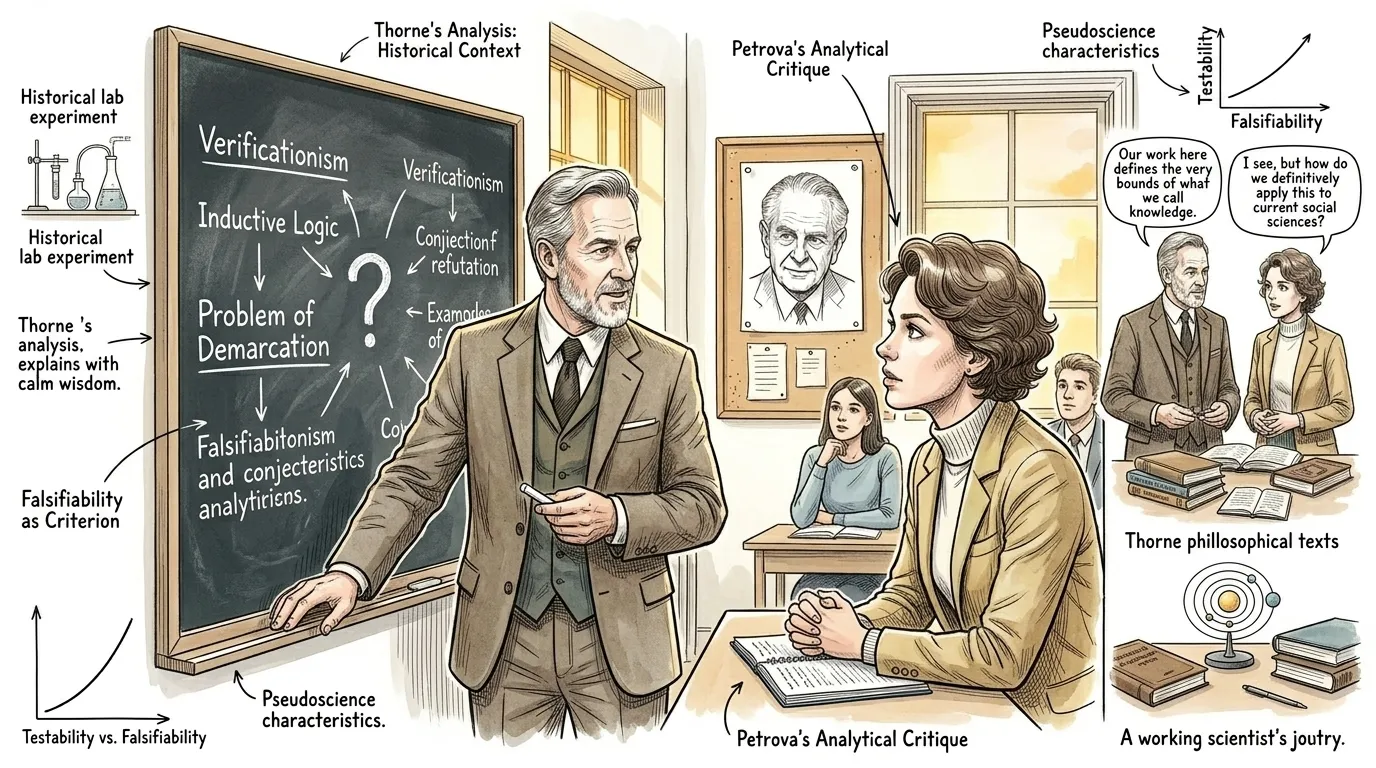
Before Popper, the dominant view often centered on verification, the idea that a theory gained scientific status by accumulating confirming observations. Yet, this approach inadvertently opened the door to theories that seemed to explain everything, and thus, explained nothing at all. This intellectual challenge, known as the 'problem of demarcation,' sought to draw a clear line between science and pseudoscience.
""What fascinated Popper," Dr. Thorne explained, turning slightly from the chalkboard, "was the stark difference between theories like Einstein's relativity, which made bold, risky predictions, and others—like Marxism or Freudian psychoanalysis—which seemed to fit any observation." Dr. Petrova nodded. "Indeed, if a theory can explain every possible outcome, then no observation can ever contradict it. So, how do we distinguish genuine science, open to being proven wrong, from mere speculation?""
Philosophy Note: Problem of Demarcation: Distinguishing scientific theories from non-scientific or pseudoscientific ones. Verificationism: The idea that scientific theories are established by finding evidence that confirms them.
Page 3
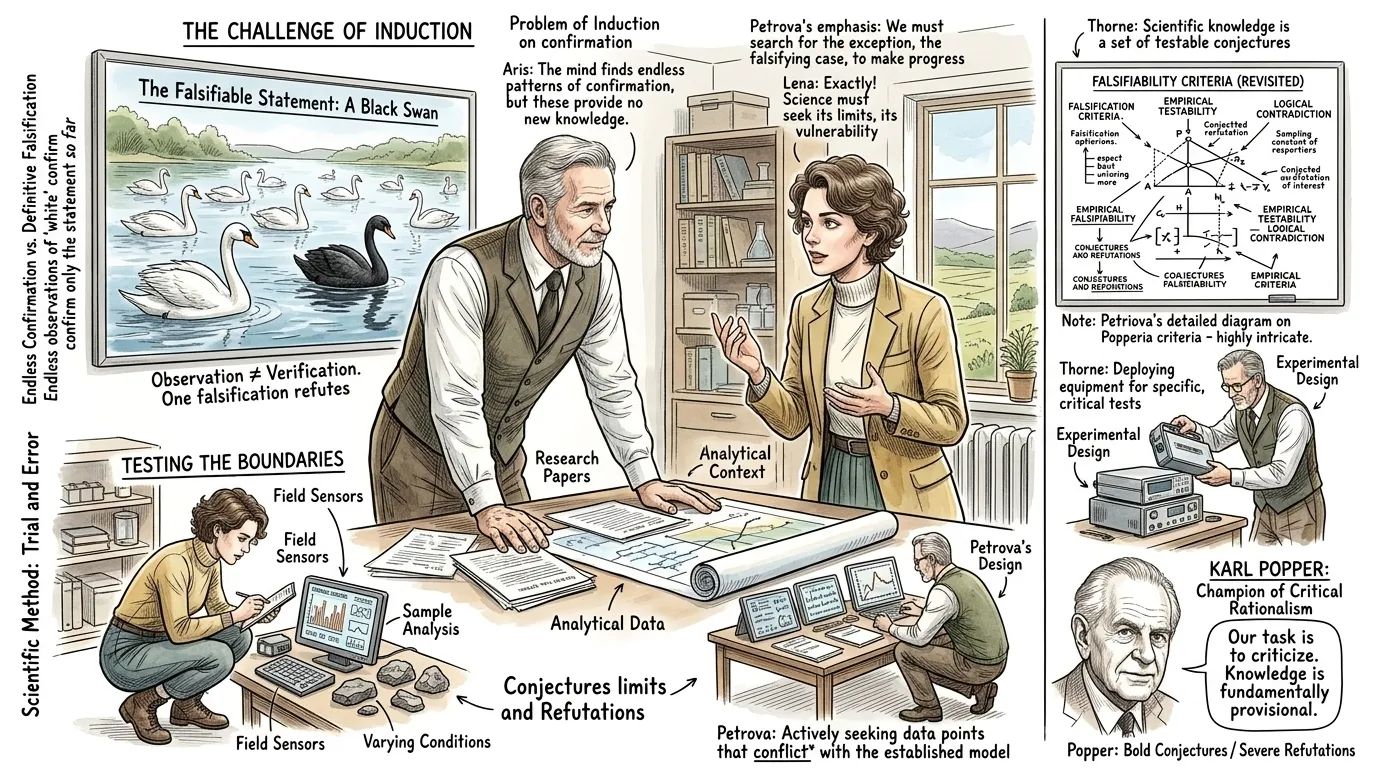
Popper observed that followers of theories like Marxism or Freudian psychology could find confirmation for their beliefs everywhere. Every social upheaval, every personal trauma, could be interpreted as further proof. This made these theories seem incredibly powerful, but to Popper, it signaled a fundamental weakness: they were immune to refutation.
""Popper saw this endless confirmation as a trap," Dr. Thorne remarked, his voice calm. "It didn't lead to deeper understanding, but rather to dogmatism. As David Hume might have implied, observing countless white swans doesn't logically guarantee all swans are white; it only takes one black swan to fundamentally alter our conclusion." Dr. Petrova added, "He realized that simply accumulating 'proof' could be dangerously misleading, and that a truly scientific mindset demands we actively seek the limits of our own understanding.""
Philosophy Note: Problem of Induction: Philosophical challenge of justifying the inference from past observations to future predictions. Popper's insight: Theories that explain everything are practically unfalsifiable and therefore non-scientific.
Page 4
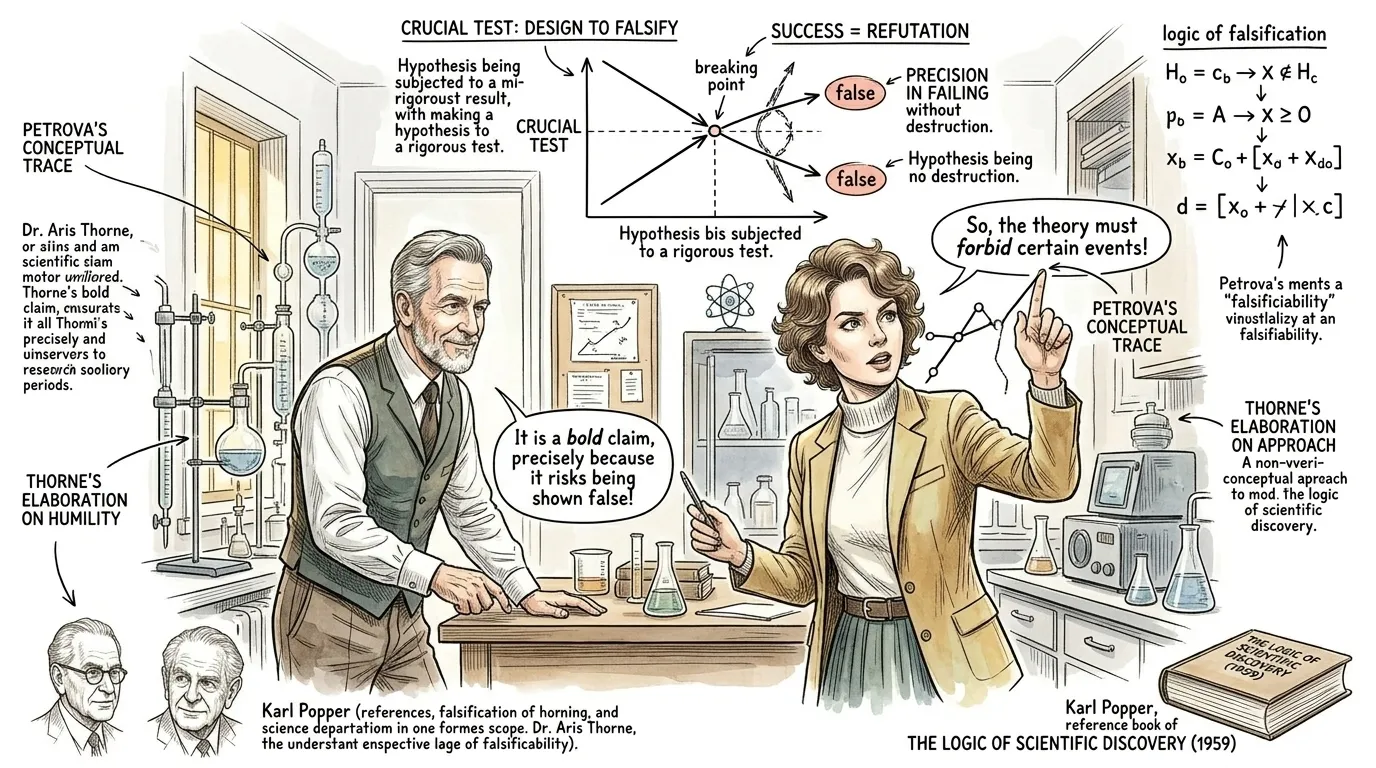
Popper proposed a revolutionary criterion for distinguishing science: falsifiability. A scientific theory, he argued, must make precise predictions that, if wrong, would demonstrate the theory itself to be false. It must be open to empirical testing and, crucially, to potential refutation. This concept became the bedrock of his philosophy of science.
""So, it's not about finding supportive evidence," Dr. Petrova clarified, her finger tracing a conceptual line in the air. "It's about designing tests that could potentially break the theory. If a theory survives rigorous attempts to prove it false, then we provisionally accept it, but always knowing it might be overturned tomorrow." Dr. Thorne elaborated, "Exactly. For Popper, science progresses by bravely eliminating false theories, not by endlessly accumulating 'proof' for supposedly true ones. This forces scientists to be bold in their conjectures, but humble in their claims.""
Philosophy Note: Falsifiability: A theory is scientific only if it is capable of being proven false by observation or experiment. Conjectures and Refutations: Popper's term for the scientific process of proposing bold hypotheses and rigorously attempting to falsify them.
Page 5
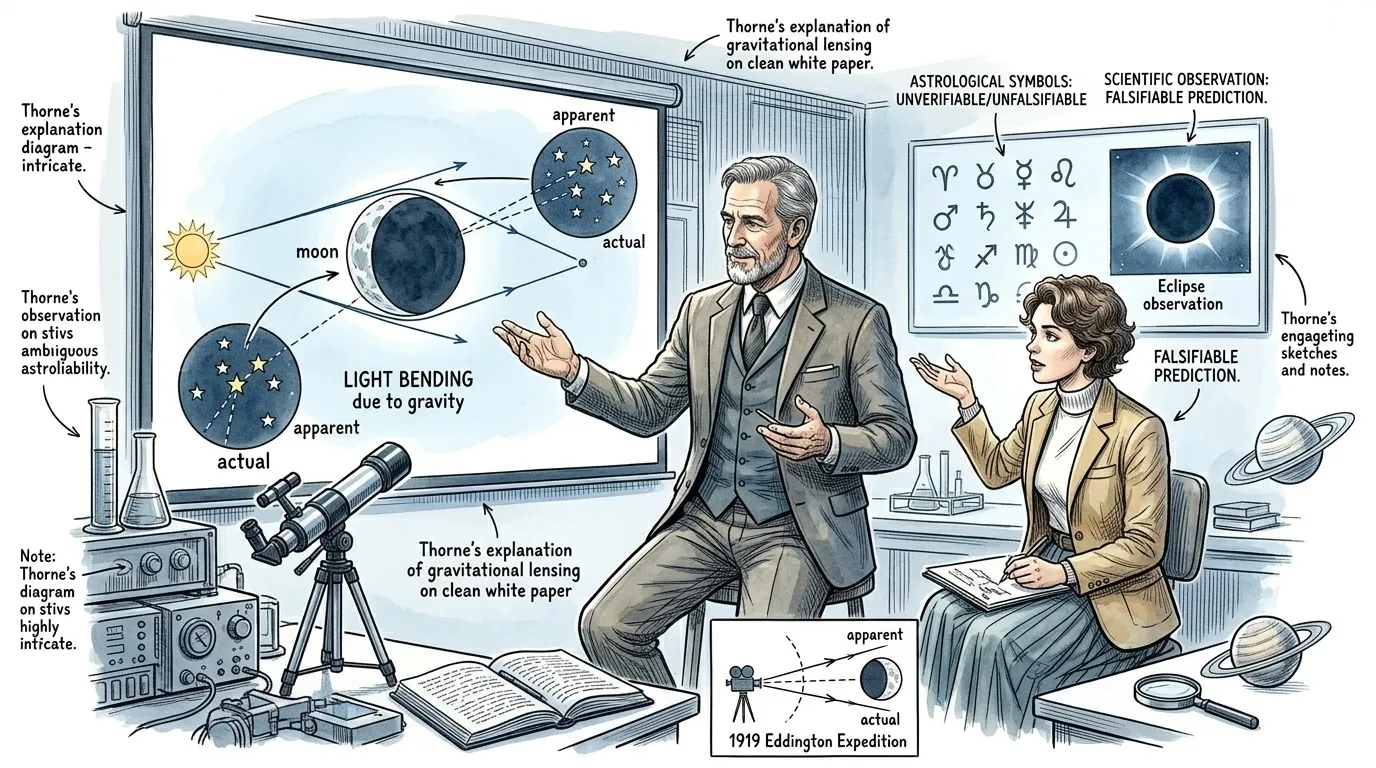
Popper found his ideal scientific theory in Albert Einstein's general theory of relativity. Einstein's theory made incredibly precise and risky predictions – such as the bending of light by gravity – which, if disproven, would have invalidated the entire theory. This willingness to expose itself to potential refutation, Popper argued, was the hallmark of true science, unlike the all-encompassing, unfalsifiable claims of astrology or certain sociological theories.
""Consider the contrast," Dr. Thorne urged, drawing attention to a projected image of a solar eclipse. "Einstein's theory predicted a specific, measurable deflection of starlight during an eclipse. If observations had shown otherwise, the theory would have been false. That's a bold, falsifiable claim." Dr. Petrova added, "Compare that to a horoscope, which can be interpreted to fit almost any outcome, making it essentially immune to refutation. This distinction is what provides the intellectual rigor that science demands.""
Philosophy Note: Einstein's Theory of Relativity: A classic example of a falsifiable scientific theory due to its precise and testable predictions. Pseudoscience: Claims presented as scientific but lacking empirical support and falsifiability (e.g., astrology, some forms of psychoanalysis, pre-Popperian Marxism).
Page 6
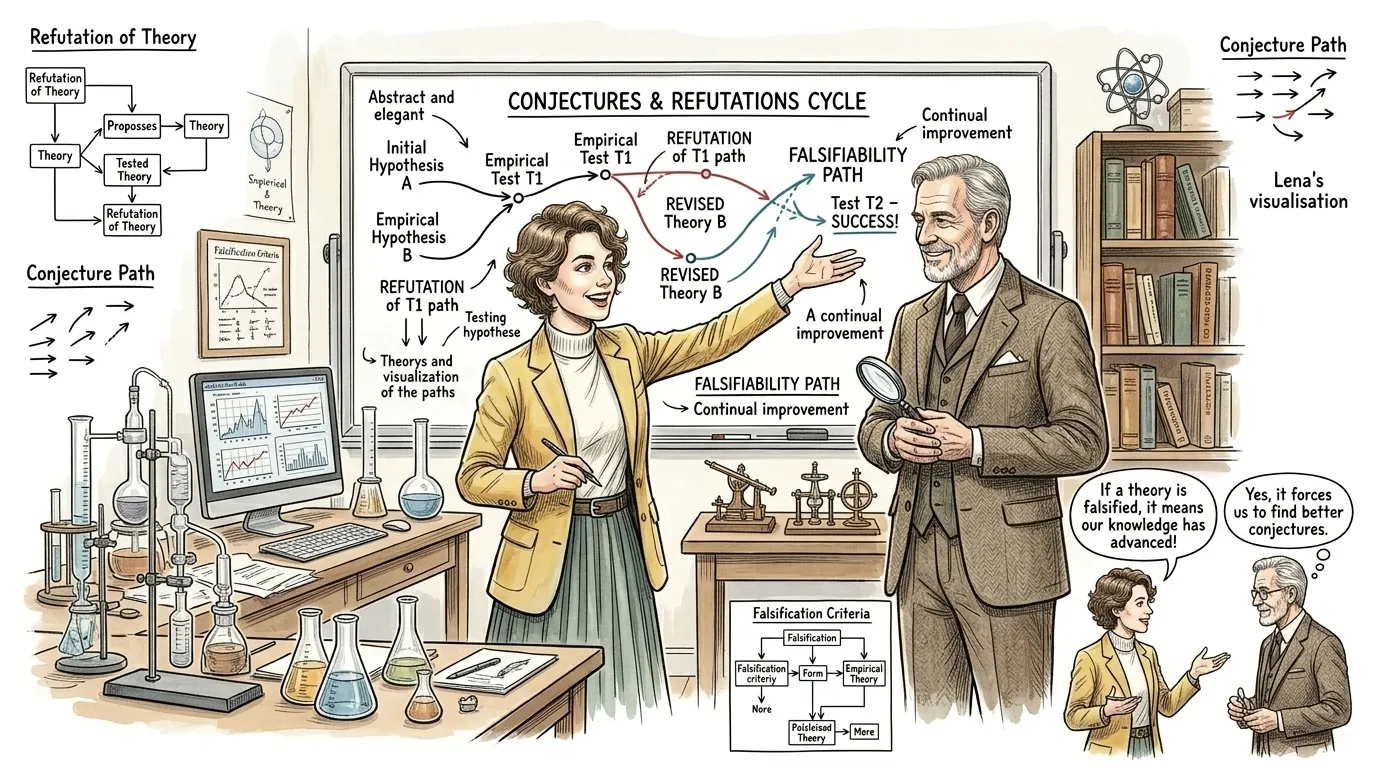
For Popper, scientific knowledge is never definitively proven. It's always tentative, a series of 'conjectures and refutations.' We propose bold hypotheses (conjectures), then rigorously test them to find their flaws (refutations). If a theory withstands repeated attempts to falsify it, we accept it provisionally, but always remain open to new evidence that could overturn it.
""This view transforms science from a quest for certainty into an ongoing, dynamic process," Dr. Petrova stated, making a sweeping motion with her hand. "It means we must embrace uncertainty, viewing even our best theories as temporary truths, always susceptible to revision." Dr. Thorne added, "It's a powerful engine for progress, as each failed hypothesis clears the way for a better, more robust one. We learn most profoundly from our mistakes, not from our successes.""
Philosophy Note: Critical Rationalism: Popper's term for his philosophy, emphasizing reason's role in critical evaluation and problem-solving, rather than positive justification. Provisional Knowledge: The understanding that all scientific theories are subject to future revision or falsification.
Page 7
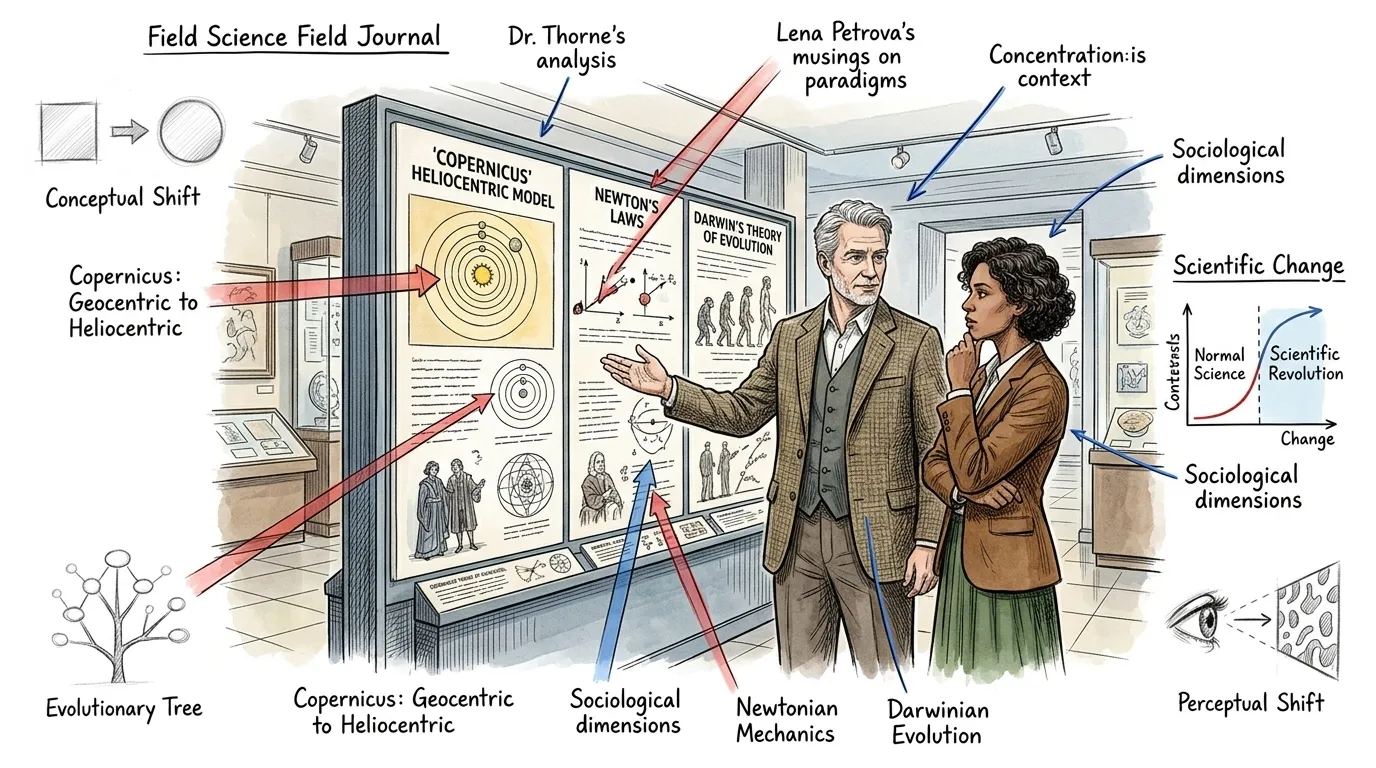
While Popper's ideas were profoundly influential, they were not without critics. Thomas Kuhn, another prominent philosopher of science, offered a different perspective, suggesting that science doesn't always progress through neat falsifications. Instead, Kuhn argued, science operates within 'paradigms' of normal science, with revolutionary shifts occurring only when anomalies accumulate to such an extent that the old paradigm collapses, leading to an entirely new way of seeing the world.
""Kuhn's work introduced a crucial sociological dimension to the philosophy of science," Dr. Thorne explained, turning to a display featuring images of scientific revolutions. "He argued that scientists often work within a shared set of beliefs and practices, a 'paradigm,' and are often resistant to falsification until a crisis emerges." Dr. Petrova mused, "So, while Popper focuses on the logical method, Kuhn highlights the human and historical context, showing that the acceptance or rejection of theories isn't always a purely rational, isolated act, but also a community-driven one.""
Philosophy Note: Thomas Kuhn (1922-1996): American philosopher of science, author of 'The Structure of Scientific Revolutions.' Paradigm: A framework of concepts, assumptions, and practices within which a scientific community operates.
Page 8
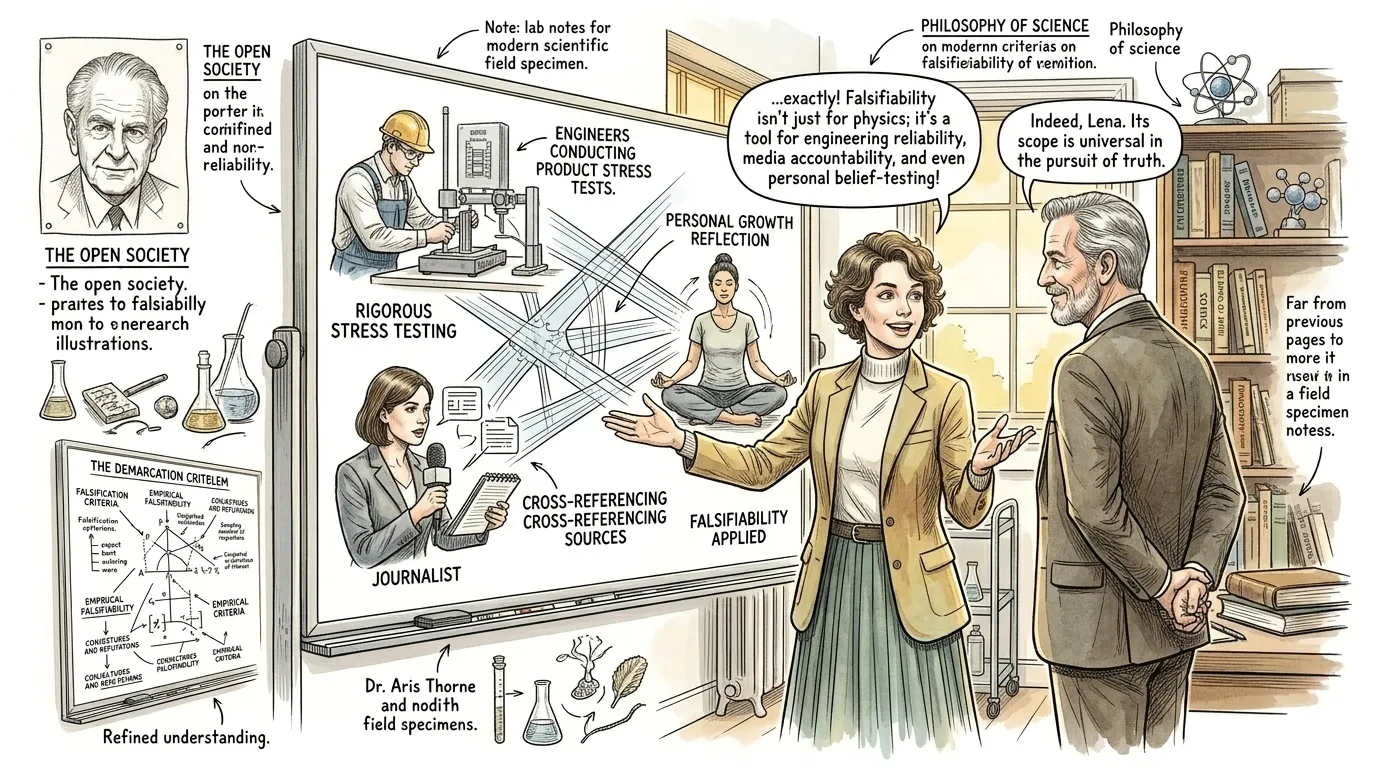
Beyond the philosophy of science, Popper's insights on falsifiability resonate deeply in many aspects of contemporary life. From evidence-based policy making to critical thinking in everyday choices, the principle of seeking refutation helps us scrutinize claims, challenge assumptions, and make more informed decisions.
""Popper's legacy extends far beyond laboratory science," Dr. Petrova asserted, gesturing to a series of modern scenarios. "Think about product testing: manufacturers try to break their products, not just confirm they work. Or in journalism, where good reporting seeks out contradictory evidence." Dr. Thorne added, "Even in personal growth, applying a falsificationist mindset means we're constantly testing our beliefs and assumptions, ready to discard them if they don't hold up. It's a continuous pursuit of intellectual honesty.""
Philosophy Note: Evidence-Based Policy: Making decisions based on rigorous data and testing, allowing for policy revision if outcomes are negative. Critical Thinking: The objective analysis and evaluation of information, often involving skepticism and searching for counter-evidence.
Page 9
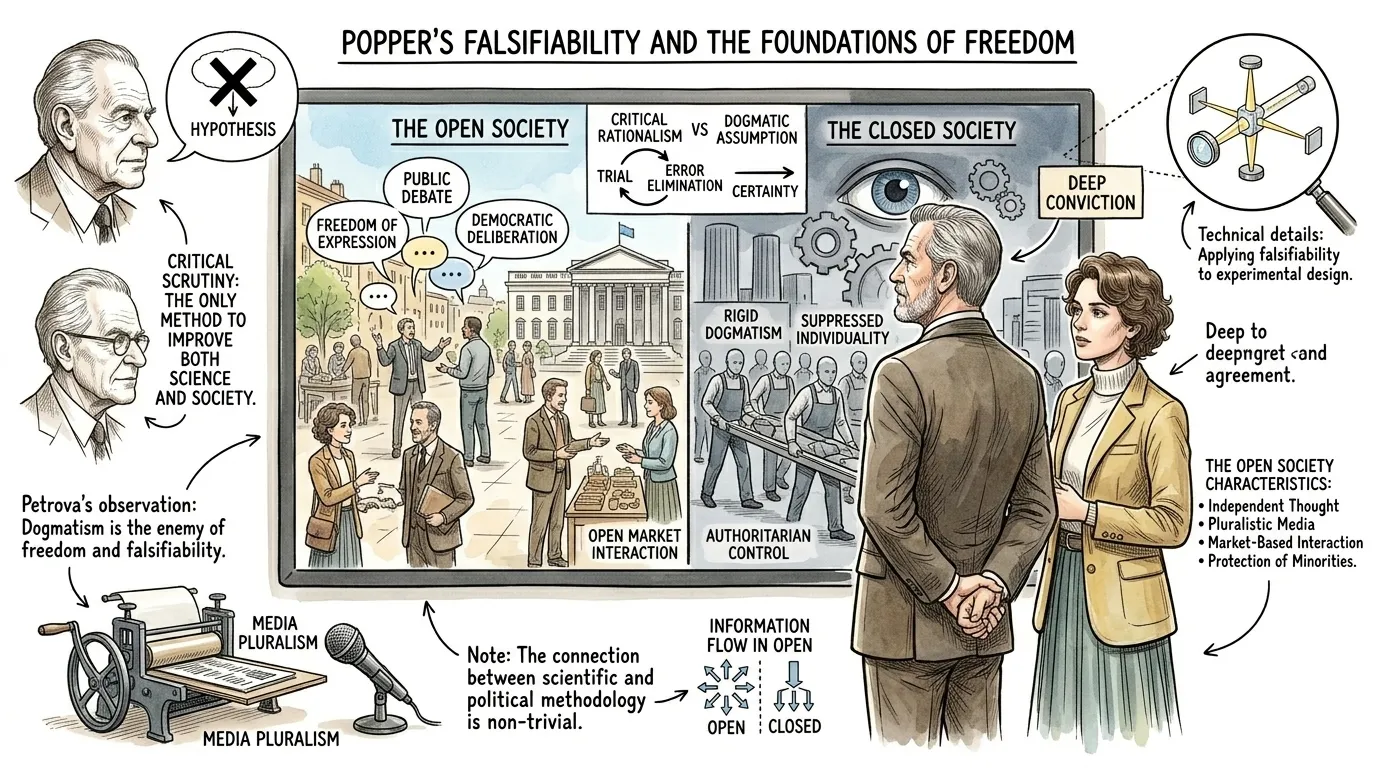
Popper's philosophical project wasn't confined to science; it extended profoundly into political thought. He applied the same critical rationalism to society itself, advocating for an 'open society' – one characterized by democratic governance, freedom of thought, and the constant possibility of reform based on critical discussion and error correction. This stood in stark opposition to totalitarian systems, which he dubbed 'closed societies.'
""This is where Popper truly connected his scientific philosophy to human freedom," Dr. Thorne emphasized, looking at an image contrasting societal structures. "An open society, like a good scientific theory, must be open to criticism and reform. It thrives on the possibility of being wrong, on correcting its mistakes through rational debate." Dr. Petrova agreed, "He saw dogmatism, whether scientific or political, as fundamentally dangerous. The 'enemies of the open society' were those who believed they held ultimate, unchallengeable truths, leading to authoritarianism and suppression.""
Philosophy Note: Open Society: A political system characterized by freedom of thought, social mobility, and democratic governance, open to reform through critical discussion. Closed Society: A totalitarian system, rigid and resistant to change or criticism.
Page 10
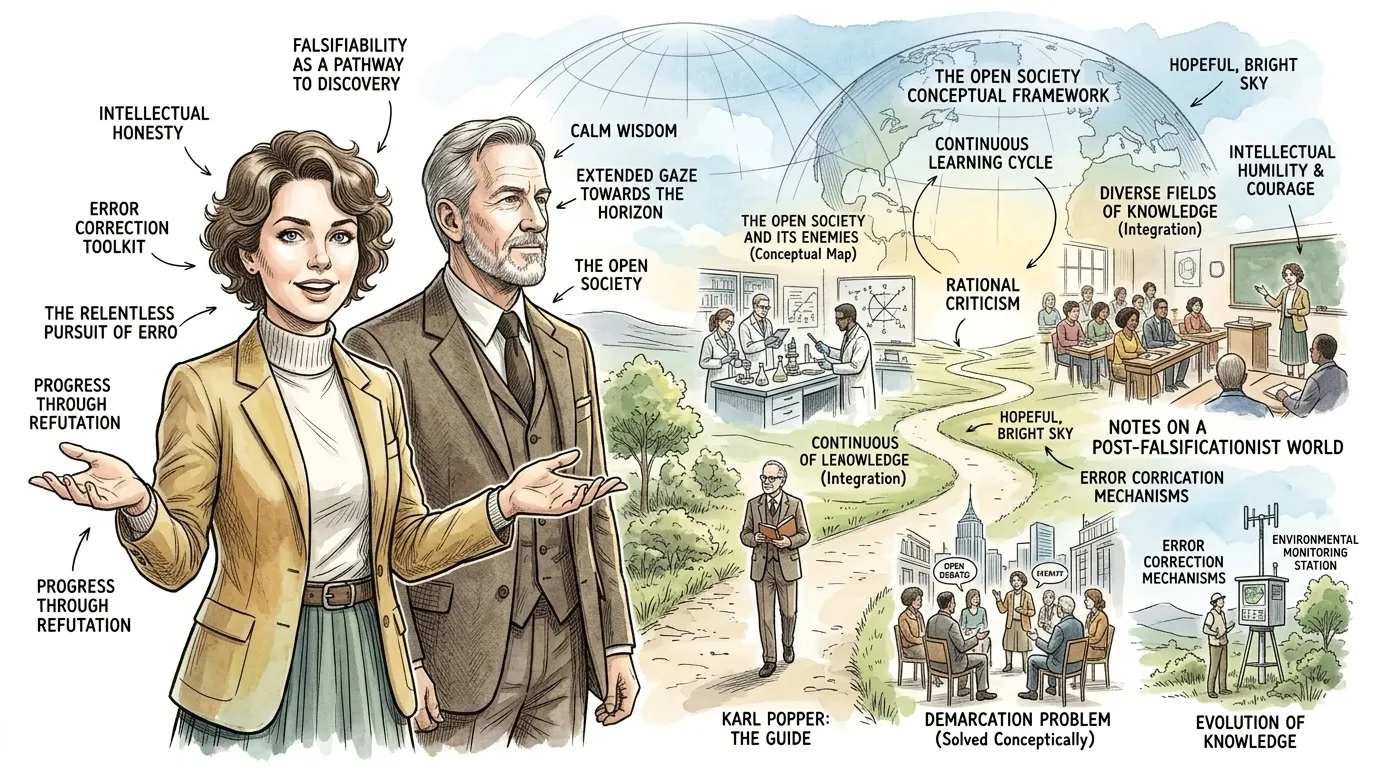
Karl Popper's legacy is a profound call for intellectual humility and courage. He taught us that knowledge is not about certainty, but about a never-ending journey of discovery, fueled by the willingness to challenge our deepest convictions. His critical rationalism remains a powerful antidote to dogmatism, urging us to question, to test, and to remain eternally open to the possibility that we might be wrong, even about our most cherished beliefs.
""Popper gave us a toolkit for navigating a complex world," Dr. Petrova concluded, her voice resonant. "He showed that true strength lies in intellectual honesty, in understanding that our knowledge is always provisional, and that progress comes from relentlessly pursuing errors." Dr. Thorne looked out at the imagined horizon. "Indeed. His enduring message is one of hope in the face of uncertainty: by embracing criticism and the possibility of refutation, we not only refine our understanding, but also build a more open, more rational world.""
Philosophy Note: Critical Rationalism: The philosophical position that rational inquiry proceeds by proposing theories and trying to falsify them. Intellectual Humility: Recognizing the limits of one's own knowledge and understanding, a core tenet of Popper's philosophy.
About this story
- Audience: general readers
Questions and answers
Read Wonder Philosophy on your phone
Wonder Philosophy is available on Android and iPhone and iPad. Get Wonder Philosophy on Google Play · Get Wonder Philosophy on the App Store.