Madhva
Explore Madhva's Dvaita Vedanta, a dualistic philosophy challenging the Advaita's non-dualism. Understand the five eternal distinctions and their implications for individual existence and devotion.
Page 1
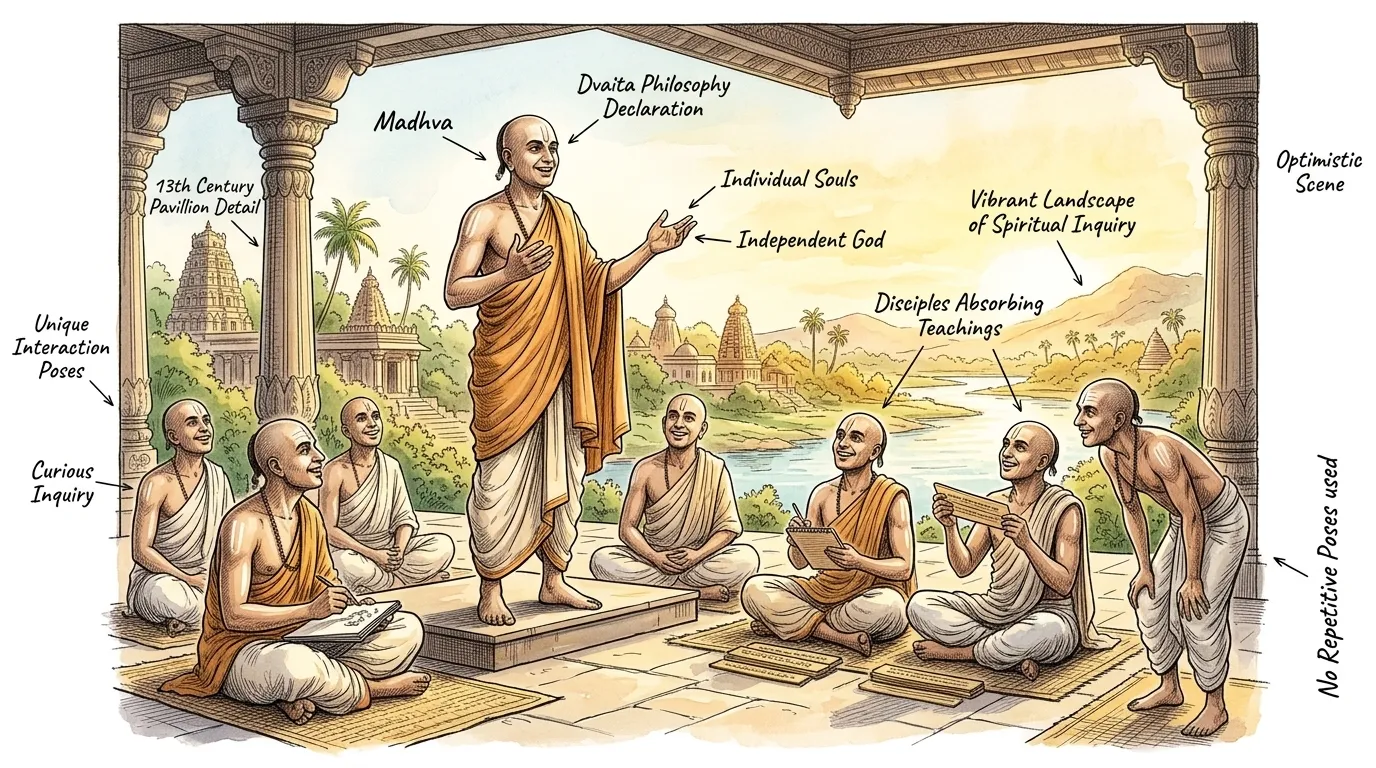
In 13th-century South India, amidst a vibrant landscape of spiritual inquiry, a revolutionary idea began to challenge prevailing philosophical norms. Madhva, a visionary philosopher, asserted a radical perspective on the nature of reality. His core doctrine, Dvaita Vedanta, established an eternal, fundamental distinction between God, individual souls, and the material world.
""The universe we perceive is not an illusion, nor is every being merely a facet of one divine essence," Madhva declared, his voice resonating through the open-air pavilion. "There exists an absolute, eternal difference. This distinction, my students, is the very foundation of truth.""
Philosophy Note: Madhva (Madhvācārya)
13th Century, Udupi, India
Core Idea: Dvaita Vedanta (Dualism)
Addressing: The fundamental relationship between God, self, and world.
Page 2
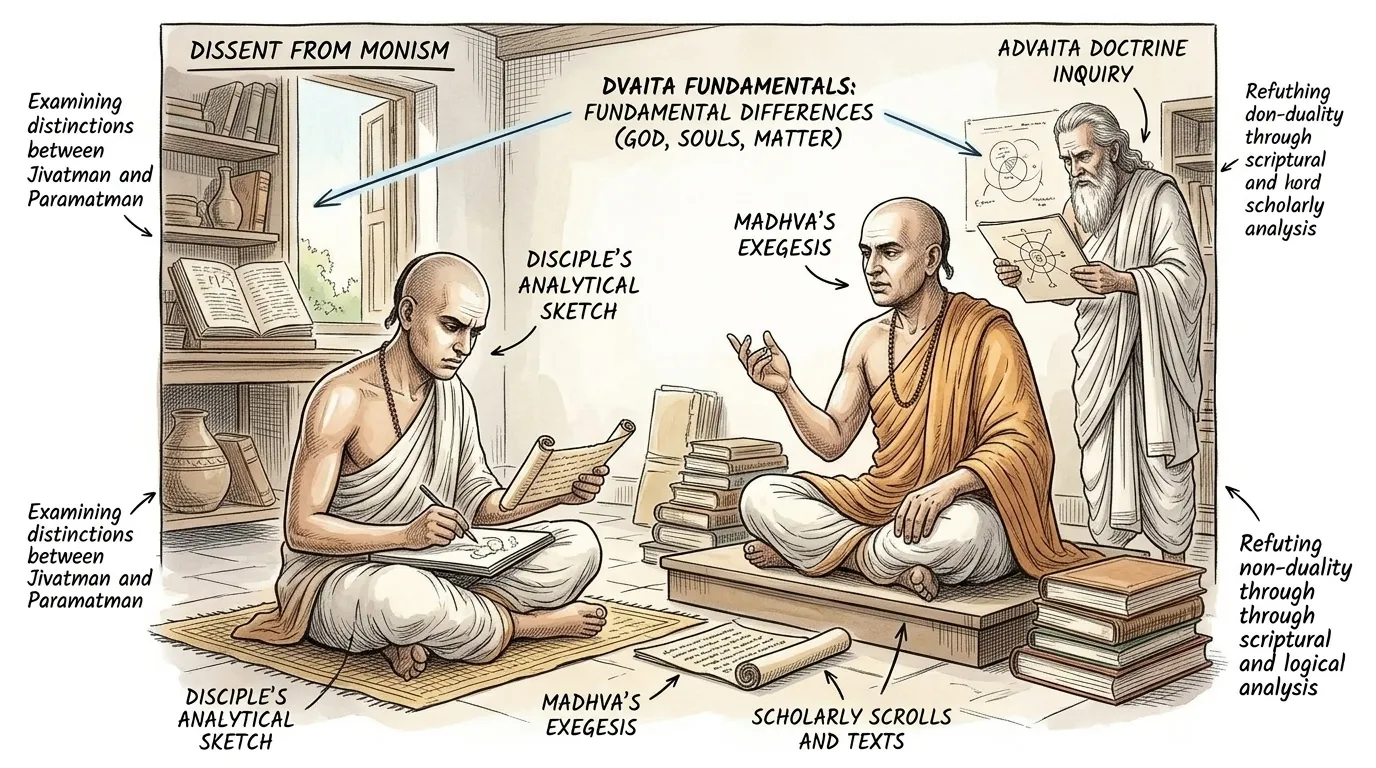
Before Madhva, the philosophy of Advaita Vedanta, emphasizing ultimate non-duality, held significant sway across Indian thought. Its central tenet often suggested an essential oneness, where the individual soul (Atman) was fundamentally identical with the ultimate reality (Brahman). This presented a challenge for understanding individual experience and devotion.
""Master, the revered Shankaracharya's Advaita doctrine proclaims an ultimate unity," a Disciple inquired, his brow furrowed with contemplation. "What is the basis for your assertion of profound difference, when so many speak of oneness?" Madhva nodded thoughtfully. "Indeed, my son. Many understand reality through statements such as 'Tat Tvam Asi' – 'That Thou Art,' a phrase found in the Chandogya Upanishad. They interpret it to mean the individual soul is identical with the ultimate Brahman, the One without a second. However, for us, this oneness is merely an illusion, a philosophical misstep.""
Philosophy Note: Advaita Vedanta: Emphasizes ultimate non-duality, soul (Atman) identical with Brahman.
Dvaita's Challenge: Reinterpreting classical texts to assert fundamental differences.
Page 3
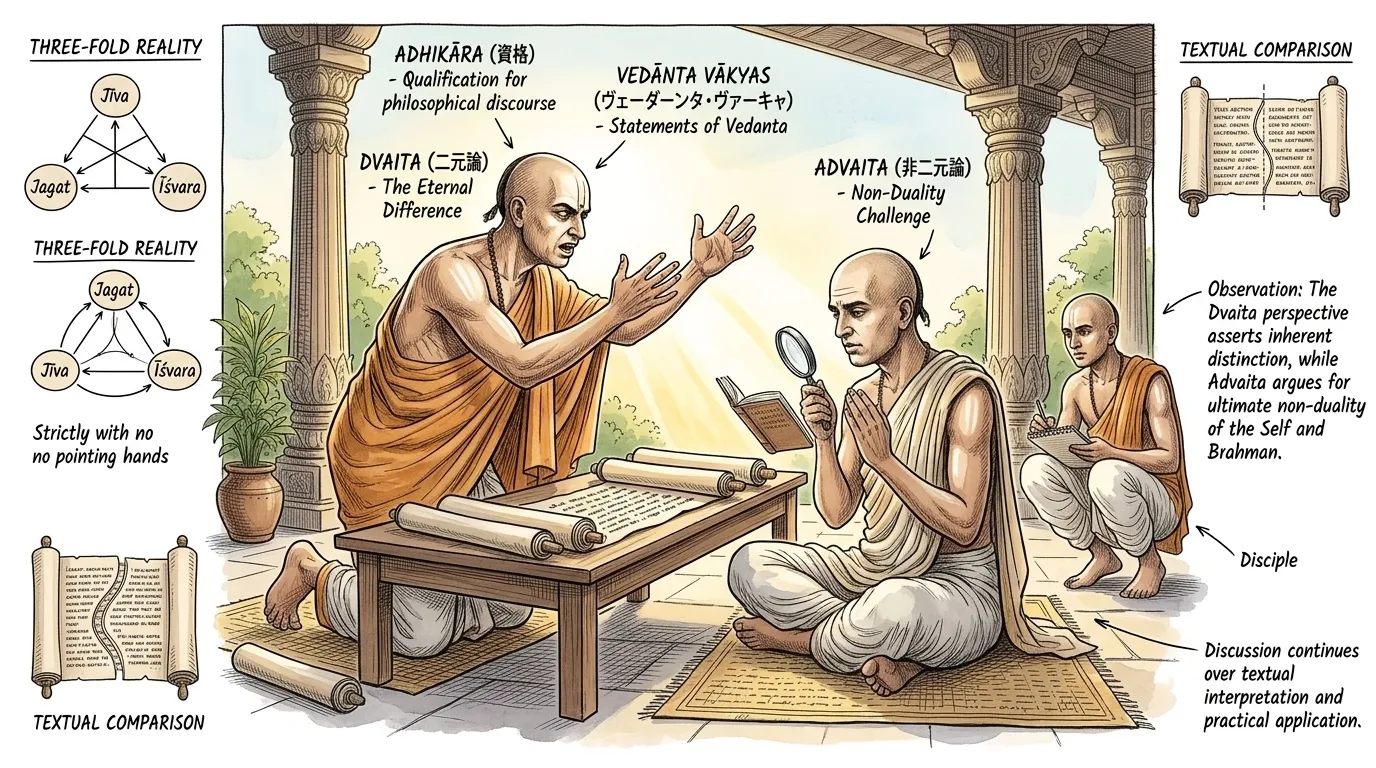
Madhva's philosophy, Dvaita, posits five fundamental and eternal distinctions (Pancha Bheda) that define existence. These are not superficial differences but inherent, ontological separations that cannot be overcome or dissolved, even in liberation. This was a direct refutation of any notion of ultimate unity.
""The core of our understanding lies in recognizing five eternal distinctions," Madhva asserted, looking directly at an Advaita Scholar, a composed man in his 50s with a shaven head and saffron robes. "There is the difference between God and the individual soul, between one soul and another, and between God and matter. Furthermore, there is the difference between a soul and matter, and between one piece of matter and another. These are absolute." The Advaita Scholar folded his hands, his expression thoughtful. "But revered one, if all existence arises from a singular Brahman, how can such distinctions be anything but phenomenal, ultimately unreal?" Madhva met his gaze, unflinching. "They are not phenomenal. They are the very fabric of reality, eternally real.""
Philosophy Note: Pancha Bheda (Five Differences):
1. God and individual soul
2. One soul and another
3. God and matter
4. Soul and matter
5. One piece of matter and another
Page 4
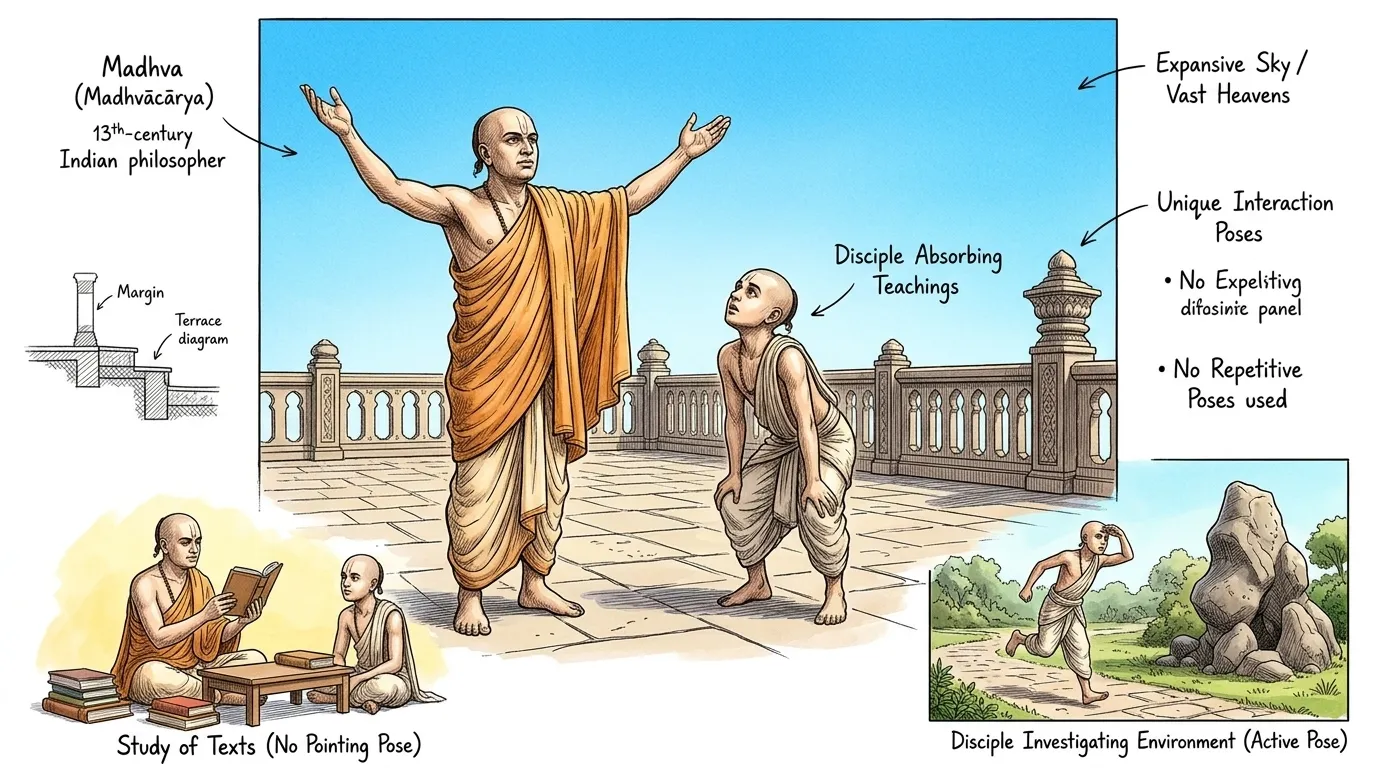
Central to Dvaita is the concept of God (Vishnu or Brahman) as the supremely independent reality, the only truly self-existent entity. All other realities – individual souls and matter – are entirely dependent on God for their existence, knowledge, and activity. This dependence does not diminish their reality but defines their relationship to the ultimate cause.
""Understand this clearly," Madhva explained to his Disciple, gesturing towards the heavens. "Ishvara, the Supreme Being, is absolutely independent. He is the ultimate controller, the creator, maintainer, and destroyer of the cosmos. Everything else, every jiva, every atom of prakriti, exists solely by His will and grace." The Disciple nodded, absorbing his words. "So, our individual existence, our very consciousness, is a gift, not an illusion?" Madhva affirmed, "Precisely. We are real, and our experiences are real, but our reality is entirely dependent. It is a reality secondary to His supreme independence.""
Philosophy Note: God (Vishnu/Brahman): Supreme, Independent Reality.
Souls & Matter: Dependent realities, real but not self-existent.
Page 5
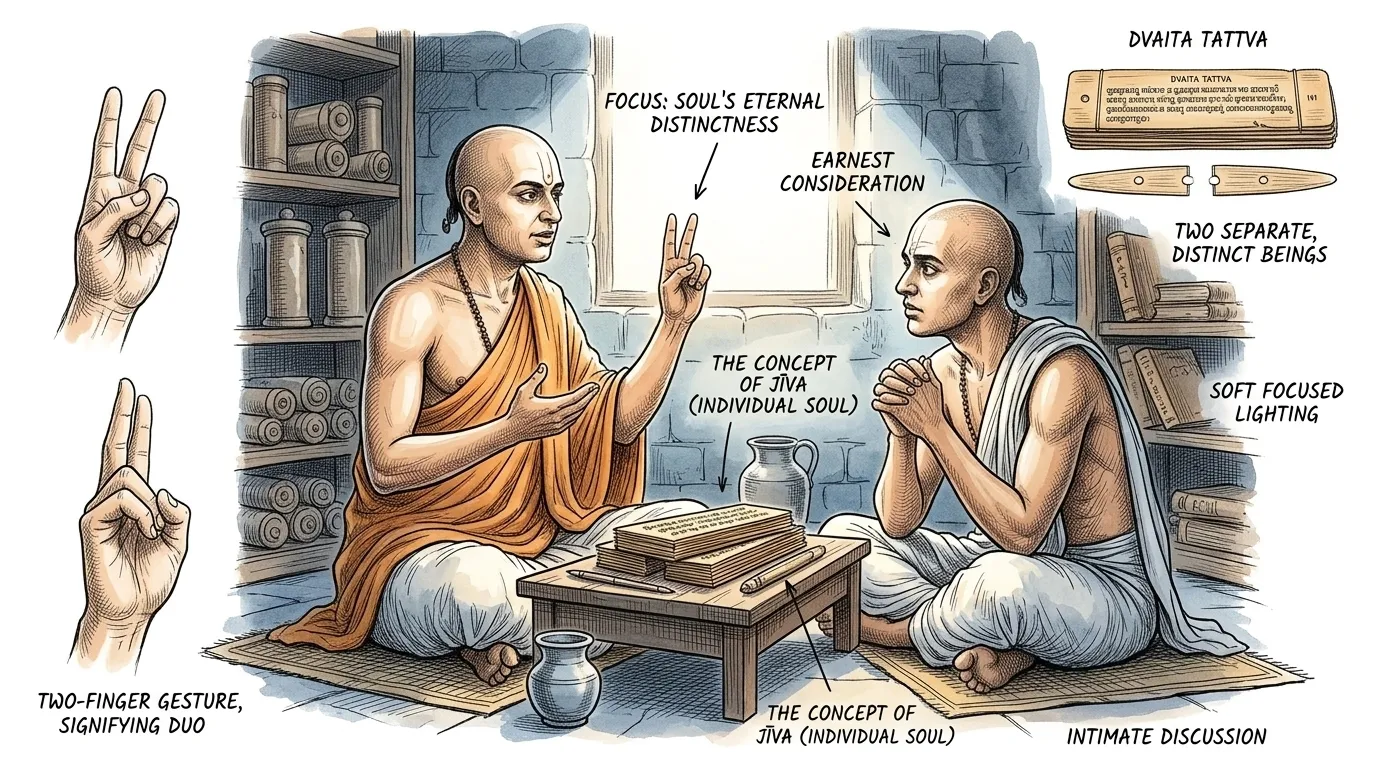
Madhva further emphasized that individual souls (jivas) are not only distinct from God but are also fundamentally distinct from each other. Moreover, souls are not equal; they possess inherent differences in their nature, knowledge, and capacity for bliss. This leads to a concept of 'graded liberation,' where different souls achieve different levels of spiritual realization and eternal happiness.
""Each soul possesses its own unique and eternal nature, distinct from every other," Madhva clarified to his Disciple, holding up two fingers to emphasize the point. "Just as no two fingerprints are identical, no two souls are ever truly the same. Their capacities for knowledge, devotion, and experience of bliss are inherently varied." The Disciple considered this. "So, our destinies, our paths to liberation, are not uniform?" Madhva confirmed, "Indeed. Liberation is not a singular, undifferentiated state. It is graded, reflecting the inherent qualities and sincere efforts of each individual soul. Some achieve higher states of bliss, others lower, based on their inherent nature and spiritual journey.""
Philosophy Note: Individual Souls (Jivas): Distinct from God and each other.
Graded Liberation: Souls achieve varying levels of bliss based on inherent nature and spiritual effort.
Page 6
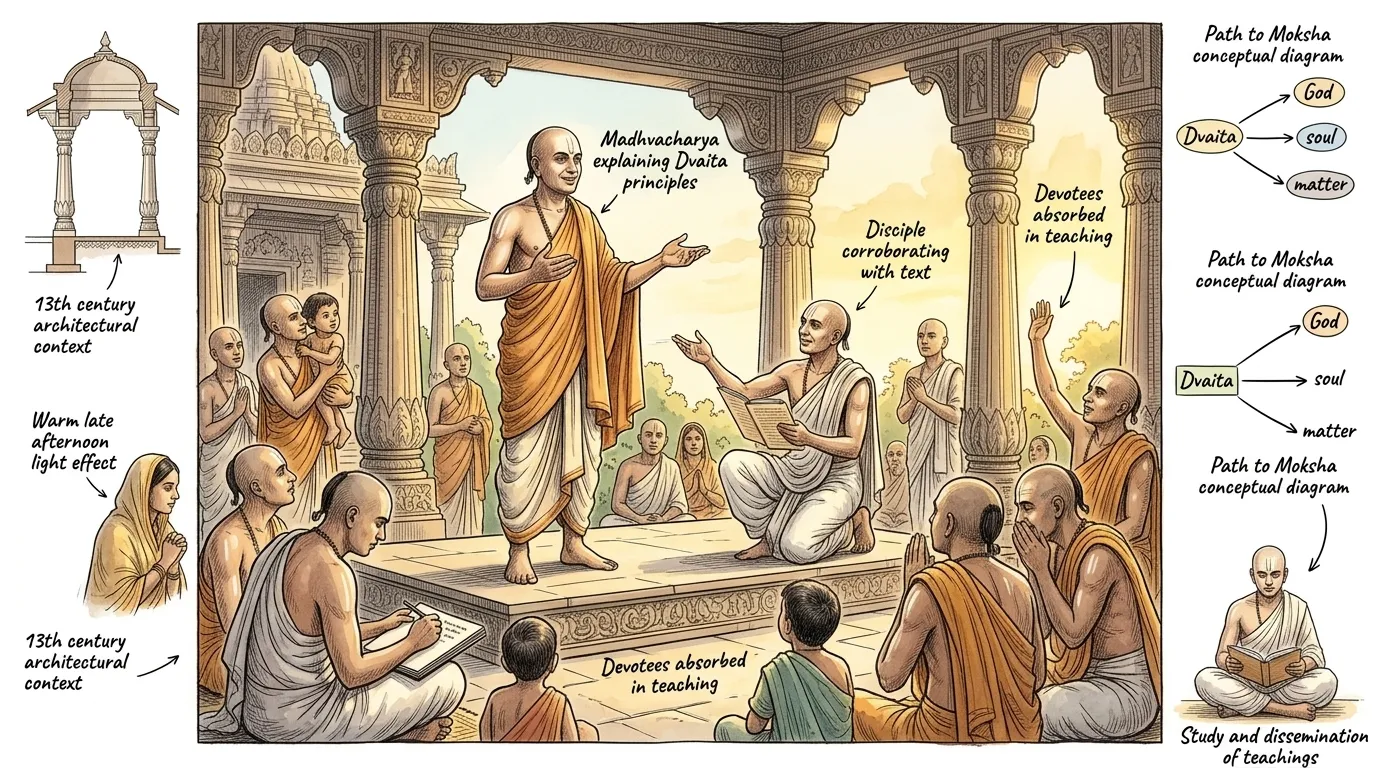
For Dvaita, the path to liberation (moksha) involves devotion (bhakti) to God and correct knowledge (jnana) of His supreme nature and the real distinctions of existence. It is through understanding these truths and cultivating unwavering love and service to God that souls can overcome worldly suffering and attain their inherent, blissful nature, albeit in varying degrees.
""The path to moksha is not absorption into an undifferentiated Brahman, but rather a profound deepening of one's relationship with the Supreme," Madhva explained, looking out at a group of devotees. "It is through selfless devotion, constant remembrance, and a clear understanding of the absolute distinctions that one truly approaches Him. This knowledge is not merely intellectual; it transforms our very being." A senior Disciple, standing beside Madhva, added, "Indeed, true knowledge reveals the independence of Ishvara and our own inherent servitude, fostering a genuine, unwavering love that transcends all worldly attachments. It is a journey of increasing clarity and devotion.""
Philosophy Note: Path to Moksha: Bhakti (devotion) and Jnana (correct knowledge).
Outcome: Deepening relationship with God, overcoming suffering, attaining inherent blissful nature.
Page 7
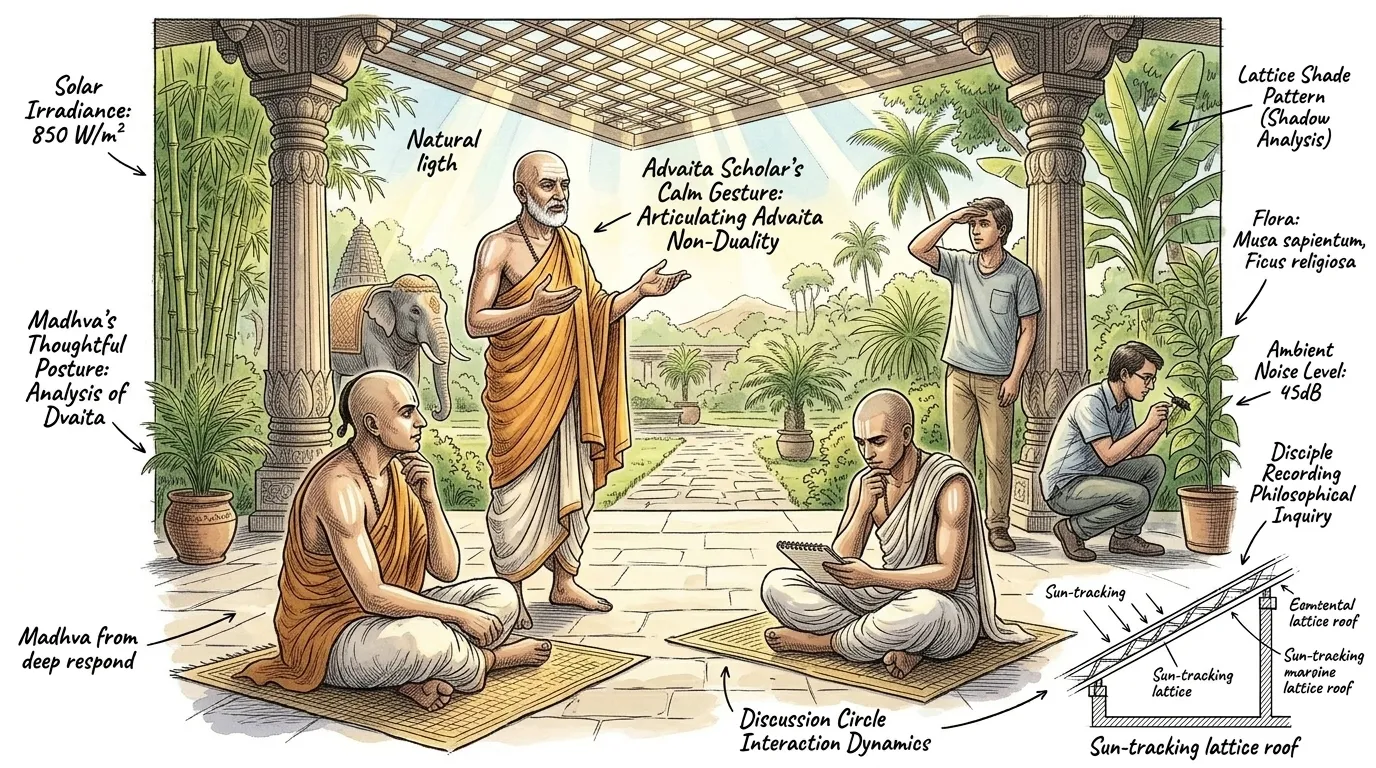
Madhva's Dvaita philosophy faced staunch opposition from the established Advaita Vedanta school. Advaitins argued that while empirical distinctions are undeniable in the phenomenal world (vyavaharika), ultimate reality (paramarthika) is non-dual, a singular, attributeless Brahman. They viewed Madhva's dualism as limiting the infinitude of Brahman and perpetuating a fundamental misunderstanding of reality through the veil of illusion (maya).
""While we acknowledge the apparent diversity of the world, to elevate these distinctions to ultimate reality is to misunderstand the very nature of Brahman," the Advaita Scholar countered, his voice calm yet firm, addressing Madhva directly in a sunlit discussion circle. "The scriptures speak of Brahman as 'One without a second.' All forms, all individualities, are ultimately superimpositions, products of Maya, the cosmic illusion. True liberation lies in realizing this fundamental non-duality, not in celebrating eternal difference." Madhva listened intently. "But to dismiss distinctions as illusion risks rendering our actions, our devotion, and even our suffering, ultimately unreal. Our experiences are too profound to be mere phantoms.""
Philosophy Note: Advaita Response: Ultimate reality is non-dual Brahman; distinctions are phenomenal (maya).
Critique: Dvaita limits Brahman, misinterprets reality.
Page 8
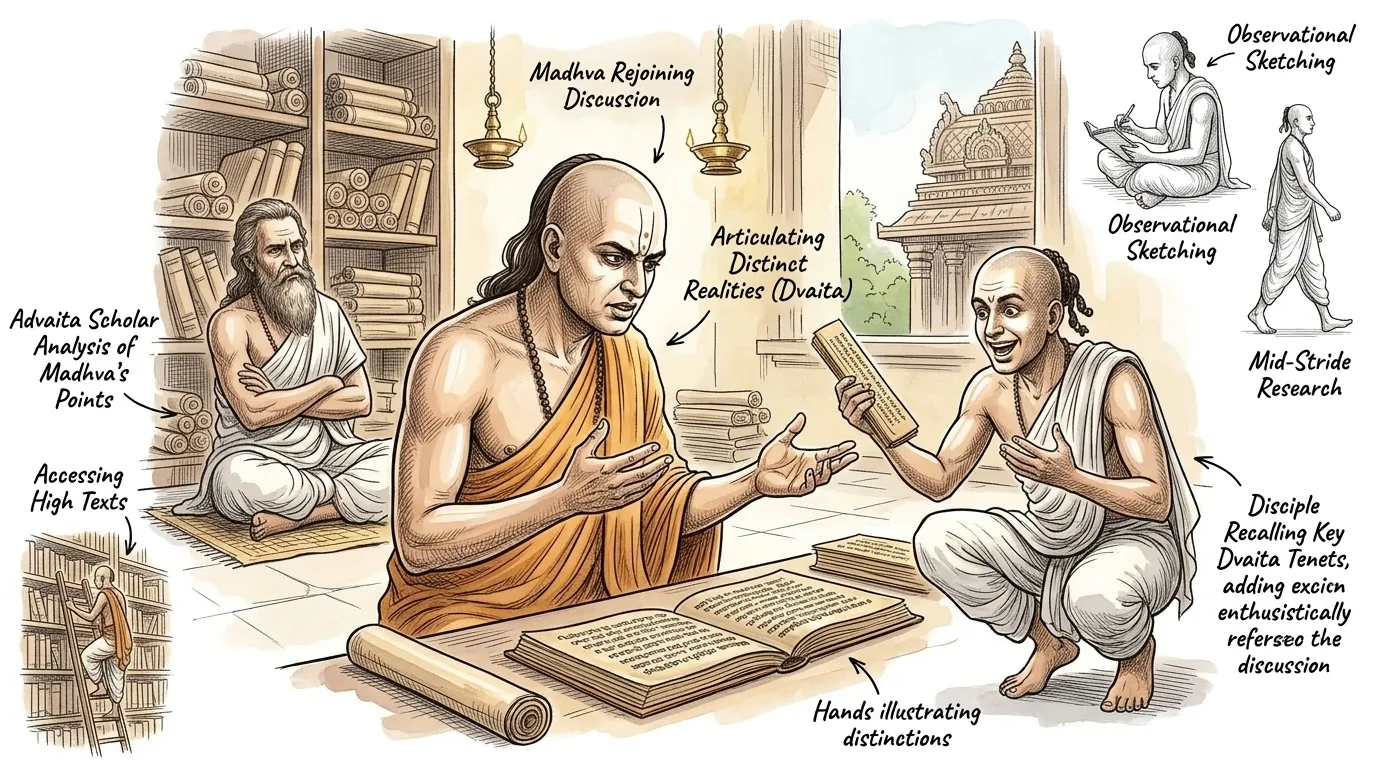
Madhva's response to Advaita's critique was a steadfast reaffirmation of the reality of distinctions and the meaningfulness of individual existence. He argued that the scriptures, when properly interpreted, consistently uphold difference. His philosophical framework provides a robust foundation for personal devotion, ethical action, and a sense of individual purpose, all rooted in a tangible, relatable reality.
""The very act of seeking liberation, the very concept of devotion, implies a distinction between the worshipper and the worshipped," Madhva rejoined, his argument sharp and precise. "If 'That Thou Art' meant absolute identity without remainder, then there would be no reason for the Vedas to speak of paths, of grace, or of the distinct joys of the liberated soul. We must engage with reality as it presents itself." The Disciple, remembering Madhva's earlier teachings, added, "Indeed, Master. The five fundamental differences you illuminated on the first day provide the only coherent framework for understanding the diverse experiences of life, from suffering to salvation, grounding them in a reality that is truly meaningful, rather than an ultimate illusion to be transcended.""
Philosophy Note: Madhva's Rebuttal: Scriptures support difference; devotion requires distinction.
Enduring Value: Provides a meaningful framework for individual purpose, ethics, and devotion.
Page 9
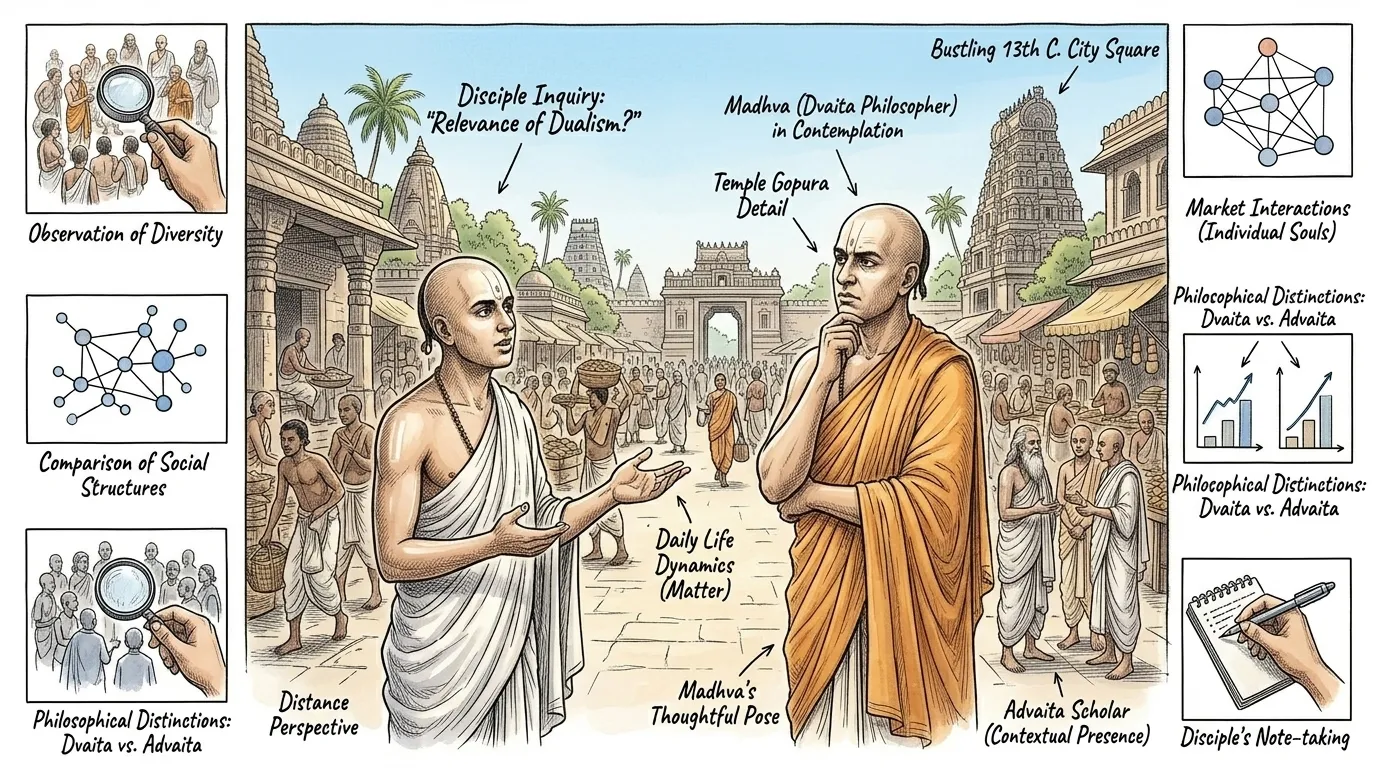
Madhva's Dvaita philosophy, though ancient, carries profound implications for contemporary life. Its emphasis on individual distinctness and a personal relationship with the divine informs ethical decision-making, fosters a sense of personal responsibility, and provides solace in recognizing unique spiritual journeys. It offers a framework where individual efforts and identities truly matter.
""How does this ancient doctrine resonate in our complex modern world, Master?" the Disciple asked, contemplating a bustling city square. Madhva, observing the myriad individuals moving through daily life, replied, "Consider the modern quest for individual identity and purpose. Our philosophy affirms that each person is uniquely distinct, not just a temporary manifestation of a single reality. This means your choices, your compassion, your pursuit of knowledge—they all carry eternal significance because you, as an individual soul, are eternally real and distinct. This provides a robust foundation for ethics, where each action, whether good or ill, carries distinct and lasting consequences, not dissolving into a unified whole.""
Philosophy Note: Modern Relevance:
- Individual Identity & Purpose
- Ethical Responsibility
- Unique Spiritual Paths
- Meaningful Action & Consequence
Page 10
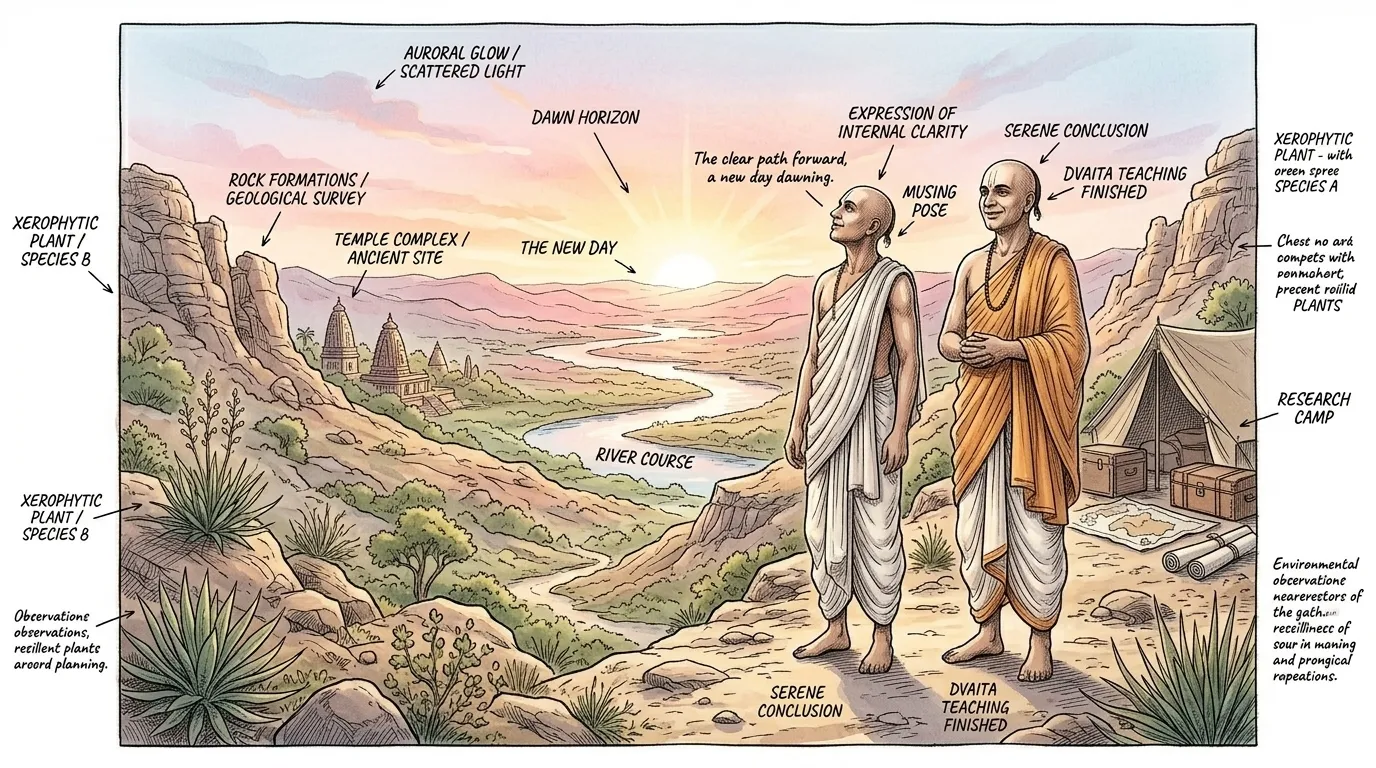
Madhva's Dvaita Vedanta continues to be a vibrant and influential school of thought within Indian philosophy and beyond. Its clear articulation of dualism provides a distinct theological and metaphysical alternative, profoundly shaping devotional traditions, intellectual debates, and the personal spiritual lives of millions. It stands as a testament to the enduring human quest for understanding the nature of reality and our place within it.
""The clarity of Dvaita offers profound comfort and purpose," the Disciple mused, looking towards a horizon where the first rays of dawn were breaking. "It affirms our distinctness, yet binds us in a dependent relationship with the Supreme, making devotion both logical and deeply meaningful." Madhva, a serene smile on his face, concluded, "Indeed. The truth of difference does not diminish the sacred; rather, it elevates the uniqueness of every soul's journey and the magnificence of the divine. This understanding, once illuminated, continues to guide those who seek genuine connection and lasting meaning.""
Philosophy Note: Dvaita's Enduring Legacy:
- Influential school in Indian philosophy
- Shapes devotional traditions
- Guides personal spiritual lives
- Offers a distinct metaphysical alternative
About this story
- Audience: general readers
Questions and answers
Read Wonder Philosophy on your phone
Wonder Philosophy is available on Android and iPhone and iPad. Get Wonder Philosophy on Google Play · Get Wonder Philosophy on the App Store.