Mencius
Mencius — an illustrated philosophy story. 10 illustrated pages, free to read on Wonder Philosophy.

Page 1
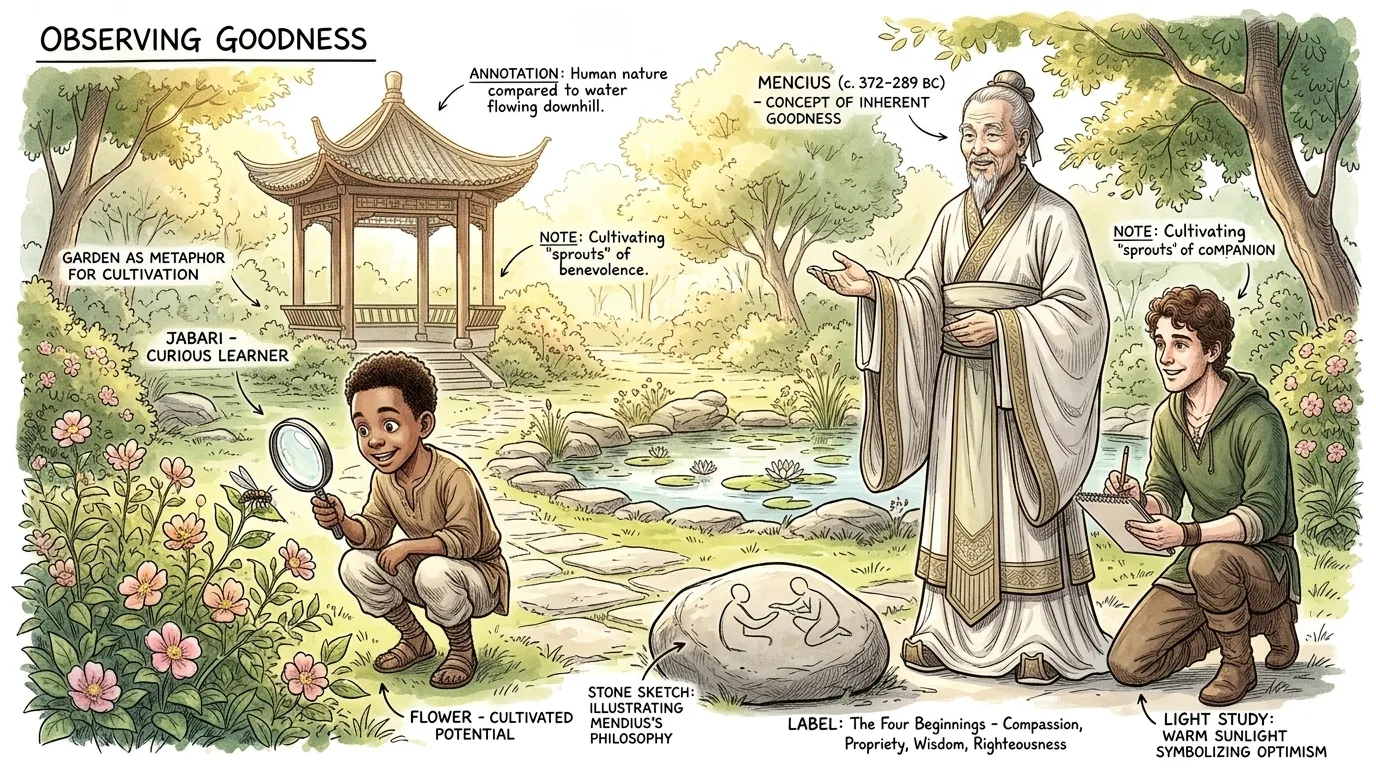
Mencius, a towering figure in Confucianism, championed the belief that human nature is inherently good. This idea, revolutionary for its time, continues to resonate today, offering a hopeful perspective on human potential and the importance of moral cultivation. But what does this mean in a world filled with conflict and wrongdoing?
Philosophy Note: Mencius [c. 372 – c. 289 BCE]: Also known as Mengzi, he was a Chinese Confucian philosopher who has often been described as the 'second Sage', that is, after only Confucius himself.
Page 2
![Born centuries after Confucius [551-479 BCE], Mencius inherited and expanded upon the master's teachings. In a time of political upheaval and moral decay…](https://thewonderbooks.com/images/stories/mencius/illustrations/mencius_page_02_v1775194417397.webp "Born centuries after Confucius [551-479 BCE], Mencius inherited and expanded upon the master's teachings. In a time of political upheaval and moral decay…")
Born centuries after Confucius [551-479 BCE], Mencius inherited and expanded upon the master's teachings. In a time of political upheaval and moral decay, Mencius sought to restore order and virtue by emphasizing the importance of ethical leadership and the cultivation of inner goodness. Mencius believed that by tapping into our innate moral sense, we could create a more harmonious and just society.
Philosophy Note: Confucianism: A system of philosophical and ethical teachings founded by Confucius, emphasizing social harmony, filial piety, and the importance of moral virtue.
Page 3

Mencius argued that all people are born with the 'four beginnings' – seeds of compassion, righteousness, propriety, and wisdom. These beginnings, he believed, are not learned but are inherent aspects of human nature. Just as a seed needs nourishment to grow into a plant, these beginnings need cultivation to develop into full-fledged virtues.
Philosophy Note: Four Beginnings: Mencius's concept of innate moral tendencies, including compassion, righteousness, propriety, and wisdom.
Page 4

To illustrate his point, Mencius used the famous analogy of a child about to fall into a well. He argued that anyone, upon seeing such a sight, would instinctively feel alarm and distress, not because they seek to gain favor with the child's parents or to earn praise from their neighbors, but because of their innate sense of compassion. This, he said, is evidence of our inherent goodness.
Philosophy Note: Analogy of the Child and the Well: Mencius's thought experiment to demonstrate the innate human capacity for compassion.
Page 5
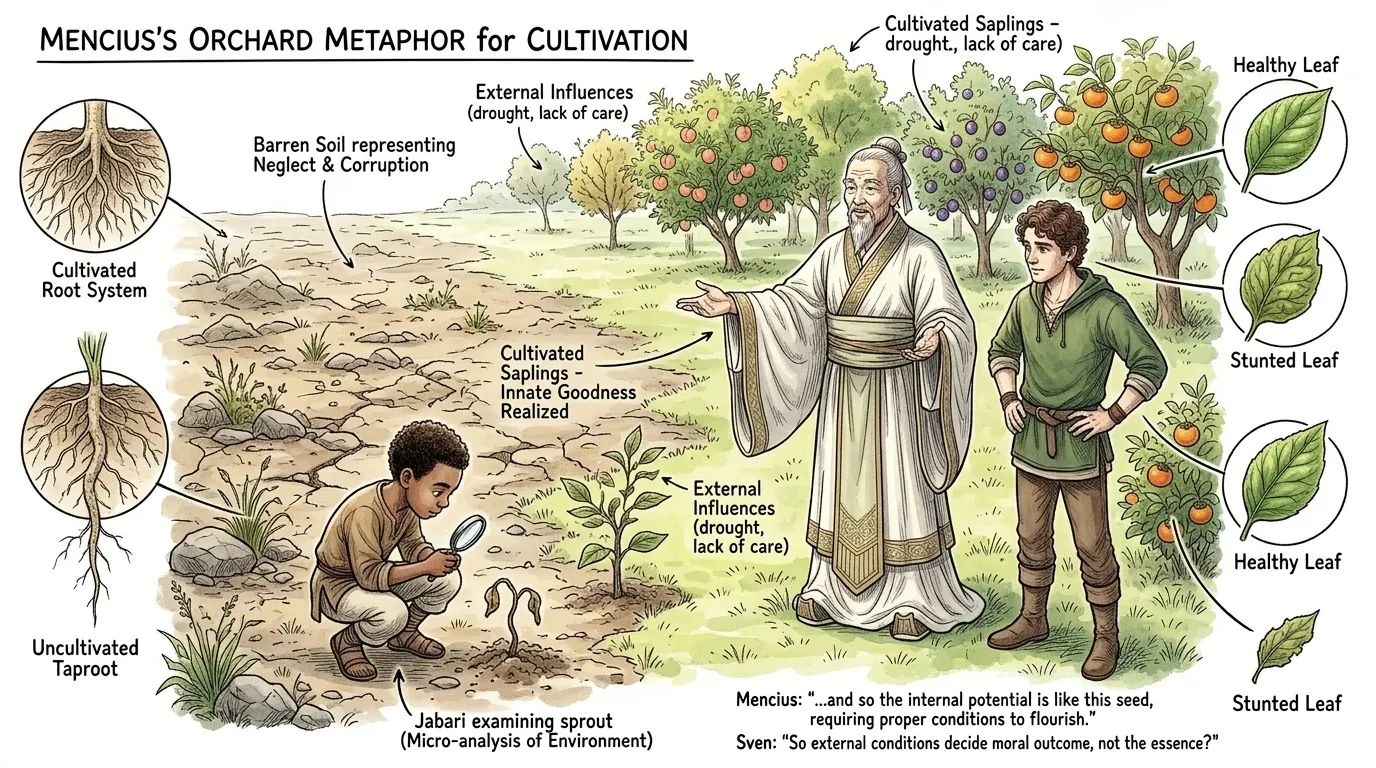
Mencius stressed that while human nature is inherently good, it is also susceptible to corruption. External influences, such as a poor environment or lack of education, can lead individuals astray. Therefore, it is crucial to create a society that fosters moral development through education, ethical leadership, and the promotion of virtuous behavior.
Philosophy Note: Moral Cultivation: The process of developing and refining one's inherent virtues through education, self-reflection, and ethical practice.
Page 6
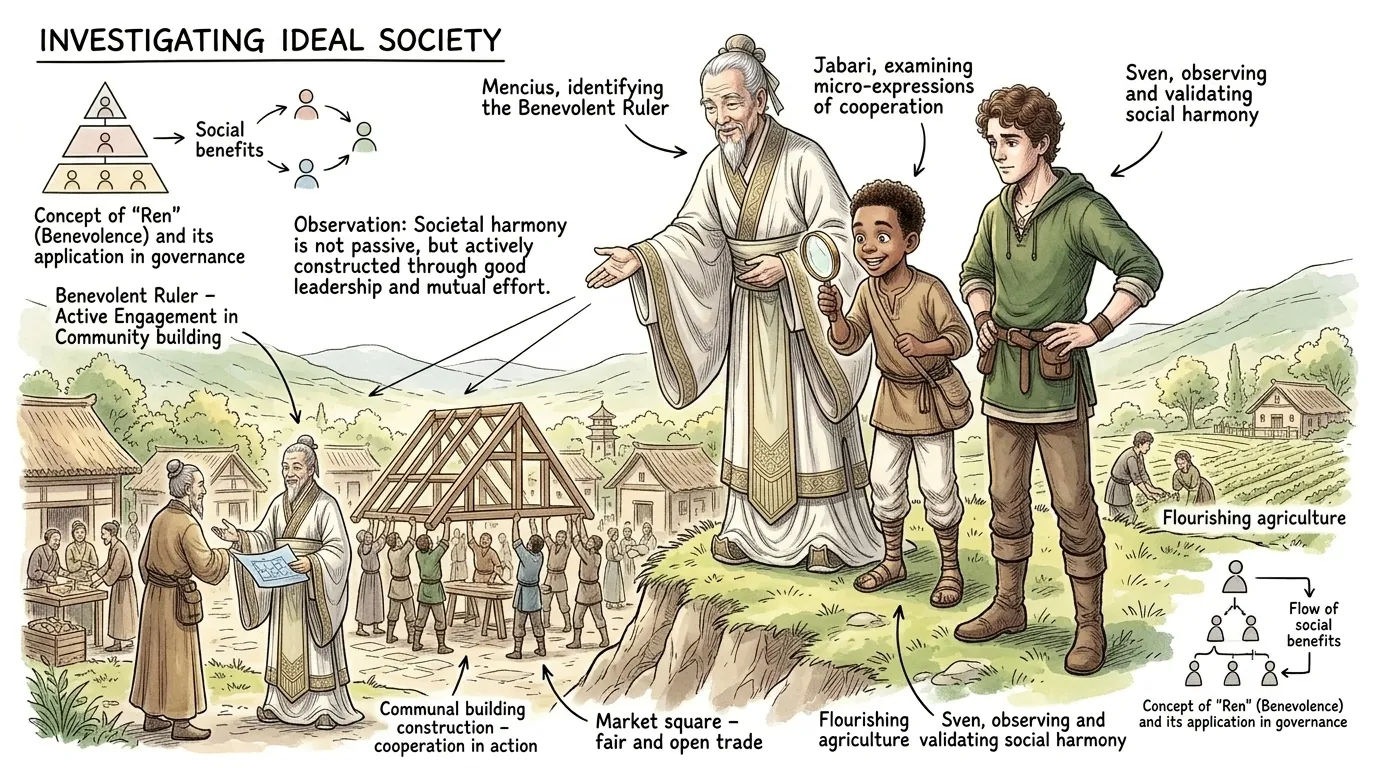
For Mencius, the ruler's primary responsibility was to provide for the well-being of the people and to create a moral environment that encourages virtue. He believed that a just ruler should govern by benevolence, setting an example of ethical conduct and ensuring that the basic needs of the population are met. Only then can society flourish.
Philosophy Note: Benevolent Governance: Mencius's concept of ethical rule, emphasizing the ruler's responsibility to care for the people and promote moral virtue.
Page 7
![Mencius's view was not universally accepted. Xunzi [c. 310 – c. 235 BCE], another prominent Confucian philosopher, argued that human nature is inherently evil…](https://thewonderbooks.com/images/stories/mencius/illustrations/mencius_page_07_v1775194629806.webp "Mencius's view was not universally accepted. Xunzi [c. 310 – c. 235 BCE], another prominent Confucian philosopher, argued that human nature is inherently evil…")
Mencius's view was not universally accepted. Xunzi [c. 310 – c. 235 BCE], another prominent Confucian philosopher, argued that human nature is inherently evil and that goodness can only be achieved through strict laws and rigorous social controls. This debate continues to shape discussions about human nature and the best way to organize society.
Philosophy Note: Xunzi: A Confucian philosopher who argued that human nature is inherently evil and requires external constraints to become good.
Page 8

Mencius's ideas remain relevant today. In a world grappling with ethical dilemmas and social injustices, his emphasis on inherent goodness offers a powerful message of hope. It suggests that we all possess the potential for virtue and that by cultivating our inner goodness, we can create a more just and compassionate world. After all, as Confucius himself said, 'To see what is right and not to do it is a lack of courage'.
Philosophy Note: Modern Applications: Mencius's philosophy continues to inform discussions about ethics, education, and the role of government in promoting social well-being.
Page 9

Mencius challenged us to reflect on our own actions and to strive for moral excellence. By embracing our innate goodness and actively cultivating virtue, we can contribute to a more harmonious and just society, living up to the potential within us all. That little spark can set the world on fire.
Philosophy Note: The Call to Benevolence: Embracing inherent goodness can contribute to a more harmonious and just society.
Page 10

Mencius's legacy endures as a testament to the power of hope and the potential for human goodness. His teachings inspire us to believe in ourselves, to strive for moral excellence, and to work towards a world where compassion and justice prevail. It is a message of continuous self-improvement and boundless faith in humanity.
Philosophy Note: Mencius's Legacy: His teachings inspire us to believe in ourselves, to strive for moral excellence, and to work towards a world where compassion and justice prevail.
About this story
- Audience: kids (ages 6–12)
Questions and answers
Read Wonder Philosophy on your phone
Wonder Philosophy is available on Android and iPhone and iPad. Get Wonder Philosophy on Google Play · Get Wonder Philosophy on the App Store.