Paul Ricoeur
Paul Ricoeur — an illustrated philosophy story. 10 illustrated pages, free to read on Wonder Philosophy.

Page 1
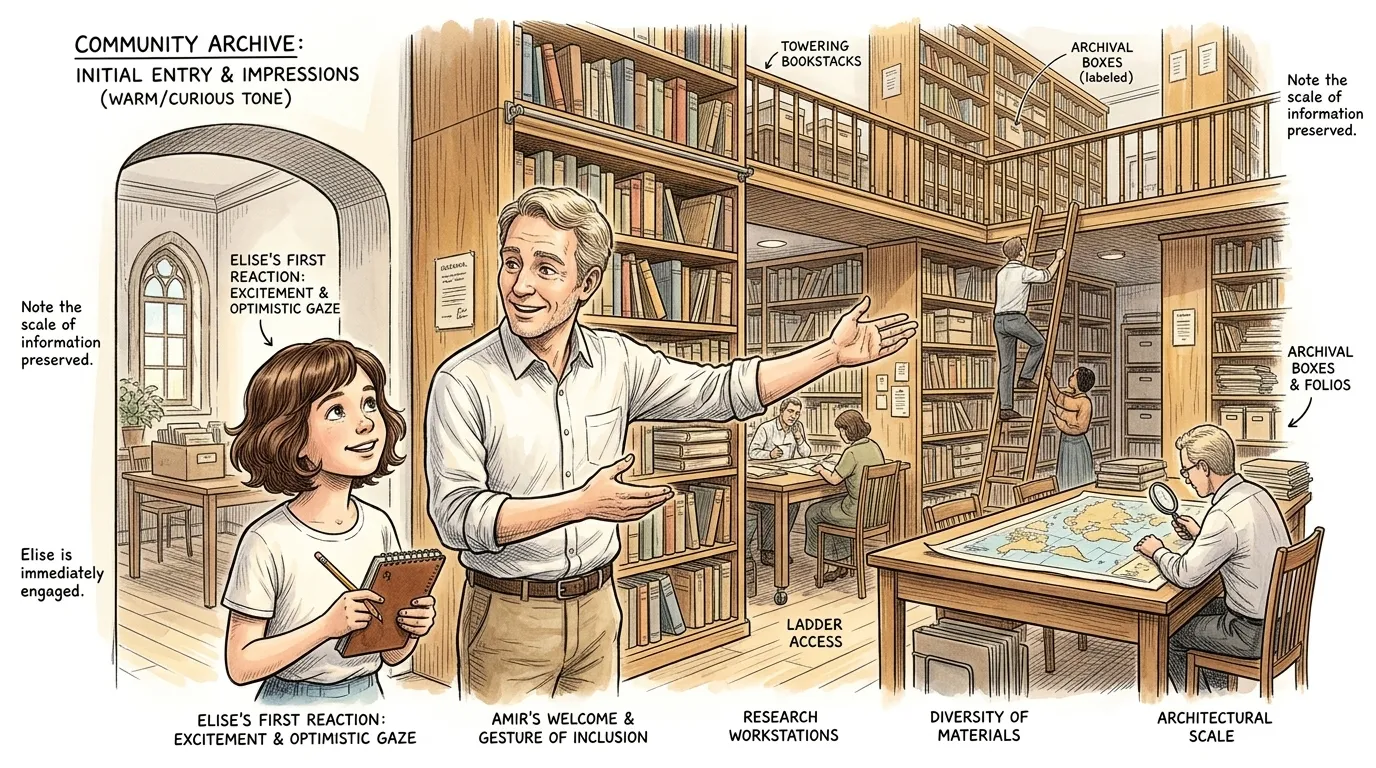
Elise and Amir entered the quiet hush of the old community archive, its towering shelves filled with the silent whispers of countless lives. \"Every one of these documents holds a story, Elise,\" Amir said, gesturing to the rows of books. \"But understanding them deeply, truly grasping what they mean, is a profound challenge, much like understanding ourselves.\"
""What do you mean, Amir? Isn't understanding just reading the words?" Elise asked, her brow furrowed in thought. "Not always," Amir replied, "Paul Ricoeur, a thoughtful philosopher, spent his life exploring how we interpret everything, from old texts to our very own experiences, to build meaning and identity.""
Philosophy Note: Paul Ricoeur (1913-2005) was a French philosopher known for his work in phenomenology and hermeneutics, focusing on the theory of interpretation, especially of texts, actions, and the self. He explored how narrative structures our understanding of identity and history.
Page 2

Amir led Elise towards a section marked 'Local History,' where older, more fragile artifacts were stored. \"Think of the stories here as different voices, some clear, some faint, all waiting to be truly heard and understood,\" he explained quietly. They carefully opened a dusty wooden crate that contained forgotten donations from decades ago.
""Look at this!" Elise exclaimed, carefully lifting a small, leather-bound journal. "It's old, really old, and some of the pages are water-damaged. There are strange drawings and symbols mixed in with the writing." Amir took it gently. "This, Elise, is a perfect example of what Ricoeur called a 'text'—not just words, but any human creation that begs for interpretation.""
Philosophy Note: Ricoeur extended the concept of 'text' beyond written documents to include human actions and experiences, arguing that these, too, can be 'read' and interpreted to uncover their deeper meaning, much like deciphering a complex book.
Page 3
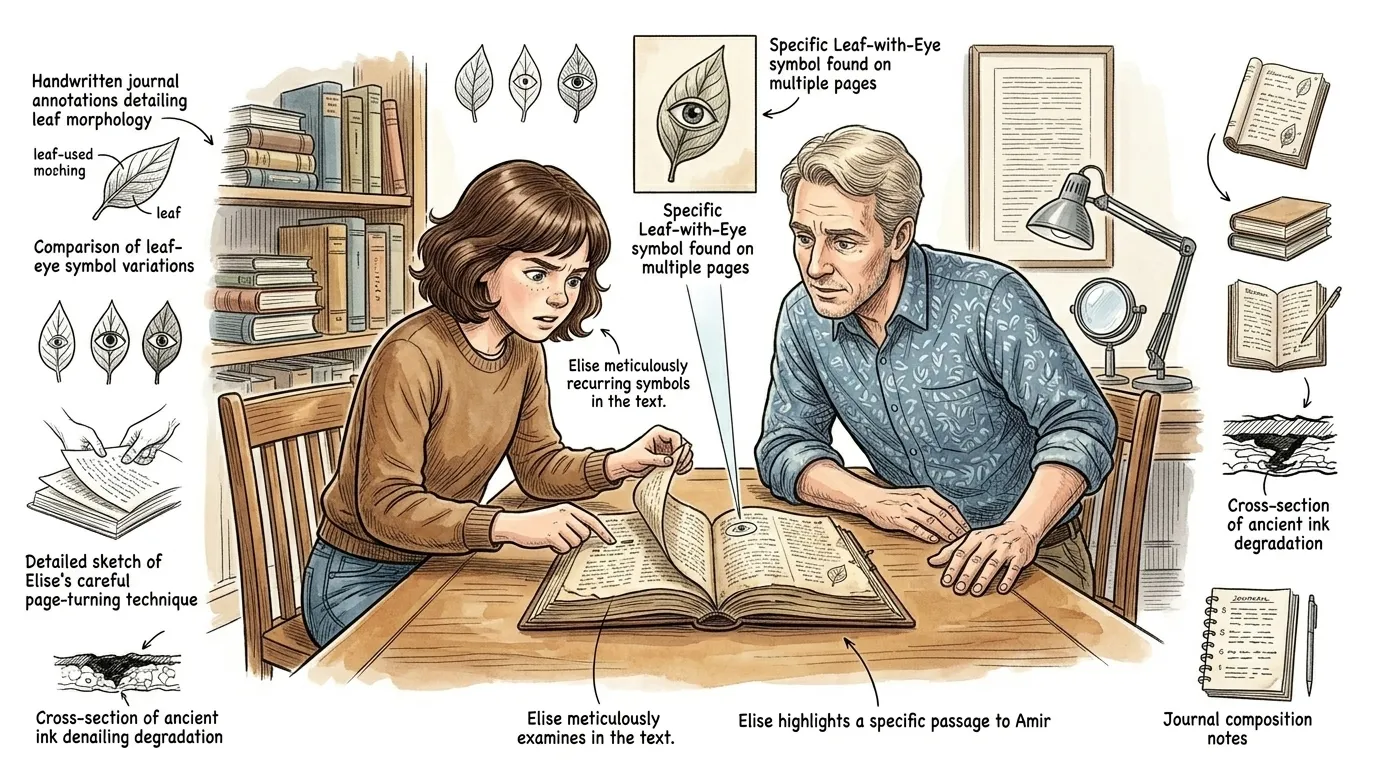
They carried the fragile journal to a large, polished wooden table, a circle of quiet concentration forming around it. Elise carefully turned the brittle pages, noting the faded ink and recurring, ornate symbols scattered throughout the entries. Each one seemed almost like a personal stamp, yet its meaning was entirely unclear.
""Many entries are fragmented," Elise observed, pointing to a passage where a drawing of a stylized leaf with an eye in its center appeared. "And this leaf-eye symbol keeps showing up. Is it just decoration, or does it mean something more?" Amir leaned closer. "Ricoeur taught us that to understand a text, especially one like this, we must interpret its symbols, its silences, and its fragmented narratives as much as its explicit words. Every detail offers a clue to the author's perspective.""
Philosophy Note: Hermeneutics, for Ricoeur, involves a dialectic between 'explanation' (analyzing the text's structure and parts) and 'understanding' (grasping its overall meaning and intention). Symbols play a crucial role, inviting deeper, multi-layered interpretations beyond the literal.
Page 4

Amir explained that true interpretation is not a single act but a continuous dialogue between the reader and the text, enriching both. He showed Elise how a single word could shift the entire meaning of a sentence, and how a sentence contributed to the overall message. Understanding, he insisted, grows with each pass.
""When we try to understand this journal," Amir elaborated, "we're not just looking at facts. We're trying to grasp the author's intentions, their feelings, their world. Ricoeur called this the 'hermeneutic circle'—we move from understanding the parts to understanding the whole, and then back again, refining our view each time." Elise nodded slowly. "So, if we understand what this author believed, it might change how we see their individual actions?""
Philosophy Note: The 'hermeneutic circle' describes the process where understanding of the individual parts of a text (words, sentences) depends on understanding the whole, and vice-versa. Ricoeur emphasized this iterative movement, where initial guesses are refined through deeper engagement with the text.
Page 5
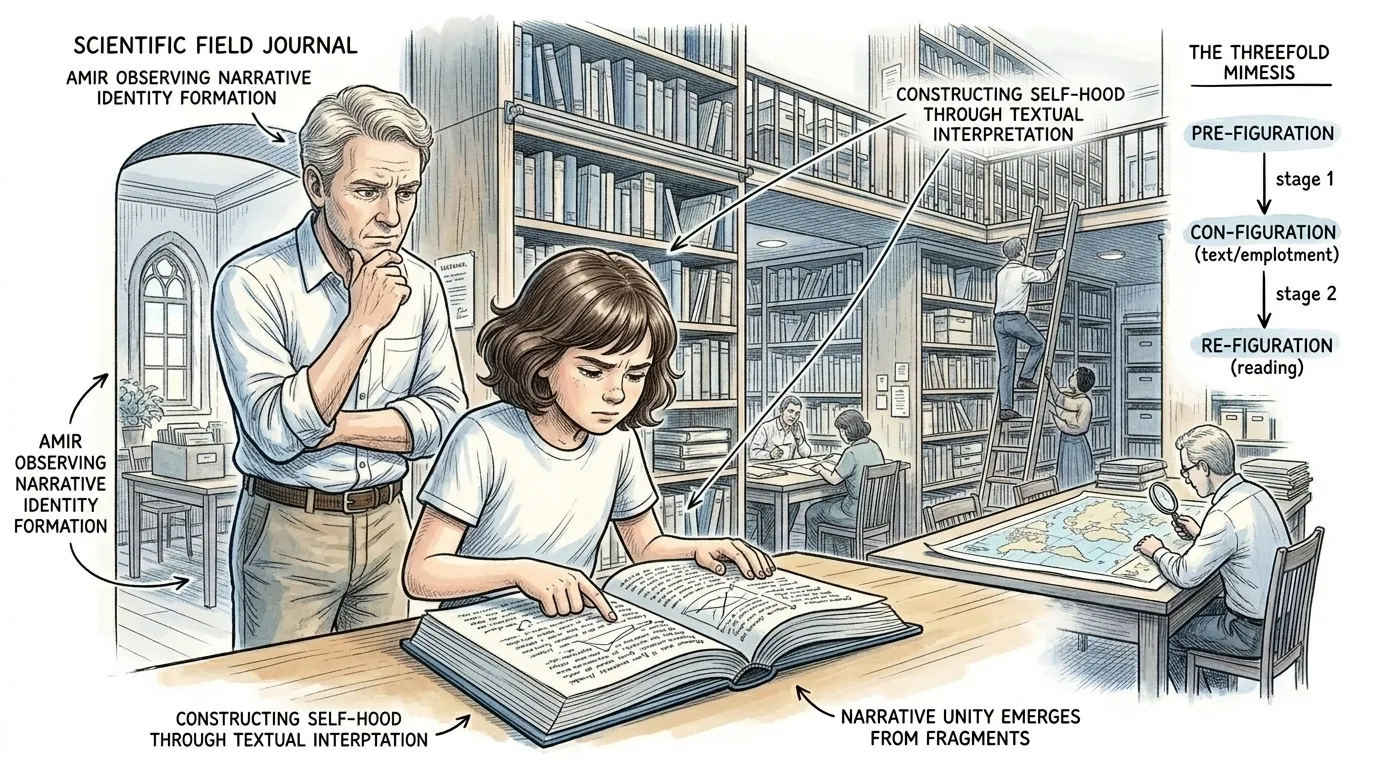
As they continued to pore over the journal, fragments of the author's life began to emerge, not as a list of events but as a developing narrative. Each entry, even the most cryptic, contributed to a portrait of a person. It was clear the journal was not merely a record, but a deliberate construction of self.
""This author, in writing this journal, was shaping their own story, creating their identity," Amir noted. "Ricoeur believed that our identity isn't fixed; it's a constant, ongoing narrative we tell about ourselves, and that others tell about us. We are, in essence, the stories we live and recount." Elise traced a finger along a particularly dense passage. "So, this isn't just about what happened, but how they chose to remember and present it?""
Philosophy Note: For Ricoeur, 'narrative identity' is central. Our sense of self is not a static substance but a dynamic process shaped by the stories we construct about our past, present, and future. This process involves both 'sameness' (what endures) and 'selfhood' (the evolving, interpreted self).
Page 6
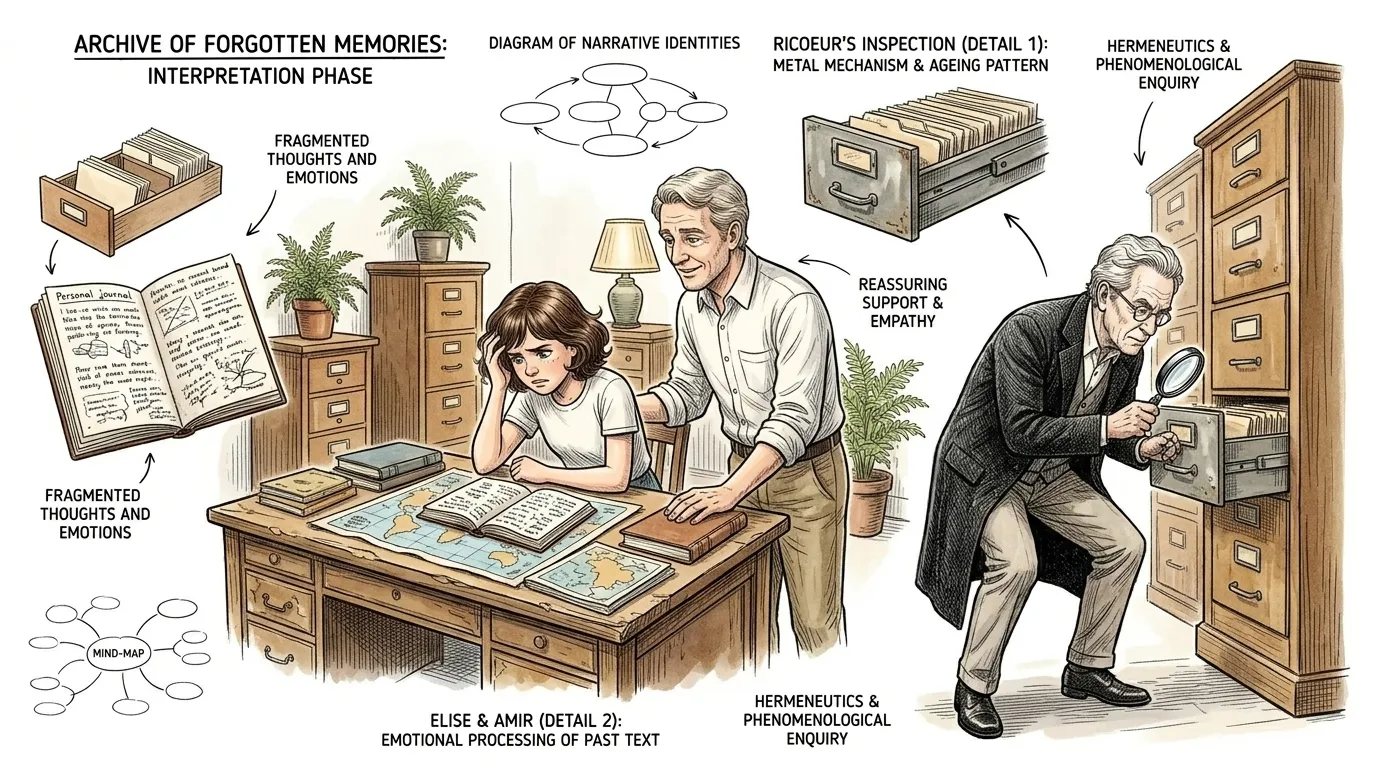
The journal entries painted a picture of someone wrestling with significant decisions and personal losses, experiences that echoed the struggles of many generations. The weight of these past moments seemed almost palpable, demanding careful attention and respect. It was clear that the author was trying to make sense of their own difficult history.
""It's challenging to truly grasp the meaning behind these fragmented thoughts and feelings," Elise admitted, feeling a sense of frustration. Amir looked at her kindly. "It is. But remember what the American writer William Faulkner once said: 'The past is never dead. It's not even past.' This journal shows us that the past continues to live through interpretation, shaping our present understandings.""
Philosophy Note: Ricoeur explored the ethical and epistemological dimensions of memory and history. He argued that history is not just a collection of facts, but an interpretative act, where we narrate the past in a way that gives it meaning for the present. The challenge lies in doing justice to past suffering while constructing a meaningful historical narrative.
Page 7
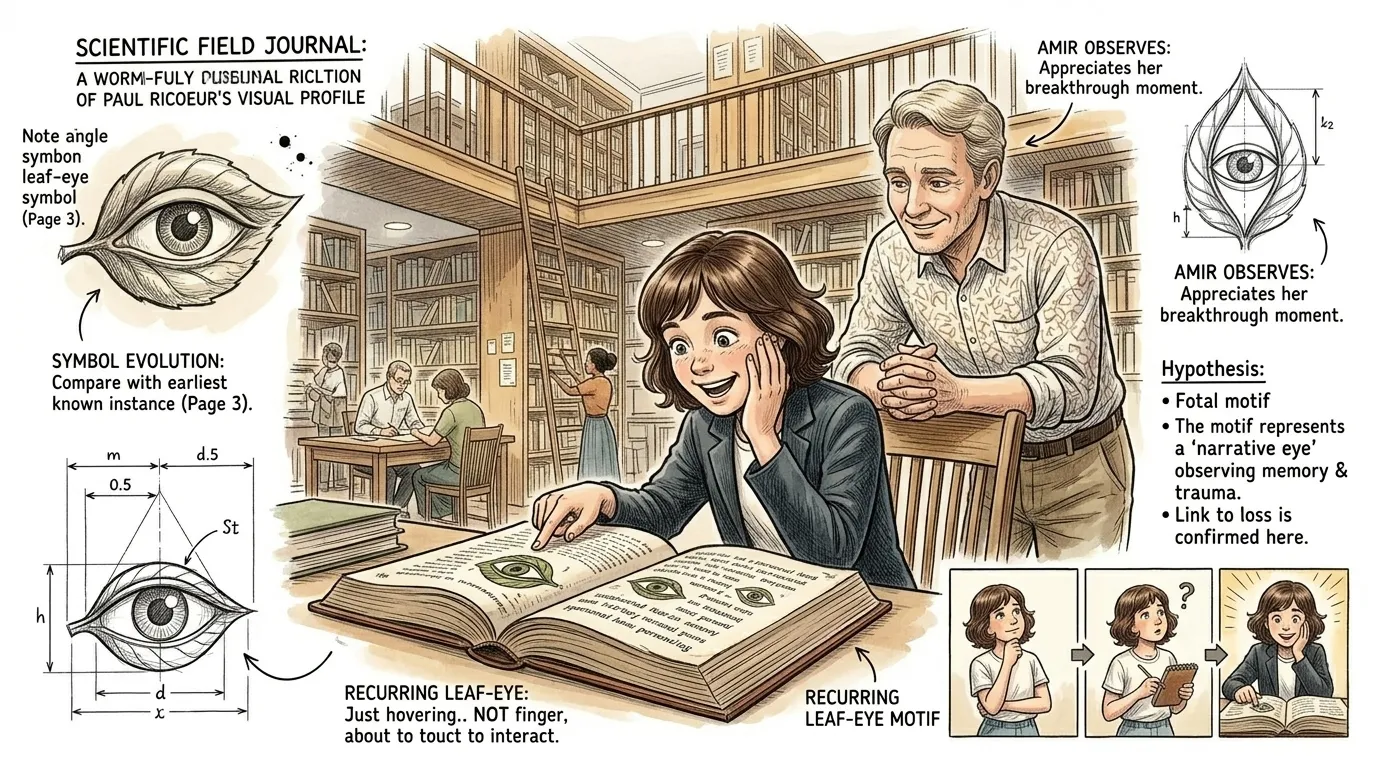
Elise stared at the page, her mind replaying Amir's words about symbols and context. Suddenly, her eyes widened as she looked at the recurring leaf-eye symbol, then back at a specific, difficult passage about personal loss. A flicker of realization crossed her face. The symbol wasn't just a design; it was an emotional marker.
""Amir," Elise said, her voice hushed with discovery, "this leaf-eye symbol—it's always present when the author writes about feeling lost or needing guidance, or when they mention their late parent! It's not just an abstract idea; it's a specific plea or remembrance, like their way of calling out for understanding!" Amir smiled. "Precisely, Elise! You've moved beyond the literal words to interpret the symbolic meaning, connecting a part to the whole narrative of their experience.""
Philosophy Note: This represents a critical moment in hermeneutics: the ability to discern the deeper, often emotional or contextual, meaning of a symbol within a larger narrative. Ricoeur would emphasize that such interpretative leaps are essential for moving from mere explanation to profound understanding.
Page 8

With this new insight, the fragments of the journal began to coalesce, revealing a more poignant and coherent story than they had initially grasped. The author's struggles and hopes, once veiled in ambiguity, now resonated with unexpected clarity. The journal transformed from a collection of cryptic entries into a deeply human confession.
""Now I understand this passage about leaving home!" Elise exclaimed, re-reading with fresh eyes. "It wasn't just about moving, but about leaving a part of their identity behind, searching for a new path, just as the leaf-eye symbol suggests a search for direction after loss." Amir nodded. "By interpreting that crucial symbol, you've unlocked a deeper layer of this person's narrative, truly understanding how they constructed their own story in the face of adversity. That's Ricoeur's hermeneutics in action.""
Philosophy Note: The successful interpretation of the symbol allows for a richer understanding of the narrative's 'configurational emplotment' – how disparate events are woven into a coherent, meaningful story. This act of interpretation reveals the author's narrative identity, providing insight into their experience and worldview.
Page 9

The old journal, once a mere relic, had become a living testament to a human life, its story now understood across generations. Elise felt a profound connection to the unknown author, a bond forged through the careful act of interpretation. It was a powerful reminder of how stories transcend time and connect us all.
""It's amazing how deeply we can understand someone, even from so long ago, just by carefully interpreting their story," Elise mused, closing the journal gently. "This isn't just about history anymore; it feels like I know this person." Amir agreed. "Ricoeur believed that through these narratives—historical, fictional, or personal—we encounter the 'other,' and in doing so, we also gain a deeper understanding of ourselves and our own identities.""
Philosophy Note: Ricoeur consistently emphasized the ethical dimension of hermeneutics. Interpretation is not merely an intellectual exercise but a moral one, requiring empathy and openness to the 'other.' Understanding narrative identity allows us to build bridges across time and difference, fostering mutual recognition and respect.
Page 10
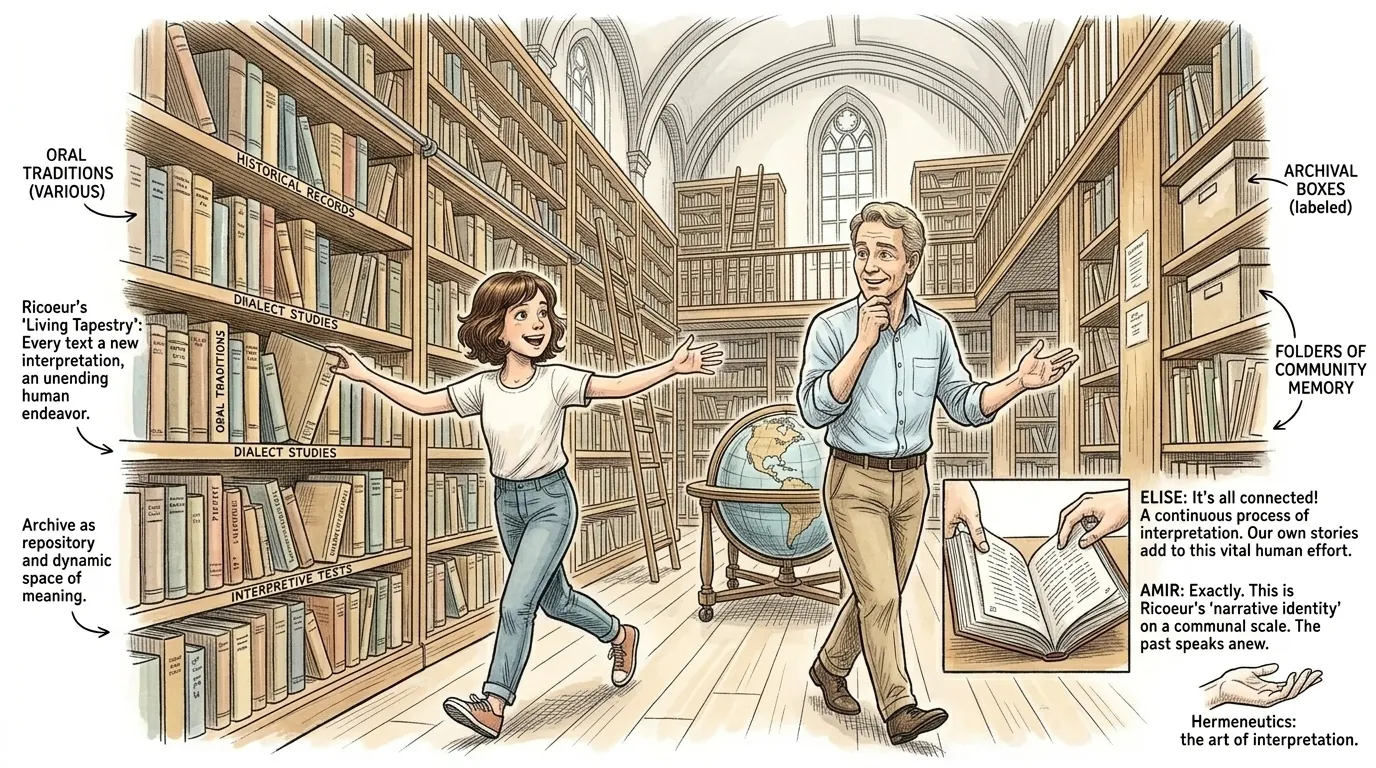
As they prepared to leave the archive, the concept of narrative identity felt less like a philosophical idea and more like a lived reality. Every person, every community, holds a complex tapestry of stories. Understanding these narratives, and interpreting our own, is a continuous, vital human endeavor. The archive felt richer, not just with books, but with lives waiting to be understood.
""So, Paul Ricoeur's philosophy helps us understand that we are always telling and interpreting our own stories, and the stories of others?" Elise summarized. "Exactly," Amir confirmed. "From personal journals to historical accounts, from daily conversations to grand epics—our lives are woven from these narratives. Ricoeur reminds us that by engaging deeply with these stories, we continually define, redefine, and enrich what it means to be human.""
Philosophy Note: Ricoeur's legacy lies in his comprehensive theory of the interpretive self, which integrates phenomenology, hermeneutics, and structuralism. His work offers a powerful framework for understanding how language, narrative, and symbolism shape our identity, history, and ethical engagement with the world, making him a cornerstone of modern critical philosophy.
About this story
- Audience: general readers
Questions and answers
Read Wonder Philosophy on your phone
Wonder Philosophy is available on Android and iPhone and iPad. Get Wonder Philosophy on Google Play · Get Wonder Philosophy on the App Store.