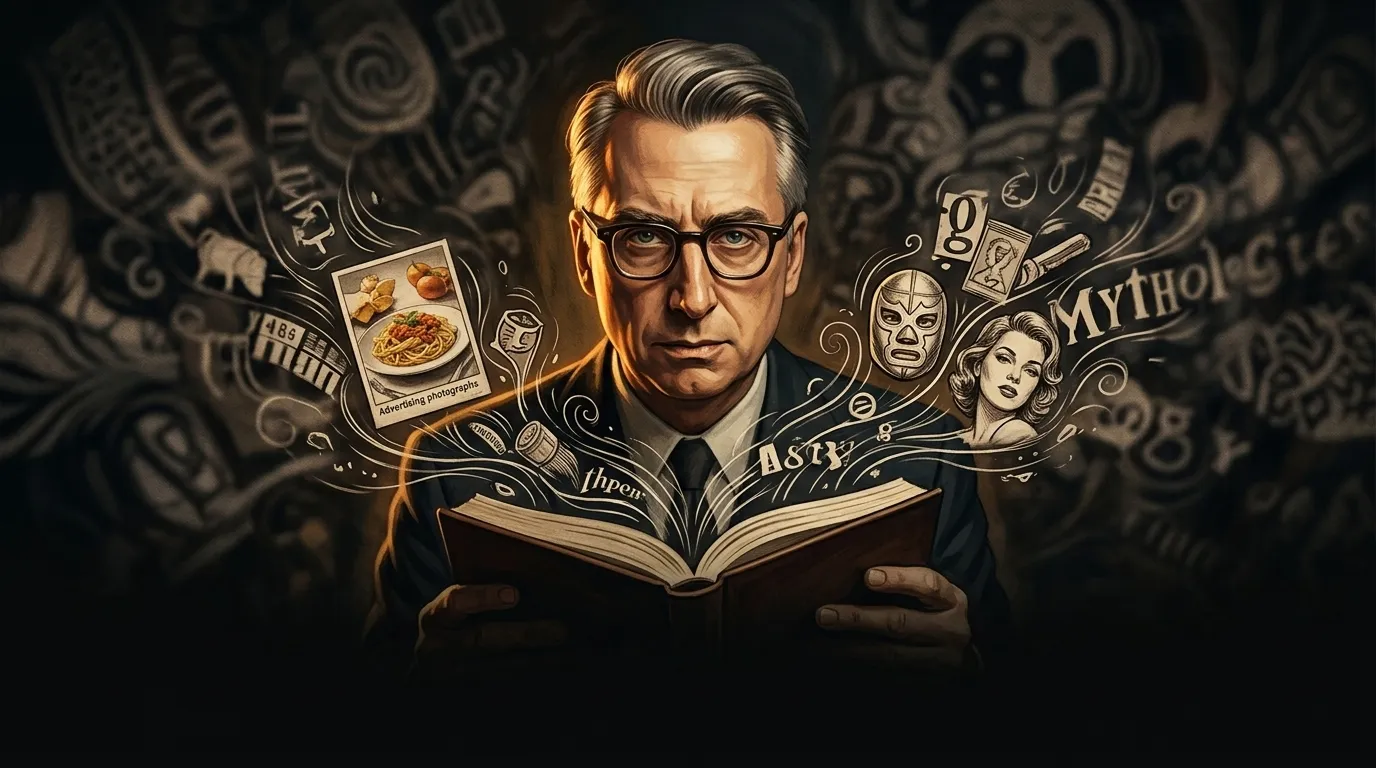
Roland Barthes
Roland Barthes — an illustrated philosophy story. 10 illustrated pages, free to read on Wonder Philosophy.
Page 1
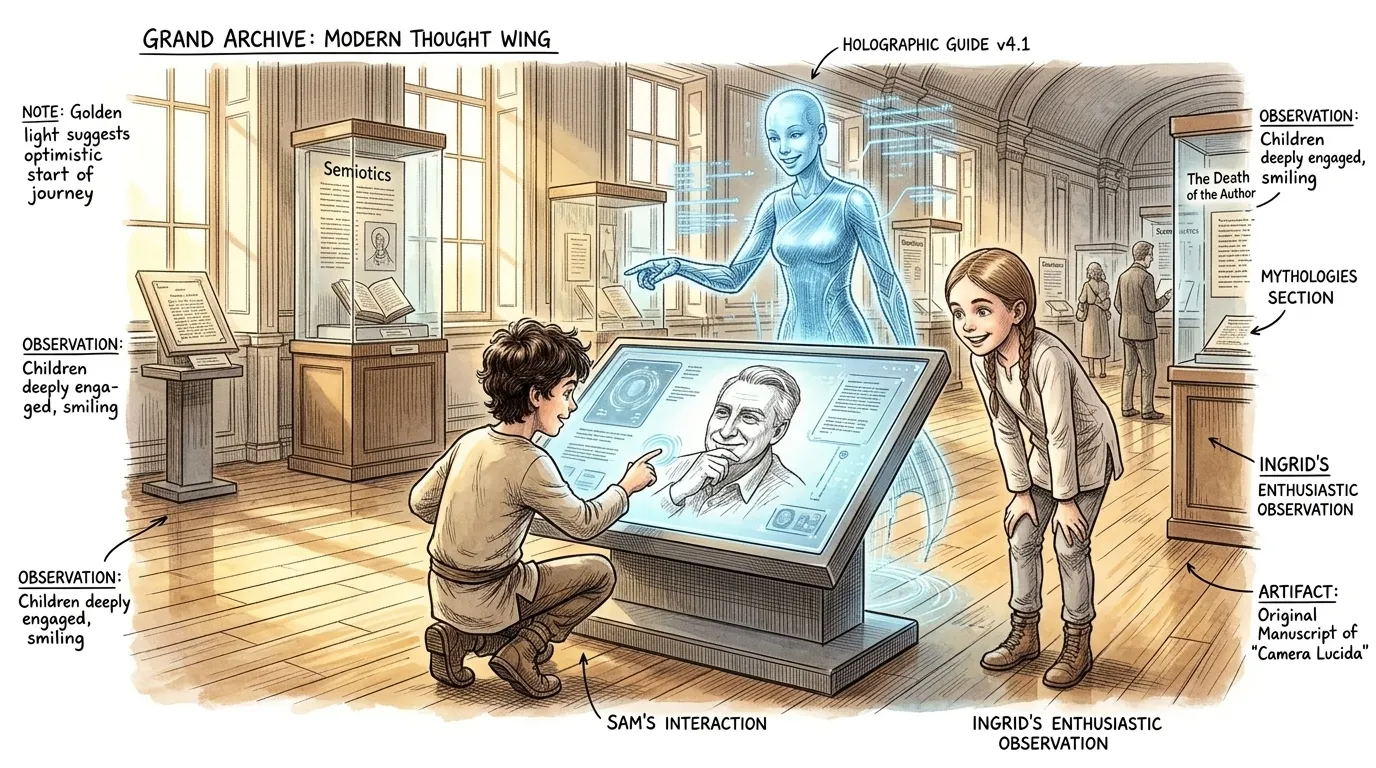
Sami and Ingrid stood before a large interactive screen in the 'Modern Thought' wing of the Grand Archive, a digital display showing a portrait of a thoughtful man. Light spilled across the polished floor, illuminating historical artifacts from various eras.
"'This display is about Roland Barthes,' Sami announced, tapping the screen. 'It says he helped us see how everyday things, like a wrestling match or a magazine picture, are actually telling us secret stories, or 'myths,' about our culture.' Ingrid nodded slowly, her eyes fixed on the screen. 'So, he wasn't just looking at what things are, but what they mean to us without us even realizing it?'"
Philosophy Note: Roland Barthes (1915-1980) was a French literary theorist, philosopher, linguist, and semiotician. He is a key figure in structuralism and post-structuralism, movements that critically examined how meaning is produced and understood in language and culture.
Page 2
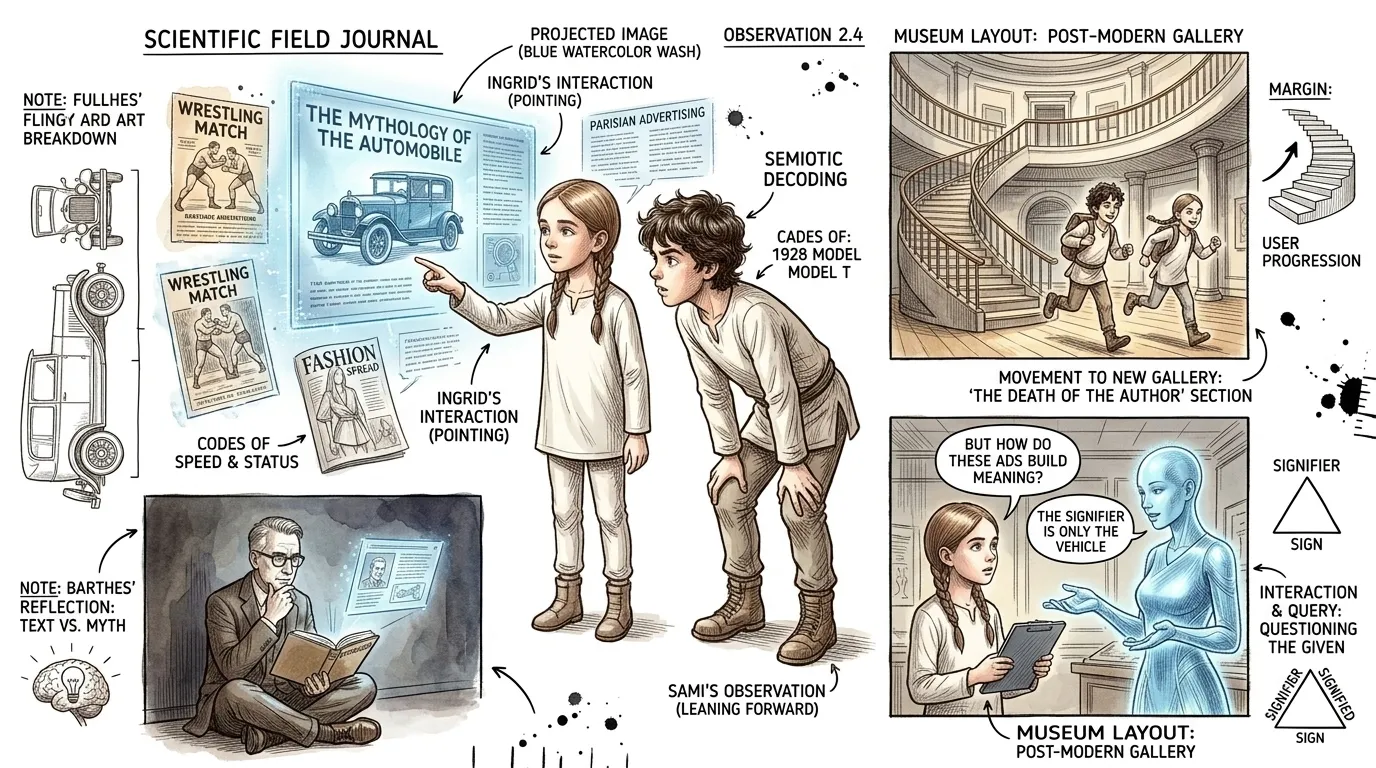
They moved to a holographic projection showing snippets of 20th-century life: advertisements, wrestling posters, fashion spreads. Barthes' early work explored these common cultural objects.
"'Barthes started by looking at things we usually don't think much about, like ads for soap or pictures of movie stars,' Ingrid explained, pointing at a projected image of an old car advertisement. 'He saw them not just as products, but as powerful 'signs' that tell us what society values, what's 'normal,' or even what's 'natural' – even when it's totally made up.' Sami leaned closer to study the advertisement. 'So, like, this ad isn't just selling a car, it's also selling an idea of freedom or success?'"
Philosophy Note: Barthes' seminal work, 'Mythologies' (1957), analyzed a range of contemporary cultural phenomena, from professional wrestling to plastic toys, revealing how they function as 'myths' that naturalize ideological messages within society.
Page 3
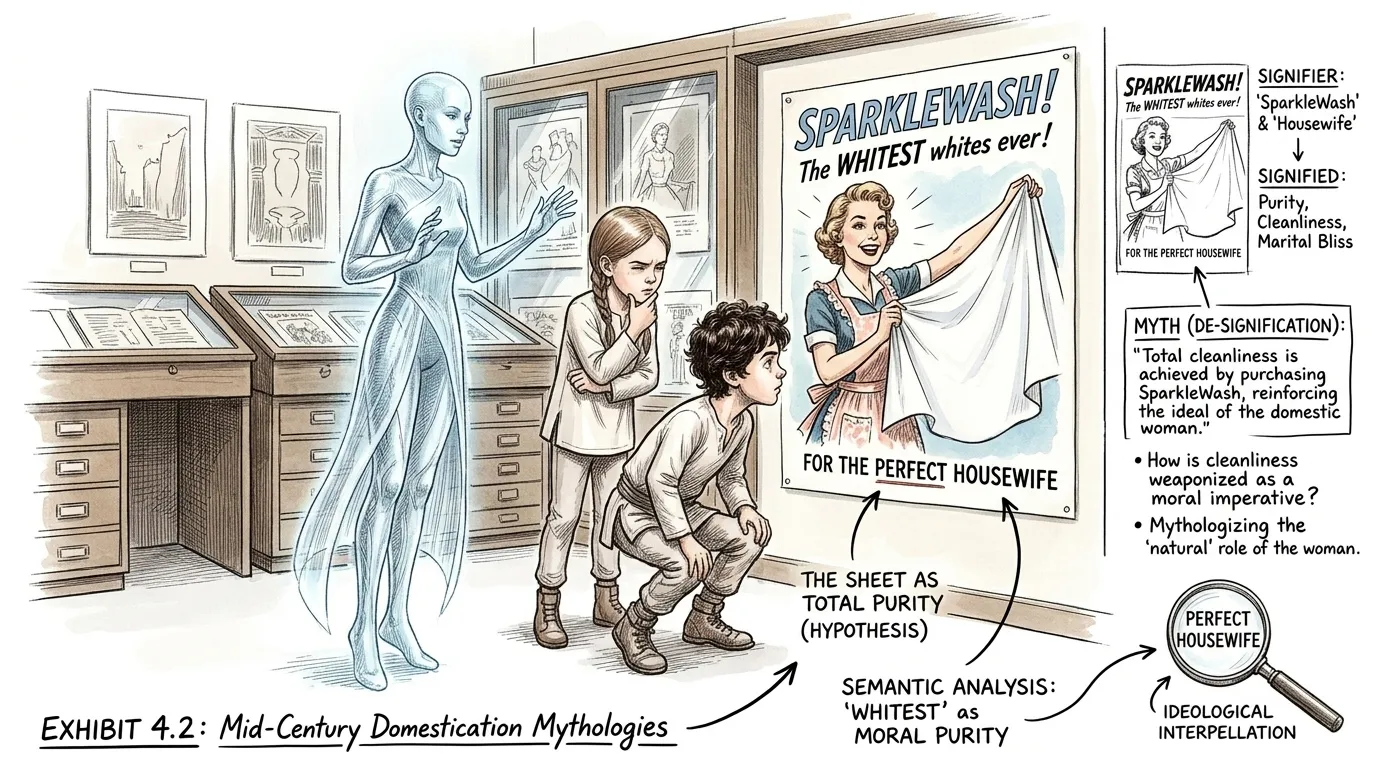
A helpful holographic guide appeared, materializing as a shimmering, translucent outline. The guide presented a specific, antique magazine advertisement for a brand of laundry detergent, dating from the mid-20th century.
"'Roland Barthes called these unspoken cultural messages 'mythologies',' the holographic guide chimed, gesturing toward the vintage laundry detergent ad. 'He showed how they use simple signs—like a sparkling white shirt in an advertisement—to build bigger ideas, like 'cleanliness equals virtue' or 'progress is always good.' This particular ad, for a fictional brand called 'SparkleWash,' used the image of a beaming housewife holding up a pristine white sheet.' Ingrid squinted at the image, then looked at Sami. 'So the 'sparkling white shirt' isn't just clean, it's also telling a story about who should do laundry, and what a 'good' home looks like?'"
Philosophy Note: Barthes argued that 'myth' operates by transforming a sign (like an image of a clean shirt) into a signifier for a second-order meaning (like societal values). This process makes cultural ideas seem natural and universal, rather than constructed.
Page 4
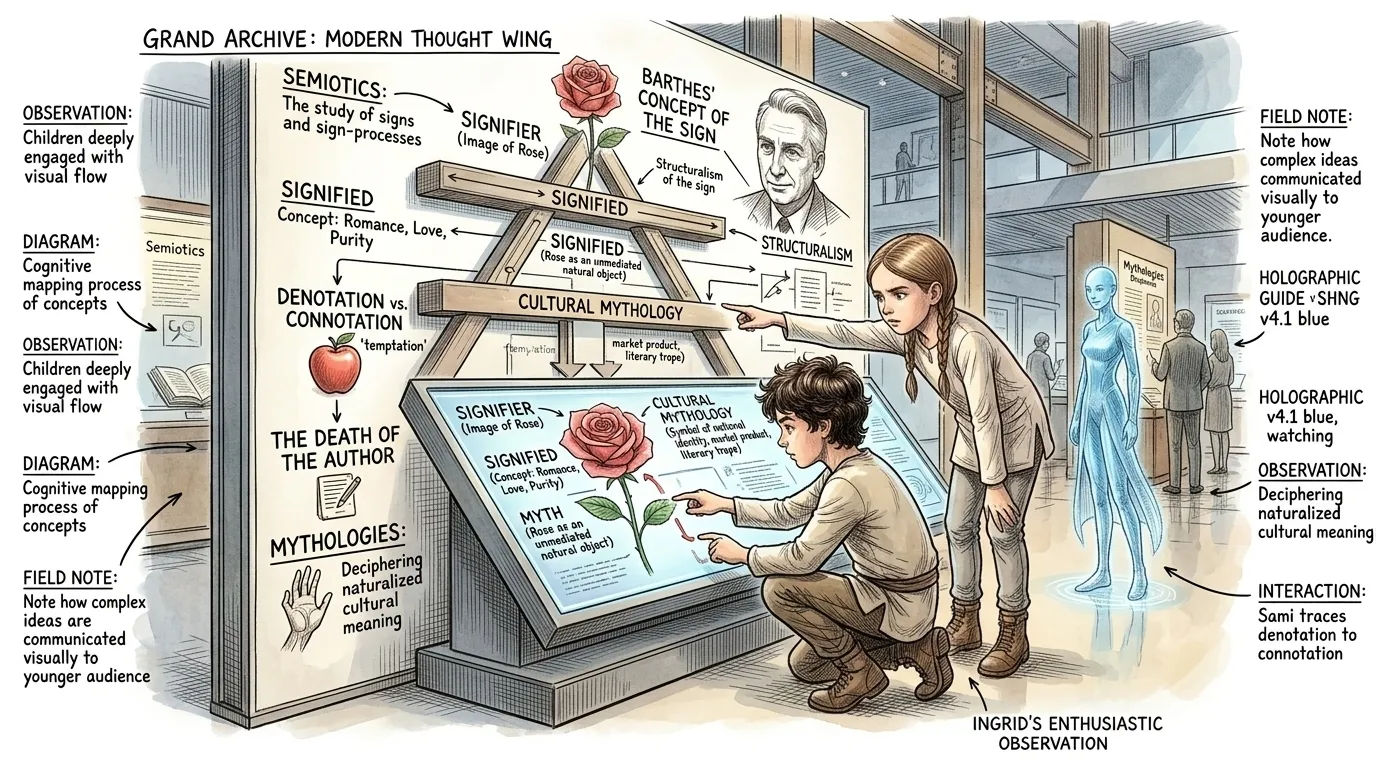
Sami and Ingrid moved to another display, which illustrated Barthes' ideas about how signs work. It showed how a simple image can carry multiple layers of meaning.
"'Barthes explained that everything around us is a sign,' Sami said, tracing a finger over a diagram on the display. 'A rose, for instance, is a sign. Its basic meaning is 'a flower.' But in a love poem or on Valentine's Day, it also signifies 'love' or 'romance.' That second meaning is the 'myth' that society has built around it.' Ingrid pointed to another part of the diagram. 'And he showed how these 'mythologies' aren't always bad, but they shape how we see the world without us even noticing, right?'"
Philosophy Note: Barthes built upon Ferdinand de Saussure's linguistic theory, distinguishing between the 'denotation' (literal meaning) and 'connotation' (cultural or mythical meaning) of signs. This layering of meaning is central to his analysis of cultural phenomena.
Page 5
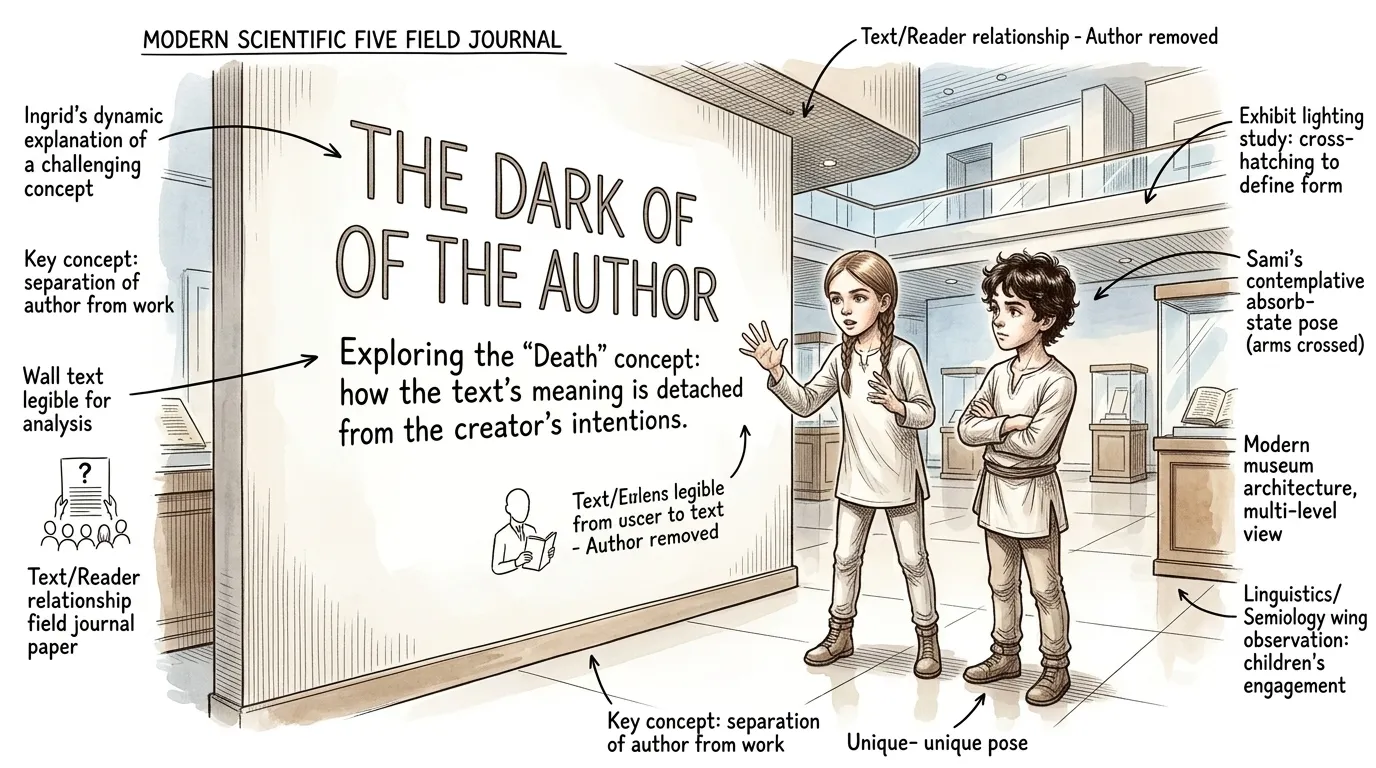
Next, they explored Barthes' more challenging concept: 'The Death of the Author.' It suggested that a writer's intentions don't define a text's meaning.
"'Barthes also had a really famous idea called 'The Death of the Author',' Ingrid explained, gesturing to a wall text on a display. 'It means that once a writer publishes a book or creates a piece of art, the meaning of that work doesn't belong to the author anymore. It belongs to us, the readers or viewers, and our own interpretations.' Sami looked thoughtful. 'So, what the author meant to say isn't the most important thing; it's what we understand from it?'"
Philosophy Note: 'The Death of the Author' (1967) is one of Barthes' most influential essays. It challenged traditional literary criticism by asserting that a text's meaning is not fixed by its author's intention but is instead created in the act of reading.
Page 6
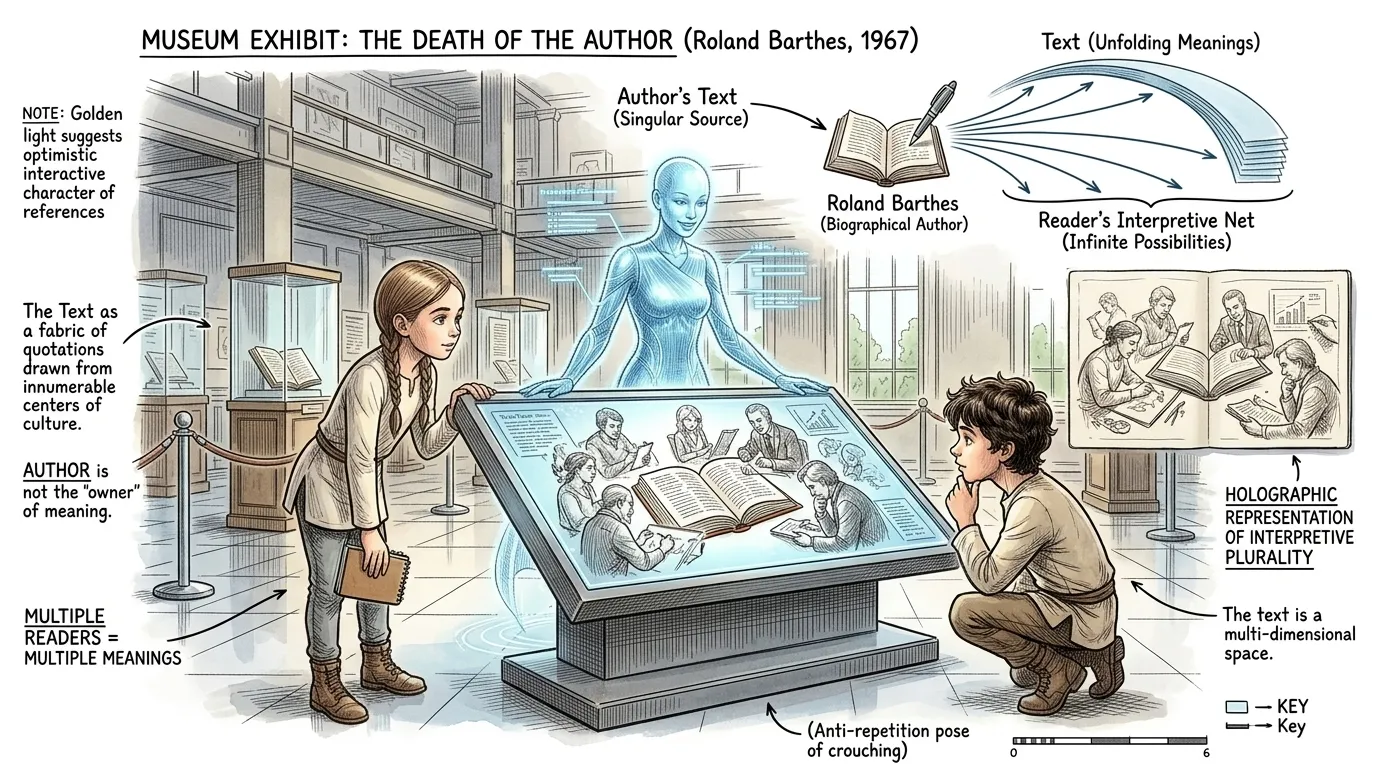
The holographic guide reappeared to further clarify the implications of 'The Death of the Author,' showing how it shifts power from the creator to the audience.
"'This idea frees us, the audience, to find our own meanings,' the holographic guide explained, its shimmering form hovering over a depiction of multiple readers interpreting the same book in different ways. 'It means a story can have countless interpretations, and none is more 'correct' than another just because the author might have intended something specific.' Ingrid considered this, then looked at Sami. 'So, it makes reading and art much more personal, and it gives us, the readers, a lot of power?'"
Philosophy Note: Barthes' concept empowers the reader, allowing for a more subjective and culturally sensitive engagement with texts. It also implies that a text is a 'tissue of quotations' drawn from countless centers of culture, rather than a single original creation.
Page 7
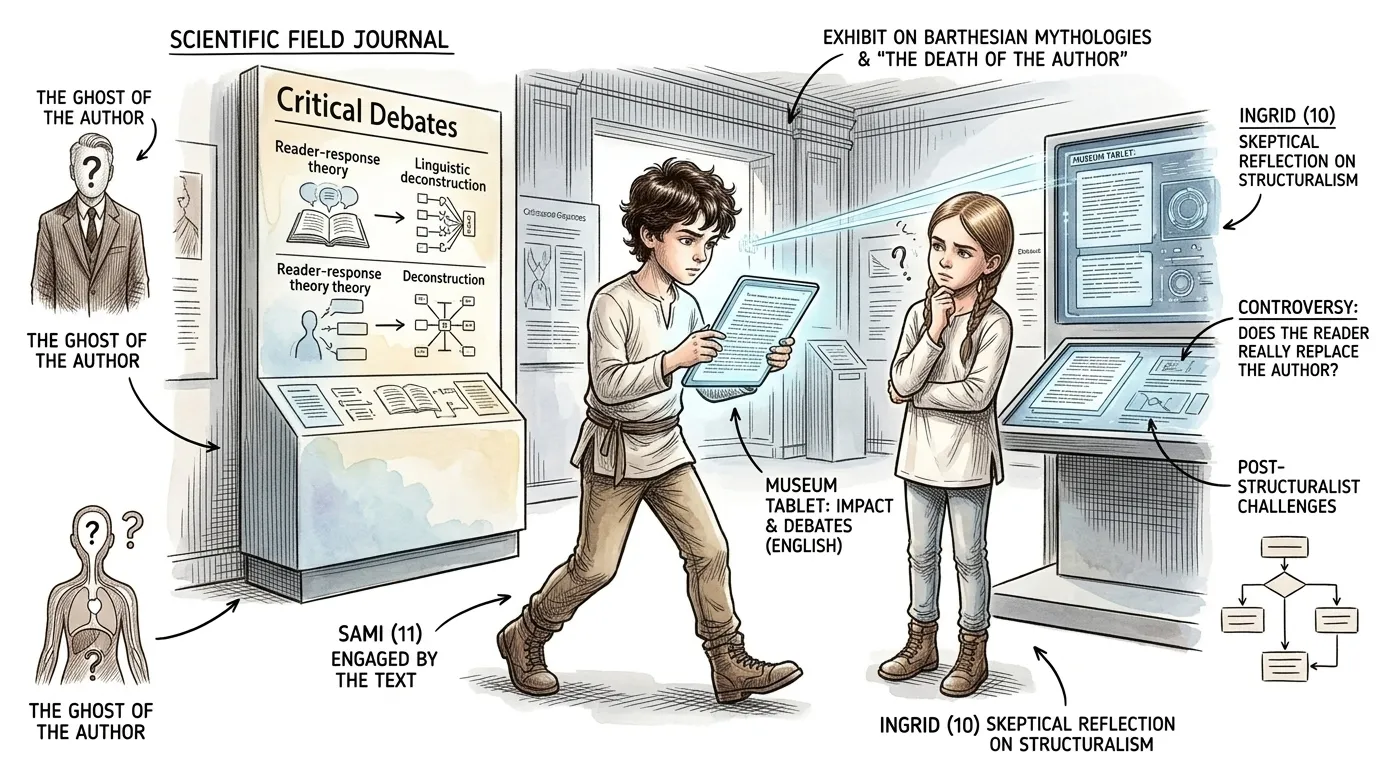
They then found themselves in a section discussing the impact and debates surrounding Barthes' radical ideas. Some found his theories liberating, while others felt they dismissed the author's voice too much.
"'Some people found 'The Death of the Author' a bit scary,' Sami noted, reading from a tablet provided by the museum. 'They worried that if the author's intention doesn't matter, then anything could mean anything, and we'd lose a lot of meaning!' Ingrid shook her head thoughtfully. 'But Barthes probably meant it more like, 'Let's look beyond just what the author said, and see what we bring to the story,' right? It's about being active thinkers, not just passively taking in what someone tells us.'"
Philosophy Note: While celebrated for its liberating potential, 'The Death of the Author' also faced criticism for potentially undermining authorial responsibility and leading to arbitrary interpretations. Barthes himself continued to evolve his ideas, later exploring the deeply personal connection between photography and the viewer in 'Camera Lucida.'
Page 8
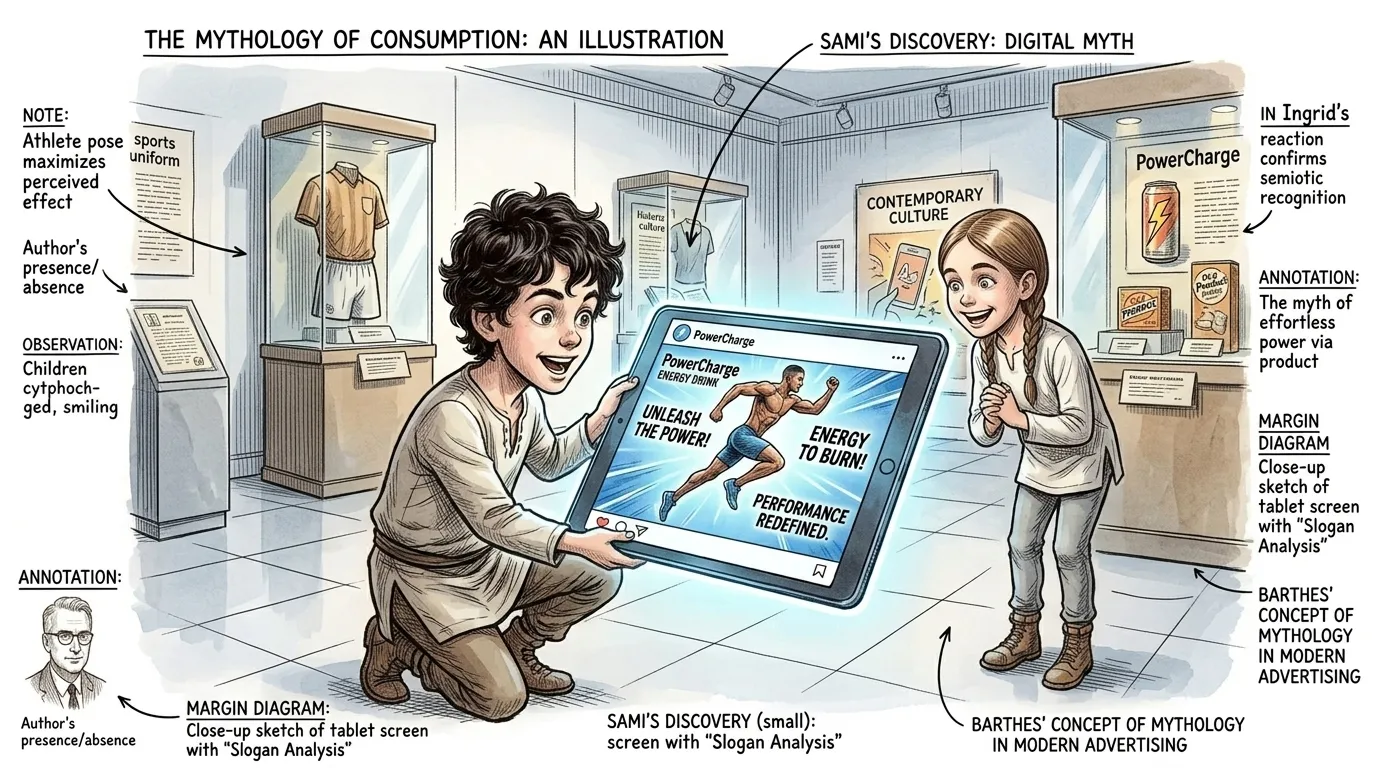
Suddenly, a notification appeared on Sami's tablet, displaying a modern social media advertisement for a popular energy drink, complete with vibrant graphics and catchy slogans. It was precisely the kind of everyday 'myth' Barthes would analyze.
"'Look at this ad for 'PowerCharge' energy drink,' Sami exclaimed, holding up his tablet, which glowed with the advertisement for a 'PowerCharge' energy drink showing a muscular athlete. 'It's not just selling a drink, it's selling the idea that if you drink it, you'll be strong, successful, and always winning!' Ingrid smiled. 'Exactly! Remember that old 'SparkleWash' ad we saw earlier? Just like that, this ad uses bright colors and a fit athlete to create a 'myth' that links the drink to power and coolness, even if the drink itself just gives you a sugar rush!'"
Philosophy Note: Barthes' methodologies remain highly relevant for analyzing contemporary media, advertising, and popular culture. His tools allow us to critically examine how brands, social media trends, and influencers construct 'myths' around products, lifestyles, and identities.
Page 9
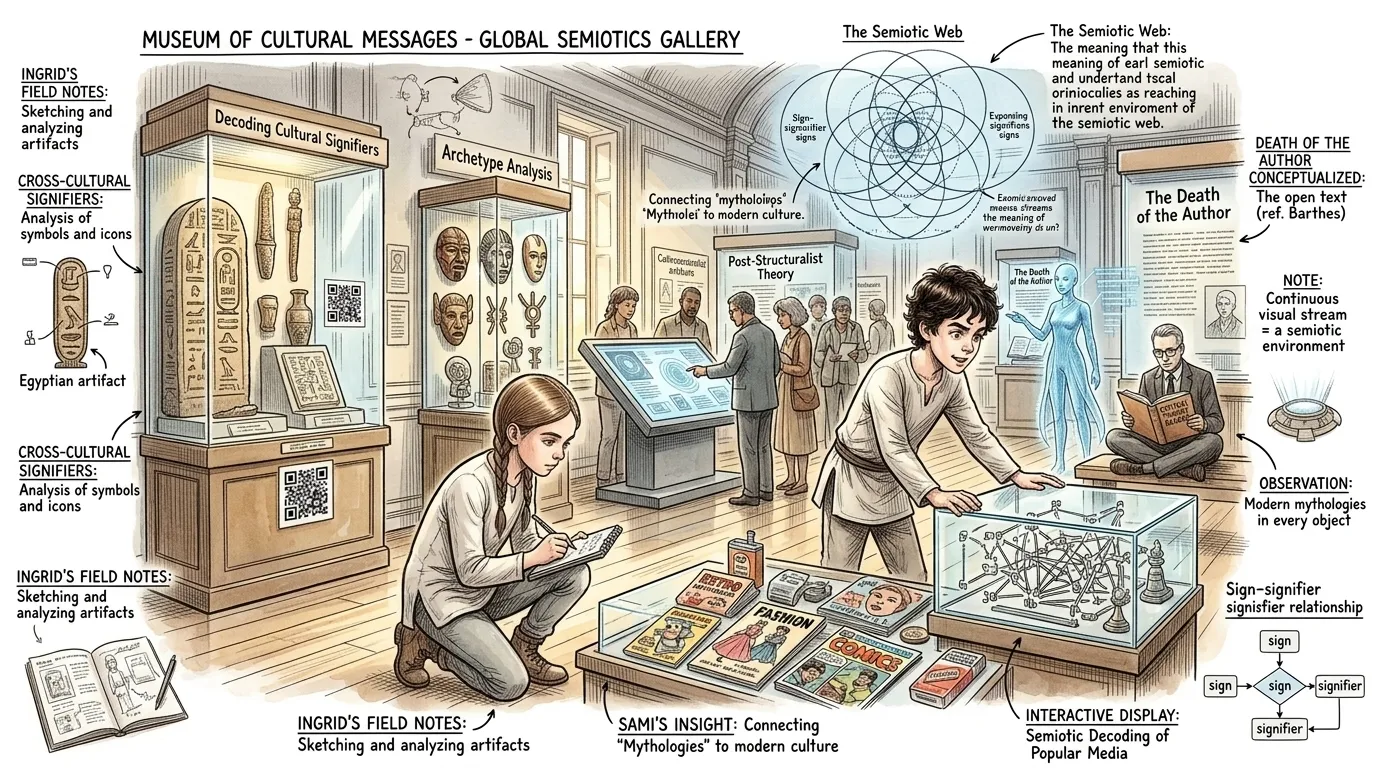
Sami and Ingrid realized how Barthes' insights could help them understand the countless messages they encounter every day.
"'Roland Barthes truly taught us how to 'read' the world around us, not just books,' Ingrid observed, looking around the bustling museum, full of diverse exhibits. 'He showed us that every image, every product, every trend carries hidden messages that shape our understanding.' Sami nodded emphatically. 'It's like he said, 'Language is a skin: I rub my language against the other.' He meant our words and ideas are how we connect and interact, shaping the meanings we create together, which is super important when trying to understand all these cultural 'skins' we encounter!'"
Philosophy Note: Barthes' enduring legacy lies in equipping us with the tools to be critical readers of culture. His work encourages us to question the 'naturalness' of certain ideas and to recognize the constructed nature of meaning, fostering intellectual autonomy.
Page 10
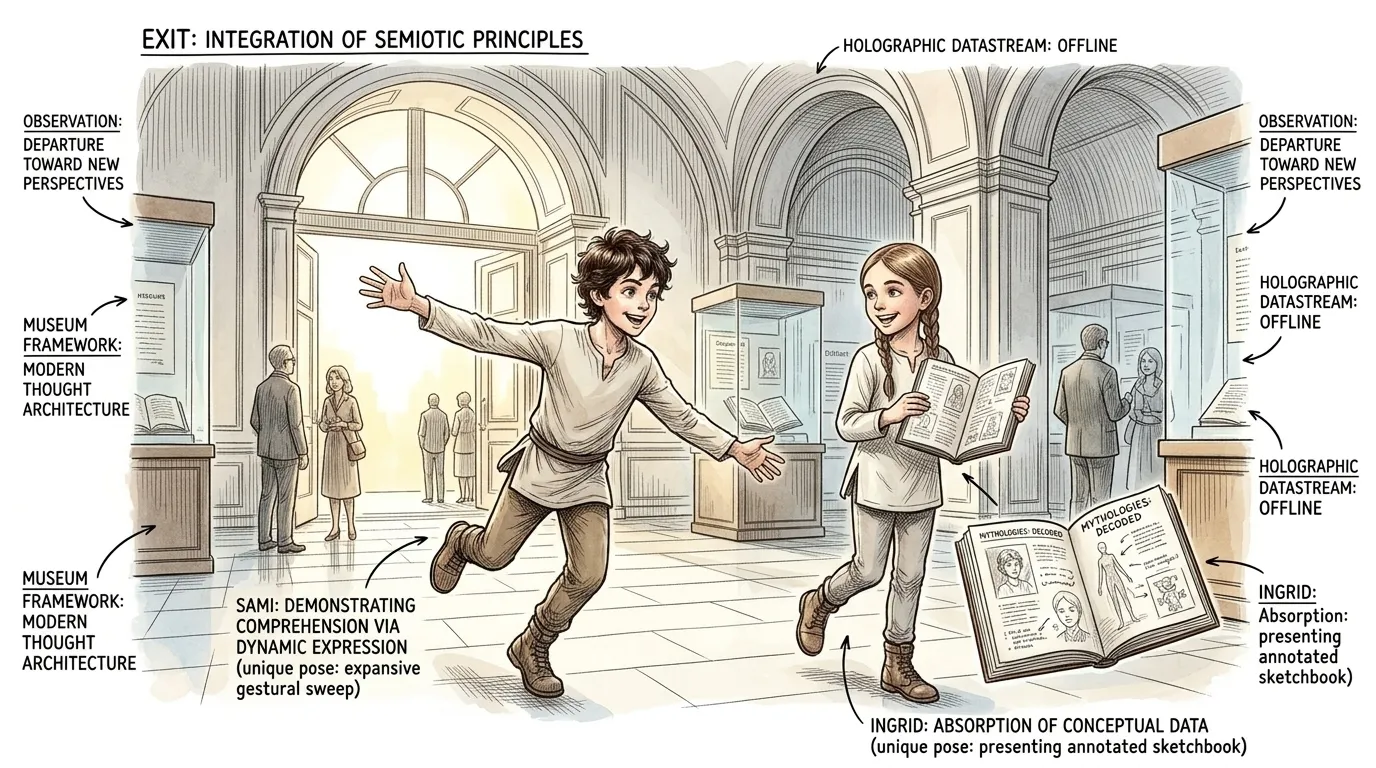
As their visit concluded, Sami and Ingrid understood that Barthes' work was an invitation to look deeper, to question, and to actively participate in the creation of meaning.
"'So, Barthes wasn't just telling us what to think, but how to think about the world's messages,' Sami concluded, gesturing towards the exit of the Modern Thought wing. 'He gave us a way to analyze everything, from news articles to fashion, and see the hidden ideas behind them.' Ingrid smiled, her mind clearly buzzing with new perspectives. 'It makes you realize that understanding the world isn't just about facts, but about interpreting all the 'signs' and 'myths' that surround us every single day!'"
Philosophy Note: Roland Barthes' work continues to be a cornerstone of semiotics, literary theory, and cultural studies. His ideas empower individuals to deconstruct cultural narratives, making us more discerning consumers and creators of meaning in an increasingly complex world.
About this story
- Audience: kids (ages 6–12)
Questions and answers
Read Wonder Philosophy on your phone
Wonder Philosophy is available on Android and iPhone and iPad. Get Wonder Philosophy on Google Play · Get Wonder Philosophy on the App Store.