Shantarakshita
Explore Shantarakshita's synthesis of Madhyamaka and Yogacara, bridging conventional and ultimate truths. Discover how this framework shaped Tibetan Buddhism and offers insights into mind and reality.
Page 1
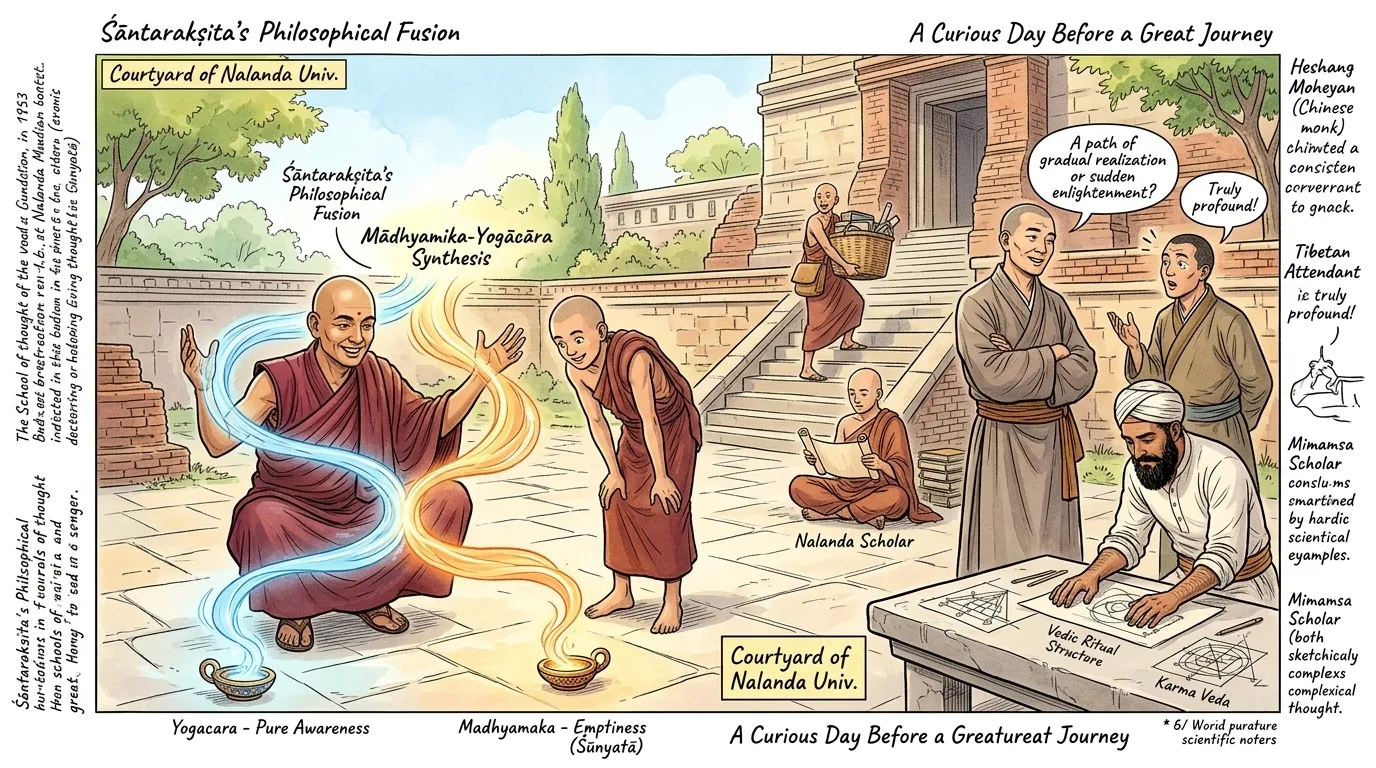
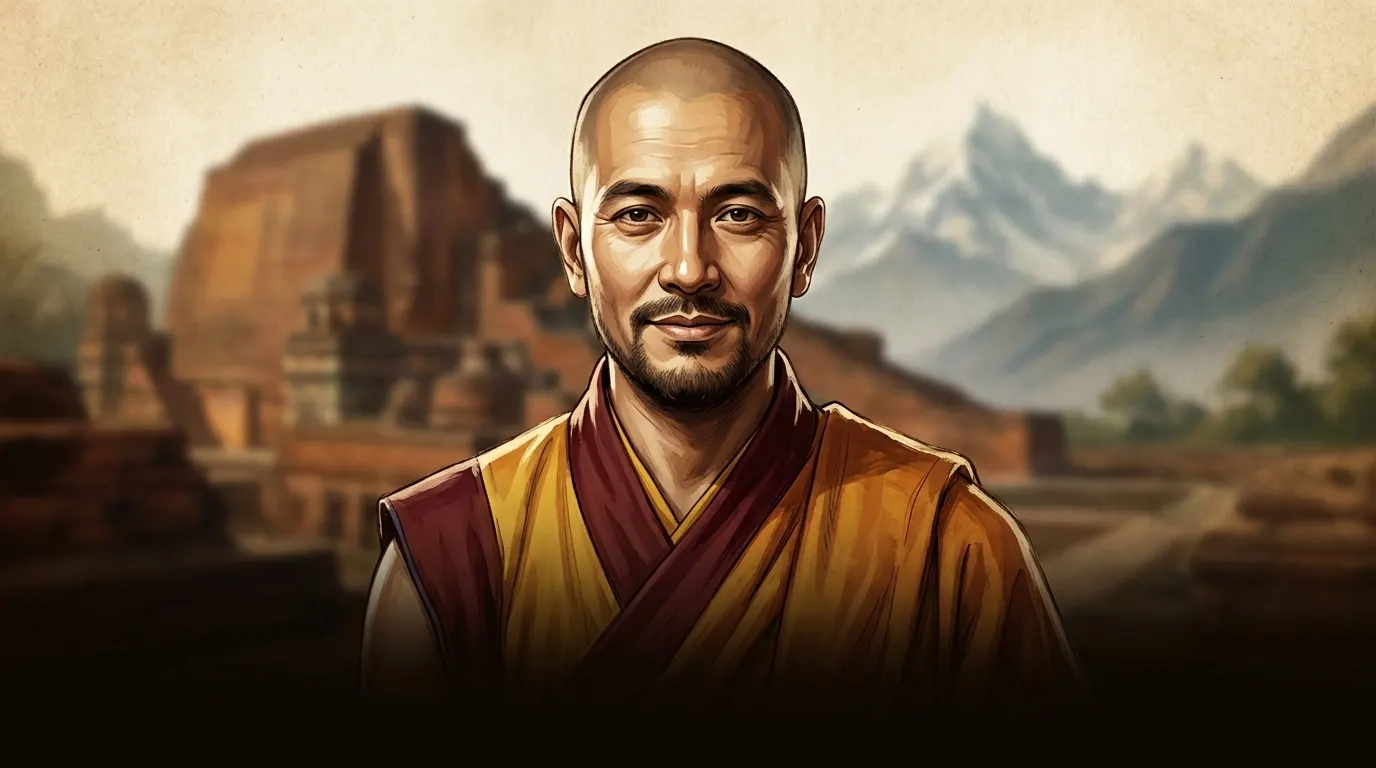
In the 8th century, amidst the flourishing intellectual hubs of ancient India, a philosopher of unparalleled insight emerged: Shantarakshita. As a revered abbot of Nalanda University, he confronted a profound challenge within Buddhist thought: reconciling two seemingly opposing doctrines. His solution, a sophisticated synthesis of Madhyamaka's radical emptiness and Yogacara's focus on consciousness, offered a robust framework for understanding reality.
Philosophy Note: Shantarakshita's synthesis sought to unify the conventional truth (Yogacara's mind-only reality) with the ultimate truth (Madhyamaka's emptiness), providing a complete philosophical path.
Page 2
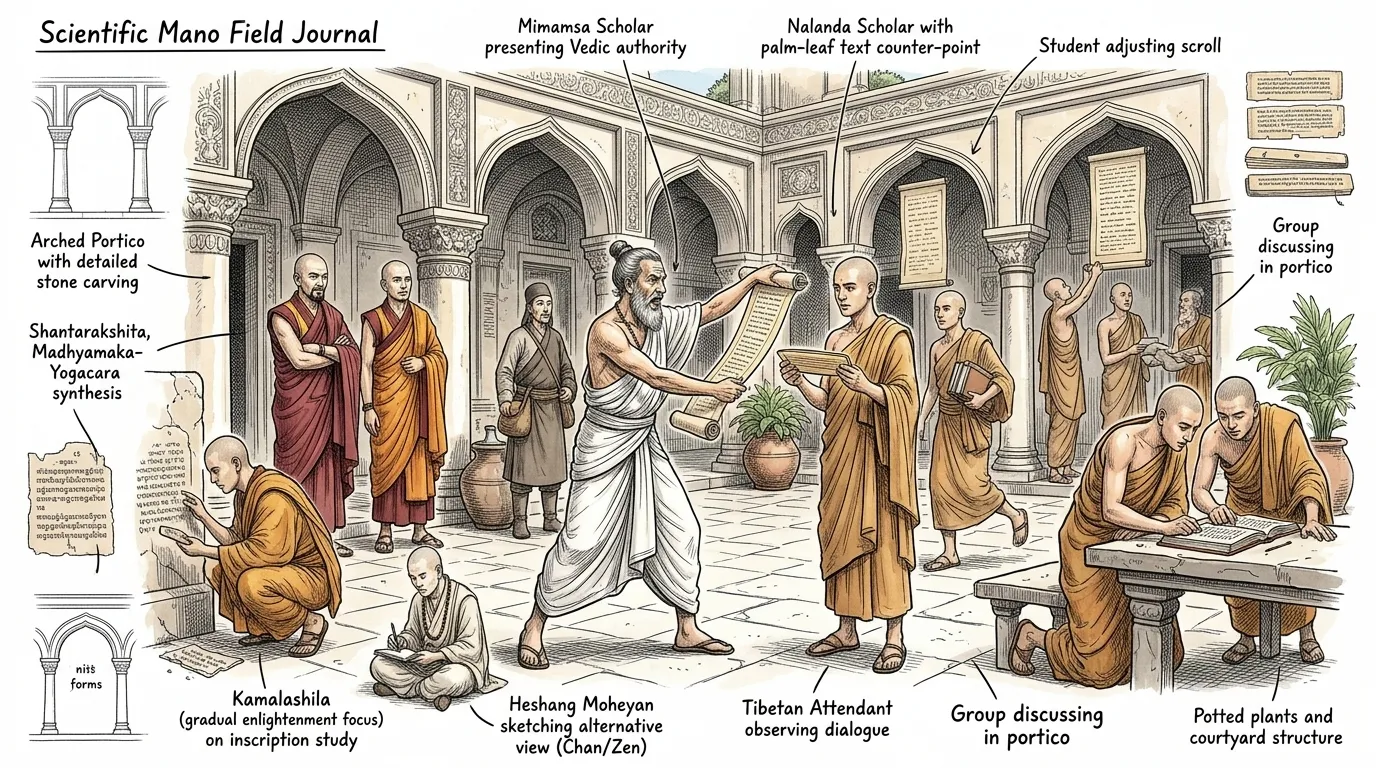
Nalanda University, during Shantarakshita's era, was a vibrant epicenter of learning, where diverse philosophical schools engaged in rigorous debate and intellectual exchange. Within this environment, Madhyamaka, which asserted the ultimate emptiness of all phenomena, and Yogacara, which emphasized the mind's role in constructing reality, often appeared as competing perspectives. Shantarakshita's early work laid the groundwork for a groundbreaking integration, demonstrating a deep mastery of both traditions.
"A Mimamsa Scholar, a middle-aged Indian man with a topknot and pristine white dhoti, gestures emphatically with a scroll. "The Vedic texts contain the ultimate truth; all other claims are secondary to ritual and divine injunction." A Nalanda Scholar, a young man with a shaved head and simple ochre robe, counters, holding a palm-leaf text, "But what is the nature of the mind that perceives these truths? The Yogacara view offers clarity on our experience.""
Philosophy Note: Nalanda University was a central hub for Buddhist philosophy, where schools like Madhyamaka (founded by Nagarjuna) and Yogacara (founded by Asanga and Vasubandhu) developed and debated their distinct views on reality and perception.
Page 3
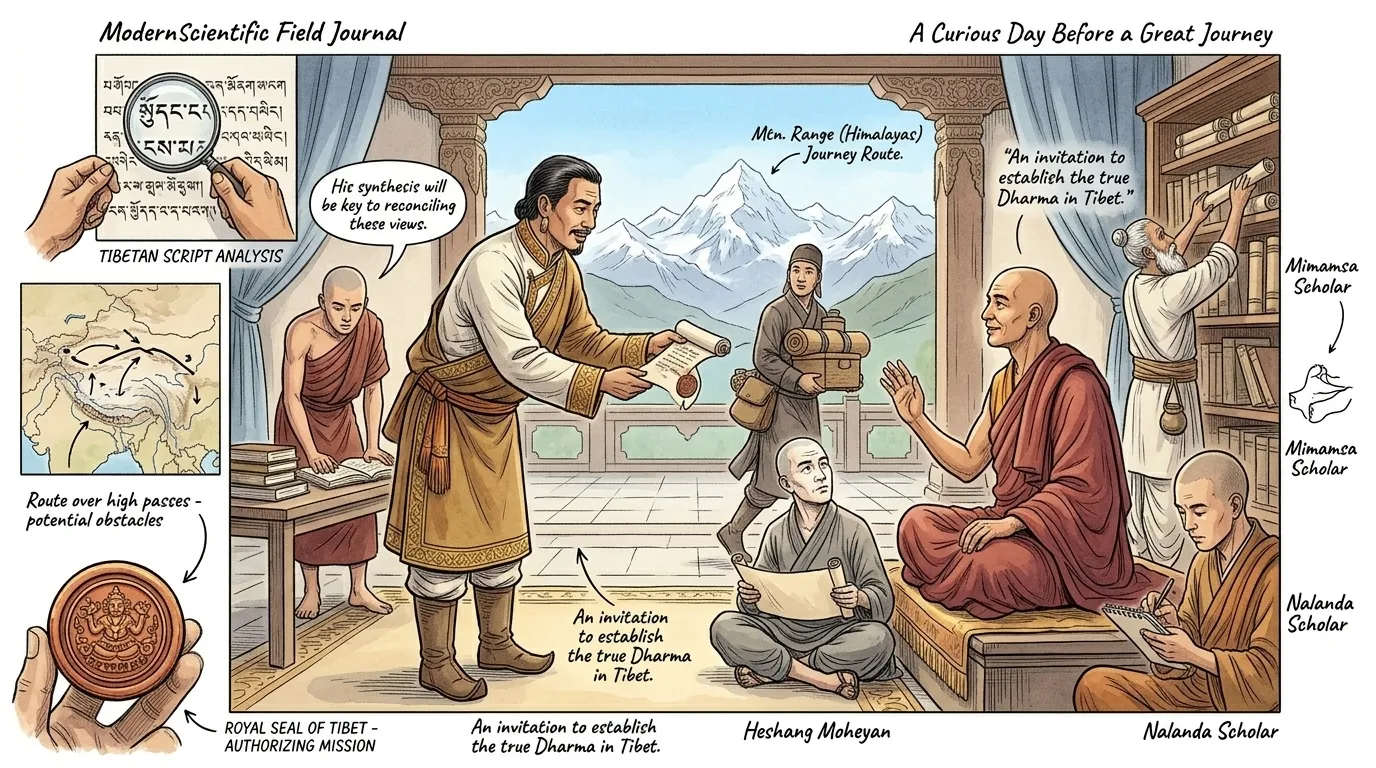
Beyond India, a new intellectual frontier was opening in Tibet. King Trisong Detsen, seeking to establish Buddhism as the bedrock of Tibetan society, recognized the need for a profound and complete philosophical system. He extended an invitation to Shantarakshita, a scholar renowned not only for his intellectual acumen but also for his deep spiritual realization. This invitation marked a pivotal moment, shifting Shantarakshita's focus from the academic debates of Nalanda to the monumental task of cultural and intellectual transplantation.
"King Trisong Detsen, a regal Tibetan man with traditional garments and an earnest expression, addresses Shantarakshita. "Great Master, our land is fertile ground, but requires the wisdom of the Dharma to truly flourish. Will you journey to Tibet and illuminate our path?" Shantarakshita, with a gentle smile, replies, "The Dharma is a light for all beings. I shall come, to share the teachings and help build a foundation of understanding.""
Philosophy Note: Shantarakshita's journey to Tibet was not merely a relocation but a critical mission to introduce and firmly establish sophisticated Indian Buddhist philosophy in a new cultural context, laying the groundwork for what would become Tibetan Buddhism.
Page 4
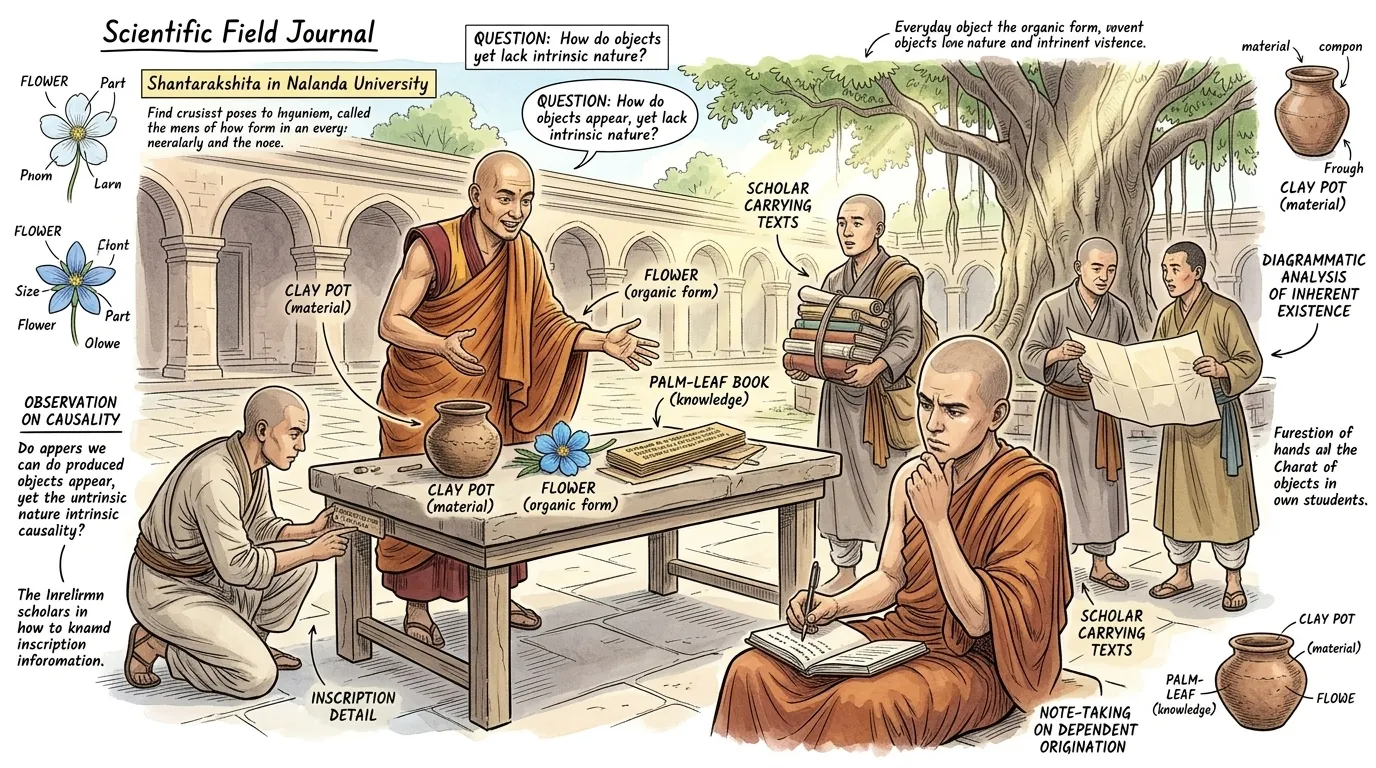
To comprehend Shantarakshita's synthesis, one must first grasp its constituent parts. Madhyamaka, or the 'Middle Way' school, asserts that all phenomena lack inherent existence. This means that nothing possesses an independent, unchangeable essence. Instead, things arise in dependence on causes, conditions, and conceptual imputation. This 'emptiness' is not a void or nothingness, but rather the absence of intrinsic nature, a profound understanding that liberates from attachment and fixed views.
"Shantarakshita, gesturing towards a collection of objects (a clay pot, a flower, a book), explains to a small group of Nalanda Scholars. "Consider this pot: is its 'pot-ness' inherent, or does it depend on clay, water, the potter, and our concept of a pot?" A young Nalanda Scholar, with a thoughtful expression, replies, "So, its identity is not fixed, but arises in relation to other factors and our perception.""
Philosophy Note: Madhyamaka, primarily associated with Nagarjuna, posits that all phenomena are empty of inherent existence (svabhava), meaning they exist only in dependence on other things, including our minds. This is the doctrine of dependent origination.
Page 5
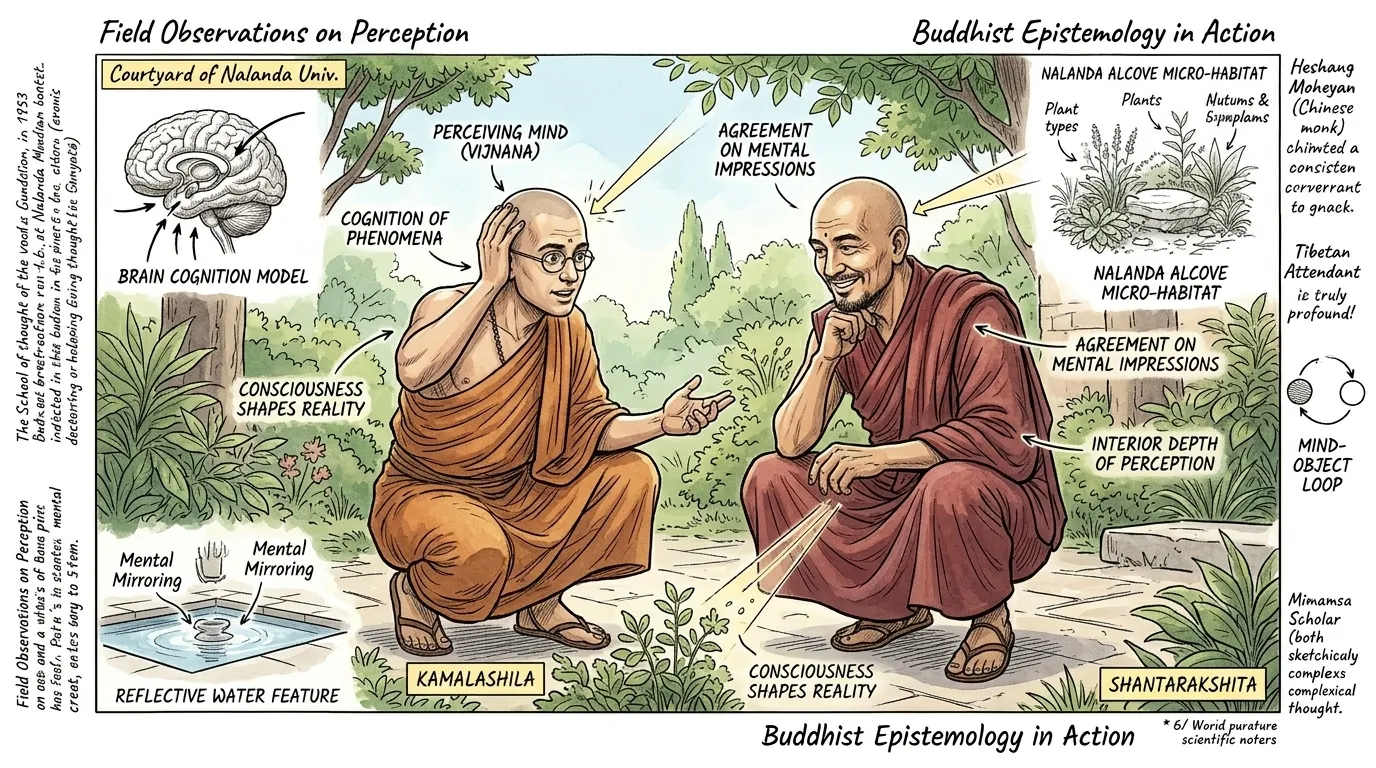
Complementing Madhyamaka, the Yogacara school focuses on the subjective experience, asserting that all phenomena are ultimately manifestations of consciousness. While external objects might appear to exist independently, Yogacara contends they are not truly separate from the mind that perceives them. This 'mind-only' (cittamatra) doctrine delves into the intricate workings of consciousness, explaining how our perceptions, thoughts, and emotions shape the reality we experience, highlighting the power and pervasiveness of the mind.
"Kamalashila, a younger Indian monk with spectacles, points to his own head thoughtfully. "The world as we know it, with all its sights and sounds, is fundamentally an experience within our consciousness. The mind is not merely a receptor, but an active participant." Shantarakshita nods, adding, "Indeed, our very understanding of objects arises from the seeds of past experiences and karmic imprints stored within the mind.""
Philosophy Note: Yogacara, associated with Asanga and Vasubandhu, argues that what appears as external reality is, in essence, a manifestation of mind or consciousness, emphasizing the subjective and constructive nature of experience.
Page 6
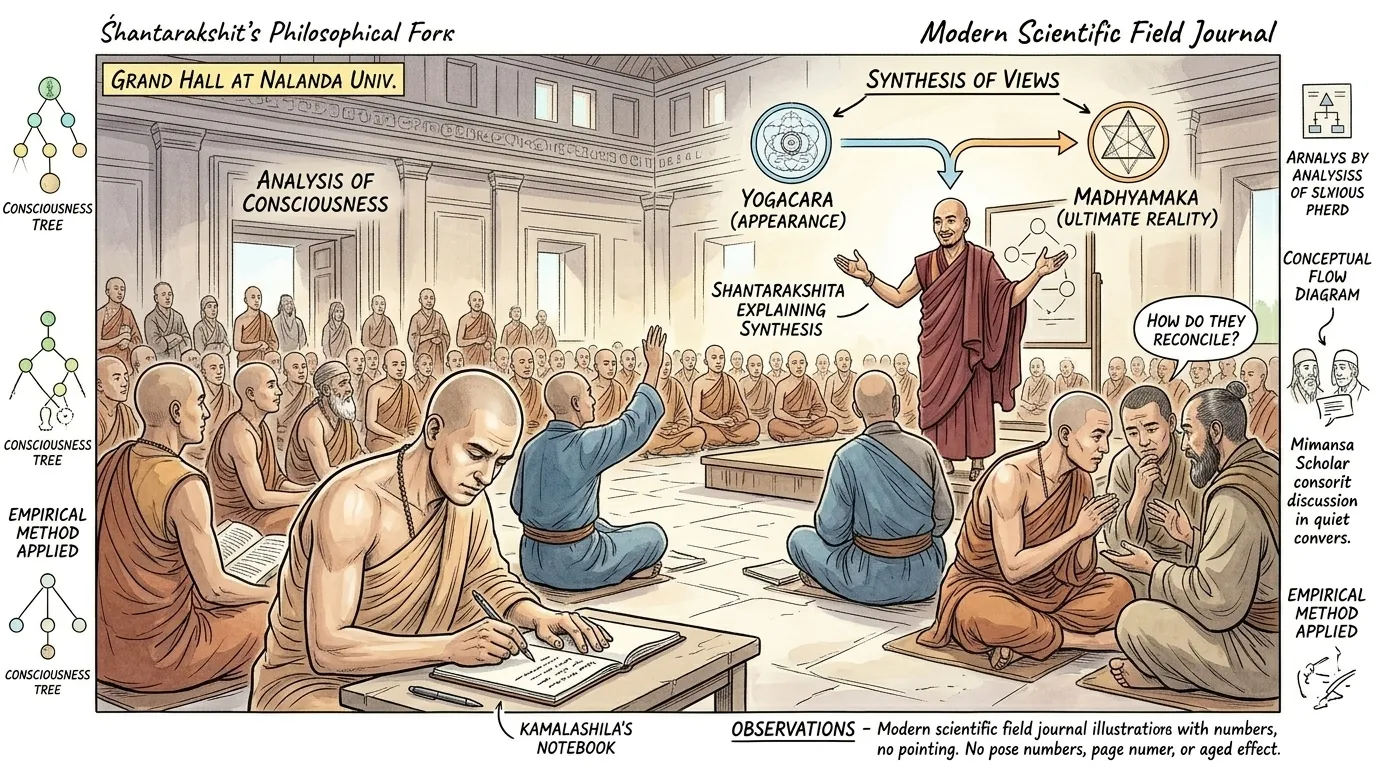
Shantarakshita's genius lay in his ability to reconcile these two powerful, yet seemingly divergent, philosophies. He argued that Yogacara's 'mind-only' position accurately describes how we experience conventional reality—how our consciousness constructs the world of appearances. However, he maintained that Madhyamaka's 'emptiness' reveals the ultimate nature of that constructed reality: that even though it appears solid and independent, it is ultimately empty of inherent existence. Thus, Yogacara describes how things appear, while Madhyamaka explains how they truly are.
"Shantarakshita, addressing a gathered assembly of monks and scholars in a large hall, illustrates his point. "The world as perceived by our mind is not a delusion, but a conventional reality—a valid appearance. Yet, to delve deeper is to realize that this very appearance, like a dream, lacks intrinsic being." Kamalashila, seated respectfully among the disciples, takes notes, his expression one of profound understanding."
Philosophy Note: Shantarakshita's unique 'Yogacara-Madhyamaka' synthesis proposed that Yogacara provides the conventional understanding of how phenomena arise from mind, while Madhyamaka provides the ultimate understanding that these mind-dependent phenomena are empty of inherent existence.
Page 7
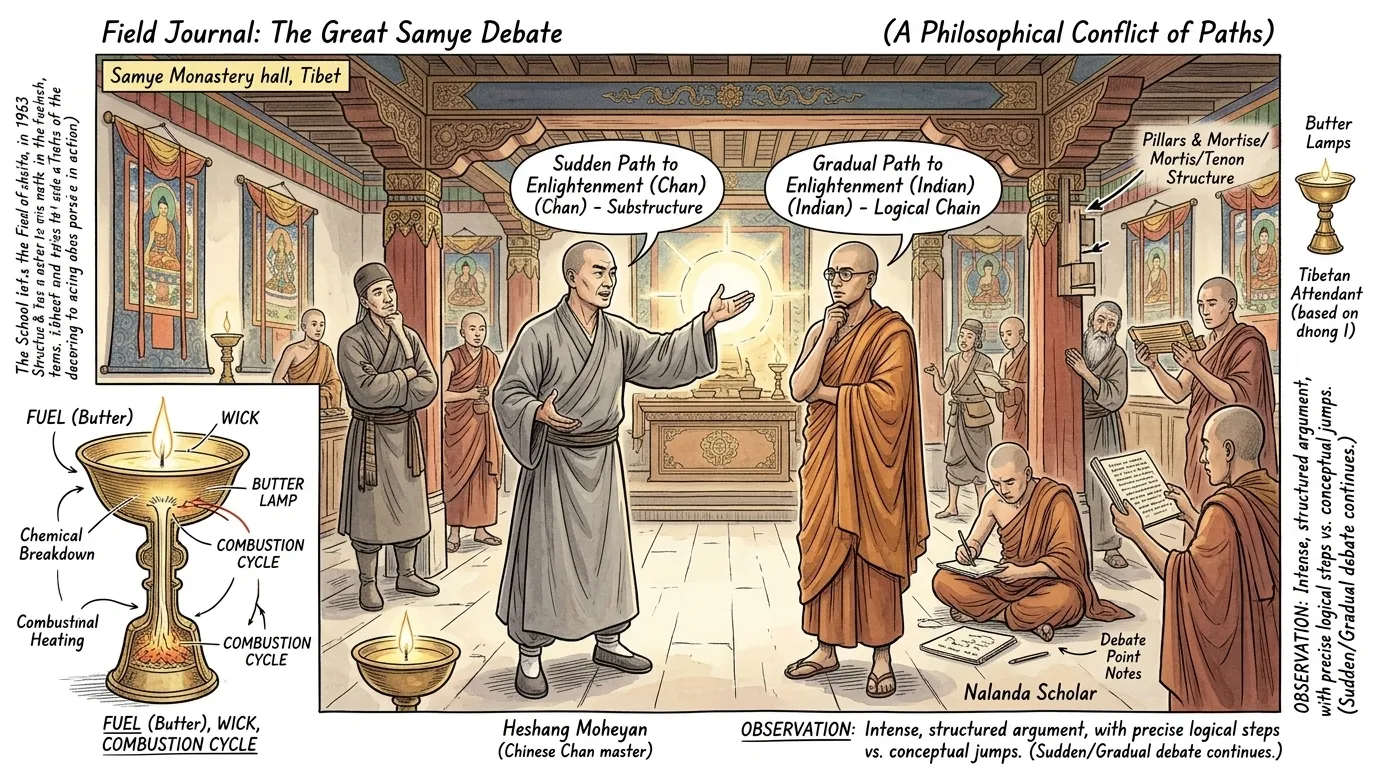
Shantarakshita's influence in Tibet culminated in one of the most significant philosophical confrontations in Buddhist history: the Samye Debate. After his passing, his disciple Kamalashila championed Shantarakshita's view of a 'gradual path' to enlightenment, emphasizing the necessity of extensive study, ethical discipline, and progressive meditation. This approach was challenged by Heshang Moheyan, a Chinese Chan master, who advocated for 'sudden enlightenment,' arguing that all conceptual activity should be ceased to achieve immediate realization.
"Heshang Moheyan, a middle-aged Chinese monk in loose gray robes, states firmly, "Enlightenment is not built piece by piece, but realized in an instant when all thought ceases. Effortless non-thinking is the path!" Kamalashila, the younger Indian monk, responds with measured intensity, "True liberation is cultivated through wisdom and compassion, not merely the suppression of thought. One must understand emptiness through reasoned analysis and ethical action.""
Philosophy Note: The Samye Debate (792-794 CE) was a pivotal moment for the future of Buddhism in Tibet, determining whether the gradual, scholastic path of Indian Buddhism or the sudden, meditative approach of Chinese Chan Buddhism would become dominant.
Page 8
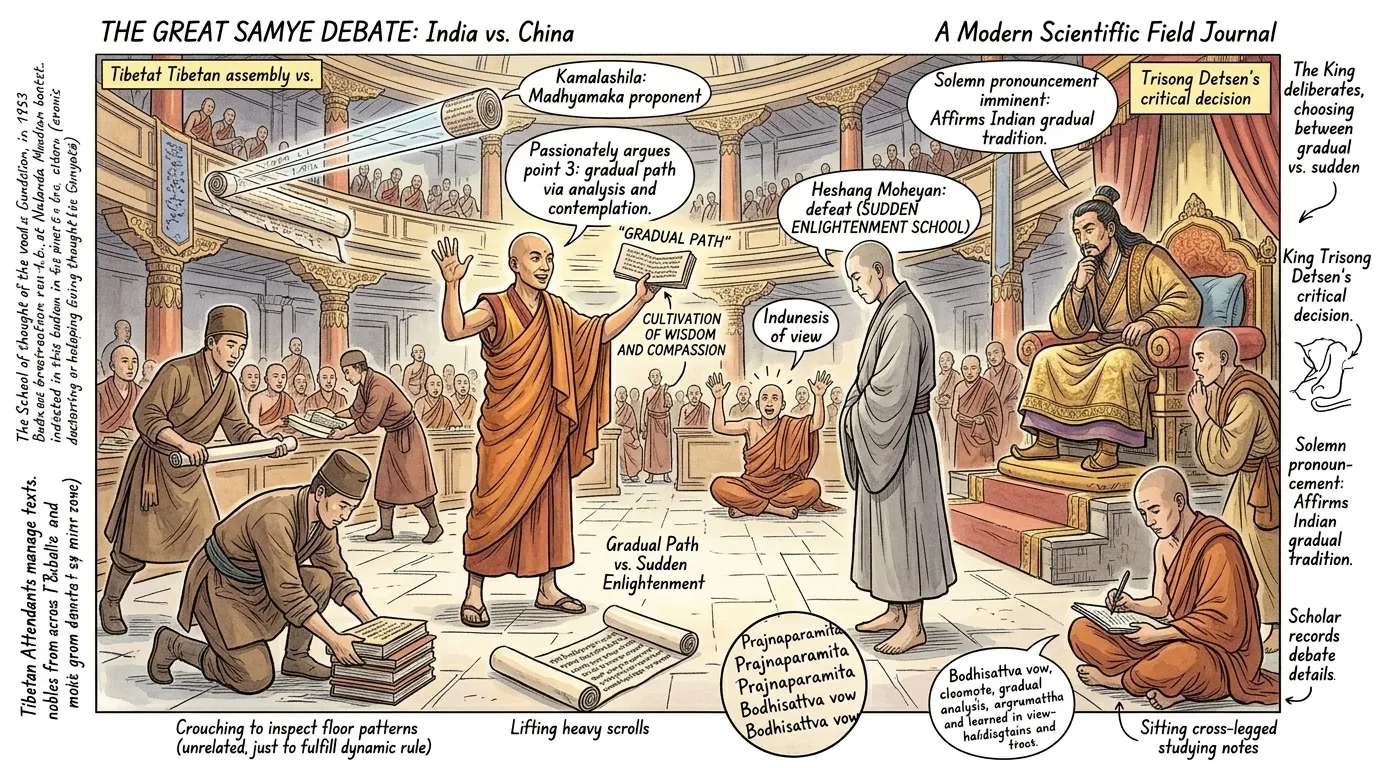
Kamalashila, armed with Shantarakshita's intricate synthesis, meticulously dismantled Moheyan's arguments. He explained that a true understanding of emptiness, as taught by Madhyamaka, required precise conceptual analysis and the cultivation of wisdom, not merely a blank mind. Ethical action and compassionate engagement, he argued, were indispensable. His eloquent defense of the gradual path resonated deeply, ultimately convincing King Trisong Detsen to endorse the Indian Buddhist tradition, cementing Shantarakshita's intellectual legacy and the future direction of Tibetan Buddhism.
"Kamalashila, passionately presenting his final points, emphasizes, "Without understanding the nature of phenomena, how can one truly transcend illusion? The mind must be trained, wisdom cultivated through study, and compassion practiced to truly realize emptiness." Heshang Moheyan, though defeated, maintains a stoic expression, acknowledging the intellectual force of the argument. King Trisong Detsen, after careful deliberation, makes his pronouncement, affirming the Indian tradition."
Philosophy Note: Kamalashila's success at Samye ensured that the dominant form of Buddhism in Tibet would be the intellectual, scholastic, and gradual path rooted in Indian Mahayana traditions, especially the Yogacara-Madhyamaka synthesis of Shantarakshita.
Page 9
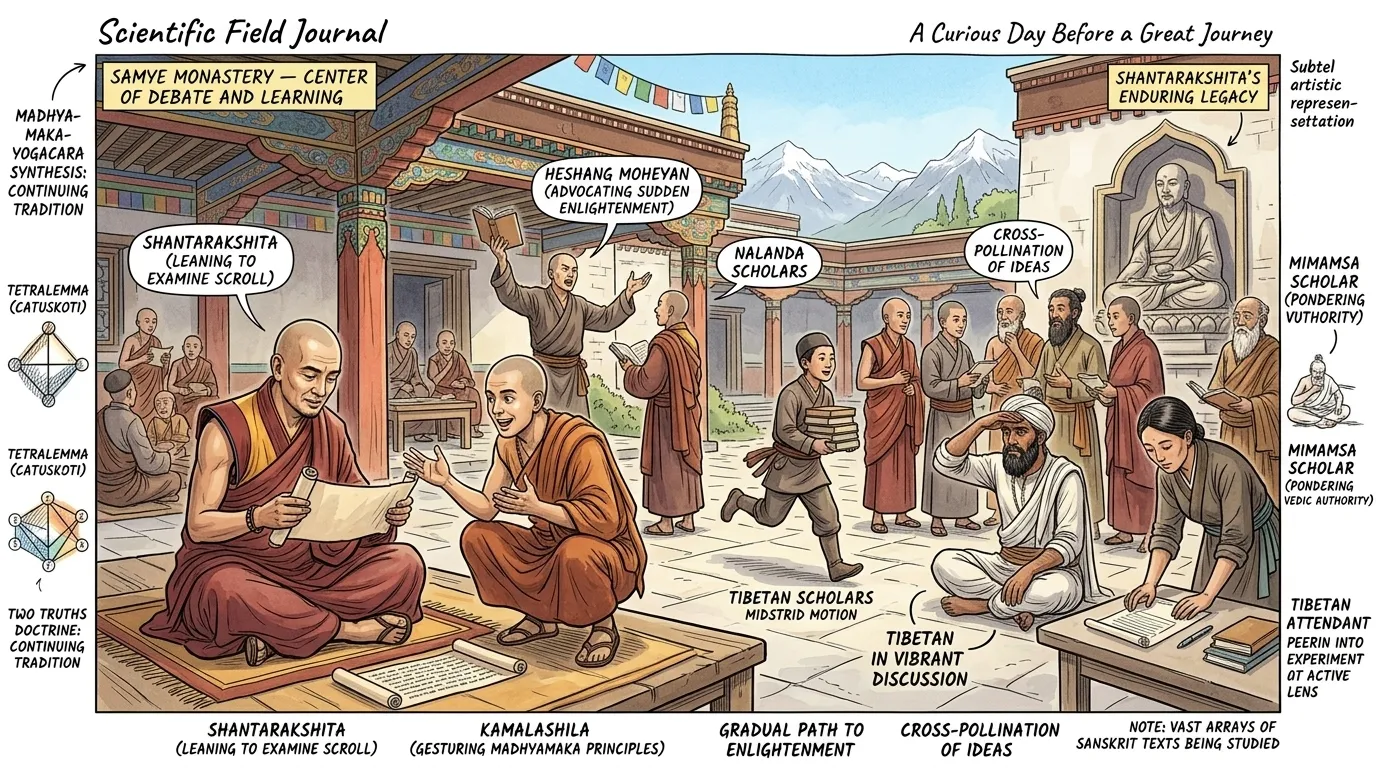
Shantarakshita's work fundamentally shaped Tibetan Buddhism, establishing a rigorous intellectual foundation that continues to define its scholastic tradition. His synthesis provided a cohesive worldview, allowing practitioners to integrate the conventional reality of experience with the ultimate truth of emptiness without contradiction. This holistic approach fostered an environment of profound philosophical inquiry and ethical development, making Tibetan Buddhism one of the most intellectually robust spiritual traditions in the world.
Philosophy Note: Shantarakshita's philosophical contributions formed the bedrock of Tibetan Buddhist thought, integrating epistemology, logic, and a two-truths doctrine (conventional and ultimate) that fostered both intellectual rigor and spiritual insight.
Page 10
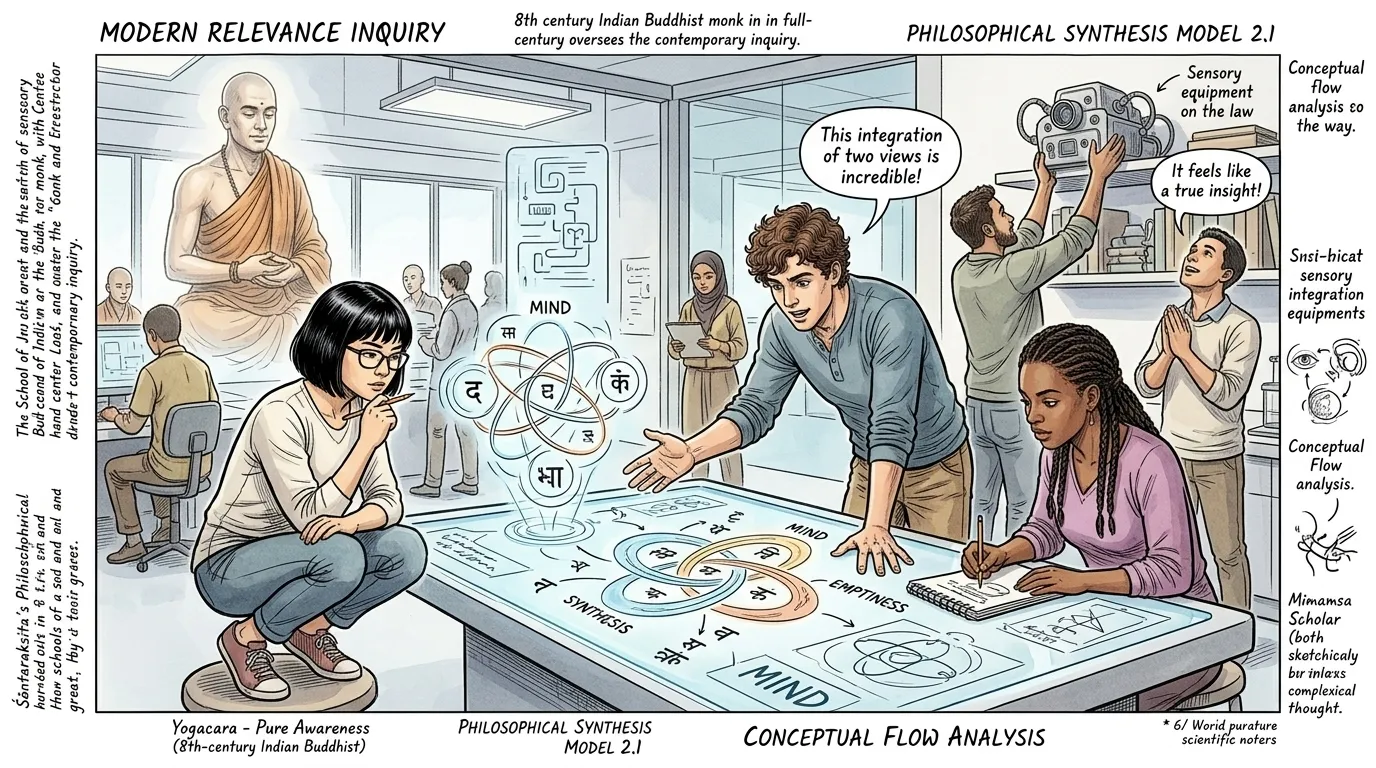
Shantarakshita's synthesis remains remarkably relevant today, offering a sophisticated framework for navigating our understanding of mind and reality. In a world grappling with subjective experience, objective facts, and the constructed nature of perception, his work encourages us to examine both how we experience phenomena and their ultimate nature. From the philosophical underpinnings of cognitive science to the ethical considerations of our interconnected world, Shantarakshita's vision provides a powerful lens through which to understand and engage with life's complexities.
Philosophy Note: Shantarakshita's synthesis offers a nuanced perspective on the relationship between subjective experience and objective reality, applicable to fields ranging from cognitive science and psychology to ethics and systems thinking in the modern world.
About this story
- Audience: general readers
Questions and answers
Read Wonder Philosophy on your phone
Wonder Philosophy is available on Android and iPhone and iPad. Get Wonder Philosophy on Google Play · Get Wonder Philosophy on the App Store.