Xunzi
Xunzi — an illustrated philosophy story. 10 illustrated pages, free to read on Wonder Philosophy.

Page 1
![Why should we care about a philosopher who lived over two thousand years ago? Xunzi [298-238 BCE], a Confucian thinker from ancient China, offers a starkly…](https://thewonderbooks.com/images/stories/xunzi/illustrations/xunzi_page_01_v1775194984704.webp "Why should we care about a philosopher who lived over two thousand years ago? Xunzi [298-238 BCE], a Confucian thinker from ancient China, offers a starkly…")
Why should we care about a philosopher who lived over two thousand years ago? Xunzi [298-238 BCE], a Confucian thinker from ancient China, offers a starkly realistic view of human nature. His ideas about self-cultivation and the importance of institutions are surprisingly relevant in today's complex world. We must look into human nature to find what is needed to create an ideal society.
Philosophy Note: Xunzi's philosophy emphasizes the need for social order and ethical conduct, ideas that continue to resonate in contemporary discussions about governance and individual responsibility.
Page 2
![Xunzi lived during the tumultuous Warring States period [475-221 BCE] in China. Unlike Mencius [372-289 BCE], another prominent Confucian, Xunzi believed that…](https://thewonderbooks.com/images/stories/xunzi/illustrations/xunzi_page_02_v1775195017530.webp "Xunzi lived during the tumultuous Warring States period [475-221 BCE] in China. Unlike Mencius [372-289 BCE], another prominent Confucian, Xunzi believed that…")
Xunzi lived during the tumultuous Warring States period [475-221 BCE] in China. Unlike Mencius [372-289 BCE], another prominent Confucian, Xunzi believed that human nature is inherently bad. He argued that people are born with desires that, if left unchecked, lead to conflict and chaos. This contrasted sharply with Mencius's view that human nature is innately good, holding that people are naturally drawn toward compassion and moral behavior. He was a major dissenter in his time due to his contrary views on the nature of humanity.
Philosophy Note: The Warring States period was a time of intense political and social upheaval in China, influencing Xunzi's emphasis on the need for strong institutions and ethical guidance.
Page 3
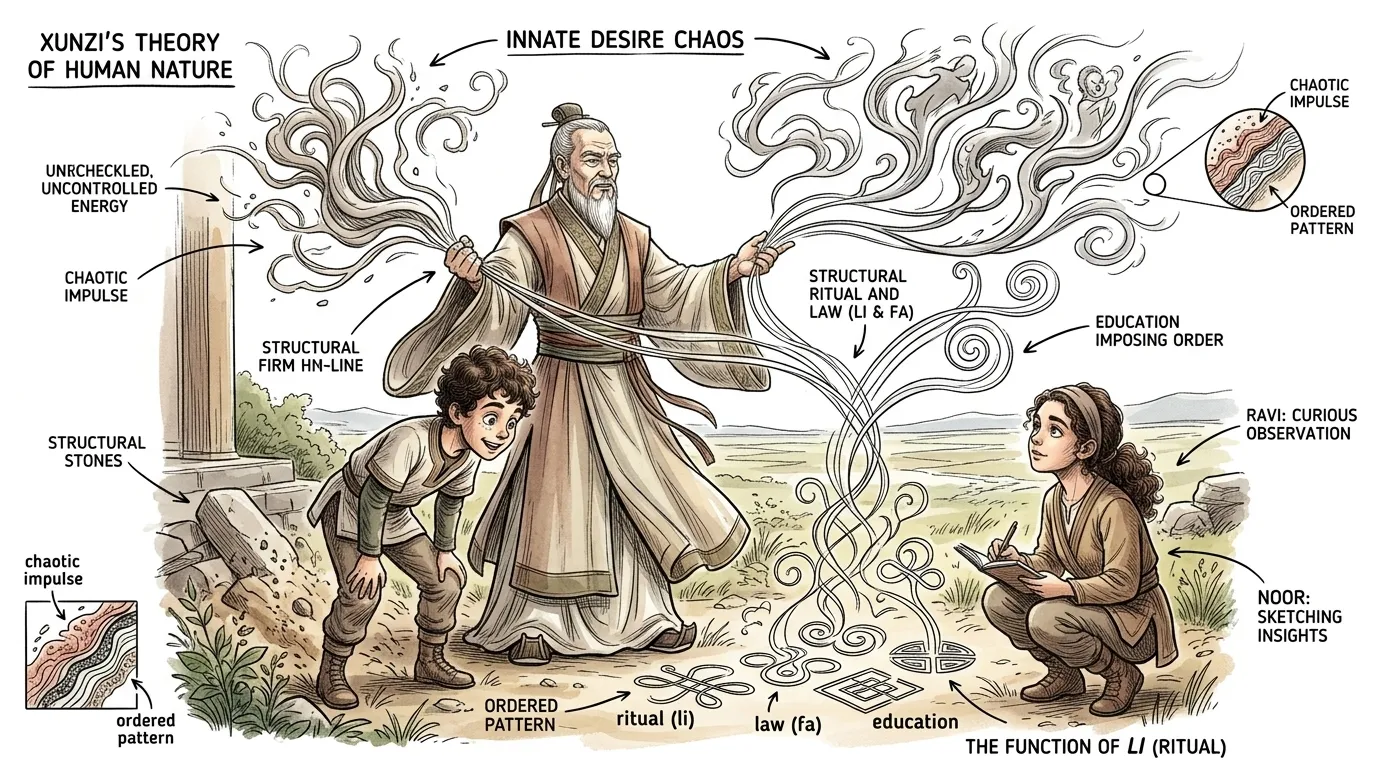
"People are born with desires," Xunzi argued, "and if these desires are not regulated, they will inevitably lead to contention." He saw society as a project of constant self-cultivation and imposed order. Without education and the guidance of moral principles, humans would descend into barbarity. He saw ritual and law as necessary tools for restraining humanity's darker inclinations.
Philosophy Note: Xunzi's perspective challenges optimistic views of human nature, emphasizing the importance of ethical frameworks and social structures in fostering a harmonious society.
Page 4

For Xunzi, education was the key to transforming human nature. He believed that through diligent study and practice of rituals, people could learn to control their desires and cultivate moral character. The process was arduous and required constant effort, but it was the only path to a well-ordered society. Teachers and sages played a vital role in guiding individuals along this path, providing examples of virtuous behavior and instilling a sense of social responsibility. He emphasized the importance of a strong moral education to restrain bad natured humans.
Philosophy Note: Xunzi's emphasis on education aligns with Confucian values but stresses the need for rigorous training and self-discipline to overcome inherent human tendencies.
Page 5
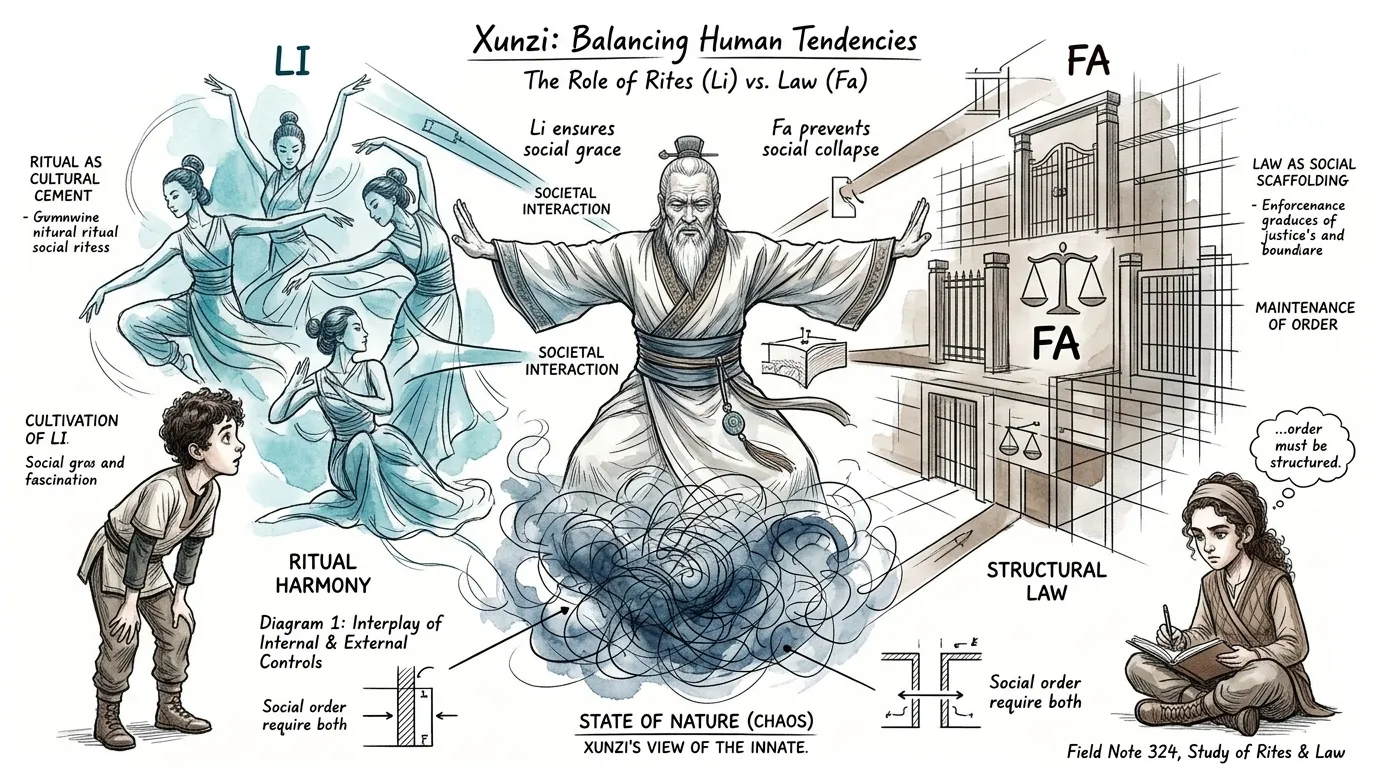
Xunzi saw ritual (li) and law (fa) as essential tools for maintaining social order. Rituals provided a framework for proper behavior, while laws set clear boundaries and consequences for transgressions. He believed that a combination of moral guidance and legal enforcement was necessary to create a stable and just society. Without these structures, human desires would inevitably lead to chaos and conflict.
Philosophy Note: Xunzi's advocacy for ritual and law reflects a pragmatic approach to governance, recognizing the need for both moral suasion and coercive power to maintain social stability.
Page 6

Self-cultivation, for Xunzi, was a lifelong project. It involved constant self-reflection, study, and practice of ethical behavior. Individuals had to actively work to overcome their inherent tendencies toward selfishness and vice. This required a commitment to personal discipline and a willingness to learn from others. The goal was to transform oneself into a virtuous and responsible member of society.
Philosophy Note: Xunzi's concept of self-cultivation emphasizes the active role individuals play in shaping their character and moral compass, contributing to a more ethical society.
Page 7

Xunzi's philosophy has faced criticism for its pessimistic view of human nature. Some argue that it underestimates the potential for innate goodness and compassion. Others point out that his emphasis on ritual and law could lead to authoritarianism. However, Xunzi's ideas have also been praised for their realism and their focus on practical solutions to social problems. Comparing him to Laozi [6th century BCE] whose philosophy focused on human nature, it is clear to see these two philosophies are completely at odds.
Philosophy Note: Xunzi's ideas remain a subject of debate, with critics questioning his pessimistic view of human nature and proponents highlighting the practical implications of his philosophy.
Page 8

In today's world, Xunzi's philosophy offers valuable insights into the challenges of governance and ethical conduct. His emphasis on the importance of education, institutions, and self-cultivation is relevant in a society grappling with issues of social order and individual responsibility. He gives a different perspective on how to reach utopia than many other philosophers.
"Tane asked Solana, "Do you think we can become good people if we have natural bad tendencies?""
Philosophy Note: Xunzi's philosophy continues to inspire reflection on the role of education, institutions, and individual effort in shaping a just and ethical society.
Page 9
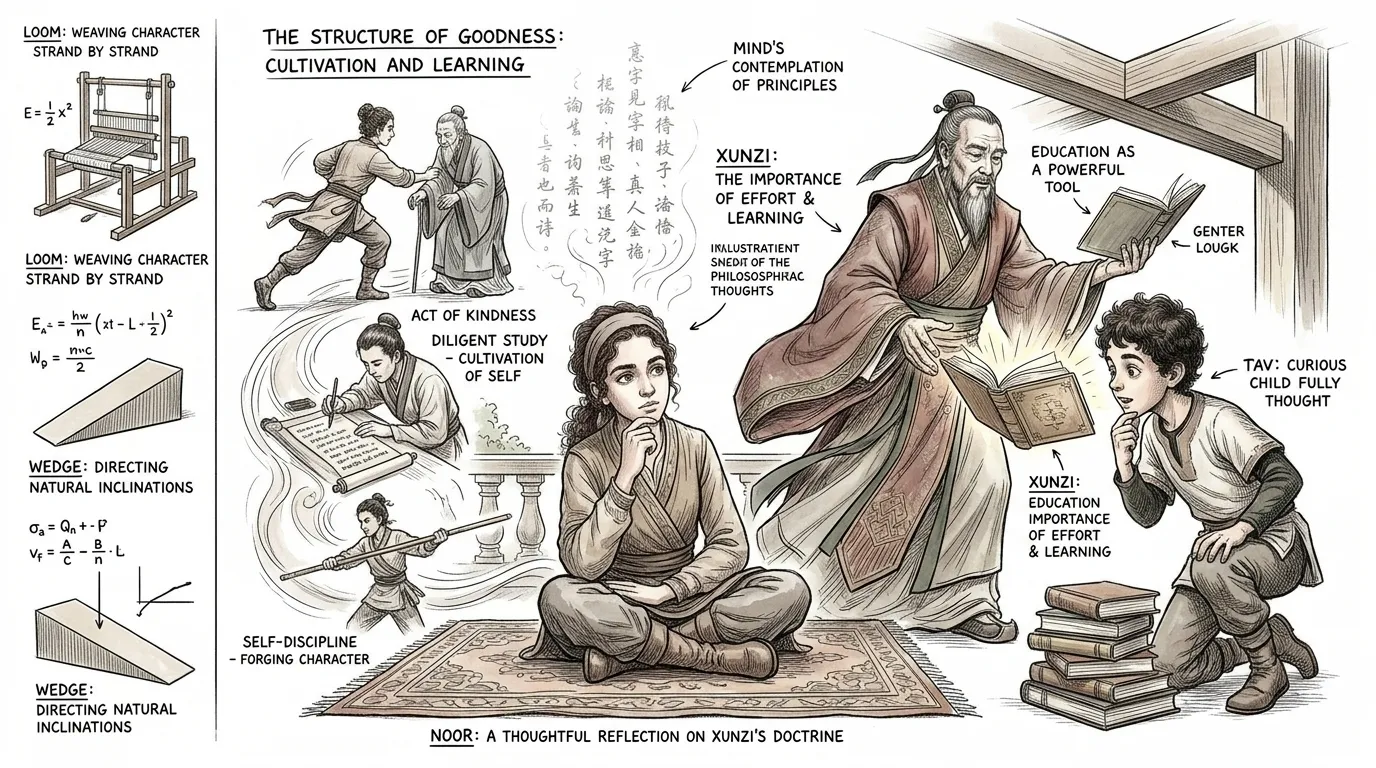
"The nature of man is evil; his goodness is the result of his activity," Xunzi wrote. This means that humans are not born good but can become good through learning and practice. Solana pondered this statement, thinking about how much effort it takes to be honest and kind. It doesn't come naturally, she realized, it requires constant work. "If there is no ritual, then there will be violence".
"Solana said thoughtfully, "It's like what Nelson Mandela said, 'Education is the most powerful weapon which you can use to change the world.' Xunzi believed education could change our very nature!""
Philosophy Note: Xunzi's legacy endures as a reminder of the ongoing need for ethical guidance, institutional strength, and personal responsibility in shaping a better future.
Page 10

Xunzi's emphasis on structures—rules, laws, and institutions—can guide us today. How do we best set up systems that guide the self-interested impulses of human nature? How can we organize incentives and penalties for the greatest good? He argued we have to do this consciously, because humans aren't good on their own. This will allow us to not rely on luck or good nature, but an active system designed to do good.
Philosophy Note: Xunzi's philosophy continues to inspire reflection on the role of education, institutions, and individual effort in shaping a just and ethical society.
About this story
- Audience: general readers
Read Wonder Philosophy on your phone
Wonder Philosophy is available on Android and iPhone and iPad. Get Wonder Philosophy on Google Play · Get Wonder Philosophy on the App Store.