Zhuangzi
Zhuangzi — an illustrated philosophy story. 10 illustrated pages, free to read on Wonder Philosophy.

Page 1

Zhuangzi's philosophy encourages us to embrace spontaneity and accept the ever-changing nature of life. In a world obsessed with control and achievement, his teachings offer a refreshing perspective: find freedom by aligning with the Dao [Dao: The Way, the fundamental principle of the universe]. Zhuangzi lived during a time of great social upheaval in ancient China, a period marked by political fragmentation and philosophical ferment.
Philosophy Note: Zhuangzi lived during the Warring States period (475-221 BCE) in China, a time of constant conflict and philosophical innovation.
Page 2
![Born around 369 BCE, Zhuangzi, also known as Zhuang Zhou, lived in the state of Meng [Meng: A small state within ancient China].](https://thewonderbooks.com/images/stories/zhuangzi/illustrations/zhuangzi_page_02_v1775196000239.webp "Born around 369 BCE, Zhuangzi, also known as Zhuang Zhou, lived in the state of Meng [Meng: A small state within ancient China].")
Born around 369 BCE, Zhuangzi, also known as Zhuang Zhou, lived in the state of Meng [Meng: A small state within ancient China]. He was a contemporary of other influential thinkers, such as Mencius [Mencius: A Confucian philosopher]. Unlike many, Zhuangzi avoided seeking high office, preferring a life of contemplation and writing. His famous work, the Zhuangzi, is a collection of anecdotes, parables, and philosophical reflections.
"Lian, Katya"
Philosophy Note: The Zhuangzi is characterized by its imaginative style and rejection of rigid Confucian social norms.
Page 3
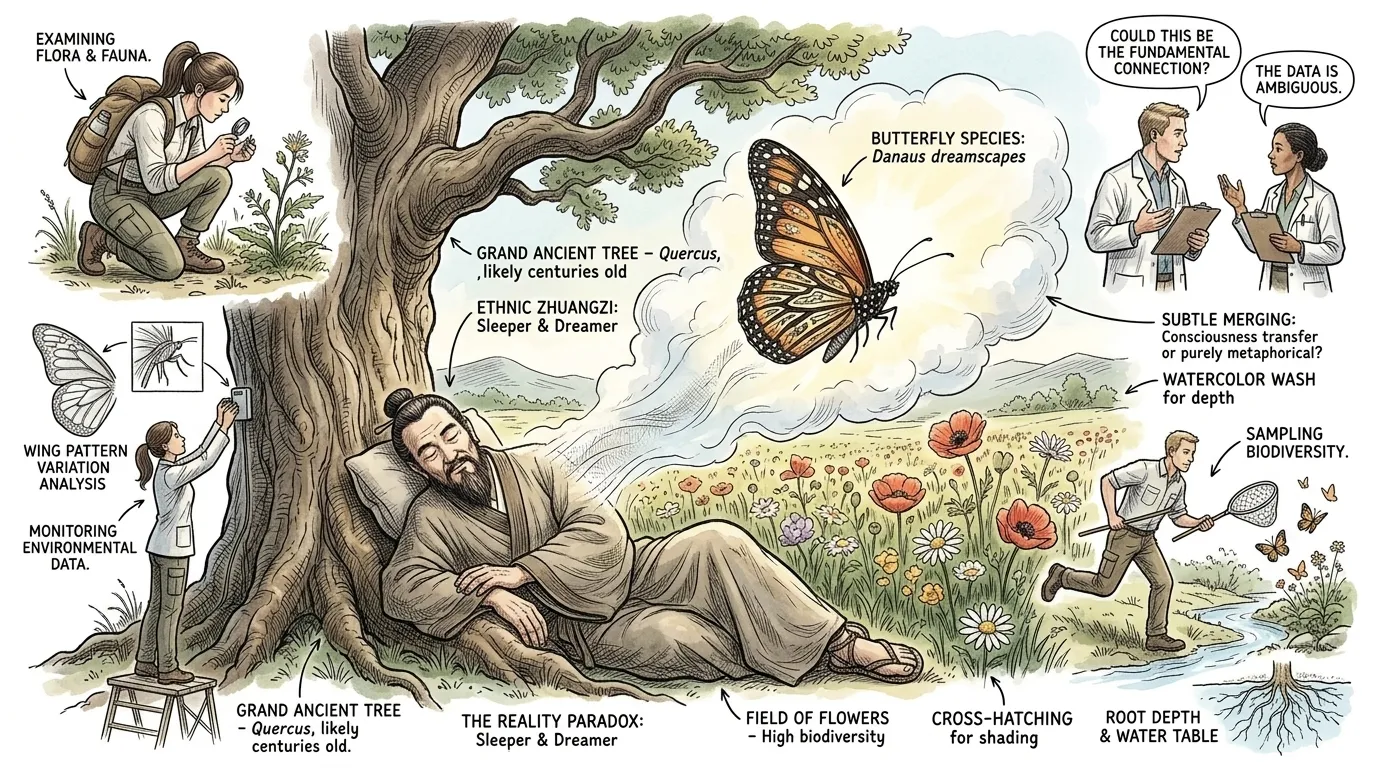
One of Zhuangzi's most famous stories is the butterfly dream. He recounts dreaming he was a butterfly, fluttering about, unaware of being Zhuang Zhou. Upon waking, he wondered: was he Zhuang Zhou who had dreamed of being a butterfly, or was he a butterfly now dreaming he was Zhuang Zhou? This illustrates a central theme: the fluidity of reality and the limitations of human perception.
Philosophy Note: The butterfly dream challenges the distinction between reality and illusion, questioning the certainty of our knowledge.
Page 4
![Zhuangzi advocated wuwei [Wuwei: effortless action], often translated as 'non-action'. However, it doesn't mean passivity.](https://thewonderbooks.com/images/stories/zhuangzi/illustrations/zhuangzi_page_04_v1775196068465.webp "Zhuangzi advocated wuwei [Wuwei: effortless action], often translated as 'non-action'. However, it doesn't mean passivity.")
Zhuangzi advocated wuwei [Wuwei: effortless action], often translated as 'non-action'. However, it doesn't mean passivity. Instead, it describes a state of being where one acts in accordance with the Dao, effortlessly and spontaneously, without forcing or resisting. It is about aligning oneself with the natural flow of things, like a skilled artisan who knows their craft so well that their movements become intuitive.
"Lian, Katya"
Philosophy Note: Wuwei is about cultivating inner stillness and allowing actions to arise naturally from that state of being.
Page 5

Zhuangzi uses the parable of the useless tree to illustrate the value of being perceived as 'useless' by society. A carpenter refuses to cut down a large, gnarled tree because it is unsuitable for timber. Zhuangzi argues that the tree's uselessness is precisely what allows it to live a long and fulfilling life. This challenges conventional notions of success and productivity.
"Lian, Katya"
Philosophy Note: The 'uselessness' is a form of freedom from societal expectations and the pressures of achievement.
Page 6
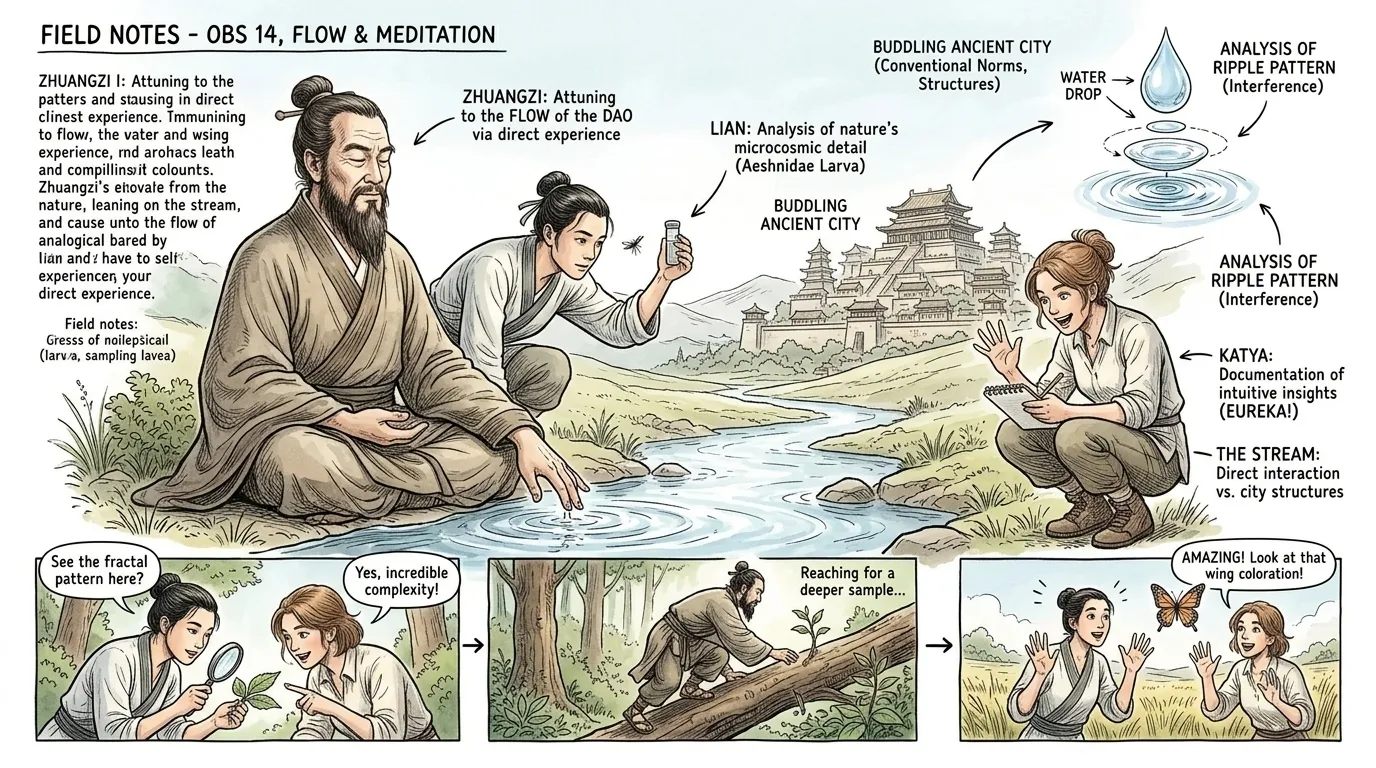
Zhuangzi questioned the value of conventional wisdom and societal norms. He believed that true understanding comes from direct experience and intuition, not from adhering to rigid rules or intellectual dogma. He encouraged individuals to cultivate their inner wisdom and to trust their own judgment, even if it goes against the grain.
"Lian, Katya"
Philosophy Note: Zhuangzi valued experiential knowledge and intuitive understanding over purely intellectual pursuits.
Page 7

Zhuangzi's philosophy differs significantly from Confucianism, which emphasizes social order, ritual, and moral cultivation. While Confucianism seeks to improve society through ethical conduct and good governance, Zhuangzi focuses on individual freedom and harmony with the Dao. Some critics argue that Zhuangzi's teachings can lead to social apathy or a rejection of responsibility.
"Lian, Katya"
Philosophy Note: Zhuangzi's individualistic focus contrasts sharply with Confucianism's emphasis on social harmony and duty.
Page 8

Zhuangzi's ideas remain relevant today, particularly in a world characterized by constant stress and societal pressure. His emphasis on spontaneity, acceptance, and finding joy in the present moment provides a powerful antidote to the modern obsession with productivity and achievement. As Katya reflected, remembering advice from her grandmother: "'The journey of a thousand miles begins with a single step,' as Lao Tzu said. We should stop worrying about goals and appreciate each moment."
Philosophy Note: Zhuangzi's emphasis on finding contentment in the present aligns with modern mindfulness practices.
Page 9

Zhuangzi's acceptance of change and impermanence offers a valuable perspective in navigating the uncertainties of life. He encourages us to let go of our attachments and to embrace the ever-flowing nature of existence. By accepting change, we can find a deeper sense of peace and resilience.
Philosophy Note: Acceptance of impermanence is a key to finding inner peace and resilience.
Page 10

Zhuangzi's philosophy continues to inspire individuals seeking a more authentic and meaningful way of life. His teachings offer a path towards inner freedom, spontaneity, and harmony with the natural world. By embracing his wisdom, we can navigate the complexities of modern life with greater ease and find lasting joy in the present moment.
Philosophy Note: Zhuangzi's enduring legacy lies in his timeless wisdom and his message of individual freedom and acceptance.
About this story
- Audience: general readers
Questions and answers
Read Wonder Philosophy on your phone
Wonder Philosophy is available on Android and iPhone and iPad. Get Wonder Philosophy on Google Play · Get Wonder Philosophy on the App Store.