Anaxagoras
Anaxagoras — an illustrated philosophy story. 10 illustrated pages, free to read on Wonder Philosophy.
Page 1
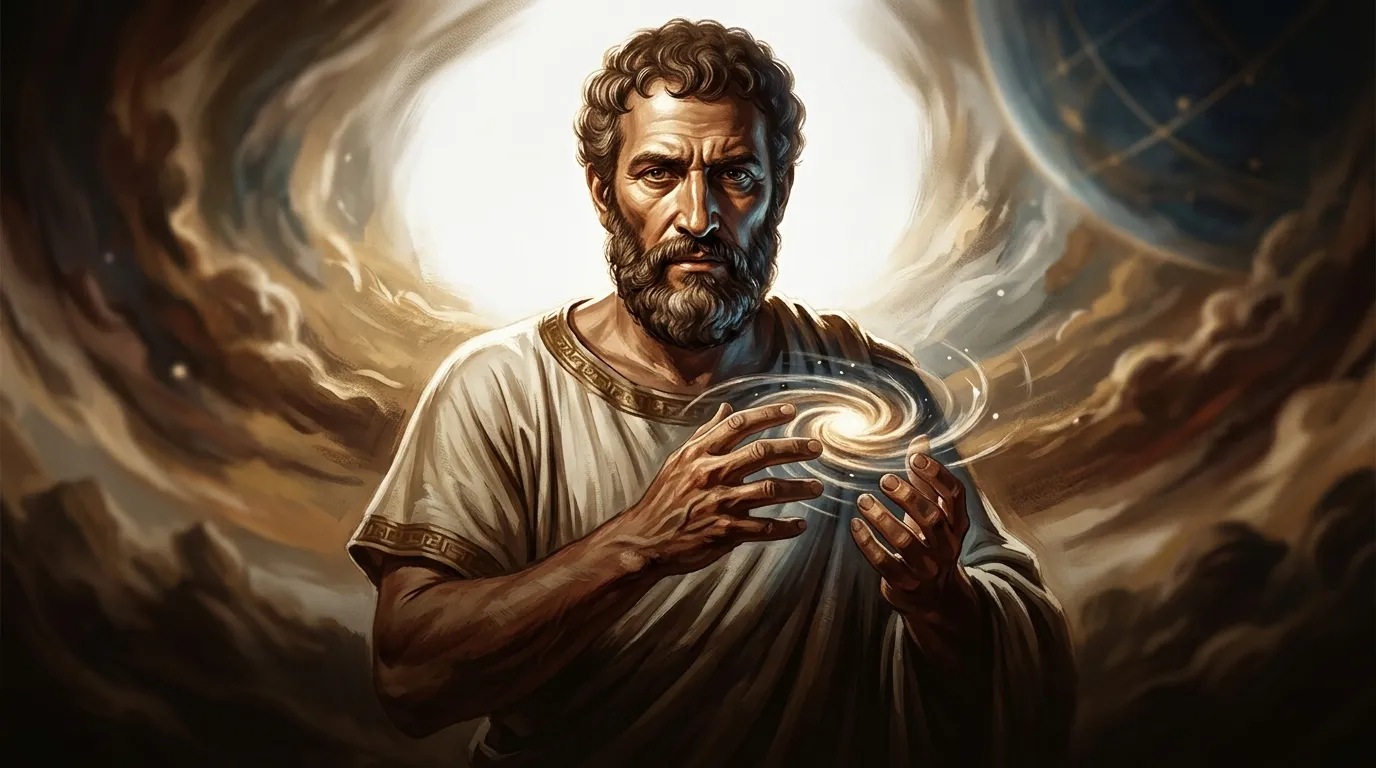
![Anaxagoras of Clazomenae [c. 510 – 428 BC] changed everything. Before him, many believed the universe was made of a few simple elements.](https://thewonderbooks.com/images/stories/anaxagoras/illustrations/anaxagoras_page_01_v1775183030451.webp "Anaxagoras of Clazomenae [c. 510 – 428 BC] changed everything. Before him, many believed the universe was made of a few simple elements.")
Anaxagoras of Clazomenae [c. 510 – 428 BC] changed everything. Before him, many believed the universe was made of a few simple elements. Anaxagoras proposed something radical: 'everything is in everything.' This idea, that every substance contains a bit of every other substance, shaped science and philosophy.
Philosophy Note: Anaxagoras's theory of 'seeds' (spermata) influenced later atomic theory.
Page 2
![Born in Clazomenae [modern-day Turkey], Anaxagoras brought Ionian philosophy to Athens, then becoming the center of Greek intellectual life.](https://thewonderbooks.com/images/stories/anaxagoras/illustrations/anaxagoras_page_02_v1775183063395.webp "Born in Clazomenae [modern-day Turkey], Anaxagoras brought Ionian philosophy to Athens, then becoming the center of Greek intellectual life.")
Born in Clazomenae [modern-day Turkey], Anaxagoras brought Ionian philosophy to Athens, then becoming the center of Greek intellectual life. His arrival marked a shift, introducing new ways of thinking about the cosmos and nature. He was one of the first philosophers to prioritize reason and observation over mythological explanations.
Philosophy Note: Anaxagoras was associated with Pericles, a prominent Athenian statesman.
Page 3
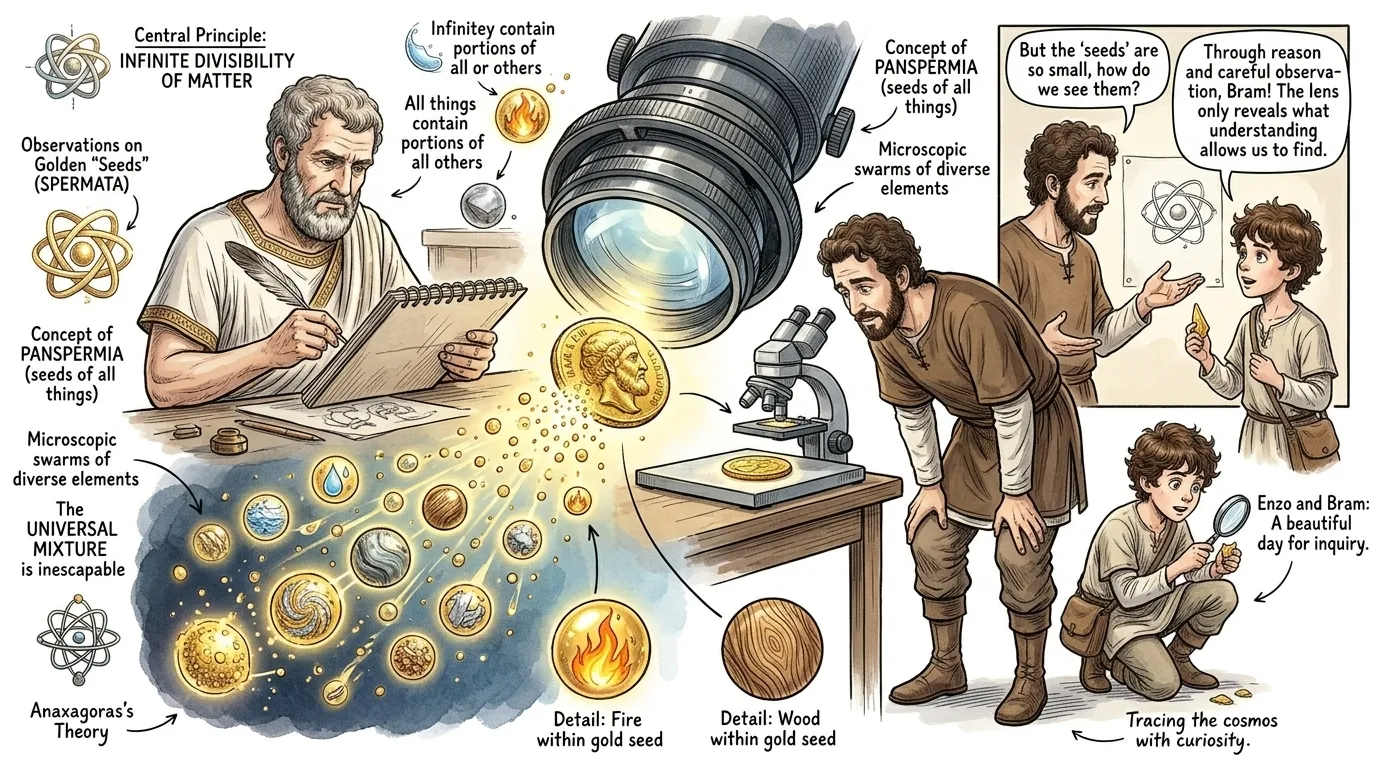
Imagine breaking a piece of gold into smaller and smaller pieces. Would it eventually stop being gold? Anaxagoras said no. He believed every tiny piece, every 'seed,' contains a bit of everything else. Gold is mostly gold, but also contains traces of every other substance in the universe.
Philosophy Note: Anaxagoras used the term 'seeds' (spermata) to describe the fundamental constituents of matter.
Page 4
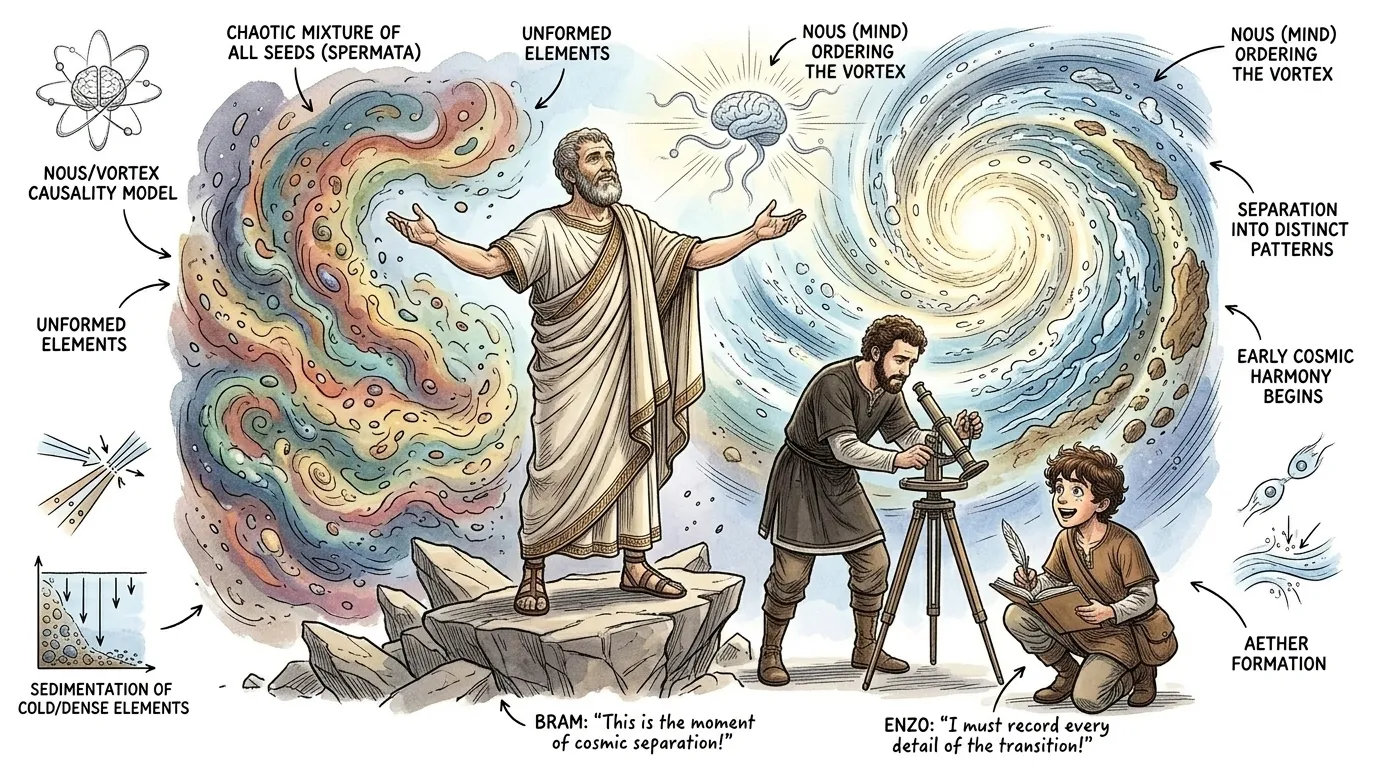
But what organizes all these 'seeds'? Anaxagoras introduced 'Nous' – Mind or Intelligence – as the driving force. Nous is separate, pure, and initiates order in the cosmos, setting the initial vortex in motion that separated out the elements. It's the reason why the universe isn't just a chaotic soup.
Philosophy Note: Nous (Νοῦς) is often translated as 'Mind,' 'Intellect,' or 'Reason.'
Page 5
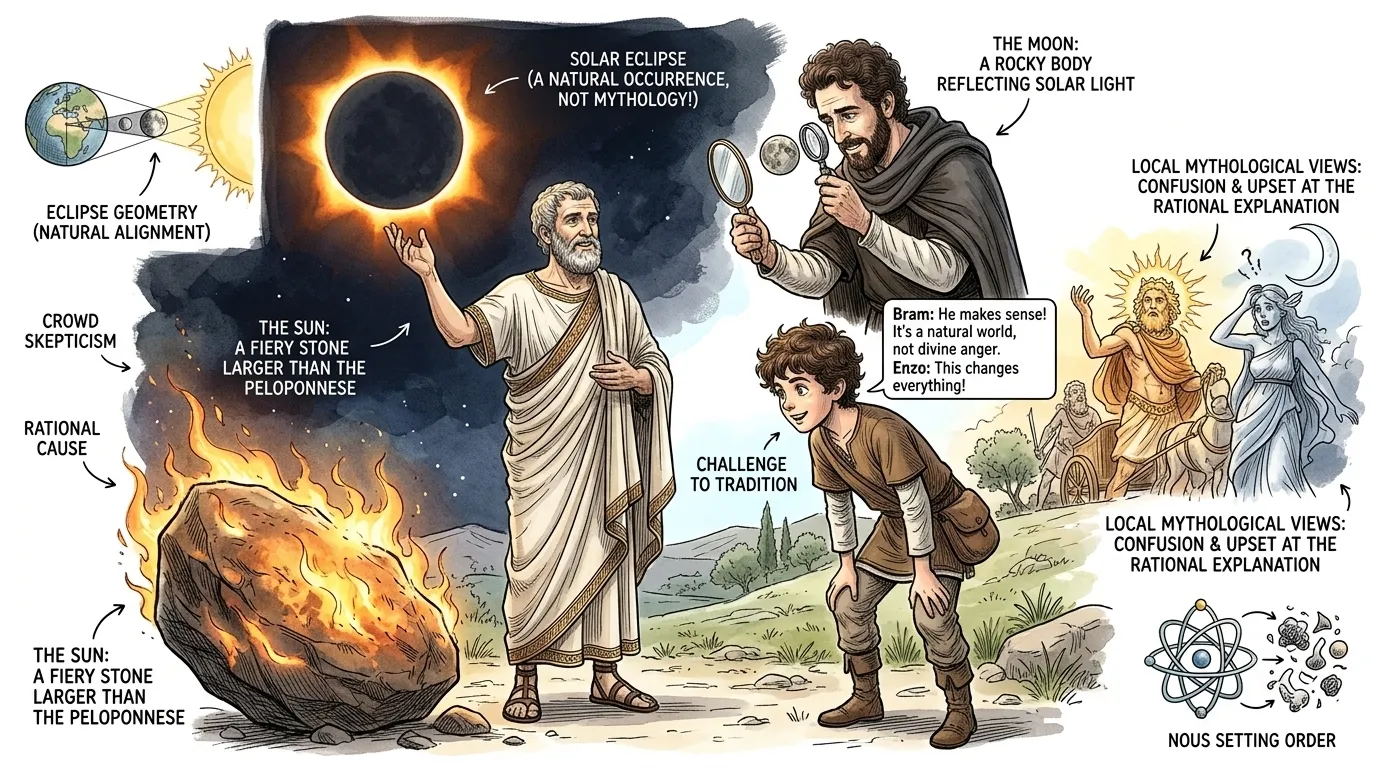
Anaxagoras used his theory to explain natural phenomena. He argued that the sun was not a god, but a fiery stone, larger than the Peloponnese. He also correctly explained eclipses, suggesting they were caused by the moon blocking the sun's light. This rational approach challenged traditional beliefs.
Philosophy Note: Anaxagoras's scientific explanations sometimes clashed with religious views, leading to accusations of impiety.
Page 6
![His radical views made enemies. Accused of impiety [disrespect for the gods], Anaxagoras was forced to leave Athens. His association with Pericles likely…](https://thewonderbooks.com/images/stories/anaxagoras/illustrations/anaxagoras_page_06_v1775183176405.webp "His radical views made enemies. Accused of impiety [disrespect for the gods], Anaxagoras was forced to leave Athens. His association with Pericles likely…")
His radical views made enemies. Accused of impiety [disrespect for the gods], Anaxagoras was forced to leave Athens. His association with Pericles likely protected him for a time, but eventually, the political climate turned against him. He spent his final years in Lampsacus, where he continued to teach.
Philosophy Note: Political tensions and religious conservatism contributed to Anaxagoras's exile.
Page 7
![Anaxagoras's ideas influenced later philosophers like Democritus [c. 460 – c. 370 BC] and even Plato [c. 428/427 or 424/423 – 348/347 BC].](https://thewonderbooks.com/images/stories/anaxagoras/illustrations/anaxagoras_page_07_v1775183204299.webp "Anaxagoras's ideas influenced later philosophers like Democritus [c. 460 – c. 370 BC] and even Plato [c. 428/427 or 424/423 – 348/347 BC].")
Anaxagoras's ideas influenced later philosophers like Democritus [c. 460 – c. 370 BC] and even Plato [c. 428/427 or 424/423 – 348/347 BC]. His emphasis on reason and observation paved the way for scientific inquiry. His concept of 'everything in everything' foreshadowed later ideas about the interconnectedness of matter.
Philosophy Note: Anaxagoras's teachings continued to spread even after his exile.
Page 8
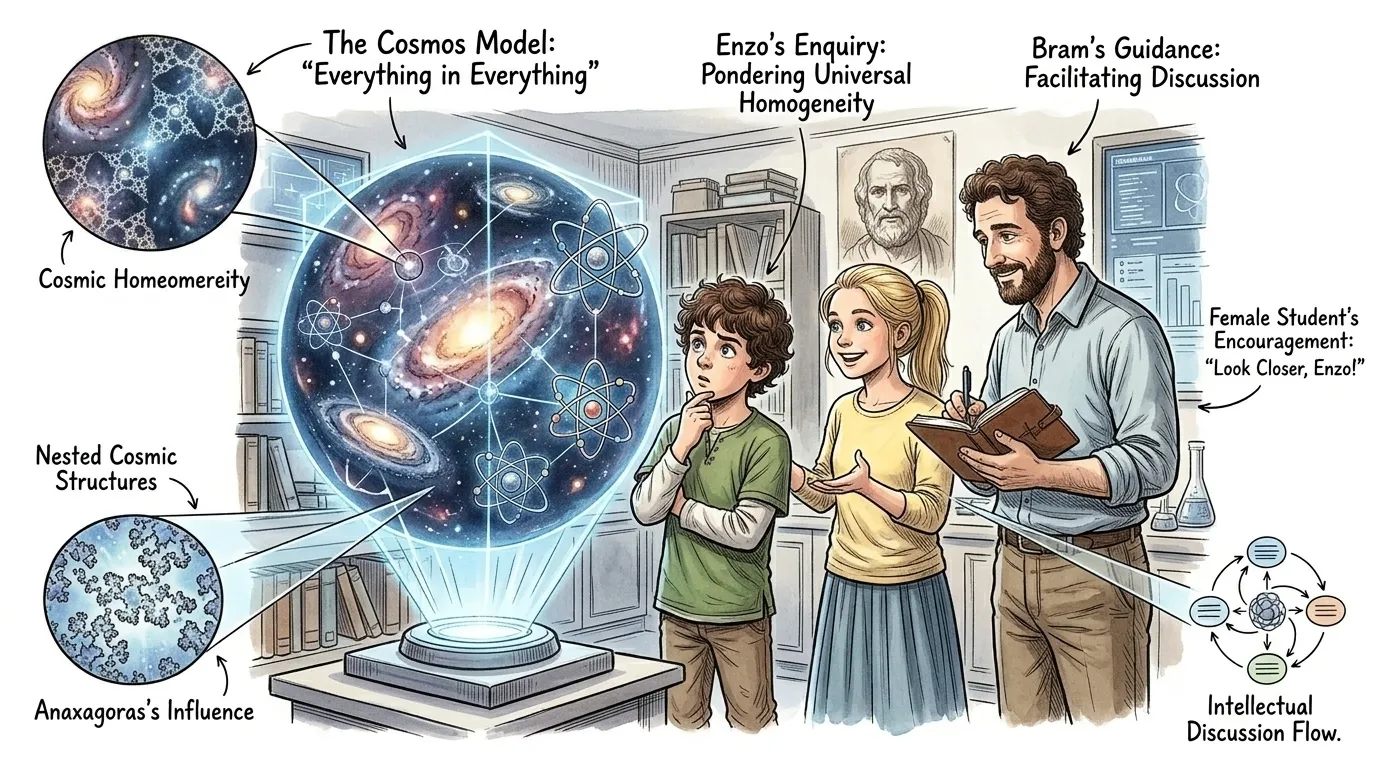
Even today, Anaxagoras's questions resonate. How is the universe organized? What are the fundamental building blocks of reality? What is the role of intelligence in the cosmos? These questions continue to drive scientific and philosophical inquiry. Yousef asks, 'If everything is in everything, how can we be sure of anything?'
"Yasmin replies, 'That's the point, Yousef! As Socrates said, 'The only true wisdom is in knowing you know nothing.' We must always keep questioning and exploring!'"
Philosophy Note: Anaxagoras's philosophical contributions continue to influence contemporary thought.
Page 9
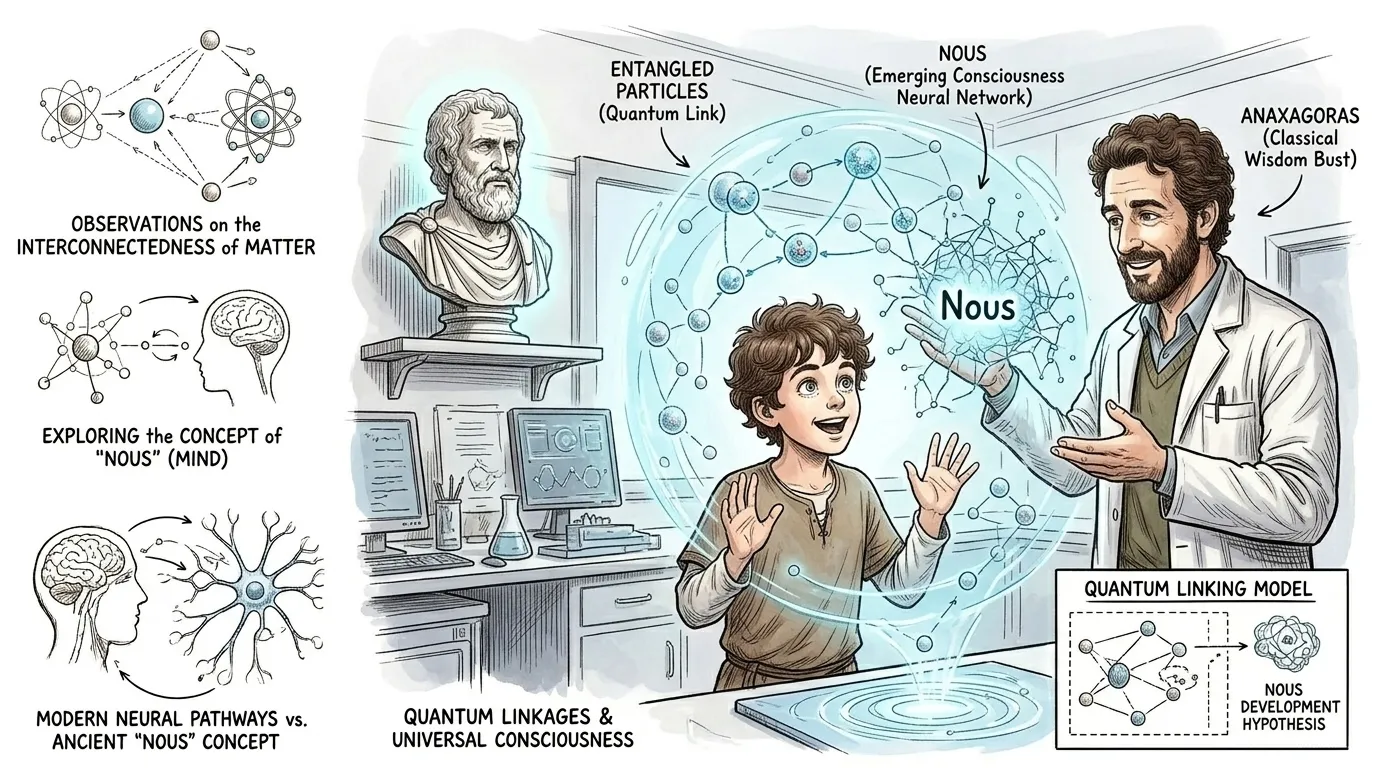
Anaxagoras's 'everything in everything' can be seen as an early precursor to concepts in modern physics, such as quantum entanglement, where particles are interconnected regardless of distance. His emphasis on Mind (Nous) also foreshadows discussions about consciousness and the origin of intelligence.
Philosophy Note: Modern science explores the interconnectedness of the universe at a deeper level.
Page 10
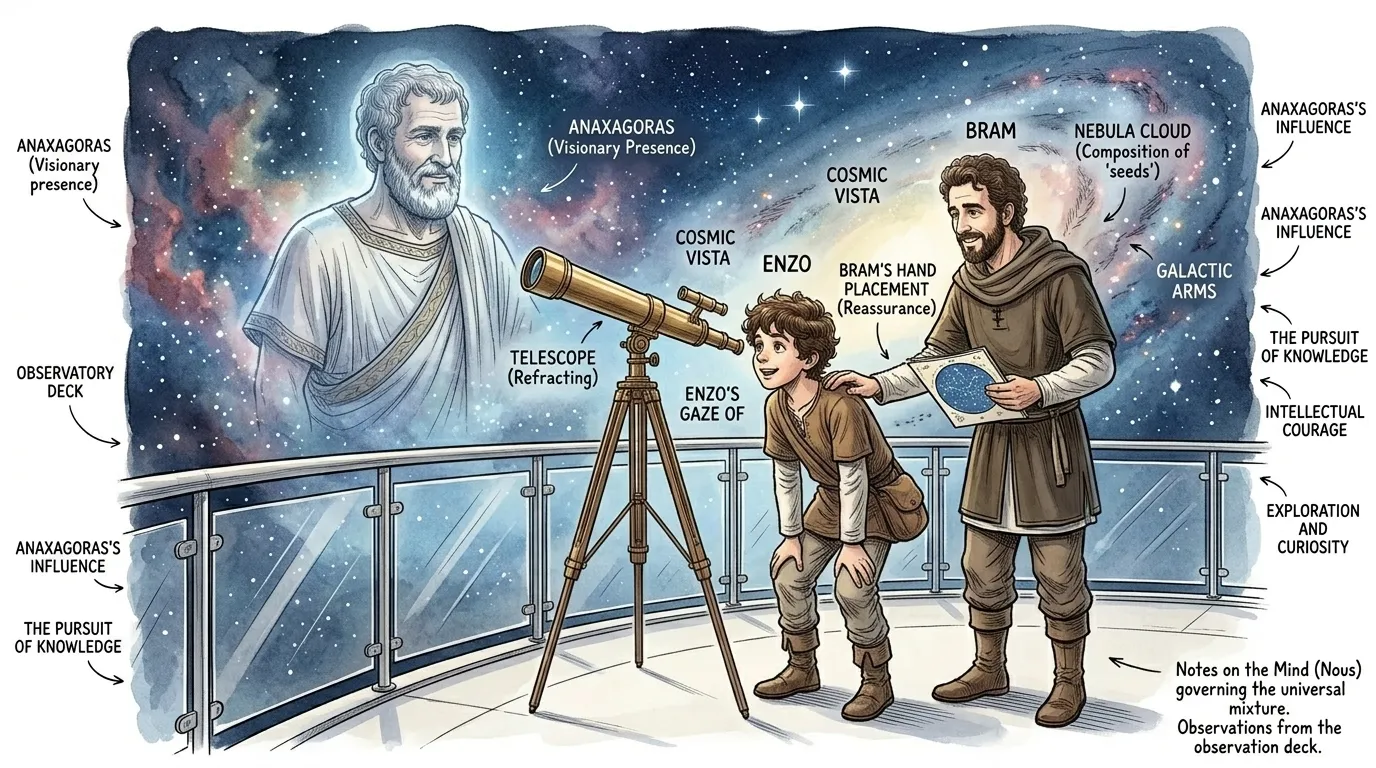
Anaxagoras's story teaches us the importance of questioning, observing, and challenging assumptions. His courage to pursue reason, even in the face of opposition, remains an inspiration. The quest to understand the universe is a journey that continues today, building upon the foundations laid by thinkers like Anaxagoras.
Philosophy Note: The search for knowledge continues to drive humanity's exploration of the universe.
About this story
- Audience: kids (ages 6–12)
Questions and answers
Read Wonder Philosophy on your phone
Wonder Philosophy is available on Android and iPhone and iPad. Get Wonder Philosophy on Google Play · Get Wonder Philosophy on the App Store.