Antonio Gramsci
Antonio Gramsci — an illustrated philosophy story. 8 illustrated pages, free to read on Wonder Philosophy.
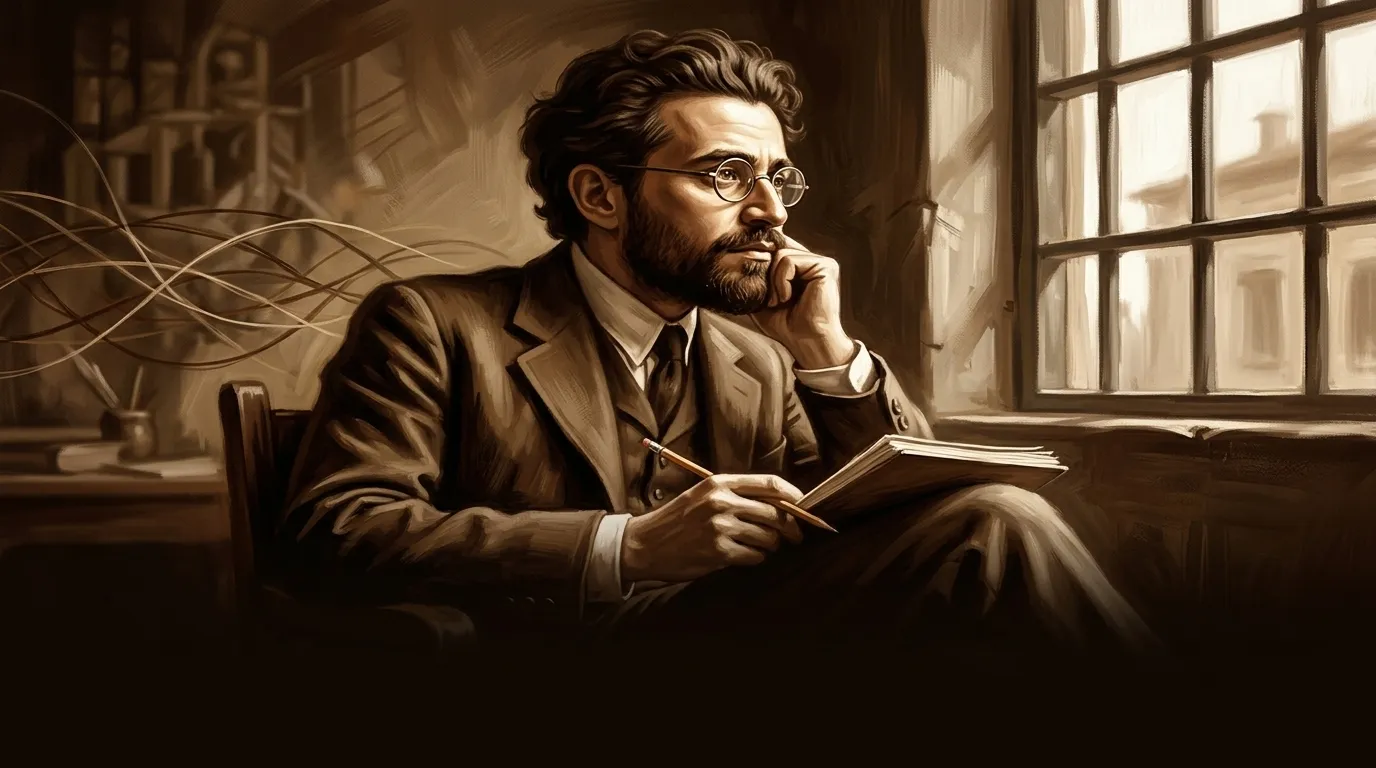
Page 1
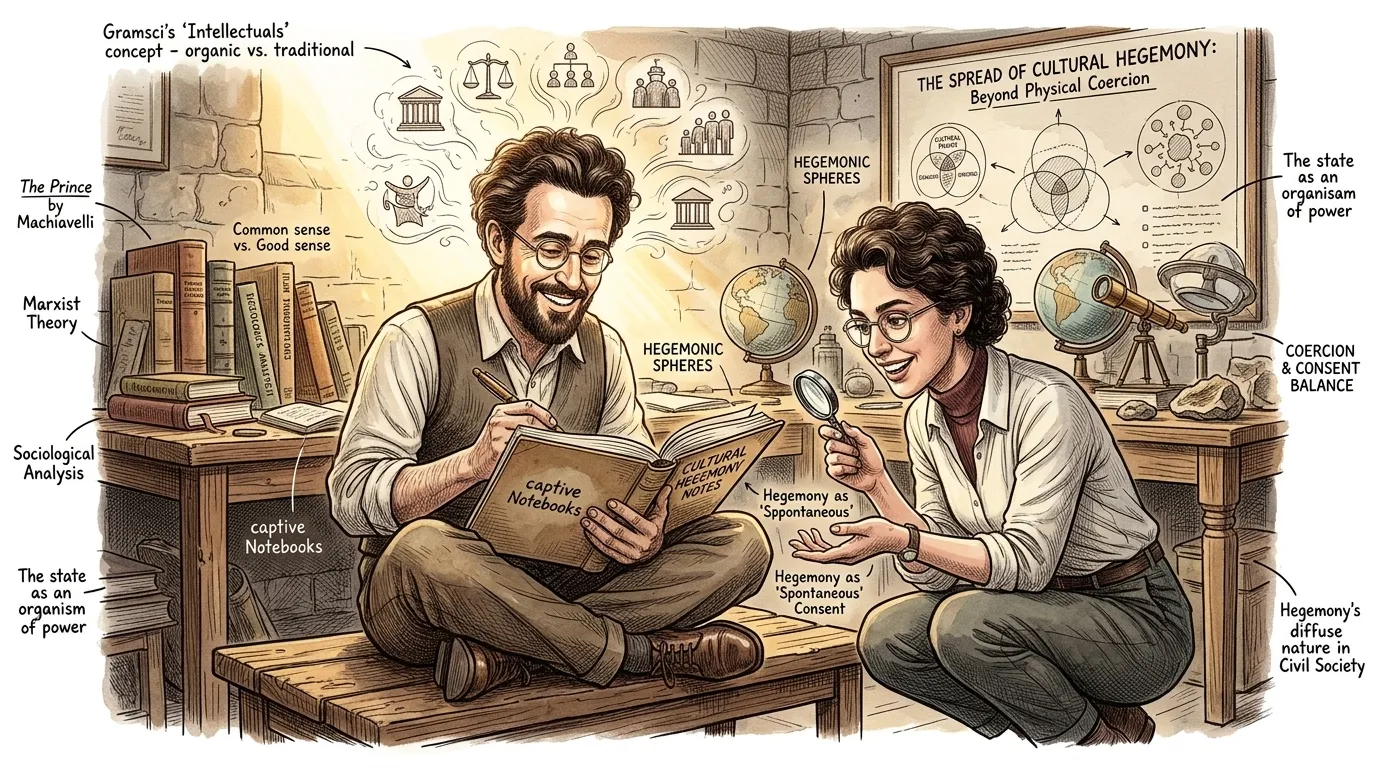
Antonio Gramsci, an Italian Marxist theorist and politician, fundamentally reshaped our understanding of power. His unique insights, forged in the confines of a Fascist prison cell, revealed how societal control operates far beyond mere physical force or economic dominance. He argued that true power often resides in the realm of culture and ideas, shaping collective consciousness.
""Power is not merely about tanks and bayonets," Gramsci might have observed in his prison notebooks. "It is woven into the very fabric of our thoughts, our institutions, and what we consider 'common sense'.""
Philosophy Note: Antonio Gramsci: Italian Marxist theorist. Core Idea: Hegemony – power maintained through cultural and ideological consent, not just force.
Page 2
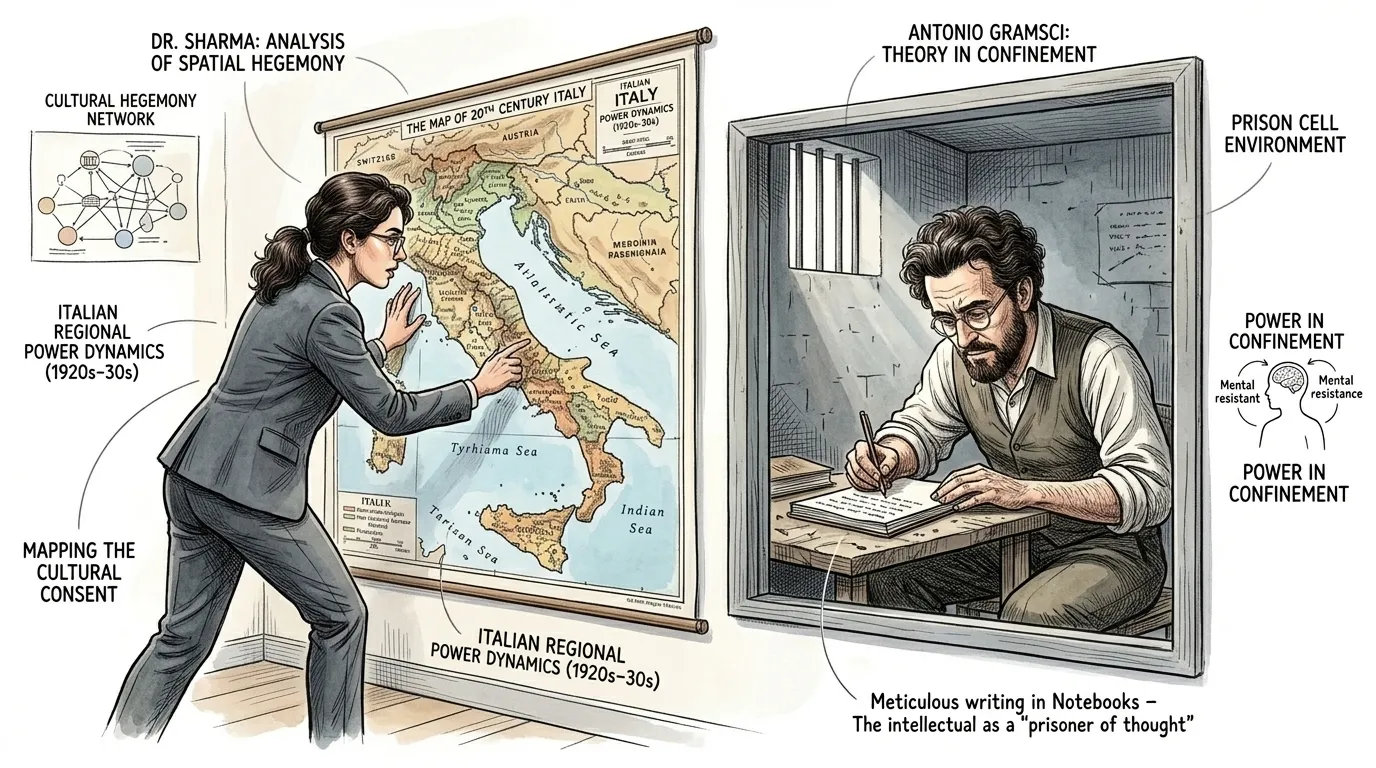
Gramsci's foundational ideas crystallized during a period of immense personal struggle, imprisoned by Mussolini's Fascist regime. Accused of political crimes, he was condemned to over two decades of confinement, though he died before its completion. It was in this crucible of isolation and reflection that he crafted his most profound theoretical contributions.
"Dr. Anya Sharma, a contemporary scholar with long, dark brown wavy hair in a low ponytail, an oval face, warm brown eyes, fair skin, and a focused expression, wearing a dark grey pantsuit and white blouse, gestures to a historical map. "Gramsci's imprisonment wasn't just a political act; it gave him a unique, albeit brutal, laboratory. From behind bars, he meticulously analyzed the mechanisms of societal control. He questioned, as Niccolò Machiavelli once wrote, 'Whether it is better to be loved than feared, or feared than loved.' Gramsci probed how consent, not just coercion, truly operates.""
Philosophy Note: Fascist Italy (1926-1937): Gramsci's imprisonment by Mussolini. Context: Challenging traditional Marxist views on revolution through economic determinism.
Page 3
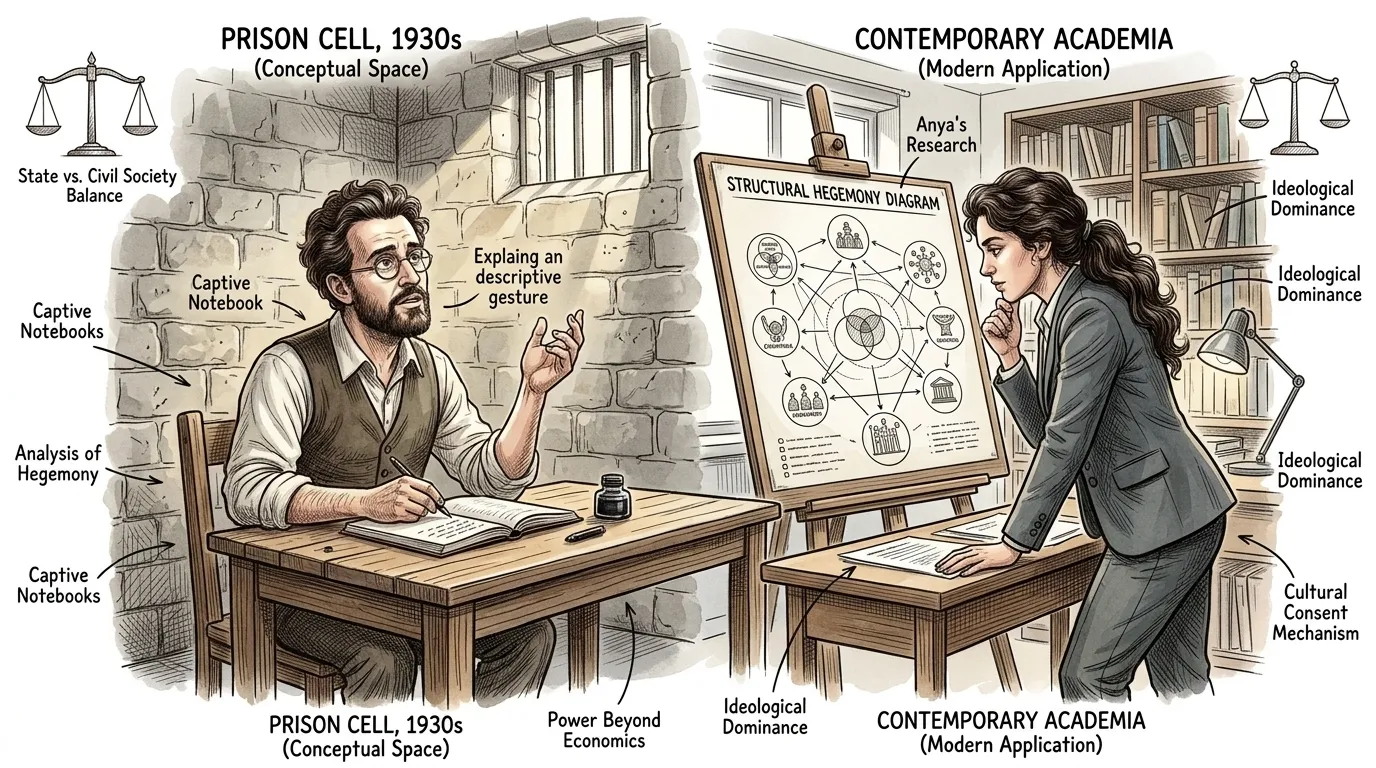
Gramsci challenged conventional Marxist thought, which largely focused on economic structures and direct state coercion to explain class power. He observed that in many Western societies, the ruling class maintained power not solely through force, but through a more subtle, pervasive cultural and ideological dominance.
"Gramsci, seated at a simple wooden table with his notebook open, looks up, eyes reflecting deep insight. "The state uses force, yes, but what about the power that makes people accept their place, believe in the 'naturalness' of the existing order? This, my friend, is 'hegemony.' It is the subtle leadership, not just dictation, that shapes our world." Dr. Sharma nods, adding, "It's the idea that a dominant group's worldview becomes so ingrained, so 'common sense,' that it's rarely questioned. This is the profound insight we 'discover' when we analyze modern society.""
Philosophy Note: Hegemony: A concept where a dominant group maintains power by shaping society's ideas, values, and norms, leading to the voluntary consent of subordinate groups. Not solely economic or coercive.
Page 4
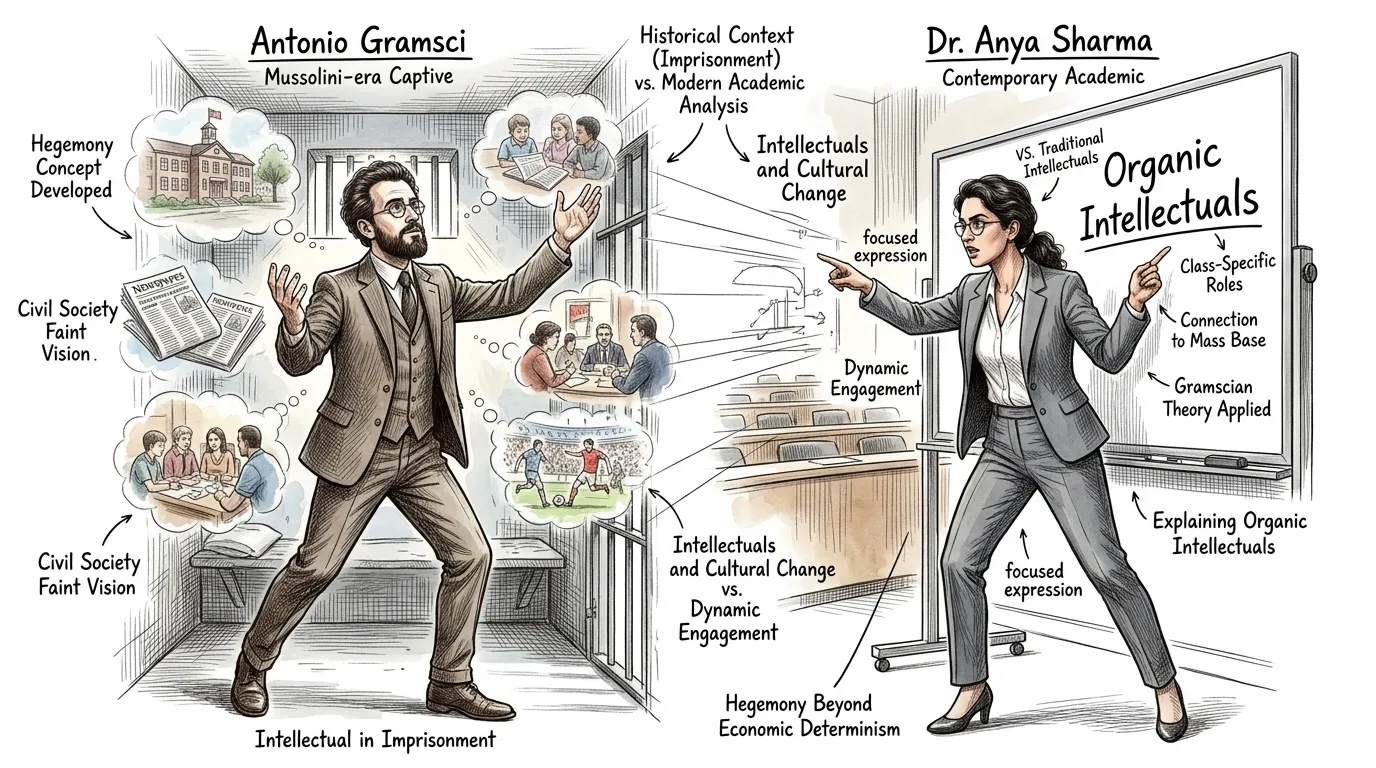
Gramsci distinguished between 'political society' (the state's coercive apparatus) and 'civil society' (the complex network of non-state institutions like schools, churches, media, and cultural organizations). He argued that civil society is the primary site where hegemony is constructed and maintained. These institutions propagate the dominant ideology, making it seem normal and universal.
""Consider the schools, the newspapers, the prevailing stories we tell ourselves," Gramsci explains, gesturing around his small cell as if envisioning the world outside. "These are not merely reflections of power; they are active architects of consent. They shape our 'common sense'." Dr. Sharma adds, "And within this, Gramsci introduced the 'organic intellectual'—not a detached academic, but someone who emerges from a specific class to articulate its worldview, linking theory to practical struggle. This is critical for challenging dominant narratives.""
Philosophy Note: Civil Society: Non-state institutions (education, media, religion) where dominant ideas are disseminated. Organic Intellectuals: Thinkers who emerge from a class to articulate its interests, fostering new consciousness.
Page 5
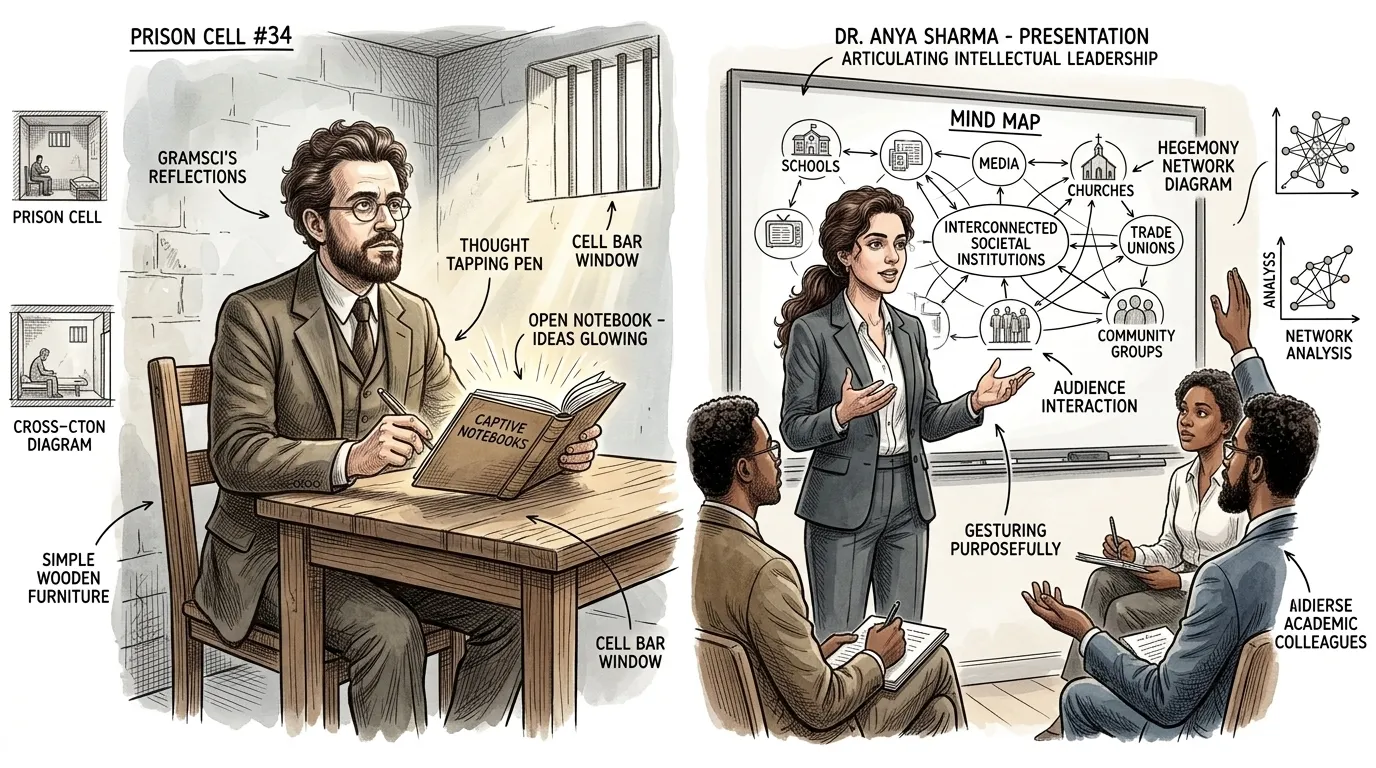
If power is deeply embedded in culture and consent, then revolution cannot be a sudden, frontal assault. Gramsci proposed a 'war of position'—a long-term, patient struggle within civil society to challenge and transform dominant ideas, creating a new, counter-hegemonic 'common sense.' This contrasts with the 'war of maneuver,' a direct, military-style confrontation.
""To truly shift power," Gramsci explains, tapping his pen on his notebook, "one must not merely seize the palace, but change the minds that build it. The 'war of position' is fought in the classrooms, the newspapers, the hearts of the people." Dr. Sharma clarifies, "It's about intellectual and moral leadership, building alliances, and articulating alternative visions of society. This slow, steady erosion of the dominant narrative is the patient work of change, creating a new societal foundation from within. It's a profound strategy for systemic transformation.""
Philosophy Note: War of Position: A long-term cultural and ideological struggle within civil society to challenge dominant ideas and build counter-hegemony. War of Maneuver: Direct, frontal assault on state power.
Page 6
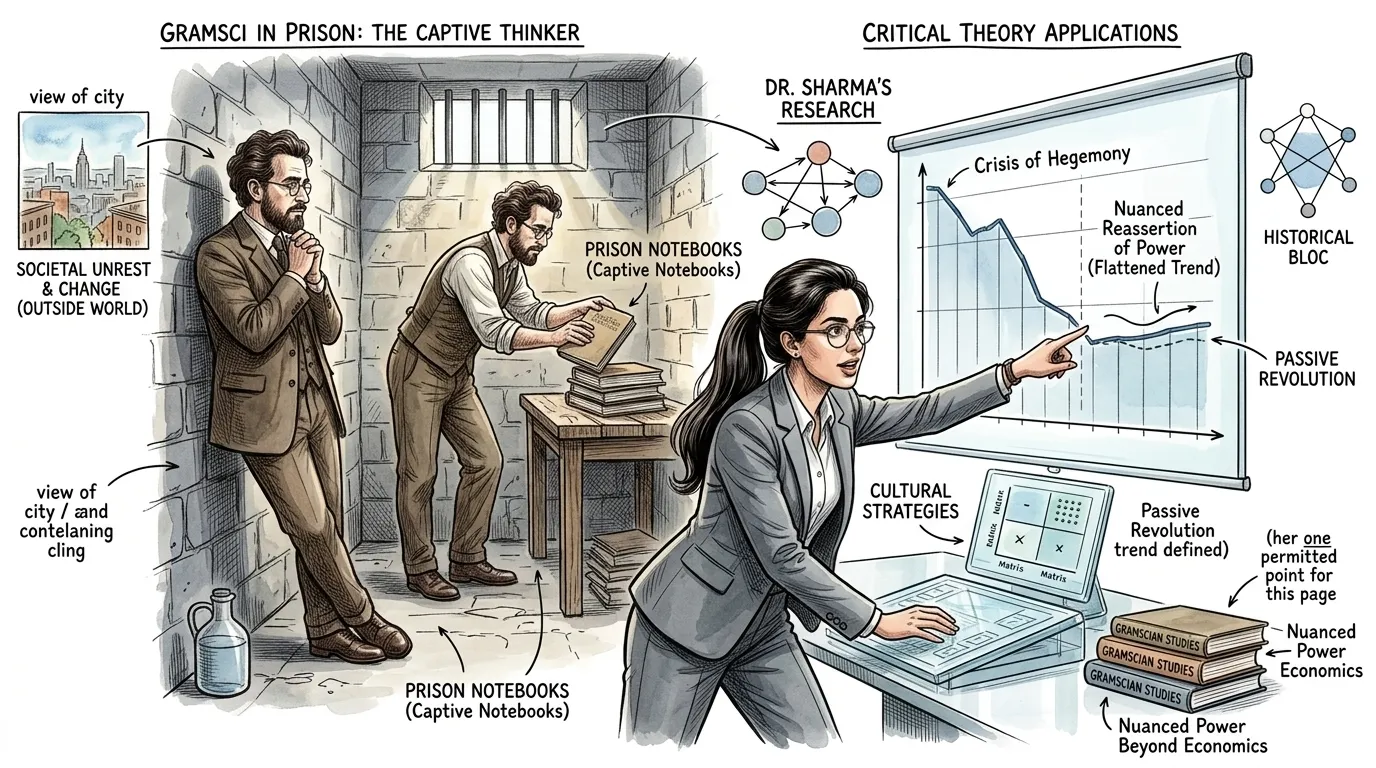
Gramsci theorized that a 'crisis of hegemony' occurs when the ruling class's moral and intellectual leadership falters, and its ideas no longer resonate or justify the existing order for subordinate groups. In such moments, the ruling class might resort to 'passive revolution,' introducing reforms from above to defuse potential radical change without fundamentally altering power structures.
""When the old certainties crumble," Gramsci muses, gazing out his window, "when the people no longer fully believe in the leaders' vision, that is a 'crisis of hegemony.' It's a dangerous moment, often leading to either true transformation or a clever reassertion of power." Dr. Sharma clarifies, "This 'passive revolution' is when the ruling elite co-opts elements of the opposition's demands, making superficial changes to maintain core control. It's a sophisticated defense mechanism against genuine societal shifts.""
Philosophy Note: Crisis of Hegemony: When a ruling class loses its moral and intellectual authority, and its ideas are no longer accepted by subordinate groups. Passive Revolution: Reforms from above to prevent radical change, maintaining existing power structures.
Page 7
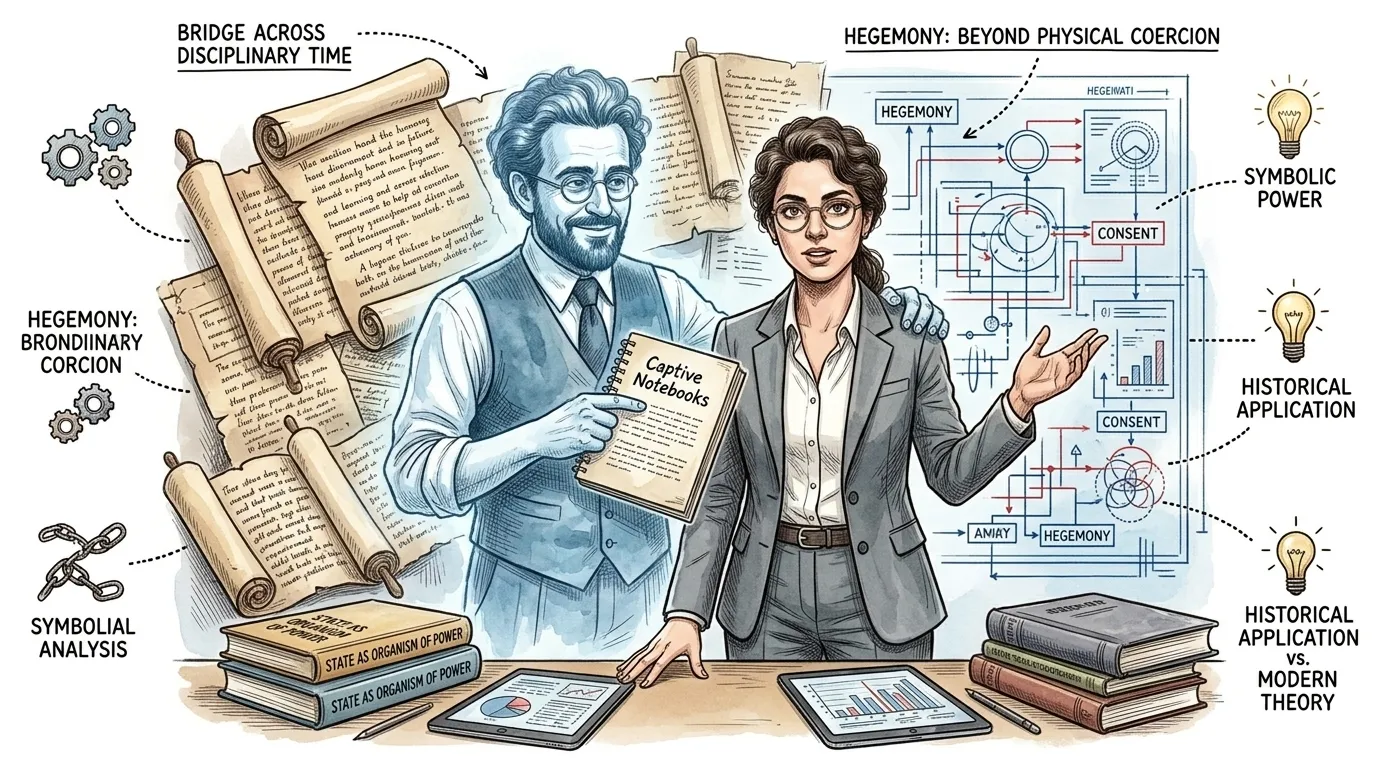
Gramsci's work provided a sophisticated lens through which to analyze power, moving beyond simplistic economic determinism. While his ideas were revolutionary, they also invited criticism, particularly regarding the ambiguity of how 'counter-hegemony' is truly achieved and the potential for a new form of intellectual elite.
""Gramsci's genius," Dr. Sharma asserts, looking directly at the camera, "lies in showing that consent isn't always voluntary; it's often manufactured. But how do you truly dismantle a worldview so deeply ingrained?" Gramsci, a spectral figure by her side, observes, "The struggle is continuous. It is a never-ending process of challenge and counter-challenge, a dialectic of ideas. As the poet Percy Bysshe Shelley famously wrote, 'The great instrument of moral good is the imagination.' We must imagine, and then build, a different world.""
Philosophy Note: Legacy: Shifted focus from economic to cultural power. Criticism: Ambiguity of practical counter-hegemonic strategies; risk of intellectual elitism in 'organic intellectuals'.
Page 8
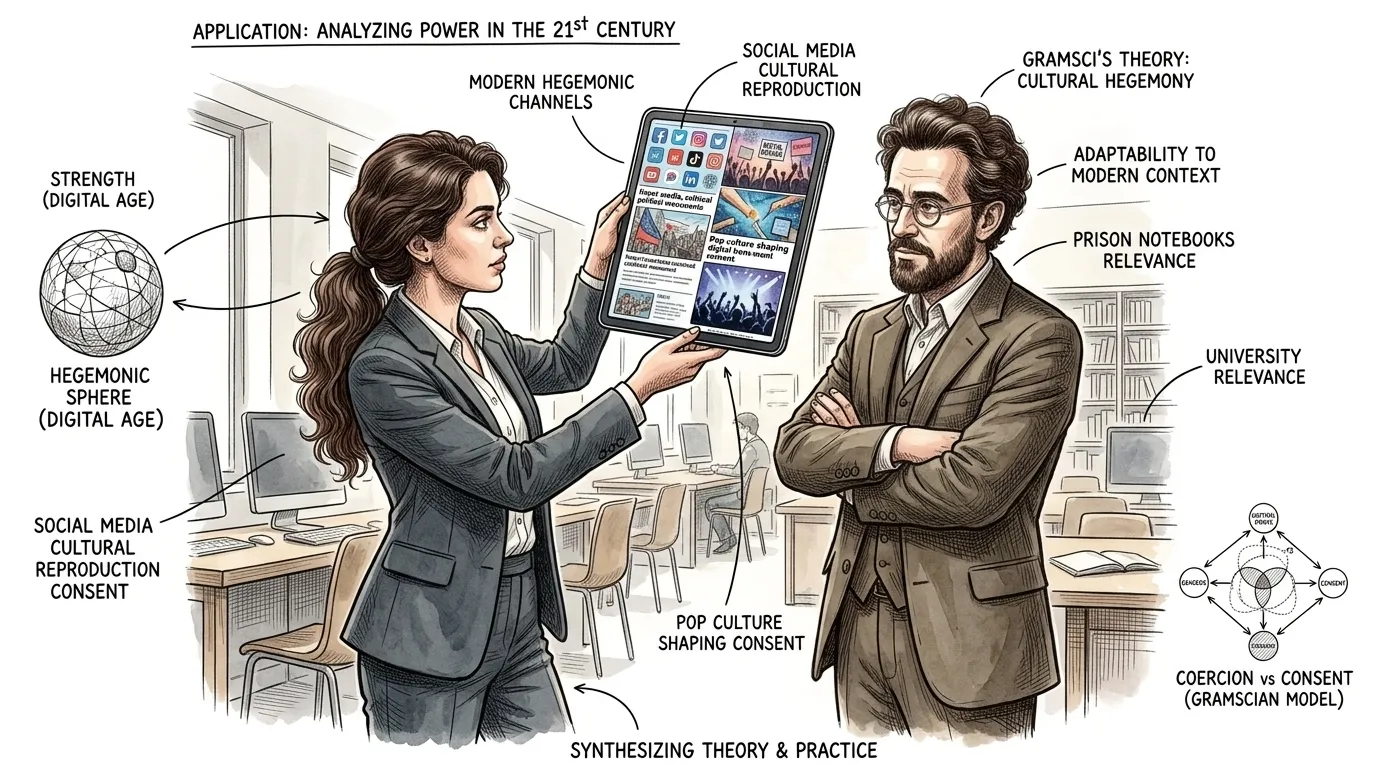
The profound insights Gramsci provided into hegemony remain acutely relevant for understanding contemporary society. The mechanisms he described, once confined to print media and schools, have expanded dramatically through digital technologies and globalized culture, allowing dominant narratives to be propagated with unprecedented speed and reach.
"Dr. Sharma holds up her tablet, displaying images of current events. "Think of how social media shapes discourse, how entertainment influences values, how educational curricula are debated. This 'cultural knowledge' that we previously discussed as Gramsci's key insight—the pervasive influence of ideas—is now our vital 'tool' to dissect these phenomena. He helps us see beyond the surface, to identify where true power is being exercised." Antonio Gramsci, a contemplative presence, nods, indicating his theories still resonate."
Philosophy Note: Modern Relevance: Analyzing media narratives, political discourse, education, and popular culture through a Gramscian lens. The 'cultural knowledge' of hegemony helps us interpret subtle power dynamics in society today.
About this story
- Audience: general readers
Questions and answers
Read Wonder Philosophy on your phone
Wonder Philosophy is available on Android and iPhone and iPad. Get Wonder Philosophy on Google Play · Get Wonder Philosophy on the App Store.