Aristotle
Aristotle — an illustrated philosophy story. 10 illustrated pages, free to read on Wonder Philosophy.
Page 1
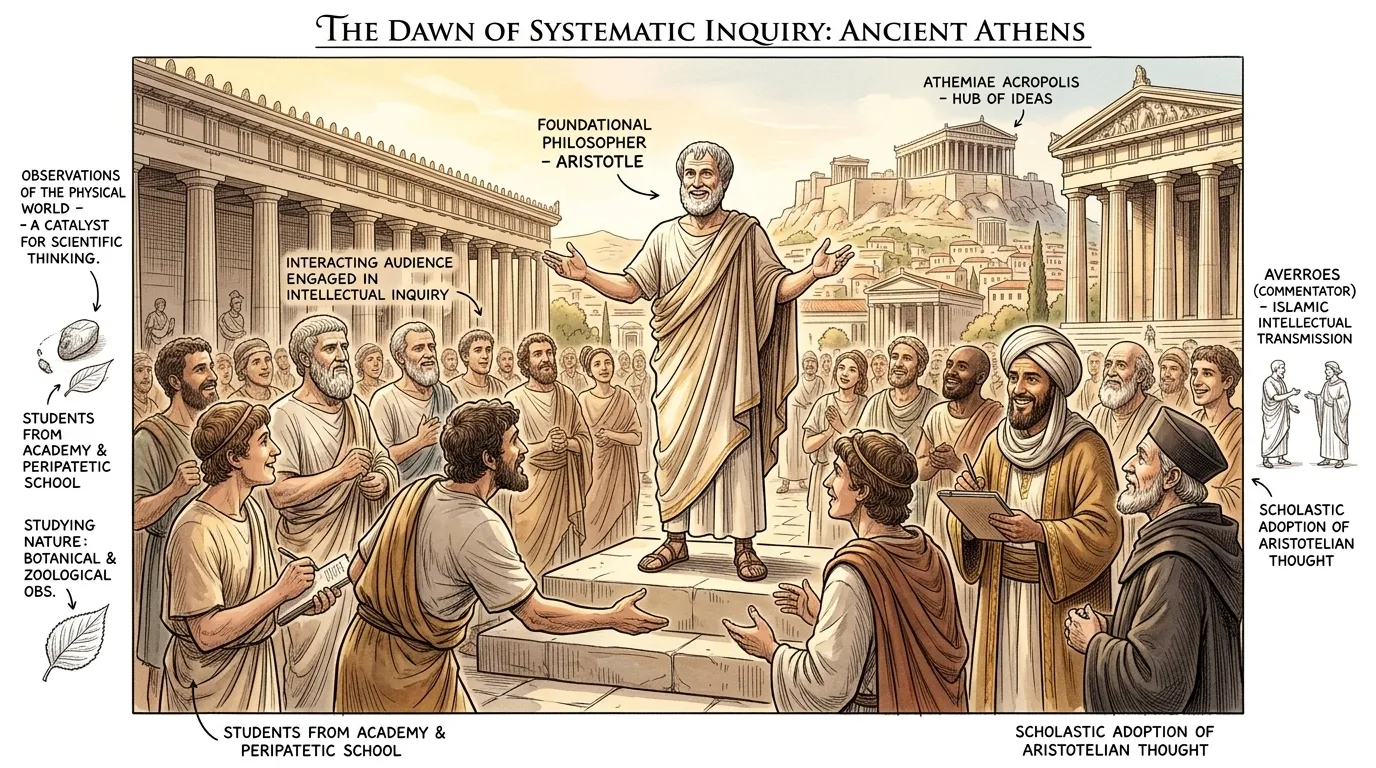
Amidst the bustling intellectual energy of ancient Athens, a man of profound curiosity and disciplined thought began to weave the fabric of Western understanding. He sought to encompass all human knowledge into a unified, logical system, a vision that would shape centuries of inquiry.
""Friends, I declare that all knowledge, from the smallest insect to the grandest state, can be observed, categorized, and understood," Aristotle announced to a rapt audience. "We must not merely speculate about the world, but actively engage with it, dissecting its parts and discovering its underlying principles. Only through systematic inquiry can we truly grasp the essence of reality.""
Philosophy Note: Aristotle (384–322 BCE): Greek philosopher and polymath. Student of Plato, teacher of Alexander the Great. His Lyceum in Athens was a center of systematic research. This era marks the foundational period of empirical and logical inquiry.
Page 2
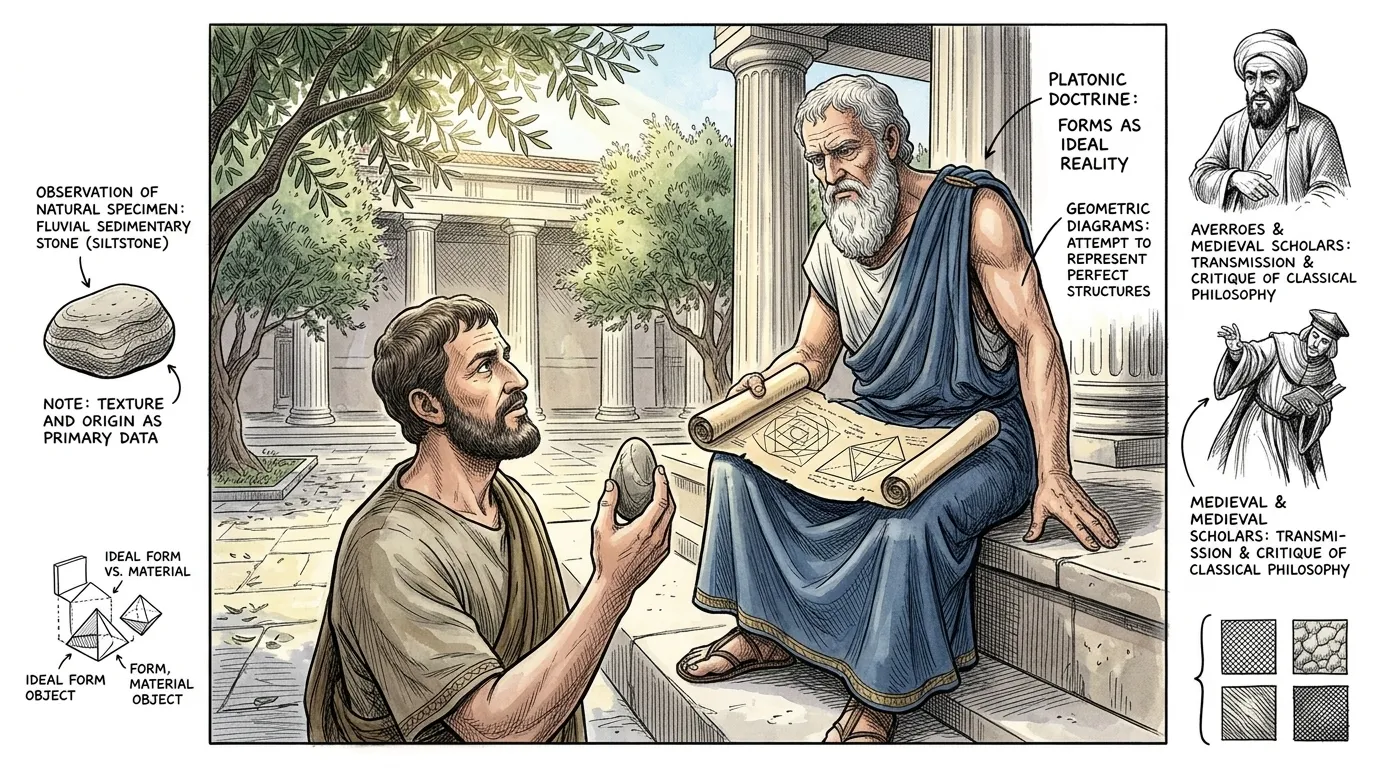
Aristotle, a brilliant student of Plato, grappled with the prevailing philosophical currents of his time. His mentor emphasized transcendent 'Forms' as the ultimate reality, separate from our sensory experience. Yet, Aristotle increasingly believed that true understanding must begin with the world directly before us.
""Master Plato," Aristotle began respectfully, standing beside his former teacher in a quiet corner of the Academy. "Your Forms are magnificent, perfect blueprints. But how do we truly understand a horse without studying this horse, its muscles, its habits, its very breath?" Plato, an older, revered man in his 60s, with a long white beard and a serious expression, wearing a deep blue Greek chiton, replied, "The particulars merely reflect the universal Form, my dear Aristotle. The true essence lies beyond their imperfect manifestations." "Perhaps," Aristotle mused, clutching a small, smooth river stone, "but it is through these imperfect manifestations that knowledge first enters our minds. We must observe, classify, and deduce from what is tangible.""
Philosophy Note: The Academy of Plato (founded c. 387 BCE): An influential school where philosophical inquiry focused on abstract concepts and ideal Forms. Aristotle's departure marked a shift towards empirical observation and classification.
Page 3
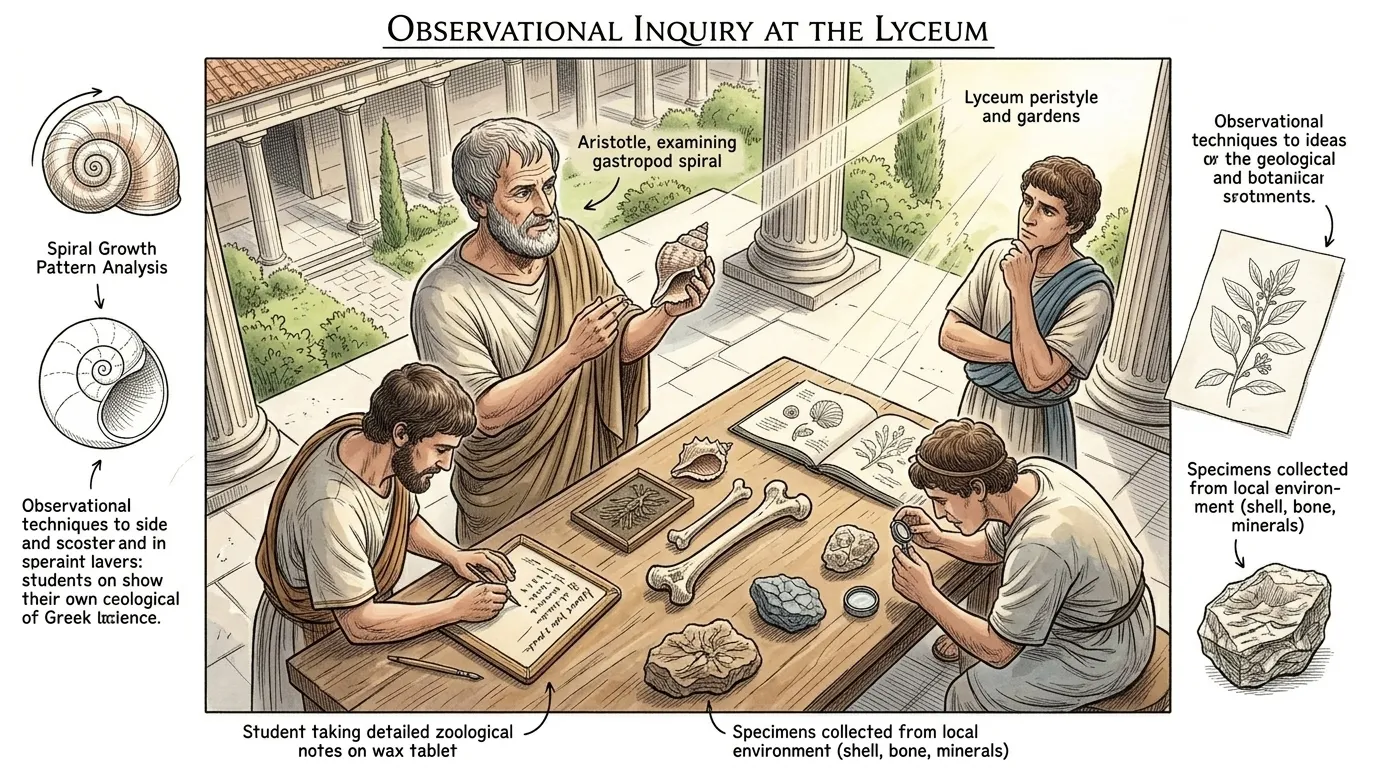
This fundamental divergence led Aristotle to develop a revolutionary methodology: empirical observation coupled with rigorous logical analysis. He believed that by examining specific instances, we could discern universal truths and create comprehensive systems of knowledge.
""To truly grasp the nature of things," Aristotle explained to a small group of his own students at the Lyceum, gesturing towards a collection of biological specimens on a table, "we must collect data, dissect, observe patterns, and then apply reason. Just as a potter understands clay by working it, we understand the world by immersing ourselves in its details." One student, intrigued, asked, "So, we build our understanding from the ground up, rather than descending from abstract ideals?" "Precisely!" Aristotle affirmed, picking up a carefully preserved seashell. "This shell, in all its unique forms and structures, reveals principles that apply to all shells. By compiling enough specific observations, we can develop accurate generalizations and establish sciences.""
Philosophy Note: The Lyceum (founded c. 335 BCE): Aristotle's school, known as the Peripatetic school, emphasized empirical research, systematic collection of data, and classification across various fields of study.
Page 4
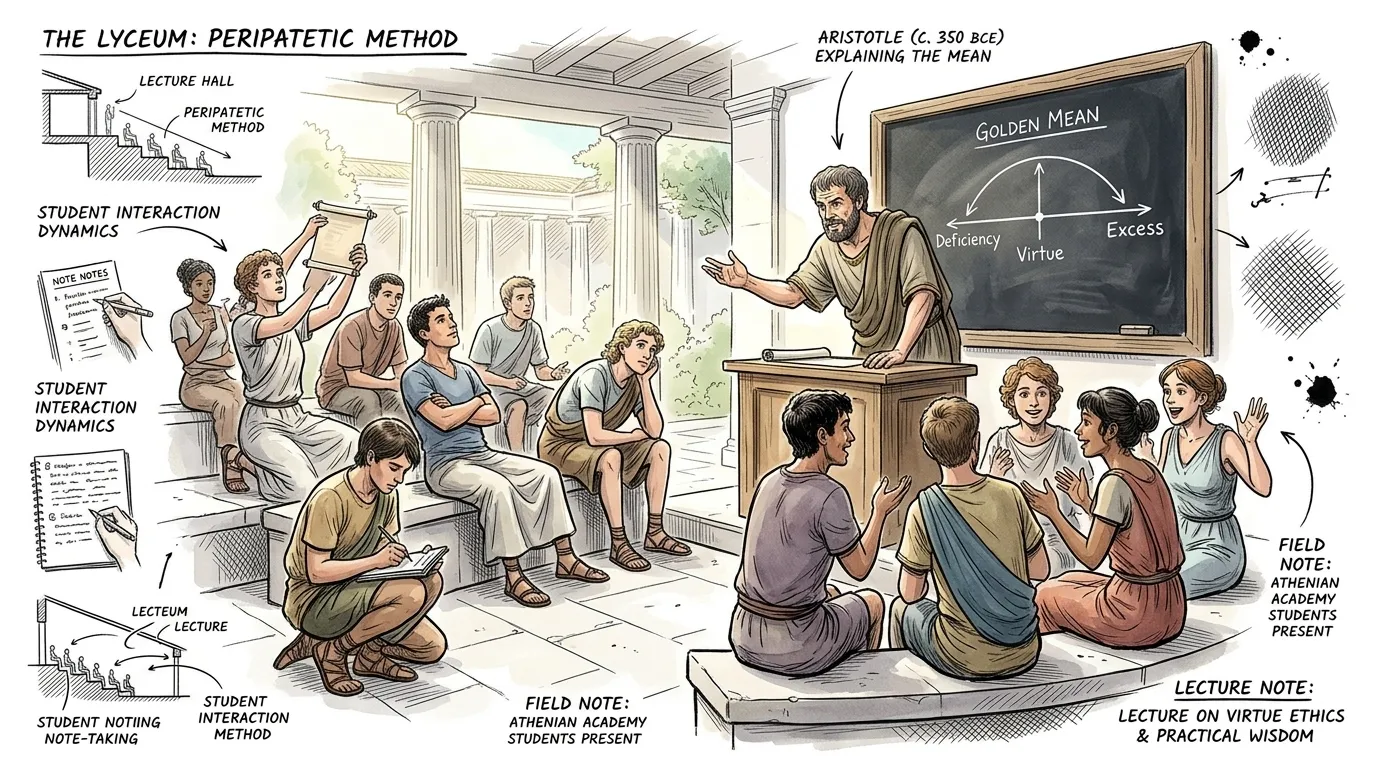
Beyond understanding the natural world, Aristotle turned his systematic gaze to human life and ethics. He asked: 'What is the ultimate goal of human existence?' His answer was 'eudaimonia,' often translated as flourishing or living well, which is achieved through virtuous action.
""Every craft, every inquiry, aims at some good," Aristotle posited, pacing before his students in a lecture hall. "What, then, is the highest good for human beings? It is not pleasure, nor honor, nor wealth, for these are means to an end. The highest good is 'eudaimonia'—a life of flourishing, achieved by fulfilling our unique human function." A student inquired, "And how do we achieve this flourishing?" "Through virtue," Aristotle clarified, stopping to face them directly. "Living virtuously means finding the 'mean' between extremes. Courage, for example, is the mean between recklessness and cowardice. Practical wisdom guides us in this pursuit, enabling us to act appropriately in every situation.""
Philosophy Note: Nicomachean Ethics: Aristotle's major work on ethics, exploring virtue, happiness (eudaimonia), and practical wisdom. It introduced the concept of the 'Golden Mean' as a balance between extremes.
Page 5
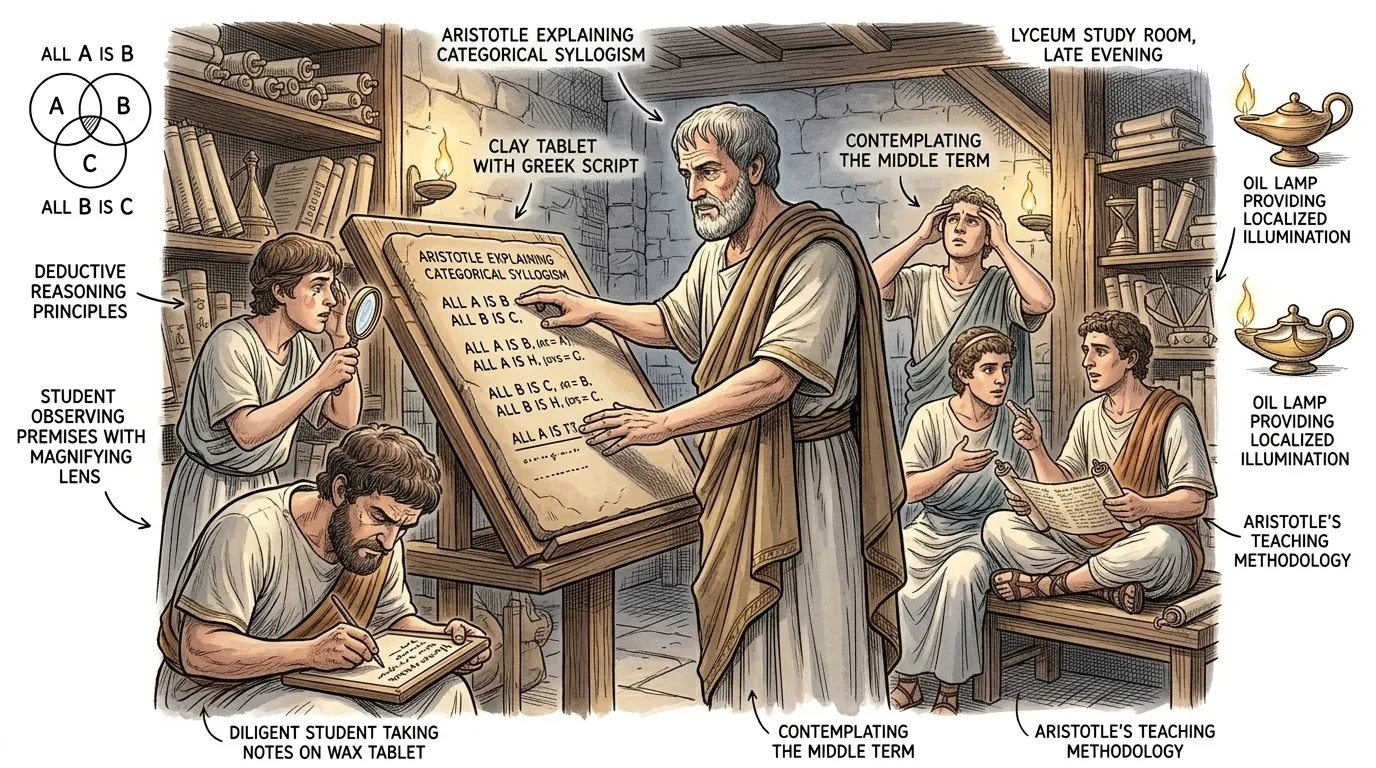
A cornerstone of Aristotle's approach, essential for all forms of inquiry, was his groundbreaking work in logic. He was the first to formalize the rules of reasoning, providing a framework to assess the validity of arguments, independent of their content.
""How can we build knowledge reliably if our thoughts are chaotic?" Aristotle challenged his class, tapping a stylus against a tablet. "We need a tool, an 'organon,' for correct thinking. This tool is logic." A student pondered, "So, it's about making sure our arguments are sound, not just what they argue?" "Precisely!" Aristotle affirmed. "Consider this: 'All men are mortal. Socrates is a man. Therefore, Socrates is mortal.' This is a valid deduction, a 'syllogism.' The structure guarantees the truth of the conclusion, provided the premises are true. It allows us to move from general truths to specific ones, or to derive new knowledge.""
Philosophy Note: Organon: The collection of Aristotle's six works on logic, which systematized the study of valid inference and provided the foundation for Western logic, particularly the theory of the syllogism.
Page 6
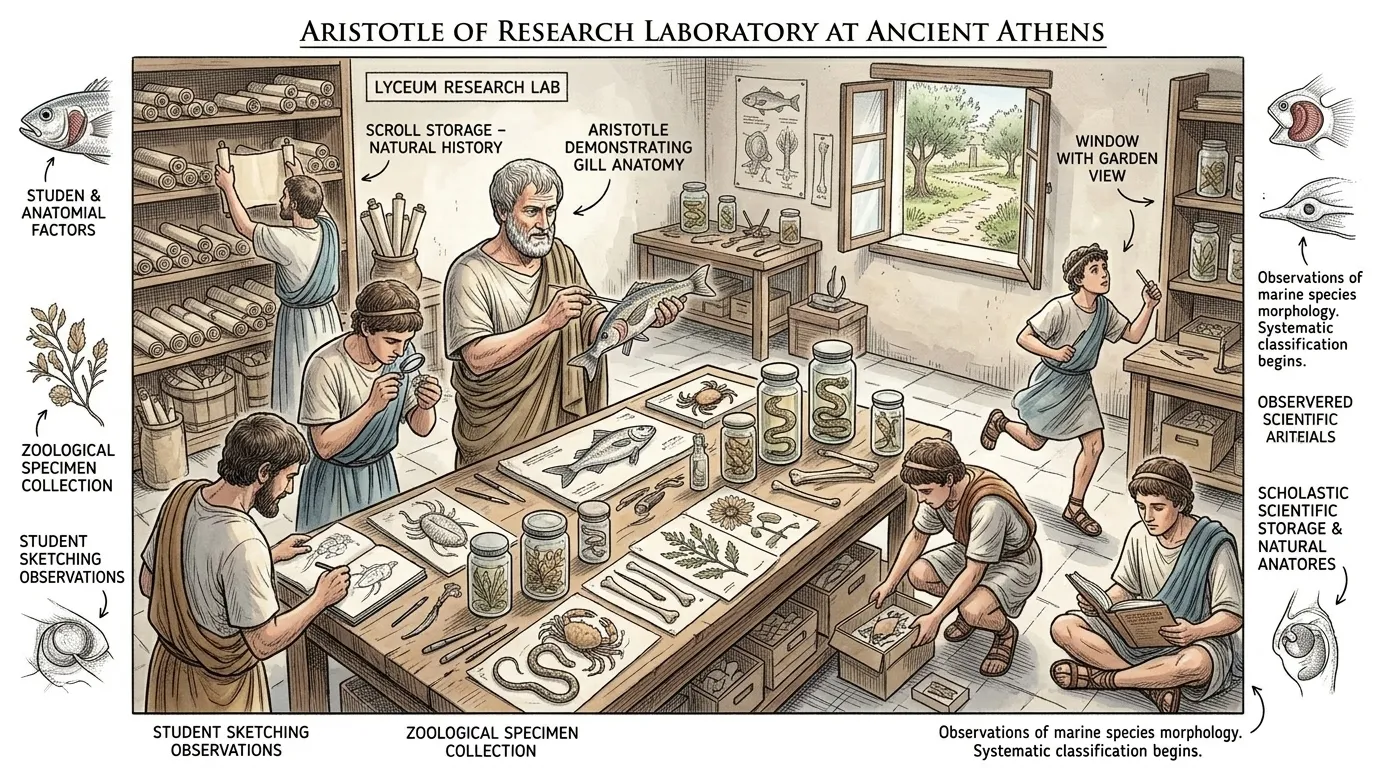
Aristotle's empirical method shone brightest in his biological studies. He painstakingly collected and categorized vast numbers of plants and animals, dissecting specimens, noting their habits, and establishing early principles of classification that preceded modern taxonomy by millennia.
""Observe the intricate design of nature!" Aristotle exclaimed, holding up a preserved fish specimen in his research laboratory. "Every creature, no matter how small, has a purpose, a 'telos,' guiding its development. We must describe them, compare them, understand their parts and their functions." A student, bending over a detailed drawing of a bird's anatomy, commented, "Your method allows us to see connections, Master, how different species adapt to their environments." "Indeed," Aristotle replied, picking up a scroll filled with detailed sketches. "By classifying them into genera and species based on shared characteristics, we begin to uncover the grand order of the natural world. This is not mere cataloging; it is understanding creation itself.""
Philosophy Note: Aristotle's biological works, like 'History of Animals' and 'Parts of Animals,' involved extensive empirical research, including dissections and observations, laying the groundwork for zoology and botany.
Page 7
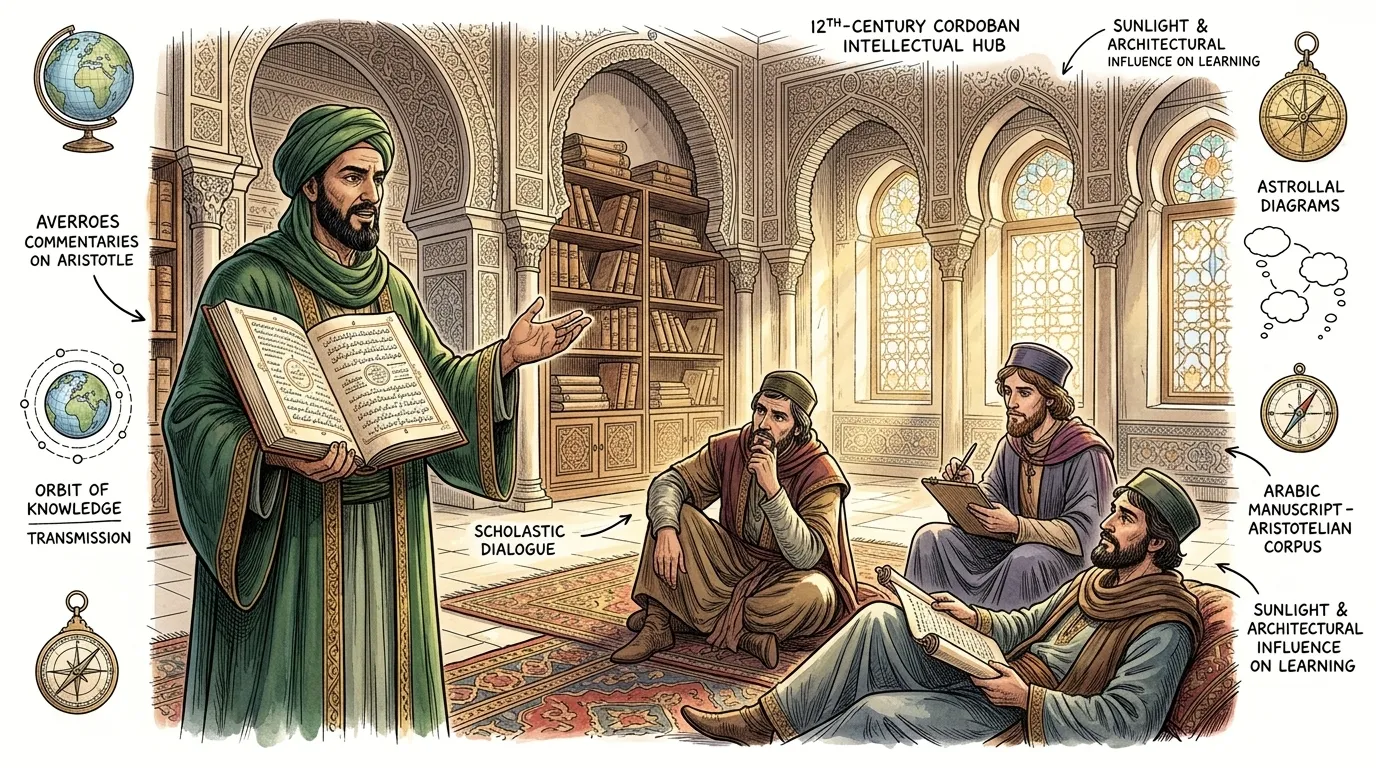
After the decline of the Western Roman Empire, many of Aristotle's works were lost to Europe for centuries. However, they found new life in the Islamic Golden Age, preserved, translated, and profoundly influenced by brilliant Arab scholars like Averroes, who meticulously interpreted and commented on his vast corpus.
""The Greek master, Aristotle, his logic illuminates the path to truth, and his science unveils the wonders of creation!" Averroes declared, addressing a group of scholars in a bustling library in Cordoba. Averroes, a scholarly man in his 50s with a dark, trimmed beard and a green turban, gestured to a stack of Arabic manuscripts. "His Organon, his Metaphysics, his Biology – they provide a universal framework for understanding the world, compatible with reason and faith. We must strive to fully comprehend his meaning." A younger scholar asked, "But some of his ideas, like the eternity of the world, seem to challenge our faith. How do we reconcile this?" "Our task is not to blindly accept, but to critically engage," Averroes replied, thoughtfully stroking his beard. "He forces us to refine our own arguments, to seek deeper truths. His method is a bridge.""
Philosophy Note: Averroes (Ibn Rushd, 1126–1198 CE): An Andalusian polymath who was one of the most influential interpreters of Aristotle in the Islamic world. His commentaries helped reintroduce Aristotle to Western Europe.
Page 8
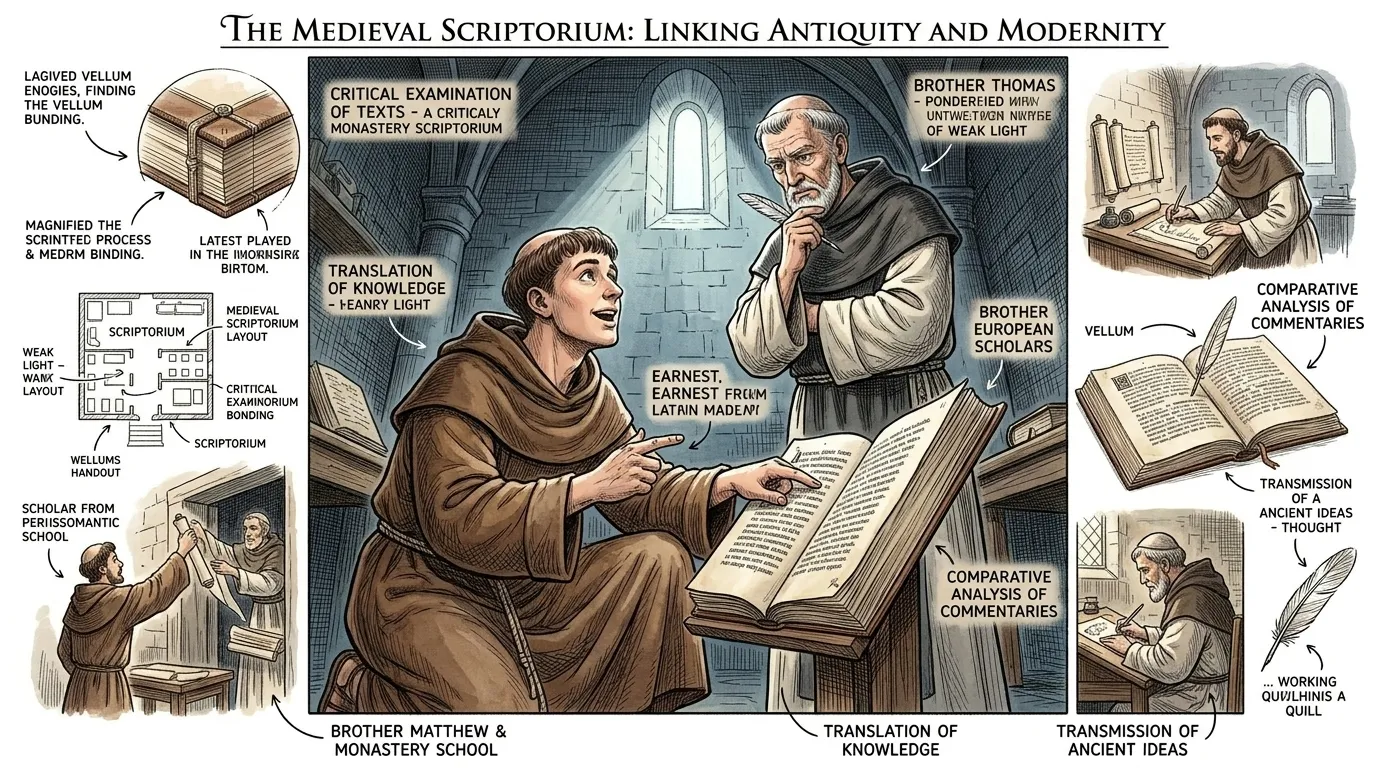
Averroes's commentaries, translated into Latin, sparked an intellectual revolution in medieval Europe. Aristotle's systematic thought, especially his logic and empirical approach, challenged existing scholastic frameworks and forced theologians and scholars to integrate a new, rigorous method of inquiry.
""Brother Thomas, Averroes's interpretation of Aristotle's method—the very systematic inquiry Aristotle himself championed—offers us a robust way to explore even the most complex theological questions!" A Medieval European Scholar, a younger, earnest man in his 30s with short hair and a brown monastic habit, exclaimed to a senior colleague, pointing to a Latin translation of Averroes's commentary. The senior scholar, Brother Thomas, nodded slowly. "Indeed, Brother Matthew. Aristotle's insistence on careful observation and logical deduction allows us to untangle ambiguities. As the Roman philosopher Seneca once said, 'Every new beginning comes from some other beginning's end.' The rediscovery of Aristotle marks a profound new beginning for our understanding of God's creation." "Precisely," Matthew agreed. "His framework, applied to nature and ethics, provides the tools for clarity we desperately needed.""
Philosophy Note: Scholasticism: A medieval philosophical movement that attempted to reconcile classical philosophy (especially Aristotle) with Christian theology. Thomas Aquinas (often identified with Brother Thomas above) was a pivotal figure.
Page 9
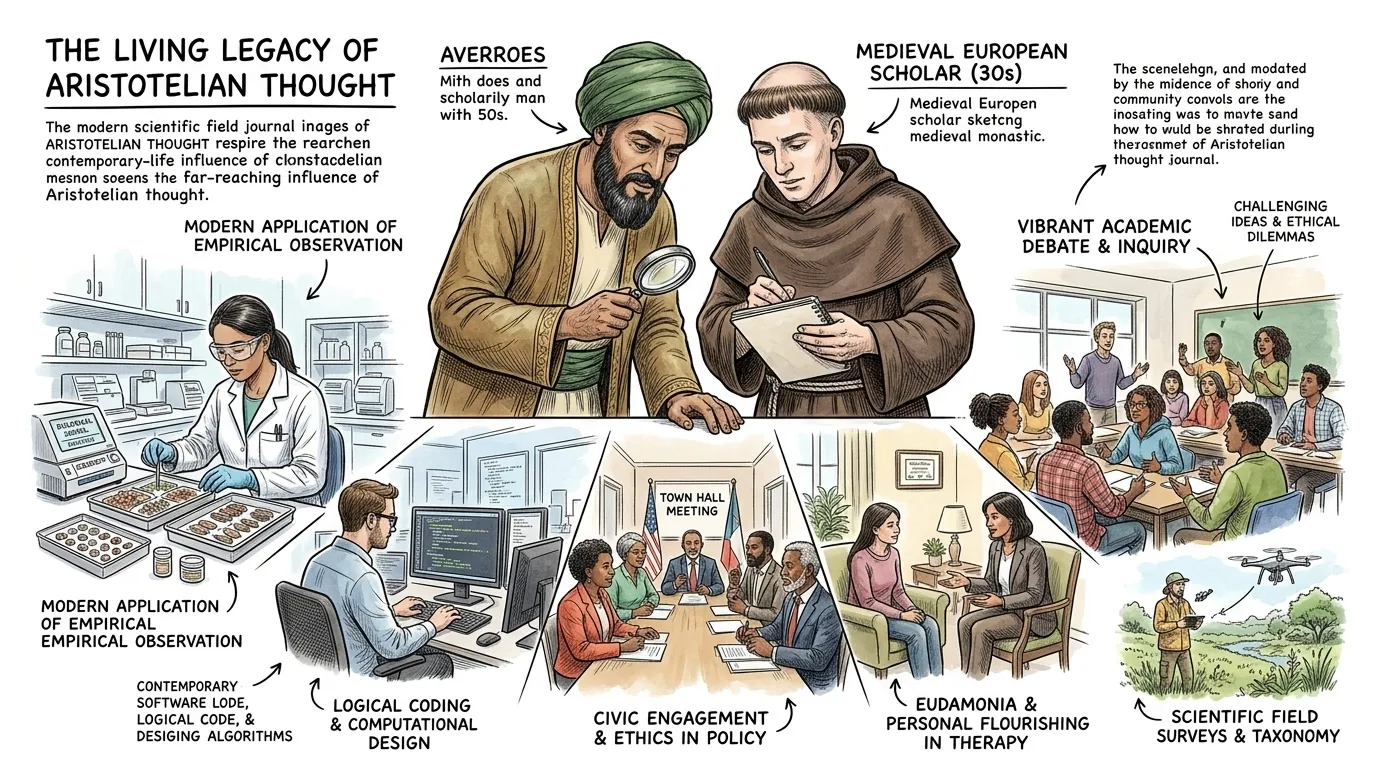
Aristotle's foundational ideas, though ancient, continue to shape our modern world. His contributions to logic, ethics, biology, politics, and the very concept of systematic inquiry remain an indispensable part of our intellectual heritage.
""Look at how his logic underpins computer science, or how his biological classifications inform modern taxonomy," the Medieval Scholar remarked to Averroes, now standing in a more metaphorical space, overlooking a montage of modern scenes. "His 'eudaimonia' still guides discussions on human well-being and purpose in psychology and ethics." Averroes smiled, surveying the panorama. "And his political analyses, examining different forms of government, offer timeless insights into governance. The systematic approach he championed, the 'knowledge' we discussed, still pushes the boundaries of every scientific discipline." "Indeed," the Medieval Scholar affirmed, "He truly provided the enduring blueprint for how to investigate, understand, and live well in the world.""
Philosophy Note: Aristotle's legacy: His formal logic influenced computational thought; his biology underpinned natural sciences for centuries; his ethics remains a major school of thought; his politics laid groundwork for political philosophy.
Page 10
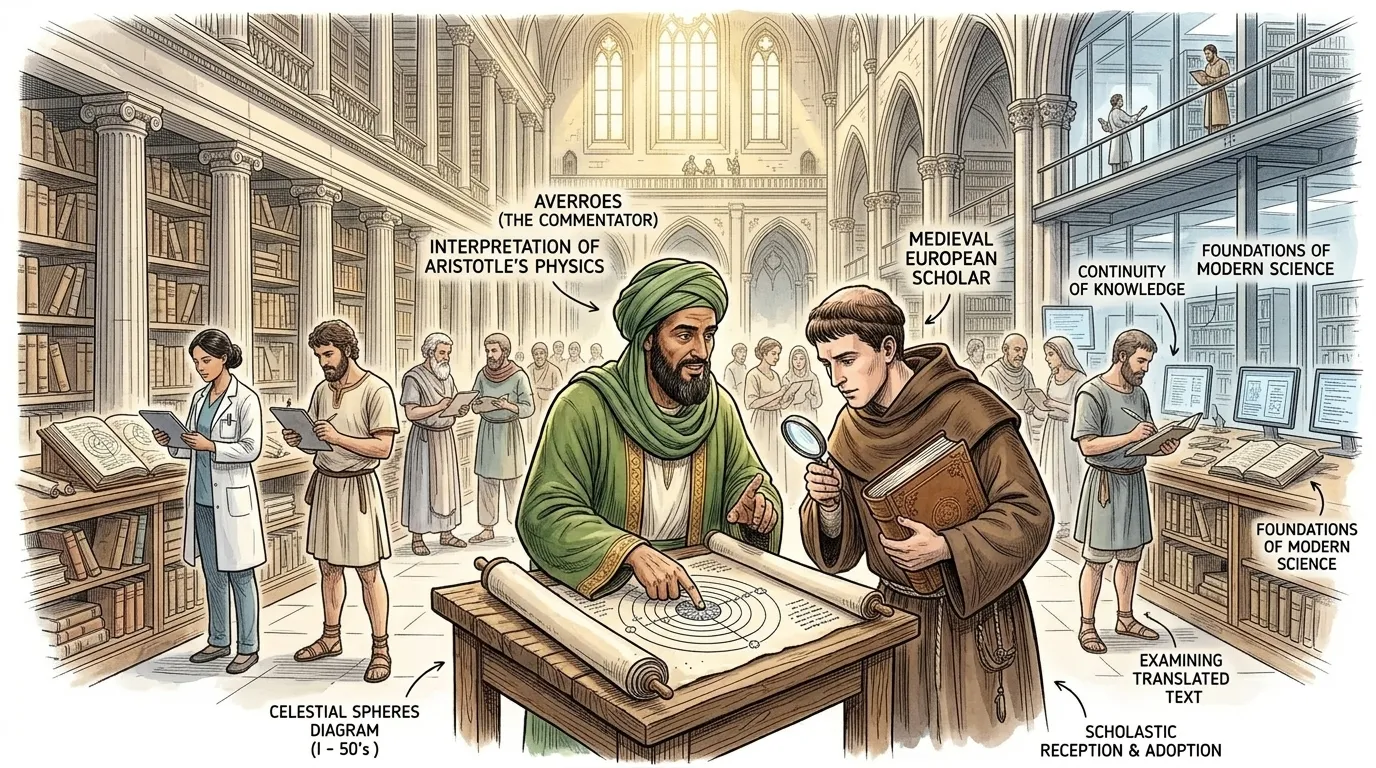
From the ancient Lyceum to the digital age, Aristotle's call to observe, analyze, and reason continues to resonate. His work teaches us that true wisdom emerges not from abstract speculation alone, but from a diligent engagement with the world around us, and a constant effort to categorize and understand its complexities.
""Aristotle's emphasis on purpose, on 'telos,' still inspires us to ask 'why?' beyond just 'how?'" Averroes reflected, looking out into a vast, symbolic library that spanned eras. The Medieval Scholar nodded. "And his dedication to a comprehensive understanding, linking ethics to politics, and biology to metaphysics, reminds us that knowledge is interconnected. His method remains a vibrant invitation for every generation to think critically and systematically." "The journey of discovery never ends," Averroes concluded, "but Aristotle gave us a map and a compass that still serve us today.""
Philosophy Note: Aristotle's enduring impact: His holistic approach and emphasis on empirical observation, logical reasoning, and the pursuit of flourishing (eudaimonia) continue to be fundamental to philosophy, science, and human self-understanding.
About this story
- Audience: general readers
Read Wonder Philosophy on your phone
Wonder Philosophy is available on Android and iPhone and iPad. Get Wonder Philosophy on Google Play · Get Wonder Philosophy on the App Store.