Bertrand Russell
Bertrand Russell — an illustrated philosophy story. 10 illustrated pages, free to read on Wonder Philosophy.

Page 1
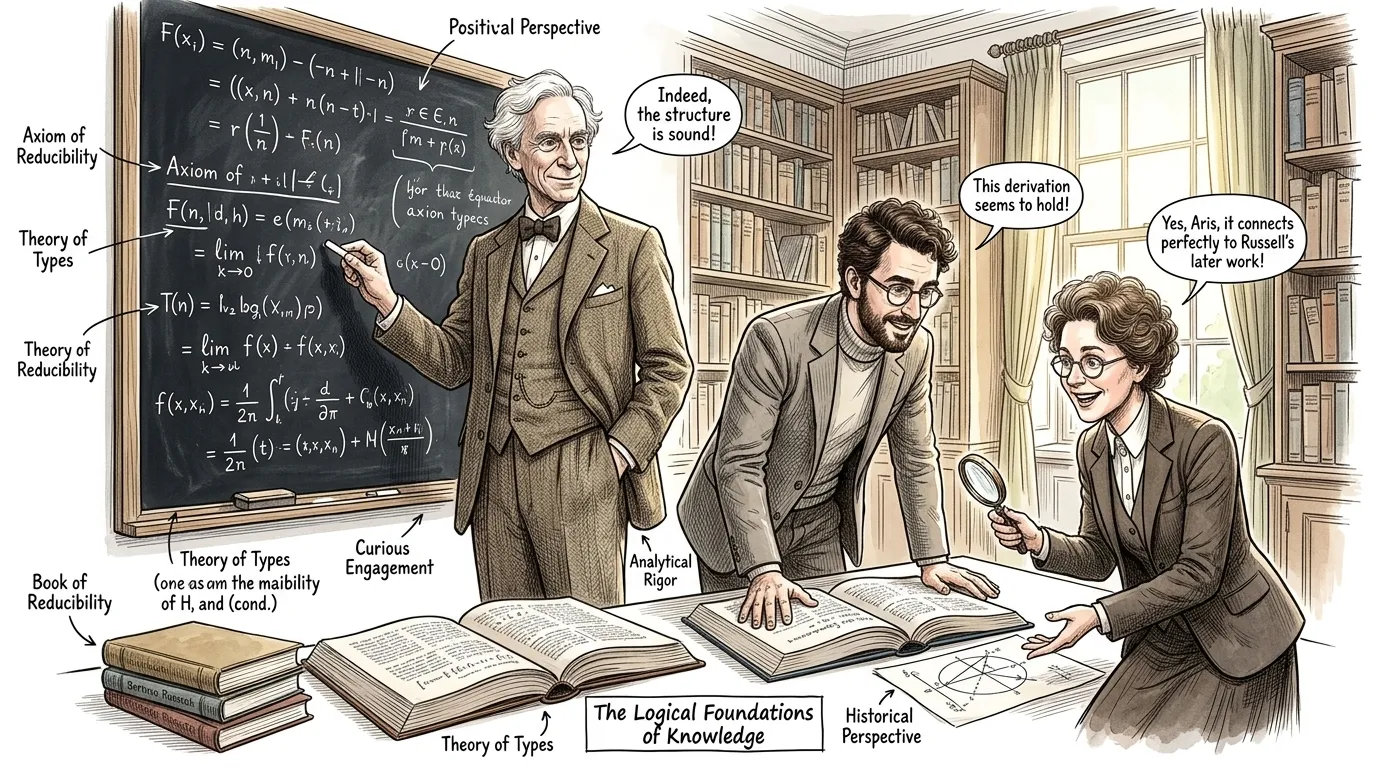
Bertrand Russell, a titan of 20th-century thought, dedicated his life to bringing precision and reason to human understanding. He believed that many philosophical problems could be dissolved, rather than solved, through rigorous logical analysis. By dissecting language and concepts with unprecedented clarity, Russell aimed to expose the true nature of reality and the limits of our knowledge.
"'Many a problem which had been thought to be a problem of philosophy, will be found to be, in fact, a problem of syntax,' Bertrand Russell declared, his gaze fixed on a complex equation on his blackboard. 'We must not be misled by the structure of language to assume a corresponding structure in the world it describes. What truly exists often hides behind the words we use.'"
Philosophy Note: Bertrand Russell (1872-1970): British philosopher, logician, mathematician, and social critic. A founder of analytic philosophy, he championed logical analysis as a tool to address philosophical and scientific problems. Awarded the Nobel Prize in Literature in 1950.
Page 2
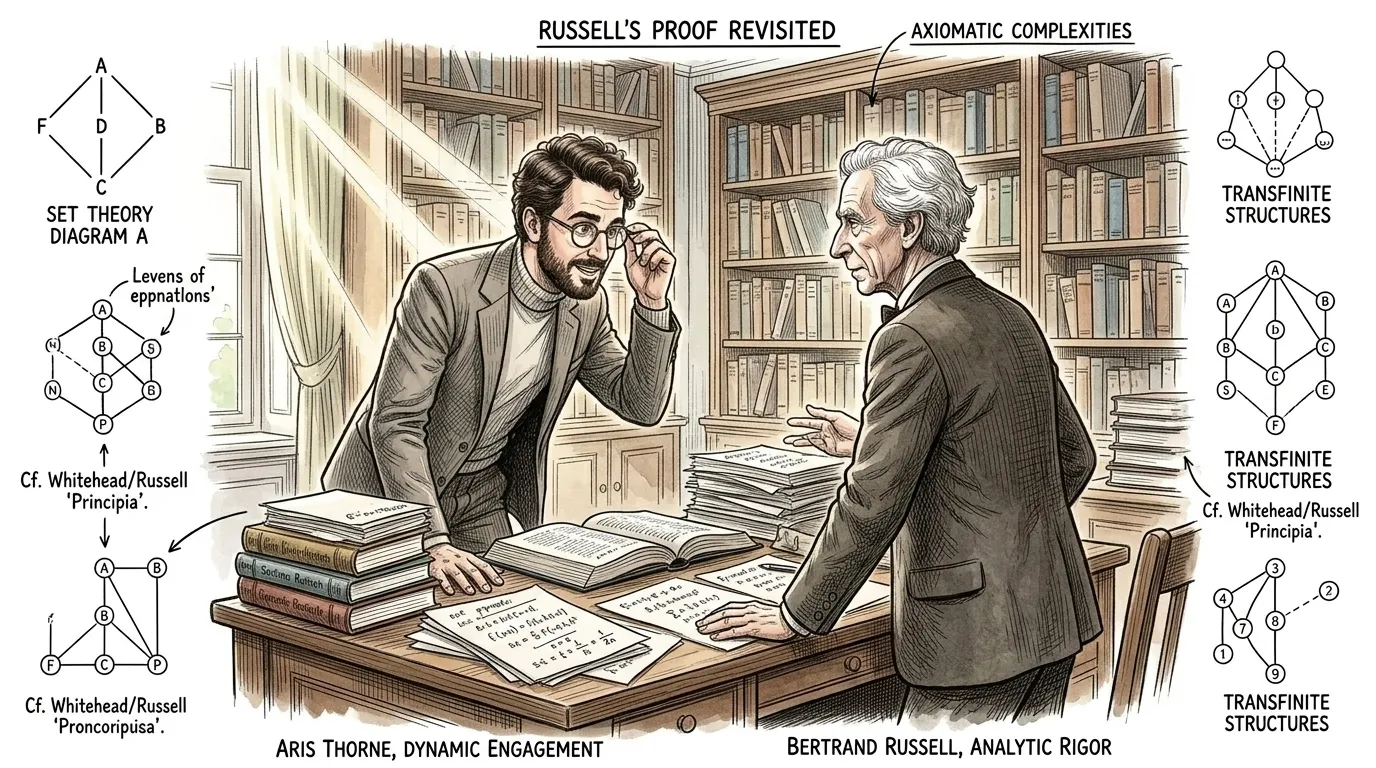
Russell's journey began in the late 19th century, confronting the very foundations of mathematics, which he felt were unstable. Alongside Alfred North Whitehead, he authored 'Principia Mathematica,' an monumental work that sought to derive all of mathematics from a set of logical axioms. This ambitious project aimed to provide absolute certainty to mathematical truths, revealing mathematics as an extension of logic itself.
"Dr. Aris Thorne leaned forward, adjusting his spectacles. 'Professor Russell, your work in 'Principia Mathematica' truly revolutionized how we view mathematics. The sheer scope, attempting to reduce arithmetic to pure logic, was unprecedented. But what problem, precisely, did you feel needed such a radical solution?' Russell turned from a desk piled with proofs. 'The crisis of contradictions, Dr. Thorne. The discovery of paradoxes within set theory threatened the entire edifice of mathematics. We needed a secure, logical foundation, or everything rested on sand.'"
Philosophy Note: Principia Mathematica (1910-1913): A three-volume work by Russell and Whitehead attempting to create a logical basis for mathematics. Russell's Paradox: A paradox in set theory discovered by Russell, highlighting the need for a more rigorous logical foundation.
Page 3
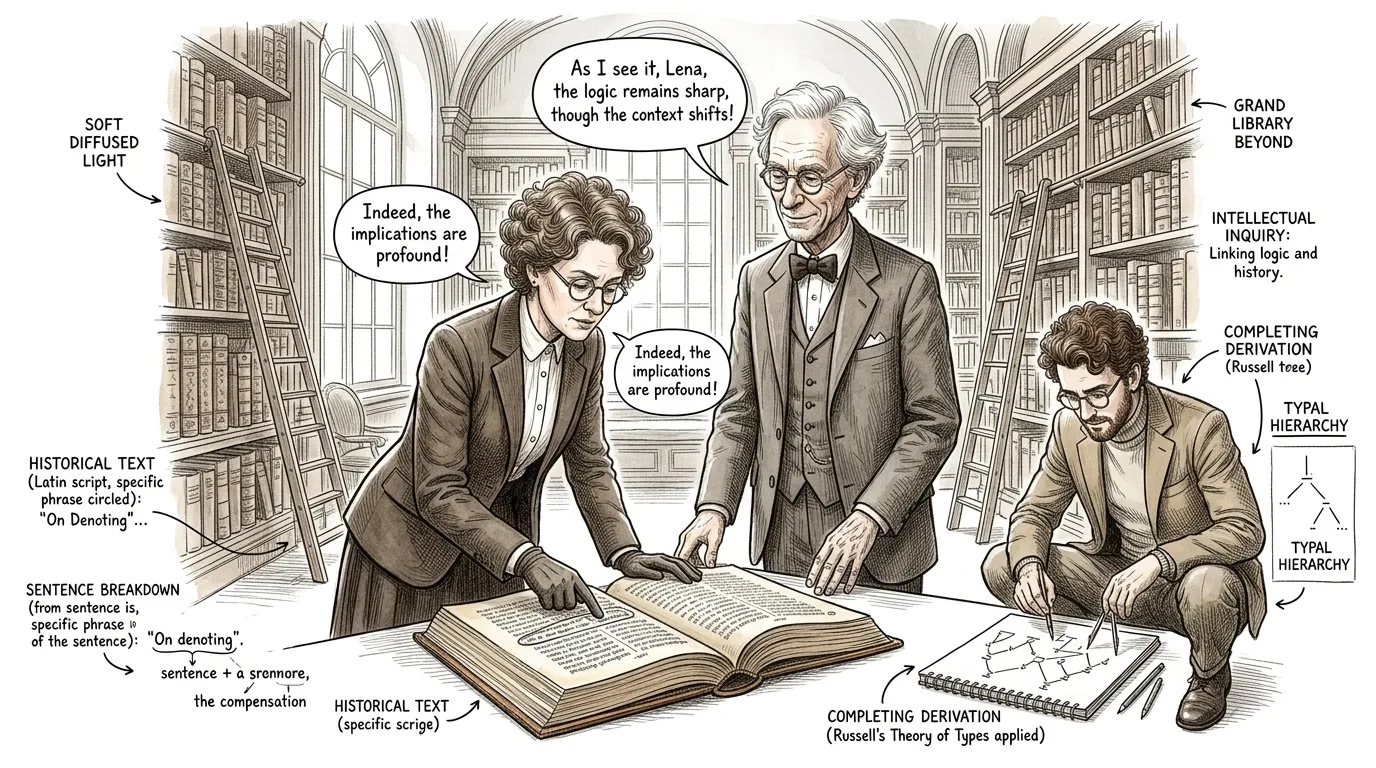
Beyond mathematics, Russell extended his logical analysis to ordinary language, developing his influential 'Theory of Descriptions.' This theory provided a powerful tool for understanding how definite descriptions – phrases like 'the present King of France' or 'the author of Waverley' – acquire meaning, even when their referents don't exist or aren't immediately clear. It revealed that the grammatical form of a sentence often masks its true logical structure, leading to philosophical confusion.
"Professor Lena Petrova traced a finger along a page in a historical text. 'Your 'Theory of Descriptions' profoundly impacted how we analyze meaning. It showed that sentences referring to non-existent entities, like 'the present King of France is bald,' aren't meaningless, but rather logically false, if properly broken down.' Russell nodded thoughtfully. 'Precisely, Professor. We analyze such a statement not as referring to a non-existent thing, but as a complex assertion: that there exists an 'x' who is King of France, that there is only one such 'x', and that this 'x' is bald. When the first part fails, the entire assertion becomes false, rather than nonsensical.'"
Philosophy Note: Theory of Descriptions (1905): Russell's groundbreaking theory analyzing the logical form of sentences containing definite descriptions, resolving paradoxes of non-referring terms and contributing to the development of analytic philosophy.
Page 4
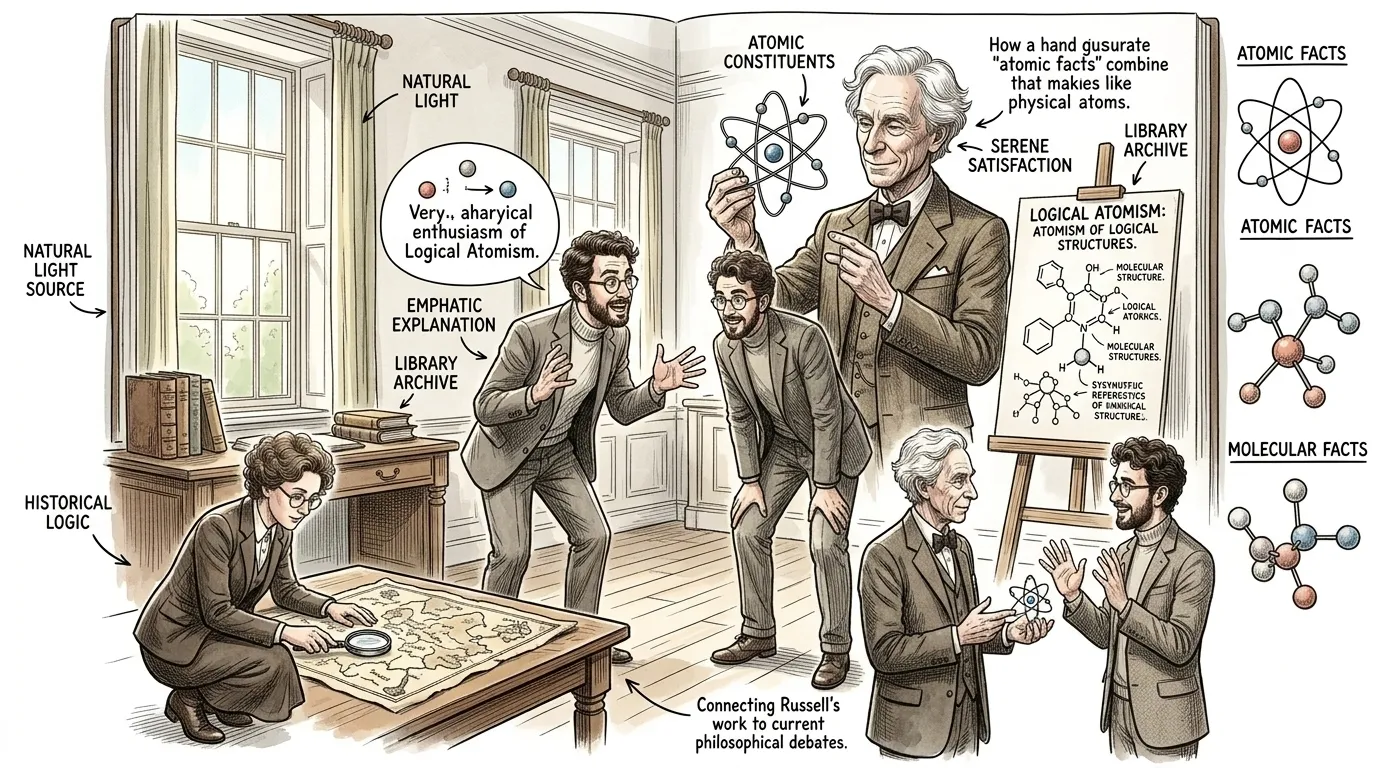
From his work on logic and language, Russell articulated 'Logical Atomism.' This view proposed that the world is ultimately composed of 'atomic facts' – simple, irreducible units of reality that can be directly observed or apprehended. Complex facts, he argued, are logical constructions built from these fundamental atoms. This perspective profoundly influenced early 20th-century philosophy, particularly the Vienna Circle and Ludwig Wittgenstein, pushing towards a scientific and empirical approach to understanding the world.
"Dr. Thorne gestured emphatically. 'Logical Atomism was such a powerful idea, Professor. The notion that complex truths could be broken down into their simplest, verifiable components— it offered a path to clarity amidst philosophical ambiguity.' Russell affirmed, 'Indeed. Just as physical atoms combine to form molecules, so too do 'atomic facts' combine to form the more complex propositions we use to describe the world. The goal is to strip away the layers of linguistic and conceptual obscurity to reveal these ultimate constituents of reality.'"
Philosophy Note: Logical Atomism: A philosophical theory developed by Russell and Wittgenstein (though with different interpretations) postulating that the world consists of ultimate, independent 'atomic facts' from which all other facts are constructed. It influenced logical positivism.
Page 5
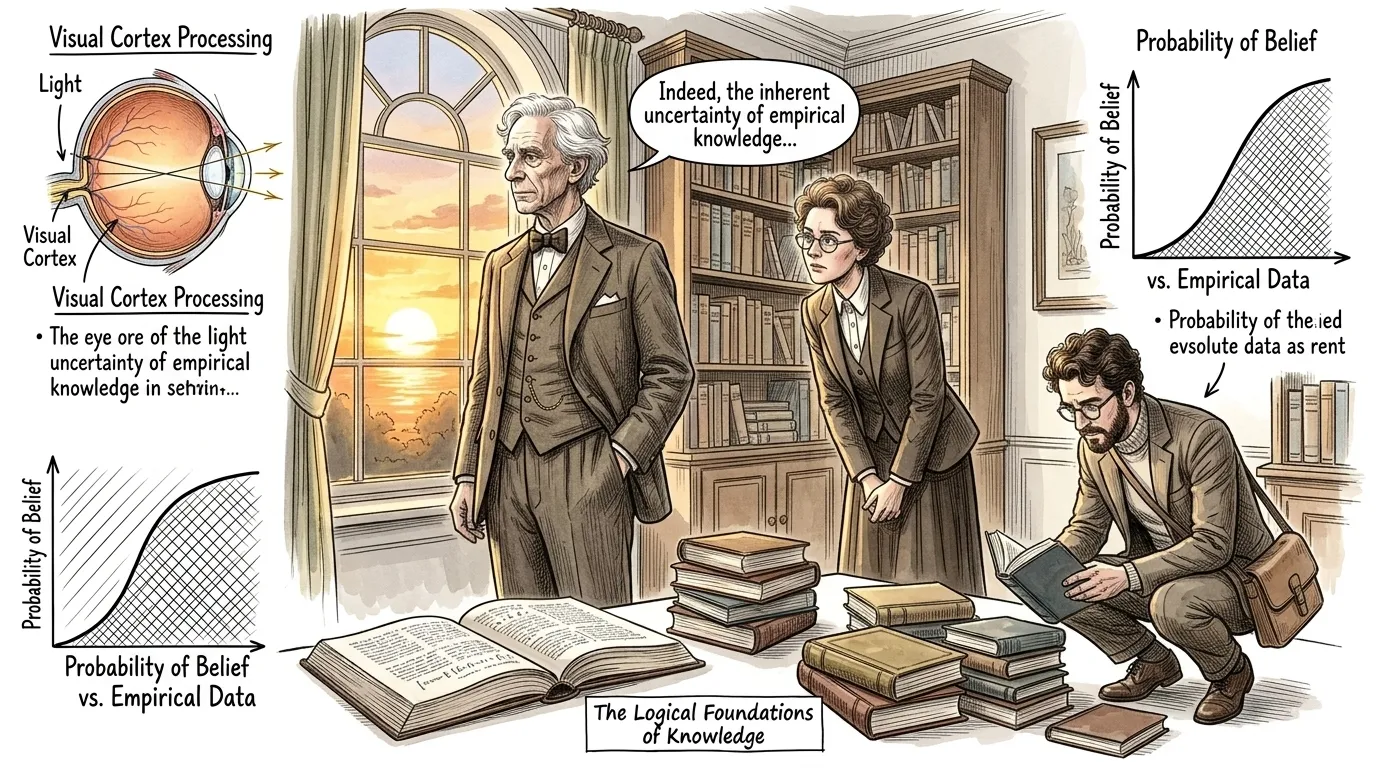
Despite his faith in logic, Russell also grappled with profound skeptical challenges, notably the 'Problem of Induction.' This problem, famously articulated by David Hume, questions the rational justification for believing that future events will resemble past ones. Why do we assume the sun will rise tomorrow just because it always has? Russell acknowledged that while we operate daily on inductive reasoning, it lacks a purely logical proof, posing a fundamental limit to our certainties about the world.
"Professor Petrova paused, a thoughtful frown on her face. 'While your work sought certainty in logic, you also confronted its limits, particularly with induction. It seems such a fundamental part of our reasoning, yet, as Hume pointed out, it remains logically unprovable.' Russell gazed out a large window at a setting sun. 'Indeed. The problem of induction serves as a stark reminder of the inherent uncertainty in our empirical knowledge. We may have an animal faith that the sun will rise again, but there is no logical necessity for it. This insight, I believe, is crucial for intellectual humility.'"
Philosophy Note: Problem of Induction: The philosophical question of whether inductive reasoning (drawing general conclusions from specific observations) can be rationally justified. Hume famously argued it cannot be, leading to significant philosophical skepticism regarding empirical knowledge.
Page 6
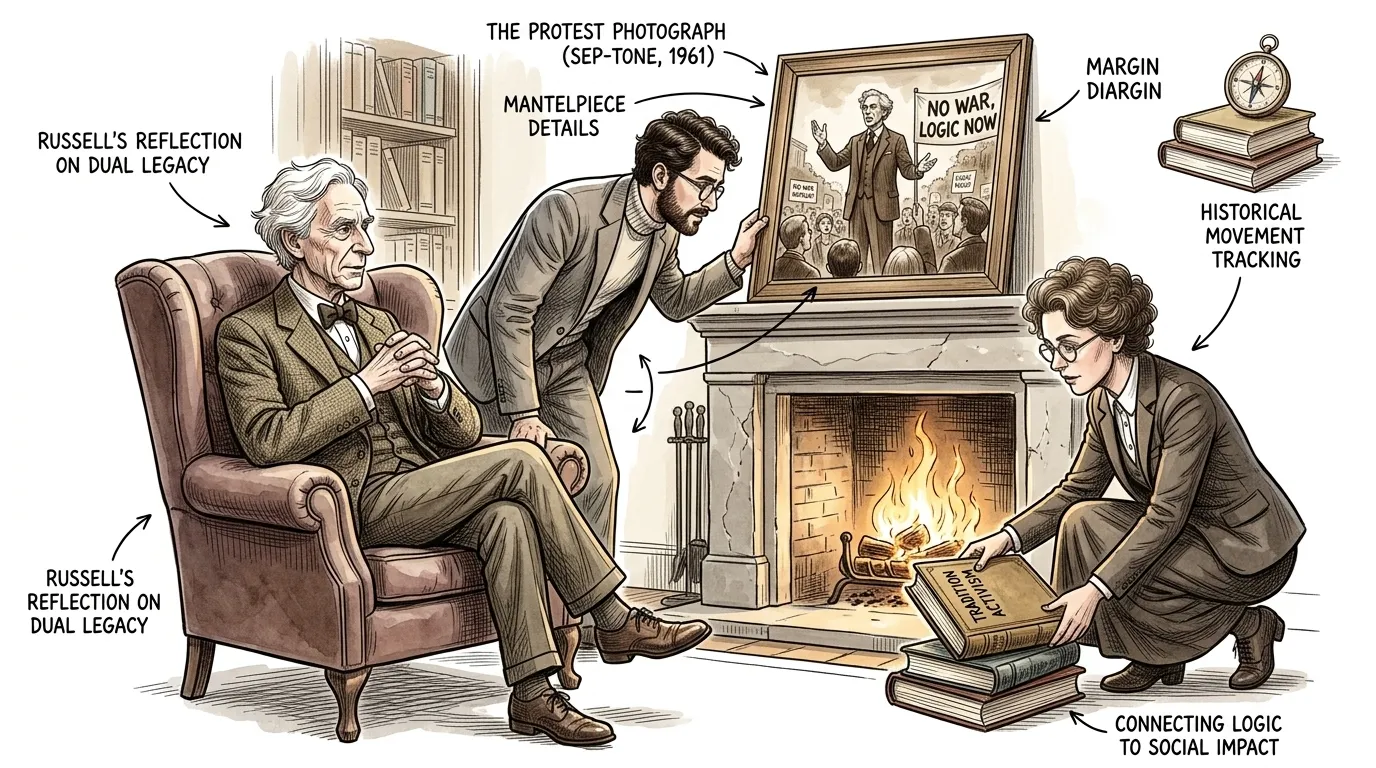
Russell's intellectual rigor was matched by his passionate engagement with social and political issues. A staunch pacifist, he vehemently opposed war, particularly during World War I, for which he was imprisoned. He later campaigned against nuclear weapons, advocated for free speech, and condemned oppressive political regimes. His activism was not separate from his philosophy but rather an application of his rational principles to the ethical challenges of his time, demanding clarity and reason in public life.
"Dr. Thorne looked at a framed photograph of a younger Russell speaking at a protest. 'Your commitment to social justice and peace, even to the point of imprisonment, speaks volumes. How did you reconcile the abstract pursuits of logic with the urgent demands of political action?' Russell settled into an armchair, his expression firm. 'One cannot remain in an ivory tower when the world is ablaze. The same clarity of thought required to unravel logical paradoxes is necessary to expose fallacies in political rhetoric and to advocate for human decency. As I once wrote, 'The good life is one inspired by love and guided by knowledge.' Knowledge demands action when injustice prevails.'"
Philosophy Note: Pacifism: Belief that war and violence are unjustifiable and that all disputes should be settled peacefully. Russell was a prominent pacifist and anti-war activist, famously protesting World War I and the nuclear arms race.
Page 7
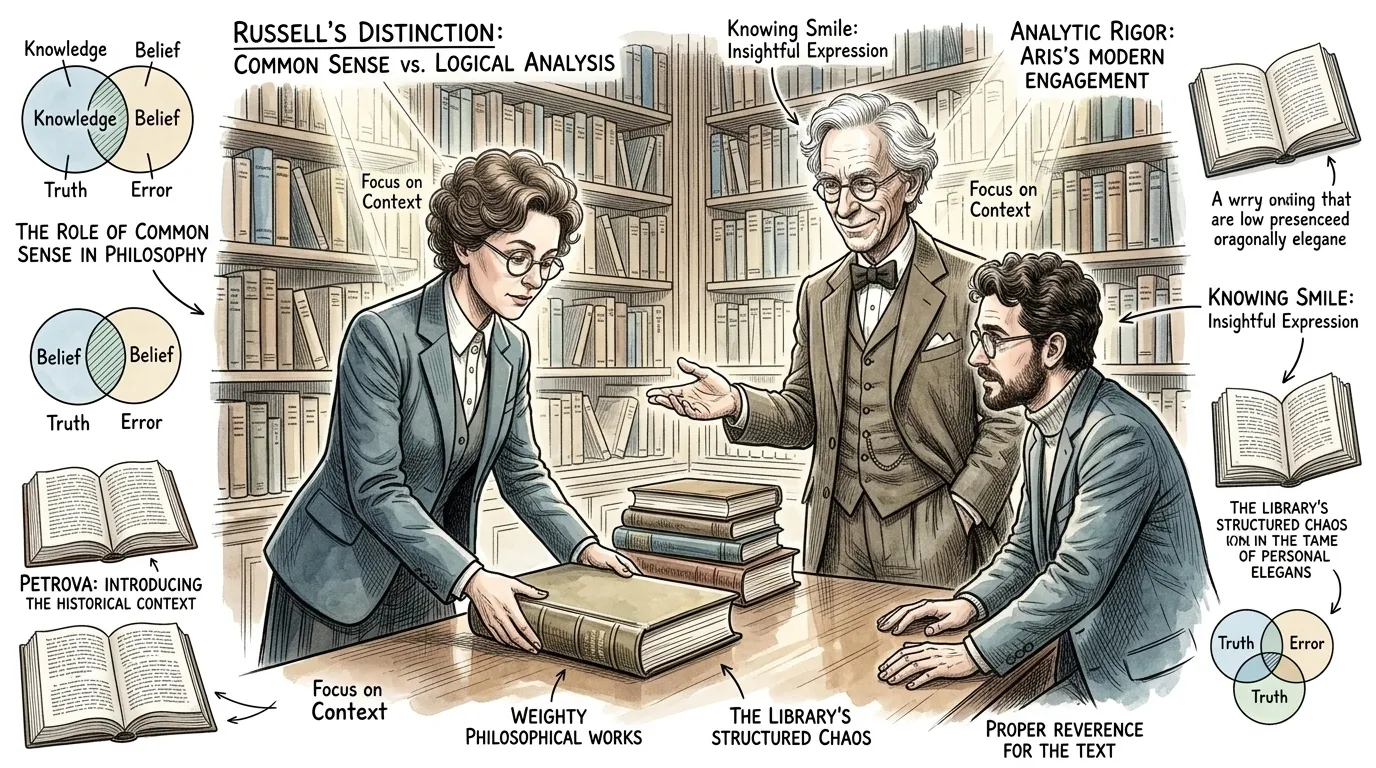
Russell's critical philosophy often led him to challenge traditional metaphysical assertions – claims about the fundamental nature of reality that transcend empirical observation. He meticulously dissected arguments for God's existence, the nature of mind, and the absolute certainty of knowledge, often finding them to be based on linguistic errors or unwarranted assumptions. Yet, he also acknowledged the practical utility of 'common sense' while understanding its philosophical limitations, seeking to clarify where one truly ends and the other begins.
"Professor Petrova carefully placed a book on a table. 'Your critiques of metaphysics often left traditional philosophers scrambling. Yet, you weren't an absolute skeptic; you valued common sense, albeit critically.' Russell gave a wry smile. 'Absolutely. Common sense is where we start, but not where we finish. It provides a rough guide for daily living, but philosophy must push beyond its surface to examine the underlying assumptions. We must ask: are these 'common sense' beliefs truly self-evident, or are they mere habits of thought that logical analysis can dismantle?'"
Philosophy Note: Critique of Metaphysics: Russell's rigorous examination and often rejection of philosophical theories about the fundamental nature of reality, especially those not amenable to empirical or logical verification. Common Sense: Refers to beliefs and propositions generally accepted as true without rigorous proof; Russell sought to clarify its role and limitations in philosophical inquiry.
Page 8
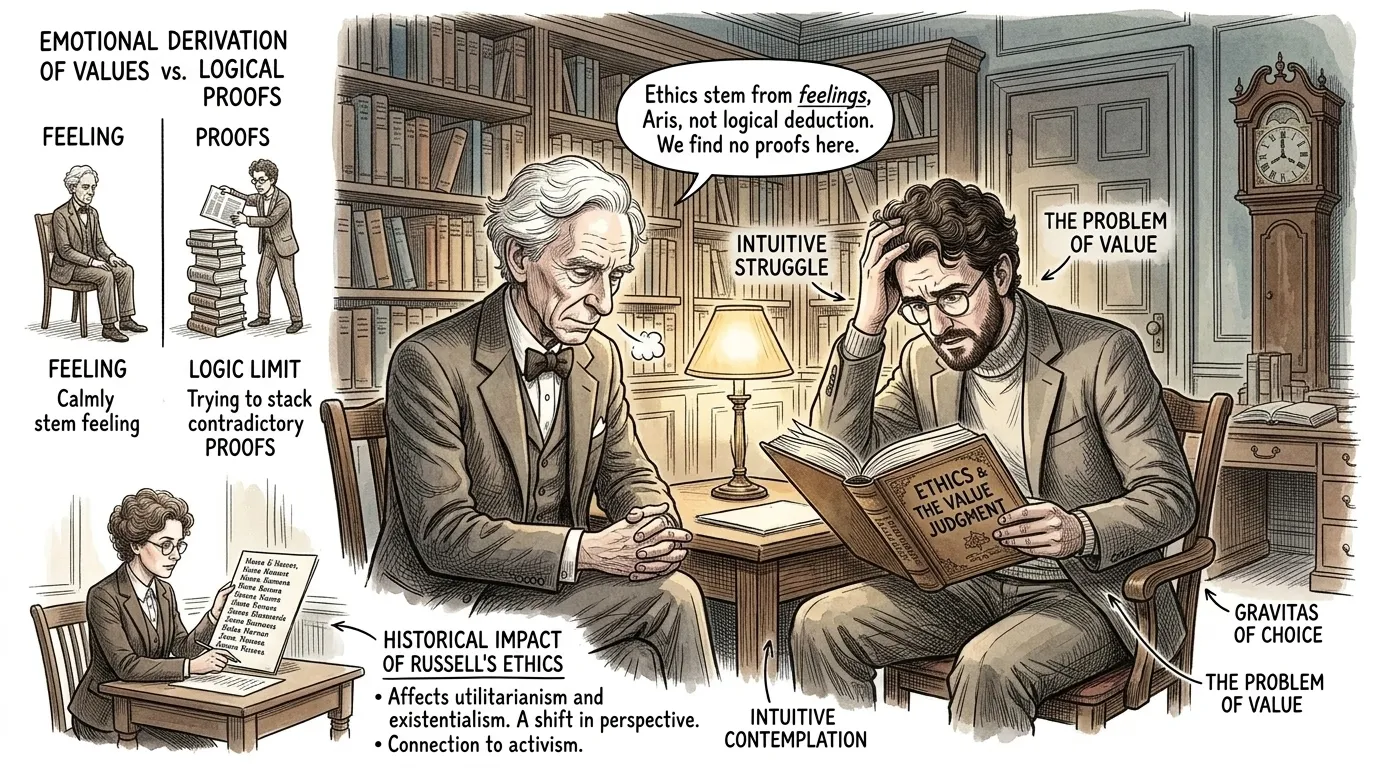
While Russell believed logic could reveal facts, he struggled with the 'Problem of Value.' He argued that propositions about ethics or aesthetics—what is 'good' or 'beautiful'—could not be derived solely from facts or logic. While he championed a life guided by knowledge, he acknowledged that the ultimate source of our values might lie outside the realm of purely rational demonstration, leading to a profound tension between his scientific outlook and his ethical commitments. This tension remains a central debate in moral philosophy today.
"Dr. Thorne ran a hand through his hair. 'After all your efforts to ground knowledge in logic, how did you reconcile the deeply human realm of values, of right and wrong, which seem to resist purely logical formulation?' Russell sighed, looking at his hands. 'This is the persistent dilemma, isn't it? As I famously said, 'What we do depends upon desire, not upon knowledge.' Logic can tell us the consequences of our actions, but not which consequences we ought to desire. Our ethical convictions, our sense of good, ultimately stem from our feelings, our passions, our shared humanity, rather than from deductive proof.'"
Philosophy Note: Problem of Value: The philosophical challenge of understanding the nature and justification of moral, aesthetic, and ethical judgments. Russell, like Hume, argued that values (what 'ought to be') cannot be logically derived from factual statements (what 'is'). Quote attributed to Bertrand Russell.
Page 9

Bertrand Russell's enduring legacy lies in his relentless insistence on clarity, precision, and rational skepticism. His work provided a blueprint for how to approach complex problems, whether in mathematics, language, or society. He taught us to question assumptions, to demand evidence, and to expose sophistry. His influence permeates modern philosophy, shaping fields from logic and epistemology to political philosophy and the philosophy of science.
"Professor Petrova gestured towards a timeline on a screen. 'Russell's approach, even when confronting the limits of logic, has given generations the tools to think critically. His demand for clear language and verifiable claims is more crucial than ever in our complex world.' Russell looked at her, a glimmer in his eye. 'Indeed. The task of philosophy, as I saw it, is to liberate humanity from superstition and prejudice through the application of reason. It is not to solve all mysteries, but to clarify the legitimate questions and to teach us how to approach them with intellectual honesty.'"
Philosophy Note: Legacy of Bertrand Russell: His emphasis on logical analysis, linguistic clarity, and empiricism profoundly influenced 20th-century analytic philosophy and continues to shape critical thinking across various disciplines.
Page 10
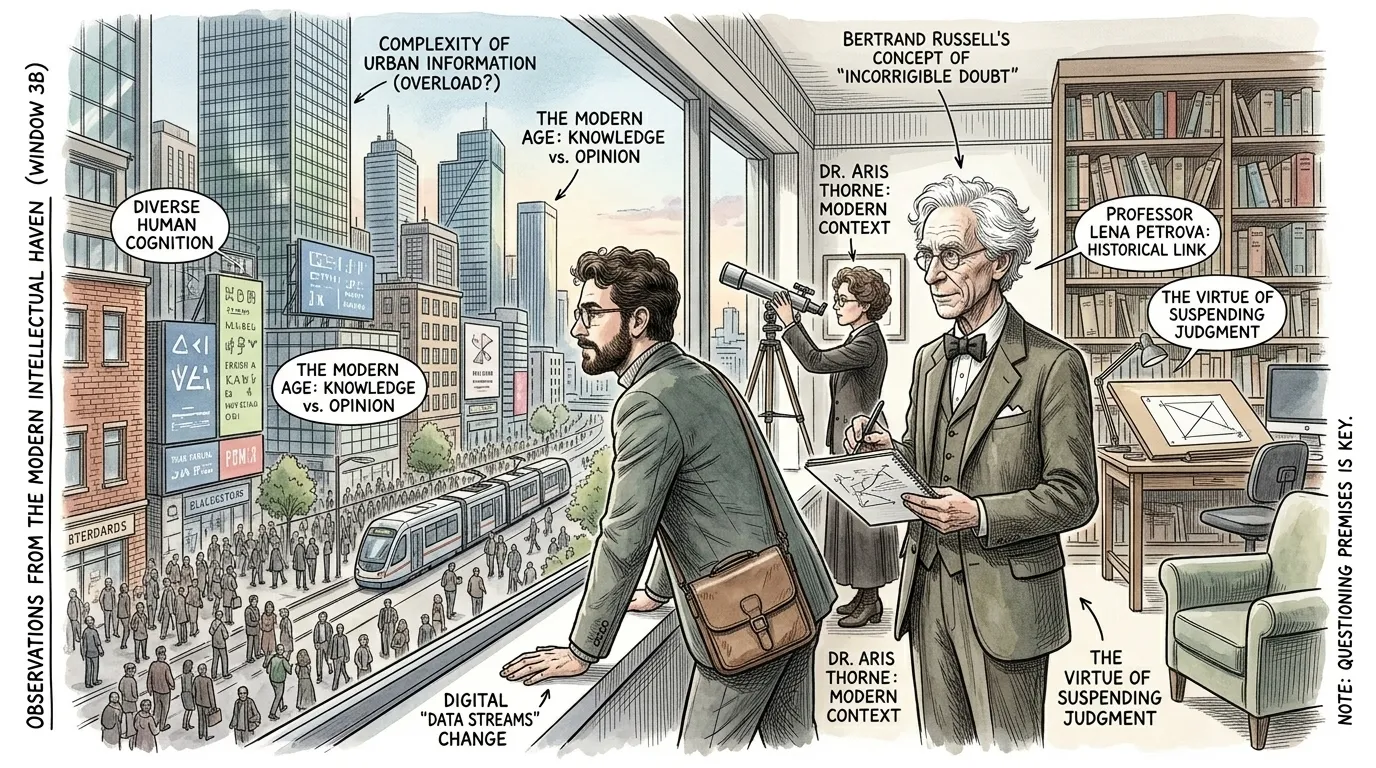
In an age saturated with information and competing claims, Russell's principles offer an essential framework for navigating complexity. His emphasis on logical rigor, the careful analysis of language, and a healthy skepticism towards unsubstantiated assertions are vital skills. From evaluating news and political rhetoric to making personal decisions, Russell's call for clear thought provides a powerful defense against manipulation and confusion, encouraging us to seek understanding based on evidence and reason.
"Dr. Thorne looked at the modern world around them. 'His insights feel incredibly relevant today. Faced with 'fake news' and complex data, how do we apply Russell's core message?' Russell replied, 'We must be vigilant. Question the premises. Unpack the language. Discern what is being asserted from what is merely implied. Do not accept a statement until you understand its precise meaning and the evidence offered to support it. As I once put it, 'The whole problem with the world is that fools and fanatics are always so certain of themselves, and wiser people so full of doubts.' Cultivate doubt, but seek clarity.'"
Philosophy Note: Modern Relevance: Russell's methods of logical analysis, critical thinking, and demand for evidential support remain crucial tools for navigating information overload, political discourse, and personal decision-making in the 21st century. Quote attributed to Bertrand Russell.
About this story
- Audience: general readers
Questions and answers
Read Wonder Philosophy on your phone
Wonder Philosophy is available on Android and iPhone and iPad. Get Wonder Philosophy on Google Play · Get Wonder Philosophy on the App Store.