Charles Taylor
Charles Taylor — an illustrated philosophy story. 10 illustrated pages, free to read on Wonder Philosophy.

Page 1

Dr. Aris Thorne stands before a large digital display, his hand gesturing towards a complex mind map. "Charles Taylor offers us a profound lens to understand something fundamental: how our modern sense of self, our very identity, is not merely an individual construction, but deeply woven into our history and the society around us."
Dr. Lena Petrova, adjusting her tablet, interjects, "Indeed, his work illuminates why, even in a world where traditional sources of meaning have faded, we relentlessly search for purpose and authenticity. It's a foundational human drive, even if we don't always understand its roots."
""Charles Taylor offers us a profound lens to understand something fundamental: how our modern sense of self, our very identity, is not merely an individual construction, but deeply woven into our history and the society around us," Dr. Aris Thorne explains, gesturing towards a complex mind map.
"Indeed, his work illuminates why, even in a world where traditional sources of meaning have faded, we relentlessly search for purpose and authenticity. It's a foundational human drive, even if we don't always understand its roots," Dr. Lena Petrova adds, adjusting her tablet."
Philosophy Note: Charles Taylor (1931-Present), Canadian Philosopher. Key Work: 'Sources of the Self: The Making of the Modern Identity' (1989).
Page 2
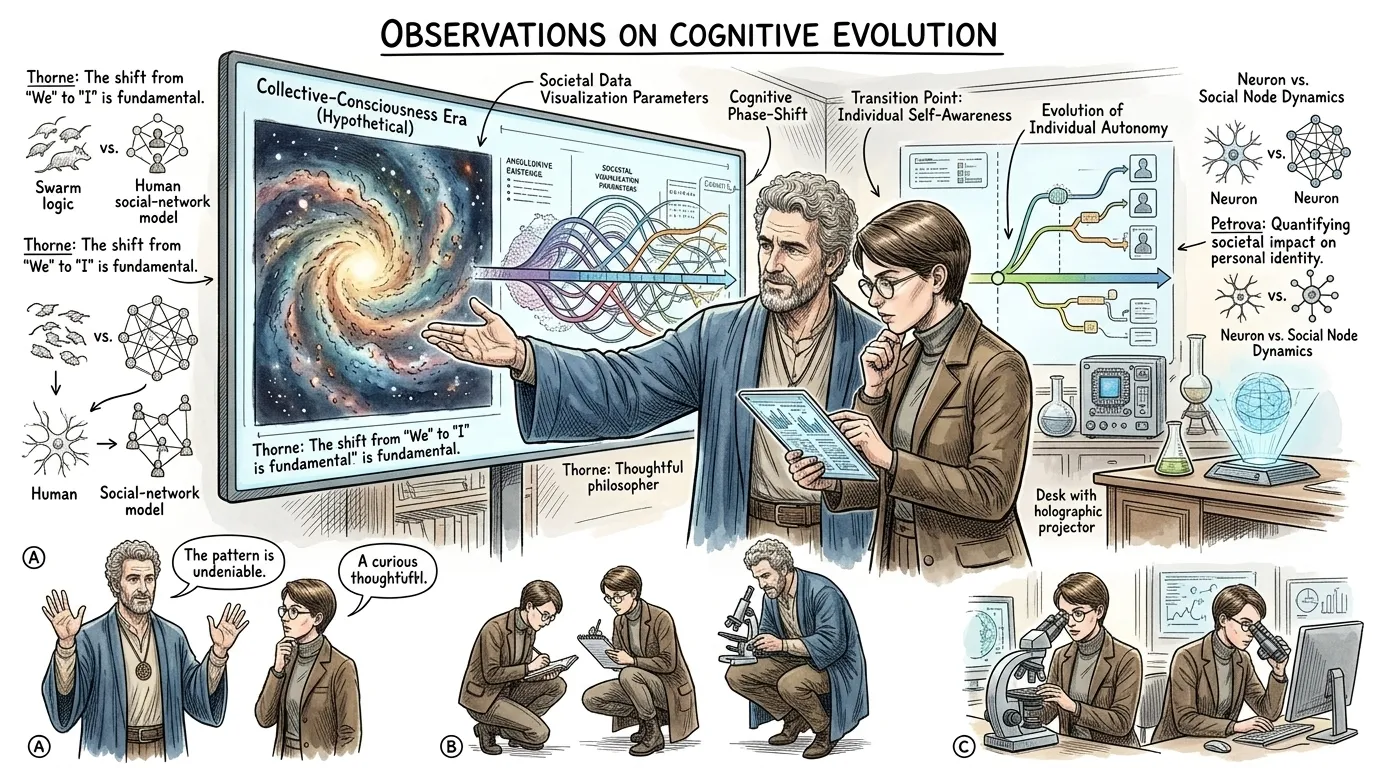
Dr. Thorne turns to a historical timeline projected on the screen. "To grasp Taylor's contribution, we must first understand the historical shift in human experience. For much of history, our ancestors lived within what Taylor calls a 'porous self,' deeply connected to a cosmic, spiritual order where meaning was external and inherent."
Dr. Petrova nods, adding, "Identity wasn't something you primarily 'found' within; it was largely given, defined by your place in a grand, coherent spiritual and social hierarchy. This contrasts sharply with the individualistic quest of modernity."
""To grasp Taylor's contribution, we must first understand the historical shift in human experience. For much of history, our ancestors lived within what Taylor calls a 'porous self,' deeply connected to a cosmic, spiritual order where meaning was external and inherent," Dr. Aris Thorne explains, gesturing to a historical timeline.
Dr. Lena Petrova nods, adding, "Identity wasn't something you primarily 'found' within; it was largely given, defined by your place in a grand, coherent spiritual and social hierarchy. This contrasts sharply with the individualistic quest of modernity.""
Philosophy Note: Historical Evolution of the Self: From collective, spiritually integrated identities to individual, self-defined ones. Key terms: 'Porous Self' vs. 'Buffered Self'.
Page 3
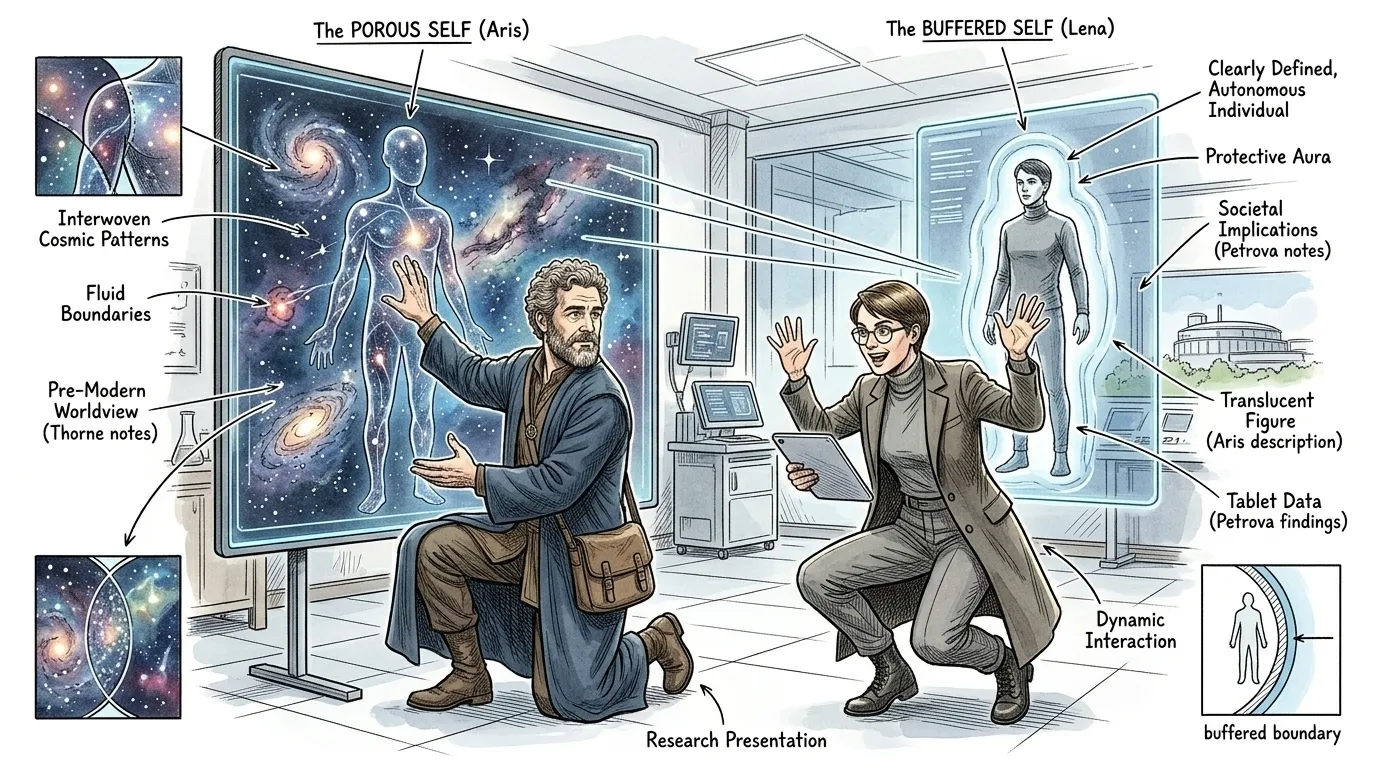
Dr. Thorne elaborates, "The 'porous self' of pre-modern times experienced the world as inherently meaningful, sensitive to spiritual forces and moral demands emanating from the cosmos itself. Their identity was less about internal choice and more about attunement to this external order."
"However, with the Enlightenment and the rise of scientific rationality, we began constructing what Taylor terms the 'buffered self'," Dr. Petrova explains. "This self sees itself as an autonomous individual, shielded from the external world's spiritual influences, primarily finding meaning through internal reflection and personal experience. This distinction is central to understanding our modern predicament."
""The 'porous self' of pre-modern times experienced the world as inherently meaningful, sensitive to spiritual forces and moral demands emanating from the cosmos itself. Their identity was less about internal choice and more about attunement to this external order," Dr. Aris Thorne elaborates.
"However, with the Enlightenment and the rise of scientific rationality, we began constructing what Taylor terms the 'buffered self'," Dr. Lena Petrova explains. "This self sees itself as an autonomous individual, shielded from the external world's spiritual influences, primarily finding meaning through internal reflection and personal experience. This distinction is central to understanding our modern predicament.""
Philosophy Note: The shift from a 'porous self' (open to external spiritual influence) to a 'buffered self' (autonomous, self-contained) is a core concept introduced here, setting the stage for understanding modern identity.
Page 4
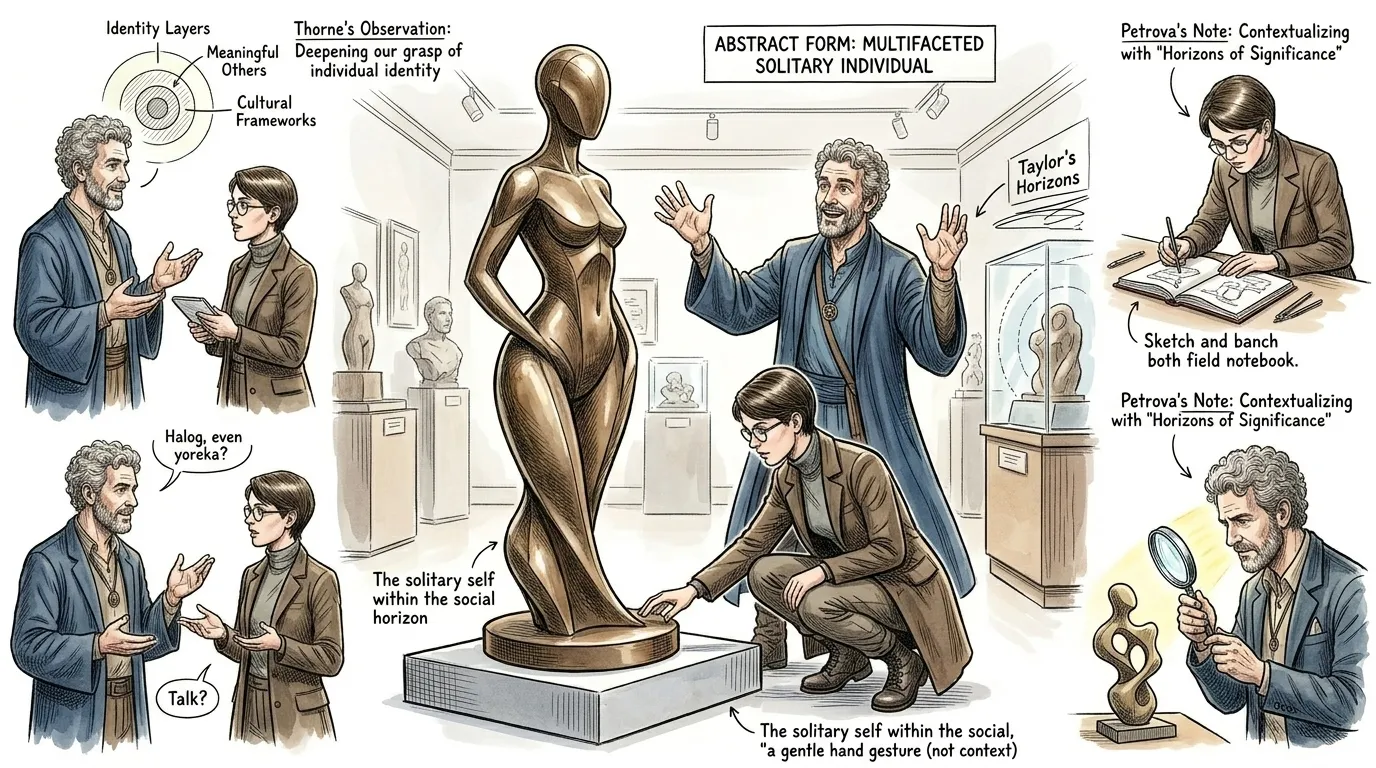
Dr. Thorne gestures to an abstract sculpture representing an individual. "Taylor doesn't dismiss the modern drive for authenticity; rather, he seeks to redeem it from its more superficial expressions. For him, authenticity isn't mere self-indulgence or doing 'whatever feels right' without external reference."
"True authenticity, Taylor argues, is about finding your unique way to be human, yes, but crucially, this discovery must happen against a backdrop of meaningful 'horizons of significance,'" Dr. Petrova clarifies. "Without these shared, external values, the pursuit of authenticity can become shallow, leading to an empty individualism."
""Taylor doesn't dismiss the modern drive for authenticity; rather, he seeks to redeem it from its more superficial expressions. For him, authenticity isn't mere self-indulgence or doing 'whatever feels right' without external reference," Dr. Aris Thorne states, gesturing to an abstract sculpture.
"True authenticity, Taylor argues, is about finding your unique way to be human, yes, but crucially, this discovery must happen against a backdrop of meaningful 'horizons of significance,'" Dr. Lena Petrova clarifies. "Without these shared, external values, the pursuit of authenticity can become shallow, leading to an empty individualism.""
Philosophy Note: Authenticity: More than self-expression; it requires a 'horizon of significance' to prevent 'atomistic individualism.' Related to the earlier 'buffered self' concept.
Page 5
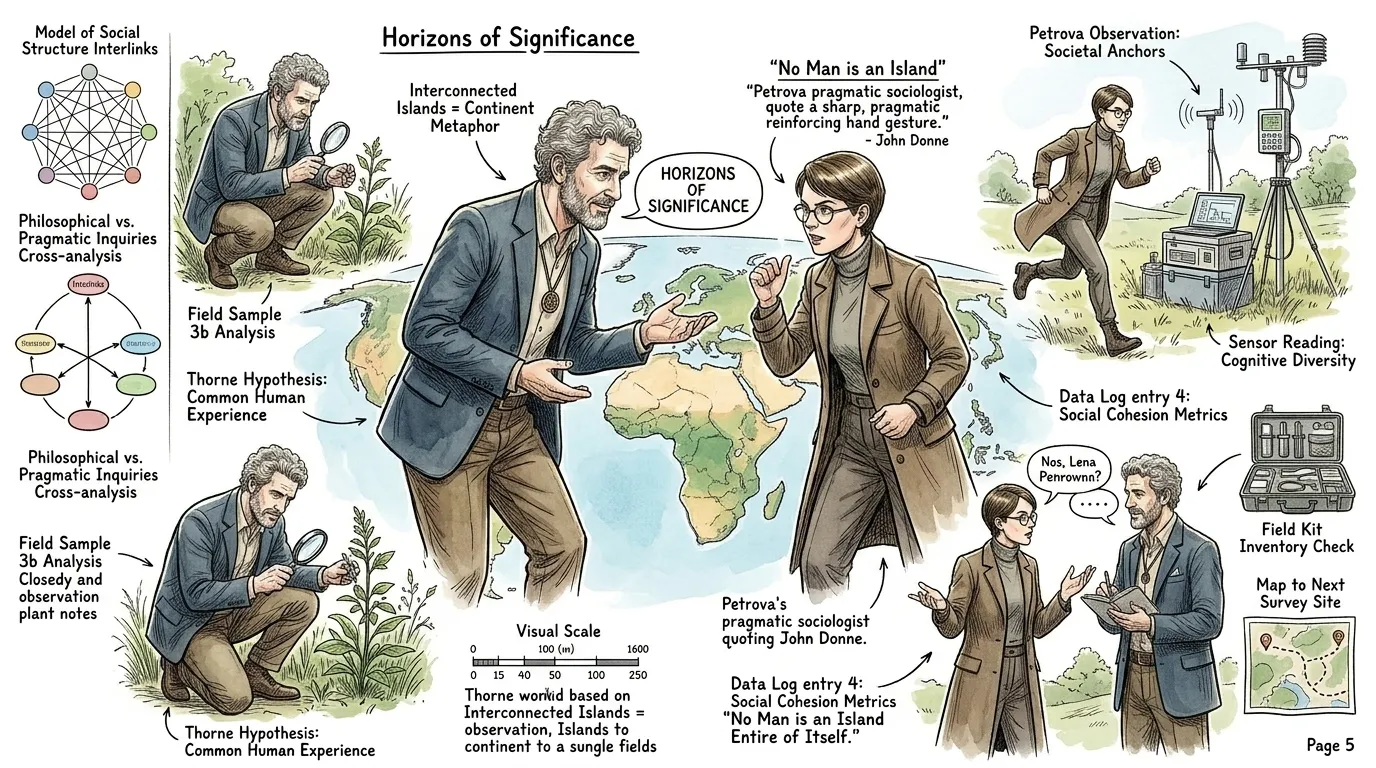
Dr. Thorne leans in, emphasizing, "For Taylor, these 'horizons of significance' are the frameworks—moral, spiritual, cultural—that provide meaning and value, allowing us to judge our choices as truly important. Without them, our choices become arbitrary, our authenticity hollow."
"Precisely," Dr. Petrova affirms. "As the poet John Donne famously wrote centuries ago, 'No man is an island, entire of itself; every man is a piece of the continent, a part of the main.' Taylor reminds us that our search for self is never truly solitary, but always in relation to larger meanings and frameworks that precede us."
""For Taylor, these 'horizons of significance' are the frameworks—moral, spiritual, cultural—that provide meaning and value, allowing us to judge our choices as truly important. Without them, our choices become arbitrary, our authenticity hollow," Dr. Aris Thorne states, emphasizing his point.
"Precisely," Dr. Lena Petrova affirms. "As the poet John Donne famously wrote centuries ago, 'No man is an island, entire of itself; every man is a piece of the continent, a part of the main.' Taylor reminds us that our search for self is never truly solitary, but always in relation to larger meanings and frameworks that precede us.""
Philosophy Note: John Donne (1572-1631), English Poet. Quote from 'Devotions upon Emergent Occasions' (1624). This reinforces the dependence of the 'buffered self' on external significance, connecting back to page 3's concept.
Page 6

Dr. Thorne gestures to a diagram on the screen showing layers of reality. "In 'A Secular Age,' Taylor examines how we came to inhabit what he calls the 'immanent frame'—a social imaginary where life's meaning is sought entirely within human existence, without reference to a transcendent God or cosmic order."
"This doesn't mean spirituality vanishes," Dr. Petrova clarifies, "but it transforms. Many in this 'immanent frame' experience a 'cross-pressured' existence, feeling pulled between the allure of secular humanism and a persistent yearning for transcendence. Both faith and unbelief remain live, often unsettling, options."
""In 'A Secular Age,' Taylor examines how we came to inhabit what he calls the 'immanent frame'—a social imaginary where life's meaning is sought entirely within human existence, without reference to a transcendent God or cosmic order," Dr. Aris Thorne explains, pointing to a diagram.
"This doesn't mean spirituality vanishes," Dr. Lena Petrova clarifies, "but it transforms. Many in this 'immanent frame' experience a 'cross-pressured' existence, feeling pulled between the allure of secular humanism and a persistent yearning for transcendence. Both faith and unbelief remain live, often unsettling, options.""
Philosophy Note: 'The Immanent Frame': A self-sufficient order of human existence. 'Cross-pressured': The simultaneous pull between secular and transcendent worldviews.
Page 7
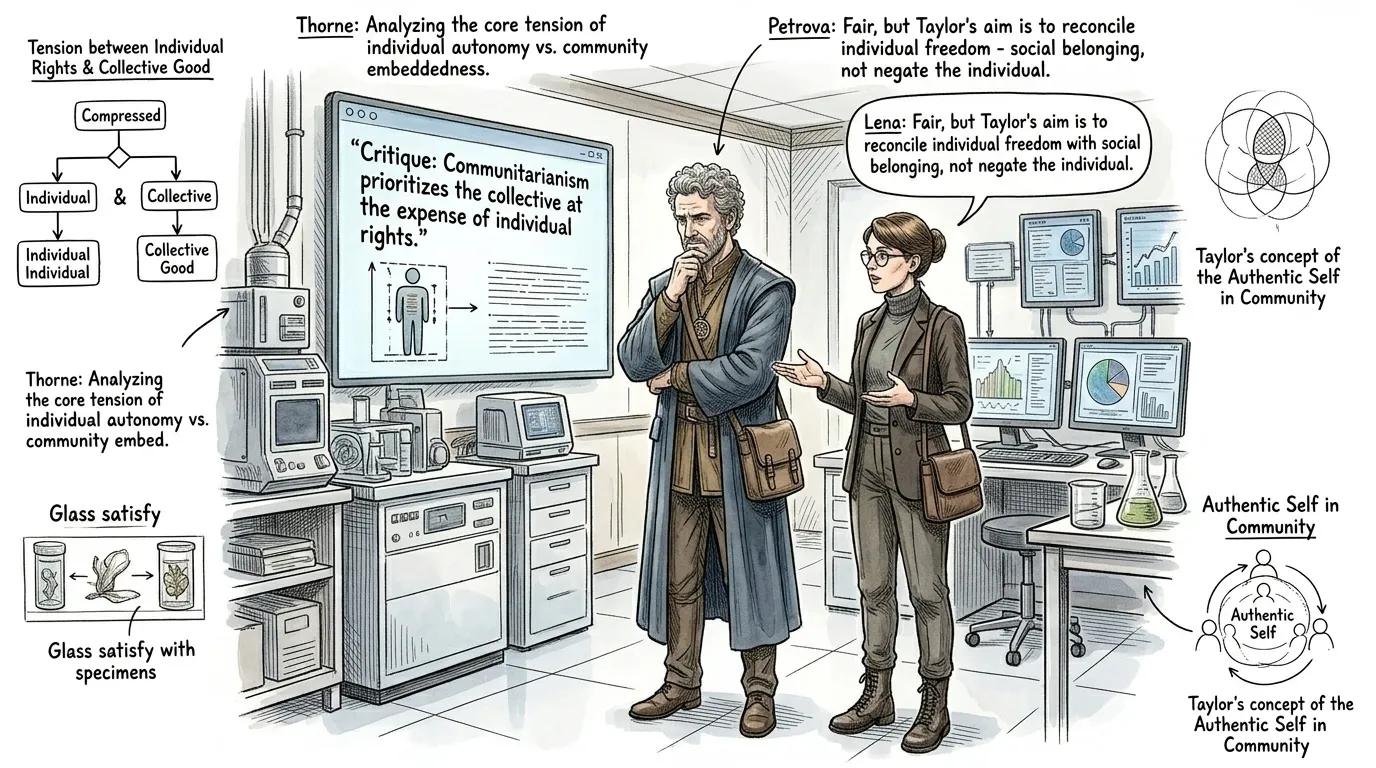
Dr. Thorne thoughtfully considers a projected quote critical of communitarianism. "Taylor's emphasis on shared 'horizons of significance' and community has drawn criticism, particularly from staunch individualists. Some argue that his communitarian leanings might risk stifling individual liberty, perhaps pushing towards a conformity that undermines personal freedom."
"It's a valid tension," Dr. Petrova concedes, "but Taylor isn't advocating for a return to pre-modern collective identity. Instead, he highlights that genuine individual flourishing, the kind that isn't hollow, requires a rich social and moral context—a community that provides the very language and frameworks for self-understanding. It's not about sacrificing freedom, but grounding it meaningfully."
""Taylor's emphasis on shared 'horizons of significance' and community has drawn criticism, particularly from staunch individualists. Some argue that his communitarian leanings might risk stifling individual liberty, perhaps pushing towards a conformity that undermines personal freedom," Dr. Aris Thorne states, contemplating a projected quote.
"It's a valid tension," Dr. Lena Petrova concedes, "but Taylor isn't advocating for a return to pre-modern collective identity. Instead, he highlights that genuine individual flourishing, the kind that isn't hollow, requires a rich social and moral context—a community that provides the very language and frameworks for self-understanding. It's not about sacrificing freedom, but grounding it meaningfully.""
Philosophy Note: Critiques of Communitarianism: Concern that emphasis on community might infringe on individual autonomy. Taylor argues for grounding liberty, not restricting it.
Page 8

Dr. Thorne adjusts the interactive display to show a split-screen. "Taylor's ideas are in constant dialogue with other major thinkers, notably Jürgen Habermas. While Taylor focuses on the substantive moral sources of identity, Habermas emphasizes the procedures of rational communication in shaping legitimate norms in a pluralistic society."
"Their exchange is incredibly rich," Dr. Petrova notes, highlighting the dynamic between the two concepts. "Taylor asks, 'What are the good things that give our lives meaning?' while Habermas asks, 'How can we, with our diverse meanings, agree on fair rules and reach mutual understanding in public discourse?' Together, they offer crucial insights into both the content and the process of modern ethical life."
""Taylor's ideas are in constant dialogue with other major thinkers, notably Jürgen Habermas. While Taylor focuses on the substantive moral sources of identity, Habermas emphasizes the procedures of rational communication in shaping legitimate norms in a pluralistic society," Dr. Aris Thorne explains, adjusting the display.
"Their exchange is incredibly rich," Dr. Lena Petrova notes, highlighting the dynamic. "Taylor asks, 'What are the good things that give our lives meaning?' while Habermas asks, 'How can we, with our diverse meanings, agree on fair rules and reach mutual understanding in public discourse?' Together, they offer crucial insights into both the content and the process of modern ethical life.""
Philosophy Note: Jürgen Habermas (1929-Present), German Philosopher. Key Concepts: Communicative Action, Public Reason. Comparison: Taylor (substantive sources of meaning) vs. Habermas (procedural legitimacy).
Page 9

Dr. Thorne brings up a montage of contemporary scenes. "Taylor's insights are remarkably pertinent today, helping us understand the intensity of identity politics, the search for meaning in a fragmented digital landscape, and even the allure of fundamentalisms."
"Consider social media," Dr. Petrova points out. "It simultaneously offers new 'horizons of significance' through global communities and connections, while also exacerbating the pressures on the 'buffered self' to constantly curate and perform an authentic identity, often leading to anxiety and alienation. His work gives us the vocabulary to dissect these complex phenomena."
""Taylor's insights are remarkably pertinent today, helping us understand the intensity of identity politics, the search for meaning in a fragmented digital landscape, and even the allure of fundamentalisms," Dr. Aris Thorne states, pointing to a montage.
"Consider social media," Dr. Lena Petrova points out. "It simultaneously offers new 'horizons of significance' through global communities and connections, while also exacerbating the pressures on the 'buffered self' to constantly curate and perform an authentic identity, often leading to anxiety and alienation. His work gives us the vocabulary to dissect these complex phenomena.""
Philosophy Note: Modern Applications: Identity politics, social media's impact on self-perception, the persistent search for meaning in a secular, digital age. Connects 'buffered self' (P3) with contemporary pressures.
Page 10
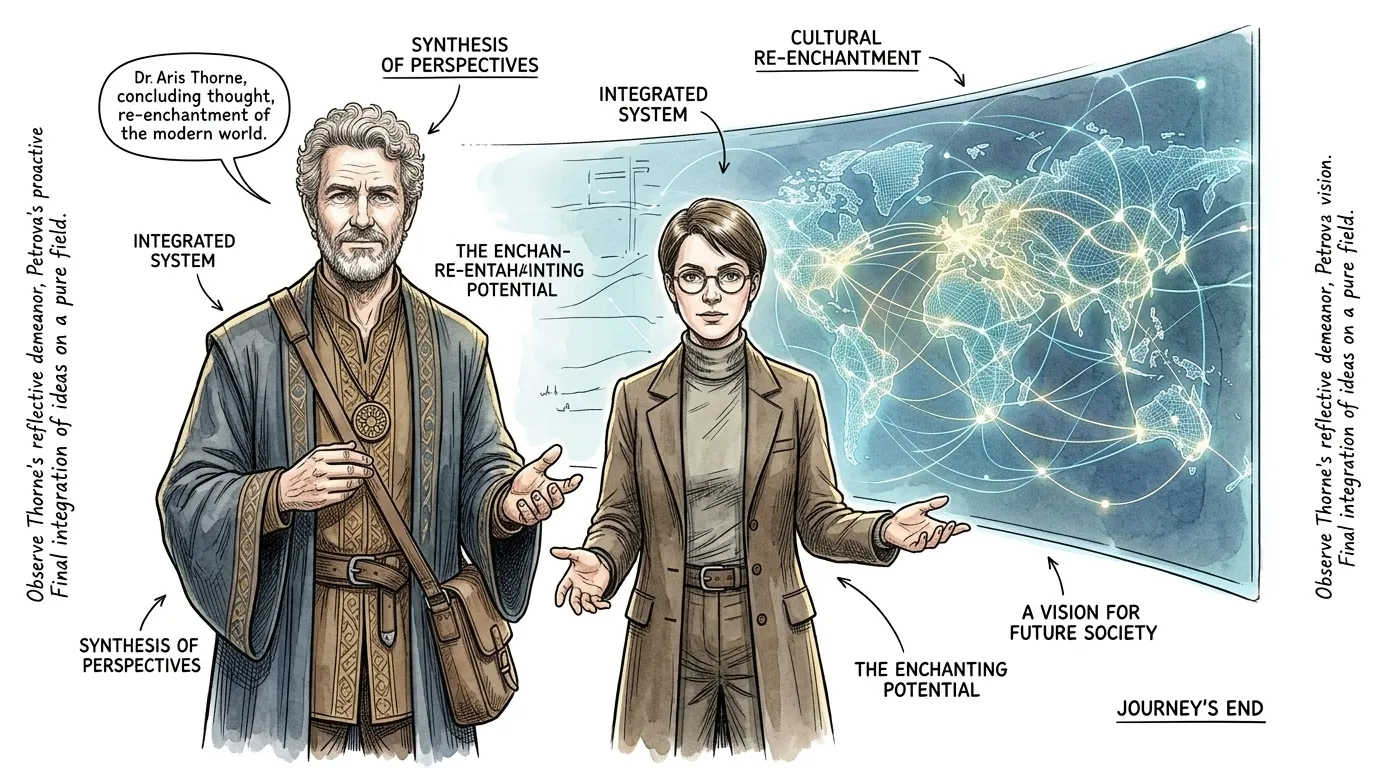
Dr. Thorne offers a concluding thought, looking directly ahead. "Charles Taylor's enduring legacy lies in his profound re-evaluation of modernity itself. He challenges the notion that secularization means a simple 'subtraction' of religion; instead, he shows us how the very conditions of modern life, even with our 'buffered selves,' continue to foster deep human needs for meaning and connection."
Dr. Petrova adds, "He compels us to critically examine the stories and shared understandings that shape us, urging us towards a richer, more ethically grounded understanding of who we are, and how we might collectively navigate the moral challenges of our time. His work is an invitation to 're-enchant' our secular world, not by denying its realities, but by recognizing its hidden depths."
""Charles Taylor's enduring legacy lies in his profound re-evaluation of modernity itself. He challenges the notion that secularization means a simple 'subtraction' of religion; instead, he shows us how the very conditions of modern life, even with our 'buffered selves,' continue to foster deep human needs for meaning and connection," Dr. Aris Thorne concludes, looking directly ahead.
"He compels us to critically examine the stories and shared understandings that shape us, urging us towards a richer, more ethically grounded understanding of who we are, and how we might collectively navigate the moral challenges of our time. His work is an invitation to 're-enchant' our secular world, not by denying its realities, but by recognizing its hidden depths," Dr. Lena Petrova adds."
Philosophy Note: Taylor's enduring impact: Re-framing secularism, highlighting the persistent human need for meaning, and advocating for ethically grounded identity formation. Calls for a 're-enchantment' of the modern world.
About this story
- Audience: general readers
Questions and answers
Read Wonder Philosophy on your phone
Wonder Philosophy is available on Android and iPhone and iPad. Get Wonder Philosophy on Google Play · Get Wonder Philosophy on the App Store.