Cicero
Cicero — an illustrated philosophy story. 10 illustrated pages, free to read on Wonder Philosophy.

Page 1

Cicero's ideas about rhetoric, ethics, and politics still resonate today. His concept of humanitas [meaning 'humanity', but encompassing virtue, culture, and civic duty] shaped Western thought. But why does a Roman statesman who died over two thousand years ago still matter?
"Sara, an energetic 11-year-old, looked up at Nils, an elderly philosopher. "Why study someone who lived so long ago? What's the point?""
Philosophy Note: Cicero (106-43 BCE) was a Roman statesman, lawyer, scholar, and philosopher.
Page 2

Marcus Tullius Cicero lived during the late Roman Republic, a period of political upheaval and civil war. He witnessed the rise and fall of powerful figures like Julius Caesar and fought to preserve the Republic's values. His life was a constant negotiation between principle and pragmatism. His prolific writings give us a deep understanding of Roman society and thought.
"Nils smiled. "Cicero lived through incredibly turbulent times, Sara. Understanding his world helps us understand his ideas.""
Philosophy Note: The Roman Republic (509-27 BCE) was a period of representative government before the rise of the Roman Empire.
Page 3

Cicero was renowned for his oratorical skills. He believed that rhetoric wasn't just about eloquence, but about using language to persuade people towards truth and justice. His speeches, like the Philippics [a series of speeches against Mark Antony], are models of persuasive writing and political courage. He saw rhetoric as essential for a functioning republic.
"Sara tilted her head. "So, he was like a really good speaker?""
Philosophy Note: Rhetoric is the art of effective or persuasive speaking or writing.
Page 4

Cicero's ethical philosophy centered on virtue. He believed that individuals should strive for wisdom, justice, courage, and temperance. He saw these virtues as essential for both personal fulfillment and the well-being of society. He also argued that the best form of government was one that served the common good, not just the interests of a few.
"Nils explained, "He believed in living a life of virtue. That meant striving to be wise, just, brave, and moderate in all things.""
Philosophy Note: Cicero's ethical ideas were heavily influenced by Greek philosophy, especially Stoicism.
Page 5
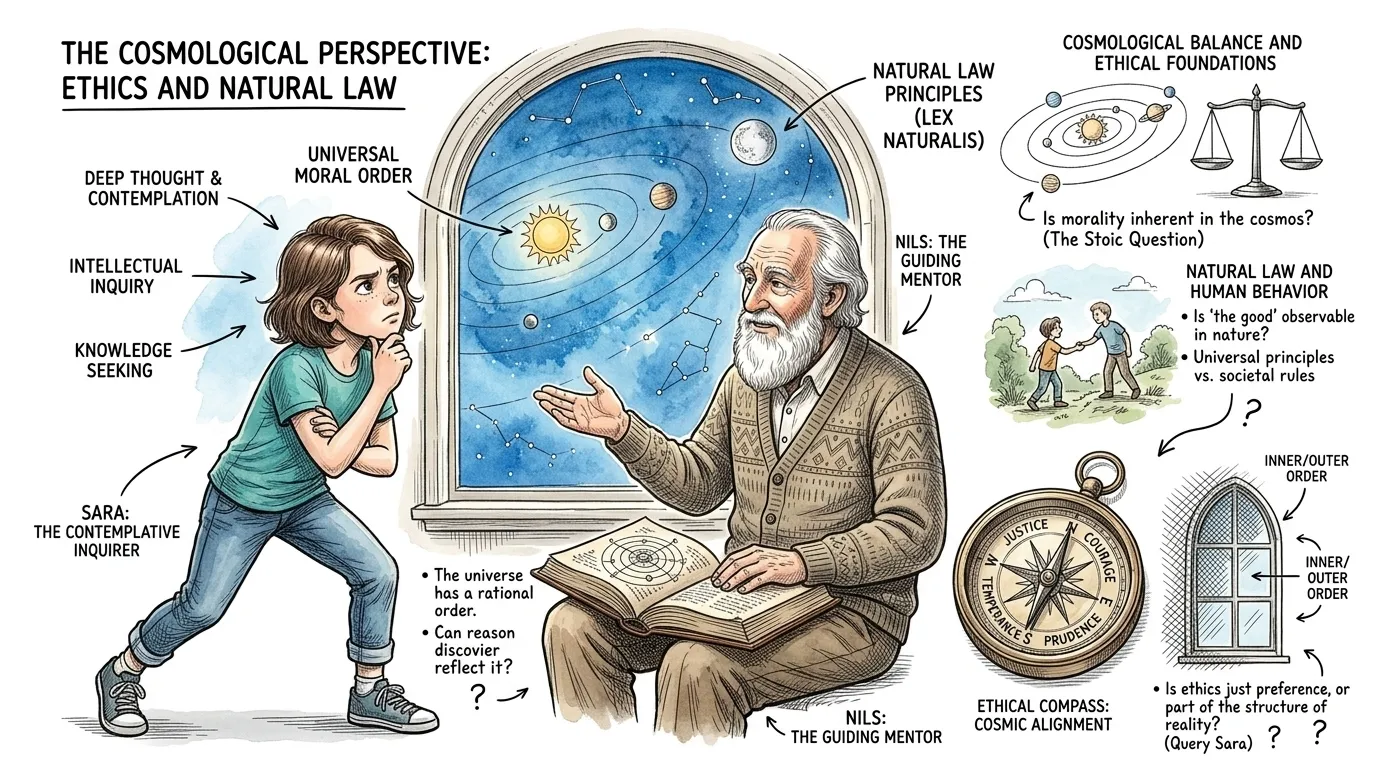
Cicero articulated a theory of natural law, arguing that there is a universal moral order that is accessible to human reason. This law, he believed, transcends human laws and provides a standard for judging their legitimacy. He argued that unjust laws are not laws at all, reflecting his belief in a higher moral authority.
"Sara furrowed her brow. "So, like, there's a set of rules everyone should follow, even if they aren't written down?""
Philosophy Note: Natural law is the belief that certain rights or values are inherent by virtue of human nature and universally cognizable through reason.
Page 6

Cicero explored the importance of friendship and duty in his writings. He believed that true friendship is based on shared virtue and mutual respect. He also emphasized the importance of fulfilling one's civic duties and contributing to the common good. He saw these obligations as essential for a flourishing society.
"Nils nodded. "He wrote extensively about friendship and our duties to each other and to our community.""
Philosophy Note: Cicero's 'On Friendship' (De Amicitia) is a famous treatise on the nature of true friendship.
Page 7

Cicero wasn't without his critics. Some accused him of being inconsistent, of prioritizing his own political career over his philosophical principles. His actions during the political turmoil of his time often contradicted his stated ideals. He was ultimately assassinated for his opposition to Mark Antony. This complexity makes him a compelling figure for study.
"Sara asked, "But wasn't he also involved in some pretty shady stuff?""
Philosophy Note: Cicero's assassination in 43 BCE marked the end of the Roman Republic.
Page 8

Cicero's ideas about rhetoric, ethics, and politics continue to inform debates about democracy, justice, and civic responsibility. His emphasis on natural law has influenced legal and political thought for centuries. His writings on friendship and duty remain relevant in our increasingly fragmented world. As Franklin D. Roosevelt, another leader facing immense political challenges, said, "The only limit to our realization of tomorrow will be our doubts of today."
"Nils responded, "Absolutely. Cicero's life and writings offer important lessons for us today. In an age of misinformation and political division, he reminds us of the importance of truth, justice, and the common good.""
Philosophy Note: Cicero's works are still studied in law schools and philosophy departments around the world.
Page 9

Cicero's emphasis on cultivating virtue remains highly relevant. He believed that personal character is essential for a flourishing society. His call to strive for wisdom, justice, courage, and temperance is a timeless guide for living a meaningful and ethical life. It's about more than just personal success; it's about contributing to a better world.
""So, it's not just about knowing the right thing, but doing it?" Vera asked."
Philosophy Note: Cicero's concept of officium (duty) highlights the importance of acting in accordance with virtue and reason.
Page 10

Cicero's impact on Western thought is undeniable. His writings have shaped our understanding of rhetoric, ethics, politics, and law. He serves as a reminder that even in the face of immense challenges, we must strive for truth, justice, and the common good. His words continue to inspire us to live lives of purpose and meaning.
"Nils concluded, "Cicero teaches us that even after thousands of years, ideas can still shape the world.""
Philosophy Note: Cicero's works influenced the Founding Fathers of the United States and continue to shape democratic ideals.
About this story
- Audience: kids (ages 6–12)
Questions and answers
Read Wonder Philosophy on your phone
Wonder Philosophy is available on Android and iPhone and iPad. Get Wonder Philosophy on Google Play · Get Wonder Philosophy on the App Store.