Democritus
Democritus — an illustrated philosophy story. 10 illustrated pages, free to read on Wonder Philosophy.
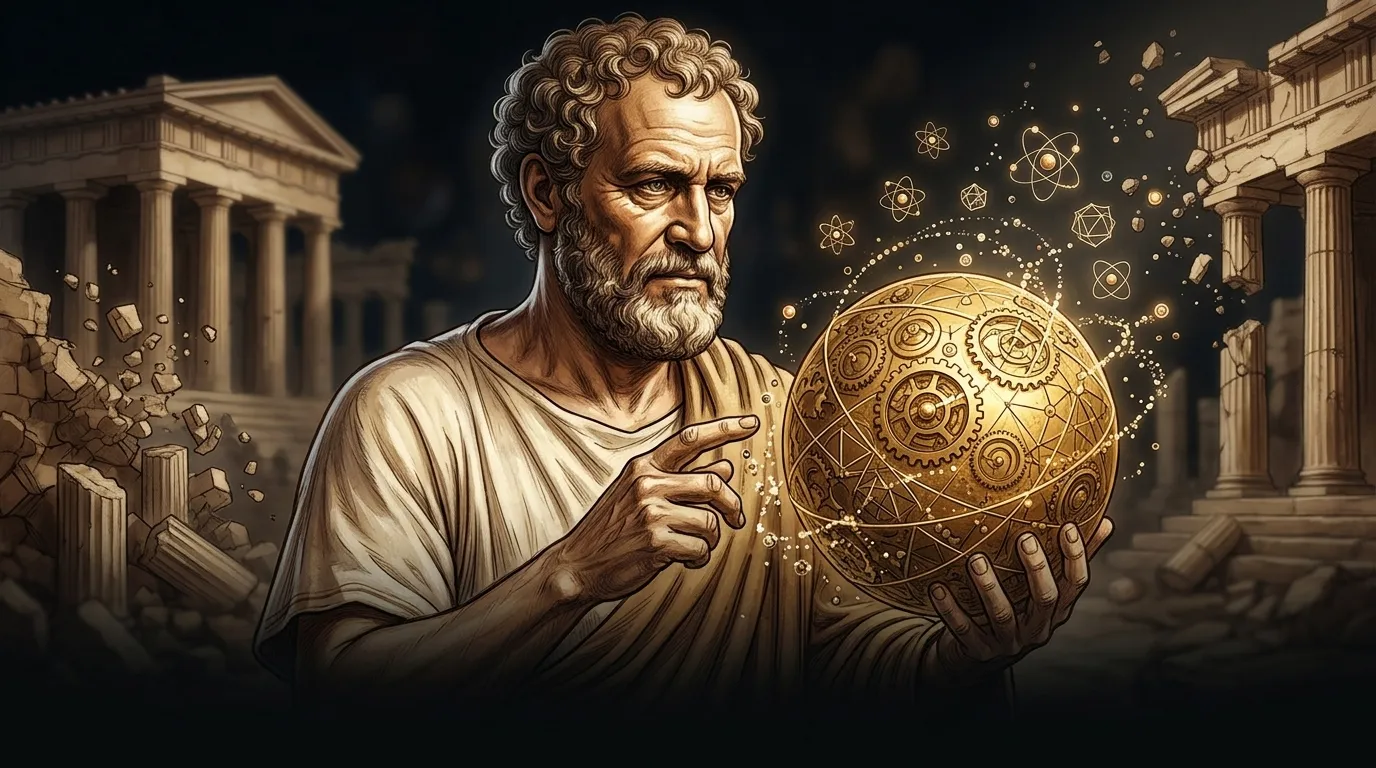
Page 1
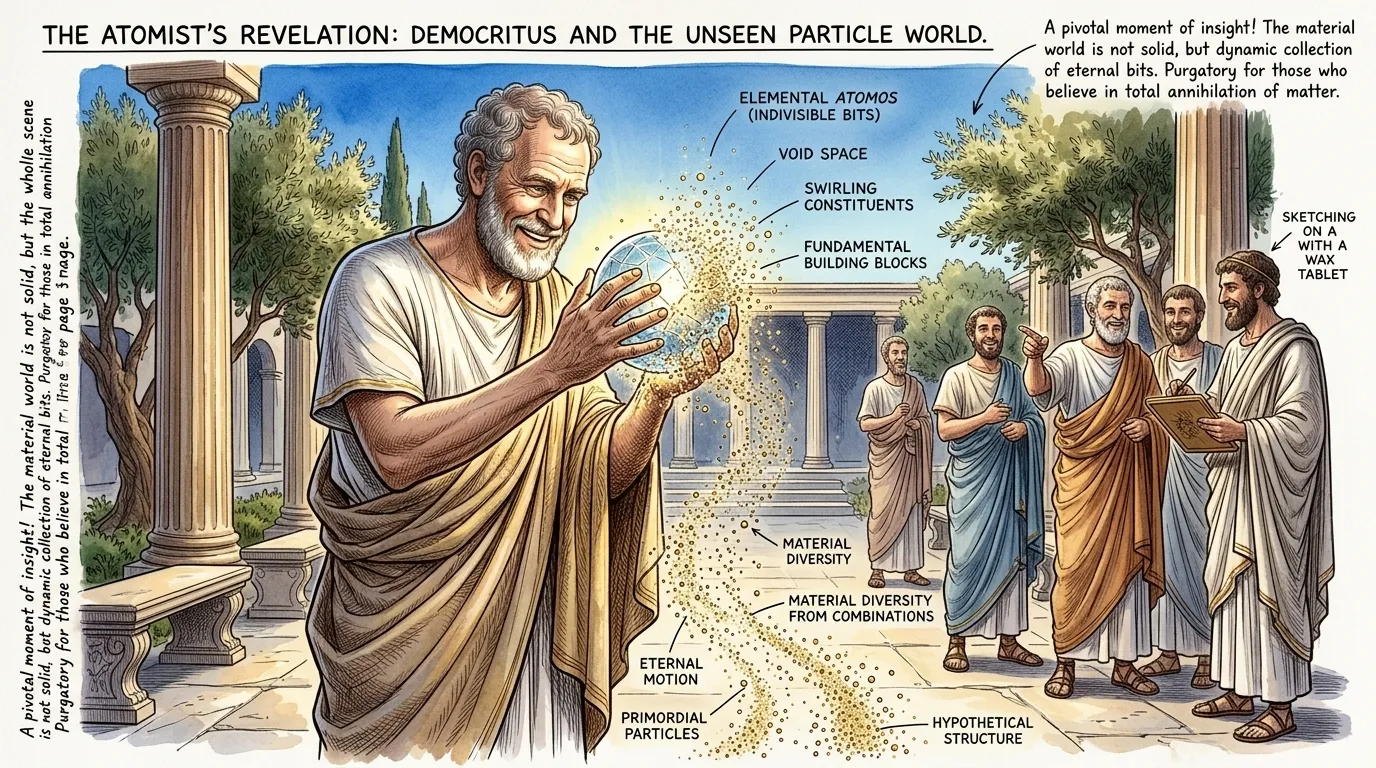
Imagine the world isn't solid but made of tiny, indivisible bits. That's the idea Democritus championed over two thousand years ago. It still shapes how we understand reality today, from chemistry to quantum physics.
Philosophy Note: Democritus (460 – 370 BC) proposed the atomic theory, suggesting all matter is composed of indivisible particles called atoms.
Page 2
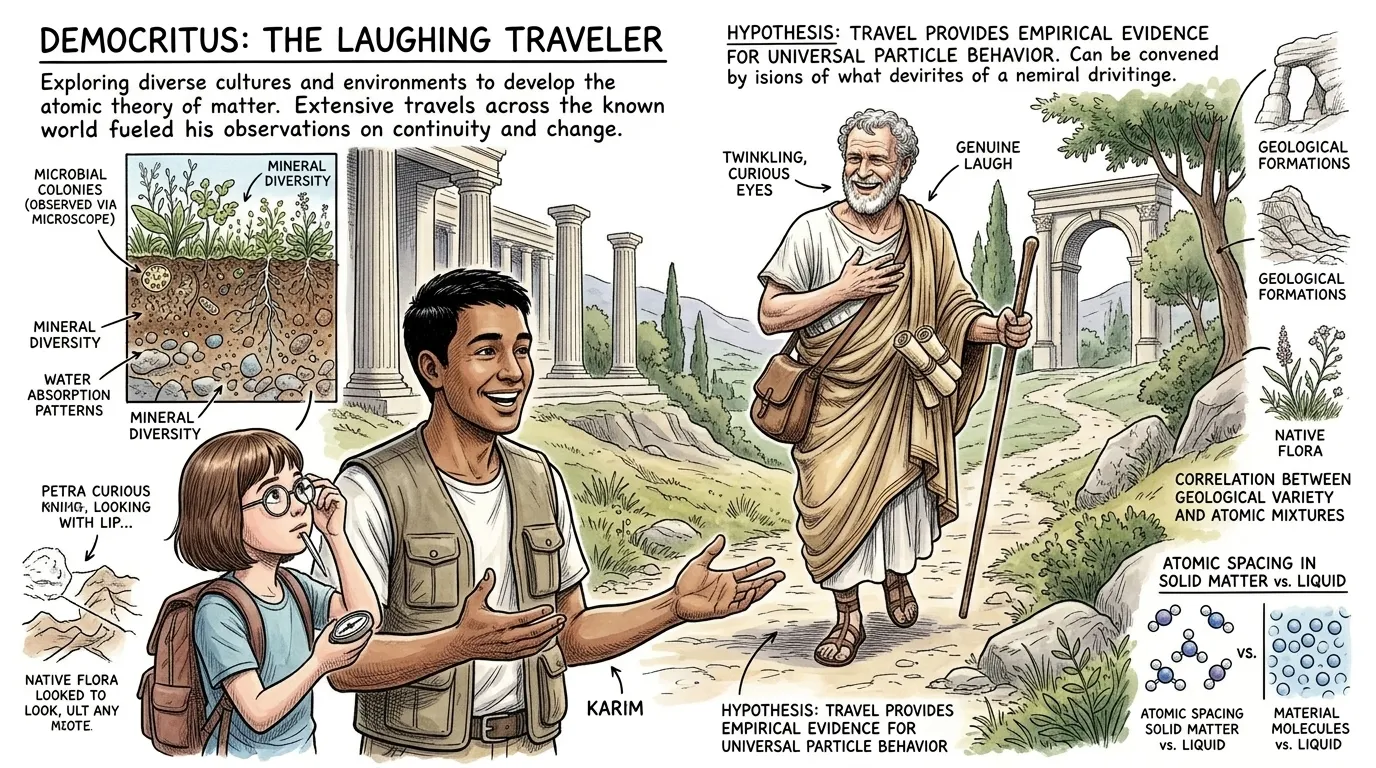
Democritus, often called 'the laughing philosopher,' traveled extensively, seeking knowledge. He questioned Parmenides' idea that change is an illusion. Democritus believed in a reality of constant motion and combination.
"'Why do you call him the laughing philosopher, Karim?' Petra asked, adjusting her glasses. 'Because,' Karim replied, smiling. 'He approached the world with curiosity and humor, unlike some of his more serious contemporaries. He believed in finding joy in understanding nature.'"
Philosophy Note: Parmenides (515 – 450 BC) argued that reality is unchanging, a single, unified entity.
Page 3
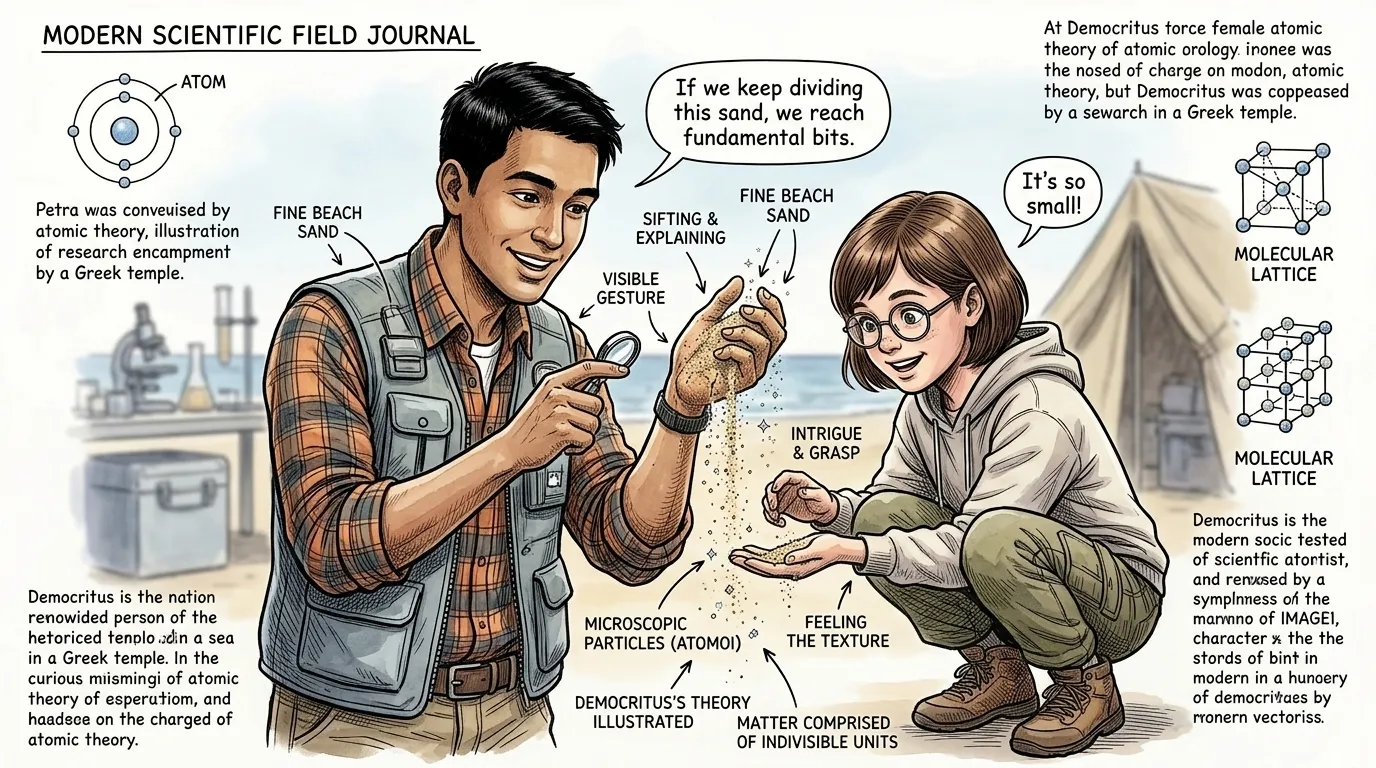
Democritus proposed that everything is made of 'atoms' moving in 'the void.' These atoms, though unseen, determine the properties of all things. He believed even the soul was made of special, smooth atoms.
"Karim holds up a handful of sand. 'Democritus thought that if we could zoom in enough, we'd see that even something as seemingly continuous as sand is actually made of separate, tiny particles with empty space in between them.' Petra, intrigued, holds her hand up to Karim to feel the grainy sand."
Philosophy Note: The concept of 'the void' was as important as atoms. It allowed for movement and interaction.
Page 4
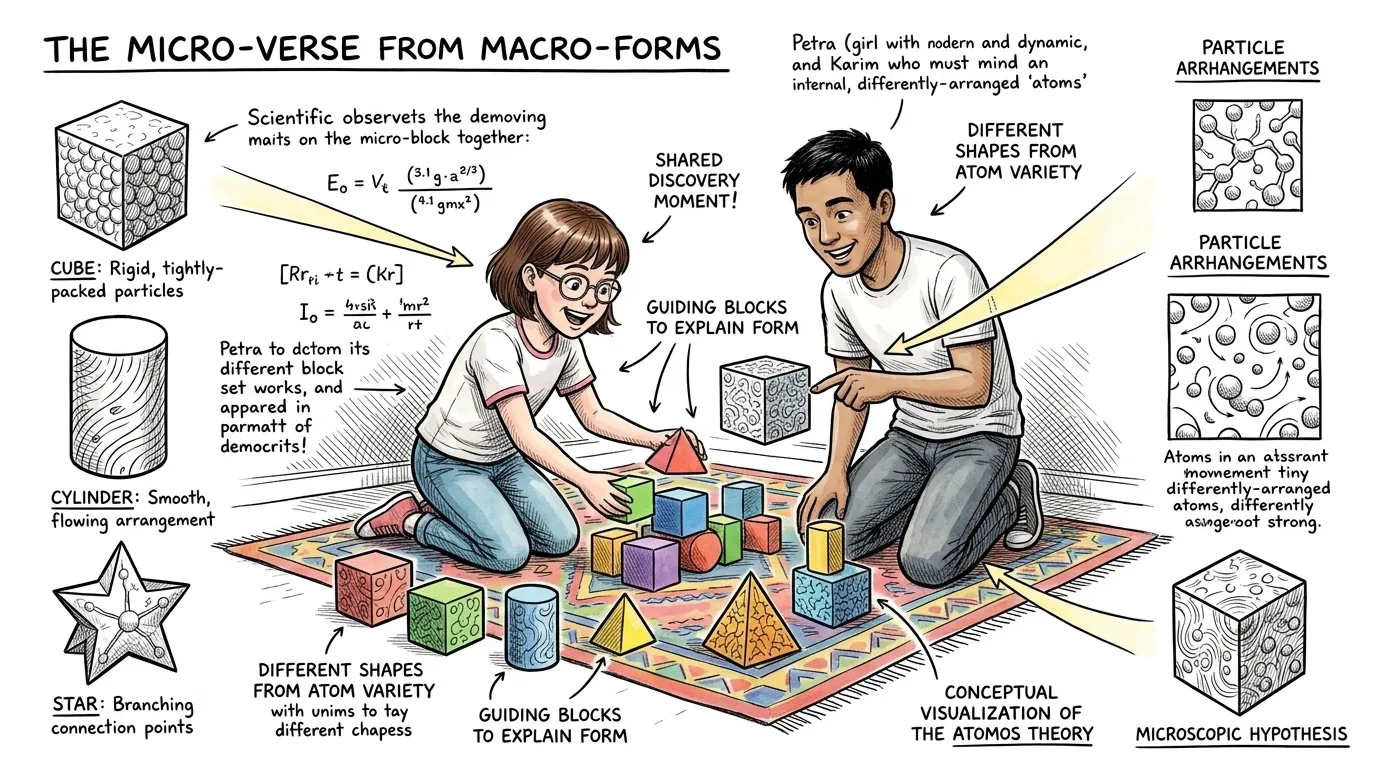
Democritus didn't just say things were made of atoms, but he also said they were different! He stated that the different shapes, order, and position of atoms make up all the various substances we observe.
"Look at the different blocks! Each one a different shape.' Petra exclaims, pulling out blocks from her modern building block set. Karim kneels beside her. 'Exactly!,' she points out. 'Democritus might say that the atoms making up these blocks are arranged differently, giving each one its unique form.'"
Philosophy Note: Democritus's atomism wasn't based on experiment, but on logical deduction.
Page 5
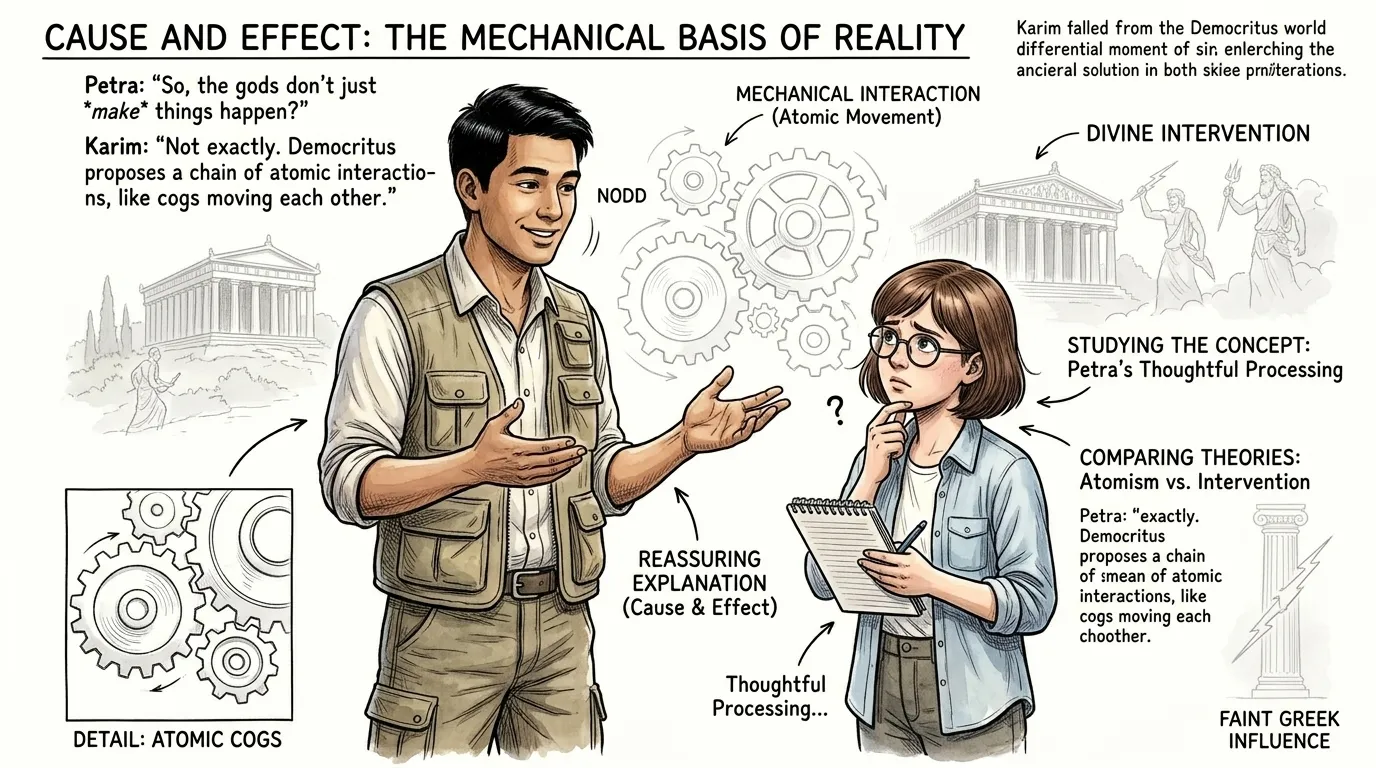
For Democritus, there was no divine purpose. Everything occurred due to the mechanical interaction of atoms. This was a radical departure from the prevailing belief in gods controlling events.
"Petra looked confused. 'So, he didn't believe in gods making things happen?' Karim nodded. 'Democritus thought everything happened because of cause and effect, the way atoms bumped into each other. No higher power needed.'"
Philosophy Note: This mechanistic view of the universe was a precursor to modern scientific thought.
Page 6

Democritus knew that our senses can be deceiving. He argued that things like color and taste are not inherent properties of atoms, but rather, arise from our interaction with them. This anticipated later ideas in epistemology.
"Karim held out two apples. 'These apples seem red and sweet, right?' Petra took a bite. 'Yep! But Democritus might say that 'red' and 'sweet' aren't actually in the apple. They are how our senses interpret the atoms that make up the apple.'"
Philosophy Note: Epistemology is the branch of philosophy that deals with knowledge and justification.
Page 7
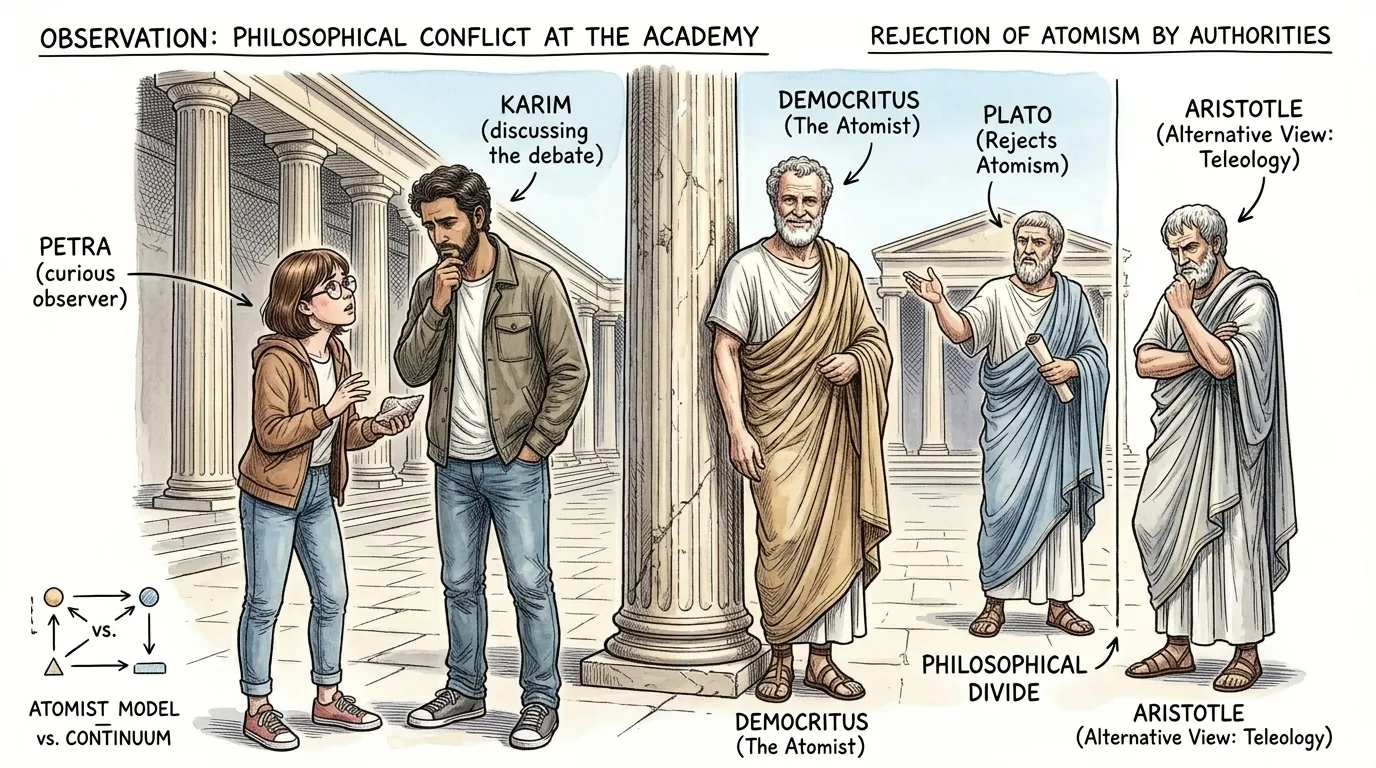
Not everyone agreed with Democritus. Plato and Aristotle, for example, rejected atomism. They preferred explanations involving forms and inherent purposes. Their views dominated Western thought for centuries.
"'So, were people mad at Democritus?' Petra asked. Karim nods. 'Many, including some very famous philosophers, strongly disagreed with him. Aristotle believed everything had a purpose. It took a long time for atomism to gain wider acceptance.'"
Philosophy Note: Plato believed in a realm of perfect 'Forms' that underpinned reality. Aristotle focused on empirical observation and teleology (purpose).
Page 8
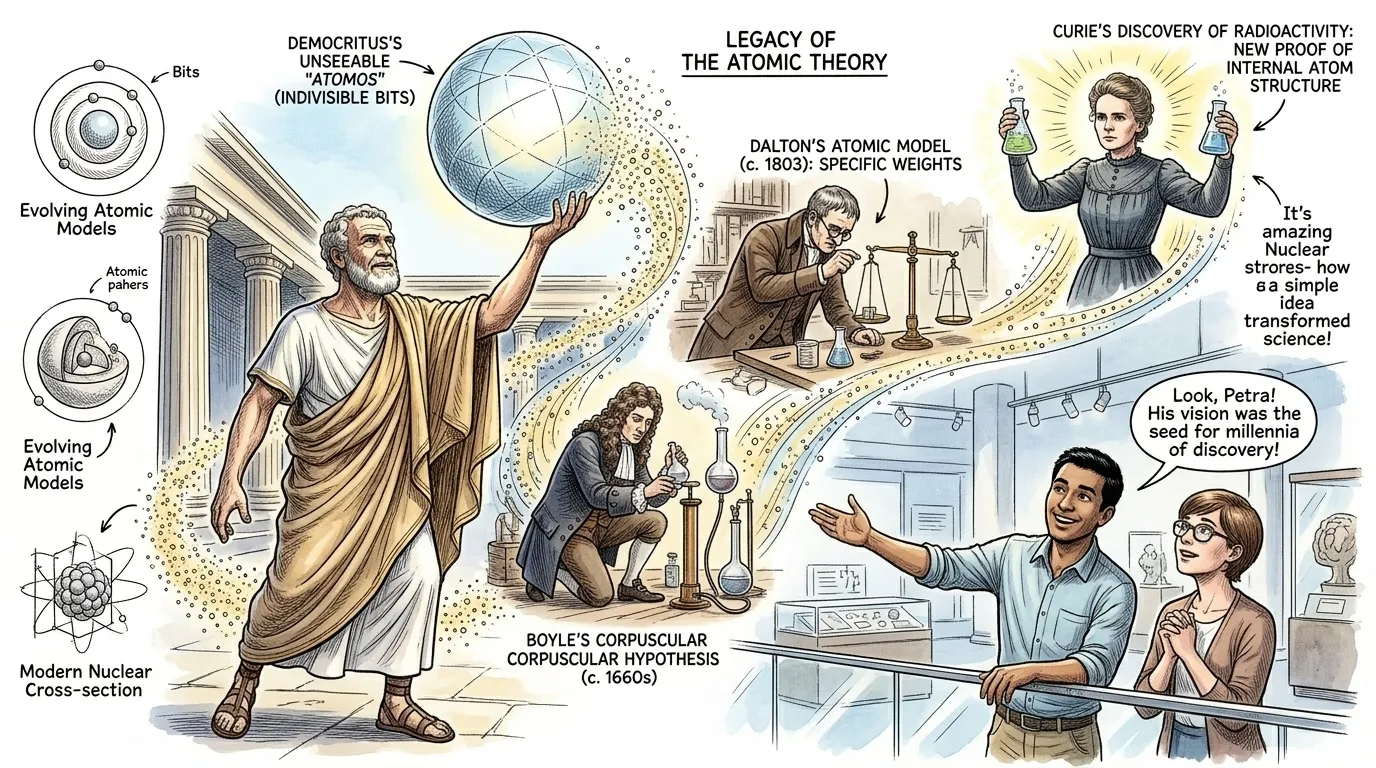
It wasn't until the Scientific Revolution that Democritus's ideas gained renewed attention. Scientists like Dalton and Boyle used experiments to prove the existence of atoms, laying the foundation for modern chemistry.
"'I guess he was ahead of his time,' said Petra. 'Definitely! As Marie Curie, the famous scientist once said, 'Nothing in life is to be feared, it is only to be understood.' Democritus' ideas were not fully understood back then, but now they are the foundation of modern science!'"
Philosophy Note: John Dalton (1766 – 1844) developed modern atomic theory based on experimental evidence.
Page 9
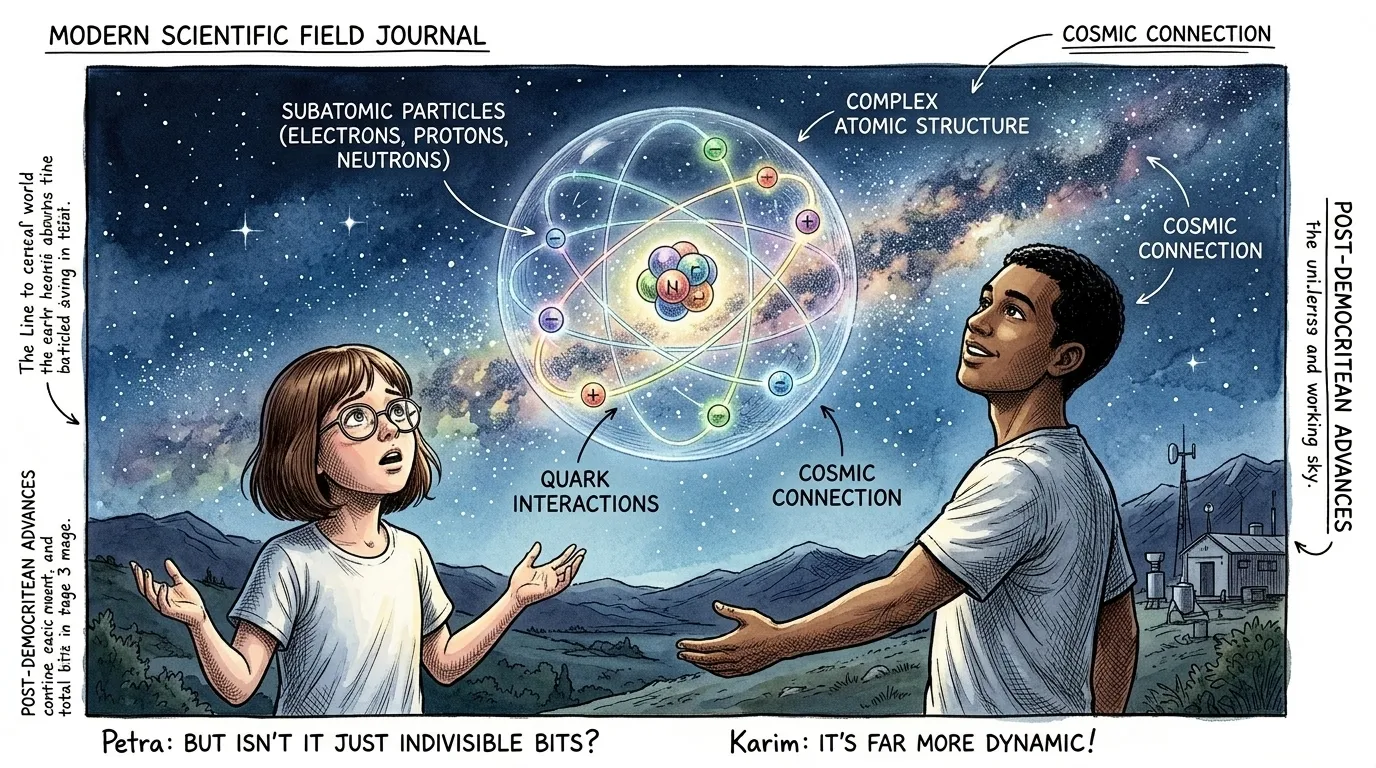
Quantum physics reveals that the 'atoms' Democritus imagined are not indivisible but composed of even smaller particles. Yet, his core idea – that reality is made of fundamental building blocks – remains central to our understanding.
"'So, atoms aren't the smallest things after all?' asks Petra. 'That's right. Now we know about electrons, protons, quarks... but Democritus's idea that everything's made of basic pieces is still super important,' Karim replies, looking up at the starry sky."
Philosophy Note: Quantum physics explores the behavior of matter at the atomic and subatomic levels.
Page 10
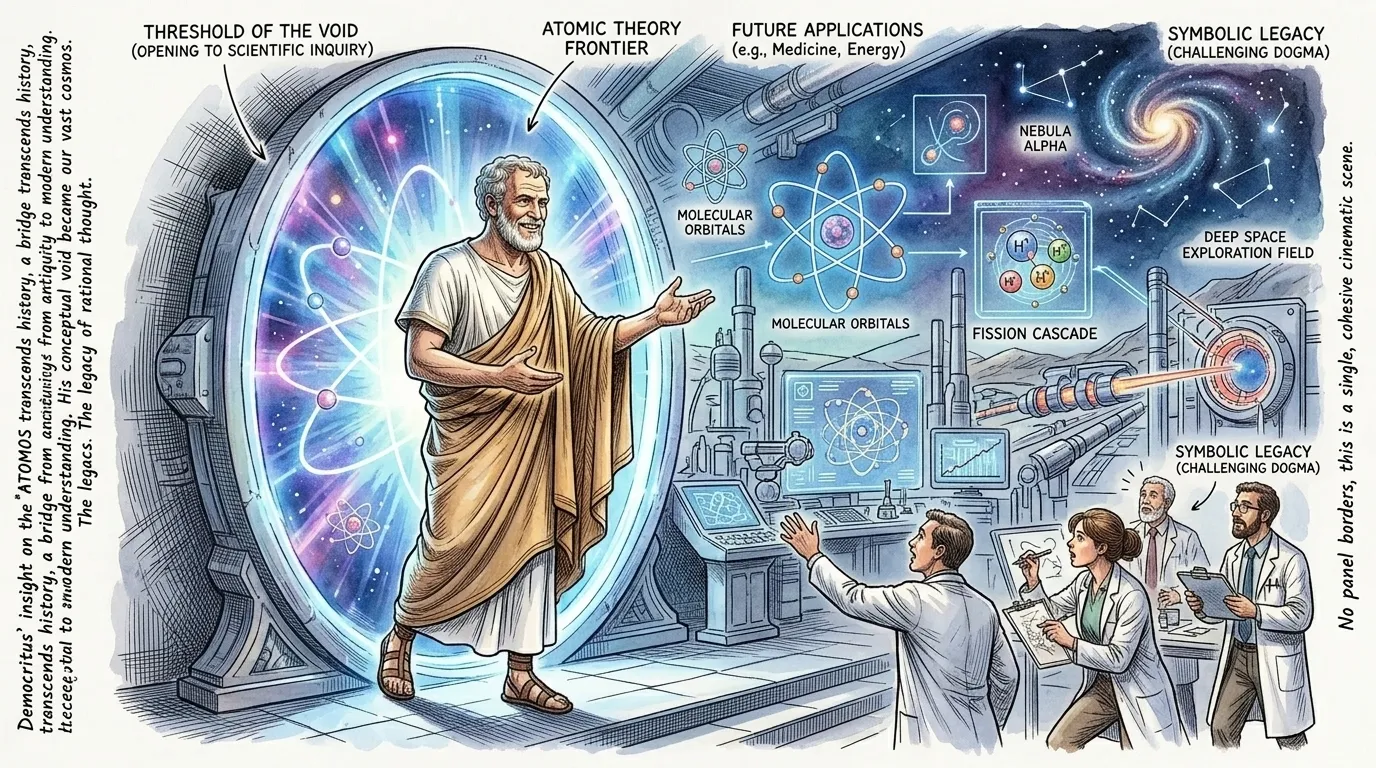
Democritus's atomic theory wasn't just about physics. It was a way of thinking that challenged traditional beliefs and opened the door to scientific inquiry. His legacy lives on in every discovery that seeks to understand the fundamental nature of reality.
Philosophy Note: Democritus's ideas laid the groundwork for future scientific and philosophical advancements.
About this story
- Audience: general readers
Questions and answers
Read Wonder Philosophy on your phone
Wonder Philosophy is available on Android and iPhone and iPad. Get Wonder Philosophy on Google Play · Get Wonder Philosophy on the App Store.